ANIMALTOXICITY
STUDIES (= NON CLINICALTOXICITY STUDIES)
Overview
• Introduction
• Requirements
• Classification of toxicity studies
• Methodology
• Conclusion
OBJECTIVES
• Identify toxic substances prior to clinical use
• Cumulative toxicity study
• Allow careful selection of doses
• Dose identification like MLD, lethal dose, MTD, etc
• Therapeutic index
REQUIREMENTS
• Follow Good Laborotary Practice (GLP)
• Trained and qualified staff.
• Instruments- properly calibrated and standardized.
• SOPs should be followed
• All documents and tissues preserved for 5 years.
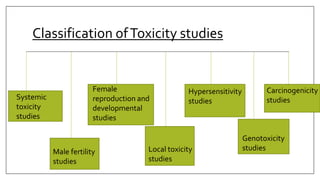
Classification ofToxicity studies
Systemic
toxicity
studies
Male fertility
studies
Female
reproduction and
developmental
studies
Hypersensitivity
studies
Genotoxicity
studies
Carcinogenicity
studies
Local toxicity
studies
Systemic toxicity studies
1. Single dose toxicity studies
2. Repeated – dose toxicity
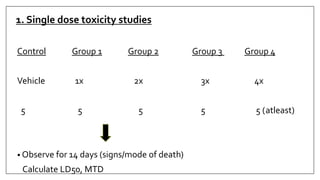
Control Group 1 Group 2 Group 3 Group 4
Vehicle 1x 2x 3x 4x
5 5 5 5 5 (atleast)
• Observe for 14 days (signs/mode of death)
Calculate LD50, MTD
1. Single dose toxicity studies
Calculation of LD50
1. Graphical method
2. Arithmetic method
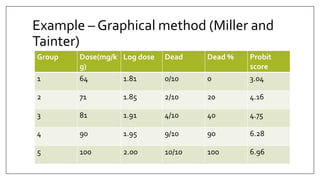
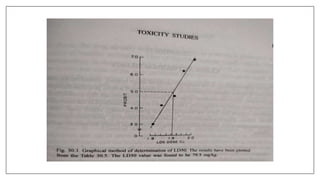
Example – Graphical method (Miller and
Tainter)
Group Dose(mg/k
g)
Log dose Dead Dead % Probit
score
1 64 1.81 0/10 0 3.04
2 71 1.85 2/10 20 4.16
3 81 1.91 4/10 40 4.75
4 90 1.95 9/10 90 6.28
5 100 2.00 10/10 100 6.96
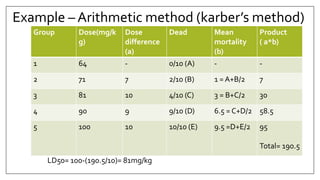
Example – Arithmetic method (karber’s method)
Group Dose(mg/k
g)
Dose
difference
(a)
Dead Mean
mortality
(b)
Product
( a*b)
1 64 - 0/10 (A) - -
2 71 7 2/10 (B) 1 = A+B/2 7
3 81 10 4/10 (C) 3 = B+C/2 30
4 90 9 9/10 (D) 6.5 = C+D/2 58.5
5 100 10 10/10 (E) 9.5 =D+E/2 95
Total= 190.5
LD50= 100-(190.5/10)= 81mg/kg
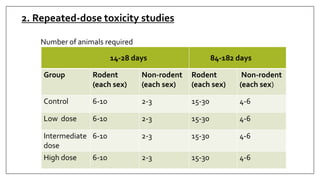
2. Repeated-dose toxicity studies
Number of animals required
14-28 days 84-182 days
Group Rodent
(each sex)
Non-rodent
(each sex)
Rodent
(each sex)
Non-rodent
(each sex)
Control 6-10 2-3 15-30 4-6
Low dose 6-10 2-3 15-30 4-6
Intermediate
dose
6-10 2-3 15-30 4-6
High dose 6-10 2-3 15-30 4-6
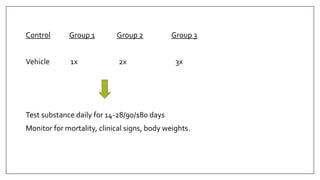
Control Group 1 Group 2 Group 3
Vehicle 1x 2x 3x
Test substance daily for 14-28/90/180 days
Monitor for mortality, clinical signs, body weights.
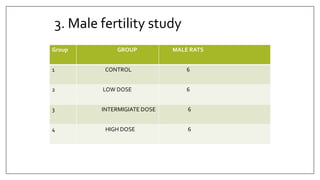
3. Male fertility study
Group GROUP MALE RATS
1 CONTROL 6
2 LOW DOSE 6
3 INTERMIGIATE DOSE 6
4 HIGH DOSE 6
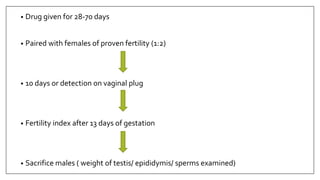
• Drug given for 28-70 days
• Paired with females of proven fertility (1:2)
• 10 days or detection on vaginal plug
• Fertility index after 13 days of gestation
• Sacrifice males ( weight of testis/ epididymis/ sperms examined)
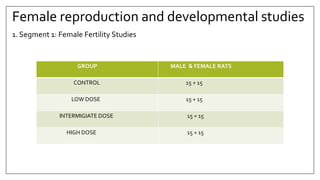
Female reproduction and developmental studies
1. Segment 1: Female Fertility Studies
GROUP MALE & FEMALE RATS
CONTROL 15 + 15
LOW DOSE 15 + 15
INTERMIGIATE DOSE 15 + 15
HIGH DOSE 15 + 15
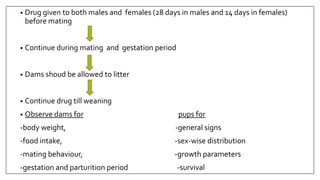
• Drug given to both males and females (28 days in males and 14 days in females)
before mating
• Continue during mating and gestation period
• Dams shoud be allowed to litter
• Continue drug till weaning
• Observe dams for pups for
-body weight, -general signs
-food intake, -sex-wise distribution
-mating behaviour, -growth parameters
-gestation and parturition period -survival
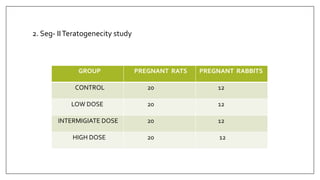
2. Seg- IITeratogenecity study
GROUP PREGNANT RATS PREGNANT RABBITS
CONTROL 20 12
LOW DOSE 20 12
INTERMIGIATE DOSE 20 12
HIGH DOSE 20 12
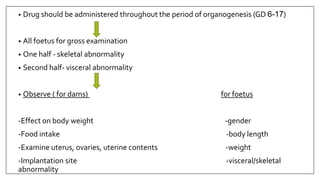
• Drug should be administered throughout the period of organogenesis (GD 6-17)
• All foetus for gross examination
• One half - skeletal abnormality
• Second half- visceral abnormality
• Observe ( for dams) for foetus
-Effect on body weight -gender
-Food intake -body length
-Examine uterus, ovaries, uterine contents -weight
-Implantation site -visceral/skeletal
abnormality
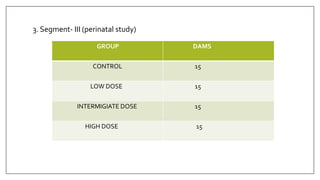
3. Segment- III (perinatal study)
GROUP DAMS
CONTROL 15
LOW DOSE 15
INTERMIGIATE DOSE 15
HIGH DOSE 15
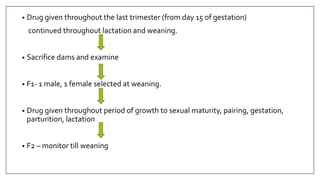
• Drug given throughout the last trimester (from day 15 of gestation)
continued throughout lactation and weaning.
• Sacrifice dams and examine
• F1- 1 male, 1 female selected at weaning.
• Drug given throughout period of growth to sexual maturity, pairing, gestation,
parturition, lactation
• F2 – monitor till weaning
LOCALTOXICITY STUDIES
1.DermalToxicity study
• Study should be done in rabbit and rat
• Test material- applied on 10% surface area
• Three formulations of varius concentrations applied ( several fold higher
than clinical)
• Duration- 7 to 90 days
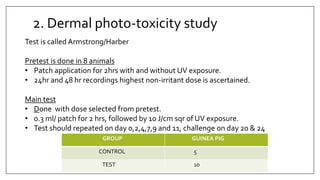
2. Dermal photo-toxicity study
GROUP GUINEA PIG
CONTROL 5
TEST 10
Test is called Armstrong/Harber
Pretest is done in 8 animals
• Patch application for 2hrs with and without UV exposure.
• 24hr and 48 hr recordings highest non-irritant dose is ascertained.
Main test
• Done with dose selected from pretest.
• 0.3 ml/ patch for 2 hrs, followed by 10 J/cm sqr of UV exposure.
• Test should repeated on day 0,2,4,7,9 and 11, challenge on day 20 & 24
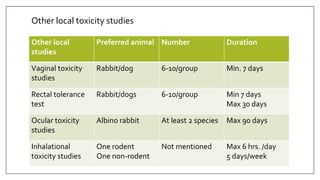
Other local
studies
Preferred animal Number Duration
Vaginal toxicity
studies
Rabbit/dog 6-10/group Min. 7 days
Rectal tolerance
test
Rabbit/dogs 6-10/group Min 7 days
Max 30 days
Ocular toxicity
studies
Albino rabbit At least 2 species Max 90 days
Inhalational
toxicity studies
One rodent
One non-rodent
Not mentioned Max 6 hrs. /day
5 days/week
Other local toxicity studies
3. Genotoxicity studies
• In vitro test
Chromosomal damage with mammalian cells
• In- vivo test
Rodent hematopoetic cells
Test for measurements of DNA adducts
DNA strand break
• Test for gene mutation in bacteria
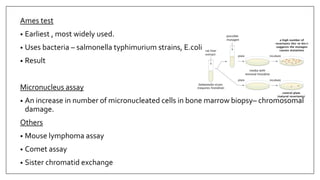
Ames test
• Earliest , most widely used.
• Uses bacteria – salmonella typhimurium strains, E.coli
• Result
Micronucleus assay
• An increase in number of micronucleated cells in bone marrow biopsy– chromosomal
damage.
Others
• Mouse lymphoma assay
• Comet assay
• Sister chromatid exchange
4. Carcinogenicity studies
Ideal for -
• For drugs to be used for more than 6 months
• Drugs for intermittent use in chronic condition
• Concern about carcinogenicity
• Rodent (preferable rat).
• 3 dose levels
• Highest- sub-lethal
• Lowest- human intented dose
• 7 days /week for 24 months
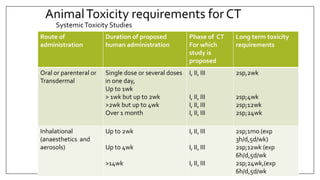
AnimalToxicity requirements for CT
SystemicToxicity Studies
Route of
administration
Duration of proposed
human administration
Phase of CT
For which
study is
proposed
Long term toxicity
requirements
Oral or parenteral or
Transdermal
Single dose or several doses
in one day,
Up to 1wk
> 1wk but up to 2wk
>2wk but up to 4wk
Over 1 month
I, II, III
I, II, III
I, II, III
I, II, III
2sp,2wk
2sp;4wk
2sp;12wk
2sp;24wk
Inhalational
(anaesthetics and
aerosols)
Up to 2wk
Up to 4wk
>14wk
I, II, III
I, II, III
I, II, III
2sp;1mo (exp
3h/d,5d/wk)
2sp;12wk (exp
6h/d,5d/wk
2sp;24wk,(exp
6h/d,5d/wk
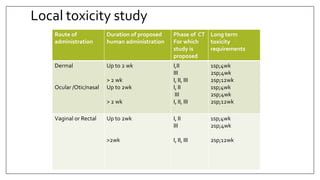
Local toxicity study
Route of
administration
Duration of proposed
human administration
Phase of CT
For which
study is
proposed
Long term
toxicity
requirements
Dermal
Ocular /Otic/nasal
Up to 2 wk
> 2 wk
Up to 2wk
> 2 wk
I,II
III
I, II, III
I, II
III
I, II, III
1sp;4wk
2sp;4wk
2sp;12wk
1sp;4wk
2sp;4wk
2sp;12wk
Vaginal or Rectal Up to 2wk
>2wk
I, II
III
I, II, III
1sp;4wk
2sp;4wk
2sp;12wk
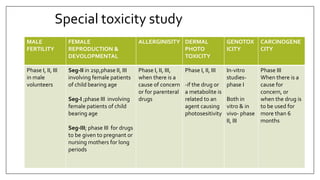
Special toxicity study
MALE
FERTILITY
FEMALE
REPRODUCTION &
DEVOLOPMENTAL
ALLERGINISITY DERMAL
PHOTO
TOXICITY
GENOTOX
ICITY
CARCINOGENE
CITY
Phase I, II, III
in male
volunteers
Seg-II in 2sp,phase II, III
involving female patients
of child bearing age
Seg-I ;phase III involving
female patients of child
bearing age
Seg-III; phase III for drugs
to be given to pregnant or
nursing mothers for long
periods
Phase I, II, III,
when there is a
cause of concern
or for parenteral
drugs
Phase I, II, III
-if the drug or
a metabolite is
related to an
agent causing
photosesitivity
In-vitro
studies-
phase I
Both in
vitro & in
vivo- phase
II, III
Phase III
When there is a
cause for
concern, or
when the drug is
to be used for
more than 6
months
animal toxicity studies.pptx

animal toxicity studies.pptx

  • 1.
    ANIMALTOXICITY STUDIES (= NONCLINICALTOXICITY STUDIES)
  • 2.
    Overview • Introduction • Requirements •Classification of toxicity studies • Methodology • Conclusion
  • 3.
    OBJECTIVES • Identify toxicsubstances prior to clinical use • Cumulative toxicity study • Allow careful selection of doses • Dose identification like MLD, lethal dose, MTD, etc • Therapeutic index
  • 4.
    REQUIREMENTS • Follow GoodLaborotary Practice (GLP) • Trained and qualified staff. • Instruments- properly calibrated and standardized. • SOPs should be followed • All documents and tissues preserved for 5 years.
  • 5.
    Classification ofToxicity studies Systemic toxicity studies Malefertility studies Female reproduction and developmental studies Hypersensitivity studies Genotoxicity studies Carcinogenicity studies Local toxicity studies
  • 6.
    Systemic toxicity studies 1.Single dose toxicity studies 2. Repeated – dose toxicity
  • 7.
    Control Group 1Group 2 Group 3 Group 4 Vehicle 1x 2x 3x 4x 5 5 5 5 5 (atleast) • Observe for 14 days (signs/mode of death) Calculate LD50, MTD 1. Single dose toxicity studies
  • 8.
    Calculation of LD50 1.Graphical method 2. Arithmetic method
  • 9.
    Example – Graphicalmethod (Miller and Tainter) Group Dose(mg/k g) Log dose Dead Dead % Probit score 1 64 1.81 0/10 0 3.04 2 71 1.85 2/10 20 4.16 3 81 1.91 4/10 40 4.75 4 90 1.95 9/10 90 6.28 5 100 2.00 10/10 100 6.96
  • 11.
    Example – Arithmeticmethod (karber’s method) Group Dose(mg/k g) Dose difference (a) Dead Mean mortality (b) Product ( a*b) 1 64 - 0/10 (A) - - 2 71 7 2/10 (B) 1 = A+B/2 7 3 81 10 4/10 (C) 3 = B+C/2 30 4 90 9 9/10 (D) 6.5 = C+D/2 58.5 5 100 10 10/10 (E) 9.5 =D+E/2 95 Total= 190.5 LD50= 100-(190.5/10)= 81mg/kg
  • 13.
    2. Repeated-dose toxicitystudies Number of animals required 14-28 days 84-182 days Group Rodent (each sex) Non-rodent (each sex) Rodent (each sex) Non-rodent (each sex) Control 6-10 2-3 15-30 4-6 Low dose 6-10 2-3 15-30 4-6 Intermediate dose 6-10 2-3 15-30 4-6 High dose 6-10 2-3 15-30 4-6
  • 14.
    Control Group 1Group 2 Group 3 Vehicle 1x 2x 3x Test substance daily for 14-28/90/180 days Monitor for mortality, clinical signs, body weights.
  • 15.
    3. Male fertilitystudy Group GROUP MALE RATS 1 CONTROL 6 2 LOW DOSE 6 3 INTERMIGIATE DOSE 6 4 HIGH DOSE 6
  • 16.
    • Drug givenfor 28-70 days • Paired with females of proven fertility (1:2) • 10 days or detection on vaginal plug • Fertility index after 13 days of gestation • Sacrifice males ( weight of testis/ epididymis/ sperms examined)
  • 17.
    Female reproduction anddevelopmental studies 1. Segment 1: Female Fertility Studies GROUP MALE & FEMALE RATS CONTROL 15 + 15 LOW DOSE 15 + 15 INTERMIGIATE DOSE 15 + 15 HIGH DOSE 15 + 15
  • 18.
    • Drug givento both males and females (28 days in males and 14 days in females) before mating • Continue during mating and gestation period • Dams shoud be allowed to litter • Continue drug till weaning • Observe dams for pups for -body weight, -general signs -food intake, -sex-wise distribution -mating behaviour, -growth parameters -gestation and parturition period -survival
  • 19.
    2. Seg- IITeratogenecitystudy GROUP PREGNANT RATS PREGNANT RABBITS CONTROL 20 12 LOW DOSE 20 12 INTERMIGIATE DOSE 20 12 HIGH DOSE 20 12
  • 20.
    • Drug shouldbe administered throughout the period of organogenesis (GD 6-17) • All foetus for gross examination • One half - skeletal abnormality • Second half- visceral abnormality • Observe ( for dams) for foetus -Effect on body weight -gender -Food intake -body length -Examine uterus, ovaries, uterine contents -weight -Implantation site -visceral/skeletal abnormality
  • 21.
    3. Segment- III(perinatal study) GROUP DAMS CONTROL 15 LOW DOSE 15 INTERMIGIATE DOSE 15 HIGH DOSE 15
  • 22.
    • Drug giventhroughout the last trimester (from day 15 of gestation) continued throughout lactation and weaning. • Sacrifice dams and examine • F1- 1 male, 1 female selected at weaning. • Drug given throughout period of growth to sexual maturity, pairing, gestation, parturition, lactation • F2 – monitor till weaning
  • 23.
  • 24.
    1.DermalToxicity study • Studyshould be done in rabbit and rat • Test material- applied on 10% surface area • Three formulations of varius concentrations applied ( several fold higher than clinical) • Duration- 7 to 90 days
  • 25.
    2. Dermal photo-toxicitystudy GROUP GUINEA PIG CONTROL 5 TEST 10 Test is called Armstrong/Harber Pretest is done in 8 animals • Patch application for 2hrs with and without UV exposure. • 24hr and 48 hr recordings highest non-irritant dose is ascertained. Main test • Done with dose selected from pretest. • 0.3 ml/ patch for 2 hrs, followed by 10 J/cm sqr of UV exposure. • Test should repeated on day 0,2,4,7,9 and 11, challenge on day 20 & 24
  • 26.
    Other local studies Preferred animalNumber Duration Vaginal toxicity studies Rabbit/dog 6-10/group Min. 7 days Rectal tolerance test Rabbit/dogs 6-10/group Min 7 days Max 30 days Ocular toxicity studies Albino rabbit At least 2 species Max 90 days Inhalational toxicity studies One rodent One non-rodent Not mentioned Max 6 hrs. /day 5 days/week Other local toxicity studies
  • 27.
    3. Genotoxicity studies •In vitro test Chromosomal damage with mammalian cells • In- vivo test Rodent hematopoetic cells Test for measurements of DNA adducts DNA strand break • Test for gene mutation in bacteria
  • 28.
    Ames test • Earliest, most widely used. • Uses bacteria – salmonella typhimurium strains, E.coli • Result Micronucleus assay • An increase in number of micronucleated cells in bone marrow biopsy– chromosomal damage. Others • Mouse lymphoma assay • Comet assay • Sister chromatid exchange
  • 29.
    4. Carcinogenicity studies Idealfor - • For drugs to be used for more than 6 months • Drugs for intermittent use in chronic condition • Concern about carcinogenicity • Rodent (preferable rat). • 3 dose levels • Highest- sub-lethal • Lowest- human intented dose • 7 days /week for 24 months
  • 30.
    AnimalToxicity requirements forCT SystemicToxicity Studies Route of administration Duration of proposed human administration Phase of CT For which study is proposed Long term toxicity requirements Oral or parenteral or Transdermal Single dose or several doses in one day, Up to 1wk > 1wk but up to 2wk >2wk but up to 4wk Over 1 month I, II, III I, II, III I, II, III I, II, III 2sp,2wk 2sp;4wk 2sp;12wk 2sp;24wk Inhalational (anaesthetics and aerosols) Up to 2wk Up to 4wk >14wk I, II, III I, II, III I, II, III 2sp;1mo (exp 3h/d,5d/wk) 2sp;12wk (exp 6h/d,5d/wk 2sp;24wk,(exp 6h/d,5d/wk
  • 31.
    Local toxicity study Routeof administration Duration of proposed human administration Phase of CT For which study is proposed Long term toxicity requirements Dermal Ocular /Otic/nasal Up to 2 wk > 2 wk Up to 2wk > 2 wk I,II III I, II, III I, II III I, II, III 1sp;4wk 2sp;4wk 2sp;12wk 1sp;4wk 2sp;4wk 2sp;12wk Vaginal or Rectal Up to 2wk >2wk I, II III I, II, III 1sp;4wk 2sp;4wk 2sp;12wk
  • 32.
    Special toxicity study MALE FERTILITY FEMALE REPRODUCTION& DEVOLOPMENTAL ALLERGINISITY DERMAL PHOTO TOXICITY GENOTOX ICITY CARCINOGENE CITY Phase I, II, III in male volunteers Seg-II in 2sp,phase II, III involving female patients of child bearing age Seg-I ;phase III involving female patients of child bearing age Seg-III; phase III for drugs to be given to pregnant or nursing mothers for long periods Phase I, II, III, when there is a cause of concern or for parenteral drugs Phase I, II, III -if the drug or a metabolite is related to an agent causing photosesitivity In-vitro studies- phase I Both in vitro & in vivo- phase II, III Phase III When there is a cause for concern, or when the drug is to be used for more than 6 months

Editor's Notes

  • #4 Ultimate goal is to translate the animal response into an understanding of the risk for human subjects.
  • #7 Single bolus/ continuous infusion/ several doses in 24 hrs
  • #8 2 rodent species Same route as intended in humans Limit- 2g/kg (10times)
  • #9 1. Accurate mostlt. Should be tried first
  • #10 Corrected formula= for 0% dead : 100 (0.25/n) for 100% dead: 100(n-0.25/n) Probit score = type of regression used to analyse binomial reponse variables. It is precise but require 2 grps of partial responses (i.e mortality greater than 0 but less than 100) it transforms curve into straight line.
  • #11 LD50 is the antilog value that falls on X axis. i.e antilog 1.9 = 80mg/Kg
  • #12 Corrected formula= for 0% dead : 100 (0.25/n) 190 is divided by the number of animals in each group. = 19.05 This number is subtracted from the dose that produces 100% mortality i.e 100mg/kg = 100-19.05 = 81mg/kg= LD50
  • #14 2 mammals (1 non-rodent)
  • #16 Rat preferred Drug continued during mating. 4 groups- highest having minimum toxicity in systemic study
  • #21 Highest dose should cause min maternal toxicity
  • #26 done in drug or metabolite related to photosensitivity.
  • #28 Results from atleast 1 or more validated assays from both classes must be included
  • #29 Liver fraction s9 mix. Micronucleus – chromosome fragment not incorporated into daughter nuclei