ICT for a Future-Proof TVET –
Opportunities and Challenges
Dominic Orr, FiBS Research Institute for the Economics of Education and
Social Affairs, Germany
International Forum on ICT and Education 2030 | 10-11 July 2017 | Qingdao, the People’s Republic of China
Source: http://banksy.co.uk/out.asp
ICT for a Future-Proof TVET – Opportunities and Challenges
International Forum on ICT and Education 2030 | 10-11 July 2017 | Qingdao, the People’s Republic of China
What is TVET – Technical and Vocational Education and Training – and when does it occur?
| p. 2
• TVET has a broad scope, which makes it so important
Primary and
lower secondary
education
Upper secondary
education -
vocational
Upper secondary
education -
academic
Technical /
short-cycle
Bachelor
course
Master
course
Doctorate
TVET-learning during
working life
- formal
- non-formal
- informal
Note: areas encompassed by dotted lines are normally considered as TVET. Source: author
ICT for a Future-Proof TVET – Opportunities and Challenges
International Forum on ICT and Education 2030 | 10-11 July 2017 | Qingdao, the People’s Republic of China
UNESCO’s view of current challenges
| p. 3
• To provide job-ready graduates with applied knowledge and skills for the job market. The
Shanghai Consensus (UNESCO, 2012) calls for an “Enhancing relevance of TVET”
• To provide new opportunities for learning and for upskilling in work-based settings. The
UNESCO Strategy for TVET (UNESCO, 2016) states that “UNESCO will also support Member
States to leverage digital technologies to …[enable] the learning and recognition of [core]
skills in workplace settings.”
• To be inclusive by bridging gaps between informal, non-formal and formal learning and
providing educational pathways for those, who have left the general educational system
early (UNESCO, 2015)
ICT for a Future-Proof TVET – Opportunities and Challenges
International Forum on ICT and Education 2030 | 10-11 July 2017 | Qingdao, the People’s Republic of China
Jobs as a bundle of tasks
| p. 4
• Which skills are required
for executing these
tasks?
- Routine (noncognitive or
cognitive)
- Non-routine
(noncognitive or
cognitive)
• Different impact on jobs
• Globalisation and
digitalisation promote
further unbundling of
tasks, where possible
Source: Hess et al. 2016
ICT for a Future-Proof TVET – Opportunities and Challenges
International Forum on ICT and Education 2030 | 10-11 July 2017 | Qingdao, the People’s Republic of China
Skills and knowledge sets
| p. 5
• Skills challenges for TVET
1. How can learners obtain the right skills for the future?
2. How can learners obtain the right skills for now?
• Education & training tends to provide 3 types of skills and knowledge sets
1. Foundational skills – to build on into the future (21st Century Skills)
2. Just-in-case technical skills and knowledge – to make graduates work-ready
3. Just-in-time technical skills and knowledge – for adaptation and flexibility
ICT for a Future-Proof TVET – Opportunities and Challenges
International Forum on ICT and Education 2030 | 10-11 July 2017 | Qingdao, the People’s Republic of China
Digital transformations in core educational processes
| p. 6
3 central processes, which can be improved and
adapted through digitalisation:
 Content – subject knowledge, support and guidance
and learning analytics
 Delivery – place, pace and timing of delivery of the
content
 Recognition – consists of both assessment and
credentialization, which are formal processes leading
to recognition of learning achievements
Source: author
ICT for a Future-Proof TVET – Opportunities and Challenges
International Forum on ICT and Education 2030 | 10-11 July 2017 | Qingdao, the People’s Republic of China
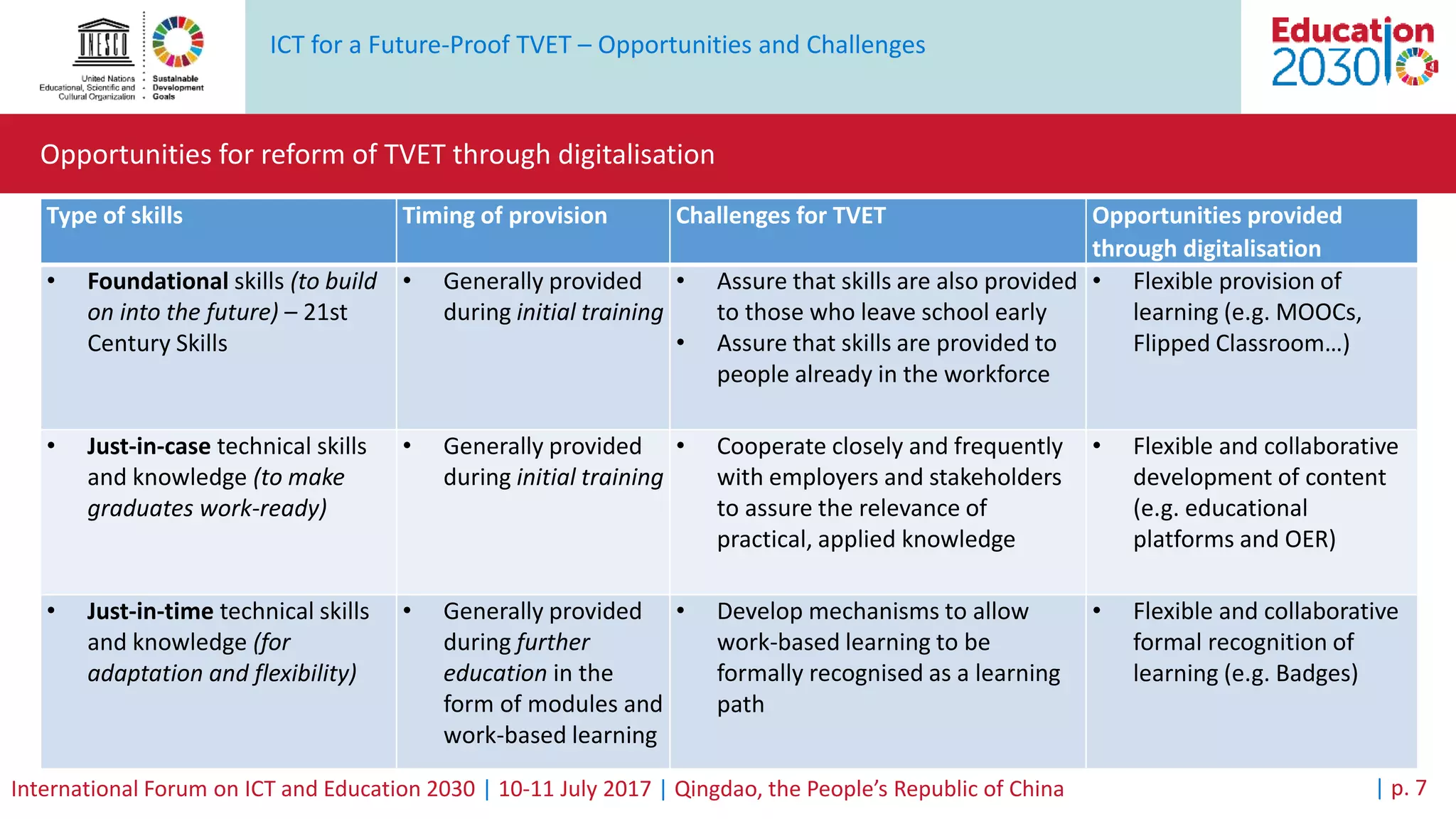
Opportunities for reform of TVET through digitalisation
| p. 7
Type of skills Timing of provision Challenges for TVET Opportunities provided
through digitalisation
• Foundational skills (to build
on into the future) – 21st
Century Skills
• Generally provided
during initial training
• Assure that skills are also provided
to those who leave school early
• Assure that skills are provided to
people already in the workforce
• Flexible provision of
learning (e.g. MOOCs,
Flipped Classroom…)
• Just-in-case technical skills
and knowledge (to make
graduates work-ready)
• Generally provided
during initial training
• Cooperate closely and frequently
with employers and stakeholders
to assure the relevance of
practical, applied knowledge
• Flexible and collaborative
development of content
(e.g. educational
platforms and OER)
• Just-in-time technical skills
and knowledge (for
adaptation and flexibility)
• Generally provided
during further
education in the
form of modules and
work-based learning
• Develop mechanisms to allow
work-based learning to be
formally recognised as a learning
path
• Flexible and collaborative
formal recognition of
learning (e.g. Badges)
ICT for a Future-Proof TVET – Opportunities and Challenges
International Forum on ICT and Education 2030 | 10-11 July 2017 | Qingdao, the People’s Republic of China
ICT Policies and skills - required
| p. 8
Source: The Foundation for Young Australians, 2016
• One occupational data
analysis for Australia
sees that less than
10% will require no
digital skills in the next
2-5 years.
• Instead labour force
participants will need
the skills of a digital
citizen or digital
worker, able to
configure and use
digital systems
ICT for a Future-Proof TVET – Opportunities and Challenges
International Forum on ICT and Education 2030 | 10-11 July 2017 | Qingdao, the People’s Republic of China
ICT Policies and skills – a mix of policy framework and empowering citizens
| p. 9
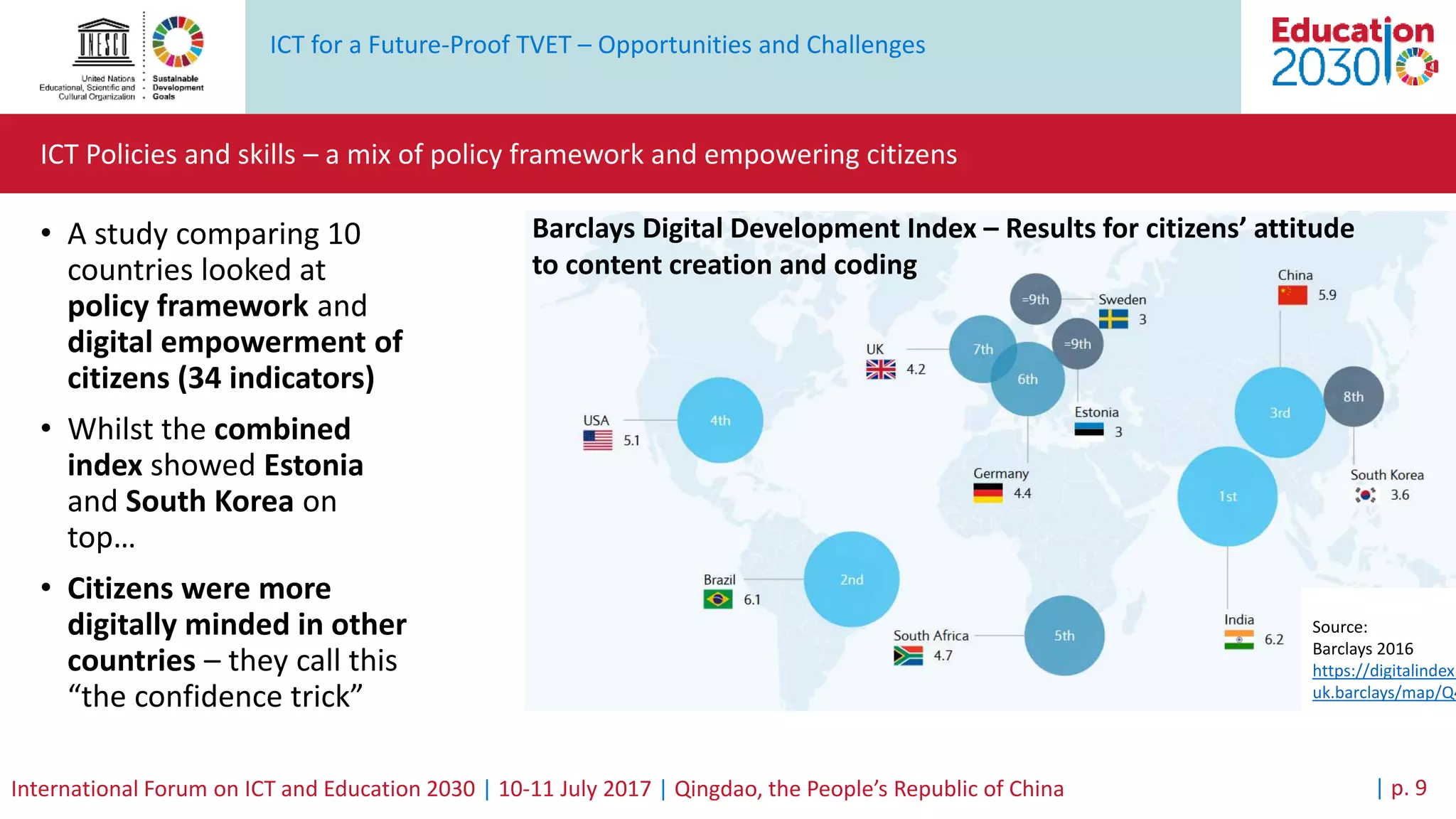
• A study comparing 10
countries looked at
policy framework and
digital empowerment of
citizens (34 indicators)
• Whilst the combined
index showed Estonia
and South Korea on
top…
• Citizens were more
digitally minded in other
countries – they call this
“the confidence trick”
Source:
Barclays 2016
https://digitalindex.
uk.barclays/map/Q4
Barclays Digital Development Index – Results for citizens’ attitude
to content creation and coding
ICT for a Future-Proof TVET – Opportunities and Challenges
International Forum on ICT and Education 2030 | 10-11 July 2017 | Qingdao, the People’s Republic of China | p. 10
Thank you
Learn more: http://www.fibs.eu/
Dr. Dominic Orr, Senior Researcher
d.orr@fibs.eu
ICT for a Future-Proof TVET – Opportunities and Challenges
International Forum on ICT and Education 2030 | 10-11 July 2017 | Qingdao, the People’s Republic of China | p. 11
Sources used:
• Barclays. (2016). From Inclusion to Empowerment: The Barclays Digital Development Index. Retrieved from
https://digitalindex.uk.barclays/download/report/1/Barclays Digital Development Index.pdf
• Hess, N. C. L., Carlson, D. J., Inder, J. D., Jesulola, E., Mcfarlane, J. R., & Smart, N. A. (2016). World
Development Report 2016: Digital Dividends. The World Bank. https://doi.org/10.1596/978-1-4648-0671-1
• The Foundation for Young Australians. (2016). The new basics - Big data reveals the skills young people
need for the New Work Order. The Foundation for Young Australians. Retrieved from
https://www.fya.org.au/wp-content/uploads/2016/04/The-New-Basics_Update_Web.pdf
• UNESCO. (2016). Strategy for Technical and Vocational Education and Training (TVET), (2016-2021).
Retrieved from http://unesdoc.unesco.org/images/0024/002452/245239e.pdf
• UNESCO. (2015). Proposal for the revision of the 2001 revised recommendation concerning technical and
vocational education. Retrieved from http://unesdoc.unesco.org/images/0023/002341/234137e.pdf
• UNESCO. (2012). Shanghai Consensus: Recommendations of the Third International Congress on Technical
and Vocational Education and Training “Transforming TVET: Building skills for work and life.” Retrieved
from http://www.unesco.org/fileadmin/MULTIMEDIA/HQ/ED/pdf/outcomesdocumentFinalwithlogo.pdf

ICT for a Future-Proof TVET – Opportunities and Challenges

  • 1.
    ICT for aFuture-Proof TVET – Opportunities and Challenges Dominic Orr, FiBS Research Institute for the Economics of Education and Social Affairs, Germany International Forum on ICT and Education 2030 | 10-11 July 2017 | Qingdao, the People’s Republic of China Source: http://banksy.co.uk/out.asp
  • 2.
    ICT for aFuture-Proof TVET – Opportunities and Challenges International Forum on ICT and Education 2030 | 10-11 July 2017 | Qingdao, the People’s Republic of China What is TVET – Technical and Vocational Education and Training – and when does it occur? | p. 2 • TVET has a broad scope, which makes it so important Primary and lower secondary education Upper secondary education - vocational Upper secondary education - academic Technical / short-cycle Bachelor course Master course Doctorate TVET-learning during working life - formal - non-formal - informal Note: areas encompassed by dotted lines are normally considered as TVET. Source: author
  • 3.
    ICT for aFuture-Proof TVET – Opportunities and Challenges International Forum on ICT and Education 2030 | 10-11 July 2017 | Qingdao, the People’s Republic of China UNESCO’s view of current challenges | p. 3 • To provide job-ready graduates with applied knowledge and skills for the job market. The Shanghai Consensus (UNESCO, 2012) calls for an “Enhancing relevance of TVET” • To provide new opportunities for learning and for upskilling in work-based settings. The UNESCO Strategy for TVET (UNESCO, 2016) states that “UNESCO will also support Member States to leverage digital technologies to …[enable] the learning and recognition of [core] skills in workplace settings.” • To be inclusive by bridging gaps between informal, non-formal and formal learning and providing educational pathways for those, who have left the general educational system early (UNESCO, 2015)
  • 4.
    ICT for aFuture-Proof TVET – Opportunities and Challenges International Forum on ICT and Education 2030 | 10-11 July 2017 | Qingdao, the People’s Republic of China Jobs as a bundle of tasks | p. 4 • Which skills are required for executing these tasks? - Routine (noncognitive or cognitive) - Non-routine (noncognitive or cognitive) • Different impact on jobs • Globalisation and digitalisation promote further unbundling of tasks, where possible Source: Hess et al. 2016
  • 5.
    ICT for aFuture-Proof TVET – Opportunities and Challenges International Forum on ICT and Education 2030 | 10-11 July 2017 | Qingdao, the People’s Republic of China Skills and knowledge sets | p. 5 • Skills challenges for TVET 1. How can learners obtain the right skills for the future? 2. How can learners obtain the right skills for now? • Education & training tends to provide 3 types of skills and knowledge sets 1. Foundational skills – to build on into the future (21st Century Skills) 2. Just-in-case technical skills and knowledge – to make graduates work-ready 3. Just-in-time technical skills and knowledge – for adaptation and flexibility
  • 6.
    ICT for aFuture-Proof TVET – Opportunities and Challenges International Forum on ICT and Education 2030 | 10-11 July 2017 | Qingdao, the People’s Republic of China Digital transformations in core educational processes | p. 6 3 central processes, which can be improved and adapted through digitalisation:  Content – subject knowledge, support and guidance and learning analytics  Delivery – place, pace and timing of delivery of the content  Recognition – consists of both assessment and credentialization, which are formal processes leading to recognition of learning achievements Source: author
  • 7.
    ICT for aFuture-Proof TVET – Opportunities and Challenges International Forum on ICT and Education 2030 | 10-11 July 2017 | Qingdao, the People’s Republic of China Opportunities for reform of TVET through digitalisation | p. 7 Type of skills Timing of provision Challenges for TVET Opportunities provided through digitalisation • Foundational skills (to build on into the future) – 21st Century Skills • Generally provided during initial training • Assure that skills are also provided to those who leave school early • Assure that skills are provided to people already in the workforce • Flexible provision of learning (e.g. MOOCs, Flipped Classroom…) • Just-in-case technical skills and knowledge (to make graduates work-ready) • Generally provided during initial training • Cooperate closely and frequently with employers and stakeholders to assure the relevance of practical, applied knowledge • Flexible and collaborative development of content (e.g. educational platforms and OER) • Just-in-time technical skills and knowledge (for adaptation and flexibility) • Generally provided during further education in the form of modules and work-based learning • Develop mechanisms to allow work-based learning to be formally recognised as a learning path • Flexible and collaborative formal recognition of learning (e.g. Badges)
  • 8.
    ICT for aFuture-Proof TVET – Opportunities and Challenges International Forum on ICT and Education 2030 | 10-11 July 2017 | Qingdao, the People’s Republic of China ICT Policies and skills - required | p. 8 Source: The Foundation for Young Australians, 2016 • One occupational data analysis for Australia sees that less than 10% will require no digital skills in the next 2-5 years. • Instead labour force participants will need the skills of a digital citizen or digital worker, able to configure and use digital systems
  • 9.
    ICT for aFuture-Proof TVET – Opportunities and Challenges International Forum on ICT and Education 2030 | 10-11 July 2017 | Qingdao, the People’s Republic of China ICT Policies and skills – a mix of policy framework and empowering citizens | p. 9 • A study comparing 10 countries looked at policy framework and digital empowerment of citizens (34 indicators) • Whilst the combined index showed Estonia and South Korea on top… • Citizens were more digitally minded in other countries – they call this “the confidence trick” Source: Barclays 2016 https://digitalindex. uk.barclays/map/Q4 Barclays Digital Development Index – Results for citizens’ attitude to content creation and coding
  • 10.
    ICT for aFuture-Proof TVET – Opportunities and Challenges International Forum on ICT and Education 2030 | 10-11 July 2017 | Qingdao, the People’s Republic of China | p. 10 Thank you Learn more: http://www.fibs.eu/ Dr. Dominic Orr, Senior Researcher d.orr@fibs.eu
  • 11.
    ICT for aFuture-Proof TVET – Opportunities and Challenges International Forum on ICT and Education 2030 | 10-11 July 2017 | Qingdao, the People’s Republic of China | p. 11 Sources used: • Barclays. (2016). From Inclusion to Empowerment: The Barclays Digital Development Index. Retrieved from https://digitalindex.uk.barclays/download/report/1/Barclays Digital Development Index.pdf • Hess, N. C. L., Carlson, D. J., Inder, J. D., Jesulola, E., Mcfarlane, J. R., & Smart, N. A. (2016). World Development Report 2016: Digital Dividends. The World Bank. https://doi.org/10.1596/978-1-4648-0671-1 • The Foundation for Young Australians. (2016). The new basics - Big data reveals the skills young people need for the New Work Order. The Foundation for Young Australians. Retrieved from https://www.fya.org.au/wp-content/uploads/2016/04/The-New-Basics_Update_Web.pdf • UNESCO. (2016). Strategy for Technical and Vocational Education and Training (TVET), (2016-2021). Retrieved from http://unesdoc.unesco.org/images/0024/002452/245239e.pdf • UNESCO. (2015). Proposal for the revision of the 2001 revised recommendation concerning technical and vocational education. Retrieved from http://unesdoc.unesco.org/images/0023/002341/234137e.pdf • UNESCO. (2012). Shanghai Consensus: Recommendations of the Third International Congress on Technical and Vocational Education and Training “Transforming TVET: Building skills for work and life.” Retrieved from http://www.unesco.org/fileadmin/MULTIMEDIA/HQ/ED/pdf/outcomesdocumentFinalwithlogo.pdf