UK Government approach to
apps
Tom Loosemore
20th
February 2013
210/17/12
GDS2
At the Oct 2012
Digital Leaders’ meeting,
the position was clarified:
native apps could not be
developed without Cabinet
Office approval.
310/17/12
GDS3
The Nov 2012 Digital Strategy says:
“Stand-alone mobile apps will only
be considered once the core web
service works well on mobile
devices, and if specifically agreed
with the Cabinet Office”
410/17/12
GDS4
This presentation explains
why we have a‘by default, no
apps’ position.
And in what circumstances
apps might be considered as
exceptions.
Confusion is understandable.
So-called “Apps” come in
several very, very different
flavours.
5
GDS
610/17/12
GDS6
What is meant by ‘an app’?
1. Device-specific ‘download and
install’ apps (aka ‘native apps’)
2. Websites that respond to various
screen sizes (aka ‘responsive
websites’, ‘web apps’ or ‘HTML5’)
3. Various hybrids of the above
710/17/12
GDS7
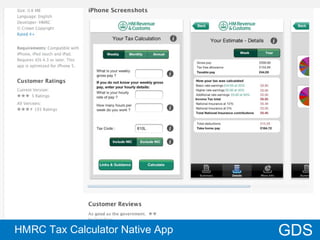
What is a‘Native’ App ?
-Downloaded, installed piece of bespoke
software.
-Free or paid-for.
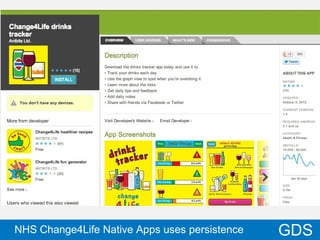
-Persists on the device.
-Can access all device features
-Proprietary code, hence requires completely
different software for iPhone/iPad, Android,
Blackberry etc.
-Spotify, Angry Birds, Instagram, Skype etc.
8
GDSHMRC Tax Calculator Native App
9
GDSNHS Change4Life Native Apps uses persistence
1010/17/12
GDS10
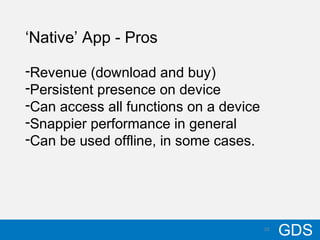
‘Native’ App - Pros
-Revenue (download and buy)
-Persistent presence on device
-Can access all functions on a device
-Snappier performance in general
-Can be used offline, in some cases.
1110/17/12
GDS11
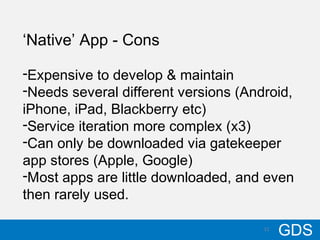
‘Native’ App - Cons
-Expensive to develop & maintain
-Needs several different versions (Android,
iPhone, iPad, Blackberry etc)
-Service iteration more complex (x3)
-Can only be downloaded via gatekeeper
app stores (Apple, Google)
-Most apps are little downloaded, and even
then rarely used.
12
GDS
1310/17/12
GDS13
What is a‘Web App’
-Uses device’s built-in web browser
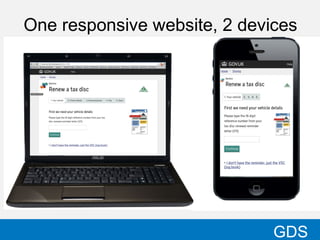
-Is a website which optimises its layout
& functionality for each device
-Uses open standards (HTML5)
-Examples: GOV.UK, PM’s dashboard,
FT webapp, Virgin Active’s ‘My Locker’,
bbc.co.uk/sport
One responsive website, 2 devices
14
GDS
15
GDS
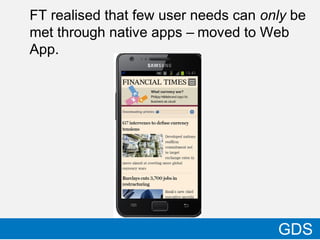
FT realised that few user needs can only be
met through native apps – moved to Web
App.
1610/17/12
GDS16
Web App - Pros
-It is your website, so costs are minimised
and service iteration simplified.
-Uses open standards (HTML5)
-No gatekeepers to constrain access
-Performance still good
-Mobile web outstripping mobile app reach
-Clear winning strategy for ‘utility’ services
which do not require complex device
features or persistence.
1710/17/12
GDS17
Web App- Cons
-Not persistent on device
-Some device features unavailable (camera,
address book)
-Requires internet connection
-Not snappy enough for some complex
services (e.g. Spotify, Facebook, Skype)
-No ‘download and buy’ revenue stream.
Hybrid App
18
- A small native app which then
loads up a bespoke website
- So, can use device features (e.g.
camera) that Web apps can’t.
- Requires a stand-alone website
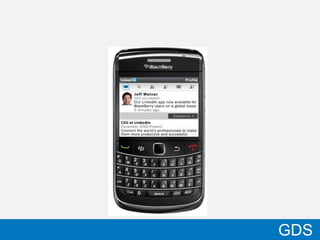
- Examples “Bing for Mobile”,
Netflix app, LinkedIn app, BBC
News app
GDS
19
GDS
2010/17/12
GDS20
Hybrid App – Pros & Cons
Not as expensive to maintain as a native
app, can access device functions and be
persistent…
…but still requires a new parallel version
of your web service, and multiple versions
to be developed for each device.
If there is a market for native or
hybrid apps, why should the
government monopolise it?
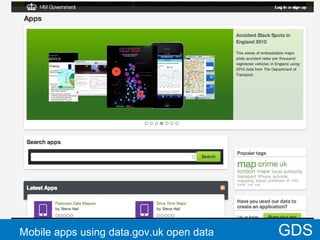
There is a vibrant market of 3rd
party native app developers
using government data & APIs.
21
GDS
22
GDSMobile apps using data.gov.uk open data
23
GDS
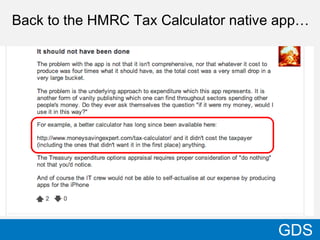
Back to the HMRC Tax Calculator native app…
Government’s position is that native &
hybrid apps currently rarely justified.
Ensure your service meets the Digital by
Default service standard and it will work
well on mobile devices.
Make your data & API available for re-
use and you will stimulate market if there
is real demand for native apps.
24
GDS
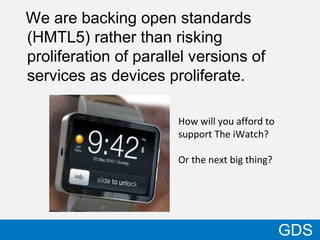
We are backing open standards
(HMTL5) rather than risking
proliferation of parallel versions of
services as devices proliferate.
25
GDS
How will you afford to
support The iWatch?
Or the next big thing?
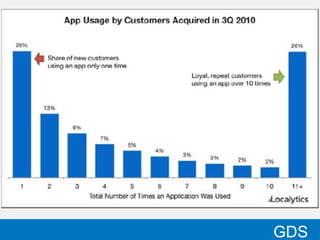
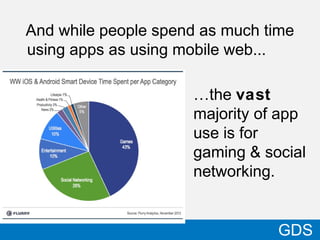
And while people spend as much time
using apps as using mobile web...
26
GDS
…the vast
majority of app
use is for
gaming & social
networking.
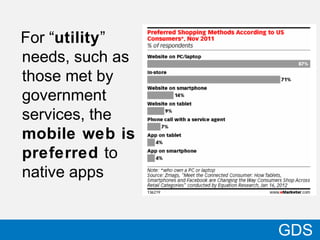
For “utility”
needs, such as
those met by
government
services, the
mobile web is
preferred to
native apps
27
GDS
So what will the ‘By default, no
native apps’ position mean for
Digital Leaders?
Ministers and civil servants will
probably still think they need
native apps so…
28
GDS
Expect to hear justifications
for why only a native or
hybrid app will do.
29
GDS
Expect to hear why web
apps aren’t all they’re
cracked up to be.
30
GDS
3110/17/12
GDS31
Five key questions you should
consider:
1.Is our web service already designed to be
responsive? If not, why not?
2.What is the user need that only a
native/hybrid App can meet?
3.Are there existing native/hybrid apps
which already meet this user need?
4.Is our service available to 3rd
parties via
API or open data? If not, why not?
5.Does meeting this need justify the lifetime
cost of native or hybrid App?
32
GDS
If after asking the questions,
you’re convinced it’s got to be
a native or hybrid app, then
let’s have a chat about an
exception.
(There will be some…)
33
GDS
The Process
34
GDS
Have you met the necessary
conditions?
NOTE: If these are not in place, it is
unlikely that your proposal will be
approved.
35
GDS
Condition 1:
Your web service is already designed
to be responsive
Condition 2:
The service or the content you’re
looking to build an app for is already
open to third-parties via APIs or as
open data
36
GDS
Answer the following
questions and provide
supporting evidence
1. What is the user need?
Please provide evidence.
37
GDS
2. Is this user need of sufficient
importance to (your users to) justify
the lifetime cost of your proposed
app?
If you believe it is, how have you
determined this?
38
GDS
3. Which 3rd-party native/hybrid apps
already exist to meet this user need?
If there are none and Condition 2 has
been met, please state why this might
be the case.
If there are 3rd-party alternatives,
explain why you believe your app is
necessary.
39
GDS
4. Is there evidence of demand for
this type of app amongst your target
users?
If you believe there is, please
provide supporting evidence e.g.
similar apps which have proven
popular with your target audience
and evidence of their popularity.
40
GDS
5. Is there evidence to justify building
an app for the platform you’re
proposing to do this for?
If so, please provide supporting
evidence e.g. analytics data that
shows proportion of visitors to your
content/service that currently access it
via relevant platform.
41
GDS
42
GDS
In addition to the evidence requested
above, all digital spend for the
development of standalone mobile
apps is subject to the GDS spend
approval process.
Contact GDS PMO for details:
pmo@digital.cabinet-office.gov.uk
Thank you.
tom.loosemore@digital.cabinet-office.gov.uk
@tomskitomski
20th
February 2013

Government Approach to Apps

  • 1.
    UK Government approachto apps Tom Loosemore 20th February 2013
  • 2.
    210/17/12 GDS2 At the Oct2012 Digital Leaders’ meeting, the position was clarified: native apps could not be developed without Cabinet Office approval.
  • 3.
    310/17/12 GDS3 The Nov 2012Digital Strategy says: “Stand-alone mobile apps will only be considered once the core web service works well on mobile devices, and if specifically agreed with the Cabinet Office”
  • 4.
    410/17/12 GDS4 This presentation explains whywe have a‘by default, no apps’ position. And in what circumstances apps might be considered as exceptions.
  • 5.
    Confusion is understandable. So-called“Apps” come in several very, very different flavours. 5 GDS
  • 6.
    610/17/12 GDS6 What is meantby ‘an app’? 1. Device-specific ‘download and install’ apps (aka ‘native apps’) 2. Websites that respond to various screen sizes (aka ‘responsive websites’, ‘web apps’ or ‘HTML5’) 3. Various hybrids of the above
  • 7.
    710/17/12 GDS7 What is a‘Native’App ? -Downloaded, installed piece of bespoke software. -Free or paid-for. -Persists on the device. -Can access all device features -Proprietary code, hence requires completely different software for iPhone/iPad, Android, Blackberry etc. -Spotify, Angry Birds, Instagram, Skype etc.
  • 8.
  • 9.
    9 GDSNHS Change4Life NativeApps uses persistence
  • 10.
    1010/17/12 GDS10 ‘Native’ App -Pros -Revenue (download and buy) -Persistent presence on device -Can access all functions on a device -Snappier performance in general -Can be used offline, in some cases.
  • 11.
    1110/17/12 GDS11 ‘Native’ App -Cons -Expensive to develop & maintain -Needs several different versions (Android, iPhone, iPad, Blackberry etc) -Service iteration more complex (x3) -Can only be downloaded via gatekeeper app stores (Apple, Google) -Most apps are little downloaded, and even then rarely used.
  • 12.
  • 13.
    1310/17/12 GDS13 What is a‘WebApp’ -Uses device’s built-in web browser -Is a website which optimises its layout & functionality for each device -Uses open standards (HTML5) -Examples: GOV.UK, PM’s dashboard, FT webapp, Virgin Active’s ‘My Locker’, bbc.co.uk/sport
  • 14.
    One responsive website,2 devices 14 GDS
  • 15.
    15 GDS FT realised thatfew user needs can only be met through native apps – moved to Web App.
  • 16.
    1610/17/12 GDS16 Web App -Pros -It is your website, so costs are minimised and service iteration simplified. -Uses open standards (HTML5) -No gatekeepers to constrain access -Performance still good -Mobile web outstripping mobile app reach -Clear winning strategy for ‘utility’ services which do not require complex device features or persistence.
  • 17.
    1710/17/12 GDS17 Web App- Cons -Notpersistent on device -Some device features unavailable (camera, address book) -Requires internet connection -Not snappy enough for some complex services (e.g. Spotify, Facebook, Skype) -No ‘download and buy’ revenue stream.
  • 18.
    Hybrid App 18 - Asmall native app which then loads up a bespoke website - So, can use device features (e.g. camera) that Web apps can’t. - Requires a stand-alone website - Examples “Bing for Mobile”, Netflix app, LinkedIn app, BBC News app GDS
  • 19.
  • 20.
    2010/17/12 GDS20 Hybrid App –Pros & Cons Not as expensive to maintain as a native app, can access device functions and be persistent… …but still requires a new parallel version of your web service, and multiple versions to be developed for each device.
  • 21.
    If there isa market for native or hybrid apps, why should the government monopolise it? There is a vibrant market of 3rd party native app developers using government data & APIs. 21 GDS
  • 22.
    22 GDSMobile apps usingdata.gov.uk open data
  • 23.
    23 GDS Back to theHMRC Tax Calculator native app…
  • 24.
    Government’s position isthat native & hybrid apps currently rarely justified. Ensure your service meets the Digital by Default service standard and it will work well on mobile devices. Make your data & API available for re- use and you will stimulate market if there is real demand for native apps. 24 GDS
  • 25.
    We are backingopen standards (HMTL5) rather than risking proliferation of parallel versions of services as devices proliferate. 25 GDS How will you afford to support The iWatch? Or the next big thing?
  • 26.
    And while peoplespend as much time using apps as using mobile web... 26 GDS …the vast majority of app use is for gaming & social networking.
  • 27.
    For “utility” needs, suchas those met by government services, the mobile web is preferred to native apps 27 GDS
  • 28.
    So what willthe ‘By default, no native apps’ position mean for Digital Leaders? Ministers and civil servants will probably still think they need native apps so… 28 GDS
  • 29.
    Expect to hearjustifications for why only a native or hybrid app will do. 29 GDS
  • 30.
    Expect to hearwhy web apps aren’t all they’re cracked up to be. 30 GDS
  • 31.
    3110/17/12 GDS31 Five key questionsyou should consider: 1.Is our web service already designed to be responsive? If not, why not? 2.What is the user need that only a native/hybrid App can meet? 3.Are there existing native/hybrid apps which already meet this user need? 4.Is our service available to 3rd parties via API or open data? If not, why not? 5.Does meeting this need justify the lifetime cost of native or hybrid App?
  • 32.
    32 GDS If after askingthe questions, you’re convinced it’s got to be a native or hybrid app, then let’s have a chat about an exception. (There will be some…)
  • 33.
  • 34.
    34 GDS Have you metthe necessary conditions? NOTE: If these are not in place, it is unlikely that your proposal will be approved.
  • 35.
    35 GDS Condition 1: Your webservice is already designed to be responsive Condition 2: The service or the content you’re looking to build an app for is already open to third-parties via APIs or as open data
  • 36.
    36 GDS Answer the following questionsand provide supporting evidence
  • 37.
    1. What isthe user need? Please provide evidence. 37 GDS
  • 38.
    2. Is thisuser need of sufficient importance to (your users to) justify the lifetime cost of your proposed app? If you believe it is, how have you determined this? 38 GDS
  • 39.
    3. Which 3rd-partynative/hybrid apps already exist to meet this user need? If there are none and Condition 2 has been met, please state why this might be the case. If there are 3rd-party alternatives, explain why you believe your app is necessary. 39 GDS
  • 40.
    4. Is thereevidence of demand for this type of app amongst your target users? If you believe there is, please provide supporting evidence e.g. similar apps which have proven popular with your target audience and evidence of their popularity. 40 GDS
  • 41.
    5. Is thereevidence to justify building an app for the platform you’re proposing to do this for? If so, please provide supporting evidence e.g. analytics data that shows proportion of visitors to your content/service that currently access it via relevant platform. 41 GDS
  • 42.
    42 GDS In addition tothe evidence requested above, all digital spend for the development of standalone mobile apps is subject to the GDS spend approval process. Contact GDS PMO for details: pmo@digital.cabinet-office.gov.uk
  • 43.

Editor's Notes

  • #18 Words With Friends (very popular) multi-player game. It was one of the 10 native apps on both Android and iPhone platforms.
  • #27 Beyond the smartphone.
  • #28 Beyond the smartphone.
  • #40 .