Maths topic for
Probability:
Axiomatic
approach to
probability
By Dhruv Sethi;
dhrsethi1@gmail.com/+91 9310805977
11th Grade
Axiomatic approach
• Let S be the sample space of a random experiment.
• The probability P is a real valued function whose domain is the power set
of S and range is the interval [0,1] satisfying the following axioms:
i. For any event E, P (E) ≥ 0
ii. P(S) = 1
iii. If E and F are mutually exclusive events, then P(E ∪ F) = P(E) + P(F)
Axiomatic approach
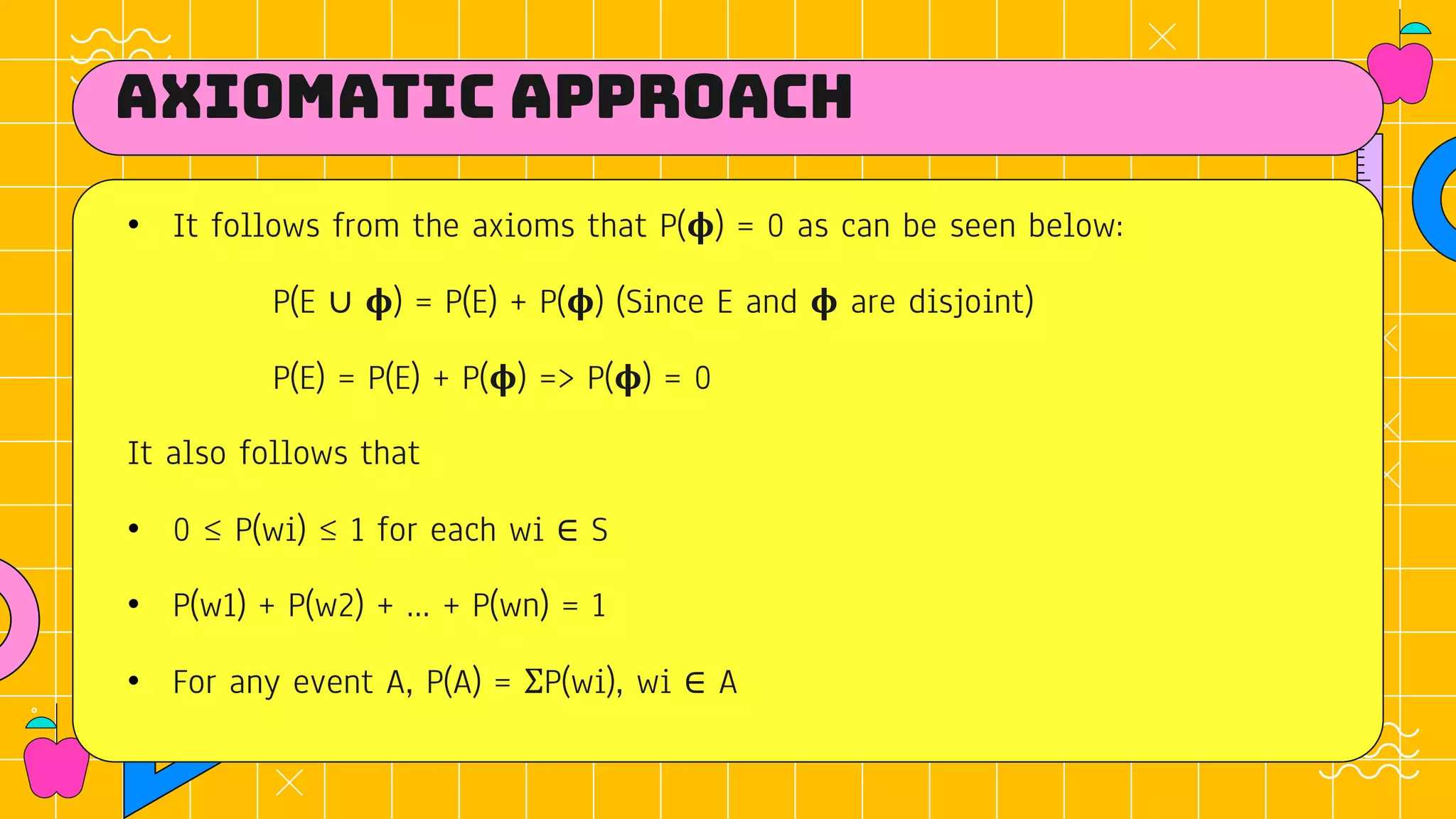
• It follows from the axioms that P(𝛟) = 0 as can be seen below:
P(E ∪ 𝛟) = P(E) + P(𝛟) (Since E and 𝛟 are disjoint)
P(E) = P(E) + P(𝛟) => P(𝛟) = 0
It also follows that
• 0 ≤ P(wi) ≤ 1 for each wi ∈ S
• P(w1) + P(w2) + … + P(wn) = 1
• For any event A, P(A) = ΣP(wi), wi ∈ A
Mutually exclusive and Exhaustive Events
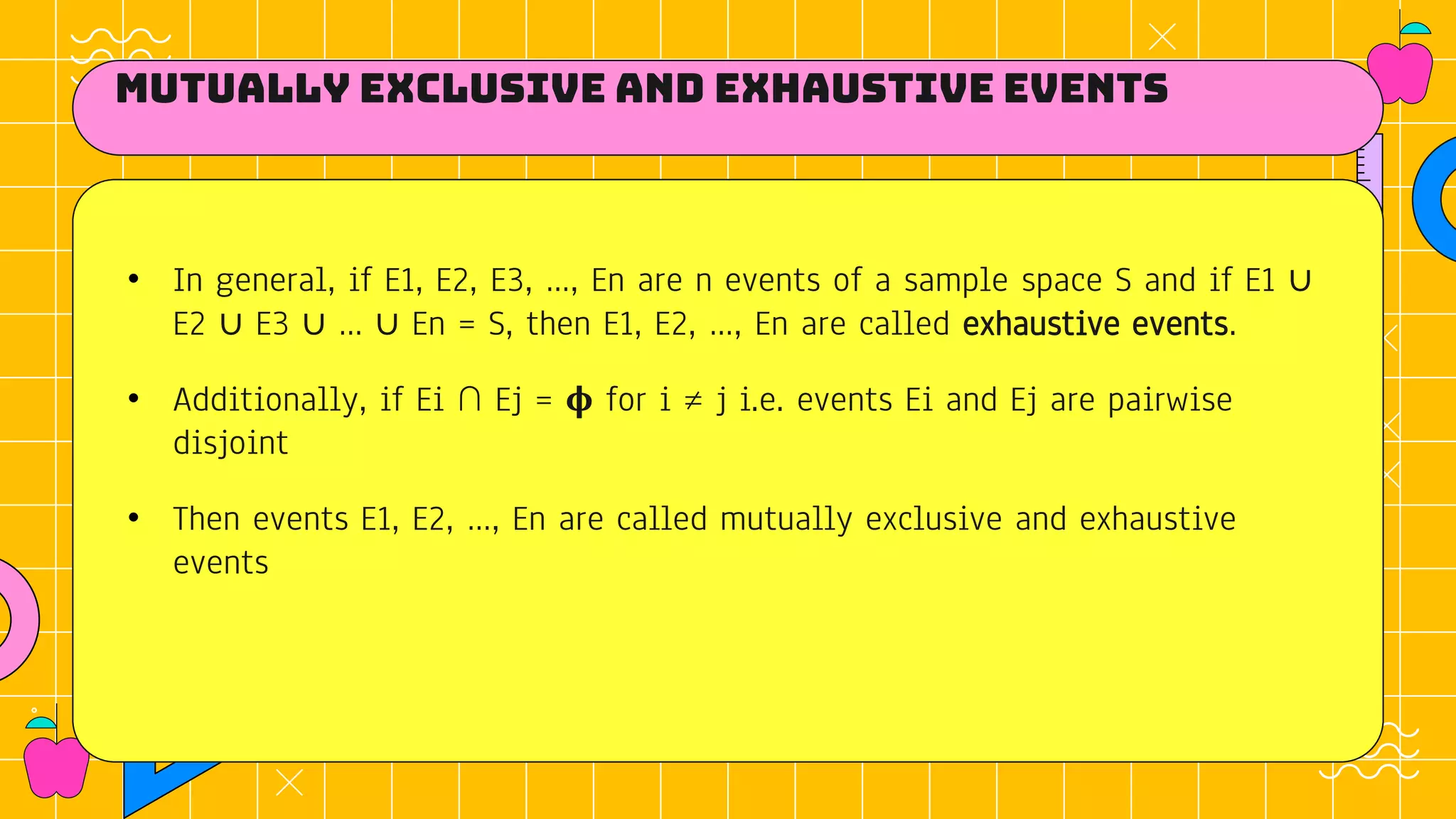
• In general, if E1, E2, E3, …, En are n events of a sample space S and if E1 ∪
E2 ∪ E3 ∪ … ∪ En = S, then E1, E2, …, En are called exhaustive events.
• Additionally, if Ei ∩ Ej = 𝛟 for i ≠ j i.e. events Ei and Ej are pairwise
disjoint
• Then events E1, E2, …, En are called mutually exclusive and exhaustive
events
Exhaustive Events
• You can contact me for private or group tuitions from the details below
• By Dhruv Sethi: +91 9310805977/dhrsethi1@gmail.com
• Whatsapp: +91 8291687783

10 axiomatic approach to probability

  • 1.
    Maths topic for Probability: Axiomatic approachto probability By Dhruv Sethi; dhrsethi1@gmail.com/+91 9310805977 11th Grade
  • 2.
    Axiomatic approach • LetS be the sample space of a random experiment. • The probability P is a real valued function whose domain is the power set of S and range is the interval [0,1] satisfying the following axioms: i. For any event E, P (E) ≥ 0 ii. P(S) = 1 iii. If E and F are mutually exclusive events, then P(E ∪ F) = P(E) + P(F)
  • 3.
    Axiomatic approach • Itfollows from the axioms that P(𝛟) = 0 as can be seen below: P(E ∪ 𝛟) = P(E) + P(𝛟) (Since E and 𝛟 are disjoint) P(E) = P(E) + P(𝛟) => P(𝛟) = 0 It also follows that • 0 ≤ P(wi) ≤ 1 for each wi ∈ S • P(w1) + P(w2) + … + P(wn) = 1 • For any event A, P(A) = ΣP(wi), wi ∈ A
  • 4.
    Mutually exclusive andExhaustive Events • In general, if E1, E2, E3, …, En are n events of a sample space S and if E1 ∪ E2 ∪ E3 ∪ … ∪ En = S, then E1, E2, …, En are called exhaustive events. • Additionally, if Ei ∩ Ej = 𝛟 for i ≠ j i.e. events Ei and Ej are pairwise disjoint • Then events E1, E2, …, En are called mutually exclusive and exhaustive events
  • 5.
    Exhaustive Events • Youcan contact me for private or group tuitions from the details below • By Dhruv Sethi: +91 9310805977/dhrsethi1@gmail.com • Whatsapp: +91 8291687783