Data Models
DEANNA MEDINA
NORTHERN ARIZONA UNIVERSITY
CIT311 ANALYSIS, DESIGN, & DATABASES:
DATABASE THEORIES: ASSIGNMENT 1.1
JULY 24, 2017
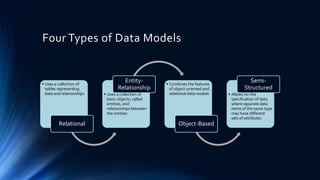
Four Types of Data Models
• Uses a collection of
tables representing
data and relationships
Relational
• Uses a collection of
basic objects, called
entities, and
relationships between
the entities
Entity-
Relationship
• Combines the features
of object-oriented and
relational data models
Object-Based
• Allows for the
specification of data
where separate data
items of the same type
may have different
sets of attributes
Semi-
Structured
Relational Data Models
• Data and relationships are represented as tables containing columns
with unique names.
• Based on the concept of mathematical relations
• The logical structure of the data model requires only that the
database be perceived by the user as tables
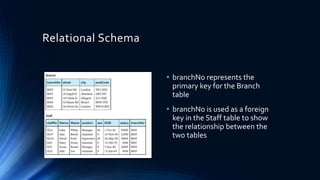
Relational Schema
• branchNo represents the
primary key for the Branch
table
• branchNo is used as a foreign
key in the Staff table to show
the relationship between the
two tables
Entity-Relationship Model
• A type of Object-Based Model
• Uses concepts of entities, attributes, and relationships
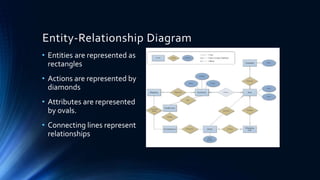
Entity-Relationship Diagram
• Entities are represented as
rectangles
• Actions are represented by
diamonds
• Attributes are represented
by ovals.
• Connecting lines represent
relationships
Object Based Model
• Uses the concepts of entities, attributes, and relationships
• Types of Object Based Models
• Entity Relationship
• Object-Oriented
• Semantic
• Functional
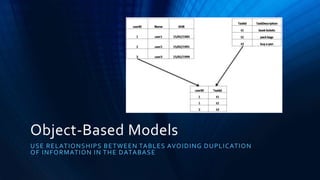
Object-Based Models
USE RELATIONSHIPS BETWEEN TABLES AVOIDING DUPLICATION
OF INFORMATION IN THE DATABASE
Semi-Structured Model
• There is no separation between the data and the schema
• A labled graph is used to represent data
• There is no predefined schema
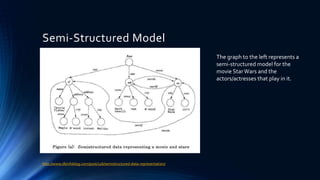
Semi-Structured Model
http://www.dbinfoblog.com/post/126/semistructured-data-representation/
The graph to the left represents a
semi-structured model for the
movie StarWars and the
actors/actresses that play in it.
References
Connolly,T.M., & Begg,C.E. (2010). Database Systems: A Practical Approach to Design, Implementation,
and Management (5th ed., pp. 1-14). Upper Saddle River, NJ: Addison-Wesley.
Entity Relationship Diagram. (n.d.) Retrieved July 25, 2017 from https://www.smartdraw.com/entity-
relationship-diagram/

Four Types of Data Models

  • 1.
    Data Models DEANNA MEDINA NORTHERNARIZONA UNIVERSITY CIT311 ANALYSIS, DESIGN, & DATABASES: DATABASE THEORIES: ASSIGNMENT 1.1 JULY 24, 2017
  • 2.
    Four Types ofData Models • Uses a collection of tables representing data and relationships Relational • Uses a collection of basic objects, called entities, and relationships between the entities Entity- Relationship • Combines the features of object-oriented and relational data models Object-Based • Allows for the specification of data where separate data items of the same type may have different sets of attributes Semi- Structured
  • 3.
    Relational Data Models •Data and relationships are represented as tables containing columns with unique names. • Based on the concept of mathematical relations • The logical structure of the data model requires only that the database be perceived by the user as tables
  • 4.
    Relational Schema • branchNorepresents the primary key for the Branch table • branchNo is used as a foreign key in the Staff table to show the relationship between the two tables
  • 5.
    Entity-Relationship Model • Atype of Object-Based Model • Uses concepts of entities, attributes, and relationships
  • 6.
    Entity-Relationship Diagram • Entitiesare represented as rectangles • Actions are represented by diamonds • Attributes are represented by ovals. • Connecting lines represent relationships
  • 7.
    Object Based Model •Uses the concepts of entities, attributes, and relationships • Types of Object Based Models • Entity Relationship • Object-Oriented • Semantic • Functional
  • 8.
    Object-Based Models USE RELATIONSHIPSBETWEEN TABLES AVOIDING DUPLICATION OF INFORMATION IN THE DATABASE
  • 9.
    Semi-Structured Model • Thereis no separation between the data and the schema • A labled graph is used to represent data • There is no predefined schema
  • 10.
    Semi-Structured Model http://www.dbinfoblog.com/post/126/semistructured-data-representation/ The graphto the left represents a semi-structured model for the movie StarWars and the actors/actresses that play in it.
  • 11.
    References Connolly,T.M., & Begg,C.E.(2010). Database Systems: A Practical Approach to Design, Implementation, and Management (5th ed., pp. 1-14). Upper Saddle River, NJ: Addison-Wesley. Entity Relationship Diagram. (n.d.) Retrieved July 25, 2017 from https://www.smartdraw.com/entity- relationship-diagram/