Data Model
Data Model
DataModel Basic Building
Blocks
Hierarchical Model
Network Model
Relational Model
Entity-
Relationship(ER)
Model
Object-Oriented(OO)
Model
Object-Relational(OR)
Model
Semi-structured Model
2.1
Database Management
System 2
Data Model
Sharmistha Roy
Sharmistha Roy
Faculty of Computing andInformationTechnology
Usha MartinUniversity
2.
Data Model
Data Model
DataModel Basic Building
Blocks
Hierarchical Model
Network Model
Relational Model
Entity-
Relationship(ER)
Model
Object-Oriented(OO)
Model
Object-Relational(OR)
Model
Semi-structured Model
2.2
Data Model
Data Model
Data model is a collection of conceptual tools for describing
data, data relationships, data semantics and consistency
constraints. That means a data model provides a way to
describe the design of a database
• It is relatively simple representation, usually graphical, of
complex real-world data structures
• Data modeling is considered as the most important part of
the database design process
Sharmistha Roy
3.
Data Model
Data Model
DataModel Basic Building
Blocks
Hierarchical Model
Network Model
Relational Model
Entity-
Relationship(ER)
Model
Object-Oriented(OO)
Model
Object-Relational(OR)
Model
Semi-structured Model
2.3
Data Model Basic Building Blocks
Entity
An entity is anything about which data are to be collected and
stored. An entity represents a particular type of object in the
real world
Entity Set
Set of entities of the same type that share the same properties
are called as entity sets
Attribute
An attribute is a characteristic of an entity
Constraints
A constraint is a restriction placed on the data. Constraints are
important because they help to ensure data integrity
Sharmistha Roy
4.
Data Model
Data Model
DataModel Basic Building
Blocks
Hierarchical Model
Network Model
Relational Model
Entity-
Relationship(ER)
Model
Object-Oriented(OO)
Model
Object-Relational(OR)
Model
Semi-structured Model
2.4
Data Model Basic Building Blocks...
Relationship
A relationship describes an association among entities.
Different types of relationship are:
• One-to-One (1:1) Relationship:
• One-to-Many (1:M) Relationship:
• Many-to-Many (M:N) Relationship:
Sharmistha Roy
5.
Data Model
Data Model
DataModel Basic Building
Blocks
Hierarchical Model
Network Model
Relational Model
Entity-
Relationship(ER)
Model
Object-Oriented(OO)
Model
Object-Relational(OR)
Model
Semi-structured Model
2.5
Hierarchical Model
Hierarchical Model
The hierarchical model was developed in the 1960s to manage
large amount of data for complex manufacturing projects. Its
basic logical structure is represented by an upside-down tree.
The hierarchical structure contains levels of segments. It
depicts a set of 1:M relationships between a parent and its
children segments
Sharmistha Roy
6.
Data Model
Data Model
DataModel Basic Building
Blocks
Hierarchical Model
Network Model
Relational Model
Entity-
Relationship(ER)
Model
Object-Oriented(OO)
Model
Object-Relational(OR)
Model
Semi-structured Model
2.6
Hierarchical Model...
• Advantages:
• Efficient storage for data that have a clear hierarchy
• Parent/child relationship promotes conceptual simplicity &
data integrity
• It is efficient with 1:M relationships
• It promotes data sharing
• Disadvantages:
• It is complex to implement
• It is difficult to manage
• There are implementation limitations, that means it can’t
represent M:N relationships
• There is no DDL and DML
• There is lack of standards
Sharmistha Roy
7.
Data Model
Data Model
DataModel Basic Building
Blocks
Hierarchical Model
Network Model
Relational Model
Entity-
Relationship(ER)
Model
Object-Oriented(OO)
Model
Object-Relational(OR)
Model
Semi-structured Model
2.7
Network Model
Network Model
The network model was created to represent complex data
relationships more effectively than the hierarchical model, to
improve database performance, and to impose a database
standard. A user perceives the network model as a collection
of records in 1:M relationships
Sharmistha Roy
8.
Data Model
Data Model
DataModel Basic Building
Blocks
Hierarchical Model
Network Model
Relational Model
Entity-
Relationship(ER)
Model
Object-Oriented(OO)
Model
Object-Relational(OR)
Model
Semi-structured Model
2.8
Network Model...
• Advantages:
• It represents complex data relationships better than
hierarchical models
• It handles more relationship types, such as M: N and
multi-parent
• Data access is more flexible than hierarchical model
• Improved database performance
• It includes DDL and DML
• Disadvantages:
• System complexity limits efficiency
• Navigational system yields complex implementation and
management
• Structural changes require changes in all application
programs
• Database contains a complex array of pointers that thread
through a set of records
• Put heavy pressure on programmers due the complex
structure
• Networks can become chaotic unless planned carefully
Sharmistha Roy
9.
Data Model
Data Model
DataModel Basic Building
Blocks
Hierarchical Model
Network Model
Relational Model
Entity-
Relationship(ER)
Model
Object-Oriented(OO)
Model
Object-Relational(OR)
Model
Semi-structured Model
2.9
Relational Model
Relational Model
The relational model was introduced by E. F. Codd in 1970.
This data model is implemented through RDBMS; which is
easier to understand and implement
The most important advantage of the RDBMS is its ability to
hide the complexities of the relational model from the user.
Another reason for the relational data model’s rise to
dominance is its powerful and flexible query language.
Generally, SQL is used for this purpose
Sharmistha Roy
10.
Data Model
Data Model
DataModel Basic Building
Blocks
Hierarchical Model
Network Model
Relational Model
Entity-
Relationship(ER)
Model
Object-Oriented(OO)
Model
Object-Relational(OR)
Model
Semi-structured Model
2.10
Relational Model...
• Advantages:
• Changes in a table’s structure do not affect data access or
application programs
• Tabular view substantially improves conceptual simplicity,
thereby promoting easier database design, implementation,
management and use
• Have referential integrity controls ensure data consistency
• RDBMS isolates the end-users from physical level details
and improves implementation and management simplicity
• Disadvantages:
• Conceptual simplicity gives relatively untrained people the
tools to use a good system poorly
• It may promote islands of information problems as
individuals and departments can easily develop their own
applications
Sharmistha Roy
11.
Data Model
Data Model
DataModel Basic Building
Blocks
Hierarchical Model
Network Model
Relational Model
Entity-
Relationship(ER)
Model
Object-Oriented(OO)
Model
Object-Relational(OR)
Model
Semi-structured Model
2.11
Entity-Relationship(ER) Model
Entity-Relationship(ER) Model
Peter Chen first introduced the ER data model in 1976; it was
the graphical representation of entities and their relationships
in a database structure that quickly became popular. Thus, the
ER-model has become a widely accepted standard for data
modeling
ER models are normally represented in an ER diagram
Sharmistha Roy
12.
Data Model
Data Model
DataModel Basic Building
Blocks
Hierarchical Model
Network Model
Relational Model
Entity-
Relationship(ER)
Model
Object-Oriented(OO)
Model
Object-Relational(OR)
Model
Semi-structured Model
2.12
Entity-Relationship(ER) Model...
• Advantages:
• Visual modeling yields exceptional conceptual simplicity
• Visual representation makes it an effective communication
tool
• It is integrated with dominant relational model
• Disadvantages:
• There is limited constraint representation
• There is limited relationship representation
• There is no DML
• Loss of information content when attributes are removed
from entities to avoid crowded displays
Sharmistha Roy
13.
Data Model
Data Model
DataModel Basic Building
Blocks
Hierarchical Model
Network Model
Relational Model
Entity-
Relationship(ER)
Model
Object-Oriented(OO)
Model
Object-Relational(OR)
Model
Semi-structured Model
2.13
Object-Oriented(OO) Model
Object-Oriented(OO) Model
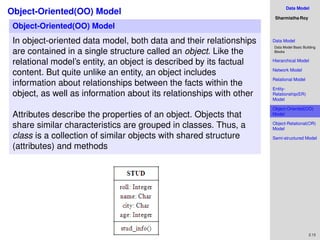
In object-oriented data model, both data and their relationships
are contained in a single structure called an object. Like the
relational model’s entity, an object is described by its factual
content. But quite unlike an entity, an object includes
information about relationships between the facts within the
object, as well as information about its relationships with other
Attributes describe the properties of an object. Objects that
share similar characteristics are grouped in classes. Thus, a
class is a collection of similar objects with shared structure
(attributes) and methods
Sharmistha Roy
14.
Data Model
Data Model
DataModel Basic Building
Blocks
Hierarchical Model
Network Model
Relational Model
Entity-
Relationship(ER)
Model
Object-Oriented(OO)
Model
Object-Relational(OR)
Model
Semi-structured Model
2.14
Object-Oriented(OO) Model...
• Advantages:
• Semantic content is added
• Support for complex objects
• Visual representation includes semantic content
• Inheritance promotes data integrity
• Disadvantages:
• It is a complex navigational system
• High system overheads slow transactions
• Slow development of standards caused vendors to supply
their own enhancements, thus eliminating a widely accepted
standard
Sharmistha Roy
15.
Data Model
Data Model
DataModel Basic Building
Blocks
Hierarchical Model
Network Model
Relational Model
Entity-
Relationship(ER)
Model
Object-Oriented(OO)
Model
Object-Relational(OR)
Model
Semi-structured Model
2.15
Object-Relational(OR) Model
Object-Relational(OR) Model
The object-oriented data model is somewhat spherical in
nature, allowing access to unique elements anywhere within a
database structure, with extremely high performance. But, it
performs extremely poorly when retrieving more than a single
data item
The relational data model is best suited for retrieval of groups
of data, but can also be used to access unique data items fairly
efficiently
Thus, by combining the features of relational data model and
object-oriented data model, object-relational data model was
created
Sharmistha Roy








![Database System Concepts AND architecture [Autosaved].pptx](https://cdn.slidesharecdn.com/ss_thumbnails/databasesystemconceptsandarchitectureautosaved-230817173311-be7f8590-thumbnail.jpg?width=640&height=640&fit=bounds)


