On The Relation of Test Smells to
Software Code Quality
Seneca
Davide Spadini, Fabio Palomba,
Andy Zaidman, Magiel Bruntink, Alberto Bacchelli
@DavideSpadini ishepard
On The Relation of Test Smells to
Software Code Quality
Seneca
Davide Spadini, Fabio Palomba,
Andy Zaidman, Magiel Bruntink, Alberto Bacchelli
Refactoring Test Code
Arie van Deursen Leon Moonen Alex van den Bergh Gerard Kok
CWI Software Improvement Group
The Netherlands The Netherlands
http://www.cwi.nl/~{arie,leon}/ http://www.software-improvers.com/
{arie,leon}@cwi.nl {alex,gerard}@software-improvers.com
ABSTRACT
Two key aspects of extreme programming (XP) are unit
testing and merciless refactoring. Given the fact that the
ideal test code / production code ratio approaches 1:1, it is
not surprising that unit tests are being refactored. We found
that refactoring test code is different from refactoring pro-
duction code in two ways: (1) there is a distinct set of bad
smells involved, and (2) improving test code involves ad-
ditional test-specific refactorings. To share our experiences
with other XP practitioners, we describe a set of bad smells
that indicate trouble in test code, and a collection of test
refactorings to remove these smells.
Keywords
Refactoring, unit testing, extreme programming.
1 INTRODUCTION
“If there is a technique at the heart of extreme program-
ming (XP), it is unit testing” [1]. As part of their program-
ming activity, XP developers write and maintain (white
box) unit tests continually. These tests are automated,
written in the same programming language as the produc-
tion code, considered an explicit part of the code, and put
under revision control.
The XP process encourages writing a test class for every
class in the system. Methods in these test classes are used
to verify complicated functionality and unusual circum-
stances. Moreover, they are used to document code by ex-
plicitly indicating what the expected results of a method
should be for typical cases. Last but not least, tests are
added upon receiving a bug report to check for the bug and
to check the bug fix [2]. A typical test for a particular
method includes: (1) code to set up the fixture (the data
used for testing), (2) the call of the method, (3) a compari-
son of the actual results with the expected values, and (4)
code to tear down the fixture. Writing tests is usually sup-
ported by frameworks such as JUnit [3].
The test code / production code ratio may vary from project
to project, but is ideally considered to approach a ratio of
1:1. In our project we currently have a 2:3 ratio, although
others have reported a lower ratio1
. One of the corner
stones of XP is that having many tests available helps the
developers to overcome their fear for change: the tests will
provide immediate feedback if the system gets broken at a
critical place. The downside of having many tests, how-
ever, is that changes in functionality will typically involve
changes in the test code as well. The more test code we get,
the more important it becomes that this test code is as eas-
ily modifiable as the production code.
The key XP practice to keep code flexible is “refactor mer-
cilessly”: transforming the code in order to bring it in the
simplest possible state. To support this, a catalog of “code
smells” and a wide range of refactorings is available, vary-
ing from simple modifications up to ways to introduce de-
sign patterns systematically in existing code [5].
When trying to apply refactorings to the test code of our
project we discovered that refactoring test code is different
from refactoring production code. Test code has a distinct
set of smells, dealing with the ways in which test cases are
organized, how they are implemented, and how they inter-
act with each other. Moreover, improving test code in-
volves a mixture of refactorings from [5] specialized to test
code improvements, as well as a set of additional refactor-
ings, involving the modification of test classes, ways of
grouping test cases, and so on.
The goal of this paper is to share our experience in im-
proving our test code with other XP practitioners. To that
end, we describe a set of test smells indicating trouble in
test code, and a collection of test refactorings explaining
how to overcome some of these problems through a simple
program modification.
This paper assumes some familiarity with the xUnit frame-
work [3] and refactorings as described by Fowler [5]. We
will refer to refactorings described in this book using Name
1
This project started a year ago and involves the development of a prod-
uct called DocGen [4]. Development is done by a small team of five peo-
ple using XP techniques. Code is written in Java and we use the JUnit
Test smells
Does Refactoring of Test Smells
Induce Fixing Flaky Tests?
Fabio Palomba and Andy Zaidman
Delft University of Technology, The Netherlands
f.palomba@tudelft.nl, a.e.zaidman@tudelft.nl
Abstract—Regression testing is a core activity that allows devel-
opers to ensure that source code changes do not introduce bugs.
An important prerequisite then is that test cases are deterministic.
However, this is not always the case as some tests suffer from so-
called flakiness. Flaky tests have serious consequences, as they can
hide real bugs and increase software inspection costs. Existing
research has focused on understanding the root causes of test
flakiness and devising techniques to automatically fix flaky tests;
a key area of investigation being concurrency. In this paper,
we investigate the relationship between flaky tests and three
previously defined test smells, namely Resource Optimism, Indirect
Testing and Test Run War. We have set up a study involving 19,532
JUnit test methods belonging to 18 software systems. A key result
of our investigation is that 54% of tests that are flaky contain a
test code smell that can cause the flakiness. Moreover, we found
that refactoring the test smells not only removed the design flaws,
but also fixed all 54% of flaky tests causally co-occurring with
test smells.
Index Terms—Test Smells; Flaky Tests; Refactoring;
I. INTRODUCTION
Test cases form the first line of defense against the introduc-
tion of software faults, especially when testing for regression
faults [1], [2]. As such, with the help of testing frameworks
but just flaky [19]. Perhaps most importantly, from a psy-
chological point of view flaky tests can reduce a developer’s
confidence in the tests, possibly leading to ignoring actual test
failures [17]. Because of this, the research community has
spent considerably effort on trying to understand the causes
behind test flakiness [18], [20], [21], [22] and on devising
automated techniques able to fix flaky tests [23], [24], [25].
However, most of this research mainly focused the attention
on some specific causes possibly leading to the introduction of
flaky tests, such as concurrency [26], [25], [27] or test order
dependency [22] issues, thus proposing ad-hoc solutions that
cannot be used to fix flaky tests characterized by other root
causes. Indeed, according to the findings by Luo et al. [18]
who conducted an empirical study on the motivations behind
test code flakiness, the problems faced by previous research
only represent a part of whole story: a deeper analysis of
possible fixing strategies of other root causes (e.g., flakiness
due to wrong usage of external resources) is still missing.
In this paper, we aim at making a further step ahead toward
the comprehension of test flakiness, by investigating the role
of so-called test smells [28], [29], [30], i.e., poor design or
implementation choices applied by programmers during the
Empir Software Eng (2015) 20:1052–1094
DOI 10.1007/s10664-014-9313-0
Are test smells really harmful? An empirical study
Gabriele Bavota · Abdallah Qusef · Rocco Oliveto ·
Andrea De Lucia · Dave Binkley
Published online: 31 May 2014
© Springer Science+Business Media New York 2014
Abstract Bad code smells have been defined as indicators of potential problems in source
code. Techniques to identify and mitigate bad code smells have been proposed and stud-
ied. Recently bad test code smells (test smells for short) have been put forward as a kind
of bad code smell specific to tests such a unit tests. What has been missing is empirical
investigation into the prevalence and impact of bad test code smells. Two studies aimed at
providing this missing empirical data are presented. The first study finds that there is a high
diffusion of test smells in both open source and industrial software systems with 86 % of
JUnit tests exhibiting at least one test smell and six tests having six distinct test smells. The
second study provides evidence that test smells have a strong negative impact on program
comprehension and maintenance. Highlights from this second study include the finding that
comprehension is 30 % better in the absence of test smells.
On The Relation of Test Smells to
Software Code Quality
Davide Spadini,⇤‡ Fabio Palomba§ Andy Zaidman,⇤ Magiel Bruntink,‡ Alberto Bacchelli§
‡Software Improvement Group, ⇤Delft University of Technology, §University of Zurich
⇤{d.spadini, a.e.zaidman}@tudelft.nl, ‡m.bruntink@sig.eu, §{palomba, bacchelli}@ifi.uzh.ch
Abstract—Test smells are sub-optimal design choices in the
implementation of test code. As reported by recent studies, their
presence might not only negatively affect the comprehension of
test suites but can also lead to test cases being less effective
in finding bugs in production code. Although significant steps
toward understanding test smells, there is still a notable absence
of studies assessing their association with software quality.
In this paper, we investigate the relationship between the
presence of test smells and the change- and defect-proneness of
test code, as well as the defect-proneness of the tested production
code. To this aim, we collect data on 221 releases of ten software
systems and we analyze more than a million test cases to investi-
gate the association of six test smells and their co-occurrence with
software quality. Key results of our study include:(i) tests with
smells are more change- and defect-prone, (ii) ‘Indirect Testing’,
‘Eager Test’, and ‘Assertion Roulette’ are the most significant
smells for change-proneness and, (iii) production code is more
defect-prone when tested by smelly tests.
I. INTRODUCTION
Automated testing (hereafter referred to as just testing)
has become an essential process for improving the quality of
software systems [12], [47]. In fact, testing can help to point
out defects and to ensure that production code is robust under
many usage conditions [12], [16]. Writing tests, however, is as
challenging as writing production code and developers should
maintain test code with the same care they use for production
found evidence of a negative impact of test smells on both
comprehensibility and maintainability of test code [7].
Although the study by Bavota et al. [7] made a first,
necessary step toward the understanding of maintainability
aspects of test smells, our empirical knowledge on whether
and how test smells are associated with software quality
aspects is still limited. Indeed, van Deursen et al. [74] based
their definition of test smells on their anecdotal experience,
without extensive evidence on whether and how such smells
are negatively associated with the overall system quality.
To fill this gap, in this paper we quantitatively investigate
the relationship between the presence of smells in test methods
and the change- and defect-proneness of both these test
methods and the production code they intend to test. Similar
to several previous studies on software quality [24], [62], we
employ the proxy metrics change-proneness (i.e., number of
times a method changes between two releases) and defect-
proneness (i.e., number of defects the method had between two
releases). We conduct an extensive observational study [15],
collecting data from 221 releases of ten open source software
systems, analyze more than a million test cases, and inves-
tigate the association between six test smell types and the
aforementioned proxy metrics.
Based on the experience and reasoning reported by van
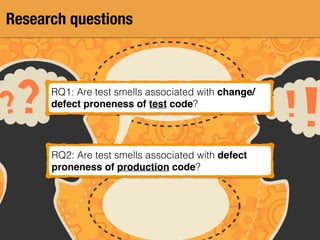
Research questions
RQ1: Are test smells associated with change/
defect proneness of test code?
RQ2: Are test smells associated with defect
proneness of production code?
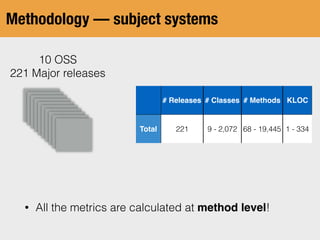
Methodology — subject systems
10 OSS
221 Major releases
# Releases # Classes # Methods KLOC
Total 221 9 - 2,072 68 - 19,445 1 - 334
• All the metrics are calculated at method level!
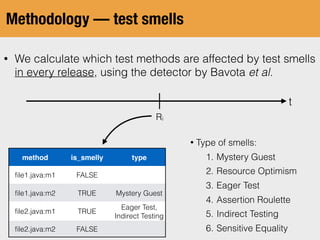
Methodology — test smells
t
Ri
• We calculate which test methods are affected by test smells
in every release, using the detector by Bavota et al.
method is_smelly type
file1.java:m1 FALSE
file1.java:m2 TRUE Mystery Guest
file2.java:m1 TRUE
Eager Test,
Indirect Testing
file2.java:m2 FALSE
• Type of smells:
1. Mystery Guest
2. Resource Optimism
3. Eager Test
4. Assertion Roulette
5. Indirect Testing
6. Sensitive Equality
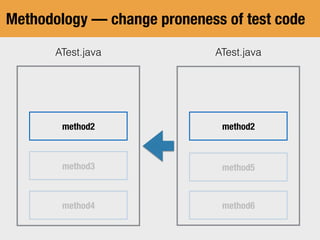
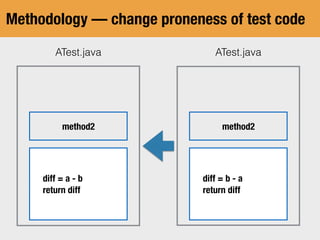
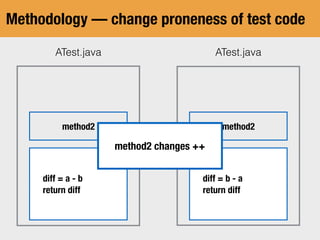
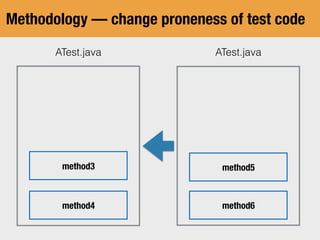
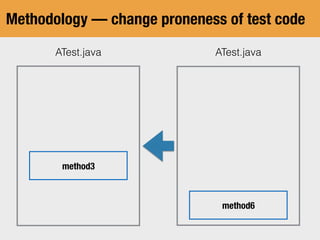
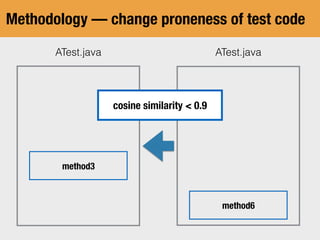
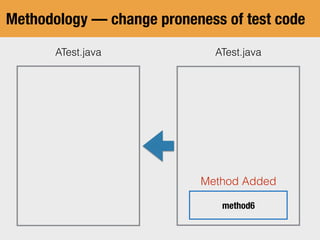
Methodology — change proneness of test code
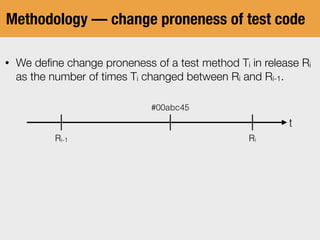
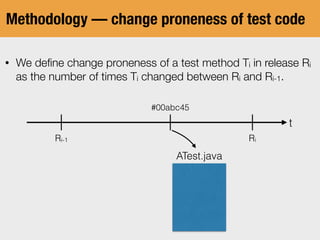
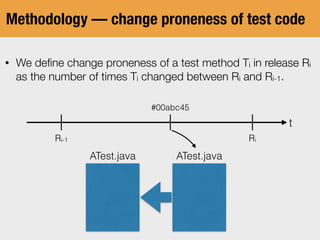
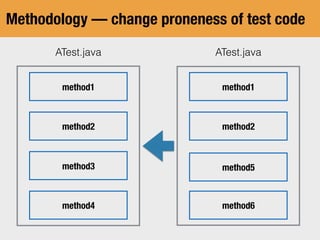
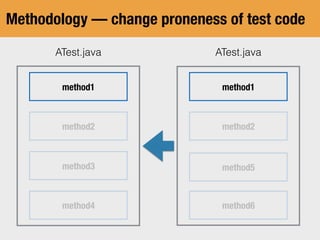
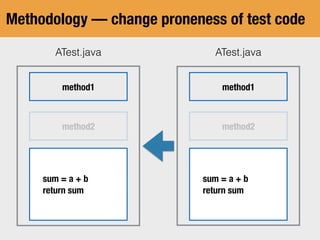
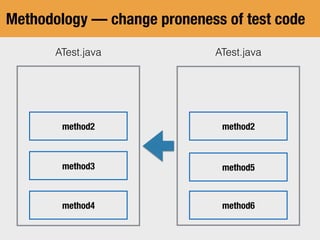
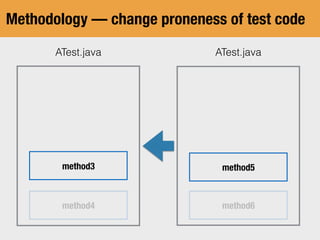
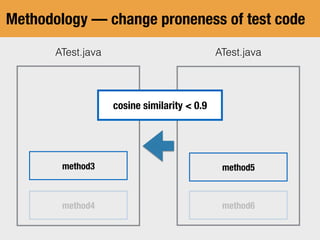
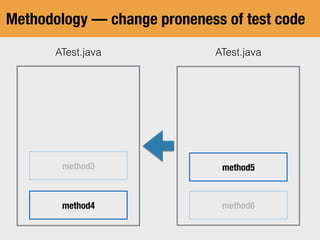
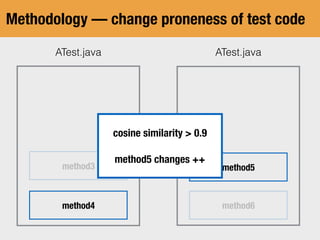
• We define change proneness of a test method Ti in release Ri
as the number of times Ti changed between Ri and Ri-1.
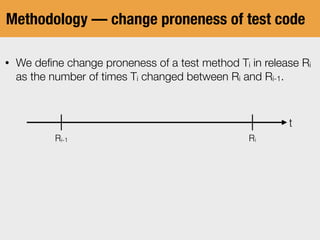
Methodology — change proneness of test code
• We define change proneness of a test method Ti in release Ri
as the number of times Ti changed between Ri and Ri-1.
t
Ri-1 Ri
Methodology — change proneness of test code
• We define change proneness of a test method Ti in release Ri
as the number of times Ti changed between Ri and Ri-1.
t
Ri-1 Ri
#00abc45
Methodology — change proneness of test code
• We define change proneness of a test method Ti in release Ri
as the number of times Ti changed between Ri and Ri-1.
t
Ri-1 Ri
ATest.java
#00abc45
Methodology — change proneness of test code
• We define change proneness of a test method Ti in release Ri
as the number of times Ti changed between Ri and Ri-1.
t
Ri-1 Ri
ATest.java
#00abc45
ATest.java
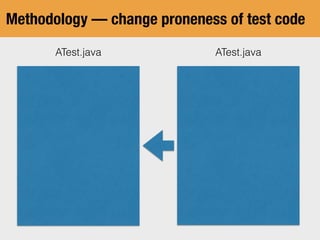
Methodology — change proneness of test code
ATest.javaATest.java
Methodology — change proneness of test code
ATest.javaATest.java
method1
method2
method5
method6
method3
method1
method2
method4
Methodology — change proneness of test code
ATest.javaATest.java
method1
method2
method5
method6
method3
method1
method2
method4
Methodology — change proneness of test code
ATest.javaATest.java
method1
method2
method5
method6
method3
method1
method2
method4
sum = a + b
return sum
sum = a + b
return sum
Methodology — change proneness of test code
ATest.javaATest.java
method2
method5
method6
method3
method2
method4
Methodology — change proneness of test code
ATest.javaATest.java
method2
method5
method6
method3
method2
method4
Methodology — change proneness of test code
ATest.javaATest.java
method2
method5
method6
method3
method2
method4
diff = a - b
return diff
diff = b - a
return diff
Methodology — change proneness of test code
ATest.javaATest.java
method2
method5
method6
method3
method2
method4
diff = a - b
return diff
diff = b - a
return diff
method2 changes ++
Methodology — change proneness of test code
ATest.javaATest.java
method5
method6
method3
method4
Methodology — change proneness of test code
ATest.javaATest.java
method5
method6
method3
method4
Methodology — change proneness of test code
ATest.javaATest.java
method5
method6
method3
method4
cosine similarity < 0.9
Methodology — change proneness of test code
ATest.javaATest.java
method5
method6
method3
method4
Methodology — change proneness of test code
ATest.javaATest.java
method5
method6
method3
method4
cosine similarity > 0.9
method5 changes ++
Methodology — change proneness of test code
ATest.javaATest.java
method6
method3
Methodology — change proneness of test code
ATest.javaATest.java
method6
method3
cosine similarity < 0.9
Methodology — change proneness of test code
ATest.javaATest.java
method6
Method Added
Methodology — defect proneness
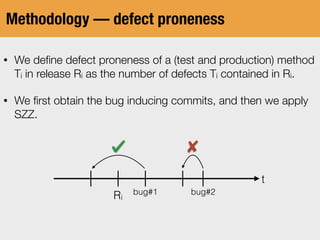
• We define defect proneness of a (test and production) method
Ti in release Ri as the number of defects Ti contained in Ri.
• We first obtain the bug inducing commits, and then we apply
SZZ.
t
Ri
bug#1 bug#2
Research questions
RQ1: Are test smells associated with change/
defect proneness of test code?
Research questions
RQ1: Are test smells associated with change/
defect proneness of test code?
RQ1.1: To what extent are test smells
associated with the change- and defect-
proneness of test code?
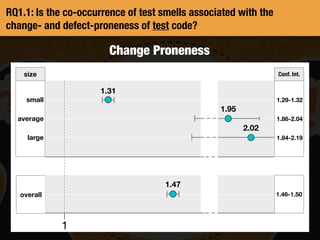
RQ1.1: Is the co-occurrence of test smells associated with the
change- and defect-proneness of test code?
Change Proneness
1
1.47
1.31
size
overall
1.95
2.02
Conf. Int.
1.46-1.50
1.29-1.32
1.86-2.04
1.84-2.19
small
average
large
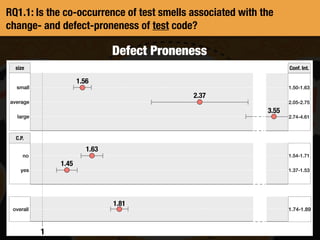
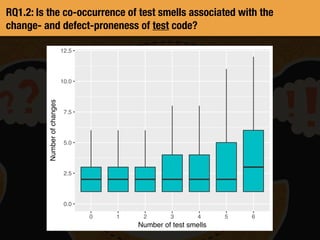
RQ1.1: Is the co-occurrence of test smells associated with the
change- and defect-proneness of test code?
Defect Proneness
1
1.45
1.63
3.55
2.37
1.56
1.81
Conf. Int.
1.50-1.63
2.05-2.75
2.74-4.61
size
small
average
large
C.P.
no
yes
overall
1.54-1.71
1.37-1.53
1.74-1.89
Research questions
RQ1: Are test smells associated with change/
defect proneness of test code?
RQ1.1: To what extent are test smells
associated with the change- and defect-
proneness of test code?
RQ1.2: Is the co-occurrence of test smells
associated with the change- and defect-
proneness of test code?
RQ1.2: Is the co-occurrence of test smells associated with the
change- and defect-proneness of test code?
0.0
2.5
5.0
7.5
10.0
12.5
0 1 2 3 4 5 6
Number of test smells
Numberofchanges
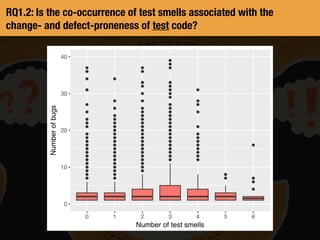
RQ1.2: Is the co-occurrence of test smells associated with the
change- and defect-proneness of test code?
0
10
20
30
40
0 1 2 3 4 5 6
Number of test smells
Numberofbugs
Research questions
RQ1: Are test smells associated with change/
defect proneness of test code?
RQ1.1: To what extent are test smells
associated with the change- and defect-
proneness of test code?
RQ1.2: Is the co-occurrence of test smells
associated with the change- and defect-
proneness of test code?
RQ1.3: Are certain test smell types more
associated with the change- and defect-
proneness of test code?
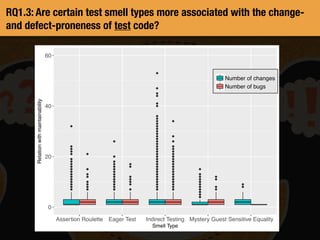
RQ1.3: Are certain test smell types more associated with the change-
and defect-proneness of test code?
0
20
40
60
Assertion Roulette Eager Test Indirect Testing Mystery Guest Sensitive Equality
Smell Type
Relationwithmaintainability
Number of changes
Number of bugs
Research questions
RQ2: Are test smells associated with defect
proneness of production code?
Research questions
RQ2: Are test smells associated with defect
proneness of production code?
RQ2.1: To what extent are test smells
associated with the defect-proneness of
production code?
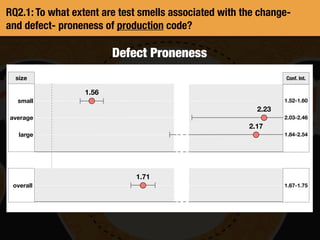
RQ2.1: To what extent are test smells associated with the change-
and defect- proneness of production code?
Defect Proneness
1
Conf. Int.
1.52-1.60
2.03-2.46
1.84-2.54
1.67-1.75
2.17
2.23
1.56
size
overall
small
average
large
1.71
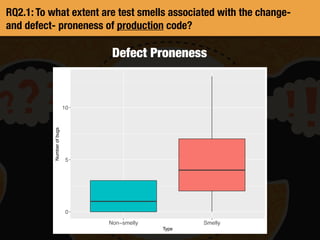
RQ2.1: To what extent are test smells associated with the change-
and defect- proneness of production code?
Defect Proneness
0
5
10
Non−smelly Smelly
Type
Numberofbugs
Research questions
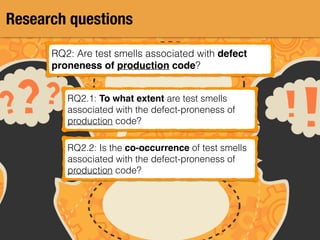
RQ2: Are test smells associated with defect
proneness of production code?
RQ2.1: To what extent are test smells
associated with the defect-proneness of
production code?
RQ2.2: Is the co-occurrence of test smells
associated with the defect-proneness of
production code?
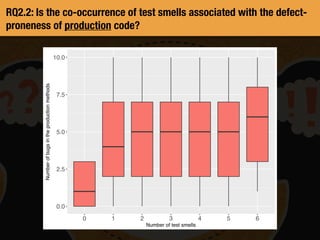
RQ2.2: Is the co-occurrence of test smells associated with the defect-
proneness of production code?
0.0
2.5
5.0
7.5
10.0
0 1 2 3 4 5 6
Number of test smells
Numberofbugsintheproductionmethods
Research questions
RQ2: Are test smells associated with defect
proneness of production code?
RQ2.1: To what extent are test smells
associated with the defect-proneness of
production code?
RQ2.2: Is the co-occurrence of test smells
associated with the defect-proneness of
production code?
RQ2.3: Are certain test smell types more
associated with the defect-proneness of
production code?
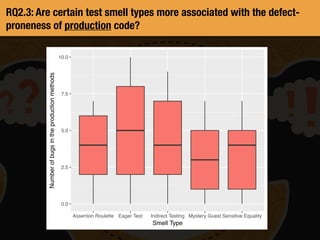
RQ2.3: Are certain test smell types more associated with the defect-
proneness of production code?
0.0
2.5
5.0
7.5
10.0
Assertion Roulette Eager Test Indirect Testing Mystery Guest Sensitive Equality
Smell Type
Numberofbugsintheproductionmethods
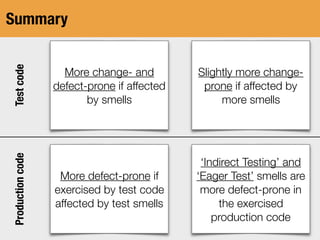
SummaryTestcodeProductioncode
More change- and
defect-prone if affected
by smells
Slightly more change-
prone if affected by
more smells
More defect-prone if
exercised by test code
affected by test smells
‘Indirect Testing’ and
‘Eager Test’ smells are
more defect-prone in
the exercised
production code
On The Relation of Test Smells to Software Code Quality

On The Relation of Test Smells to Software Code Quality

  • 1.
    On The Relationof Test Smells to Software Code Quality Seneca Davide Spadini, Fabio Palomba, Andy Zaidman, Magiel Bruntink, Alberto Bacchelli
  • 2.
    @DavideSpadini ishepard On TheRelation of Test Smells to Software Code Quality Seneca Davide Spadini, Fabio Palomba, Andy Zaidman, Magiel Bruntink, Alberto Bacchelli
  • 3.
    Refactoring Test Code Arievan Deursen Leon Moonen Alex van den Bergh Gerard Kok CWI Software Improvement Group The Netherlands The Netherlands http://www.cwi.nl/~{arie,leon}/ http://www.software-improvers.com/ {arie,leon}@cwi.nl {alex,gerard}@software-improvers.com ABSTRACT Two key aspects of extreme programming (XP) are unit testing and merciless refactoring. Given the fact that the ideal test code / production code ratio approaches 1:1, it is not surprising that unit tests are being refactored. We found that refactoring test code is different from refactoring pro- duction code in two ways: (1) there is a distinct set of bad smells involved, and (2) improving test code involves ad- ditional test-specific refactorings. To share our experiences with other XP practitioners, we describe a set of bad smells that indicate trouble in test code, and a collection of test refactorings to remove these smells. Keywords Refactoring, unit testing, extreme programming. 1 INTRODUCTION “If there is a technique at the heart of extreme program- ming (XP), it is unit testing” [1]. As part of their program- ming activity, XP developers write and maintain (white box) unit tests continually. These tests are automated, written in the same programming language as the produc- tion code, considered an explicit part of the code, and put under revision control. The XP process encourages writing a test class for every class in the system. Methods in these test classes are used to verify complicated functionality and unusual circum- stances. Moreover, they are used to document code by ex- plicitly indicating what the expected results of a method should be for typical cases. Last but not least, tests are added upon receiving a bug report to check for the bug and to check the bug fix [2]. A typical test for a particular method includes: (1) code to set up the fixture (the data used for testing), (2) the call of the method, (3) a compari- son of the actual results with the expected values, and (4) code to tear down the fixture. Writing tests is usually sup- ported by frameworks such as JUnit [3]. The test code / production code ratio may vary from project to project, but is ideally considered to approach a ratio of 1:1. In our project we currently have a 2:3 ratio, although others have reported a lower ratio1 . One of the corner stones of XP is that having many tests available helps the developers to overcome their fear for change: the tests will provide immediate feedback if the system gets broken at a critical place. The downside of having many tests, how- ever, is that changes in functionality will typically involve changes in the test code as well. The more test code we get, the more important it becomes that this test code is as eas- ily modifiable as the production code. The key XP practice to keep code flexible is “refactor mer- cilessly”: transforming the code in order to bring it in the simplest possible state. To support this, a catalog of “code smells” and a wide range of refactorings is available, vary- ing from simple modifications up to ways to introduce de- sign patterns systematically in existing code [5]. When trying to apply refactorings to the test code of our project we discovered that refactoring test code is different from refactoring production code. Test code has a distinct set of smells, dealing with the ways in which test cases are organized, how they are implemented, and how they inter- act with each other. Moreover, improving test code in- volves a mixture of refactorings from [5] specialized to test code improvements, as well as a set of additional refactor- ings, involving the modification of test classes, ways of grouping test cases, and so on. The goal of this paper is to share our experience in im- proving our test code with other XP practitioners. To that end, we describe a set of test smells indicating trouble in test code, and a collection of test refactorings explaining how to overcome some of these problems through a simple program modification. This paper assumes some familiarity with the xUnit frame- work [3] and refactorings as described by Fowler [5]. We will refer to refactorings described in this book using Name 1 This project started a year ago and involves the development of a prod- uct called DocGen [4]. Development is done by a small team of five peo- ple using XP techniques. Code is written in Java and we use the JUnit Test smells Does Refactoring of Test Smells Induce Fixing Flaky Tests? Fabio Palomba and Andy Zaidman Delft University of Technology, The Netherlands f.palomba@tudelft.nl, a.e.zaidman@tudelft.nl Abstract—Regression testing is a core activity that allows devel- opers to ensure that source code changes do not introduce bugs. An important prerequisite then is that test cases are deterministic. However, this is not always the case as some tests suffer from so- called flakiness. Flaky tests have serious consequences, as they can hide real bugs and increase software inspection costs. Existing research has focused on understanding the root causes of test flakiness and devising techniques to automatically fix flaky tests; a key area of investigation being concurrency. In this paper, we investigate the relationship between flaky tests and three previously defined test smells, namely Resource Optimism, Indirect Testing and Test Run War. We have set up a study involving 19,532 JUnit test methods belonging to 18 software systems. A key result of our investigation is that 54% of tests that are flaky contain a test code smell that can cause the flakiness. Moreover, we found that refactoring the test smells not only removed the design flaws, but also fixed all 54% of flaky tests causally co-occurring with test smells. Index Terms—Test Smells; Flaky Tests; Refactoring; I. INTRODUCTION Test cases form the first line of defense against the introduc- tion of software faults, especially when testing for regression faults [1], [2]. As such, with the help of testing frameworks but just flaky [19]. Perhaps most importantly, from a psy- chological point of view flaky tests can reduce a developer’s confidence in the tests, possibly leading to ignoring actual test failures [17]. Because of this, the research community has spent considerably effort on trying to understand the causes behind test flakiness [18], [20], [21], [22] and on devising automated techniques able to fix flaky tests [23], [24], [25]. However, most of this research mainly focused the attention on some specific causes possibly leading to the introduction of flaky tests, such as concurrency [26], [25], [27] or test order dependency [22] issues, thus proposing ad-hoc solutions that cannot be used to fix flaky tests characterized by other root causes. Indeed, according to the findings by Luo et al. [18] who conducted an empirical study on the motivations behind test code flakiness, the problems faced by previous research only represent a part of whole story: a deeper analysis of possible fixing strategies of other root causes (e.g., flakiness due to wrong usage of external resources) is still missing. In this paper, we aim at making a further step ahead toward the comprehension of test flakiness, by investigating the role of so-called test smells [28], [29], [30], i.e., poor design or implementation choices applied by programmers during the Empir Software Eng (2015) 20:1052–1094 DOI 10.1007/s10664-014-9313-0 Are test smells really harmful? An empirical study Gabriele Bavota · Abdallah Qusef · Rocco Oliveto · Andrea De Lucia · Dave Binkley Published online: 31 May 2014 © Springer Science+Business Media New York 2014 Abstract Bad code smells have been defined as indicators of potential problems in source code. Techniques to identify and mitigate bad code smells have been proposed and stud- ied. Recently bad test code smells (test smells for short) have been put forward as a kind of bad code smell specific to tests such a unit tests. What has been missing is empirical investigation into the prevalence and impact of bad test code smells. Two studies aimed at providing this missing empirical data are presented. The first study finds that there is a high diffusion of test smells in both open source and industrial software systems with 86 % of JUnit tests exhibiting at least one test smell and six tests having six distinct test smells. The second study provides evidence that test smells have a strong negative impact on program comprehension and maintenance. Highlights from this second study include the finding that comprehension is 30 % better in the absence of test smells. On The Relation of Test Smells to Software Code Quality Davide Spadini,⇤‡ Fabio Palomba§ Andy Zaidman,⇤ Magiel Bruntink,‡ Alberto Bacchelli§ ‡Software Improvement Group, ⇤Delft University of Technology, §University of Zurich ⇤{d.spadini, a.e.zaidman}@tudelft.nl, ‡m.bruntink@sig.eu, §{palomba, bacchelli}@ifi.uzh.ch Abstract—Test smells are sub-optimal design choices in the implementation of test code. As reported by recent studies, their presence might not only negatively affect the comprehension of test suites but can also lead to test cases being less effective in finding bugs in production code. Although significant steps toward understanding test smells, there is still a notable absence of studies assessing their association with software quality. In this paper, we investigate the relationship between the presence of test smells and the change- and defect-proneness of test code, as well as the defect-proneness of the tested production code. To this aim, we collect data on 221 releases of ten software systems and we analyze more than a million test cases to investi- gate the association of six test smells and their co-occurrence with software quality. Key results of our study include:(i) tests with smells are more change- and defect-prone, (ii) ‘Indirect Testing’, ‘Eager Test’, and ‘Assertion Roulette’ are the most significant smells for change-proneness and, (iii) production code is more defect-prone when tested by smelly tests. I. INTRODUCTION Automated testing (hereafter referred to as just testing) has become an essential process for improving the quality of software systems [12], [47]. In fact, testing can help to point out defects and to ensure that production code is robust under many usage conditions [12], [16]. Writing tests, however, is as challenging as writing production code and developers should maintain test code with the same care they use for production found evidence of a negative impact of test smells on both comprehensibility and maintainability of test code [7]. Although the study by Bavota et al. [7] made a first, necessary step toward the understanding of maintainability aspects of test smells, our empirical knowledge on whether and how test smells are associated with software quality aspects is still limited. Indeed, van Deursen et al. [74] based their definition of test smells on their anecdotal experience, without extensive evidence on whether and how such smells are negatively associated with the overall system quality. To fill this gap, in this paper we quantitatively investigate the relationship between the presence of smells in test methods and the change- and defect-proneness of both these test methods and the production code they intend to test. Similar to several previous studies on software quality [24], [62], we employ the proxy metrics change-proneness (i.e., number of times a method changes between two releases) and defect- proneness (i.e., number of defects the method had between two releases). We conduct an extensive observational study [15], collecting data from 221 releases of ten open source software systems, analyze more than a million test cases, and inves- tigate the association between six test smell types and the aforementioned proxy metrics. Based on the experience and reasoning reported by van
  • 4.
    Research questions RQ1: Aretest smells associated with change/ defect proneness of test code? RQ2: Are test smells associated with defect proneness of production code?
  • 5.
    Methodology — subjectsystems 10 OSS 221 Major releases # Releases # Classes # Methods KLOC Total 221 9 - 2,072 68 - 19,445 1 - 334 • All the metrics are calculated at method level!
  • 6.
    Methodology — testsmells t Ri • We calculate which test methods are affected by test smells in every release, using the detector by Bavota et al. method is_smelly type file1.java:m1 FALSE file1.java:m2 TRUE Mystery Guest file2.java:m1 TRUE Eager Test, Indirect Testing file2.java:m2 FALSE • Type of smells: 1. Mystery Guest 2. Resource Optimism 3. Eager Test 4. Assertion Roulette 5. Indirect Testing 6. Sensitive Equality
  • 7.
    Methodology — changeproneness of test code • We define change proneness of a test method Ti in release Ri as the number of times Ti changed between Ri and Ri-1.
  • 8.
    Methodology — changeproneness of test code • We define change proneness of a test method Ti in release Ri as the number of times Ti changed between Ri and Ri-1. t Ri-1 Ri
  • 9.
    Methodology — changeproneness of test code • We define change proneness of a test method Ti in release Ri as the number of times Ti changed between Ri and Ri-1. t Ri-1 Ri #00abc45
  • 10.
    Methodology — changeproneness of test code • We define change proneness of a test method Ti in release Ri as the number of times Ti changed between Ri and Ri-1. t Ri-1 Ri ATest.java #00abc45
  • 11.
    Methodology — changeproneness of test code • We define change proneness of a test method Ti in release Ri as the number of times Ti changed between Ri and Ri-1. t Ri-1 Ri ATest.java #00abc45 ATest.java
  • 12.
    Methodology — changeproneness of test code ATest.javaATest.java
  • 13.
    Methodology — changeproneness of test code ATest.javaATest.java method1 method2 method5 method6 method3 method1 method2 method4
  • 14.
    Methodology — changeproneness of test code ATest.javaATest.java method1 method2 method5 method6 method3 method1 method2 method4
  • 15.
    Methodology — changeproneness of test code ATest.javaATest.java method1 method2 method5 method6 method3 method1 method2 method4 sum = a + b return sum sum = a + b return sum
  • 16.
    Methodology — changeproneness of test code ATest.javaATest.java method2 method5 method6 method3 method2 method4
  • 17.
    Methodology — changeproneness of test code ATest.javaATest.java method2 method5 method6 method3 method2 method4
  • 18.
    Methodology — changeproneness of test code ATest.javaATest.java method2 method5 method6 method3 method2 method4 diff = a - b return diff diff = b - a return diff
  • 19.
    Methodology — changeproneness of test code ATest.javaATest.java method2 method5 method6 method3 method2 method4 diff = a - b return diff diff = b - a return diff method2 changes ++
  • 20.
    Methodology — changeproneness of test code ATest.javaATest.java method5 method6 method3 method4
  • 21.
    Methodology — changeproneness of test code ATest.javaATest.java method5 method6 method3 method4
  • 22.
    Methodology — changeproneness of test code ATest.javaATest.java method5 method6 method3 method4 cosine similarity < 0.9
  • 23.
    Methodology — changeproneness of test code ATest.javaATest.java method5 method6 method3 method4
  • 24.
    Methodology — changeproneness of test code ATest.javaATest.java method5 method6 method3 method4 cosine similarity > 0.9 method5 changes ++
  • 25.
    Methodology — changeproneness of test code ATest.javaATest.java method6 method3
  • 26.
    Methodology — changeproneness of test code ATest.javaATest.java method6 method3 cosine similarity < 0.9
  • 27.
    Methodology — changeproneness of test code ATest.javaATest.java method6 Method Added
  • 28.
    Methodology — defectproneness • We define defect proneness of a (test and production) method Ti in release Ri as the number of defects Ti contained in Ri. • We first obtain the bug inducing commits, and then we apply SZZ. t Ri bug#1 bug#2
  • 29.
    Research questions RQ1: Aretest smells associated with change/ defect proneness of test code?
  • 30.
    Research questions RQ1: Aretest smells associated with change/ defect proneness of test code? RQ1.1: To what extent are test smells associated with the change- and defect- proneness of test code?
  • 31.
    RQ1.1: Is theco-occurrence of test smells associated with the change- and defect-proneness of test code? Change Proneness 1 1.47 1.31 size overall 1.95 2.02 Conf. Int. 1.46-1.50 1.29-1.32 1.86-2.04 1.84-2.19 small average large
  • 32.
    RQ1.1: Is theco-occurrence of test smells associated with the change- and defect-proneness of test code? Defect Proneness 1 1.45 1.63 3.55 2.37 1.56 1.81 Conf. Int. 1.50-1.63 2.05-2.75 2.74-4.61 size small average large C.P. no yes overall 1.54-1.71 1.37-1.53 1.74-1.89
  • 33.
    Research questions RQ1: Aretest smells associated with change/ defect proneness of test code? RQ1.1: To what extent are test smells associated with the change- and defect- proneness of test code? RQ1.2: Is the co-occurrence of test smells associated with the change- and defect- proneness of test code?
  • 34.
    RQ1.2: Is theco-occurrence of test smells associated with the change- and defect-proneness of test code? 0.0 2.5 5.0 7.5 10.0 12.5 0 1 2 3 4 5 6 Number of test smells Numberofchanges
  • 35.
    RQ1.2: Is theco-occurrence of test smells associated with the change- and defect-proneness of test code? 0 10 20 30 40 0 1 2 3 4 5 6 Number of test smells Numberofbugs
  • 36.
    Research questions RQ1: Aretest smells associated with change/ defect proneness of test code? RQ1.1: To what extent are test smells associated with the change- and defect- proneness of test code? RQ1.2: Is the co-occurrence of test smells associated with the change- and defect- proneness of test code? RQ1.3: Are certain test smell types more associated with the change- and defect- proneness of test code?
  • 37.
    RQ1.3: Are certaintest smell types more associated with the change- and defect-proneness of test code? 0 20 40 60 Assertion Roulette Eager Test Indirect Testing Mystery Guest Sensitive Equality Smell Type Relationwithmaintainability Number of changes Number of bugs
  • 38.
    Research questions RQ2: Aretest smells associated with defect proneness of production code?
  • 39.
    Research questions RQ2: Aretest smells associated with defect proneness of production code? RQ2.1: To what extent are test smells associated with the defect-proneness of production code?
  • 40.
    RQ2.1: To whatextent are test smells associated with the change- and defect- proneness of production code? Defect Proneness 1 Conf. Int. 1.52-1.60 2.03-2.46 1.84-2.54 1.67-1.75 2.17 2.23 1.56 size overall small average large 1.71
  • 41.
    RQ2.1: To whatextent are test smells associated with the change- and defect- proneness of production code? Defect Proneness 0 5 10 Non−smelly Smelly Type Numberofbugs
  • 42.
    Research questions RQ2: Aretest smells associated with defect proneness of production code? RQ2.1: To what extent are test smells associated with the defect-proneness of production code? RQ2.2: Is the co-occurrence of test smells associated with the defect-proneness of production code?
  • 43.
    RQ2.2: Is theco-occurrence of test smells associated with the defect- proneness of production code? 0.0 2.5 5.0 7.5 10.0 0 1 2 3 4 5 6 Number of test smells Numberofbugsintheproductionmethods
  • 44.
    Research questions RQ2: Aretest smells associated with defect proneness of production code? RQ2.1: To what extent are test smells associated with the defect-proneness of production code? RQ2.2: Is the co-occurrence of test smells associated with the defect-proneness of production code? RQ2.3: Are certain test smell types more associated with the defect-proneness of production code?
  • 45.
    RQ2.3: Are certaintest smell types more associated with the defect- proneness of production code? 0.0 2.5 5.0 7.5 10.0 Assertion Roulette Eager Test Indirect Testing Mystery Guest Sensitive Equality Smell Type Numberofbugsintheproductionmethods
  • 46.
    SummaryTestcodeProductioncode More change- and defect-proneif affected by smells Slightly more change- prone if affected by more smells More defect-prone if exercised by test code affected by test smells ‘Indirect Testing’ and ‘Eager Test’ smells are more defect-prone in the exercised production code