The Journal of Systems and Software 138 (2018) 158–173
Contents lists available at ScienceDirect
The Journal of Systems and Software
journal homepage: www.elsevier.com/locate/jss
A survey on software smells
Tushar Sharma∗
, Diomidis Spinellis
Department of Management Science and Technology, Athens University of Economics and Business, Greece
a r t i c l e i n f o
Article history:
Received 15 July 2017
Revised 12 December 2017
Accepted 27 December 2017
Available online 28 December 2017
Keywords:
Code smells
Software smells
Antipatterns
Software quality
Maintainability
Smell detection tools
Technical debt
a b s t r a c t
Context: Smells in software systems impair software quality and make them hard to maintain and evolve.
The software engineering community has explored various dimensions concerning smells and produced
extensive research related to smells. The plethora of information poses challenges to the community to
comprehend the state-of-the-art tools and techniques.
Objective: We aim to present the current knowledge related to software smells and identify challenges
as well as opportunities in the current practices.
Method: We explore the definitions of smells, their causes as well as effects, and their detection mech-
anisms presented in the current literature. We studied 445 primary studies in detail, synthesized the
information, and documented our observations.
Results: The study reveals five possible defining characteristics of smells — indicator, poor solution, violates
best-practices, impacts quality, and recurrence. We curate ten common factors that cause smells to occur
including lack of skill or awareness and priority to features over quality. We classify existing smell detection
methods into five groups — metrics, rules/heuristics, history, machine learning, and optimization-based de-
tection. Challenges in the smells detection include the tools’ proneness to false-positives and poor coverage
of smells detectable by existing tools.
© 2017 Published by Elsevier Inc.
1. Introduction
Kent Beck coined the term “code smell” in the context of iden-
tifying quality issues in code that can be refactored to improve the
maintainability of a software (Fowler, 1999). He emphasized that
the presence of excessive number of smells in a software system
makes the software hard to maintain and evolve.
Since then, the smell metaphor has been extended to var-
ious related subdomains of software systems including testing
(Deursen et al., 2001), database (Karwin, 2010), and configuration
(Sharma et al., 2016a). Further, since the inception of the metaphor,
the software engineering community has explored various associ-
ated dimensions that include proposing a catalog of smells, detect-
ing smells using a variety of techniques, exploring the relationships
among smells, and identifying the causes and effects of smells.
The large number of available resources poses a challenge,
equally to both researchers and practitioners, to comprehend the
status quo of tools, methods, and techniques concerning software
smells. Analyzing and synthesizing available information could not
only help the software engineering community understand the ex-
∗
Corresponding author.
E-mail addresses: tusharsharma@ieee.org, tushar@aueb.gr (T. Sharma),
dds@aueb.gr (D. Spinellis).
isting knowledge, but also reveal the challenges that exist in the
present set of methods and opportunities to address them.
There have been a few attempts to understand current practices
and provide an overview of the existing knowledge about software
smells. Singh and Kaur (2017) present a systematic literature re-
view on code smells and refactoring in object-oriented software
systems by studying 238 primary studies. The survey focuses on
the smell detection methods and tools as well as the techniques
and tools used to refactor them. The authors divide smell detection
methods based on the degree of automation employed in smell de-
tection methods.
Similarly, Zhang et al. (2011) review studies from year 2000
to 2009 and draw a few observations about current research on
smells. They reveal a large gap in existing smells’ literature — cur-
rent studies have chosen a small number of smells for their study
and some of the smells (such as message chains) are poorly ex-
plored by the community. Further, the study emphasizes that the
impact of code smells is not well understood.
Various tools have been proposed to detect smells.
Fernandes et al. (2016) provides a comprehensive study containing
a comparison of 84 smell detection tools. Similarly, Rasool and
Arshad (2015) also review existing code smell detection tools
and reveal the challenges associated with them. A few studies
(Al Dallal, 2015; Mens and Tourwé, 2004) provide an extensive
coverage to refactoring techniques available to refactor the smells.
https://doi.org/10.1016/j.jss.2017.12.034
0164-1212/© 2017 Published by Elsevier Inc.
T. Sharma, D. Spinellis / The Journal of Systems and Software 138 (2018) 158–173 159
Table 1
Studies selected in the Phase 1.
Venue Type #Studies
Automated Software Engineering Conference 24
Empirical Software Engineering Journal 61
Empirical Software Engineering and Measurement Conference 68
European Conference on Object-Oriented Programming Conference 2
Foundations of Software Engineering Conference 19
IEEE Software Journal 78
International Conference of Software Maintenance and Evolution Conference 220
International Conference on Program Comprehension Conference 38
International Conference on Software Engineering Conference 85
Journal of Systems and Software Journal 146
Mining Software Repositories Conference 28
Software Analysis, Evolution, and Reengineering / European Conference on
Software Maintenance and Reengineering
Conference 135
Source Code Analysis and Manipulation Conference 22
Systems, Programming, Languages and Applications: Software for Humanity Conference 8
Transactions on Software Engineering Journal 83
Transactions on Software Engineering and Methodology Journal 11
Total selected studies in Phase 1 1028
In this study, we explore the resources related to smells exten-
sively that were published between the years 1999 and 2016 and
present the current knowledge in a synthesized and consolidated
form. Additionally, our goal is to identify challenges in the present
knowledge and find opportunities to overcome them.
1.1. Contributions of this study
This survey makes the following contributions to the field.
• The study provides a holistic status quo of various dimensions
associated with software smells. These dimensions include defi-
nition, classification, types, detection methods, as well as causes
and impacts of smells.
• It presents the state-of-the-art in the current research, reveal
deficiencies in present tools and techniques, and identifies re-
search opportunities to advance the domain.
The rest of the paper is organized as follows: we define the
methodology followed in the study in Section 2. We discuss the
results in Section 3 and we present our conclusions in Section 4.
2. Methodology
In this section, we first present the objectives of this study and
derived research questions. We illustrate the search protocol that
we used to identify relevant studies. The search protocol includes
not only the steps to collect the initial set of studies, but also in-
clusion and exclusion criteria that we apply on the initial set of
studies to obtain a filtered set of primary studies.
2.1. Research objectives and questions
The goal of this study is to provide a consolidated yet exten-
sive overview of software smells covering their definition, types,
causes, detection methods, and impact on various aspects of soft-
ware development. In this study, we address the following research
questions:
RQ1: What is the definition of a software smell?
We aim to understand how the term “smell” is defined by
various researchers. We infer basic defining characteristics
and types of smells.
RQ2: How do smells get introduced in software systems?
We explore the reasons that cause smells in software sys-
tems.
RQ3: How do smells affect the software development processes, ar-
tifacts, or people?
We present the impact of smells on software systems.
Specifically, we study impacts of smells on processes, arti-
facts, and people.
RQ4: How do smells get detected?
We discuss the techniques employed by researchers to iden-
tify smells.
RQ5: What are the open research questions?
We present the perceived deficiencies and the open research
questions with respect to smells, their detection, and their
interpretations.
2.2. Literature search protocol
The literature search protocol aims to identify primary studies
which form the basis of the survey. Our search protocol has three
phases:
1. We identify a list of relevant conferences and journals and
manually search their proceedings.
2. We search seven well-known digital libraries.
3. We perform filtering and consolidation of the studies identified
in the previous phases and prepare a single library of relevant
studies.
2.2.1. Literature search – Phase 1
We identify a comprehensive list of conferences and journals
based on papers published in these venues related to smells. We
manually search the proceedings of the selected venues between
the years 1999 and 2016. The start year has been selected as 1999
since the smell metaphor was introduced in 1999. During the man-
ual search, the following set of terms were searched in the title
of studies: smell, antipattern, quality, maintainability, maintenance,
and metric. All the studies containing at least one of the search
terms in their title were selected and recorded. Table 1 presents
the selected conferences and journals along with their correspond-
ing number of studies selected in Phase 1.
The domain of refactoring is closely related to that of software
smells. Given the vast knowledge present in the field of refactor-
ing, it requires a separate study specifically for software refactor-
ing. Therefore, we consider work concerning refactoring outside
the scope of this study.
160 T. Sharma, D. Spinellis / The Journal of Systems and Software 138 (2018) 158–173
Table 2
Studies selected in the Phase 2.
Digital Library Number of studies
Google Scholar 196
SpringerLink 44
ACM Digital Library 108
ScienceDirect 40
Scopus 150
IEEE Xplore 151
Web of Science 58
Total selected studies in Phase 2 747
2.2.2. Literature search – Phase 2
In the second phase, we carried out search on seven well-
known digital libraries. The terms used for the search are: software
smell, antipattern, software quality, maintainability, maintenance, and
software metric. We appended the term “software” to the search
terms in order to obtain more relevant results. Additionally, we
apply filters such as “computer science” and “software engineer-
ing” wherever it was possible and relevant to refine the search re-
sults. Table 2 shows the searched digital libraries and correspond-
ing number of selected studies.
2.2.3. Literature search – Phase 3
In the third phase, we defined inclusion and exclusion criteria
to filter out irrelevant studies and to prepare a consolidated library.
The inclusion/exclusion criteria are listed below.
Inclusion criteria
• Studies that discuss smells in software development, present a
catalog of one of the different types of software smells (such
as code smells, test smells, and configuration smells), produce
factors that cause smells, or explore their impact on any facet
of software development (for instance, artifacts, people, or pro-
cess).
• Studies introducing smell detection mechanisms or providing a
comparison using any suitable technique.
• Resources revealing the deficiencies in the present set of meth-
ods, tools, and practices.
Exclusion criteria
• Studies focusing on external (in-use) software quality or not di-
rectly related with software smells.
• Studies that propose the refactoring of smells, or identifies
refactoring opportunities.
• Articles containing keynote, extended abstract, editorial, tuto-
rial, poster, or panel discussion (due to insufficient details and
small size).
• Studies whose full text is not available.
Each selected article from phase 1 or 2 went through a man-
ual inspection of title, keywords, and abstract. The inspection ap-
plied the inclusion and exclusion criteria leading to inclusion or
exclusion of the articles. We obtained 445 articles after complet-
ing the inspection and removing the duplicates. These articles are
the primary studies that we studied in detail. We took notes while
studying the selected articles. We then mark all the relevant ar-
ticles for each research question and included them in the corre-
sponding discussion.
We did not limit ourselves to only to the primary studies.
We included secondary sources of information and articles as and
when we spotted them while studying primary studies. Therefore,
although our primary studies belong to the period 1999 – 2016,
due to the inclusion of the secondary studies, we refer studies in
this paper that were published before or after the selected period.
An interested reader may find the list of all the selected papers in
each phase online (Sharma and Spinellis, 2017b).
After we completed the detailed study, we categorized the
resources based on the dimensions of smells they belong to.
Fig. 1 provides an overview of the studied dimensions of software
smells; a number in brackets shows the number of associated ref-
erences. A document containing extended version of the figure has
been made available online (Sharma, 2017); the document addi-
tionally shows all the references in the figure.
Fig. 1. Overview of the study; a number in brackets shows the number of associated references.
T. Sharma, D. Spinellis / The Journal of Systems and Software 138 (2018) 158–173 161
Table 3
Types of smells.
Focus References
Implementation Fowler (1999), Arnaoudova et al. (2013), Brown et al. (1998), Fard and Mesbah (2013), Abebe et al. (2011), Guerrouj et al. (2016)
Design Suryanarayana et al. (2014), Binkley et al. (2008)
Architecture Garcia et al. (2009), Brown et al. (1998), Lauder and Kent (2000)
Tests Greiler et al. (2013), Hauptmann et al. (2013),Deursen et al. (2001)
Performance Smith (2000), Sharma and Anwer (2014), Wang et al. (2014)
Configuration systems Sharma et al. (2016a)
Database Karwin (2010)
Aspect-oriented systems Alves et al. (2014), Bertran et al. (2011)
Energy Vetr et al. (2013)
Models El-Attar and Miller (2009), Das and Dingel (2016)
Services Palma et al. (2014), Král and Žemliˇcka (2007), Palma and Mohay (2015)
Usability Almeida et al. (2015)
Reuse Long (2001)
Web Nguyen et al. (2012)
3. Results and discussion
In this section, we present our synthesized observations corre-
sponding to each research question addressed in this study.
3.1. RQ1: What is the definition of a software smell?
We break down the question into the following sub-questions
where each sub-question deals with precisely one specific aspect
of software smells’ definition.
RQ1.1: What are the defining characteristics of a software smell?
RQ1.2: What are the types of smells?
RQ1.3: How are the smells classified?
RQ1.4: Are smells and antipatterns considered synonyms?
3.1.1. RQ1.1: What are the defining characteristics of a software
smell?
Kent Beck coined the term “code smell” (Fowler, 1999) and de-
fined it informally as “certain structures in the code that suggest
(sometimes they scream for) the possibility of refactoring”. Later, vari-
ous researchers gave diverse definitions of software smells. A com-
plete list of definitions of smells provided by various authors can
be found online (Sharma and Spinellis, 2017a). Based on these, we
synthesize the following five possible defining characteristics of a
software smell.
• Indicator: Authors define smells as an indicator to or a symp-
tom of a deeper design problem (Moha et al., 2010; Yamashita,
2014; Suryanarayana et al., 2014; da Silva Sousa, 2016).
• Poor solution: The literature describes smells as a suboptimal
or poor solution (Khomh et al., 2011; Khan and El-Attar, 2016;
Fourati et al., 2011; Arnaoudova et al., 2013; Van Emden and
Moonen, 2002; Cortellessa et al., 2014).
• Violates best practices: According to authors such as
Suryanarayana et al. (2014) and Sharma et al. (2016a), smells
violate recommended best practices of the domain.
• Impacts quality: Smells make it difficult for a software sys-
tem to evolve and maintain (Yamashita, 2014; Khomh et al.,
2011). It is commonly agreed that smells impact the quality of
the system (Jaafar et al., 2013; Moha and Guéhéneuc, 2007; Ar-
naoudova et al., 2013; Garcia et al., 2009; Sharma et al., 2016a;
Suryanarayana et al., 2014).
• Recurrence: Many authors define smells as recurring problems
(Maiga et al., 2012; Peters and Zaidman, 2012; Khomh et al.,
2011).
3.1.2. RQ1.2: What are the types of smells?
Authors have explored smells in different domains and in differ-
ent focus areas. Within software system domain, authors have fo-
cused on specific aspects such as configuration systems, tests, and
models. These explorations have resulted in various smell catalogs.
Table 3 presents a summary of catalogs and corresponding refer-
ences.
We have compiled an extensive catalog belonging to each focus
area. Here, considering the space constraints, we provide a brief
catalog of code smells in Table 4. We have selected the smells
to include in this table based on the popularity of the smells i.e.,
based on the number of times the smell has been studied in the
literature. The comprehensive and evolving taxonomy of software
smells can be accessed online.1
3.1.3. RQ1.3: How are the smells classified?
An appropriate classification is required to better comprehend
a long list of smells based on their characteristics. We collected,
categorized, inferred, and synthesized the following set of meta-
classification of software smells.
• Effect-based smell classification: Mäntylä et al. (2003) clas-
sified smells based on their effects on software development
activities. The categories provided by the classification include
bloaters, couplers, and change preventers.
• Principle-based smell classification: Ganesh et al. (2013) and
Suryanarayana et al. (2014) classified design smells based on
the primary object-oriented design principle that the smells vi-
olate. The principle-based classification divided the smells in
four categories namely: abstraction, modularization, encapsula-
tion, and hierarchy smells.
• Artifact characteristics-based smell classification:
Wake (2003) proposed a smell classification based on char-
acteristics of the types. Categories such as data, interfaces,
responsibility, and unnecessary complexity include in his clas-
sification. Similarly, Karwin (2010) classified sql antipatterns
in the following categories — logical database design, physical
database design, query, and application development antipatterns.
• Granularity-based smell classification: Moha et al. (2010) clas-
sified smells using two-level classification. At first, a smell is
classified in either inter-class and intra-class category. The sec-
ond level of classification assigns non-orthogonal categories
i.e., structural, lexical, and measurable to the smells. Similarly,
Brown et al. (1998) discussed antipatterns classified in three
major categories — software development, software architecture,
and software project management antipatterns.
Bailey (1994) discusses a few desirable properties of a classifica-
tion. By applying them in the context of our study, we propose that
an ideal classification of smells must exhibit the following proper-
ties.
1
http://www.tusharma.in/smells.
162 T. Sharma, D. Spinellis / The Journal of Systems and Software 138 (2018) 158–173
Table 4
Common code smells.
Code Smell / References Description
God class Riel (1996) The god class smell occurs when a huge class which is surrounded by many data classes acts as a controller
(i.e., takes most of the decisions and monopolises the functionality offered by the software). The class
defines many data members and methods and exhibits low cohesion.
Related smells: Insufficient modularization (Suryanarayana et al., 2014), Blob (Brown et al., 1998), Brain class
(Vidal et al., 2014).
Feature envy Fowler (1999) This smell occurs when a method seems more interested in a class other than the one it actually is in.
Shotgun surgery Fowler (1999) This smell characterizes the situation when one kind of change leads to a lot of changes to multiple different
classes. When the changes are all over the place, they are hard to find, and it’s easy to miss an important
change.
Data class Fowler (1999) This smell occurs when a class contains only fields and possibly getters/setters without any behavior
(methods).
Related smells: Broken modularization (Suryanarayana et al., 2014).
Long method Fowler (1999) This smell occurs when a method is too long to understand.
Related smells: God method (Riel, 1996), Brain method (Vidal et al., 2014).
Functional decomposition Brown et al. (1998) This smell occurs when the experienced developers coming from procedural languages background write
highly procedural and non-object-oriented code in an object-oriented language.
Refused bequest Fowler (1999) This smell occurs when a subclass rejects some of the methods or properties offered by its superclass.
Related smells: Rebellious hierarchy (Suryanarayana et al., 2014)
Spaghetti code Brown et al. (1998) This smell refers to an unmaintainable, incomprehensible code without any structure. The smell does not
exploit and prevents the use of object-orientation mechanisms and concepts.
Divergent change Fowler (1999) Divergent change occurs when one class is commonly changed in different ways for different reasons.
Related smells: Multifaceted abstraction (Suryanarayana et al., 2014).
Long parameter list Fowler (1999) This smell occurs when a method accepts a long list of parameters. Such lists are hard to understand and
difficult to use.
Duplicate code Fowler (1999) This smell occurs when same code structure is duplicated to multiple places within a software system.
Related smells: Duplicate abstraction (Suryanarayana et al., 2014), Unfactored hierarchy (Suryanarayana et al.,
2014), Cut and paste programming (Brown et al., 1998).
Cyclically-dependent modularization
Suryanarayana et al. (2014)
This smell arises when two or more abstractions depend on each other directly or indirectly.
Related smells: Dependency cycles Marquardt (2001)
Deficient encapsulation
Suryanarayana et al. (2014)
This smell occurs when the declared accessibility of one or more members of an abstraction is more
permissive than actually required.
Related smells: Excessive global variables (Fard and Mesbah, 2013).
Lava flow Brown et al. (1998) This smell is characterized by a piece of code that nobody remembers the purpose and usage, and is largely
not utilized.
Related smells: Unutilized abstraction (Suryanarayana et al., 2014).
Speculative generality Fowler (1999) This smell occurs where an abstraction is created based on speculated requirements. It is often unnecessary
that makes things difficult to understand and maintain.
Related smells: Speculative hierarchy (Suryanarayana et al., 2014)
Lazy class Fowler (1999) Related smells: Unnecessary abstraction (Suryanarayana et al., 2014).
Related smells: Unnecessary abstraction (Suryanarayana et al., 2014).
Switch statement Fowler (1999) This smell occurs when switch statements that switch on type codes are spread across the software system
instead of exploiting polymorphism.
Related smells: Unexploited encapsulation (Suryanarayana et al., 2014), Missing hierarchy
(Suryanarayana et al., 2014).
Primitive obsession Fowler (1999) This smell occurs when primitive data types are used where an abstraction encapsulating the primitives could
serve better.
Related smells: Missing abstraction (Suryanarayana et al., 2014).
Swiss army knife Brown et al. (1998) This smell arises when the designer attempts to provide all possible uses of the class and ends up in an
excessively complex class interface.
Related smells: Multifaceted abstraction (Suryanarayana et al., 2014).
• Exhaustive: classify all the considered smells,
• Simple: classify smells within the scope and granularity effort-
lessly,
• Consistent: produce a consistent classification even if it carried
out by different people, and
• Coherent: produce clearly distinguishable categories without
overlaps.
3.1.4. Are smells and antipatterns considered synonyms?
Software engineering researchers and practitioners often use
the terms “antipattern” and “smell” interchangeably. Specifically,
authors such as Palma et al. (2013), Palomba et al. (2015b), and
Linares-Vásquez et al. (2014) use both the terms as synonyms. For
instance, Linares-Vásquez et al. (2014) asserts this notion explicitly
— “...we use the word smells to refer to both code smells and antipat-
terns, ...”
Some authors treat antipatterns and smells as qual-
ity defects at different granularity. For example, Moha and
Guéhéneuc (2007) and Moha et al. (2010) defined design defects
as antipatterns at design granularity and as smells at implementa-
tion granularity.
Andrew Koenig (1995) coined the term “antipatterns” in 1995
and defined it as follows: “An antipattern is just like pattern, ex-
cept that instead of solution it gives something that looks superficially
like a solution, but isn’t one”. Hallal et al. (2004) also describes an-
tipatterns in this vein — “something that looks like a good idea, but
which backfires badly when applied”. Based on Andrew’s definition,
our following interpretation makes antipatterns fundamentally dif-
ferent from smells — antipatterns get chosen but smells occur, mostly
inadvertently. An antipattern is chosen in the assumption that the
usage will bring more benefits than liabilities whereas smells get
introduced due to the lack of knowledge and awareness most of
the times.
Brown et al. (1998) specify one key characteristic of antipat-
terns as “...that generates decidedly negative consequences.” This
characteristic makes antipatterns significantly different from smells
T. Sharma, D. Spinellis / The Journal of Systems and Software 138 (2018) 158–173 163
— a smell is considered as an indicator (refer Section 3.1.1) of
a problem (rather than the problem itself) whereas antipatterns
bring decidedly negative consequences.
An antipattern may lead to smells. For instance, a variant of
Singleton introduces sub-type knowledge in a base class leading
to cyclic hierarchy (Suryanarayana et al., 2014) smell in the code
(Fontana et al., 2016). Further, the presence of smells may indi-
cate that a certain practice is an antipattern rather than a rec-
ommended practice in a given context. For example, the Singleton
pattern makes an abstraction difficult to test and hence introduces
test smells; the presence of test smells helps us identify that the
employed pattern is deteriorating the quality more than helping us
solving a design problem.
3.1.5. Implications
We can draw the following implications from the above-
discussed research question.
• We found that smells may occur in various stages of software
development and impair many dimensions of software quality
of different artifact types. This implies that software developers
should adopt practices to avoid smells at different granularities,
artifacts, and quality dimensions at all stages of software devel-
opment.
• We identified the core characteristics of software smells. This
can help the research community to identify smells even when
they are not tagged as smells. For example, it is a recom-
mended practice to avoid accessing external dependencies, such
as a database, in a unit test (Beck, 2002). A non-adherence
to the recommended practice exhibits the smell characteristics
violates best practices and impacts quality (maintainability and
performance). Therefore, such a violation of the recommended
practice could be identified as a test smell despite not being
referred to as a smell.
• We elaborated the distinction between antipatterns and smells.
This distinction can be further explored in future research on
these topics.
3.2. RQ2: How do smells get introduced in software systems?
Authors have explored factors that introduce smells in software
systems. We classify such causal factors into the following consol-
idated list.
• C1: Lack of skill or awareness: A major reason that cause
smells in software systems is poor technical skills of develop-
ers and lack of awareness towards writing high quality code.
Many authors (Suryanarayana et al., 2014; Martini et al., 2014;
Curcio et al., 2016; Tom et al., 2013) have pointed out this cause
in their studies.
• C2: Frequently changing requirements: Certain design deci-
sions are made to fulfil the requirements at hand; however,
frequent changes in requirements impair the effective decision
making and introduce smells (Martini et al., 2014; Lavallée and
Robillard, 2015).
• C3: Language, platform, or technology constraints: The cur-
rent literature (Stella et al., 2008; Martini et al., 2014; Klein-
schmager et al., 2012; Lavallée and Robillard, 2015; Curcio et al.,
2016) shows that the chosen technology influences design de-
cisions and could be another reason that leads to smells.
• C4: Knowledge gap: Missing or complex documentation intro-
duces a knowledge gap which in turn could lead to smells in a
software (Lavallée and Robillard, 2015; Martini et al., 2014).
• C5: Processes: The adopted processes may help avoid smells
to occur or remain in a software system. Therefore, an ineffec-
tive or a missing set of processes could also become a cause for
software smells (Tom et al., 2013; Suryanarayana et al., 2015).
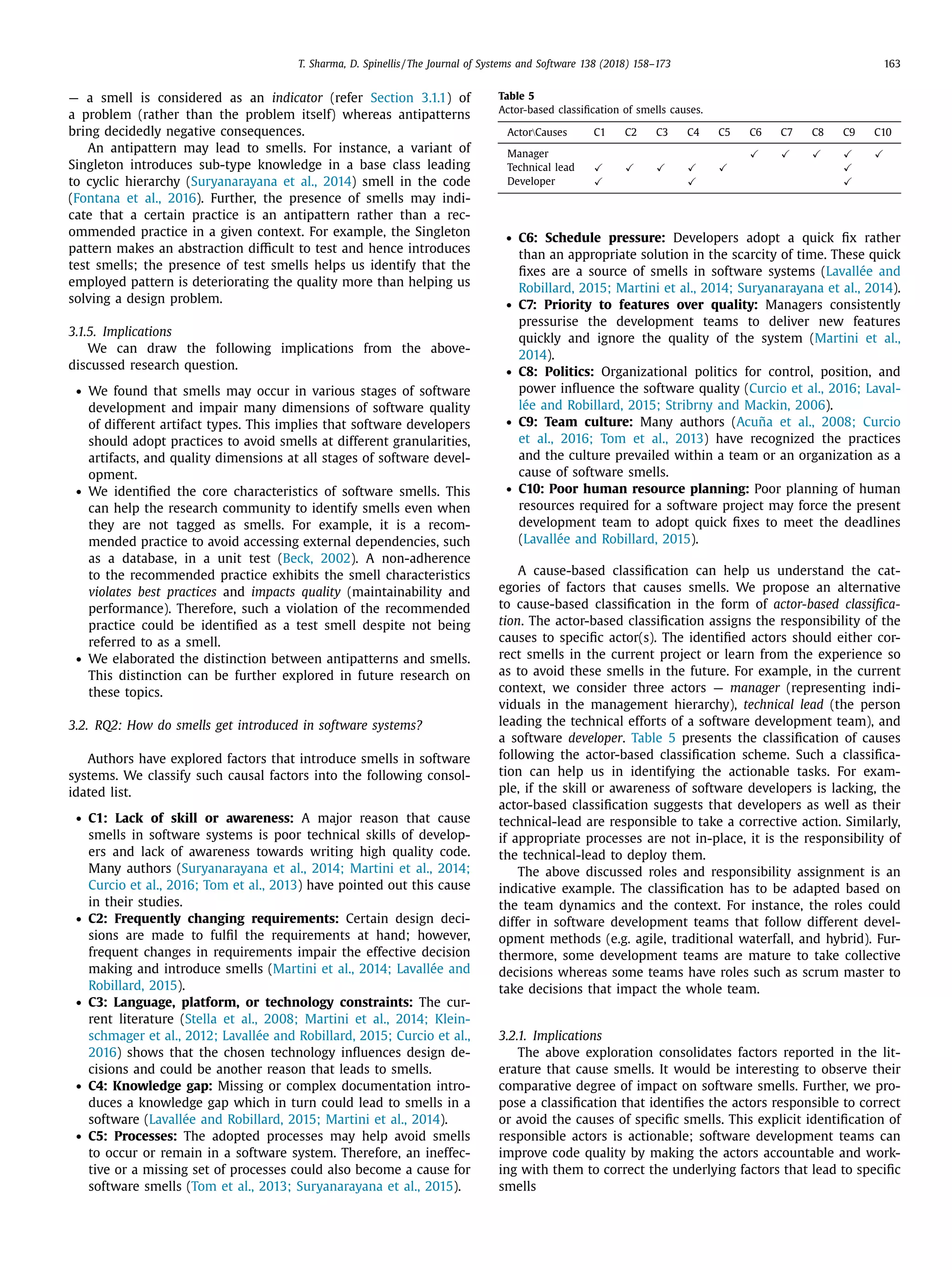
Table 5
Actor-based classification of smells causes.
ActorCauses C1 C2 C3 C4 C5 C6 C7 C8 C9 C10
Manager
Technical lead
Developer
• C6: Schedule pressure: Developers adopt a quick fix rather
than an appropriate solution in the scarcity of time. These quick
fixes are a source of smells in software systems (Lavallée and
Robillard, 2015; Martini et al., 2014; Suryanarayana et al., 2014).
• C7: Priority to features over quality: Managers consistently
pressurise the development teams to deliver new features
quickly and ignore the quality of the system (Martini et al.,
2014).
• C8: Politics: Organizational politics for control, position, and
power influence the software quality (Curcio et al., 2016; Laval-
lée and Robillard, 2015; Stribrny and Mackin, 2006).
• C9: Team culture: Many authors (Acuña et al., 2008; Curcio
et al., 2016; Tom et al., 2013) have recognized the practices
and the culture prevailed within a team or an organization as a
cause of software smells.
• C10: Poor human resource planning: Poor planning of human
resources required for a software project may force the present
development team to adopt quick fixes to meet the deadlines
(Lavallée and Robillard, 2015).
A cause-based classification can help us understand the cat-
egories of factors that causes smells. We propose an alternative
to cause-based classification in the form of actor-based classifica-
tion. The actor-based classification assigns the responsibility of the
causes to specific actor(s). The identified actors should either cor-
rect smells in the current project or learn from the experience so
as to avoid these smells in the future. For example, in the current
context, we consider three actors — manager (representing indi-
viduals in the management hierarchy), technical lead (the person
leading the technical efforts of a software development team), and
a software developer. Table 5 presents the classification of causes
following the actor-based classification scheme. Such a classifica-
tion can help us in identifying the actionable tasks. For exam-
ple, if the skill or awareness of software developers is lacking, the
actor-based classification suggests that developers as well as their
technical-lead are responsible to take a corrective action. Similarly,
if appropriate processes are not in-place, it is the responsibility of
the technical-lead to deploy them.
The above discussed roles and responsibility assignment is an
indicative example. The classification has to be adapted based on
the team dynamics and the context. For instance, the roles could
differ in software development teams that follow different devel-
opment methods (e.g. agile, traditional waterfall, and hybrid). Fur-
thermore, some development teams are mature to take collective
decisions whereas some teams have roles such as scrum master to
take decisions that impact the whole team.
3.2.1. Implications
The above exploration consolidates factors reported in the lit-
erature that cause smells. It would be interesting to observe their
comparative degree of impact on software smells. Further, we pro-
pose a classification that identifies the actors responsible to correct
or avoid the causes of specific smells. This explicit identification of
responsible actors is actionable; software development teams can
improve code quality by making the actors accountable and work-
ing with them to correct the underlying factors that lead to specific
smells
164 T. Sharma, D. Spinellis / The Journal of Systems and Software 138 (2018) 158–173
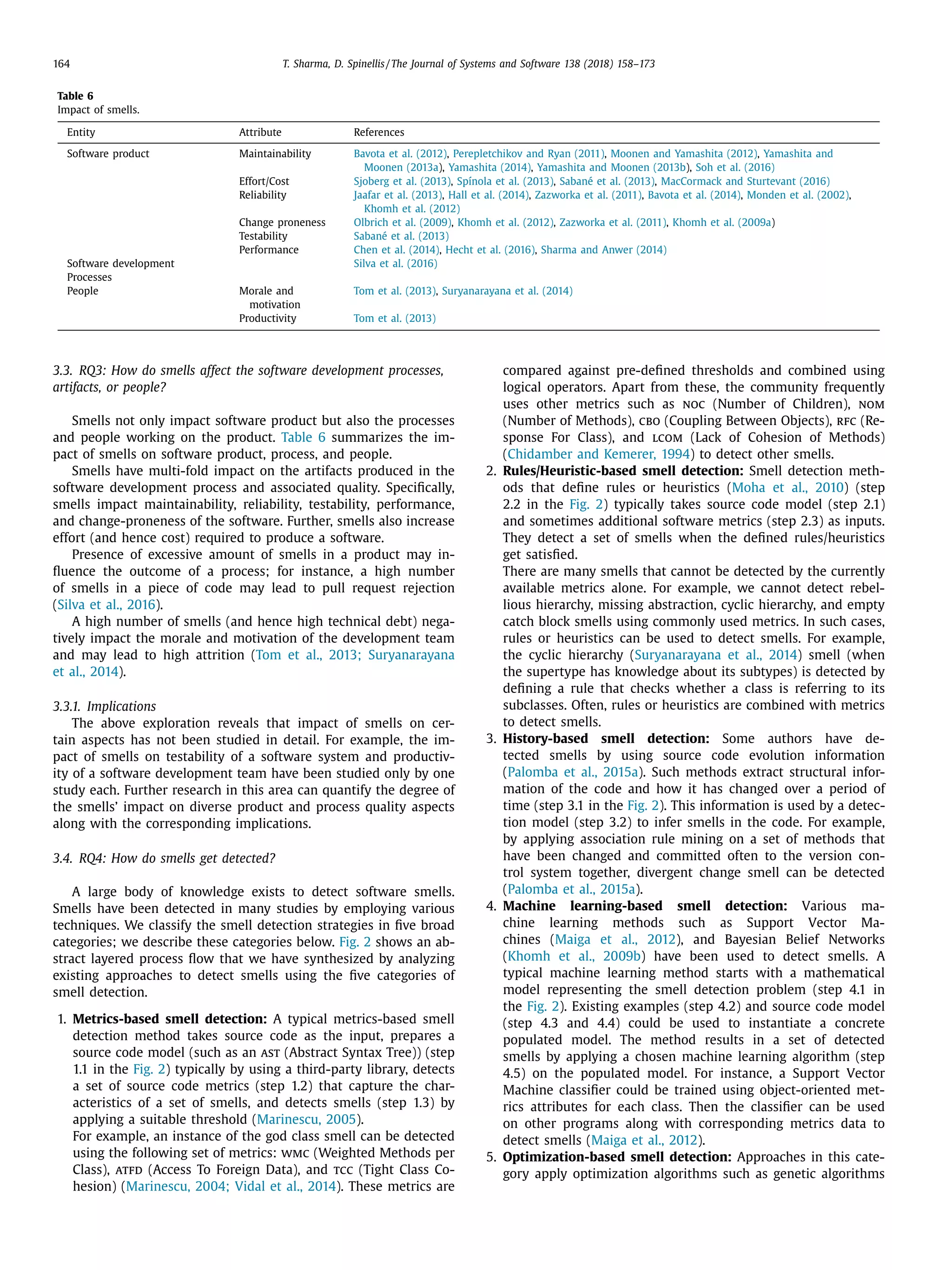
Table 6
Impact of smells.
Entity Attribute References
Software product Maintainability Bavota et al. (2012), Perepletchikov and Ryan (2011), Moonen and Yamashita (2012), Yamashita and
Moonen (2013a), Yamashita (2014), Yamashita and Moonen (2013b), Soh et al. (2016)
Effort/Cost Sjoberg et al. (2013), Spínola et al. (2013), Sabané et al. (2013), MacCormack and Sturtevant (2016)
Reliability Jaafar et al. (2013), Hall et al. (2014), Zazworka et al. (2011), Bavota et al. (2014), Monden et al. (2002),
Khomh et al. (2012)
Change proneness Olbrich et al. (2009), Khomh et al. (2012), Zazworka et al. (2011), Khomh et al. (2009a)
Testability Sabané et al. (2013)
Performance Chen et al. (2014), Hecht et al. (2016), Sharma and Anwer (2014)
Software development Silva et al. (2016)
Processes
People Morale and
motivation
Tom et al. (2013), Suryanarayana et al. (2014)
Productivity Tom et al. (2013)
3.3. RQ3: How do smells affect the software development processes,
artifacts, or people?
Smells not only impact software product but also the processes
and people working on the product. Table 6 summarizes the im-
pact of smells on software product, process, and people.
Smells have multi-fold impact on the artifacts produced in the
software development process and associated quality. Specifically,
smells impact maintainability, reliability, testability, performance,
and change-proneness of the software. Further, smells also increase
effort (and hence cost) required to produce a software.
Presence of excessive amount of smells in a product may in-
fluence the outcome of a process; for instance, a high number
of smells in a piece of code may lead to pull request rejection
(Silva et al., 2016).
A high number of smells (and hence high technical debt) nega-
tively impact the morale and motivation of the development team
and may lead to high attrition (Tom et al., 2013; Suryanarayana
et al., 2014).
3.3.1. Implications
The above exploration reveals that impact of smells on cer-
tain aspects has not been studied in detail. For example, the im-
pact of smells on testability of a software system and productiv-
ity of a software development team have been studied only by one
study each. Further research in this area can quantify the degree of
the smells’ impact on diverse product and process quality aspects
along with the corresponding implications.
3.4. RQ4: How do smells get detected?
A large body of knowledge exists to detect software smells.
Smells have been detected in many studies by employing various
techniques. We classify the smell detection strategies in five broad
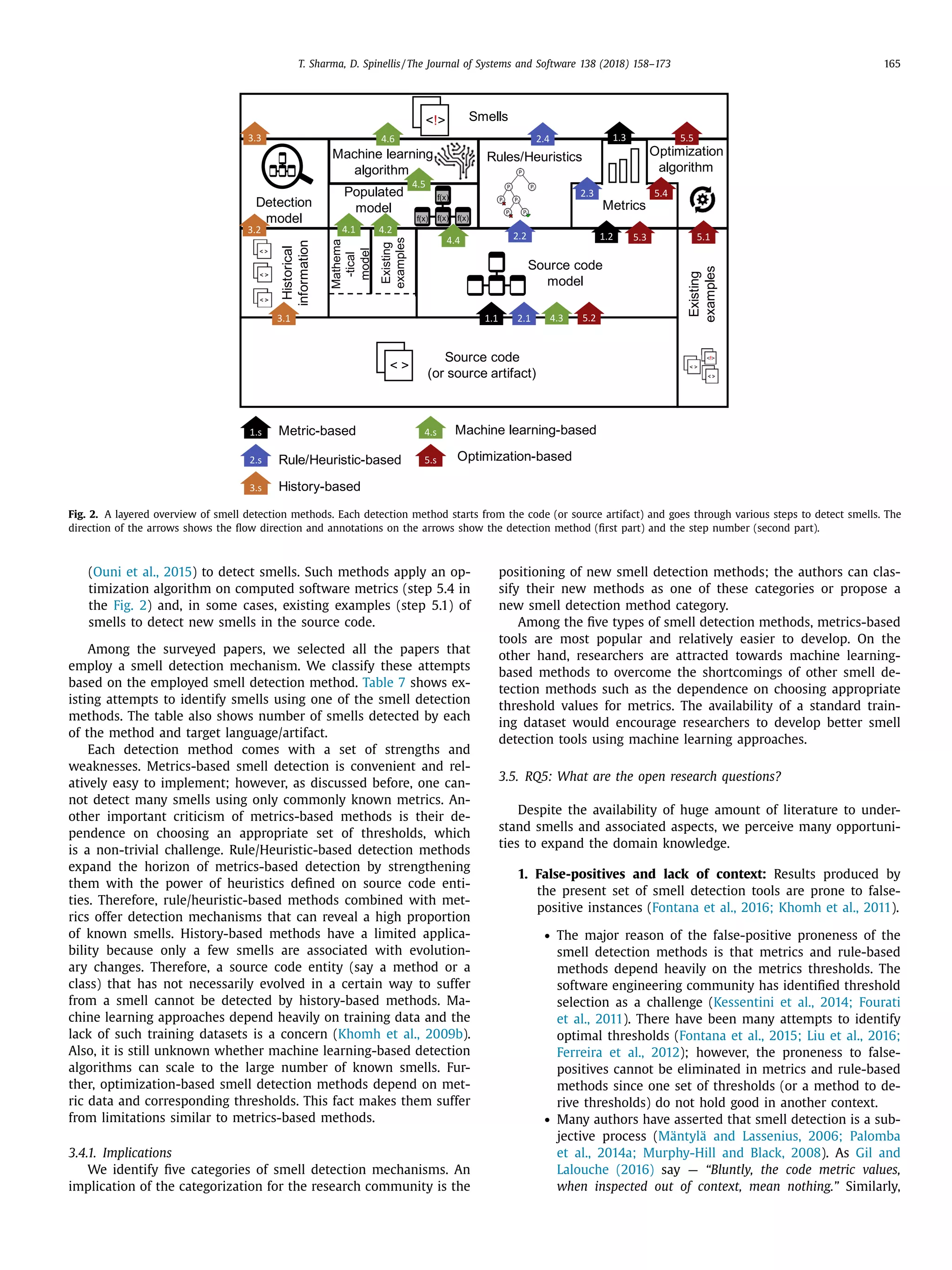
categories; we describe these categories below. Fig. 2 shows an ab-
stract layered process flow that we have synthesized by analyzing
existing approaches to detect smells using the five categories of
smell detection.
1. Metrics-based smell detection: A typical metrics-based smell
detection method takes source code as the input, prepares a
source code model (such as an ast (Abstract Syntax Tree)) (step
1.1 in the Fig. 2) typically by using a third-party library, detects
a set of source code metrics (step 1.2) that capture the char-
acteristics of a set of smells, and detects smells (step 1.3) by
applying a suitable threshold (Marinescu, 2005).
For example, an instance of the god class smell can be detected
using the following set of metrics: wmc (Weighted Methods per
Class), atfd (Access To Foreign Data), and tcc (Tight Class Co-
hesion) (Marinescu, 2004; Vidal et al., 2014). These metrics are
compared against pre-defined thresholds and combined using
logical operators. Apart from these, the community frequently
uses other metrics such as noc (Number of Children), nom
(Number of Methods), cbo (Coupling Between Objects), rfc (Re-
sponse For Class), and lcom (Lack of Cohesion of Methods)
(Chidamber and Kemerer, 1994) to detect other smells.
2. Rules/Heuristic-based smell detection: Smell detection meth-
ods that define rules or heuristics (Moha et al., 2010) (step
2.2 in the Fig. 2) typically takes source code model (step 2.1)
and sometimes additional software metrics (step 2.3) as inputs.
They detect a set of smells when the defined rules/heuristics
get satisfied.
There are many smells that cannot be detected by the currently
available metrics alone. For example, we cannot detect rebel-
lious hierarchy, missing abstraction, cyclic hierarchy, and empty
catch block smells using commonly used metrics. In such cases,
rules or heuristics can be used to detect smells. For example,
the cyclic hierarchy (Suryanarayana et al., 2014) smell (when
the supertype has knowledge about its subtypes) is detected by
defining a rule that checks whether a class is referring to its
subclasses. Often, rules or heuristics are combined with metrics
to detect smells.
3. History-based smell detection: Some authors have de-
tected smells by using source code evolution information
(Palomba et al., 2015a). Such methods extract structural infor-
mation of the code and how it has changed over a period of
time (step 3.1 in the Fig. 2). This information is used by a detec-
tion model (step 3.2) to infer smells in the code. For example,
by applying association rule mining on a set of methods that
have been changed and committed often to the version con-
trol system together, divergent change smell can be detected
(Palomba et al., 2015a).
4. Machine learning-based smell detection: Various ma-
chine learning methods such as Support Vector Ma-
chines (Maiga et al., 2012), and Bayesian Belief Networks
(Khomh et al., 2009b) have been used to detect smells. A
typical machine learning method starts with a mathematical
model representing the smell detection problem (step 4.1 in
the Fig. 2). Existing examples (step 4.2) and source code model
(step 4.3 and 4.4) could be used to instantiate a concrete
populated model. The method results in a set of detected
smells by applying a chosen machine learning algorithm (step
4.5) on the populated model. For instance, a Support Vector
Machine classifier could be trained using object-oriented met-
rics attributes for each class. Then the classifier can be used
on other programs along with corresponding metrics data to
detect smells (Maiga et al., 2012).
5. Optimization-based smell detection: Approaches in this cate-
gory apply optimization algorithms such as genetic algorithms
T. Sharma, D. Spinellis / The Journal of Systems and Software 138 (2018) 158–173 165
Fig. 2. A layered overview of smell detection methods. Each detection method starts from the code (or source artifact) and goes through various steps to detect smells. The
direction of the arrows shows the flow direction and annotations on the arrows show the detection method (first part) and the step number (second part).
(Ouni et al., 2015) to detect smells. Such methods apply an op-
timization algorithm on computed software metrics (step 5.4 in
the Fig. 2) and, in some cases, existing examples (step 5.1) of
smells to detect new smells in the source code.
Among the surveyed papers, we selected all the papers that
employ a smell detection mechanism. We classify these attempts
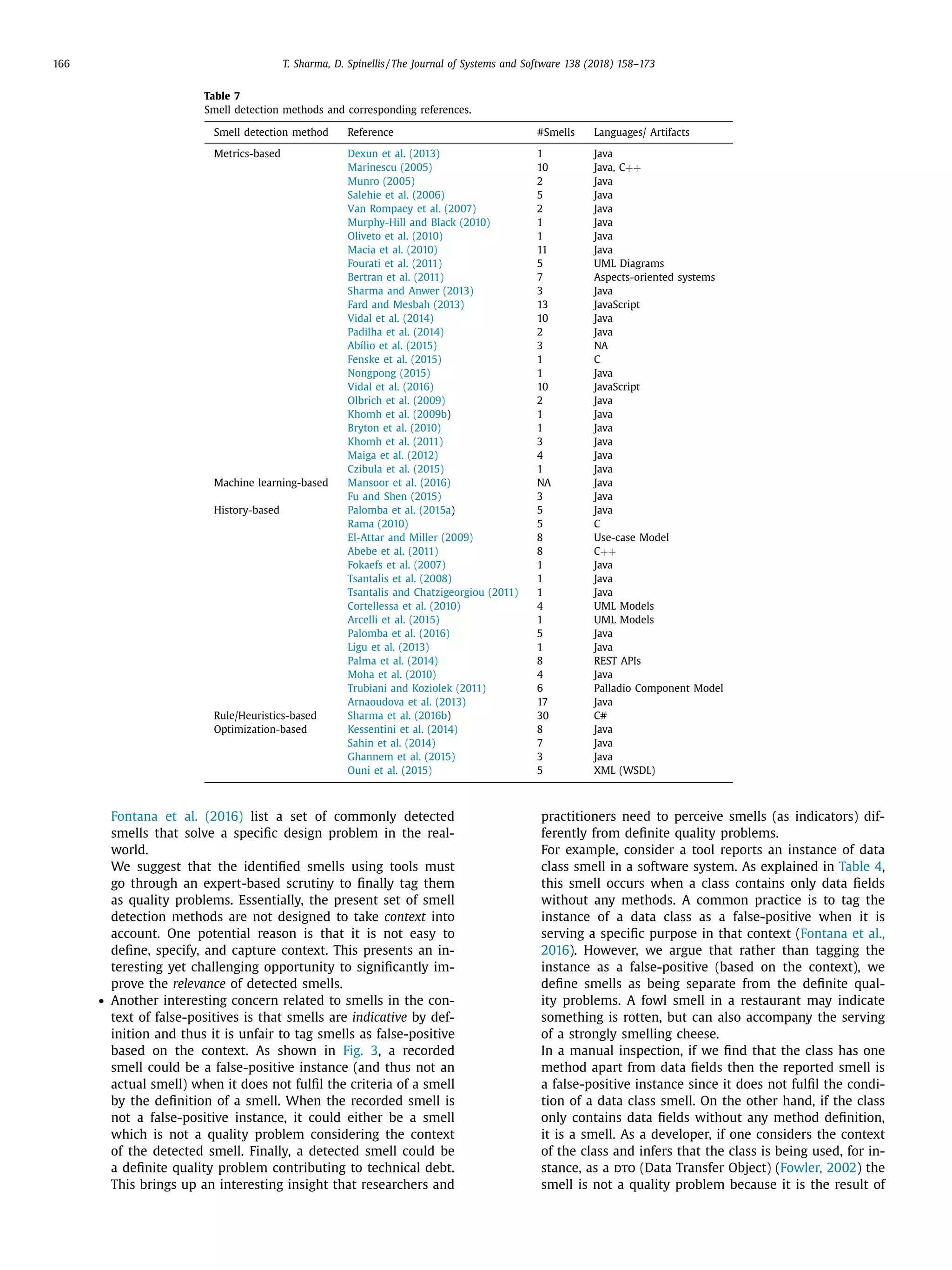
based on the employed smell detection method. Table 7 shows ex-
isting attempts to identify smells using one of the smell detection
methods. The table also shows number of smells detected by each
of the method and target language/artifact.
Each detection method comes with a set of strengths and
weaknesses. Metrics-based smell detection is convenient and rel-
atively easy to implement; however, as discussed before, one can-
not detect many smells using only commonly known metrics. An-
other important criticism of metrics-based methods is their de-
pendence on choosing an appropriate set of thresholds, which
is a non-trivial challenge. Rule/Heuristic-based detection methods
expand the horizon of metrics-based detection by strengthening
them with the power of heuristics defined on source code enti-
ties. Therefore, rule/heuristic-based methods combined with met-
rics offer detection mechanisms that can reveal a high proportion
of known smells. History-based methods have a limited applica-
bility because only a few smells are associated with evolution-
ary changes. Therefore, a source code entity (say a method or a
class) that has not necessarily evolved in a certain way to suffer
from a smell cannot be detected by history-based methods. Ma-
chine learning approaches depend heavily on training data and the
lack of such training datasets is a concern (Khomh et al., 2009b).
Also, it is still unknown whether machine learning-based detection
algorithms can scale to the large number of known smells. Fur-
ther, optimization-based smell detection methods depend on met-
ric data and corresponding thresholds. This fact makes them suffer
from limitations similar to metrics-based methods.
3.4.1. Implications
We identify five categories of smell detection mechanisms. An
implication of the categorization for the research community is the
positioning of new smell detection methods; the authors can clas-
sify their new methods as one of these categories or propose a
new smell detection method category.
Among the five types of smell detection methods, metrics-based
tools are most popular and relatively easier to develop. On the
other hand, researchers are attracted towards machine learning-
based methods to overcome the shortcomings of other smell de-
tection methods such as the dependence on choosing appropriate
threshold values for metrics. The availability of a standard train-
ing dataset would encourage researchers to develop better smell
detection tools using machine learning approaches.
3.5. RQ5: What are the open research questions?
Despite the availability of huge amount of literature to under-
stand smells and associated aspects, we perceive many opportuni-
ties to expand the domain knowledge.
1. False-positives and lack of context: Results produced by
the present set of smell detection tools are prone to false-
positive instances (Fontana et al., 2016; Khomh et al., 2011).
• The major reason of the false-positive proneness of the
smell detection methods is that metrics and rule-based
methods depend heavily on the metrics thresholds. The
software engineering community has identified threshold
selection as a challenge (Kessentini et al., 2014; Fourati
et al., 2011). There have been many attempts to identify
optimal thresholds (Fontana et al., 2015; Liu et al., 2016;
Ferreira et al., 2012); however, the proneness to false-
positives cannot be eliminated in metrics and rule-based
methods since one set of thresholds (or a method to de-
rive thresholds) do not hold good in another context.
• Many authors have asserted that smell detection is a sub-
jective process (Mäntylä and Lassenius, 2006; Palomba
et al., 2014a; Murphy-Hill and Black, 2008). As Gil and
Lalouche (2016) say — “Bluntly, the code metric values,
when inspected out of context, mean nothing.” Similarly,
166 T. Sharma, D. Spinellis / The Journal of Systems and Software 138 (2018) 158–173
Table 7
Smell detection methods and corresponding references.
Smell detection method Reference #Smells Languages/ Artifacts
Metrics-based Dexun et al. (2013) 1 Java
Marinescu (2005) 10 Java, C++
Munro (2005) 2 Java
Salehie et al. (2006) 5 Java
Van Rompaey et al. (2007) 2 Java
Murphy-Hill and Black (2010) 1 Java
Oliveto et al. (2010) 1 Java
Macia et al. (2010) 11 Java
Fourati et al. (2011) 5 UML Diagrams
Bertran et al. (2011) 7 Aspects-oriented systems
Sharma and Anwer (2013) 3 Java
Fard and Mesbah (2013) 13 JavaScript
Vidal et al. (2014) 10 Java
Padilha et al. (2014) 2 Java
Abílio et al. (2015) 3 NA
Fenske et al. (2015) 1 C
Nongpong (2015) 1 Java
Vidal et al. (2016) 10 JavaScript
Olbrich et al. (2009) 2 Java
Khomh et al. (2009b) 1 Java
Bryton et al. (2010) 1 Java
Khomh et al. (2011) 3 Java
Maiga et al. (2012) 4 Java
Czibula et al. (2015) 1 Java
Machine learning-based Mansoor et al. (2016) NA Java
Fu and Shen (2015) 3 Java
History-based Palomba et al. (2015a) 5 Java
Rama (2010) 5 C
El-Attar and Miller (2009) 8 Use-case Model
Abebe et al. (2011) 8 C++
Fokaefs et al. (2007) 1 Java
Tsantalis et al. (2008) 1 Java
Tsantalis and Chatzigeorgiou (2011) 1 Java
Cortellessa et al. (2010) 4 UML Models
Arcelli et al. (2015) 1 UML Models
Palomba et al. (2016) 5 Java
Ligu et al. (2013) 1 Java
Palma et al. (2014) 8 REST APIs
Moha et al. (2010) 4 Java
Trubiani and Koziolek (2011) 6 Palladio Component Model
Arnaoudova et al. (2013) 17 Java
Rule/Heuristics-based Sharma et al. (2016b) 30 C#
Optimization-based Kessentini et al. (2014) 8 Java
Sahin et al. (2014) 7 Java
Ghannem et al. (2015) 3 Java
Ouni et al. (2015) 5 XML (WSDL)
Fontana et al. (2016) list a set of commonly detected
smells that solve a specific design problem in the real-
world.
We suggest that the identified smells using tools must
go through an expert-based scrutiny to finally tag them
as quality problems. Essentially, the present set of smell
detection methods are not designed to take context into
account. One potential reason is that it is not easy to
define, specify, and capture context. This presents an in-
teresting yet challenging opportunity to significantly im-
prove the relevance of detected smells.
• Another interesting concern related to smells in the con-
text of false-positives is that smells are indicative by def-
inition and thus it is unfair to tag smells as false-positive
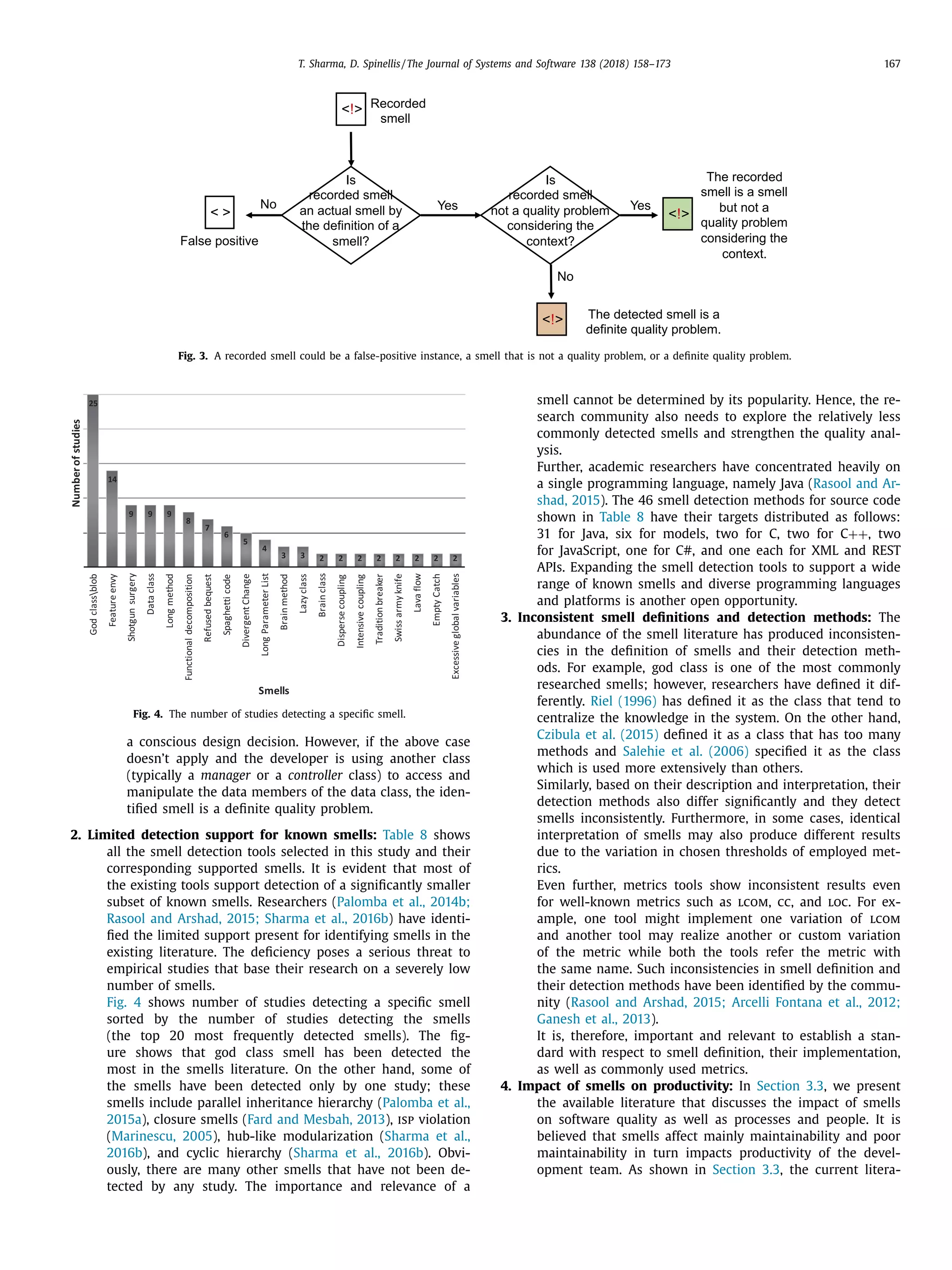
based on the context. As shown in Fig. 3, a recorded
smell could be a false-positive instance (and thus not an
actual smell) when it does not fulfil the criteria of a smell
by the definition of a smell. When the recorded smell is
not a false-positive instance, it could either be a smell
which is not a quality problem considering the context
of the detected smell. Finally, a detected smell could be
a definite quality problem contributing to technical debt.
This brings up an interesting insight that researchers and
practitioners need to perceive smells (as indicators) dif-
ferently from definite quality problems.
For example, consider a tool reports an instance of data
class smell in a software system. As explained in Table 4,
this smell occurs when a class contains only data fields
without any methods. A common practice is to tag the
instance of a data class as a false-positive when it is
serving a specific purpose in that context (Fontana et al.,
2016). However, we argue that rather than tagging the
instance as a false-positive (based on the context), we
define smells as being separate from the definite qual-
ity problems. A fowl smell in a restaurant may indicate
something is rotten, but can also accompany the serving
of a strongly smelling cheese.
In a manual inspection, if we find that the class has one
method apart from data fields then the reported smell is
a false-positive instance since it does not fulfil the condi-
tion of a data class smell. On the other hand, if the class
only contains data fields without any method definition,
it is a smell. As a developer, if one considers the context
of the class and infers that the class is being used, for in-
stance, as a dto (Data Transfer Object) (Fowler, 2002) the
smell is not a quality problem because it is the result of
T. Sharma, D. Spinellis / The Journal of Systems and Software 138 (2018) 158–173 167
Fig. 3. A recorded smell could be a false-positive instance, a smell that is not a quality problem, or a definite quality problem.
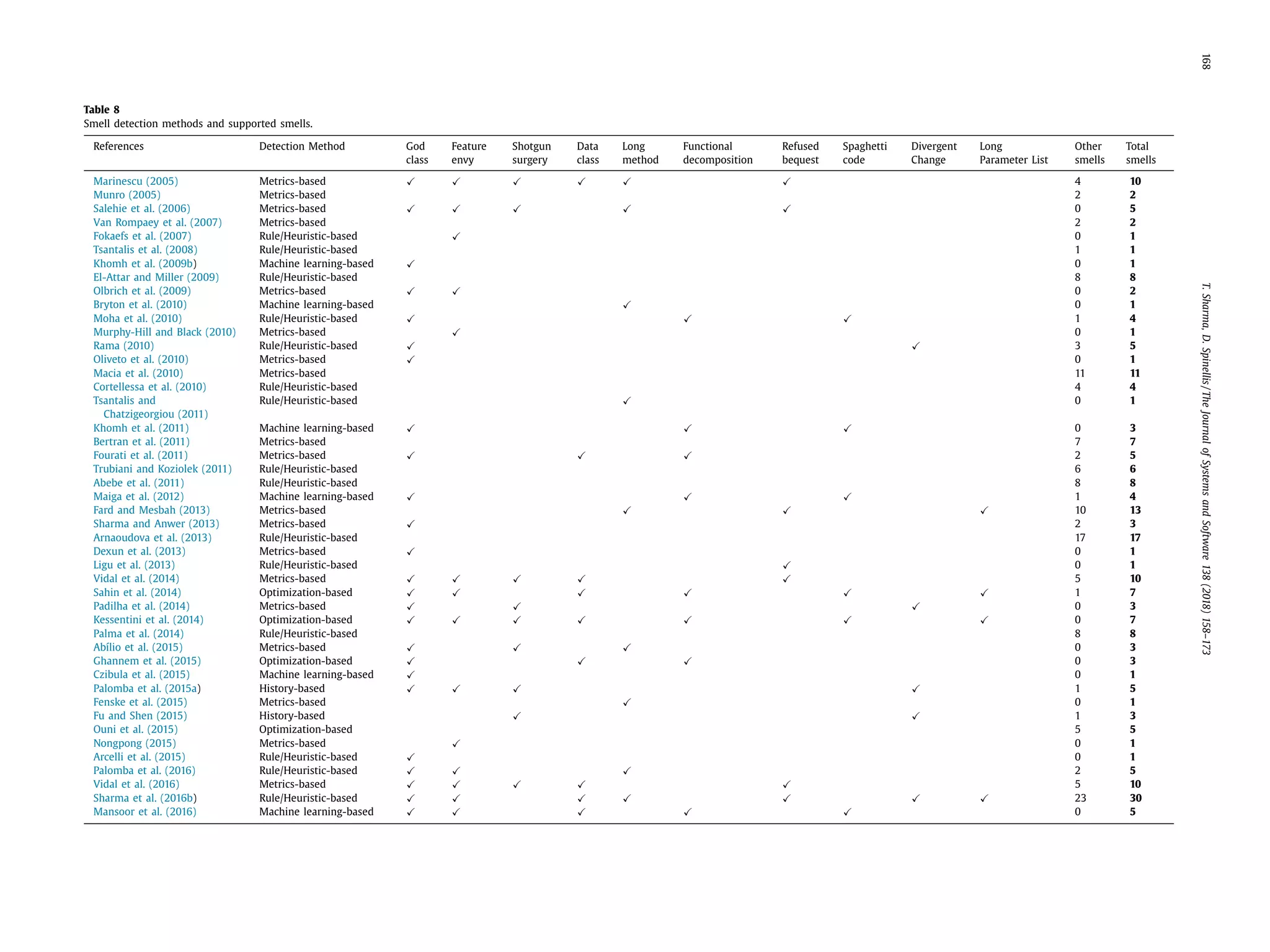
Fig. 4. The number of studies detecting a specific smell.
a conscious design decision. However, if the above case
doesn’t apply and the developer is using another class
(typically a manager or a controller class) to access and
manipulate the data members of the data class, the iden-
tified smell is a definite quality problem.
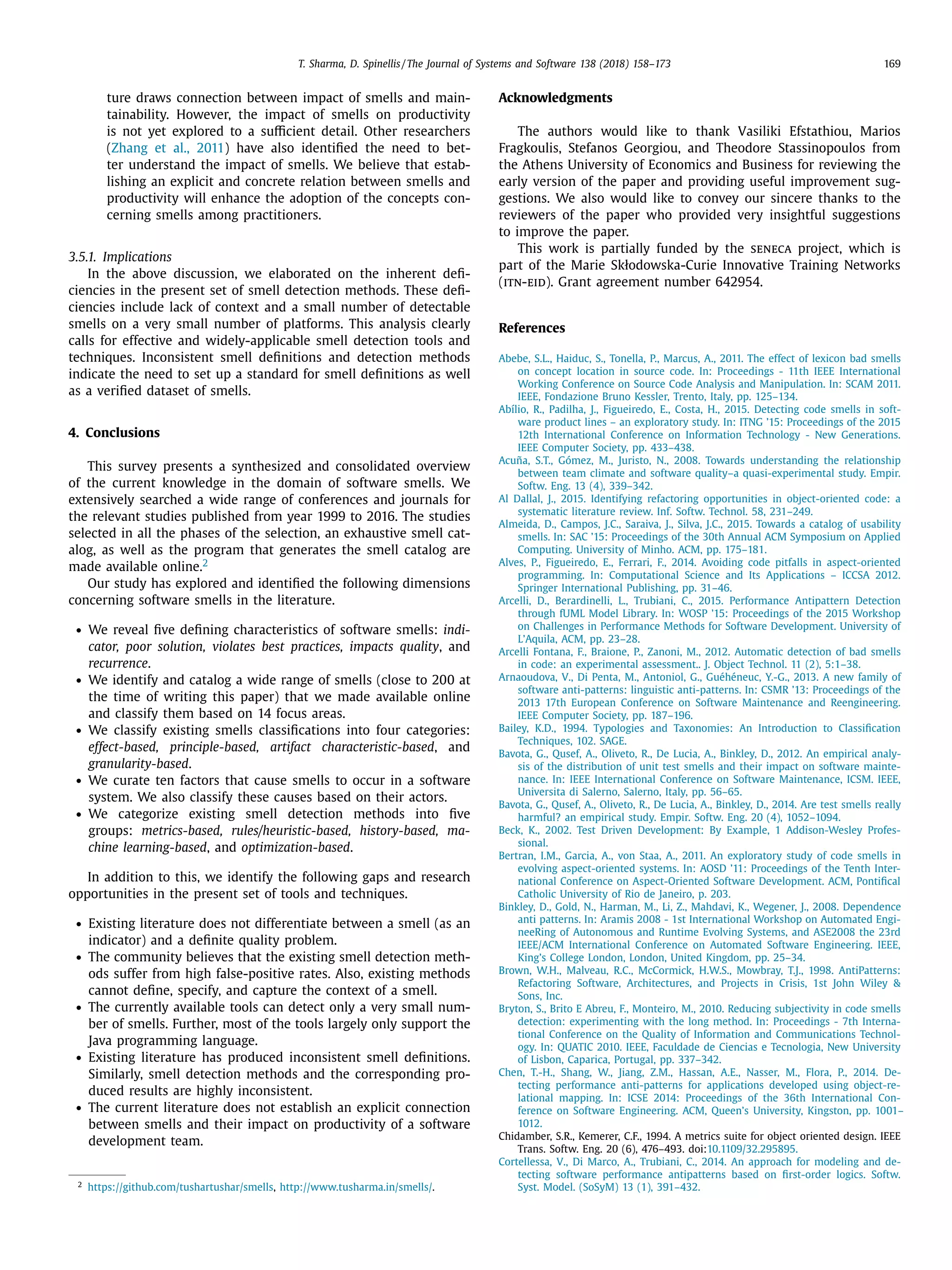
2. Limited detection support for known smells: Table 8 shows
all the smell detection tools selected in this study and their
corresponding supported smells. It is evident that most of
the existing tools support detection of a significantly smaller
subset of known smells. Researchers (Palomba et al., 2014b;
Rasool and Arshad, 2015; Sharma et al., 2016b) have identi-
fied the limited support present for identifying smells in the
existing literature. The deficiency poses a serious threat to
empirical studies that base their research on a severely low
number of smells.
Fig. 4 shows number of studies detecting a specific smell
sorted by the number of studies detecting the smells
(the top 20 most frequently detected smells). The fig-
ure shows that god class smell has been detected the
most in the smells literature. On the other hand, some of
the smells have been detected only by one study; these
smells include parallel inheritance hierarchy (Palomba et al.,
2015a), closure smells (Fard and Mesbah, 2013), isp violation
(Marinescu, 2005), hub-like modularization (Sharma et al.,
2016b), and cyclic hierarchy (Sharma et al., 2016b). Obvi-
ously, there are many other smells that have not been de-
tected by any study. The importance and relevance of a
smell cannot be determined by its popularity. Hence, the re-
search community also needs to explore the relatively less
commonly detected smells and strengthen the quality anal-
ysis.
Further, academic researchers have concentrated heavily on
a single programming language, namely Java (Rasool and Ar-
shad, 2015). The 46 smell detection methods for source code
shown in Table 8 have their targets distributed as follows:
31 for Java, six for models, two for C, two for C++, two
for JavaScript, one for C#, and one each for XML and REST
APIs. Expanding the smell detection tools to support a wide
range of known smells and diverse programming languages
and platforms is another open opportunity.
3. Inconsistent smell definitions and detection methods: The
abundance of the smell literature has produced inconsisten-
cies in the definition of smells and their detection meth-
ods. For example, god class is one of the most commonly
researched smells; however, researchers have defined it dif-
ferently. Riel (1996) has defined it as the class that tend to
centralize the knowledge in the system. On the other hand,
Czibula et al. (2015) defined it as a class that has too many
methods and Salehie et al. (2006) specified it as the class
which is used more extensively than others.
Similarly, based on their description and interpretation, their
detection methods also differ significantly and they detect
smells inconsistently. Furthermore, in some cases, identical
interpretation of smells may also produce different results
due to the variation in chosen thresholds of employed met-
rics.
Even further, metrics tools show inconsistent results even
for well-known metrics such as lcom, cc, and loc. For ex-
ample, one tool might implement one variation of lcom
and another tool may realize another or custom variation
of the metric while both the tools refer the metric with
the same name. Such inconsistencies in smell definition and
their detection methods have been identified by the commu-
nity (Rasool and Arshad, 2015; Arcelli Fontana et al., 2012;
Ganesh et al., 2013).
It is, therefore, important and relevant to establish a stan-
dard with respect to smell definition, their implementation,
as well as commonly used metrics.
4. Impact of smells on productivity: In Section 3.3, we present
the available literature that discusses the impact of smells
on software quality as well as processes and people. It is
believed that smells affect mainly maintainability and poor
maintainability in turn impacts productivity of the devel-
opment team. As shown in Section 3.3, the current litera-
168T.Sharma,D.Spinellis/TheJournalofSystemsandSoftware138(2018)158–173
Table 8
Smell detection methods and supported smells.
References Detection Method God
class
Feature
envy
Shotgun
surgery
Data
class
Long
method
Functional
decomposition
Refused
bequest
Spaghetti
code
Divergent
Change
Long
Parameter List
Other
smells
Total
smells
Marinescu (2005) Metrics-based 4 10
Munro (2005) Metrics-based 2 2
Salehie et al. (2006) Metrics-based 0 5
Van Rompaey et al. (2007) Metrics-based 2 2
Fokaefs et al. (2007) Rule/Heuristic-based 0 1
Tsantalis et al. (2008) Rule/Heuristic-based 1 1
Khomh et al. (2009b) Machine learning-based 0 1
El-Attar and Miller (2009) Rule/Heuristic-based 8 8
Olbrich et al. (2009) Metrics-based 0 2
Bryton et al. (2010) Machine learning-based 0 1
Moha et al. (2010) Rule/Heuristic-based 1 4
Murphy-Hill and Black (2010) Metrics-based 0 1
Rama (2010) Rule/Heuristic-based 3 5
Oliveto et al. (2010) Metrics-based 0 1
Macia et al. (2010) Metrics-based 11 11
Cortellessa et al. (2010) Rule/Heuristic-based 4 4
Tsantalis and
Chatzigeorgiou (2011)
Rule/Heuristic-based 0 1
Khomh et al. (2011) Machine learning-based 0 3
Bertran et al. (2011) Metrics-based 7 7
Fourati et al. (2011) Metrics-based 2 5
Trubiani and Koziolek (2011) Rule/Heuristic-based 6 6
Abebe et al. (2011) Rule/Heuristic-based 8 8
Maiga et al. (2012) Machine learning-based 1 4
Fard and Mesbah (2013) Metrics-based 10 13
Sharma and Anwer (2013) Metrics-based 2 3
Arnaoudova et al. (2013) Rule/Heuristic-based 17 17
Dexun et al. (2013) Metrics-based 0 1
Ligu et al. (2013) Rule/Heuristic-based 0 1
Vidal et al. (2014) Metrics-based 5 10
Sahin et al. (2014) Optimization-based 1 7
Padilha et al. (2014) Metrics-based 0 3
Kessentini et al. (2014) Optimization-based 0 7
Palma et al. (2014) Rule/Heuristic-based 8 8
Abílio et al. (2015) Metrics-based 0 3
Ghannem et al. (2015) Optimization-based 0 3
Czibula et al. (2015) Machine learning-based 0 1
Palomba et al. (2015a) History-based 1 5
Fenske et al. (2015) Metrics-based 0 1
Fu and Shen (2015) History-based 1 3
Ouni et al. (2015) Optimization-based 5 5
Nongpong (2015) Metrics-based 0 1
Arcelli et al. (2015) Rule/Heuristic-based 0 1
Palomba et al. (2016) Rule/Heuristic-based 2 5
Vidal et al. (2016) Metrics-based 5 10
Sharma et al. (2016b) Rule/Heuristic-based 23 30
Mansoor et al. (2016) Machine learning-based 0 5
T. Sharma, D. Spinellis / The Journal of Systems and Software 138 (2018) 158–173 169
ture draws connection between impact of smells and main-
tainability. However, the impact of smells on productivity
is not yet explored to a sufficient detail. Other researchers
(Zhang et al., 2011) have also identified the need to bet-
ter understand the impact of smells. We believe that estab-
lishing an explicit and concrete relation between smells and
productivity will enhance the adoption of the concepts con-
cerning smells among practitioners.
3.5.1. Implications
In the above discussion, we elaborated on the inherent defi-
ciencies in the present set of smell detection methods. These defi-
ciencies include lack of context and a small number of detectable
smells on a very small number of platforms. This analysis clearly
calls for effective and widely-applicable smell detection tools and
techniques. Inconsistent smell definitions and detection methods
indicate the need to set up a standard for smell definitions as well
as a verified dataset of smells.
4. Conclusions
This survey presents a synthesized and consolidated overview
of the current knowledge in the domain of software smells. We
extensively searched a wide range of conferences and journals for
the relevant studies published from year 1999 to 2016. The studies
selected in all the phases of the selection, an exhaustive smell cat-
alog, as well as the program that generates the smell catalog are
made available online.2
Our study has explored and identified the following dimensions
concerning software smells in the literature.
• We reveal five defining characteristics of software smells: indi-
cator, poor solution, violates best practices, impacts quality, and
recurrence.
• We identify and catalog a wide range of smells (close to 200 at
the time of writing this paper) that we made available online
and classify them based on 14 focus areas.
• We classify existing smells classifications into four categories:
effect-based, principle-based, artifact characteristic-based, and
granularity-based.
• We curate ten factors that cause smells to occur in a software
system. We also classify these causes based on their actors.
• We categorize existing smell detection methods into five
groups: metrics-based, rules/heuristic-based, history-based, ma-
chine learning-based, and optimization-based.
In addition to this, we identify the following gaps and research
opportunities in the present set of tools and techniques.
• Existing literature does not differentiate between a smell (as an
indicator) and a definite quality problem.
• The community believes that the existing smell detection meth-
ods suffer from high false-positive rates. Also, existing methods
cannot define, specify, and capture the context of a smell.
• The currently available tools can detect only a very small num-
ber of smells. Further, most of the tools largely only support the
Java programming language.
• Existing literature has produced inconsistent smell definitions.
Similarly, smell detection methods and the corresponding pro-
duced results are highly inconsistent.
• The current literature does not establish an explicit connection
between smells and their impact on productivity of a software
development team.
2
https://github.com/tushartushar/smells, http://www.tusharma.in/smells/.
Acknowledgments
The authors would like to thank Vasiliki Efstathiou, Marios
Fragkoulis, Stefanos Georgiou, and Theodore Stassinopoulos from
the Athens University of Economics and Business for reviewing the
early version of the paper and providing useful improvement sug-
gestions. We also would like to convey our sincere thanks to the
reviewers of the paper who provided very insightful suggestions
to improve the paper.
This work is partially funded by the seneca project, which is
part of the Marie Skłodowska-Curie Innovative Training Networks
(itn-eid). Grant agreement number 642954.
References
Abebe, S.L., Haiduc, S., Tonella, P., Marcus, A., 2011. The effect of lexicon bad smells
on concept location in source code. In: Proceedings - 11th IEEE International
Working Conference on Source Code Analysis and Manipulation. In: SCAM 2011.
IEEE, Fondazione Bruno Kessler, Trento, Italy, pp. 125–134.
Abílio, R., Padilha, J., Figueiredo, E., Costa, H., 2015. Detecting code smells in soft-
ware product lines – an exploratory study. In: ITNG ’15: Proceedings of the 2015
12th International Conference on Information Technology - New Generations.
IEEE Computer Society, pp. 433–438.
Acuña, S.T., Gómez, M., Juristo, N., 2008. Towards understanding the relationship
between team climate and software quality–a quasi-experimental study. Empir.
Softw. Eng. 13 (4), 339–342.
Al Dallal, J., 2015. Identifying refactoring opportunities in object-oriented code: a
systematic literature review. Inf. Softw. Technol. 58, 231–249.
Almeida, D., Campos, J.C., Saraiva, J., Silva, J.C., 2015. Towards a catalog of usability
smells. In: SAC ’15: Proceedings of the 30th Annual ACM Symposium on Applied
Computing. University of Minho. ACM, pp. 175–181.
Alves, P., Figueiredo, E., Ferrari, F., 2014. Avoiding code pitfalls in aspect-oriented
programming. In: Computational Science and Its Applications – ICCSA 2012.
Springer International Publishing, pp. 31–46.
Arcelli, D., Berardinelli, L., Trubiani, C., 2015. Performance Antipattern Detection
through fUML Model Library. In: WOSP ’15: Proceedings of the 2015 Workshop
on Challenges in Performance Methods for Software Development. University of
L’Aquila, ACM, pp. 23–28.
Arcelli Fontana, F., Braione, P., Zanoni, M., 2012. Automatic detection of bad smells
in code: an experimental assessment.. J. Object Technol. 11 (2), 5:1–38.
Arnaoudova, V., Di Penta, M., Antoniol, G., Guéhéneuc, Y.-G., 2013. A new family of
software anti-patterns: linguistic anti-patterns. In: CSMR ’13: Proceedings of the
2013 17th European Conference on Software Maintenance and Reengineering.
IEEE Computer Society, pp. 187–196.
Bailey, K.D., 1994. Typologies and Taxonomies: An Introduction to Classification
Techniques, 102. SAGE.
Bavota, G., Qusef, A., Oliveto, R., De Lucia, A., Binkley, D., 2012. An empirical analy-
sis of the distribution of unit test smells and their impact on software mainte-
nance. In: IEEE International Conference on Software Maintenance, ICSM. IEEE,
Universita di Salerno, Salerno, Italy, pp. 56–65.
Bavota, G., Qusef, A., Oliveto, R., De Lucia, A., Binkley, D., 2014. Are test smells really
harmful? an empirical study. Empir. Softw. Eng. 20 (4), 1052–1094.
Beck, K., 2002. Test Driven Development: By Example, 1 Addison-Wesley Profes-
sional.
Bertran, I.M., Garcia, A., von Staa, A., 2011. An exploratory study of code smells in
evolving aspect-oriented systems. In: AOSD ’11: Proceedings of the Tenth Inter-
national Conference on Aspect-Oriented Software Development. ACM, Pontifical
Catholic University of Rio de Janeiro, p. 203.
Binkley, D., Gold, N., Harman, M., Li, Z., Mahdavi, K., Wegener, J., 2008. Dependence
anti patterns. In: Aramis 2008 - 1st International Workshop on Automated Engi-
neeRing of Autonomous and Runtime Evolving Systems, and ASE2008 the 23rd
IEEE/ACM International Conference on Automated Software Engineering. IEEE,
King’s College London, London, United Kingdom, pp. 25–34.
Brown, W.H., Malveau, R.C., McCormick, H.W.S., Mowbray, T.J., 1998. AntiPatterns:
Refactoring Software, Architectures, and Projects in Crisis, 1st John Wiley &
Sons, Inc.
Bryton, S., Brito E Abreu, F., Monteiro, M., 2010. Reducing subjectivity in code smells
detection: experimenting with the long method. In: Proceedings - 7th Interna-
tional Conference on the Quality of Information and Communications Technol-
ogy. In: QUATIC 2010. IEEE, Faculdade de Ciencias e Tecnologia, New University
of Lisbon, Caparica, Portugal, pp. 337–342.
Chen, T.-H., Shang, W., Jiang, Z.M., Hassan, A.E., Nasser, M., Flora, P., 2014. De-
tecting performance anti-patterns for applications developed using object-re-
lational mapping. In: ICSE 2014: Proceedings of the 36th International Con-
ference on Software Engineering. ACM, Queen’s University, Kingston, pp. 1001–
1012.
Chidamber, S.R., Kemerer, C.F., 1994. A metrics suite for object oriented design. IEEE
Trans. Softw. Eng. 20 (6), 476–493. doi:10.1109/32.295895.
Cortellessa, V., Di Marco, A., Trubiani, C., 2014. An approach for modeling and de-
tecting software performance antipatterns based on first-order logics. Softw.
Syst. Model. (SoSyM) 13 (1), 391–432.
170 T. Sharma, D. Spinellis / The Journal of Systems and Software 138 (2018) 158–173
Cortellessa, V., Martens, A., Reussner, R., Trubiani, C., 2010. A process to effec-
tively identify “guilty” performance antipatterns. In: Lecture Notes in Computer
Science (including subseries Lecture Notes in Artificial Intelligence and Lec-
ture Notes in Bioinformatics). Springer Berlin Heidelberg, Universita degli Studi
dell’Aquila, L’Aquila, Italy, pp. 368–382.
Curcio, K., Malucelli, A., Reinehr, S., Paludo, M.A., 2016. An analysis of the factors
determining software product quality: a comparative study. Comput. Stand. In-
terfaces 48, 10–18.
Czibula, G., Marian, Z., Czibula, I.G., 2015. Detecting software design defects using
relational association rule mining. Knowl. Inf. Syst. 42 (3), 545–577.
Das, T.K., Dingel, J., 2016. Model development guidelines for UML-RT: conventions,
patterns and antipatterns. Softw. Syst. Model. 1–36.
Deursen, A.V., Moonen, L., Bergh, A.V.D., Kok, G., 2001. Refactoring test code. In:
Marchesi, M. (Ed.), Proceedings of the 2nd International Conference on Extreme
Programming and Flexible Processes (XP2001), University of Cagliari, pp. 92–95.
Dexun, J., Peijun, M., Xiaohong, S., Tiantian, W., 2013. Detection and refactoring of
bad smell caused by large scale. Int. J. Softw.. & Appl. 4 (5), 1–13.
El-Attar, M., Miller, J., 2009. Improving the quality of use case models using antipat-
terns. Softw. Syst. Model. 9 (2), 141–160.
Fard, A.M., Mesbah, A., 2013. JSNOSE: detecting Java Script code smells. In: IEEE
13th International Working Conference on Source Code Analysis and Manipula-
tion, SCAM 2013. IEEE, The University of British Columbia, Vancouver, Canada,
pp. 116–125.
Fenske, W., Schulze, S., Meyer, D., Saake, G., 2015. When code smells twice as
much: metric-based detection of variability-aware code smells. In: 2015 IEEE
15th International Working Conference on Source Code Analysis and Manipula-
tion, SCAM 2015 - Proceedings. IEEE, Otto von Guericke University of Magde-
burg, Magdeburg, Germany, pp. 171–180.
Fernandes, E., Oliveira, J., Vale, G., Paiva, T., Figueiredo, E., 2016. A review-based
comparative study of bad smell detection tools. In: EASE ’16: Proceedings of
the 20th International Conference on Evaluation and Assessment in Software
Engineering. ACM, Federal University of Minas Gerais, pp. 12–18.
Ferreira, K.A.M., Bigonha, M.A.S., Bigonha, R.S., Mendes, L.F.O., Almeida, H.C., 2012.
Identifying thresholds for object-oriented software metrics. J. Syst. Softw. 85 (2),
244–257.
Fokaefs, M., Tsantalis, N., Chatzigeorgiou, A., 2007. JDeodorant:identification and re-
moval of feature envy bad smells. In: 2007 IEEE International Conference on
Software Maintenance. IEEE, Panepistimion Makedonias, Thessaloniki, Greece,
pp. 519–520.
Fontana, F.A., Dietrich, J., Walter, B., Yamashita, A., Zanoni, M., 2016. Antipattern and
code smell false positives: preliminary conceptualization and classification. In:
2016 IEEE 23rd International Conference on Software Analysis, Evolution, and
Reengineering (SANER). IEEE, pp. 609–613.
Fontana, F.A., Ferme, V., Zanoni, M., Yamashita, A., 2015. Automatic metric thresh-
olds derivation for code smell detection. In: WETSoM ’15: Proceedings of the
Sixth International Workshop on Emerging Trends in Software Metrics. IEEE
Press, University of Lugano, pp. 44–53.
Fourati, R., Bouassida, N., Abdallah, H.B., 2011. A metric-based approach for anti–
pattern detection in UML designs. In: Computer and Information Science 2011.
Springer Berlin Heidelberg, pp. 17–33.
Fowler, M., 1999. Refactoring: Improving the Design of Existing Programs, 1 Addis-
on-Wesley Professional.
Fowler, M., 2002. Patterns of Enterprise Application Architecture, 1 Addison-Wesley
Professional.
Fu, S., Shen, B., 2015. Code bad smell detection through evolutionary data mining.
In: International Symposium on Empirical Software Engineering and Measure-
ment. IEEE, Shanghai Jiaotong University, Shanghai, China, pp. 41–49.
Ganesh, S., Sharma, T., Suryanarayana, G., 2013. Towards a principle-based classifi-
cation of structural design smells. J. Object Technol. 12 (2), 1:1–29. doi:10.5381/
jot.2013.12.2.a1.
Garcia, J., Popescu, D., Edwards, G., Medvidovic, N., 2009. Toward a catalogue of ar-
chitectural bad smells. In: Proceedings of the 5th International Conference on
the Quality of Software Architectures: Architectures for Adaptive Software Sys-
tems. Springer-Verlag, pp. 146–162. doi:10.1007/978-3-642-02351-4_10.
Ghannem, A., El Boussaidi, G., Kessentini, M., 2015. On the use of design defect ex-
amples to detect model refactoring opportunities. Softw. Qual. J. 1–19.
Gil, J.Y., Lalouche, G., 2016. When do software complexity metrics mean nothing? –
when examined out of context.. J Object Technol 15 (1), 2:1.
Greiler, M., van Deursen, A., Storey, M.-A., 2013. Automated detection of test fixture
strategies and smells. In: 2013 IEEE Sixth International Conference on Software
Testing, Verification and Validation (ICST). IEEE, pp. 322–331.
Guerrouj, L., Kermansaravi, Z., Arnaoudova, V., Fung, B.C.M., Khomh, F., Antoniol, G.,
Guéhéneuc, Y.-G., 2016. Investigating the relation between lexical smells and
change- and fault-proneness: an empirical study. Softw. Qual. J. 1–30.
Hall, T., Zhang, M., Bowes, D., Sun, Y., 2014. Some code smells have a significant but
small effect on faults. ACM Trans. Softw. Eng. Methodol. (TOSEM) 23 (4), 33–39.
Hallal, H.H., Alikacem, E., Tunney, W.P., Boroday, S., Petrenko, A., 2004. Antipat-
tern-Based Detection of Deficiencies in Java Multithreaded Software. In: QSIC
’04: Proceedings of the Quality Software, Fourth International Conference. IEEE
Computer Society, Cent de Recherche Informatique de Montreal, pp. 258–267.
Hauptmann, B., Junker, M., Eder, S., Heinemann, L., Vaas, R., Braun, P., 2013. Hunting
for smells in natural language tests. In: ICSE ’13: Proceedings of the 2013 In-
ternational Conference on Software Engineering Technical University of Munich.
IEEE Press, pp. 1217–1220.
Hecht, G., Moha, N., Rouvoy, R., 2016. An empirical study of the performance im-
pacts of Android code smells. In: MOBILESoft ’16: Proceedings of the Interna-
tional Workshop on Mobile Software Engineering and Systems. ACM, Universite
Lille 2 Droit et Sante.
Jaafar, F., Guéhéneuc, Y.-G., Hamel, S., Khomh, F., 2013. Mining the relationship be-
tween anti-patterns dependencies and fault-proneness. In: Proceedings - Work-
ing Conference on Reverse Engineering, WCRE. IEEE, Ecole Polytechnique de
Montreal, Montreal, Canada, pp. 351–360.
Karwin, B., 2010. SQL Antipatterns: Avoiding the Pitfalls of Database Programming,
1st Pragmatic Bookshelf.
Kessentini, W., Kessentini, M., Sahraoui, H., Bechikh, S., Ouni, A., 2014. A cooperative
parallel search-Based software engineering approach for code-smells detection.
IEEE Trans. Softw. Eng. 40 (9), 841–861.
Khan, Y.A., El-Attar, M., 2016. Using model transformation to refactor use case mod-
els based on antipatterns. Inf. Syst. Front. 18 (1), 171–204.
Khomh, F., Di Penta, M., Guéhéneuc, Y.-G., 2009a. An exploratory study of the im-
pact of code smells on software change-proneness. In: 2009 16th Working Con-
ference on Reverse Engineering. IEEE, Ecole Polytechnique de Montreal, Mon-
treal, Canada, pp. 75–84.
Khomh, F., Di Penta, M., Guéhéneuc, Y.-G., Antoniol, G., 2012. An exploratory study
of the impact of antipatterns on class change- and fault-proneness. Empir.
Softw. Eng. 17 (3), 243–275.
Khomh, F., Vaucher, S., Guéhéneuc, Y.-G., Sahraoui, H., 2009b. A Bayesianapproach
for the detection of code and design smells. In: QSIC ’09: Proceedings of the
2009 Ninth International Conference on Quality Software. IEEE Computer Soci-
ety, pp. 305–314.
Khomh, F., Vaucher, S., Guéhéneuc, Y.-G., Sahraoui, H., 2011. BDTEX: a GQM-based
Bayesian approach for the detection of antipatterns. J. Syst. Softw. Ecole Poly-
technique de Montreal, Montreal, Canada 559–572.
Kleinschmager, S., Hanenberg, S., Robbes, R., Stefik, A., 2012. Do static type systems
improve the maintainability of software systems? an empirical study. In: 2012
IEEE 20th International Conference on Program Comprehension (ICPC). IEEE,
Universitat Duisburg-Essen, Essen, Germany, pp. 153–162.
Koenig, A., 1995. Patterns and antipatterns. JOOP 8 (1), 46–48.
Král, J., Žemliˇcka, M., 2007. The most important service-oriented antipatterns. In:
2nd International Conference on Software Engineering Advances - ICSEA 2007.
Charles University in Prague, Prague, Czech Republic. IEEE. 29–29
Lauder, A., Kent, S., 2000. Legacy system anti-patterns and a pattern-oriented mi-
gration response. In: Systems Engineering for Business Process Change. Springer
London, pp. 239–250.
Lavallée, M., Robillard, P.N., 2015. Why good developers write bad code: an obser-
vational case study of the impacts of organizational factors on software quality.
In: Proceedings - International Conference on Software Engineering. IEEE, Poly-
technique Montréal, Montreal, Canada, pp. 677–687.
Ligu, E., Chatzigeorgiou, A., Chaikalis, T., Ygeionomakis, N., 2013. Identification of
refused bequest code smells. In: 2013 IEEE International Conference on Software
Maintenance, pp. 392–395. doi:10.1109/ICSM.2013.55.
Linares-Vásquez, M., Klock, S., McMillan, C., Sabané, A., Poshyvanyk, D.,
Guéhéneuc, Y.-G., 2014. Domain matters: bringing further evidence of the
relationships among anti-patterns, application domains, and quality-related
metrics in Java mobile apps. In: ICPC 2014: Proceedings of the 22nd Interna-
tional Conference on Program Comprehension. ACM, The College of William
and Mary, pp. 232–243.
Liu, H., Liu, Q., Niu, Z., Liu, Y., 2016. Dynamic and automatic feedback-based thresh-
old adaptation for code smell detection. IEEE Trans. Softw. Eng. 42 (6), 544–
558.
Long, J., 2001. Software reuse antipatterns. ACM SIGSOFT Softw. Eng. Notes 26 (4),
68–76.
MacCormack, A., Sturtevant, D.J., 2016. Technical debt and system architecture: the
impact of coupling on defect-related activity. J. Syst. Softw. 120, 170–182. doi:10.
1016/j.jss.2016.06.007.
Macia, I., Garcia, A., von Staa, A., 2010. Defining and applying detection strategies
for aspect-oriented code smells. In: Proceedings - 24th Brazilian Symposium on
Software Engineering, SBES 2010. IEEE, Pontificia Universidade Catolica do Rio
de Janeiro, Rio de Janeiro, Brazil, pp. 60–69.
Maiga, A., Ali, N., Bhattacharya, N., Sabané, A., Guéhéneuc, Y.-G., Antoniol, G.,
Aïmeur, E., 2012. Support vector machines for anti-pattern detection. In: ASE
2012: Proceedings of the 27th IEEE/ACM International Conference on Automated
Software Engineering. ACM, Polytechnic School of Montreal, pp. 278–281.
Mansoor, U., Kessentini, M., Maxim, B.R., Deb, K., 2016. Multi-objective code-smells
detection using good and bad design examples. Softw. Qual. J. 1–24.
Mäntylä, M., Vanhanen, J., Lassenius, C., 2003. A taxonomy and an initial empiri-
cal study of bad smells in code. In: ICSM ’03: Proceedings of the International
Conference on Software Maintenance. IEEE Computer Society.
Mäntylä, M.V., Lassenius, C., 2006. Subjective evaluation of software evolvability us-
ing code smells: an empirical study. Empir. Softw. Eng. 11 (3), 395–431.
Marinescu, R., 2004. Detection strategies: metrics-based rules for detecting design
flaws. In: Proceedings of the 20th IEEE International Conference on Software
Maintenance. IEEE Computer Society, pp. 350–359.
Marinescu, R., 2005. Measurement and quality in object-oriented design. In: 21st
IEEE International Conference on Software Maintenance (ICSM’05). IEEE, Uni-
versitatea Politehnica din Timisoara, Timisoara, Romania, pp. 701–704.
Marquardt, K., 2001. Dependency structures architectural diagnoses and therapies.
In: Proceedings of the EuroPLop.
T. Sharma, D. Spinellis / The Journal of Systems and Software 138 (2018) 158–173 171
Martini, A., Bosch, J., Chaudron, M., 2014. Architecture technical debt: understand-
ing causes and a qualitative model. In: 2014 40th EUROMICRO Conference on
Software Engineering and Advanced Applications, pp. 85–92. doi:10.1109/SEAA.
2014.65.
Mens, T., Tourwé, T., 2004. A survey of software refactoring. IEEE Trans. Softw. Eng.
30 (2), 126–139.
Moha, N., Guéhéneuc, Y., Duchien, L., Meur, A.L., 2010. DECOR: a method for the
specification and detection of code and design smells. IEEE Trans. Softw. Eng.
36 (1), 20–36. doi:10.1109/TSE.2009.50.
Moha, N., Guéhéneuc, Y.-G., 2007. Decor: a tool for the detection of design de-
fects. In: ASE ’07: Proceedings of the Twenty-Second IEEE/ACM International
Conference on Automated Software Engineering. ACM, University of Montreal,
pp. 527–528.
Monden, A., Nakae, D., Kamiya, T., Sato, S.-i., Matsumoto, K.-i., 2002. Software qual-
ity analysis by code clones in industrial legacy software. In: METRICS ’02: Pro-
ceedings of the 8th International Symposium on Software Metrics. IEEE Com-
puter Society, p. 87.
Moonen, L., Yamashita, A., 2012. Do code smells reflect important maintainability
aspects? In: ICSM ’12: Proceedings of the 2012 IEEE International Conference
on Software Maintenance (ICSM). IEEE Computer Society, Simula Research Lab-
oratory.
Munro, M.J., 2005. Product metrics for automatic identification of “bad smell” de-
sign problems in Java source-code. In: METRICS ’05: Proceedings of the 11th
IEEE International Software Metrics Symposium (METRICS’05). IEEE Computer
Society, University of Strathclyde. 15–15
Murphy-Hill, E., Black, A.P., 2008. Seven habits of a highly effective smell detec-
tor. In: the 2008 International Workshop. ACM Press, Portland State University,
Portland, United States, pp. 36–40.
Murphy-Hill, E., Black, A.P., 2010. An interactive ambient visualization for code
smells. In: SOFTVIS ’10: Proceedings of the 5th International Symposium on
Software Visualization. ACM, North Carolina State University.
Nguyen, H.V., Nguyen, H.A., Nguyen, T.T., Nguyen, A.T., Nguyen, T.N., 2012. Detection
of embedded code smells in dynamic web applications. In: ASE 2012: Proceed-
ings of the 27th IEEE/ACM International Conference on Automated Software En-
gineering. ACM, Iowa State University, pp. 282–285.
Nongpong, K., 2015. Feature envy factor: a metric for automatic feature envy de-
tection. In: Proceedings of the 2015-7th International Conference on Knowl-
edge and Smart Technology, KST 2015. IEEE, Assumption University, Bangkok,
Bangkok, Thailand, pp. 7–12.
Olbrich, S., Cruzes, D.S., Basili, V., Zazworka, N., 2009. The evolution and impact
of code smells: a case study of two open source systems. In: 2009 3rd Interna-
tional Symposium on Empirical Software Engineering and Measurement (ESEM).
IEEE, pp. 390–400.
Oliveto, R., Khomh, F., Antoniol, G., Guéhéneuc, Y.-G., 2010. Numerical signatures of
antipatterns: an approach based on B-splines. In: CSMR ’10: Proceedings of the
2010 14th European Conference on Software Maintenance and Reengineering.
IEEE Computer Society, pp. 248–251.
Ouni, A., Kula, R.G., Kessentini, M., Inoue, K., 2015. Web service antipatterns detec-
tion using genetic programming. In: GECCO ’15: Proceedings of the 2015 Annual
Conference on Genetic and Evolutionary Computation. ACM, Osaka University,
pp. 1351–1358.
Padilha, J., Pereira, J., Figueiredo, E., Almeida, J., Garcia, A., Sant’Anna, C., 2014. On
the effectiveness of concern metrics to detect code smells: an empirical study.
In: Lecture Notes in Computer Science (including subseries Lecture Notes in
Artificial Intelligence and Lecture Notes in Bioinformatics). Springer Interna-
tional Publishing, Universidade Federal de Minas Gerais, Belo Horizonte, Brazil,
pp. 656–671.
Palma, F., Dubois, J., Moha, N., Guéhéneuc, Y.-G., 2014. Detection of REST pat-
terns and antipatterns: aheuristics-based approach. In: Franch, X., Ghose, A.K.,
Lewis, G.A., Bhiri, S. (Eds.), Lecture Notes in Computer Science (Including Sub-
series Lecture Notes in Artificial Intelligence and Lecture Notes in Bioinformat-
ics). Springer Berlin Heidelberg, Universite du Quebec a Montreal, Montreal,
Canada, pp. 230–244.
Palma, F., Moha, N., Guéhéneuc, Y.-G., 2013. Detection of process antipatterns:
a BPEL perspective. In: Proceedings - IEEE International Enterprise Dis-
tributed Object Computing Workshop, EDOC E´rcole Polytechnique, Canada. IEEE,
pp. 173–177.
Palma, F., Mohay, N., 2015. A study on the taxonomy of service antipatterns. In: 2015
IEEE 2nd International Workshop on Patterns Promotion and Anti-Patterns Pre-
vention, PPAP 2015 - Proceedings. IEEE, Ecole Polytechnique de Montreal, Mon-
treal, Canada, pp. 5–8.
Palomba, F., Bavota, G., Di Penta, M., Oliveto, R., Poshyvanyk, D., De Lucia, A., 2015a.
Mining version histories for detecting code smells. IEEE Trans. Softw. Eng. 41
(5), 462–489.
Palomba, F., Bavota, G., Penta, M.D., Oliveto, R., Lucia, A.D., 2014a. Do they really
smell bad? a study on developers’ perception of bad code smells. In: 2014 IEEE
International Conference on Software Maintenance and Evolution (ICSME). IEEE,
pp. 101–110.
Palomba, F., De Lucia, A., Bavota, G., Oliveto, R., 2014b. Anti-pattern detection.
In: Anti-pattern Detection: Methods, Challenges, and Open Issues. Elsevier,
pp. 201–238.
Palomba, F., Nucci, D.D., Tufano, M., Bavota, G., Oliveto, R., Poshyvanyk, D., De Lu-
cia, A., 2015b. Landfill: an open dataset of code smells with public evaluation.
In: Proceedings of the 12th Working Conference on Mining Software Reposito-
ries. IEEE Press, pp. 482–485.
Palomba, F., Panichella, A., De Lucia, A., Oliveto, R., Zaidman, A., 2016. A textu-
al-based technique forsmell detection. In: 2016 IEEE 24th International Con-
ference on Program Comprehension (ICPC). IEEE, Universita di Salerno, Salerno,
Italy, pp. 1–10.
Perepletchikov, M., Ryan, C., 2011. A controlled experiment for evaluating the im-
pact of coupling on the maintainability of service-oriented software. IEEE Trans.
Softw. Eng. 37 (4), 449–465.
Peters, R., Zaidman, A., 2012. Evaluating the lifespan of code smells using software
repository mining. In: Proceedings of the 2012 16th European Conference on
Software Maintenance and Reengineering. IEEE Computer Society, pp. 411–416.
doi:10.1109/CSMR.2012.79.
Rama, G.M., 2010. A desiderata for refactoring-based software modularity improve-
ment. In: ISEC ’10: Proceedings of the 3rd India software engineering confer-
ence. ACM, Infosys Technologies Limited India, pp. 93–102.
Rasool, G., Arshad, Z., 2015. A review of code smell mining techniques. J. Softw. 27
(11), 867–895.
Riel, A.J., 1996. Object-Oriented Design Heuristics, 1 Addison-Wesley.
Sabané, A., Di Penta, M., Antoniol, G., Guéhéneuc, Y.-G., 2013. A study on the rela-
tion between antipatterns and the cost of class unit testing. In: CSMR ’13: Pro-
ceedings of the 2013 17th European Conference on Software Maintenance and
Reengineering. IEEE Computer Society, pp. 167–176.
Sahin, D., Kessentini, M., Bechikh, S., Deb, K., 2014. Code-Smell detection as a bilevel
problem. ACM Trans. Softw. Eng. Methodol. (TOSEM) 24 (1), 6–44.
Salehie, M., Li, S., Tahvildari, L., 2006. A metric-based heuristic framework to detect
object-oriented design flaws. In: ICPC ’06: Proceedings of the 14th IEEE Interna-
tional Conference on Program Comprehension (ICPC’06). IEEE Computer Society,
University of Waterloo, pp. 159–168.
Sharma, T., 2017. Detailed overview of software smells. Zenodo. doi:10.5281/zenodo.
1066043.
Sharma, T., Fragkoulis, M., Spinellis, D., 2016a. Does your configuration code smell?
In: Proceedings of the 13th International Workshop on Mining Software Repos-
itories, pp. 189–200. doi:10.1145/2901739.2901761.
Sharma, T., Mishra, P., Tiwari, R., 2016b. Designite — a software design quality as-
sessment tool. In: Proceedings of the First International Workshop on Bringing
Architecture Design Thinking into Developers’ Daily Activities. ACM doi:10.1145/
2896935.2896938.
Sharma, T., Spinellis, D., 2017a. Definitions of a software smell. Zenodo. doi:10.5281/
zenodo.1066135.
Sharma, T., Spinellis, D., 2017b. Selected resources for a literature survey on soft-
ware smells [Data set]. Zenodo. doi:10.5281/zenodo.1069330.
Sharma, V.S., Anwer, S., 2013. Detecting performance antipatterns before migrat-
ing to the cloud. In: CLOUDCOM ’13: Proceedings of the 2013 IEEE Interna-
tional Conference on Cloud Computing Technology and Science - Volume 01.
IEEE Computer Society, pp. 148–151.
Sharma, V.S., Anwer, S., 2014. Performance antipatterns: detection and evaluation of
their effects in the cloud. In: Proceedings - 2014 IEEE International Conference
on Services Computing, SCC 2014. IEEE, Accenture Services Pvt Ltd., Bangalore,
India, pp. 758–765.
Silva, M.C.O., Valente, M.T., Terra, R., 2016. Does technical debt lead to the rejection
of pull requests? CoRR. arXiv:1604.01450.
da Silva Sousa, L., 2016. Spotting design problems with smell agglomerations. In:
ICSE ’16: Proceedings of the 38th International Conference on Software En-
gineering Companion. ACM, Pontifical Catholic University of Rio de Janeiro,
pp. 863–866.
Singh, S., Kaur, S., 2017. A systematic literature review: refactoring for disclosing
code smells in object oriented software. Ain Shams Eng. J. doi:10.1016/j.asej.
2017.03.002.
Sjoberg, D.I.K., Yamashita, A., Anda, B., Mockus, A., Dyba, T., 2013. Quantifying the
effect of code smells on maintenance effort. IEEE Trans. Softw. Eng. 39 (8),
1144–1156.
Smith, C., 2000. Software performance antipatterns. In: Proceedings Second Inter-
national Workshop on Software and Performance WOSP 2000. Performance En-
gineering Services, Santa Fe, United States, pp. 127–136a.
Soh, Z., Yamashita, A., Khomh, F., Guéhéneuc, Y.-G., 2016. Do code smells impact
the effort of different maintenance programming activities? In: 2016 IEEE 23rd
International Conference on Software Analysis, Evolution, and Reengineering
(SANER). IEEE, pp. 393–402.
Spínola, R.O., Zazworka, N., Vetrò, A., Seaman, C., Shull, F., 2013. Investigating tech-
nical debt folklore: shedding some light on technical debt opinion. In: Proceed-
ings of the 4th International Workshop on Managing Technical Debt. IEEE Press,
pp. 1–7.
Stella, L.F.F., Jarzabek, S., Wadhwa, B., 2008. A comparative study of maintain-
ability of web applications on J2EE, .NET and Ruby on Rails. In: Proceed-
ings - 10th IEEE International Symposium on Web Site Evolution, WSE 2008.
IEEE, National University of Singapore, Singapore City, Singapore, pp. 93–
99.
Stribrny, S., Mackin, F.B., 2006. When politics overshadow software quality. IEEE
Softw. 23 (5), 72–73.
Suryanarayana, G., Samarthyam, G., Sharma, T., 2014. Refactoring for Software De-
sign Smells: Managing Technical Debt, 1 Morgan Kaufmann.
Suryanarayana, G., Sharma, T., Samarthyam, G., 2015. Software process versus design
quality: tug of war? IEEE Softw. 32 (4), 7–11.
Tom, E., Aurum, A., Vidgen, R., 2013. An exploration of technical debt. J. Syst. Softw.
86 (6), 1498–1516. doi:10.1016/j.jss.2012.12.052.
172 T. Sharma, D. Spinellis / The Journal of Systems and Software 138 (2018) 158–173
Trubiani, C., Koziolek, A., 2011. Detection and solution of software performance an-
tipatterns in Palladio architectural models. In: ICPE ’11: Proceedings of the 2nd
ACM/SPEC International Conference on Performance engineering. Karlsruhe In-
stitute of Technology. ACM. 11–11
Tsantalis, N., Chaikalis, T., Chatzigeorgiou, A., 2008. JDeodorant:identification and re-
moval of type-checking bad smells. In: CSMR ’08: Proceedings of the 2008 12th
European Conference on Software Maintenance and Reengineering. IEEE Com-
puter Society, University of Macedonia, pp. 329–331.
Tsantalis, N., Chatzigeorgiou, A., 2011. Identification of extract method refactoring
opportunities for the decomposition of methods. J. Syst. Softw. 84 (10), 1757–
1782. doi:10.1016/j.jss.2011.05.016.
Van Emden, E., Moonen, L., 2002. Java quality assurance by detecting code smells.
In: Ninth Working Conference on Reverse Engineering, pp. 97–106.
Van Rompaey, B., Du Bois, B., Demeyer, S., Rieger, M., 2007. On the detection of test
smells: A Metrics-Based approach for general fixture and eager test. IEEE Trans.
Softw. Eng. 33 (12), 800–817.
Vetr, A., Ardito, L., Procaccianti, G., Morisio, M., 2013. Definition, Implementation
and Validation of Energy Code Smells: An Exploratory Study on an Embedded
System. ThinkMind, pp. 34–39.
Vidal, S., Vazquez, H., Díaz-Pace, J.A., Marcos, C., Garcia, A., Oizumi, W., 2016.
JSpIRIT: a flexible tool for the analysis of code smells. In: Proceedings - Interna-
tional Conference of the Chilean Computer Science Society. In: SCCC. IEEE, Uni-
versidad Nacional del Centro de la Provincia de Buenos Aires, Tandil, Argentina,
pp. 1–6.
Vidal, S.A., Marcos, C., Díaz-Pace, J.A., 2014. An approach to prioritize code smells
for refactoring. Autom. Softw. Eng. 23 (3), 501–532.
Wake, W.C., 2003. Refactoring Workbook, 1 Addison-Wesley Longman Publishing
Co., Inc.
Wang, C., Hirasawa, S., Takizawa, H., Kobayashi, H., 2014. A platform-specific code
smell alert system for high performance computing applications. In: IPDPSW
’14: Proceedings of the 2014 IEEE International Parallel & Distributed Processing
Symposium Workshops. IEEE Computer Society, pp. 652–661.
Yamashita, A., 2014. Assessing the capability of code smells to explain maintenance
problems: an empirical study combining quantitative and qualitative data. Em-
pir. Softw. Eng. 19 (4), 1111–1143.
Yamashita, A., Moonen, L., 2013a. Exploring the impact of inter-smell relations on
software maintainability: an empirical study. In: Proceedings of the 2013 Inter-
national Conference on Software Engineering. IEEE Press, pp. 682–691.
Yamashita, A., Moonen, L., 2013b. To what extent can maintenance problems be pre-
dicted by code smell detection? - an empirical study. Inf. Softw. Technol. 55
(12), 2223–2242. doi:10.1016/j.infsof.2013.08.002.
Zazworka, N., Shaw, M.A., Shull, F., Seaman, C., 2011. Investigating the impact of
design debt on software quality. In: MTD ’11: Proceedings of the 2nd Workshop
on Managing Technical Debt. ACM, Fraunhofer USA, Inc, pp. 17–23.
Zhang, M., Hall, T., Baddoo, N., 2011. Code bad smells: a review of current knowl-
edge. J. Softw. Maint. Evolut. 23 (3), 179–202.
T. Sharma, D. Spinellis / The Journal of Systems and Software 138 (2018) 158–173 173
Tushar Sharma is a Ph.D. candidate at Athens University of Economics and Business, Athens, Greece. He has worked with Siemens Research and
Technology Center, Bangalore, India for more than 7 years. He earned an MS degree in Computer Science from the Indian Institute of Technology-
Madras, Chennai, India, where he specialized in design patterns and refactoring. He co-authored the book “Refactoring for Software Design Smells:
Managing Technical Debt”. He has also co-authored two Oracle Java certification books. He has developed Designite which is a software design
quality assessment tool. He is an IEEE Senior Member.
Diomidis Spinellis is a professor in the Department of Management Science and Technology, Athens University of Economics and Business, Greece.
He is the author of two award-winning books, Code Reading and Code Quality: The Open Source Perspective, as well as more than 250 widely-cited
scientific papers. In 2016, he published the book Effective Debugging: 66 Specific Ways to Debug Software and Systems. He has served for a decade
as a member of the IEEE Software editorial board, authoring the regular “Tools of the Trade” column. He has written the UMLGraph and CScout
tools as well as code that ships with Apple’s macOS and BSD Unix. From January 2015 he is serving as the editor-in-chief of the IEEE Software. He
is a senior member of the ACM and the IEEE.

A survey on software smells

  • 1.
    The Journal ofSystems and Software 138 (2018) 158–173 Contents lists available at ScienceDirect The Journal of Systems and Software journal homepage: www.elsevier.com/locate/jss A survey on software smells Tushar Sharma∗ , Diomidis Spinellis Department of Management Science and Technology, Athens University of Economics and Business, Greece a r t i c l e i n f o Article history: Received 15 July 2017 Revised 12 December 2017 Accepted 27 December 2017 Available online 28 December 2017 Keywords: Code smells Software smells Antipatterns Software quality Maintainability Smell detection tools Technical debt a b s t r a c t Context: Smells in software systems impair software quality and make them hard to maintain and evolve. The software engineering community has explored various dimensions concerning smells and produced extensive research related to smells. The plethora of information poses challenges to the community to comprehend the state-of-the-art tools and techniques. Objective: We aim to present the current knowledge related to software smells and identify challenges as well as opportunities in the current practices. Method: We explore the definitions of smells, their causes as well as effects, and their detection mech- anisms presented in the current literature. We studied 445 primary studies in detail, synthesized the information, and documented our observations. Results: The study reveals five possible defining characteristics of smells — indicator, poor solution, violates best-practices, impacts quality, and recurrence. We curate ten common factors that cause smells to occur including lack of skill or awareness and priority to features over quality. We classify existing smell detection methods into five groups — metrics, rules/heuristics, history, machine learning, and optimization-based de- tection. Challenges in the smells detection include the tools’ proneness to false-positives and poor coverage of smells detectable by existing tools. © 2017 Published by Elsevier Inc. 1. Introduction Kent Beck coined the term “code smell” in the context of iden- tifying quality issues in code that can be refactored to improve the maintainability of a software (Fowler, 1999). He emphasized that the presence of excessive number of smells in a software system makes the software hard to maintain and evolve. Since then, the smell metaphor has been extended to var- ious related subdomains of software systems including testing (Deursen et al., 2001), database (Karwin, 2010), and configuration (Sharma et al., 2016a). Further, since the inception of the metaphor, the software engineering community has explored various associ- ated dimensions that include proposing a catalog of smells, detect- ing smells using a variety of techniques, exploring the relationships among smells, and identifying the causes and effects of smells. The large number of available resources poses a challenge, equally to both researchers and practitioners, to comprehend the status quo of tools, methods, and techniques concerning software smells. Analyzing and synthesizing available information could not only help the software engineering community understand the ex- ∗ Corresponding author. E-mail addresses: tusharsharma@ieee.org, tushar@aueb.gr (T. Sharma), dds@aueb.gr (D. Spinellis). isting knowledge, but also reveal the challenges that exist in the present set of methods and opportunities to address them. There have been a few attempts to understand current practices and provide an overview of the existing knowledge about software smells. Singh and Kaur (2017) present a systematic literature re- view on code smells and refactoring in object-oriented software systems by studying 238 primary studies. The survey focuses on the smell detection methods and tools as well as the techniques and tools used to refactor them. The authors divide smell detection methods based on the degree of automation employed in smell de- tection methods. Similarly, Zhang et al. (2011) review studies from year 2000 to 2009 and draw a few observations about current research on smells. They reveal a large gap in existing smells’ literature — cur- rent studies have chosen a small number of smells for their study and some of the smells (such as message chains) are poorly ex- plored by the community. Further, the study emphasizes that the impact of code smells is not well understood. Various tools have been proposed to detect smells. Fernandes et al. (2016) provides a comprehensive study containing a comparison of 84 smell detection tools. Similarly, Rasool and Arshad (2015) also review existing code smell detection tools and reveal the challenges associated with them. A few studies (Al Dallal, 2015; Mens and Tourwé, 2004) provide an extensive coverage to refactoring techniques available to refactor the smells. https://doi.org/10.1016/j.jss.2017.12.034 0164-1212/© 2017 Published by Elsevier Inc.
  • 2.
    T. Sharma, D.Spinellis / The Journal of Systems and Software 138 (2018) 158–173 159 Table 1 Studies selected in the Phase 1. Venue Type #Studies Automated Software Engineering Conference 24 Empirical Software Engineering Journal 61 Empirical Software Engineering and Measurement Conference 68 European Conference on Object-Oriented Programming Conference 2 Foundations of Software Engineering Conference 19 IEEE Software Journal 78 International Conference of Software Maintenance and Evolution Conference 220 International Conference on Program Comprehension Conference 38 International Conference on Software Engineering Conference 85 Journal of Systems and Software Journal 146 Mining Software Repositories Conference 28 Software Analysis, Evolution, and Reengineering / European Conference on Software Maintenance and Reengineering Conference 135 Source Code Analysis and Manipulation Conference 22 Systems, Programming, Languages and Applications: Software for Humanity Conference 8 Transactions on Software Engineering Journal 83 Transactions on Software Engineering and Methodology Journal 11 Total selected studies in Phase 1 1028 In this study, we explore the resources related to smells exten- sively that were published between the years 1999 and 2016 and present the current knowledge in a synthesized and consolidated form. Additionally, our goal is to identify challenges in the present knowledge and find opportunities to overcome them. 1.1. Contributions of this study This survey makes the following contributions to the field. • The study provides a holistic status quo of various dimensions associated with software smells. These dimensions include defi- nition, classification, types, detection methods, as well as causes and impacts of smells. • It presents the state-of-the-art in the current research, reveal deficiencies in present tools and techniques, and identifies re- search opportunities to advance the domain. The rest of the paper is organized as follows: we define the methodology followed in the study in Section 2. We discuss the results in Section 3 and we present our conclusions in Section 4. 2. Methodology In this section, we first present the objectives of this study and derived research questions. We illustrate the search protocol that we used to identify relevant studies. The search protocol includes not only the steps to collect the initial set of studies, but also in- clusion and exclusion criteria that we apply on the initial set of studies to obtain a filtered set of primary studies. 2.1. Research objectives and questions The goal of this study is to provide a consolidated yet exten- sive overview of software smells covering their definition, types, causes, detection methods, and impact on various aspects of soft- ware development. In this study, we address the following research questions: RQ1: What is the definition of a software smell? We aim to understand how the term “smell” is defined by various researchers. We infer basic defining characteristics and types of smells. RQ2: How do smells get introduced in software systems? We explore the reasons that cause smells in software sys- tems. RQ3: How do smells affect the software development processes, ar- tifacts, or people? We present the impact of smells on software systems. Specifically, we study impacts of smells on processes, arti- facts, and people. RQ4: How do smells get detected? We discuss the techniques employed by researchers to iden- tify smells. RQ5: What are the open research questions? We present the perceived deficiencies and the open research questions with respect to smells, their detection, and their interpretations. 2.2. Literature search protocol The literature search protocol aims to identify primary studies which form the basis of the survey. Our search protocol has three phases: 1. We identify a list of relevant conferences and journals and manually search their proceedings. 2. We search seven well-known digital libraries. 3. We perform filtering and consolidation of the studies identified in the previous phases and prepare a single library of relevant studies. 2.2.1. Literature search – Phase 1 We identify a comprehensive list of conferences and journals based on papers published in these venues related to smells. We manually search the proceedings of the selected venues between the years 1999 and 2016. The start year has been selected as 1999 since the smell metaphor was introduced in 1999. During the man- ual search, the following set of terms were searched in the title of studies: smell, antipattern, quality, maintainability, maintenance, and metric. All the studies containing at least one of the search terms in their title were selected and recorded. Table 1 presents the selected conferences and journals along with their correspond- ing number of studies selected in Phase 1. The domain of refactoring is closely related to that of software smells. Given the vast knowledge present in the field of refactor- ing, it requires a separate study specifically for software refactor- ing. Therefore, we consider work concerning refactoring outside the scope of this study.
  • 3.
    160 T. Sharma,D. Spinellis / The Journal of Systems and Software 138 (2018) 158–173 Table 2 Studies selected in the Phase 2. Digital Library Number of studies Google Scholar 196 SpringerLink 44 ACM Digital Library 108 ScienceDirect 40 Scopus 150 IEEE Xplore 151 Web of Science 58 Total selected studies in Phase 2 747 2.2.2. Literature search – Phase 2 In the second phase, we carried out search on seven well- known digital libraries. The terms used for the search are: software smell, antipattern, software quality, maintainability, maintenance, and software metric. We appended the term “software” to the search terms in order to obtain more relevant results. Additionally, we apply filters such as “computer science” and “software engineer- ing” wherever it was possible and relevant to refine the search re- sults. Table 2 shows the searched digital libraries and correspond- ing number of selected studies. 2.2.3. Literature search – Phase 3 In the third phase, we defined inclusion and exclusion criteria to filter out irrelevant studies and to prepare a consolidated library. The inclusion/exclusion criteria are listed below. Inclusion criteria • Studies that discuss smells in software development, present a catalog of one of the different types of software smells (such as code smells, test smells, and configuration smells), produce factors that cause smells, or explore their impact on any facet of software development (for instance, artifacts, people, or pro- cess). • Studies introducing smell detection mechanisms or providing a comparison using any suitable technique. • Resources revealing the deficiencies in the present set of meth- ods, tools, and practices. Exclusion criteria • Studies focusing on external (in-use) software quality or not di- rectly related with software smells. • Studies that propose the refactoring of smells, or identifies refactoring opportunities. • Articles containing keynote, extended abstract, editorial, tuto- rial, poster, or panel discussion (due to insufficient details and small size). • Studies whose full text is not available. Each selected article from phase 1 or 2 went through a man- ual inspection of title, keywords, and abstract. The inspection ap- plied the inclusion and exclusion criteria leading to inclusion or exclusion of the articles. We obtained 445 articles after complet- ing the inspection and removing the duplicates. These articles are the primary studies that we studied in detail. We took notes while studying the selected articles. We then mark all the relevant ar- ticles for each research question and included them in the corre- sponding discussion. We did not limit ourselves to only to the primary studies. We included secondary sources of information and articles as and when we spotted them while studying primary studies. Therefore, although our primary studies belong to the period 1999 – 2016, due to the inclusion of the secondary studies, we refer studies in this paper that were published before or after the selected period. An interested reader may find the list of all the selected papers in each phase online (Sharma and Spinellis, 2017b). After we completed the detailed study, we categorized the resources based on the dimensions of smells they belong to. Fig. 1 provides an overview of the studied dimensions of software smells; a number in brackets shows the number of associated ref- erences. A document containing extended version of the figure has been made available online (Sharma, 2017); the document addi- tionally shows all the references in the figure. Fig. 1. Overview of the study; a number in brackets shows the number of associated references.
  • 4.
    T. Sharma, D.Spinellis / The Journal of Systems and Software 138 (2018) 158–173 161 Table 3 Types of smells. Focus References Implementation Fowler (1999), Arnaoudova et al. (2013), Brown et al. (1998), Fard and Mesbah (2013), Abebe et al. (2011), Guerrouj et al. (2016) Design Suryanarayana et al. (2014), Binkley et al. (2008) Architecture Garcia et al. (2009), Brown et al. (1998), Lauder and Kent (2000) Tests Greiler et al. (2013), Hauptmann et al. (2013),Deursen et al. (2001) Performance Smith (2000), Sharma and Anwer (2014), Wang et al. (2014) Configuration systems Sharma et al. (2016a) Database Karwin (2010) Aspect-oriented systems Alves et al. (2014), Bertran et al. (2011) Energy Vetr et al. (2013) Models El-Attar and Miller (2009), Das and Dingel (2016) Services Palma et al. (2014), Král and Žemliˇcka (2007), Palma and Mohay (2015) Usability Almeida et al. (2015) Reuse Long (2001) Web Nguyen et al. (2012) 3. Results and discussion In this section, we present our synthesized observations corre- sponding to each research question addressed in this study. 3.1. RQ1: What is the definition of a software smell? We break down the question into the following sub-questions where each sub-question deals with precisely one specific aspect of software smells’ definition. RQ1.1: What are the defining characteristics of a software smell? RQ1.2: What are the types of smells? RQ1.3: How are the smells classified? RQ1.4: Are smells and antipatterns considered synonyms? 3.1.1. RQ1.1: What are the defining characteristics of a software smell? Kent Beck coined the term “code smell” (Fowler, 1999) and de- fined it informally as “certain structures in the code that suggest (sometimes they scream for) the possibility of refactoring”. Later, vari- ous researchers gave diverse definitions of software smells. A com- plete list of definitions of smells provided by various authors can be found online (Sharma and Spinellis, 2017a). Based on these, we synthesize the following five possible defining characteristics of a software smell. • Indicator: Authors define smells as an indicator to or a symp- tom of a deeper design problem (Moha et al., 2010; Yamashita, 2014; Suryanarayana et al., 2014; da Silva Sousa, 2016). • Poor solution: The literature describes smells as a suboptimal or poor solution (Khomh et al., 2011; Khan and El-Attar, 2016; Fourati et al., 2011; Arnaoudova et al., 2013; Van Emden and Moonen, 2002; Cortellessa et al., 2014). • Violates best practices: According to authors such as Suryanarayana et al. (2014) and Sharma et al. (2016a), smells violate recommended best practices of the domain. • Impacts quality: Smells make it difficult for a software sys- tem to evolve and maintain (Yamashita, 2014; Khomh et al., 2011). It is commonly agreed that smells impact the quality of the system (Jaafar et al., 2013; Moha and Guéhéneuc, 2007; Ar- naoudova et al., 2013; Garcia et al., 2009; Sharma et al., 2016a; Suryanarayana et al., 2014). • Recurrence: Many authors define smells as recurring problems (Maiga et al., 2012; Peters and Zaidman, 2012; Khomh et al., 2011). 3.1.2. RQ1.2: What are the types of smells? Authors have explored smells in different domains and in differ- ent focus areas. Within software system domain, authors have fo- cused on specific aspects such as configuration systems, tests, and models. These explorations have resulted in various smell catalogs. Table 3 presents a summary of catalogs and corresponding refer- ences. We have compiled an extensive catalog belonging to each focus area. Here, considering the space constraints, we provide a brief catalog of code smells in Table 4. We have selected the smells to include in this table based on the popularity of the smells i.e., based on the number of times the smell has been studied in the literature. The comprehensive and evolving taxonomy of software smells can be accessed online.1 3.1.3. RQ1.3: How are the smells classified? An appropriate classification is required to better comprehend a long list of smells based on their characteristics. We collected, categorized, inferred, and synthesized the following set of meta- classification of software smells. • Effect-based smell classification: Mäntylä et al. (2003) clas- sified smells based on their effects on software development activities. The categories provided by the classification include bloaters, couplers, and change preventers. • Principle-based smell classification: Ganesh et al. (2013) and Suryanarayana et al. (2014) classified design smells based on the primary object-oriented design principle that the smells vi- olate. The principle-based classification divided the smells in four categories namely: abstraction, modularization, encapsula- tion, and hierarchy smells. • Artifact characteristics-based smell classification: Wake (2003) proposed a smell classification based on char- acteristics of the types. Categories such as data, interfaces, responsibility, and unnecessary complexity include in his clas- sification. Similarly, Karwin (2010) classified sql antipatterns in the following categories — logical database design, physical database design, query, and application development antipatterns. • Granularity-based smell classification: Moha et al. (2010) clas- sified smells using two-level classification. At first, a smell is classified in either inter-class and intra-class category. The sec- ond level of classification assigns non-orthogonal categories i.e., structural, lexical, and measurable to the smells. Similarly, Brown et al. (1998) discussed antipatterns classified in three major categories — software development, software architecture, and software project management antipatterns. Bailey (1994) discusses a few desirable properties of a classifica- tion. By applying them in the context of our study, we propose that an ideal classification of smells must exhibit the following proper- ties. 1 http://www.tusharma.in/smells.
  • 5.
    162 T. Sharma,D. Spinellis / The Journal of Systems and Software 138 (2018) 158–173 Table 4 Common code smells. Code Smell / References Description God class Riel (1996) The god class smell occurs when a huge class which is surrounded by many data classes acts as a controller (i.e., takes most of the decisions and monopolises the functionality offered by the software). The class defines many data members and methods and exhibits low cohesion. Related smells: Insufficient modularization (Suryanarayana et al., 2014), Blob (Brown et al., 1998), Brain class (Vidal et al., 2014). Feature envy Fowler (1999) This smell occurs when a method seems more interested in a class other than the one it actually is in. Shotgun surgery Fowler (1999) This smell characterizes the situation when one kind of change leads to a lot of changes to multiple different classes. When the changes are all over the place, they are hard to find, and it’s easy to miss an important change. Data class Fowler (1999) This smell occurs when a class contains only fields and possibly getters/setters without any behavior (methods). Related smells: Broken modularization (Suryanarayana et al., 2014). Long method Fowler (1999) This smell occurs when a method is too long to understand. Related smells: God method (Riel, 1996), Brain method (Vidal et al., 2014). Functional decomposition Brown et al. (1998) This smell occurs when the experienced developers coming from procedural languages background write highly procedural and non-object-oriented code in an object-oriented language. Refused bequest Fowler (1999) This smell occurs when a subclass rejects some of the methods or properties offered by its superclass. Related smells: Rebellious hierarchy (Suryanarayana et al., 2014) Spaghetti code Brown et al. (1998) This smell refers to an unmaintainable, incomprehensible code without any structure. The smell does not exploit and prevents the use of object-orientation mechanisms and concepts. Divergent change Fowler (1999) Divergent change occurs when one class is commonly changed in different ways for different reasons. Related smells: Multifaceted abstraction (Suryanarayana et al., 2014). Long parameter list Fowler (1999) This smell occurs when a method accepts a long list of parameters. Such lists are hard to understand and difficult to use. Duplicate code Fowler (1999) This smell occurs when same code structure is duplicated to multiple places within a software system. Related smells: Duplicate abstraction (Suryanarayana et al., 2014), Unfactored hierarchy (Suryanarayana et al., 2014), Cut and paste programming (Brown et al., 1998). Cyclically-dependent modularization Suryanarayana et al. (2014) This smell arises when two or more abstractions depend on each other directly or indirectly. Related smells: Dependency cycles Marquardt (2001) Deficient encapsulation Suryanarayana et al. (2014) This smell occurs when the declared accessibility of one or more members of an abstraction is more permissive than actually required. Related smells: Excessive global variables (Fard and Mesbah, 2013). Lava flow Brown et al. (1998) This smell is characterized by a piece of code that nobody remembers the purpose and usage, and is largely not utilized. Related smells: Unutilized abstraction (Suryanarayana et al., 2014). Speculative generality Fowler (1999) This smell occurs where an abstraction is created based on speculated requirements. It is often unnecessary that makes things difficult to understand and maintain. Related smells: Speculative hierarchy (Suryanarayana et al., 2014) Lazy class Fowler (1999) Related smells: Unnecessary abstraction (Suryanarayana et al., 2014). Related smells: Unnecessary abstraction (Suryanarayana et al., 2014). Switch statement Fowler (1999) This smell occurs when switch statements that switch on type codes are spread across the software system instead of exploiting polymorphism. Related smells: Unexploited encapsulation (Suryanarayana et al., 2014), Missing hierarchy (Suryanarayana et al., 2014). Primitive obsession Fowler (1999) This smell occurs when primitive data types are used where an abstraction encapsulating the primitives could serve better. Related smells: Missing abstraction (Suryanarayana et al., 2014). Swiss army knife Brown et al. (1998) This smell arises when the designer attempts to provide all possible uses of the class and ends up in an excessively complex class interface. Related smells: Multifaceted abstraction (Suryanarayana et al., 2014). • Exhaustive: classify all the considered smells, • Simple: classify smells within the scope and granularity effort- lessly, • Consistent: produce a consistent classification even if it carried out by different people, and • Coherent: produce clearly distinguishable categories without overlaps. 3.1.4. Are smells and antipatterns considered synonyms? Software engineering researchers and practitioners often use the terms “antipattern” and “smell” interchangeably. Specifically, authors such as Palma et al. (2013), Palomba et al. (2015b), and Linares-Vásquez et al. (2014) use both the terms as synonyms. For instance, Linares-Vásquez et al. (2014) asserts this notion explicitly — “...we use the word smells to refer to both code smells and antipat- terns, ...” Some authors treat antipatterns and smells as qual- ity defects at different granularity. For example, Moha and Guéhéneuc (2007) and Moha et al. (2010) defined design defects as antipatterns at design granularity and as smells at implementa- tion granularity. Andrew Koenig (1995) coined the term “antipatterns” in 1995 and defined it as follows: “An antipattern is just like pattern, ex- cept that instead of solution it gives something that looks superficially like a solution, but isn’t one”. Hallal et al. (2004) also describes an- tipatterns in this vein — “something that looks like a good idea, but which backfires badly when applied”. Based on Andrew’s definition, our following interpretation makes antipatterns fundamentally dif- ferent from smells — antipatterns get chosen but smells occur, mostly inadvertently. An antipattern is chosen in the assumption that the usage will bring more benefits than liabilities whereas smells get introduced due to the lack of knowledge and awareness most of the times. Brown et al. (1998) specify one key characteristic of antipat- terns as “...that generates decidedly negative consequences.” This characteristic makes antipatterns significantly different from smells
  • 6.
    T. Sharma, D.Spinellis / The Journal of Systems and Software 138 (2018) 158–173 163 — a smell is considered as an indicator (refer Section 3.1.1) of a problem (rather than the problem itself) whereas antipatterns bring decidedly negative consequences. An antipattern may lead to smells. For instance, a variant of Singleton introduces sub-type knowledge in a base class leading to cyclic hierarchy (Suryanarayana et al., 2014) smell in the code (Fontana et al., 2016). Further, the presence of smells may indi- cate that a certain practice is an antipattern rather than a rec- ommended practice in a given context. For example, the Singleton pattern makes an abstraction difficult to test and hence introduces test smells; the presence of test smells helps us identify that the employed pattern is deteriorating the quality more than helping us solving a design problem. 3.1.5. Implications We can draw the following implications from the above- discussed research question. • We found that smells may occur in various stages of software development and impair many dimensions of software quality of different artifact types. This implies that software developers should adopt practices to avoid smells at different granularities, artifacts, and quality dimensions at all stages of software devel- opment. • We identified the core characteristics of software smells. This can help the research community to identify smells even when they are not tagged as smells. For example, it is a recom- mended practice to avoid accessing external dependencies, such as a database, in a unit test (Beck, 2002). A non-adherence to the recommended practice exhibits the smell characteristics violates best practices and impacts quality (maintainability and performance). Therefore, such a violation of the recommended practice could be identified as a test smell despite not being referred to as a smell. • We elaborated the distinction between antipatterns and smells. This distinction can be further explored in future research on these topics. 3.2. RQ2: How do smells get introduced in software systems? Authors have explored factors that introduce smells in software systems. We classify such causal factors into the following consol- idated list. • C1: Lack of skill or awareness: A major reason that cause smells in software systems is poor technical skills of develop- ers and lack of awareness towards writing high quality code. Many authors (Suryanarayana et al., 2014; Martini et al., 2014; Curcio et al., 2016; Tom et al., 2013) have pointed out this cause in their studies. • C2: Frequently changing requirements: Certain design deci- sions are made to fulfil the requirements at hand; however, frequent changes in requirements impair the effective decision making and introduce smells (Martini et al., 2014; Lavallée and Robillard, 2015). • C3: Language, platform, or technology constraints: The cur- rent literature (Stella et al., 2008; Martini et al., 2014; Klein- schmager et al., 2012; Lavallée and Robillard, 2015; Curcio et al., 2016) shows that the chosen technology influences design de- cisions and could be another reason that leads to smells. • C4: Knowledge gap: Missing or complex documentation intro- duces a knowledge gap which in turn could lead to smells in a software (Lavallée and Robillard, 2015; Martini et al., 2014). • C5: Processes: The adopted processes may help avoid smells to occur or remain in a software system. Therefore, an ineffec- tive or a missing set of processes could also become a cause for software smells (Tom et al., 2013; Suryanarayana et al., 2015). Table 5 Actor-based classification of smells causes. ActorCauses C1 C2 C3 C4 C5 C6 C7 C8 C9 C10 Manager Technical lead Developer • C6: Schedule pressure: Developers adopt a quick fix rather than an appropriate solution in the scarcity of time. These quick fixes are a source of smells in software systems (Lavallée and Robillard, 2015; Martini et al., 2014; Suryanarayana et al., 2014). • C7: Priority to features over quality: Managers consistently pressurise the development teams to deliver new features quickly and ignore the quality of the system (Martini et al., 2014). • C8: Politics: Organizational politics for control, position, and power influence the software quality (Curcio et al., 2016; Laval- lée and Robillard, 2015; Stribrny and Mackin, 2006). • C9: Team culture: Many authors (Acuña et al., 2008; Curcio et al., 2016; Tom et al., 2013) have recognized the practices and the culture prevailed within a team or an organization as a cause of software smells. • C10: Poor human resource planning: Poor planning of human resources required for a software project may force the present development team to adopt quick fixes to meet the deadlines (Lavallée and Robillard, 2015). A cause-based classification can help us understand the cat- egories of factors that causes smells. We propose an alternative to cause-based classification in the form of actor-based classifica- tion. The actor-based classification assigns the responsibility of the causes to specific actor(s). The identified actors should either cor- rect smells in the current project or learn from the experience so as to avoid these smells in the future. For example, in the current context, we consider three actors — manager (representing indi- viduals in the management hierarchy), technical lead (the person leading the technical efforts of a software development team), and a software developer. Table 5 presents the classification of causes following the actor-based classification scheme. Such a classifica- tion can help us in identifying the actionable tasks. For exam- ple, if the skill or awareness of software developers is lacking, the actor-based classification suggests that developers as well as their technical-lead are responsible to take a corrective action. Similarly, if appropriate processes are not in-place, it is the responsibility of the technical-lead to deploy them. The above discussed roles and responsibility assignment is an indicative example. The classification has to be adapted based on the team dynamics and the context. For instance, the roles could differ in software development teams that follow different devel- opment methods (e.g. agile, traditional waterfall, and hybrid). Fur- thermore, some development teams are mature to take collective decisions whereas some teams have roles such as scrum master to take decisions that impact the whole team. 3.2.1. Implications The above exploration consolidates factors reported in the lit- erature that cause smells. It would be interesting to observe their comparative degree of impact on software smells. Further, we pro- pose a classification that identifies the actors responsible to correct or avoid the causes of specific smells. This explicit identification of responsible actors is actionable; software development teams can improve code quality by making the actors accountable and work- ing with them to correct the underlying factors that lead to specific smells
  • 7.
    164 T. Sharma,D. Spinellis / The Journal of Systems and Software 138 (2018) 158–173 Table 6 Impact of smells. Entity Attribute References Software product Maintainability Bavota et al. (2012), Perepletchikov and Ryan (2011), Moonen and Yamashita (2012), Yamashita and Moonen (2013a), Yamashita (2014), Yamashita and Moonen (2013b), Soh et al. (2016) Effort/Cost Sjoberg et al. (2013), Spínola et al. (2013), Sabané et al. (2013), MacCormack and Sturtevant (2016) Reliability Jaafar et al. (2013), Hall et al. (2014), Zazworka et al. (2011), Bavota et al. (2014), Monden et al. (2002), Khomh et al. (2012) Change proneness Olbrich et al. (2009), Khomh et al. (2012), Zazworka et al. (2011), Khomh et al. (2009a) Testability Sabané et al. (2013) Performance Chen et al. (2014), Hecht et al. (2016), Sharma and Anwer (2014) Software development Silva et al. (2016) Processes People Morale and motivation Tom et al. (2013), Suryanarayana et al. (2014) Productivity Tom et al. (2013) 3.3. RQ3: How do smells affect the software development processes, artifacts, or people? Smells not only impact software product but also the processes and people working on the product. Table 6 summarizes the im- pact of smells on software product, process, and people. Smells have multi-fold impact on the artifacts produced in the software development process and associated quality. Specifically, smells impact maintainability, reliability, testability, performance, and change-proneness of the software. Further, smells also increase effort (and hence cost) required to produce a software. Presence of excessive amount of smells in a product may in- fluence the outcome of a process; for instance, a high number of smells in a piece of code may lead to pull request rejection (Silva et al., 2016). A high number of smells (and hence high technical debt) nega- tively impact the morale and motivation of the development team and may lead to high attrition (Tom et al., 2013; Suryanarayana et al., 2014). 3.3.1. Implications The above exploration reveals that impact of smells on cer- tain aspects has not been studied in detail. For example, the im- pact of smells on testability of a software system and productiv- ity of a software development team have been studied only by one study each. Further research in this area can quantify the degree of the smells’ impact on diverse product and process quality aspects along with the corresponding implications. 3.4. RQ4: How do smells get detected? A large body of knowledge exists to detect software smells. Smells have been detected in many studies by employing various techniques. We classify the smell detection strategies in five broad categories; we describe these categories below. Fig. 2 shows an ab- stract layered process flow that we have synthesized by analyzing existing approaches to detect smells using the five categories of smell detection. 1. Metrics-based smell detection: A typical metrics-based smell detection method takes source code as the input, prepares a source code model (such as an ast (Abstract Syntax Tree)) (step 1.1 in the Fig. 2) typically by using a third-party library, detects a set of source code metrics (step 1.2) that capture the char- acteristics of a set of smells, and detects smells (step 1.3) by applying a suitable threshold (Marinescu, 2005). For example, an instance of the god class smell can be detected using the following set of metrics: wmc (Weighted Methods per Class), atfd (Access To Foreign Data), and tcc (Tight Class Co- hesion) (Marinescu, 2004; Vidal et al., 2014). These metrics are compared against pre-defined thresholds and combined using logical operators. Apart from these, the community frequently uses other metrics such as noc (Number of Children), nom (Number of Methods), cbo (Coupling Between Objects), rfc (Re- sponse For Class), and lcom (Lack of Cohesion of Methods) (Chidamber and Kemerer, 1994) to detect other smells. 2. Rules/Heuristic-based smell detection: Smell detection meth- ods that define rules or heuristics (Moha et al., 2010) (step 2.2 in the Fig. 2) typically takes source code model (step 2.1) and sometimes additional software metrics (step 2.3) as inputs. They detect a set of smells when the defined rules/heuristics get satisfied. There are many smells that cannot be detected by the currently available metrics alone. For example, we cannot detect rebel- lious hierarchy, missing abstraction, cyclic hierarchy, and empty catch block smells using commonly used metrics. In such cases, rules or heuristics can be used to detect smells. For example, the cyclic hierarchy (Suryanarayana et al., 2014) smell (when the supertype has knowledge about its subtypes) is detected by defining a rule that checks whether a class is referring to its subclasses. Often, rules or heuristics are combined with metrics to detect smells. 3. History-based smell detection: Some authors have de- tected smells by using source code evolution information (Palomba et al., 2015a). Such methods extract structural infor- mation of the code and how it has changed over a period of time (step 3.1 in the Fig. 2). This information is used by a detec- tion model (step 3.2) to infer smells in the code. For example, by applying association rule mining on a set of methods that have been changed and committed often to the version con- trol system together, divergent change smell can be detected (Palomba et al., 2015a). 4. Machine learning-based smell detection: Various ma- chine learning methods such as Support Vector Ma- chines (Maiga et al., 2012), and Bayesian Belief Networks (Khomh et al., 2009b) have been used to detect smells. A typical machine learning method starts with a mathematical model representing the smell detection problem (step 4.1 in the Fig. 2). Existing examples (step 4.2) and source code model (step 4.3 and 4.4) could be used to instantiate a concrete populated model. The method results in a set of detected smells by applying a chosen machine learning algorithm (step 4.5) on the populated model. For instance, a Support Vector Machine classifier could be trained using object-oriented met- rics attributes for each class. Then the classifier can be used on other programs along with corresponding metrics data to detect smells (Maiga et al., 2012). 5. Optimization-based smell detection: Approaches in this cate- gory apply optimization algorithms such as genetic algorithms
  • 8.
    T. Sharma, D.Spinellis / The Journal of Systems and Software 138 (2018) 158–173 165 Fig. 2. A layered overview of smell detection methods. Each detection method starts from the code (or source artifact) and goes through various steps to detect smells. The direction of the arrows shows the flow direction and annotations on the arrows show the detection method (first part) and the step number (second part). (Ouni et al., 2015) to detect smells. Such methods apply an op- timization algorithm on computed software metrics (step 5.4 in the Fig. 2) and, in some cases, existing examples (step 5.1) of smells to detect new smells in the source code. Among the surveyed papers, we selected all the papers that employ a smell detection mechanism. We classify these attempts based on the employed smell detection method. Table 7 shows ex- isting attempts to identify smells using one of the smell detection methods. The table also shows number of smells detected by each of the method and target language/artifact. Each detection method comes with a set of strengths and weaknesses. Metrics-based smell detection is convenient and rel- atively easy to implement; however, as discussed before, one can- not detect many smells using only commonly known metrics. An- other important criticism of metrics-based methods is their de- pendence on choosing an appropriate set of thresholds, which is a non-trivial challenge. Rule/Heuristic-based detection methods expand the horizon of metrics-based detection by strengthening them with the power of heuristics defined on source code enti- ties. Therefore, rule/heuristic-based methods combined with met- rics offer detection mechanisms that can reveal a high proportion of known smells. History-based methods have a limited applica- bility because only a few smells are associated with evolution- ary changes. Therefore, a source code entity (say a method or a class) that has not necessarily evolved in a certain way to suffer from a smell cannot be detected by history-based methods. Ma- chine learning approaches depend heavily on training data and the lack of such training datasets is a concern (Khomh et al., 2009b). Also, it is still unknown whether machine learning-based detection algorithms can scale to the large number of known smells. Fur- ther, optimization-based smell detection methods depend on met- ric data and corresponding thresholds. This fact makes them suffer from limitations similar to metrics-based methods. 3.4.1. Implications We identify five categories of smell detection mechanisms. An implication of the categorization for the research community is the positioning of new smell detection methods; the authors can clas- sify their new methods as one of these categories or propose a new smell detection method category. Among the five types of smell detection methods, metrics-based tools are most popular and relatively easier to develop. On the other hand, researchers are attracted towards machine learning- based methods to overcome the shortcomings of other smell de- tection methods such as the dependence on choosing appropriate threshold values for metrics. The availability of a standard train- ing dataset would encourage researchers to develop better smell detection tools using machine learning approaches. 3.5. RQ5: What are the open research questions? Despite the availability of huge amount of literature to under- stand smells and associated aspects, we perceive many opportuni- ties to expand the domain knowledge. 1. False-positives and lack of context: Results produced by the present set of smell detection tools are prone to false- positive instances (Fontana et al., 2016; Khomh et al., 2011). • The major reason of the false-positive proneness of the smell detection methods is that metrics and rule-based methods depend heavily on the metrics thresholds. The software engineering community has identified threshold selection as a challenge (Kessentini et al., 2014; Fourati et al., 2011). There have been many attempts to identify optimal thresholds (Fontana et al., 2015; Liu et al., 2016; Ferreira et al., 2012); however, the proneness to false- positives cannot be eliminated in metrics and rule-based methods since one set of thresholds (or a method to de- rive thresholds) do not hold good in another context. • Many authors have asserted that smell detection is a sub- jective process (Mäntylä and Lassenius, 2006; Palomba et al., 2014a; Murphy-Hill and Black, 2008). As Gil and Lalouche (2016) say — “Bluntly, the code metric values, when inspected out of context, mean nothing.” Similarly,
  • 9.
    166 T. Sharma,D. Spinellis / The Journal of Systems and Software 138 (2018) 158–173 Table 7 Smell detection methods and corresponding references. Smell detection method Reference #Smells Languages/ Artifacts Metrics-based Dexun et al. (2013) 1 Java Marinescu (2005) 10 Java, C++ Munro (2005) 2 Java Salehie et al. (2006) 5 Java Van Rompaey et al. (2007) 2 Java Murphy-Hill and Black (2010) 1 Java Oliveto et al. (2010) 1 Java Macia et al. (2010) 11 Java Fourati et al. (2011) 5 UML Diagrams Bertran et al. (2011) 7 Aspects-oriented systems Sharma and Anwer (2013) 3 Java Fard and Mesbah (2013) 13 JavaScript Vidal et al. (2014) 10 Java Padilha et al. (2014) 2 Java Abílio et al. (2015) 3 NA Fenske et al. (2015) 1 C Nongpong (2015) 1 Java Vidal et al. (2016) 10 JavaScript Olbrich et al. (2009) 2 Java Khomh et al. (2009b) 1 Java Bryton et al. (2010) 1 Java Khomh et al. (2011) 3 Java Maiga et al. (2012) 4 Java Czibula et al. (2015) 1 Java Machine learning-based Mansoor et al. (2016) NA Java Fu and Shen (2015) 3 Java History-based Palomba et al. (2015a) 5 Java Rama (2010) 5 C El-Attar and Miller (2009) 8 Use-case Model Abebe et al. (2011) 8 C++ Fokaefs et al. (2007) 1 Java Tsantalis et al. (2008) 1 Java Tsantalis and Chatzigeorgiou (2011) 1 Java Cortellessa et al. (2010) 4 UML Models Arcelli et al. (2015) 1 UML Models Palomba et al. (2016) 5 Java Ligu et al. (2013) 1 Java Palma et al. (2014) 8 REST APIs Moha et al. (2010) 4 Java Trubiani and Koziolek (2011) 6 Palladio Component Model Arnaoudova et al. (2013) 17 Java Rule/Heuristics-based Sharma et al. (2016b) 30 C# Optimization-based Kessentini et al. (2014) 8 Java Sahin et al. (2014) 7 Java Ghannem et al. (2015) 3 Java Ouni et al. (2015) 5 XML (WSDL) Fontana et al. (2016) list a set of commonly detected smells that solve a specific design problem in the real- world. We suggest that the identified smells using tools must go through an expert-based scrutiny to finally tag them as quality problems. Essentially, the present set of smell detection methods are not designed to take context into account. One potential reason is that it is not easy to define, specify, and capture context. This presents an in- teresting yet challenging opportunity to significantly im- prove the relevance of detected smells. • Another interesting concern related to smells in the con- text of false-positives is that smells are indicative by def- inition and thus it is unfair to tag smells as false-positive based on the context. As shown in Fig. 3, a recorded smell could be a false-positive instance (and thus not an actual smell) when it does not fulfil the criteria of a smell by the definition of a smell. When the recorded smell is not a false-positive instance, it could either be a smell which is not a quality problem considering the context of the detected smell. Finally, a detected smell could be a definite quality problem contributing to technical debt. This brings up an interesting insight that researchers and practitioners need to perceive smells (as indicators) dif- ferently from definite quality problems. For example, consider a tool reports an instance of data class smell in a software system. As explained in Table 4, this smell occurs when a class contains only data fields without any methods. A common practice is to tag the instance of a data class as a false-positive when it is serving a specific purpose in that context (Fontana et al., 2016). However, we argue that rather than tagging the instance as a false-positive (based on the context), we define smells as being separate from the definite qual- ity problems. A fowl smell in a restaurant may indicate something is rotten, but can also accompany the serving of a strongly smelling cheese. In a manual inspection, if we find that the class has one method apart from data fields then the reported smell is a false-positive instance since it does not fulfil the condi- tion of a data class smell. On the other hand, if the class only contains data fields without any method definition, it is a smell. As a developer, if one considers the context of the class and infers that the class is being used, for in- stance, as a dto (Data Transfer Object) (Fowler, 2002) the smell is not a quality problem because it is the result of
  • 10.
    T. Sharma, D.Spinellis / The Journal of Systems and Software 138 (2018) 158–173 167 Fig. 3. A recorded smell could be a false-positive instance, a smell that is not a quality problem, or a definite quality problem. Fig. 4. The number of studies detecting a specific smell. a conscious design decision. However, if the above case doesn’t apply and the developer is using another class (typically a manager or a controller class) to access and manipulate the data members of the data class, the iden- tified smell is a definite quality problem. 2. Limited detection support for known smells: Table 8 shows all the smell detection tools selected in this study and their corresponding supported smells. It is evident that most of the existing tools support detection of a significantly smaller subset of known smells. Researchers (Palomba et al., 2014b; Rasool and Arshad, 2015; Sharma et al., 2016b) have identi- fied the limited support present for identifying smells in the existing literature. The deficiency poses a serious threat to empirical studies that base their research on a severely low number of smells. Fig. 4 shows number of studies detecting a specific smell sorted by the number of studies detecting the smells (the top 20 most frequently detected smells). The fig- ure shows that god class smell has been detected the most in the smells literature. On the other hand, some of the smells have been detected only by one study; these smells include parallel inheritance hierarchy (Palomba et al., 2015a), closure smells (Fard and Mesbah, 2013), isp violation (Marinescu, 2005), hub-like modularization (Sharma et al., 2016b), and cyclic hierarchy (Sharma et al., 2016b). Obvi- ously, there are many other smells that have not been de- tected by any study. The importance and relevance of a smell cannot be determined by its popularity. Hence, the re- search community also needs to explore the relatively less commonly detected smells and strengthen the quality anal- ysis. Further, academic researchers have concentrated heavily on a single programming language, namely Java (Rasool and Ar- shad, 2015). The 46 smell detection methods for source code shown in Table 8 have their targets distributed as follows: 31 for Java, six for models, two for C, two for C++, two for JavaScript, one for C#, and one each for XML and REST APIs. Expanding the smell detection tools to support a wide range of known smells and diverse programming languages and platforms is another open opportunity. 3. Inconsistent smell definitions and detection methods: The abundance of the smell literature has produced inconsisten- cies in the definition of smells and their detection meth- ods. For example, god class is one of the most commonly researched smells; however, researchers have defined it dif- ferently. Riel (1996) has defined it as the class that tend to centralize the knowledge in the system. On the other hand, Czibula et al. (2015) defined it as a class that has too many methods and Salehie et al. (2006) specified it as the class which is used more extensively than others. Similarly, based on their description and interpretation, their detection methods also differ significantly and they detect smells inconsistently. Furthermore, in some cases, identical interpretation of smells may also produce different results due to the variation in chosen thresholds of employed met- rics. Even further, metrics tools show inconsistent results even for well-known metrics such as lcom, cc, and loc. For ex- ample, one tool might implement one variation of lcom and another tool may realize another or custom variation of the metric while both the tools refer the metric with the same name. Such inconsistencies in smell definition and their detection methods have been identified by the commu- nity (Rasool and Arshad, 2015; Arcelli Fontana et al., 2012; Ganesh et al., 2013). It is, therefore, important and relevant to establish a stan- dard with respect to smell definition, their implementation, as well as commonly used metrics. 4. Impact of smells on productivity: In Section 3.3, we present the available literature that discusses the impact of smells on software quality as well as processes and people. It is believed that smells affect mainly maintainability and poor maintainability in turn impacts productivity of the devel- opment team. As shown in Section 3.3, the current litera-
  • 11.
    168T.Sharma,D.Spinellis/TheJournalofSystemsandSoftware138(2018)158–173 Table 8 Smell detectionmethods and supported smells. References Detection Method God class Feature envy Shotgun surgery Data class Long method Functional decomposition Refused bequest Spaghetti code Divergent Change Long Parameter List Other smells Total smells Marinescu (2005) Metrics-based 4 10 Munro (2005) Metrics-based 2 2 Salehie et al. (2006) Metrics-based 0 5 Van Rompaey et al. (2007) Metrics-based 2 2 Fokaefs et al. (2007) Rule/Heuristic-based 0 1 Tsantalis et al. (2008) Rule/Heuristic-based 1 1 Khomh et al. (2009b) Machine learning-based 0 1 El-Attar and Miller (2009) Rule/Heuristic-based 8 8 Olbrich et al. (2009) Metrics-based 0 2 Bryton et al. (2010) Machine learning-based 0 1 Moha et al. (2010) Rule/Heuristic-based 1 4 Murphy-Hill and Black (2010) Metrics-based 0 1 Rama (2010) Rule/Heuristic-based 3 5 Oliveto et al. (2010) Metrics-based 0 1 Macia et al. (2010) Metrics-based 11 11 Cortellessa et al. (2010) Rule/Heuristic-based 4 4 Tsantalis and Chatzigeorgiou (2011) Rule/Heuristic-based 0 1 Khomh et al. (2011) Machine learning-based 0 3 Bertran et al. (2011) Metrics-based 7 7 Fourati et al. (2011) Metrics-based 2 5 Trubiani and Koziolek (2011) Rule/Heuristic-based 6 6 Abebe et al. (2011) Rule/Heuristic-based 8 8 Maiga et al. (2012) Machine learning-based 1 4 Fard and Mesbah (2013) Metrics-based 10 13 Sharma and Anwer (2013) Metrics-based 2 3 Arnaoudova et al. (2013) Rule/Heuristic-based 17 17 Dexun et al. (2013) Metrics-based 0 1 Ligu et al. (2013) Rule/Heuristic-based 0 1 Vidal et al. (2014) Metrics-based 5 10 Sahin et al. (2014) Optimization-based 1 7 Padilha et al. (2014) Metrics-based 0 3 Kessentini et al. (2014) Optimization-based 0 7 Palma et al. (2014) Rule/Heuristic-based 8 8 Abílio et al. (2015) Metrics-based 0 3 Ghannem et al. (2015) Optimization-based 0 3 Czibula et al. (2015) Machine learning-based 0 1 Palomba et al. (2015a) History-based 1 5 Fenske et al. (2015) Metrics-based 0 1 Fu and Shen (2015) History-based 1 3 Ouni et al. (2015) Optimization-based 5 5 Nongpong (2015) Metrics-based 0 1 Arcelli et al. (2015) Rule/Heuristic-based 0 1 Palomba et al. (2016) Rule/Heuristic-based 2 5 Vidal et al. (2016) Metrics-based 5 10 Sharma et al. (2016b) Rule/Heuristic-based 23 30 Mansoor et al. (2016) Machine learning-based 0 5
  • 12.
    T. Sharma, D.Spinellis / The Journal of Systems and Software 138 (2018) 158–173 169 ture draws connection between impact of smells and main- tainability. However, the impact of smells on productivity is not yet explored to a sufficient detail. Other researchers (Zhang et al., 2011) have also identified the need to bet- ter understand the impact of smells. We believe that estab- lishing an explicit and concrete relation between smells and productivity will enhance the adoption of the concepts con- cerning smells among practitioners. 3.5.1. Implications In the above discussion, we elaborated on the inherent defi- ciencies in the present set of smell detection methods. These defi- ciencies include lack of context and a small number of detectable smells on a very small number of platforms. This analysis clearly calls for effective and widely-applicable smell detection tools and techniques. Inconsistent smell definitions and detection methods indicate the need to set up a standard for smell definitions as well as a verified dataset of smells. 4. Conclusions This survey presents a synthesized and consolidated overview of the current knowledge in the domain of software smells. We extensively searched a wide range of conferences and journals for the relevant studies published from year 1999 to 2016. The studies selected in all the phases of the selection, an exhaustive smell cat- alog, as well as the program that generates the smell catalog are made available online.2 Our study has explored and identified the following dimensions concerning software smells in the literature. • We reveal five defining characteristics of software smells: indi- cator, poor solution, violates best practices, impacts quality, and recurrence. • We identify and catalog a wide range of smells (close to 200 at the time of writing this paper) that we made available online and classify them based on 14 focus areas. • We classify existing smells classifications into four categories: effect-based, principle-based, artifact characteristic-based, and granularity-based. • We curate ten factors that cause smells to occur in a software system. We also classify these causes based on their actors. • We categorize existing smell detection methods into five groups: metrics-based, rules/heuristic-based, history-based, ma- chine learning-based, and optimization-based. In addition to this, we identify the following gaps and research opportunities in the present set of tools and techniques. • Existing literature does not differentiate between a smell (as an indicator) and a definite quality problem. • The community believes that the existing smell detection meth- ods suffer from high false-positive rates. Also, existing methods cannot define, specify, and capture the context of a smell. • The currently available tools can detect only a very small num- ber of smells. Further, most of the tools largely only support the Java programming language. • Existing literature has produced inconsistent smell definitions. Similarly, smell detection methods and the corresponding pro- duced results are highly inconsistent. • The current literature does not establish an explicit connection between smells and their impact on productivity of a software development team. 2 https://github.com/tushartushar/smells, http://www.tusharma.in/smells/. Acknowledgments The authors would like to thank Vasiliki Efstathiou, Marios Fragkoulis, Stefanos Georgiou, and Theodore Stassinopoulos from the Athens University of Economics and Business for reviewing the early version of the paper and providing useful improvement sug- gestions. We also would like to convey our sincere thanks to the reviewers of the paper who provided very insightful suggestions to improve the paper. This work is partially funded by the seneca project, which is part of the Marie Skłodowska-Curie Innovative Training Networks (itn-eid). Grant agreement number 642954. References Abebe, S.L., Haiduc, S., Tonella, P., Marcus, A., 2011. The effect of lexicon bad smells on concept location in source code. In: Proceedings - 11th IEEE International Working Conference on Source Code Analysis and Manipulation. In: SCAM 2011. IEEE, Fondazione Bruno Kessler, Trento, Italy, pp. 125–134. Abílio, R., Padilha, J., Figueiredo, E., Costa, H., 2015. Detecting code smells in soft- ware product lines – an exploratory study. In: ITNG ’15: Proceedings of the 2015 12th International Conference on Information Technology - New Generations. IEEE Computer Society, pp. 433–438. Acuña, S.T., Gómez, M., Juristo, N., 2008. Towards understanding the relationship between team climate and software quality–a quasi-experimental study. Empir. Softw. Eng. 13 (4), 339–342. Al Dallal, J., 2015. Identifying refactoring opportunities in object-oriented code: a systematic literature review. Inf. Softw. Technol. 58, 231–249. Almeida, D., Campos, J.C., Saraiva, J., Silva, J.C., 2015. Towards a catalog of usability smells. In: SAC ’15: Proceedings of the 30th Annual ACM Symposium on Applied Computing. University of Minho. ACM, pp. 175–181. Alves, P., Figueiredo, E., Ferrari, F., 2014. Avoiding code pitfalls in aspect-oriented programming. In: Computational Science and Its Applications – ICCSA 2012. Springer International Publishing, pp. 31–46. Arcelli, D., Berardinelli, L., Trubiani, C., 2015. Performance Antipattern Detection through fUML Model Library. In: WOSP ’15: Proceedings of the 2015 Workshop on Challenges in Performance Methods for Software Development. University of L’Aquila, ACM, pp. 23–28. Arcelli Fontana, F., Braione, P., Zanoni, M., 2012. Automatic detection of bad smells in code: an experimental assessment.. J. Object Technol. 11 (2), 5:1–38. Arnaoudova, V., Di Penta, M., Antoniol, G., Guéhéneuc, Y.-G., 2013. A new family of software anti-patterns: linguistic anti-patterns. In: CSMR ’13: Proceedings of the 2013 17th European Conference on Software Maintenance and Reengineering. IEEE Computer Society, pp. 187–196. Bailey, K.D., 1994. Typologies and Taxonomies: An Introduction to Classification Techniques, 102. SAGE. Bavota, G., Qusef, A., Oliveto, R., De Lucia, A., Binkley, D., 2012. An empirical analy- sis of the distribution of unit test smells and their impact on software mainte- nance. In: IEEE International Conference on Software Maintenance, ICSM. IEEE, Universita di Salerno, Salerno, Italy, pp. 56–65. Bavota, G., Qusef, A., Oliveto, R., De Lucia, A., Binkley, D., 2014. Are test smells really harmful? an empirical study. Empir. Softw. Eng. 20 (4), 1052–1094. Beck, K., 2002. Test Driven Development: By Example, 1 Addison-Wesley Profes- sional. Bertran, I.M., Garcia, A., von Staa, A., 2011. An exploratory study of code smells in evolving aspect-oriented systems. In: AOSD ’11: Proceedings of the Tenth Inter- national Conference on Aspect-Oriented Software Development. ACM, Pontifical Catholic University of Rio de Janeiro, p. 203. Binkley, D., Gold, N., Harman, M., Li, Z., Mahdavi, K., Wegener, J., 2008. Dependence anti patterns. In: Aramis 2008 - 1st International Workshop on Automated Engi- neeRing of Autonomous and Runtime Evolving Systems, and ASE2008 the 23rd IEEE/ACM International Conference on Automated Software Engineering. IEEE, King’s College London, London, United Kingdom, pp. 25–34. Brown, W.H., Malveau, R.C., McCormick, H.W.S., Mowbray, T.J., 1998. AntiPatterns: Refactoring Software, Architectures, and Projects in Crisis, 1st John Wiley & Sons, Inc. Bryton, S., Brito E Abreu, F., Monteiro, M., 2010. Reducing subjectivity in code smells detection: experimenting with the long method. In: Proceedings - 7th Interna- tional Conference on the Quality of Information and Communications Technol- ogy. In: QUATIC 2010. IEEE, Faculdade de Ciencias e Tecnologia, New University of Lisbon, Caparica, Portugal, pp. 337–342. Chen, T.-H., Shang, W., Jiang, Z.M., Hassan, A.E., Nasser, M., Flora, P., 2014. De- tecting performance anti-patterns for applications developed using object-re- lational mapping. In: ICSE 2014: Proceedings of the 36th International Con- ference on Software Engineering. ACM, Queen’s University, Kingston, pp. 1001– 1012. Chidamber, S.R., Kemerer, C.F., 1994. A metrics suite for object oriented design. IEEE Trans. Softw. Eng. 20 (6), 476–493. doi:10.1109/32.295895. Cortellessa, V., Di Marco, A., Trubiani, C., 2014. An approach for modeling and de- tecting software performance antipatterns based on first-order logics. Softw. Syst. Model. (SoSyM) 13 (1), 391–432.
  • 13.
    170 T. Sharma,D. Spinellis / The Journal of Systems and Software 138 (2018) 158–173 Cortellessa, V., Martens, A., Reussner, R., Trubiani, C., 2010. A process to effec- tively identify “guilty” performance antipatterns. In: Lecture Notes in Computer Science (including subseries Lecture Notes in Artificial Intelligence and Lec- ture Notes in Bioinformatics). Springer Berlin Heidelberg, Universita degli Studi dell’Aquila, L’Aquila, Italy, pp. 368–382. Curcio, K., Malucelli, A., Reinehr, S., Paludo, M.A., 2016. An analysis of the factors determining software product quality: a comparative study. Comput. Stand. In- terfaces 48, 10–18. Czibula, G., Marian, Z., Czibula, I.G., 2015. Detecting software design defects using relational association rule mining. Knowl. Inf. Syst. 42 (3), 545–577. Das, T.K., Dingel, J., 2016. Model development guidelines for UML-RT: conventions, patterns and antipatterns. Softw. Syst. Model. 1–36. Deursen, A.V., Moonen, L., Bergh, A.V.D., Kok, G., 2001. Refactoring test code. In: Marchesi, M. (Ed.), Proceedings of the 2nd International Conference on Extreme Programming and Flexible Processes (XP2001), University of Cagliari, pp. 92–95. Dexun, J., Peijun, M., Xiaohong, S., Tiantian, W., 2013. Detection and refactoring of bad smell caused by large scale. Int. J. Softw.. & Appl. 4 (5), 1–13. El-Attar, M., Miller, J., 2009. Improving the quality of use case models using antipat- terns. Softw. Syst. Model. 9 (2), 141–160. Fard, A.M., Mesbah, A., 2013. JSNOSE: detecting Java Script code smells. In: IEEE 13th International Working Conference on Source Code Analysis and Manipula- tion, SCAM 2013. IEEE, The University of British Columbia, Vancouver, Canada, pp. 116–125. Fenske, W., Schulze, S., Meyer, D., Saake, G., 2015. When code smells twice as much: metric-based detection of variability-aware code smells. In: 2015 IEEE 15th International Working Conference on Source Code Analysis and Manipula- tion, SCAM 2015 - Proceedings. IEEE, Otto von Guericke University of Magde- burg, Magdeburg, Germany, pp. 171–180. Fernandes, E., Oliveira, J., Vale, G., Paiva, T., Figueiredo, E., 2016. A review-based comparative study of bad smell detection tools. In: EASE ’16: Proceedings of the 20th International Conference on Evaluation and Assessment in Software Engineering. ACM, Federal University of Minas Gerais, pp. 12–18. Ferreira, K.A.M., Bigonha, M.A.S., Bigonha, R.S., Mendes, L.F.O., Almeida, H.C., 2012. Identifying thresholds for object-oriented software metrics. J. Syst. Softw. 85 (2), 244–257. Fokaefs, M., Tsantalis, N., Chatzigeorgiou, A., 2007. JDeodorant:identification and re- moval of feature envy bad smells. In: 2007 IEEE International Conference on Software Maintenance. IEEE, Panepistimion Makedonias, Thessaloniki, Greece, pp. 519–520. Fontana, F.A., Dietrich, J., Walter, B., Yamashita, A., Zanoni, M., 2016. Antipattern and code smell false positives: preliminary conceptualization and classification. In: 2016 IEEE 23rd International Conference on Software Analysis, Evolution, and Reengineering (SANER). IEEE, pp. 609–613. Fontana, F.A., Ferme, V., Zanoni, M., Yamashita, A., 2015. Automatic metric thresh- olds derivation for code smell detection. In: WETSoM ’15: Proceedings of the Sixth International Workshop on Emerging Trends in Software Metrics. IEEE Press, University of Lugano, pp. 44–53. Fourati, R., Bouassida, N., Abdallah, H.B., 2011. A metric-based approach for anti– pattern detection in UML designs. In: Computer and Information Science 2011. Springer Berlin Heidelberg, pp. 17–33. Fowler, M., 1999. Refactoring: Improving the Design of Existing Programs, 1 Addis- on-Wesley Professional. Fowler, M., 2002. Patterns of Enterprise Application Architecture, 1 Addison-Wesley Professional. Fu, S., Shen, B., 2015. Code bad smell detection through evolutionary data mining. In: International Symposium on Empirical Software Engineering and Measure- ment. IEEE, Shanghai Jiaotong University, Shanghai, China, pp. 41–49. Ganesh, S., Sharma, T., Suryanarayana, G., 2013. Towards a principle-based classifi- cation of structural design smells. J. Object Technol. 12 (2), 1:1–29. doi:10.5381/ jot.2013.12.2.a1. Garcia, J., Popescu, D., Edwards, G., Medvidovic, N., 2009. Toward a catalogue of ar- chitectural bad smells. In: Proceedings of the 5th International Conference on the Quality of Software Architectures: Architectures for Adaptive Software Sys- tems. Springer-Verlag, pp. 146–162. doi:10.1007/978-3-642-02351-4_10. Ghannem, A., El Boussaidi, G., Kessentini, M., 2015. On the use of design defect ex- amples to detect model refactoring opportunities. Softw. Qual. J. 1–19. Gil, J.Y., Lalouche, G., 2016. When do software complexity metrics mean nothing? – when examined out of context.. J Object Technol 15 (1), 2:1. Greiler, M., van Deursen, A., Storey, M.-A., 2013. Automated detection of test fixture strategies and smells. In: 2013 IEEE Sixth International Conference on Software Testing, Verification and Validation (ICST). IEEE, pp. 322–331. Guerrouj, L., Kermansaravi, Z., Arnaoudova, V., Fung, B.C.M., Khomh, F., Antoniol, G., Guéhéneuc, Y.-G., 2016. Investigating the relation between lexical smells and change- and fault-proneness: an empirical study. Softw. Qual. J. 1–30. Hall, T., Zhang, M., Bowes, D., Sun, Y., 2014. Some code smells have a significant but small effect on faults. ACM Trans. Softw. Eng. Methodol. (TOSEM) 23 (4), 33–39. Hallal, H.H., Alikacem, E., Tunney, W.P., Boroday, S., Petrenko, A., 2004. Antipat- tern-Based Detection of Deficiencies in Java Multithreaded Software. In: QSIC ’04: Proceedings of the Quality Software, Fourth International Conference. IEEE Computer Society, Cent de Recherche Informatique de Montreal, pp. 258–267. Hauptmann, B., Junker, M., Eder, S., Heinemann, L., Vaas, R., Braun, P., 2013. Hunting for smells in natural language tests. In: ICSE ’13: Proceedings of the 2013 In- ternational Conference on Software Engineering Technical University of Munich. IEEE Press, pp. 1217–1220. Hecht, G., Moha, N., Rouvoy, R., 2016. An empirical study of the performance im- pacts of Android code smells. In: MOBILESoft ’16: Proceedings of the Interna- tional Workshop on Mobile Software Engineering and Systems. ACM, Universite Lille 2 Droit et Sante. Jaafar, F., Guéhéneuc, Y.-G., Hamel, S., Khomh, F., 2013. Mining the relationship be- tween anti-patterns dependencies and fault-proneness. In: Proceedings - Work- ing Conference on Reverse Engineering, WCRE. IEEE, Ecole Polytechnique de Montreal, Montreal, Canada, pp. 351–360. Karwin, B., 2010. SQL Antipatterns: Avoiding the Pitfalls of Database Programming, 1st Pragmatic Bookshelf. Kessentini, W., Kessentini, M., Sahraoui, H., Bechikh, S., Ouni, A., 2014. A cooperative parallel search-Based software engineering approach for code-smells detection. IEEE Trans. Softw. Eng. 40 (9), 841–861. Khan, Y.A., El-Attar, M., 2016. Using model transformation to refactor use case mod- els based on antipatterns. Inf. Syst. Front. 18 (1), 171–204. Khomh, F., Di Penta, M., Guéhéneuc, Y.-G., 2009a. An exploratory study of the im- pact of code smells on software change-proneness. In: 2009 16th Working Con- ference on Reverse Engineering. IEEE, Ecole Polytechnique de Montreal, Mon- treal, Canada, pp. 75–84. Khomh, F., Di Penta, M., Guéhéneuc, Y.-G., Antoniol, G., 2012. An exploratory study of the impact of antipatterns on class change- and fault-proneness. Empir. Softw. Eng. 17 (3), 243–275. Khomh, F., Vaucher, S., Guéhéneuc, Y.-G., Sahraoui, H., 2009b. A Bayesianapproach for the detection of code and design smells. In: QSIC ’09: Proceedings of the 2009 Ninth International Conference on Quality Software. IEEE Computer Soci- ety, pp. 305–314. Khomh, F., Vaucher, S., Guéhéneuc, Y.-G., Sahraoui, H., 2011. BDTEX: a GQM-based Bayesian approach for the detection of antipatterns. J. Syst. Softw. Ecole Poly- technique de Montreal, Montreal, Canada 559–572. Kleinschmager, S., Hanenberg, S., Robbes, R., Stefik, A., 2012. Do static type systems improve the maintainability of software systems? an empirical study. In: 2012 IEEE 20th International Conference on Program Comprehension (ICPC). IEEE, Universitat Duisburg-Essen, Essen, Germany, pp. 153–162. Koenig, A., 1995. Patterns and antipatterns. JOOP 8 (1), 46–48. Král, J., Žemliˇcka, M., 2007. The most important service-oriented antipatterns. In: 2nd International Conference on Software Engineering Advances - ICSEA 2007. Charles University in Prague, Prague, Czech Republic. IEEE. 29–29 Lauder, A., Kent, S., 2000. Legacy system anti-patterns and a pattern-oriented mi- gration response. In: Systems Engineering for Business Process Change. Springer London, pp. 239–250. Lavallée, M., Robillard, P.N., 2015. Why good developers write bad code: an obser- vational case study of the impacts of organizational factors on software quality. In: Proceedings - International Conference on Software Engineering. IEEE, Poly- technique Montréal, Montreal, Canada, pp. 677–687. Ligu, E., Chatzigeorgiou, A., Chaikalis, T., Ygeionomakis, N., 2013. Identification of refused bequest code smells. In: 2013 IEEE International Conference on Software Maintenance, pp. 392–395. doi:10.1109/ICSM.2013.55. Linares-Vásquez, M., Klock, S., McMillan, C., Sabané, A., Poshyvanyk, D., Guéhéneuc, Y.-G., 2014. Domain matters: bringing further evidence of the relationships among anti-patterns, application domains, and quality-related metrics in Java mobile apps. In: ICPC 2014: Proceedings of the 22nd Interna- tional Conference on Program Comprehension. ACM, The College of William and Mary, pp. 232–243. Liu, H., Liu, Q., Niu, Z., Liu, Y., 2016. Dynamic and automatic feedback-based thresh- old adaptation for code smell detection. IEEE Trans. Softw. Eng. 42 (6), 544– 558. Long, J., 2001. Software reuse antipatterns. ACM SIGSOFT Softw. Eng. Notes 26 (4), 68–76. MacCormack, A., Sturtevant, D.J., 2016. Technical debt and system architecture: the impact of coupling on defect-related activity. J. Syst. Softw. 120, 170–182. doi:10. 1016/j.jss.2016.06.007. Macia, I., Garcia, A., von Staa, A., 2010. Defining and applying detection strategies for aspect-oriented code smells. In: Proceedings - 24th Brazilian Symposium on Software Engineering, SBES 2010. IEEE, Pontificia Universidade Catolica do Rio de Janeiro, Rio de Janeiro, Brazil, pp. 60–69. Maiga, A., Ali, N., Bhattacharya, N., Sabané, A., Guéhéneuc, Y.-G., Antoniol, G., Aïmeur, E., 2012. Support vector machines for anti-pattern detection. In: ASE 2012: Proceedings of the 27th IEEE/ACM International Conference on Automated Software Engineering. ACM, Polytechnic School of Montreal, pp. 278–281. Mansoor, U., Kessentini, M., Maxim, B.R., Deb, K., 2016. Multi-objective code-smells detection using good and bad design examples. Softw. Qual. J. 1–24. Mäntylä, M., Vanhanen, J., Lassenius, C., 2003. A taxonomy and an initial empiri- cal study of bad smells in code. In: ICSM ’03: Proceedings of the International Conference on Software Maintenance. IEEE Computer Society. Mäntylä, M.V., Lassenius, C., 2006. Subjective evaluation of software evolvability us- ing code smells: an empirical study. Empir. Softw. Eng. 11 (3), 395–431. Marinescu, R., 2004. Detection strategies: metrics-based rules for detecting design flaws. In: Proceedings of the 20th IEEE International Conference on Software Maintenance. IEEE Computer Society, pp. 350–359. Marinescu, R., 2005. Measurement and quality in object-oriented design. In: 21st IEEE International Conference on Software Maintenance (ICSM’05). IEEE, Uni- versitatea Politehnica din Timisoara, Timisoara, Romania, pp. 701–704. Marquardt, K., 2001. Dependency structures architectural diagnoses and therapies. In: Proceedings of the EuroPLop.
  • 14.
    T. Sharma, D.Spinellis / The Journal of Systems and Software 138 (2018) 158–173 171 Martini, A., Bosch, J., Chaudron, M., 2014. Architecture technical debt: understand- ing causes and a qualitative model. In: 2014 40th EUROMICRO Conference on Software Engineering and Advanced Applications, pp. 85–92. doi:10.1109/SEAA. 2014.65. Mens, T., Tourwé, T., 2004. A survey of software refactoring. IEEE Trans. Softw. Eng. 30 (2), 126–139. Moha, N., Guéhéneuc, Y., Duchien, L., Meur, A.L., 2010. DECOR: a method for the specification and detection of code and design smells. IEEE Trans. Softw. Eng. 36 (1), 20–36. doi:10.1109/TSE.2009.50. Moha, N., Guéhéneuc, Y.-G., 2007. Decor: a tool for the detection of design de- fects. In: ASE ’07: Proceedings of the Twenty-Second IEEE/ACM International Conference on Automated Software Engineering. ACM, University of Montreal, pp. 527–528. Monden, A., Nakae, D., Kamiya, T., Sato, S.-i., Matsumoto, K.-i., 2002. Software qual- ity analysis by code clones in industrial legacy software. In: METRICS ’02: Pro- ceedings of the 8th International Symposium on Software Metrics. IEEE Com- puter Society, p. 87. Moonen, L., Yamashita, A., 2012. Do code smells reflect important maintainability aspects? In: ICSM ’12: Proceedings of the 2012 IEEE International Conference on Software Maintenance (ICSM). IEEE Computer Society, Simula Research Lab- oratory. Munro, M.J., 2005. Product metrics for automatic identification of “bad smell” de- sign problems in Java source-code. In: METRICS ’05: Proceedings of the 11th IEEE International Software Metrics Symposium (METRICS’05). IEEE Computer Society, University of Strathclyde. 15–15 Murphy-Hill, E., Black, A.P., 2008. Seven habits of a highly effective smell detec- tor. In: the 2008 International Workshop. ACM Press, Portland State University, Portland, United States, pp. 36–40. Murphy-Hill, E., Black, A.P., 2010. An interactive ambient visualization for code smells. In: SOFTVIS ’10: Proceedings of the 5th International Symposium on Software Visualization. ACM, North Carolina State University. Nguyen, H.V., Nguyen, H.A., Nguyen, T.T., Nguyen, A.T., Nguyen, T.N., 2012. Detection of embedded code smells in dynamic web applications. In: ASE 2012: Proceed- ings of the 27th IEEE/ACM International Conference on Automated Software En- gineering. ACM, Iowa State University, pp. 282–285. Nongpong, K., 2015. Feature envy factor: a metric for automatic feature envy de- tection. In: Proceedings of the 2015-7th International Conference on Knowl- edge and Smart Technology, KST 2015. IEEE, Assumption University, Bangkok, Bangkok, Thailand, pp. 7–12. Olbrich, S., Cruzes, D.S., Basili, V., Zazworka, N., 2009. The evolution and impact of code smells: a case study of two open source systems. In: 2009 3rd Interna- tional Symposium on Empirical Software Engineering and Measurement (ESEM). IEEE, pp. 390–400. Oliveto, R., Khomh, F., Antoniol, G., Guéhéneuc, Y.-G., 2010. Numerical signatures of antipatterns: an approach based on B-splines. In: CSMR ’10: Proceedings of the 2010 14th European Conference on Software Maintenance and Reengineering. IEEE Computer Society, pp. 248–251. Ouni, A., Kula, R.G., Kessentini, M., Inoue, K., 2015. Web service antipatterns detec- tion using genetic programming. In: GECCO ’15: Proceedings of the 2015 Annual Conference on Genetic and Evolutionary Computation. ACM, Osaka University, pp. 1351–1358. Padilha, J., Pereira, J., Figueiredo, E., Almeida, J., Garcia, A., Sant’Anna, C., 2014. On the effectiveness of concern metrics to detect code smells: an empirical study. In: Lecture Notes in Computer Science (including subseries Lecture Notes in Artificial Intelligence and Lecture Notes in Bioinformatics). Springer Interna- tional Publishing, Universidade Federal de Minas Gerais, Belo Horizonte, Brazil, pp. 656–671. Palma, F., Dubois, J., Moha, N., Guéhéneuc, Y.-G., 2014. Detection of REST pat- terns and antipatterns: aheuristics-based approach. In: Franch, X., Ghose, A.K., Lewis, G.A., Bhiri, S. (Eds.), Lecture Notes in Computer Science (Including Sub- series Lecture Notes in Artificial Intelligence and Lecture Notes in Bioinformat- ics). Springer Berlin Heidelberg, Universite du Quebec a Montreal, Montreal, Canada, pp. 230–244. Palma, F., Moha, N., Guéhéneuc, Y.-G., 2013. Detection of process antipatterns: a BPEL perspective. In: Proceedings - IEEE International Enterprise Dis- tributed Object Computing Workshop, EDOC E´rcole Polytechnique, Canada. IEEE, pp. 173–177. Palma, F., Mohay, N., 2015. A study on the taxonomy of service antipatterns. In: 2015 IEEE 2nd International Workshop on Patterns Promotion and Anti-Patterns Pre- vention, PPAP 2015 - Proceedings. IEEE, Ecole Polytechnique de Montreal, Mon- treal, Canada, pp. 5–8. Palomba, F., Bavota, G., Di Penta, M., Oliveto, R., Poshyvanyk, D., De Lucia, A., 2015a. Mining version histories for detecting code smells. IEEE Trans. Softw. Eng. 41 (5), 462–489. Palomba, F., Bavota, G., Penta, M.D., Oliveto, R., Lucia, A.D., 2014a. Do they really smell bad? a study on developers’ perception of bad code smells. In: 2014 IEEE International Conference on Software Maintenance and Evolution (ICSME). IEEE, pp. 101–110. Palomba, F., De Lucia, A., Bavota, G., Oliveto, R., 2014b. Anti-pattern detection. In: Anti-pattern Detection: Methods, Challenges, and Open Issues. Elsevier, pp. 201–238. Palomba, F., Nucci, D.D., Tufano, M., Bavota, G., Oliveto, R., Poshyvanyk, D., De Lu- cia, A., 2015b. Landfill: an open dataset of code smells with public evaluation. In: Proceedings of the 12th Working Conference on Mining Software Reposito- ries. IEEE Press, pp. 482–485. Palomba, F., Panichella, A., De Lucia, A., Oliveto, R., Zaidman, A., 2016. A textu- al-based technique forsmell detection. In: 2016 IEEE 24th International Con- ference on Program Comprehension (ICPC). IEEE, Universita di Salerno, Salerno, Italy, pp. 1–10. Perepletchikov, M., Ryan, C., 2011. A controlled experiment for evaluating the im- pact of coupling on the maintainability of service-oriented software. IEEE Trans. Softw. Eng. 37 (4), 449–465. Peters, R., Zaidman, A., 2012. Evaluating the lifespan of code smells using software repository mining. In: Proceedings of the 2012 16th European Conference on Software Maintenance and Reengineering. IEEE Computer Society, pp. 411–416. doi:10.1109/CSMR.2012.79. Rama, G.M., 2010. A desiderata for refactoring-based software modularity improve- ment. In: ISEC ’10: Proceedings of the 3rd India software engineering confer- ence. ACM, Infosys Technologies Limited India, pp. 93–102. Rasool, G., Arshad, Z., 2015. A review of code smell mining techniques. J. Softw. 27 (11), 867–895. Riel, A.J., 1996. Object-Oriented Design Heuristics, 1 Addison-Wesley. Sabané, A., Di Penta, M., Antoniol, G., Guéhéneuc, Y.-G., 2013. A study on the rela- tion between antipatterns and the cost of class unit testing. In: CSMR ’13: Pro- ceedings of the 2013 17th European Conference on Software Maintenance and Reengineering. IEEE Computer Society, pp. 167–176. Sahin, D., Kessentini, M., Bechikh, S., Deb, K., 2014. Code-Smell detection as a bilevel problem. ACM Trans. Softw. Eng. Methodol. (TOSEM) 24 (1), 6–44. Salehie, M., Li, S., Tahvildari, L., 2006. A metric-based heuristic framework to detect object-oriented design flaws. In: ICPC ’06: Proceedings of the 14th IEEE Interna- tional Conference on Program Comprehension (ICPC’06). IEEE Computer Society, University of Waterloo, pp. 159–168. Sharma, T., 2017. Detailed overview of software smells. Zenodo. doi:10.5281/zenodo. 1066043. Sharma, T., Fragkoulis, M., Spinellis, D., 2016a. Does your configuration code smell? In: Proceedings of the 13th International Workshop on Mining Software Repos- itories, pp. 189–200. doi:10.1145/2901739.2901761. Sharma, T., Mishra, P., Tiwari, R., 2016b. Designite — a software design quality as- sessment tool. In: Proceedings of the First International Workshop on Bringing Architecture Design Thinking into Developers’ Daily Activities. ACM doi:10.1145/ 2896935.2896938. Sharma, T., Spinellis, D., 2017a. Definitions of a software smell. Zenodo. doi:10.5281/ zenodo.1066135. Sharma, T., Spinellis, D., 2017b. Selected resources for a literature survey on soft- ware smells [Data set]. Zenodo. doi:10.5281/zenodo.1069330. Sharma, V.S., Anwer, S., 2013. Detecting performance antipatterns before migrat- ing to the cloud. In: CLOUDCOM ’13: Proceedings of the 2013 IEEE Interna- tional Conference on Cloud Computing Technology and Science - Volume 01. IEEE Computer Society, pp. 148–151. Sharma, V.S., Anwer, S., 2014. Performance antipatterns: detection and evaluation of their effects in the cloud. In: Proceedings - 2014 IEEE International Conference on Services Computing, SCC 2014. IEEE, Accenture Services Pvt Ltd., Bangalore, India, pp. 758–765. Silva, M.C.O., Valente, M.T., Terra, R., 2016. Does technical debt lead to the rejection of pull requests? CoRR. arXiv:1604.01450. da Silva Sousa, L., 2016. Spotting design problems with smell agglomerations. In: ICSE ’16: Proceedings of the 38th International Conference on Software En- gineering Companion. ACM, Pontifical Catholic University of Rio de Janeiro, pp. 863–866. Singh, S., Kaur, S., 2017. A systematic literature review: refactoring for disclosing code smells in object oriented software. Ain Shams Eng. J. doi:10.1016/j.asej. 2017.03.002. Sjoberg, D.I.K., Yamashita, A., Anda, B., Mockus, A., Dyba, T., 2013. Quantifying the effect of code smells on maintenance effort. IEEE Trans. Softw. Eng. 39 (8), 1144–1156. Smith, C., 2000. Software performance antipatterns. In: Proceedings Second Inter- national Workshop on Software and Performance WOSP 2000. Performance En- gineering Services, Santa Fe, United States, pp. 127–136a. Soh, Z., Yamashita, A., Khomh, F., Guéhéneuc, Y.-G., 2016. Do code smells impact the effort of different maintenance programming activities? In: 2016 IEEE 23rd International Conference on Software Analysis, Evolution, and Reengineering (SANER). IEEE, pp. 393–402. Spínola, R.O., Zazworka, N., Vetrò, A., Seaman, C., Shull, F., 2013. Investigating tech- nical debt folklore: shedding some light on technical debt opinion. In: Proceed- ings of the 4th International Workshop on Managing Technical Debt. IEEE Press, pp. 1–7. Stella, L.F.F., Jarzabek, S., Wadhwa, B., 2008. A comparative study of maintain- ability of web applications on J2EE, .NET and Ruby on Rails. In: Proceed- ings - 10th IEEE International Symposium on Web Site Evolution, WSE 2008. IEEE, National University of Singapore, Singapore City, Singapore, pp. 93– 99. Stribrny, S., Mackin, F.B., 2006. When politics overshadow software quality. IEEE Softw. 23 (5), 72–73. Suryanarayana, G., Samarthyam, G., Sharma, T., 2014. Refactoring for Software De- sign Smells: Managing Technical Debt, 1 Morgan Kaufmann. Suryanarayana, G., Sharma, T., Samarthyam, G., 2015. Software process versus design quality: tug of war? IEEE Softw. 32 (4), 7–11. Tom, E., Aurum, A., Vidgen, R., 2013. An exploration of technical debt. J. Syst. Softw. 86 (6), 1498–1516. doi:10.1016/j.jss.2012.12.052.
  • 15.
    172 T. Sharma,D. Spinellis / The Journal of Systems and Software 138 (2018) 158–173 Trubiani, C., Koziolek, A., 2011. Detection and solution of software performance an- tipatterns in Palladio architectural models. In: ICPE ’11: Proceedings of the 2nd ACM/SPEC International Conference on Performance engineering. Karlsruhe In- stitute of Technology. ACM. 11–11 Tsantalis, N., Chaikalis, T., Chatzigeorgiou, A., 2008. JDeodorant:identification and re- moval of type-checking bad smells. In: CSMR ’08: Proceedings of the 2008 12th European Conference on Software Maintenance and Reengineering. IEEE Com- puter Society, University of Macedonia, pp. 329–331. Tsantalis, N., Chatzigeorgiou, A., 2011. Identification of extract method refactoring opportunities for the decomposition of methods. J. Syst. Softw. 84 (10), 1757– 1782. doi:10.1016/j.jss.2011.05.016. Van Emden, E., Moonen, L., 2002. Java quality assurance by detecting code smells. In: Ninth Working Conference on Reverse Engineering, pp. 97–106. Van Rompaey, B., Du Bois, B., Demeyer, S., Rieger, M., 2007. On the detection of test smells: A Metrics-Based approach for general fixture and eager test. IEEE Trans. Softw. Eng. 33 (12), 800–817. Vetr, A., Ardito, L., Procaccianti, G., Morisio, M., 2013. Definition, Implementation and Validation of Energy Code Smells: An Exploratory Study on an Embedded System. ThinkMind, pp. 34–39. Vidal, S., Vazquez, H., Díaz-Pace, J.A., Marcos, C., Garcia, A., Oizumi, W., 2016. JSpIRIT: a flexible tool for the analysis of code smells. In: Proceedings - Interna- tional Conference of the Chilean Computer Science Society. In: SCCC. IEEE, Uni- versidad Nacional del Centro de la Provincia de Buenos Aires, Tandil, Argentina, pp. 1–6. Vidal, S.A., Marcos, C., Díaz-Pace, J.A., 2014. An approach to prioritize code smells for refactoring. Autom. Softw. Eng. 23 (3), 501–532. Wake, W.C., 2003. Refactoring Workbook, 1 Addison-Wesley Longman Publishing Co., Inc. Wang, C., Hirasawa, S., Takizawa, H., Kobayashi, H., 2014. A platform-specific code smell alert system for high performance computing applications. In: IPDPSW ’14: Proceedings of the 2014 IEEE International Parallel & Distributed Processing Symposium Workshops. IEEE Computer Society, pp. 652–661. Yamashita, A., 2014. Assessing the capability of code smells to explain maintenance problems: an empirical study combining quantitative and qualitative data. Em- pir. Softw. Eng. 19 (4), 1111–1143. Yamashita, A., Moonen, L., 2013a. Exploring the impact of inter-smell relations on software maintainability: an empirical study. In: Proceedings of the 2013 Inter- national Conference on Software Engineering. IEEE Press, pp. 682–691. Yamashita, A., Moonen, L., 2013b. To what extent can maintenance problems be pre- dicted by code smell detection? - an empirical study. Inf. Softw. Technol. 55 (12), 2223–2242. doi:10.1016/j.infsof.2013.08.002. Zazworka, N., Shaw, M.A., Shull, F., Seaman, C., 2011. Investigating the impact of design debt on software quality. In: MTD ’11: Proceedings of the 2nd Workshop on Managing Technical Debt. ACM, Fraunhofer USA, Inc, pp. 17–23. Zhang, M., Hall, T., Baddoo, N., 2011. Code bad smells: a review of current knowl- edge. J. Softw. Maint. Evolut. 23 (3), 179–202.
  • 16.
    T. Sharma, D.Spinellis / The Journal of Systems and Software 138 (2018) 158–173 173 Tushar Sharma is a Ph.D. candidate at Athens University of Economics and Business, Athens, Greece. He has worked with Siemens Research and Technology Center, Bangalore, India for more than 7 years. He earned an MS degree in Computer Science from the Indian Institute of Technology- Madras, Chennai, India, where he specialized in design patterns and refactoring. He co-authored the book “Refactoring for Software Design Smells: Managing Technical Debt”. He has also co-authored two Oracle Java certification books. He has developed Designite which is a software design quality assessment tool. He is an IEEE Senior Member. Diomidis Spinellis is a professor in the Department of Management Science and Technology, Athens University of Economics and Business, Greece. He is the author of two award-winning books, Code Reading and Code Quality: The Open Source Perspective, as well as more than 250 widely-cited scientific papers. In 2016, he published the book Effective Debugging: 66 Specific Ways to Debug Software and Systems. He has served for a decade as a member of the IEEE Software editorial board, authoring the regular “Tools of the Trade” column. He has written the UMLGraph and CScout tools as well as code that ships with Apple’s macOS and BSD Unix. From January 2015 he is serving as the editor-in-chief of the IEEE Software. He is a senior member of the ACM and the IEEE.