Shock and Vibration Testing Overview
- From Sensor Selection to Analysis -
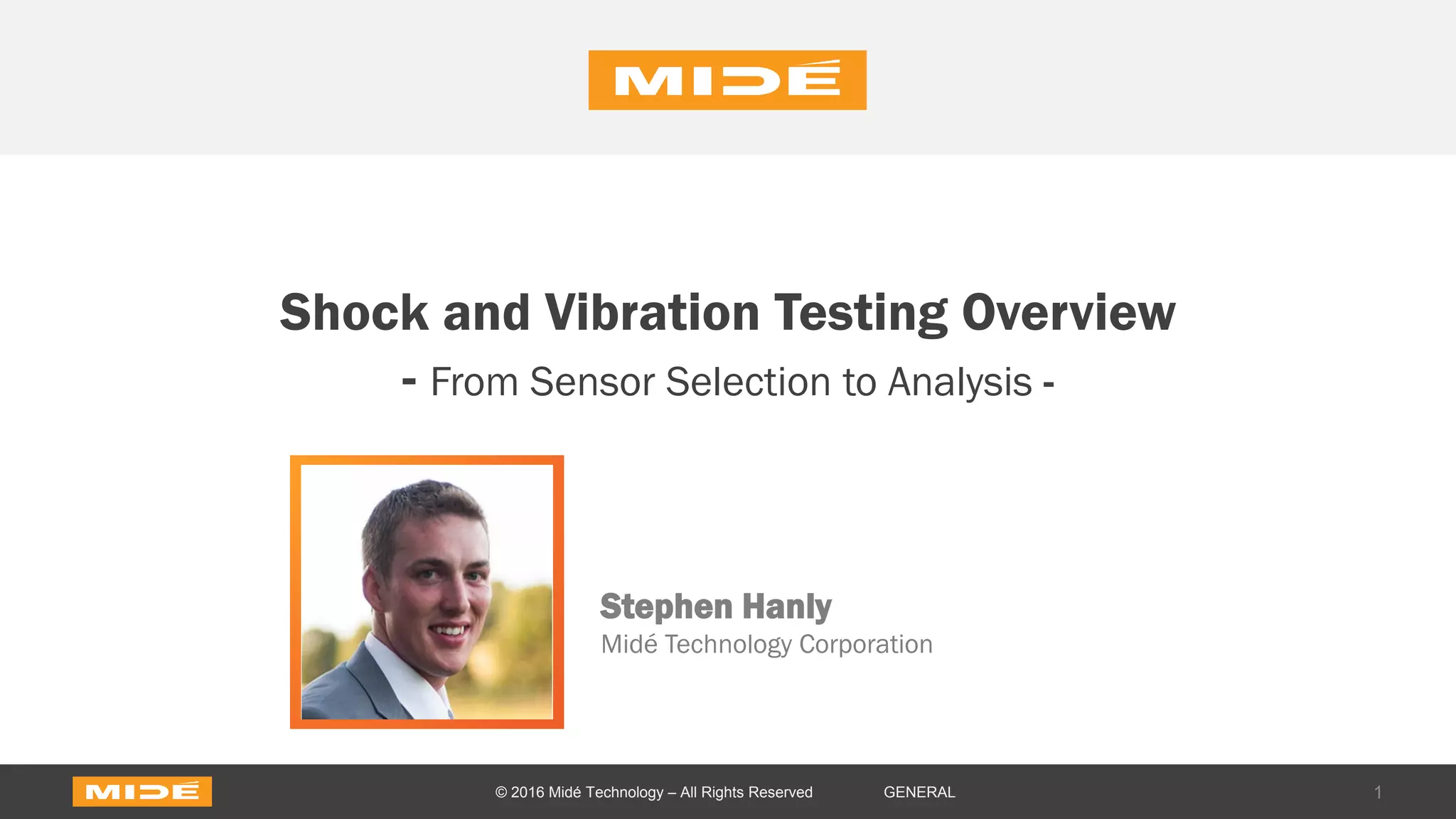
Stephen Hanly
Midé Technology Corporation
1© 2016 Midé Technology – All Rights Reserved GENERAL
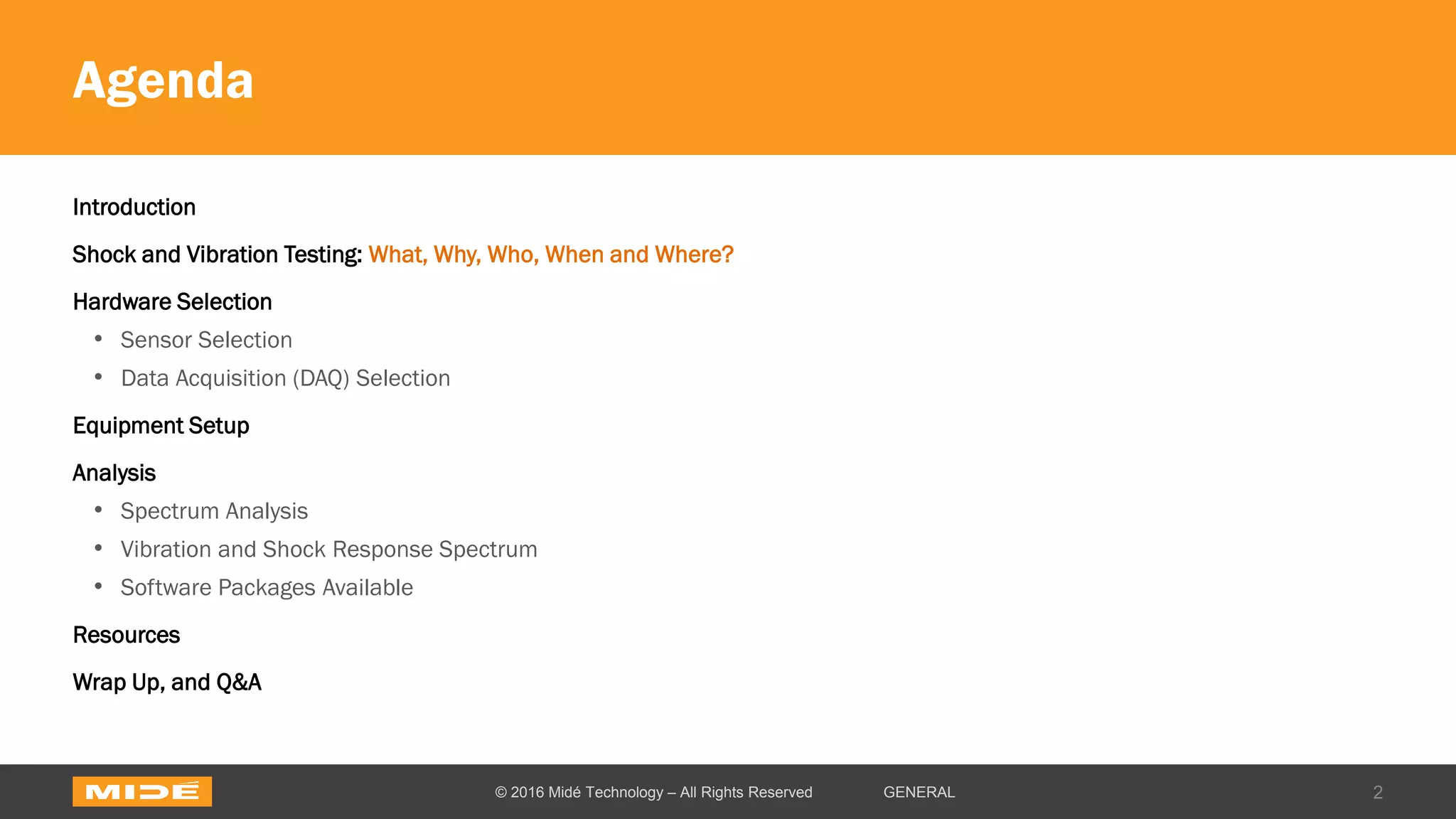
Agenda
Introduction
Shock and Vibration Testing: What, Why, Who, When and Where?
Hardware Selection
• Sensor Selection
• Data Acquisition (DAQ) Selection
Equipment Setup
Analysis
• Spectrum Analysis
• Vibration and Shock Response Spectrum
• Software Packages Available
Resources
Wrap Up, and Q&A
© 2016 Midé Technology – All Rights Reserved GENERAL 2
Shock and Vibration Testing:
What, Why, Who, When and Where?
3© 2016 Midé Technology – All Rights Reserved GENERAL
Shock and Vibration Testing Introduction
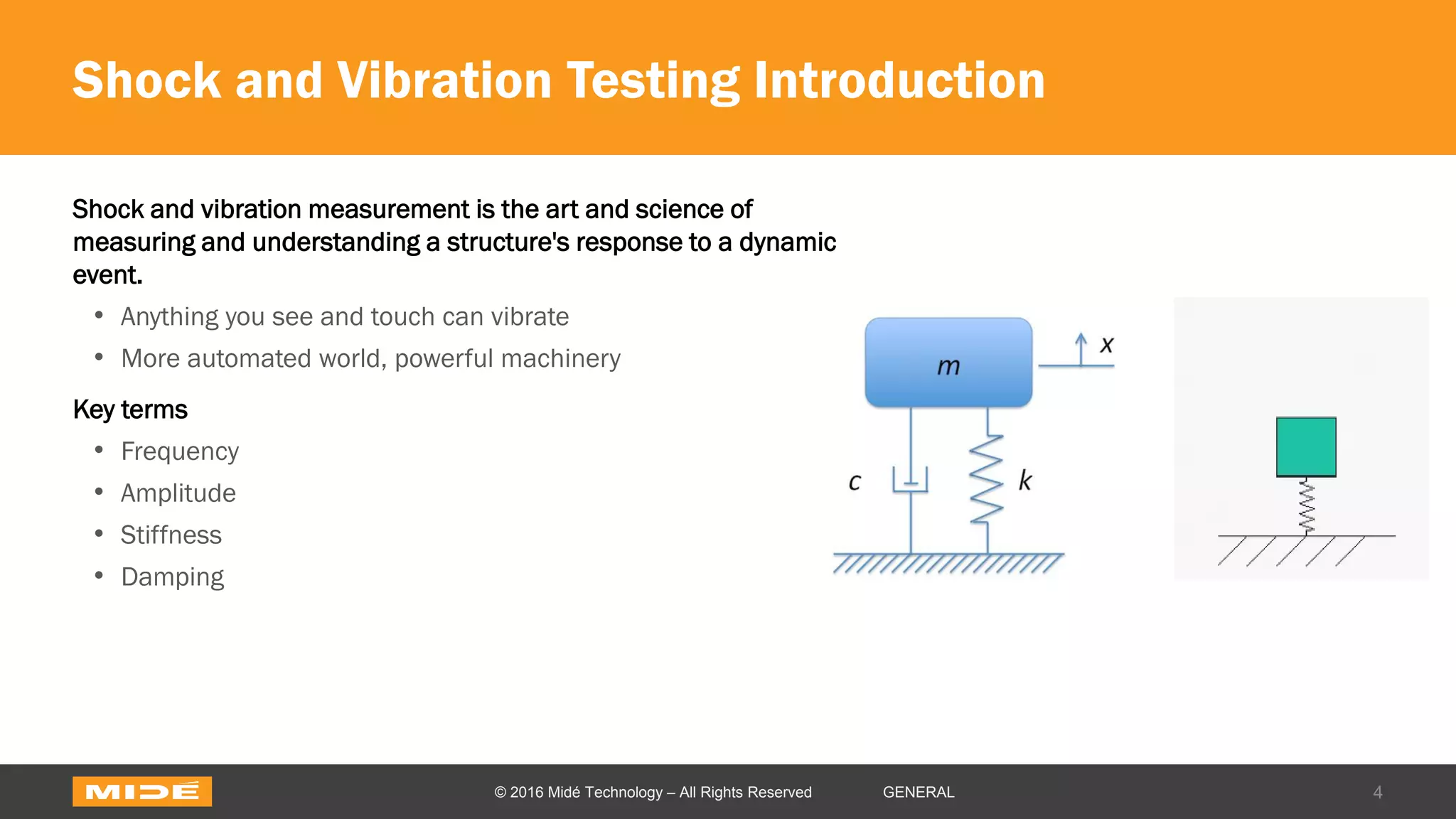
Shock and vibration measurement is the art and science of
measuring and understanding a structure's response to a dynamic
event.
• Anything you see and touch can vibrate
• More automated world, powerful machinery
Key terms
• Frequency
• Amplitude
• Stiffness
• Damping
4© 2016 Midé Technology – All Rights Reserved GENERAL
Shock and Vibration Testing Introduction
5© 2016 Midé Technology – All Rights Reserved GENERAL
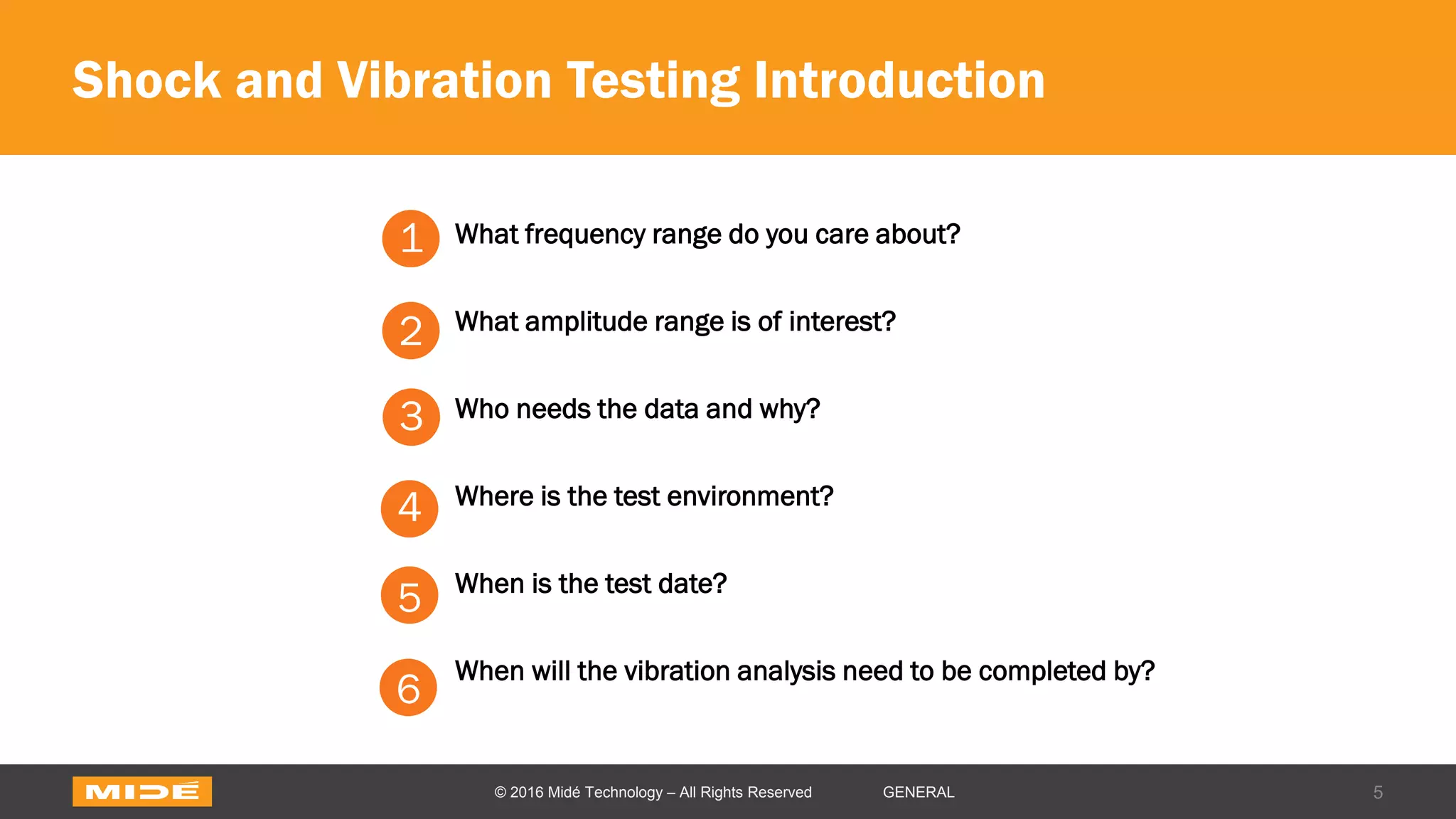
1. What frequency range do you care about?
2. What amplitude range is of interest?
3. Who needs the data and why?
4. Where is the test environment?
5. When is the test date?
6. When will the vibration analysis need to be completed by?
1
2
3
4
5
6
Hardware Setup
6© 2016 Midé Technology – All Rights Reserved GENERAL
Sensor Selection: Accelerometers
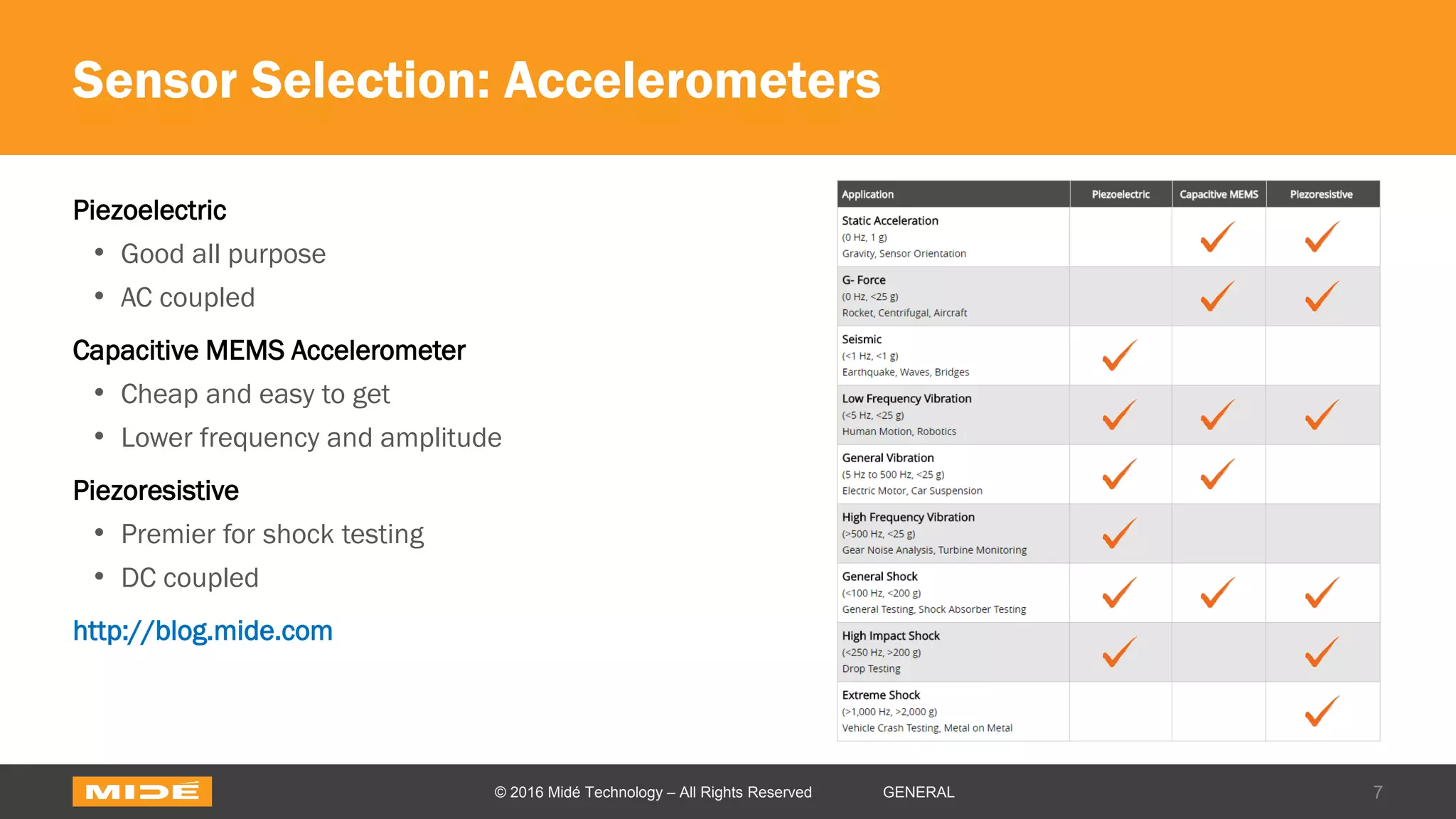
Piezoelectric
• Good all purpose
• AC coupled
Capacitive MEMS Accelerometer
• Cheap and easy to get
• Lower frequency and amplitude
Piezoresistive
• Premier for shock testing
• DC coupled
http://blog.mide.com
7© 2016 Midé Technology – All Rights Reserved GENERAL
Alternatives to Accelerometers
8© 2016 Midé Technology – All Rights Reserved GENERAL
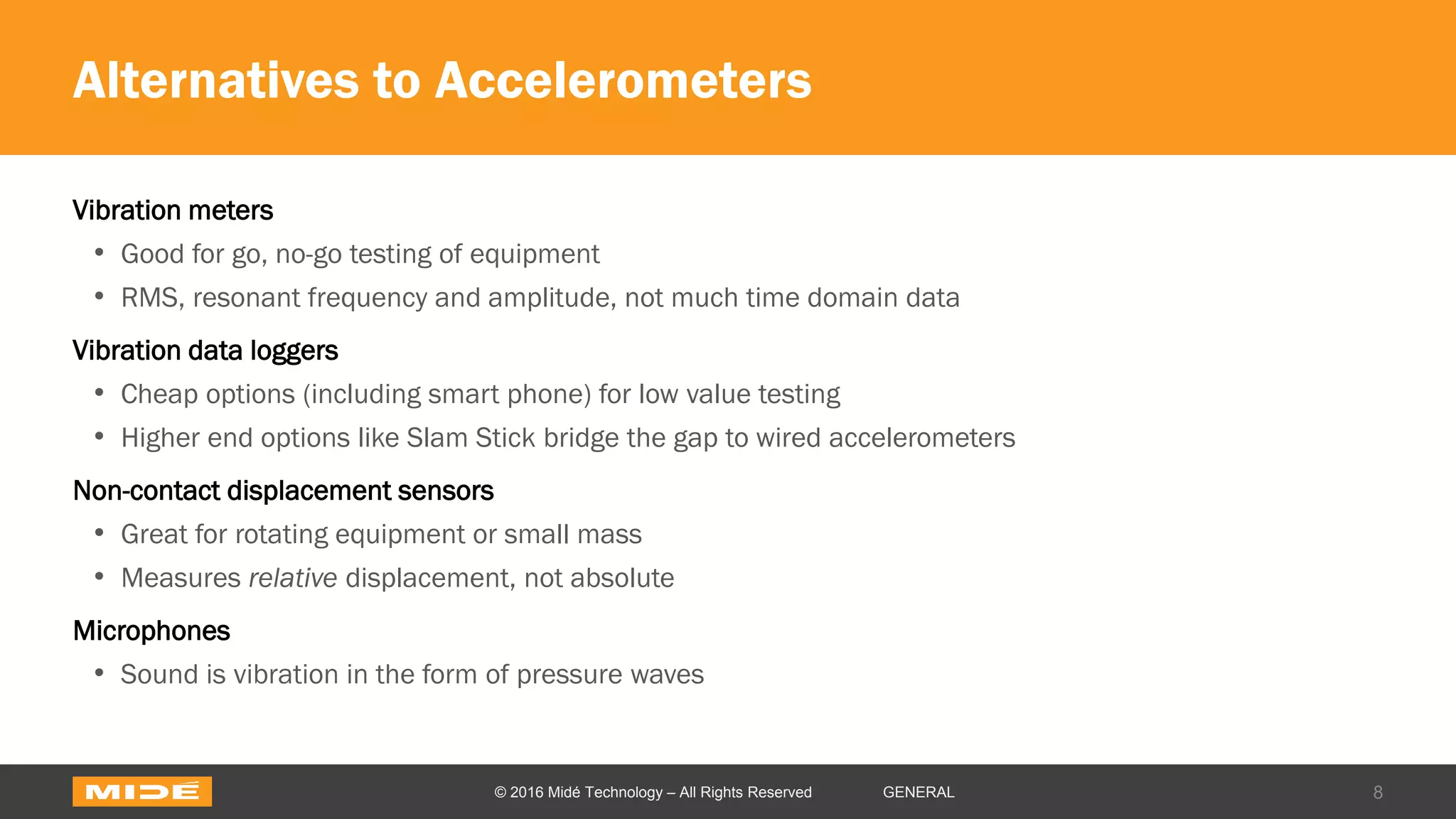
Vibration meters
• Good for go, no-go testing of equipment
• RMS, resonant frequency and amplitude, not much time domain data
Vibration data loggers
• Cheap options (including smart phone) for low value testing
• Higher end options like Slam Stick bridge the gap to wired accelerometers
Non-contact displacement sensors
• Great for rotating equipment or small mass
• Measures relative displacement, not absolute
Microphones
• Sound is vibration in the form of pressure waves
DAQ Selection: Sensor Mating
Digital or analog output?
If analog,
• Voltage range?
• Do I need an amplifier?
How to power the sensor?
9© 2016 Midé Technology – All Rights Reserved GENERAL
1
2
3
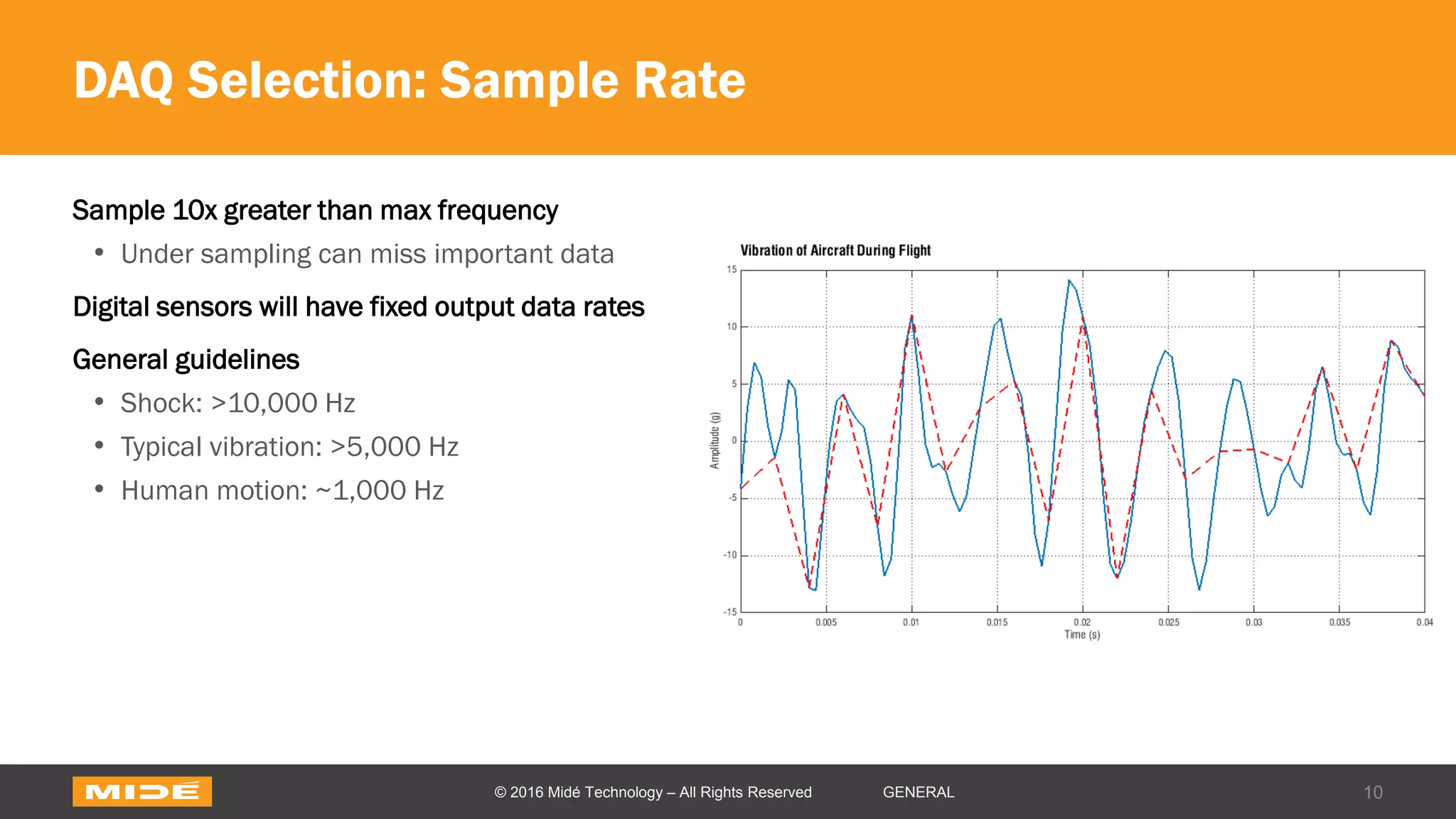
DAQ Selection: Sample Rate
Sample 10x greater than max frequency
• Under sampling can miss important data
Digital sensors will have fixed output data rates
General guidelines
• Shock: >10,000 Hz
• Typical vibration: >5,000 Hz
• Human motion: ~1,000 Hz
10© 2016 Midé Technology – All Rights Reserved GENERAL
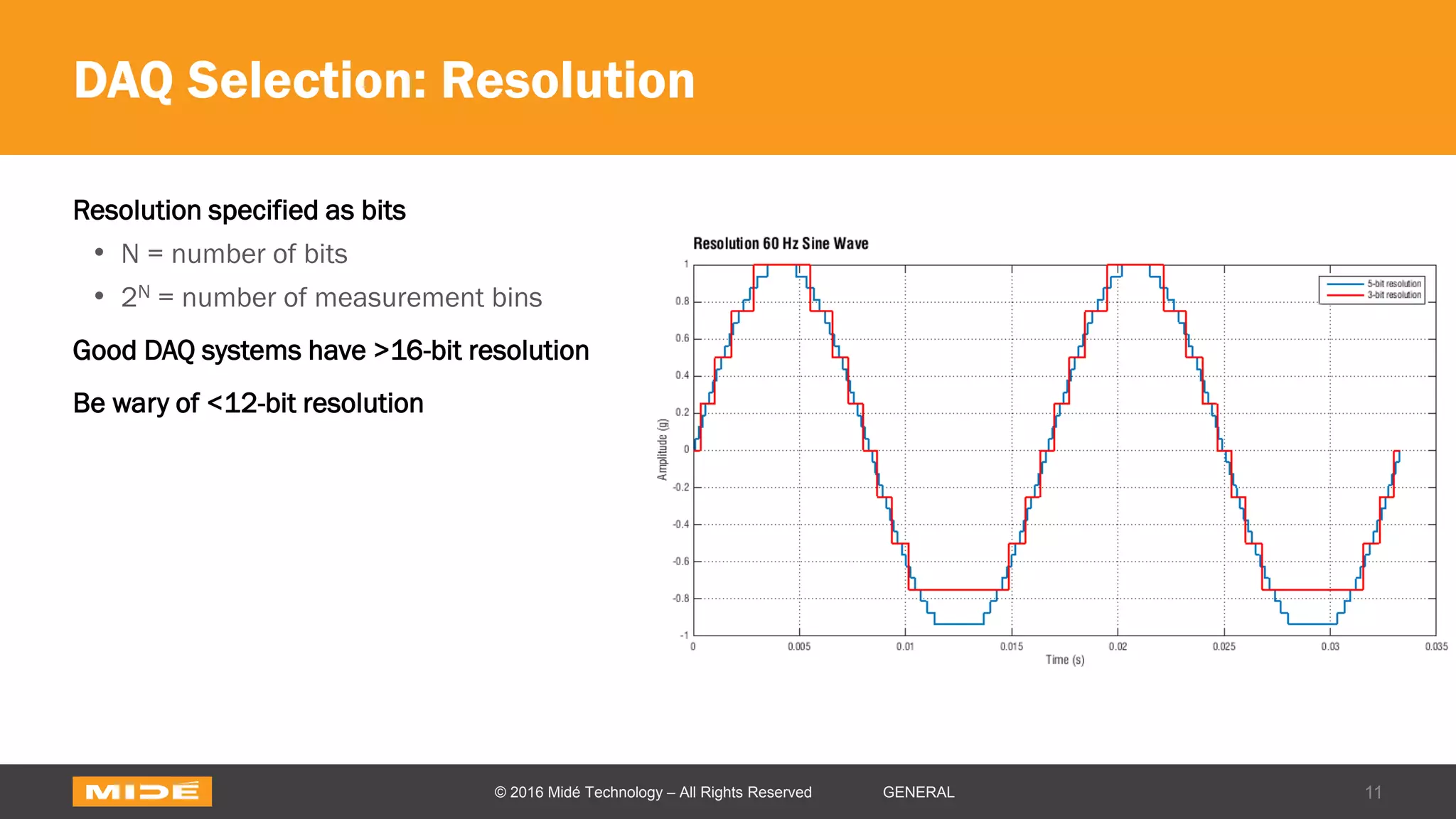
DAQ Selection: Resolution
Resolution specified as bits
• N = number of bits
• 2N = number of measurement bins
Good DAQ systems have >16-bit resolution
Be wary of <12-bit resolution
11© 2016 Midé Technology – All Rights Reserved GENERAL
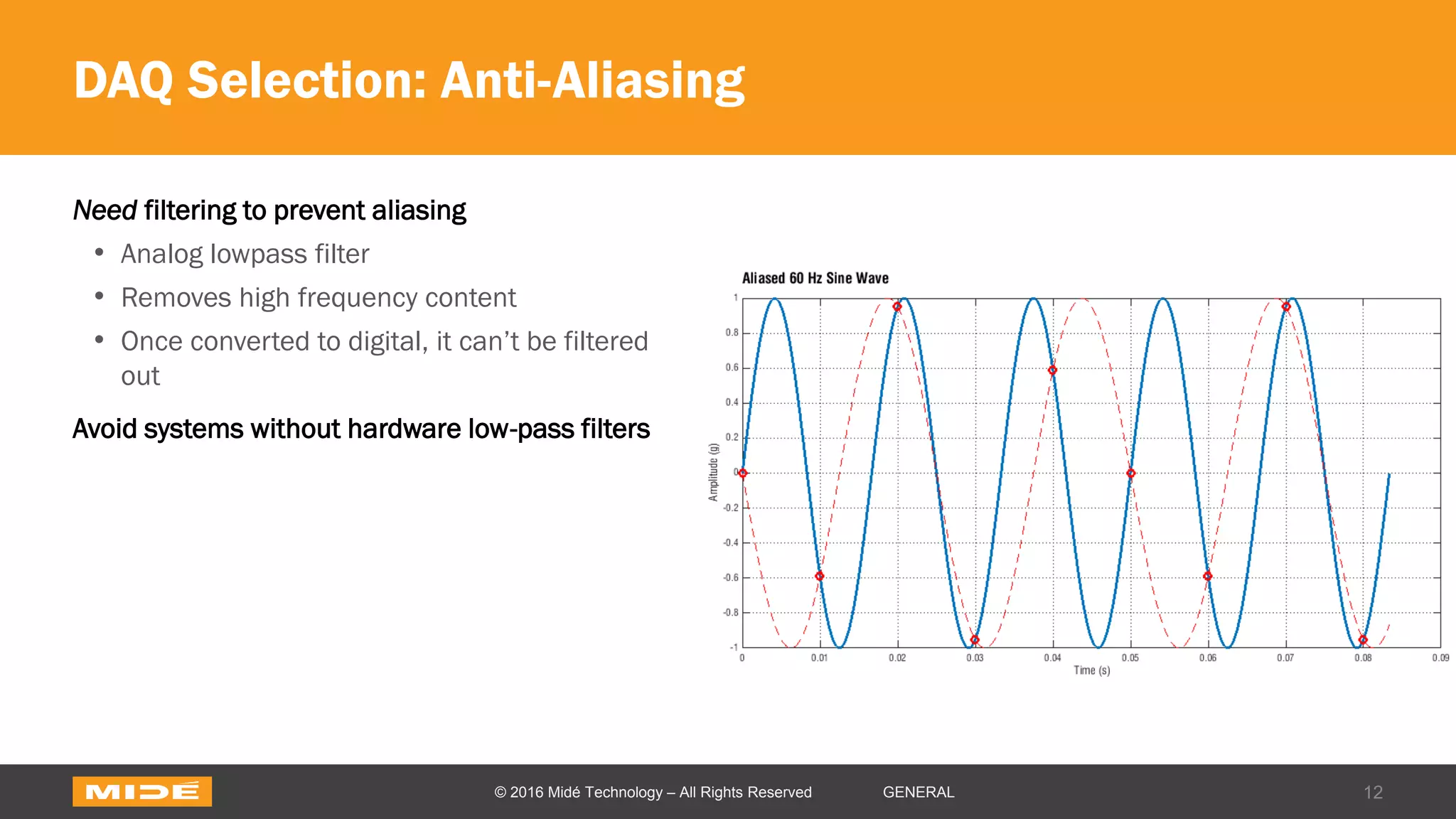
DAQ Selection: Anti-Aliasing
Need filtering to prevent aliasing
• Analog lowpass filter
• Removes high frequency content
• Once converted to digital, it can’t be filtered
out
Avoid systems without hardware low-pass filters
12© 2016 Midé Technology – All Rights Reserved GENERAL
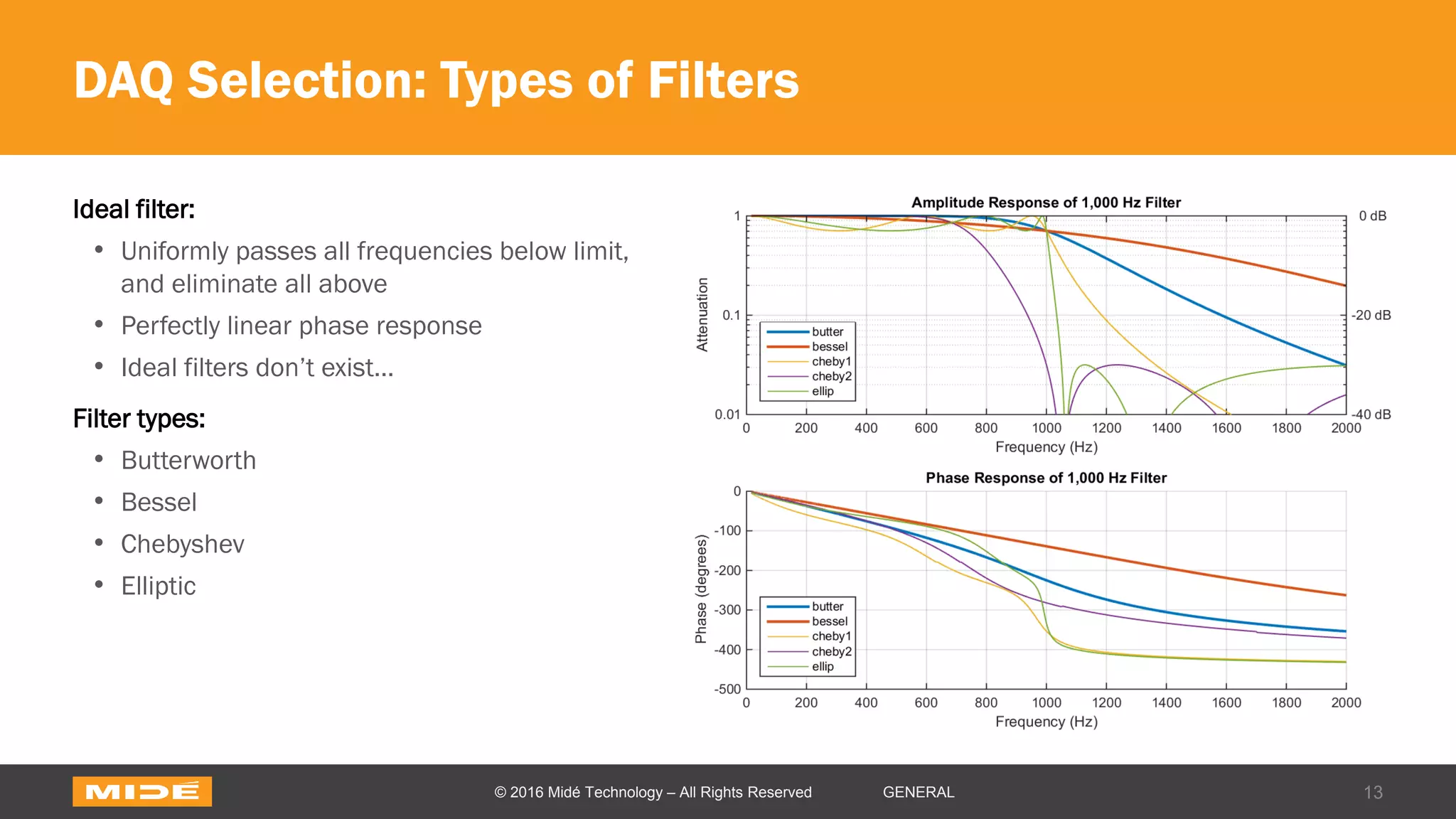
DAQ Selection: Types of Filters
Ideal filter:
• Uniformly passes all frequencies below limit,
and eliminate all above
• Perfectly linear phase response
• Ideal filters don’t exist…
Filter types:
• Butterworth
• Bessel
• Chebyshev
• Elliptic
13© 2016 Midé Technology – All Rights Reserved GENERAL
Equipment Setup
14© 2016 Midé Technology – All Rights Reserved GENERAL
Accelerometer Mounting 1
15© 2016 Midé Technology – All Rights Reserved GENERAL
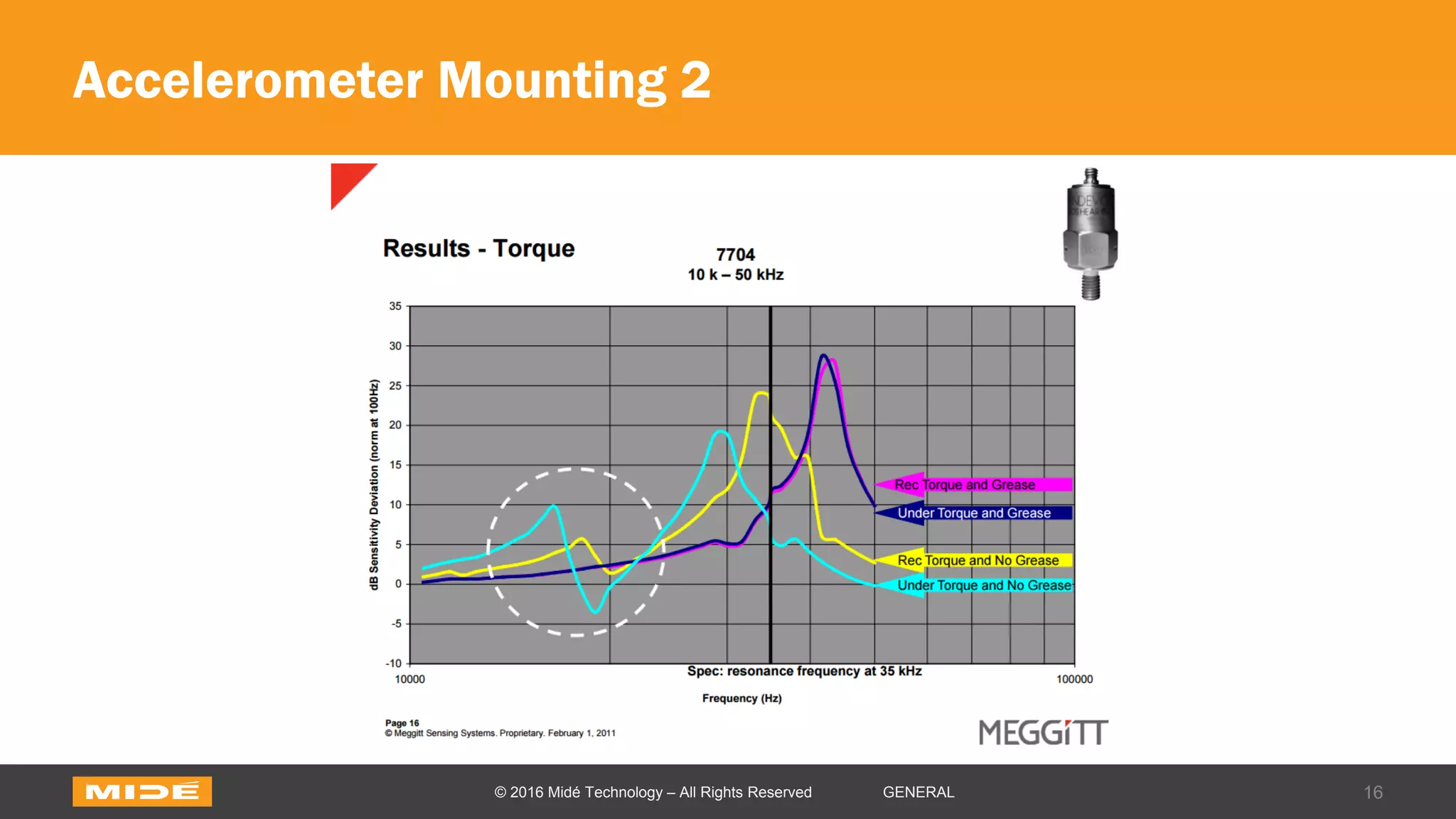
Accelerometer Mounting 2
16© 2016 Midé Technology – All Rights Reserved GENERAL
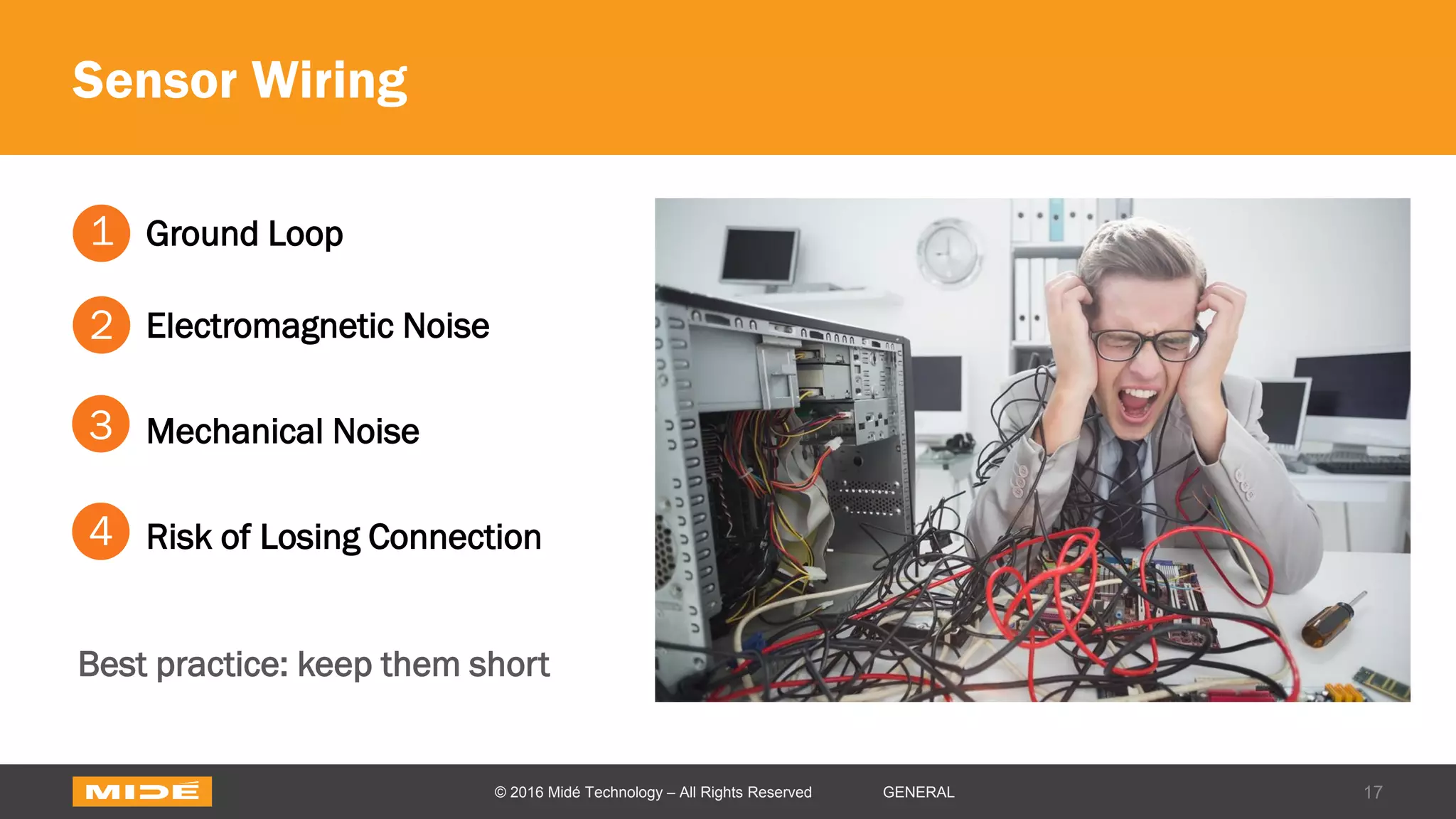
Sensor Wiring
17© 2016 Midé Technology – All Rights Reserved GENERAL
Ground Loop
Electromagnetic Noise
Mechanical Noise
Risk of Losing Connection
1
2
3
4
Best practice: keep them short
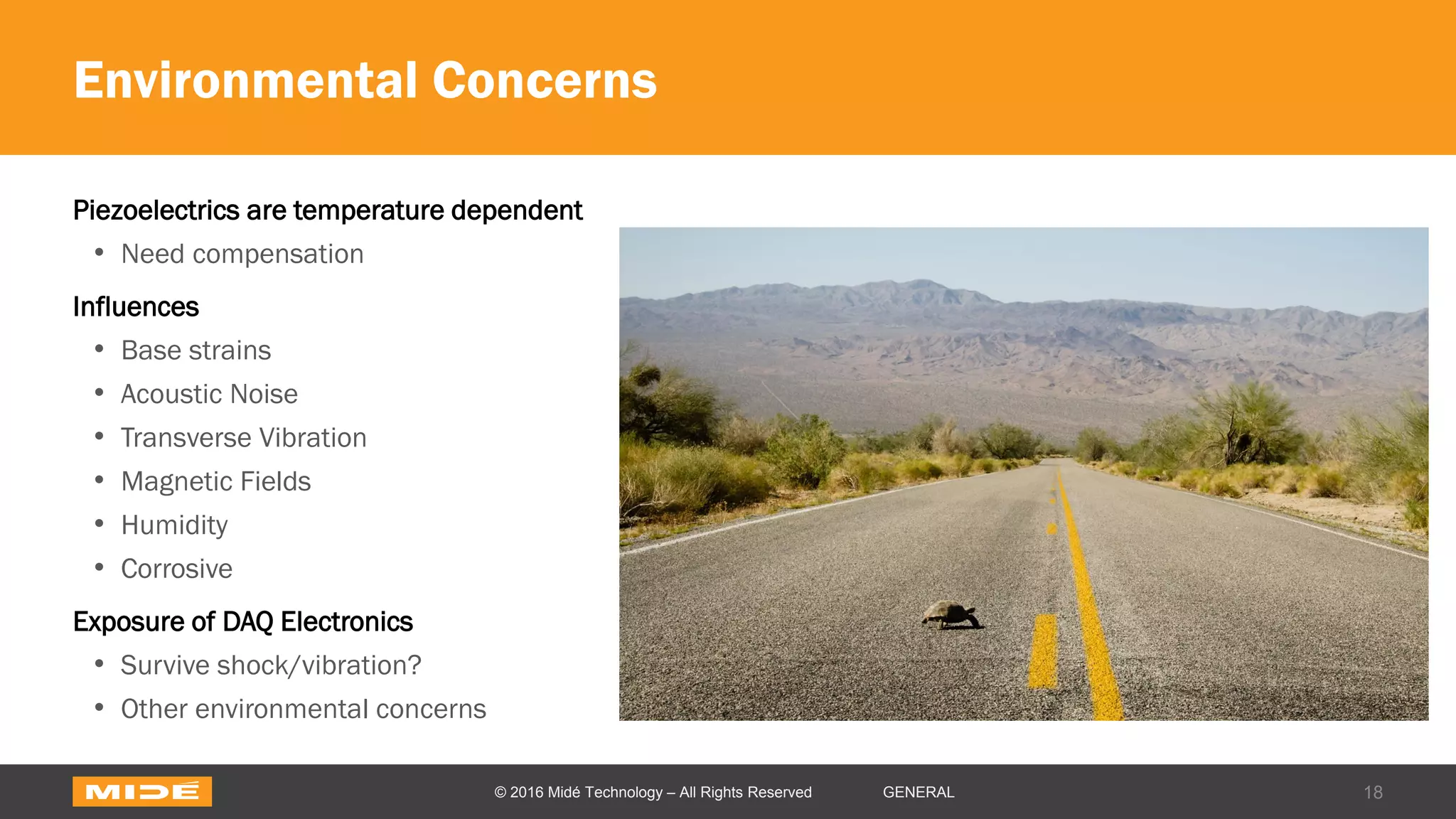
Environmental Concerns
Piezoelectrics are temperature dependent
• Need compensation
Influences
• Base strains
• Acoustic Noise
• Transverse Vibration
• Magnetic Fields
• Humidity
• Corrosive
Exposure of DAQ Electronics
• Survive shock/vibration?
• Other environmental concerns
18© 2016 Midé Technology – All Rights Reserved GENERAL
Shock and Vibration Analysis
19© 2016 Midé Technology – All Rights Reserved GENERAL
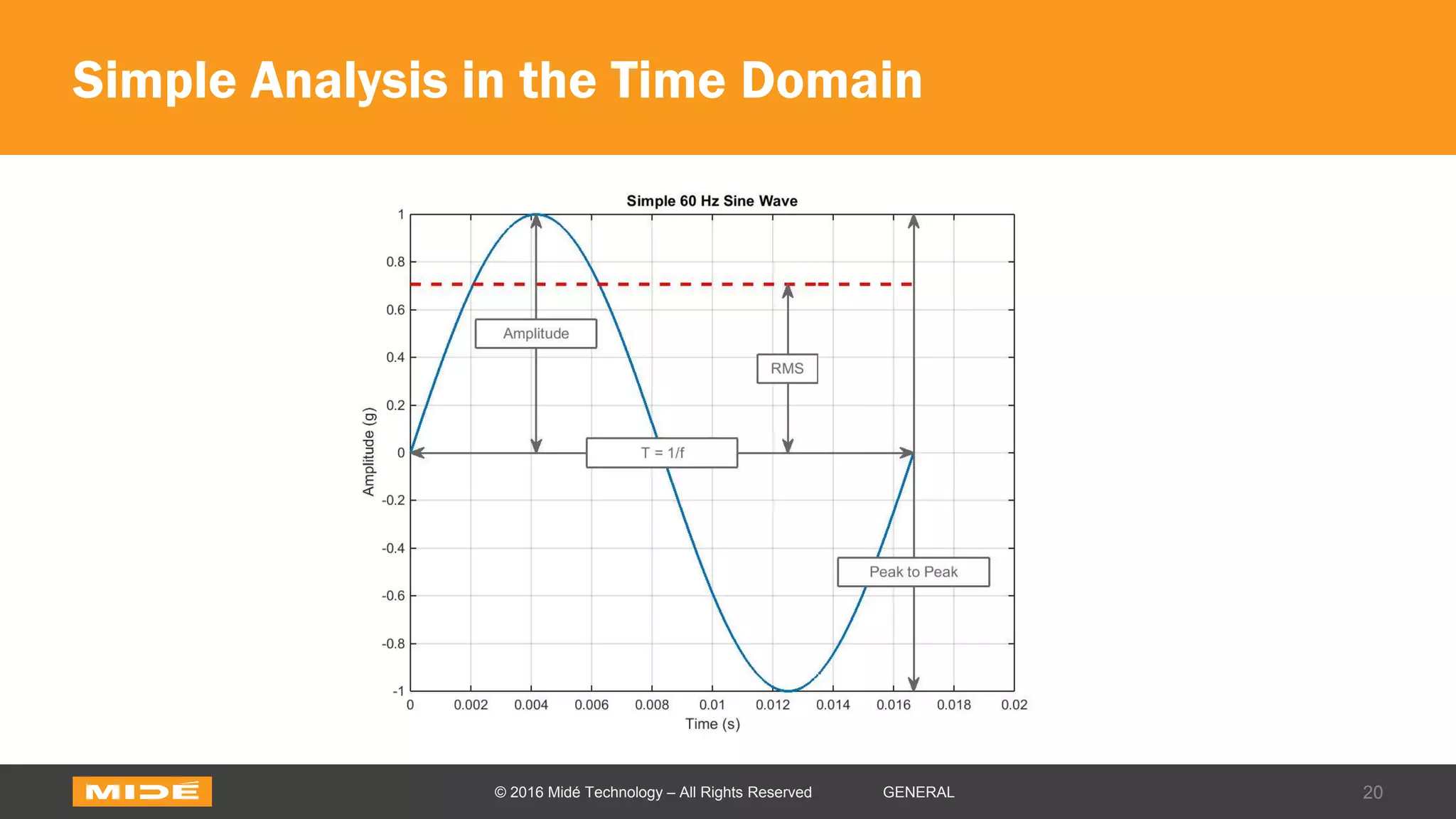
Simple Analysis in the Time Domain
20© 2016 Midé Technology – All Rights Reserved GENERAL
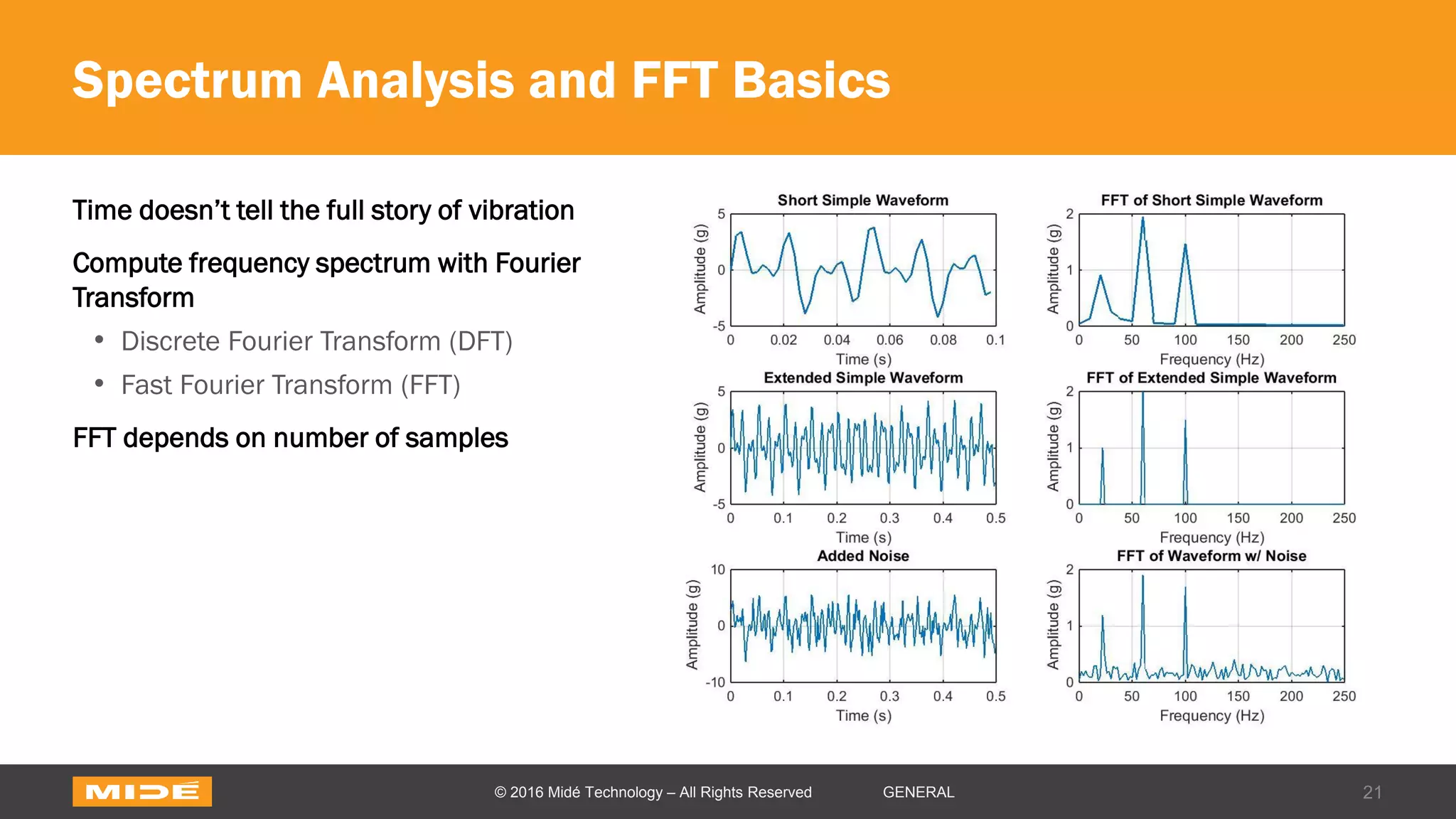
Spectrum Analysis and FFT Basics
21© 2016 Midé Technology – All Rights Reserved GENERAL
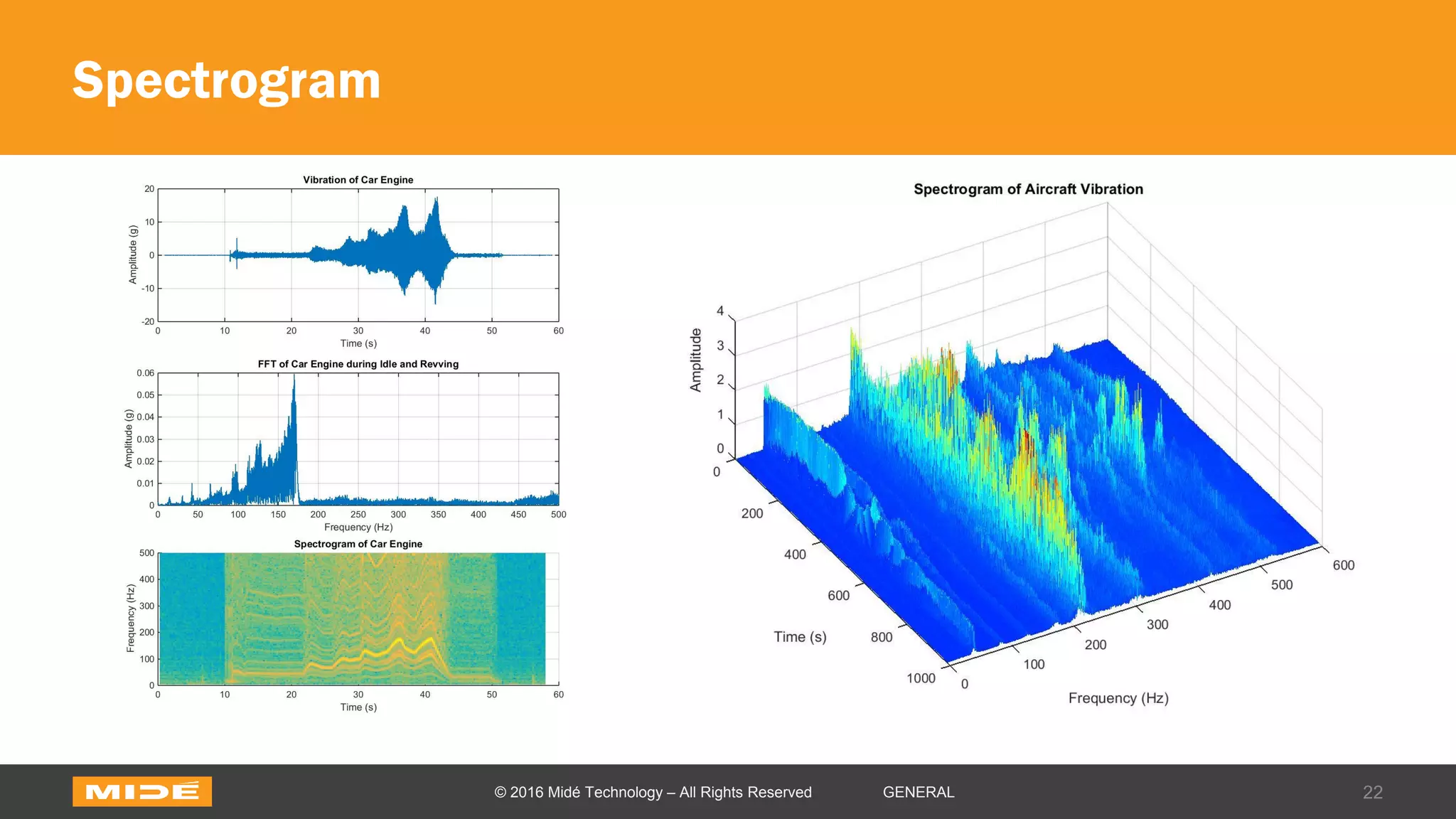
Time doesn’t tell the full story of vibration
Compute frequency spectrum with Fourier
Transform
• Discrete Fourier Transform (DFT)
• Fast Fourier Transform (FFT)
FFT depends on number of samples
Spectrogram
22© 2016 Midé Technology – All Rights Reserved GENERAL
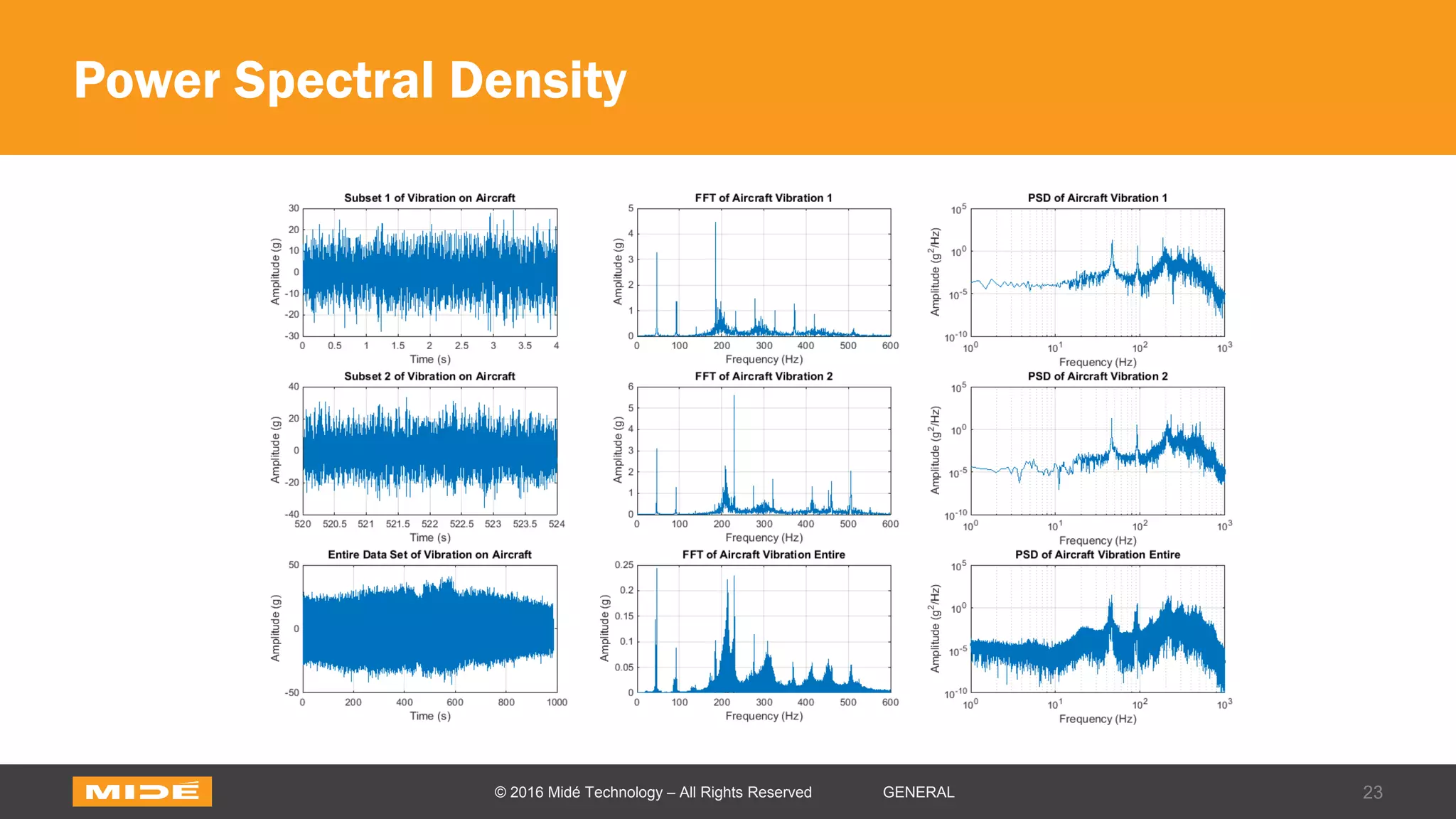
Power Spectral Density
23© 2016 Midé Technology – All Rights Reserved GENERAL
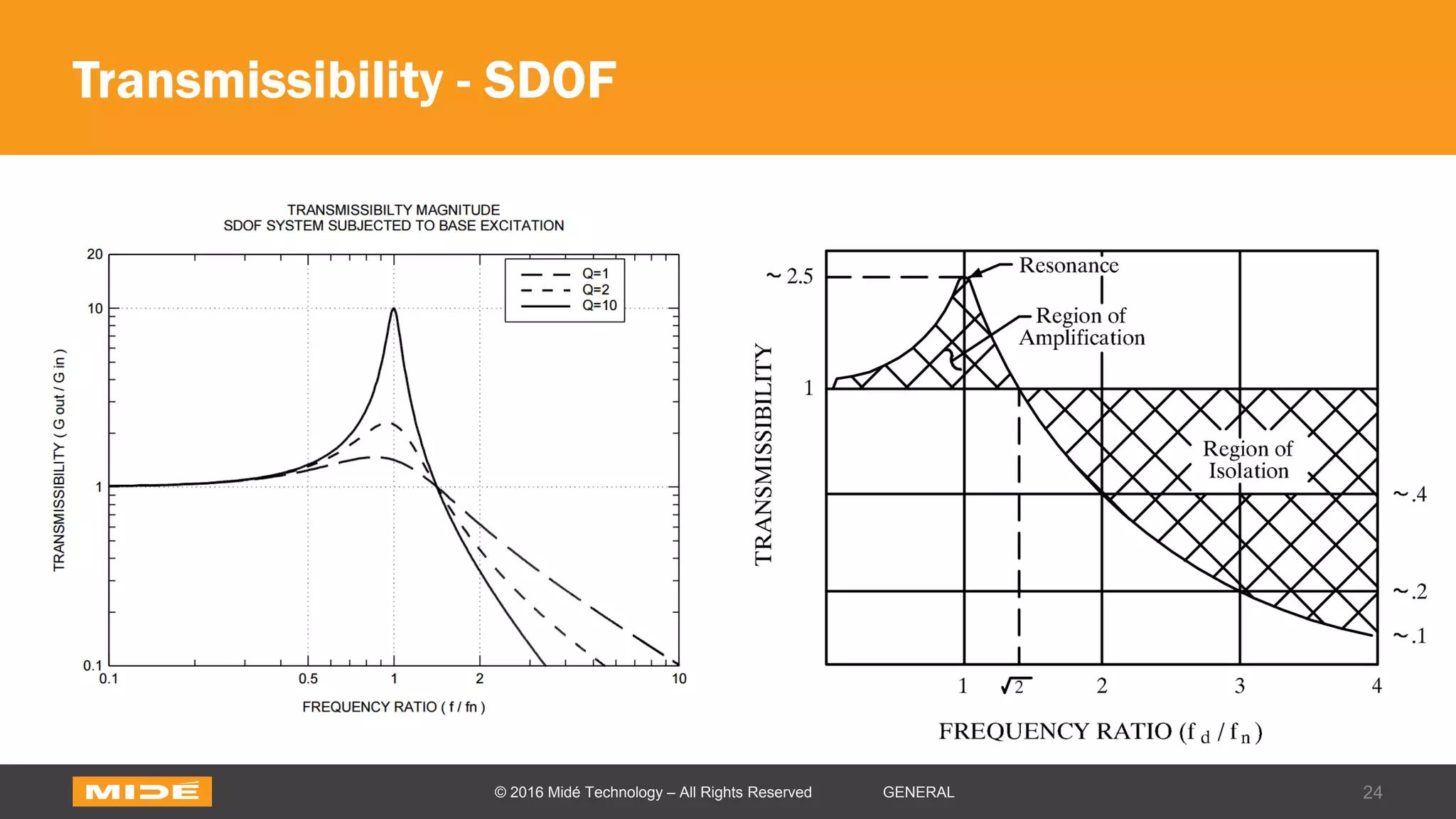
Transmissibility - SDOF
24© 2016 Midé Technology – All Rights Reserved GENERAL
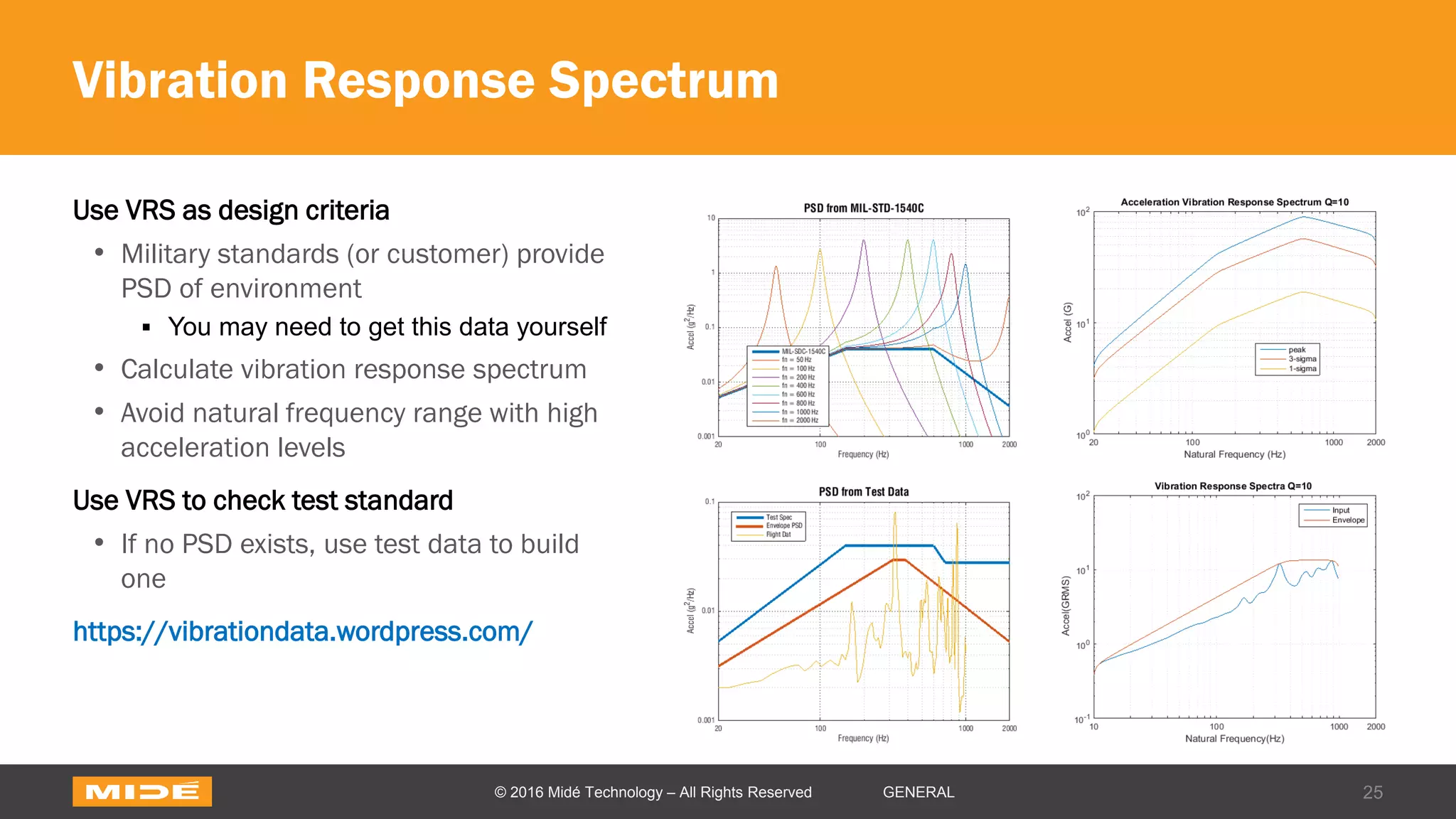
Vibration Response Spectrum
Use VRS as design criteria
• Military standards (or customer) provide
PSD of environment
 You may need to get this data yourself
• Calculate vibration response spectrum
• Avoid natural frequency range with high
acceleration levels
Use VRS to check test standard
• If no PSD exists, use test data to build
one
https://vibrationdata.wordpress.com/
25© 2016 Midé Technology – All Rights Reserved GENERAL
Shock Response Spectrum
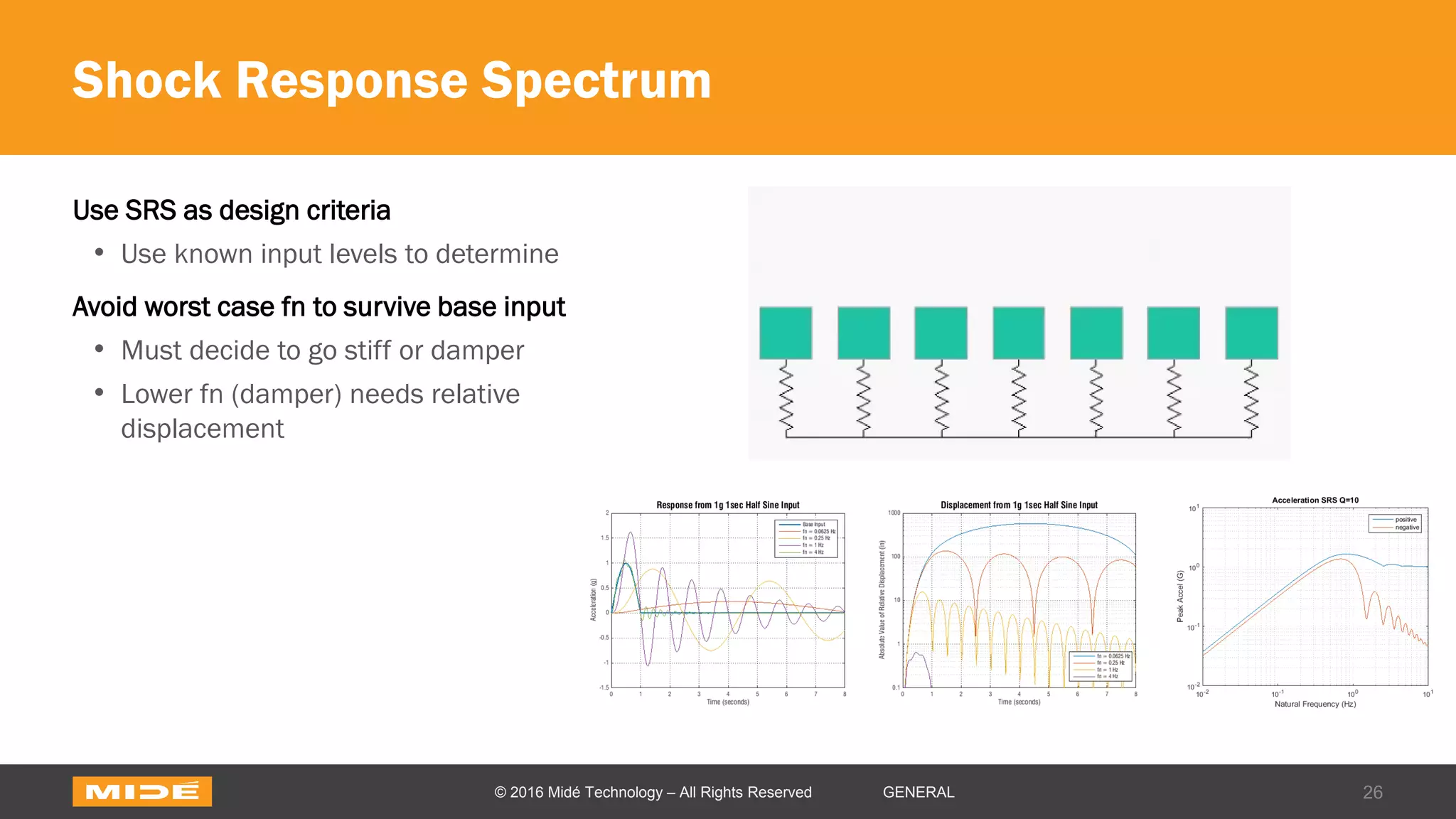
Use SRS as design criteria
• Use known input levels to determine
Avoid worst case fn to survive base input
• Must decide to go stiff or damper
• Lower fn (damper) needs relative
displacement
26© 2016 Midé Technology – All Rights Reserved GENERAL
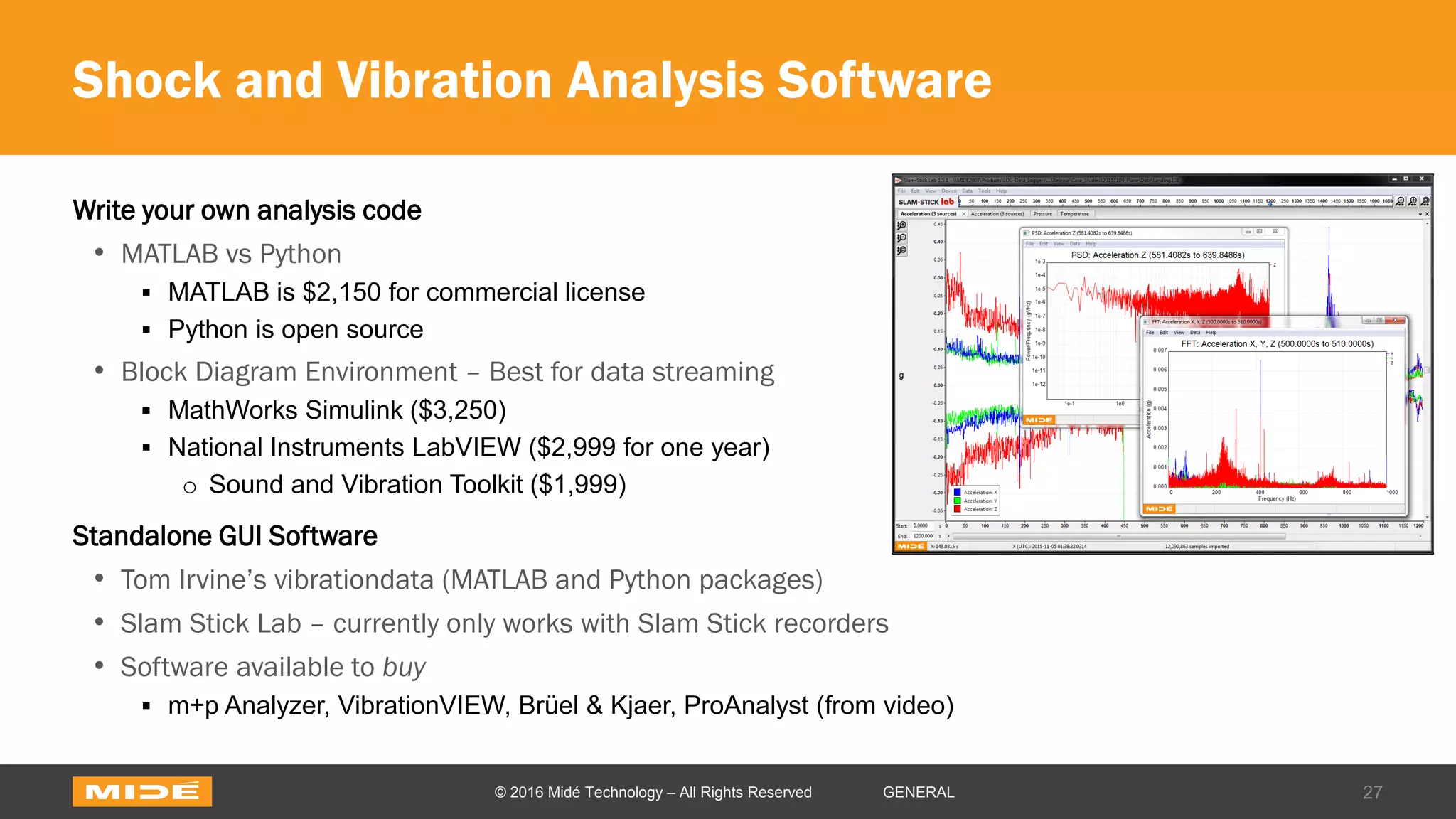
Shock and Vibration Analysis Software
Write your own analysis code
• MATLAB vs Python
 MATLAB is $2,150 for commercial license
 Python is open source
• Block Diagram Environment – Best for data streaming
 MathWorks Simulink ($3,250)
 National Instruments LabVIEW ($2,999 for one year)
o Sound and Vibration Toolkit ($1,999)
Standalone GUI Software
• Tom Irvine’s vibrationdata (MATLAB and Python packages)
• Slam Stick Lab – currently only works with Slam Stick recorders
• Software available to buy
 m+p Analyzer, VibrationVIEW, Brüel & Kjaer, ProAnalyst (from video)
27© 2016 Midé Technology – All Rights Reserved GENERAL
Wrap Up
28© 2016 Midé Technology – All Rights Reserved GENERAL
Summary
Shock and vibration measurement is an art and a science
What, Why, Who, When and Where?
• Types of accelerometers
• Alternatives to wired accelerometers
• DAQ selection
• Analysis
Analysis is the best; but most critical part
• Explore the software options available
Utilize online resources to learn!
29© 2016 Midé Technology – All Rights Reserved GENERAL
Resources
https://vibrationdata.wordpress.com/
http://blog.mide.com/
MEGGITT (Endevco) Technical Papers
PCB Piezotronics Technical Papers
Books
• Mechanical Vibration and Shock Measurements by Brüel and Kjaer
• Vibration Testing – Theory and Practice by Kenneth McConnell
• Shock and Vibration Handbook by Cyril Harris
30© 2016 Midé Technology – All Rights Reserved GENERAL
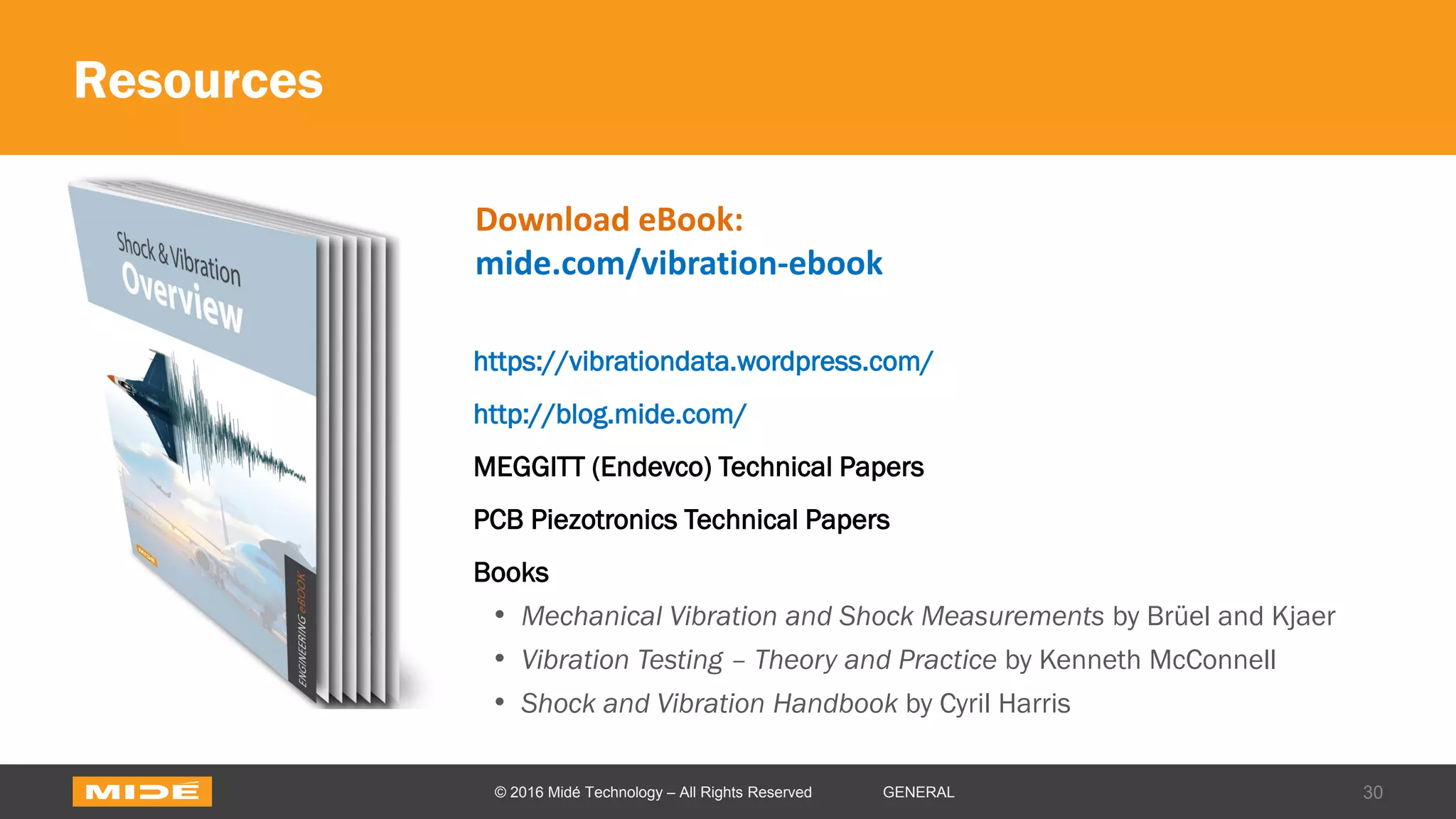
Download eBook:
mide.com/vibration-ebook
Thank You
Questions?
31© 2016 Midé Technology – All Rights Reserved GENERAL

Shock & Vibration Testing - Overview

  • 1.
    Shock and VibrationTesting Overview - From Sensor Selection to Analysis - Stephen Hanly Midé Technology Corporation 1© 2016 Midé Technology – All Rights Reserved GENERAL
  • 2.
    Agenda Introduction Shock and VibrationTesting: What, Why, Who, When and Where? Hardware Selection • Sensor Selection • Data Acquisition (DAQ) Selection Equipment Setup Analysis • Spectrum Analysis • Vibration and Shock Response Spectrum • Software Packages Available Resources Wrap Up, and Q&A © 2016 Midé Technology – All Rights Reserved GENERAL 2
  • 3.
    Shock and VibrationTesting: What, Why, Who, When and Where? 3© 2016 Midé Technology – All Rights Reserved GENERAL
  • 4.
    Shock and VibrationTesting Introduction Shock and vibration measurement is the art and science of measuring and understanding a structure's response to a dynamic event. • Anything you see and touch can vibrate • More automated world, powerful machinery Key terms • Frequency • Amplitude • Stiffness • Damping 4© 2016 Midé Technology – All Rights Reserved GENERAL
  • 5.
    Shock and VibrationTesting Introduction 5© 2016 Midé Technology – All Rights Reserved GENERAL 1. What frequency range do you care about? 2. What amplitude range is of interest? 3. Who needs the data and why? 4. Where is the test environment? 5. When is the test date? 6. When will the vibration analysis need to be completed by? 1 2 3 4 5 6
  • 6.
    Hardware Setup 6© 2016Midé Technology – All Rights Reserved GENERAL
  • 7.
    Sensor Selection: Accelerometers Piezoelectric •Good all purpose • AC coupled Capacitive MEMS Accelerometer • Cheap and easy to get • Lower frequency and amplitude Piezoresistive • Premier for shock testing • DC coupled http://blog.mide.com 7© 2016 Midé Technology – All Rights Reserved GENERAL
  • 8.
    Alternatives to Accelerometers 8©2016 Midé Technology – All Rights Reserved GENERAL Vibration meters • Good for go, no-go testing of equipment • RMS, resonant frequency and amplitude, not much time domain data Vibration data loggers • Cheap options (including smart phone) for low value testing • Higher end options like Slam Stick bridge the gap to wired accelerometers Non-contact displacement sensors • Great for rotating equipment or small mass • Measures relative displacement, not absolute Microphones • Sound is vibration in the form of pressure waves
  • 9.
    DAQ Selection: SensorMating Digital or analog output? If analog, • Voltage range? • Do I need an amplifier? How to power the sensor? 9© 2016 Midé Technology – All Rights Reserved GENERAL 1 2 3
  • 10.
    DAQ Selection: SampleRate Sample 10x greater than max frequency • Under sampling can miss important data Digital sensors will have fixed output data rates General guidelines • Shock: >10,000 Hz • Typical vibration: >5,000 Hz • Human motion: ~1,000 Hz 10© 2016 Midé Technology – All Rights Reserved GENERAL
  • 11.
    DAQ Selection: Resolution Resolutionspecified as bits • N = number of bits • 2N = number of measurement bins Good DAQ systems have >16-bit resolution Be wary of <12-bit resolution 11© 2016 Midé Technology – All Rights Reserved GENERAL
  • 12.
    DAQ Selection: Anti-Aliasing Needfiltering to prevent aliasing • Analog lowpass filter • Removes high frequency content • Once converted to digital, it can’t be filtered out Avoid systems without hardware low-pass filters 12© 2016 Midé Technology – All Rights Reserved GENERAL
  • 13.
    DAQ Selection: Typesof Filters Ideal filter: • Uniformly passes all frequencies below limit, and eliminate all above • Perfectly linear phase response • Ideal filters don’t exist… Filter types: • Butterworth • Bessel • Chebyshev • Elliptic 13© 2016 Midé Technology – All Rights Reserved GENERAL
  • 14.
    Equipment Setup 14© 2016Midé Technology – All Rights Reserved GENERAL
  • 15.
    Accelerometer Mounting 1 15©2016 Midé Technology – All Rights Reserved GENERAL
  • 16.
    Accelerometer Mounting 2 16©2016 Midé Technology – All Rights Reserved GENERAL
  • 17.
    Sensor Wiring 17© 2016Midé Technology – All Rights Reserved GENERAL Ground Loop Electromagnetic Noise Mechanical Noise Risk of Losing Connection 1 2 3 4 Best practice: keep them short
  • 18.
    Environmental Concerns Piezoelectrics aretemperature dependent • Need compensation Influences • Base strains • Acoustic Noise • Transverse Vibration • Magnetic Fields • Humidity • Corrosive Exposure of DAQ Electronics • Survive shock/vibration? • Other environmental concerns 18© 2016 Midé Technology – All Rights Reserved GENERAL
  • 19.
    Shock and VibrationAnalysis 19© 2016 Midé Technology – All Rights Reserved GENERAL
  • 20.
    Simple Analysis inthe Time Domain 20© 2016 Midé Technology – All Rights Reserved GENERAL
  • 21.
    Spectrum Analysis andFFT Basics 21© 2016 Midé Technology – All Rights Reserved GENERAL Time doesn’t tell the full story of vibration Compute frequency spectrum with Fourier Transform • Discrete Fourier Transform (DFT) • Fast Fourier Transform (FFT) FFT depends on number of samples
  • 22.
    Spectrogram 22© 2016 MidéTechnology – All Rights Reserved GENERAL
  • 23.
    Power Spectral Density 23©2016 Midé Technology – All Rights Reserved GENERAL
  • 24.
    Transmissibility - SDOF 24©2016 Midé Technology – All Rights Reserved GENERAL
  • 25.
    Vibration Response Spectrum UseVRS as design criteria • Military standards (or customer) provide PSD of environment  You may need to get this data yourself • Calculate vibration response spectrum • Avoid natural frequency range with high acceleration levels Use VRS to check test standard • If no PSD exists, use test data to build one https://vibrationdata.wordpress.com/ 25© 2016 Midé Technology – All Rights Reserved GENERAL
  • 26.
    Shock Response Spectrum UseSRS as design criteria • Use known input levels to determine Avoid worst case fn to survive base input • Must decide to go stiff or damper • Lower fn (damper) needs relative displacement 26© 2016 Midé Technology – All Rights Reserved GENERAL
  • 27.
    Shock and VibrationAnalysis Software Write your own analysis code • MATLAB vs Python  MATLAB is $2,150 for commercial license  Python is open source • Block Diagram Environment – Best for data streaming  MathWorks Simulink ($3,250)  National Instruments LabVIEW ($2,999 for one year) o Sound and Vibration Toolkit ($1,999) Standalone GUI Software • Tom Irvine’s vibrationdata (MATLAB and Python packages) • Slam Stick Lab – currently only works with Slam Stick recorders • Software available to buy  m+p Analyzer, VibrationVIEW, Brüel & Kjaer, ProAnalyst (from video) 27© 2016 Midé Technology – All Rights Reserved GENERAL
  • 28.
    Wrap Up 28© 2016Midé Technology – All Rights Reserved GENERAL
  • 29.
    Summary Shock and vibrationmeasurement is an art and a science What, Why, Who, When and Where? • Types of accelerometers • Alternatives to wired accelerometers • DAQ selection • Analysis Analysis is the best; but most critical part • Explore the software options available Utilize online resources to learn! 29© 2016 Midé Technology – All Rights Reserved GENERAL
  • 30.
    Resources https://vibrationdata.wordpress.com/ http://blog.mide.com/ MEGGITT (Endevco) TechnicalPapers PCB Piezotronics Technical Papers Books • Mechanical Vibration and Shock Measurements by Brüel and Kjaer • Vibration Testing – Theory and Practice by Kenneth McConnell • Shock and Vibration Handbook by Cyril Harris 30© 2016 Midé Technology – All Rights Reserved GENERAL Download eBook: mide.com/vibration-ebook
  • 31.
    Thank You Questions? 31© 2016Midé Technology – All Rights Reserved GENERAL