Sludge Bulking
PAPR 3531
Bulking Sludge
General definition:
A secondary (biological) sludge with poor
settling and compaction characteristics
Bulking sludges are more of a concern with activated
sludge treatment but also can occur in aerated
stabilization basins
Significance
Why care?
 High TSS and associated BOD
(~0.1-0.8 lb BOD/lb TSS) in
effluent, possibly resulting in
a permit violation
 Difficulty in achieving desired
solids in RAS and therefore
difficulty in controlling
activated sludge system
Origins of High TSS and/or
Sludge Settling Problems
Equipment design and condition (mechanical
problems):
 Uneven flow splitting (parallel clarifiers)
 Inlet and outlet structures (flow distribution, velocity
dissipation)
 Flocculation chamber
 Weir placement and condition
 Sludge removal mechanism
 Hydraulic overloading or surges
 Solids overloading or surges
 Wind-created or thermal-induced currents
Origins of High TSS and/or
Sludge Settling Problems
Problems related to solids
characteristics:
 Pin floc (from high shear/over-aeration,
low F/M, toxicity)
 Dispersed growth (from high F/M, low
nutrients)
 Rising sludge (from anaerobic gases)
 Severe foam or scum (from surfactants,
high F/M or low F/M filaments)
 Viscous bulking
 Filamentous bulking
Viscous Bulking
 a.k.a. slime, polysaccharide, hydrous, non-filamentous or
zoogloeal bulking
 Extracellular polymeric substances (EPS) surround
bacterial cells and consist of carbohydrates (i.e.,
polysaccharides), proteins, and other substances
 EPS is critical to ability of bacteria to flocculate, settle,
and dewater
 With viscous bulking, polysaccharide content is higher
than normal, which causes the density of bacteria to be
reduced (poor settling)
 Generally caused by nutrient deficiency (not enough
nitrogen or phosphorus)
Filamentous Bulking
The most common of settling and
compaction problems
Filamentous Bulking
The culprits: Filamentous
organisms (bacteria, possibly
fungi)
 Their shape is long and narrow
(length >> width)
 They remove BOD (good)
 In small concentrations they provide
physical support to flocs (good)
 At high concentrations they interfere
with settling in secondary clarifiers
(bad)
Filamentous Bulking Characteristics
 Poor compaction of sludge blanket (high
blanket level)
 If there is a supernatant, it is usually very clear
 High Sludge Volume Index (SVI)
 Large, strong flocs, but they settle poorly
 Filamentous bacteria predominate, as can be
seen with MLSS sample and a 100x microscope
Activated Sludge Under the Microscope
Good floc structure Poor floc structure
Sludge Volume Index (SVI)
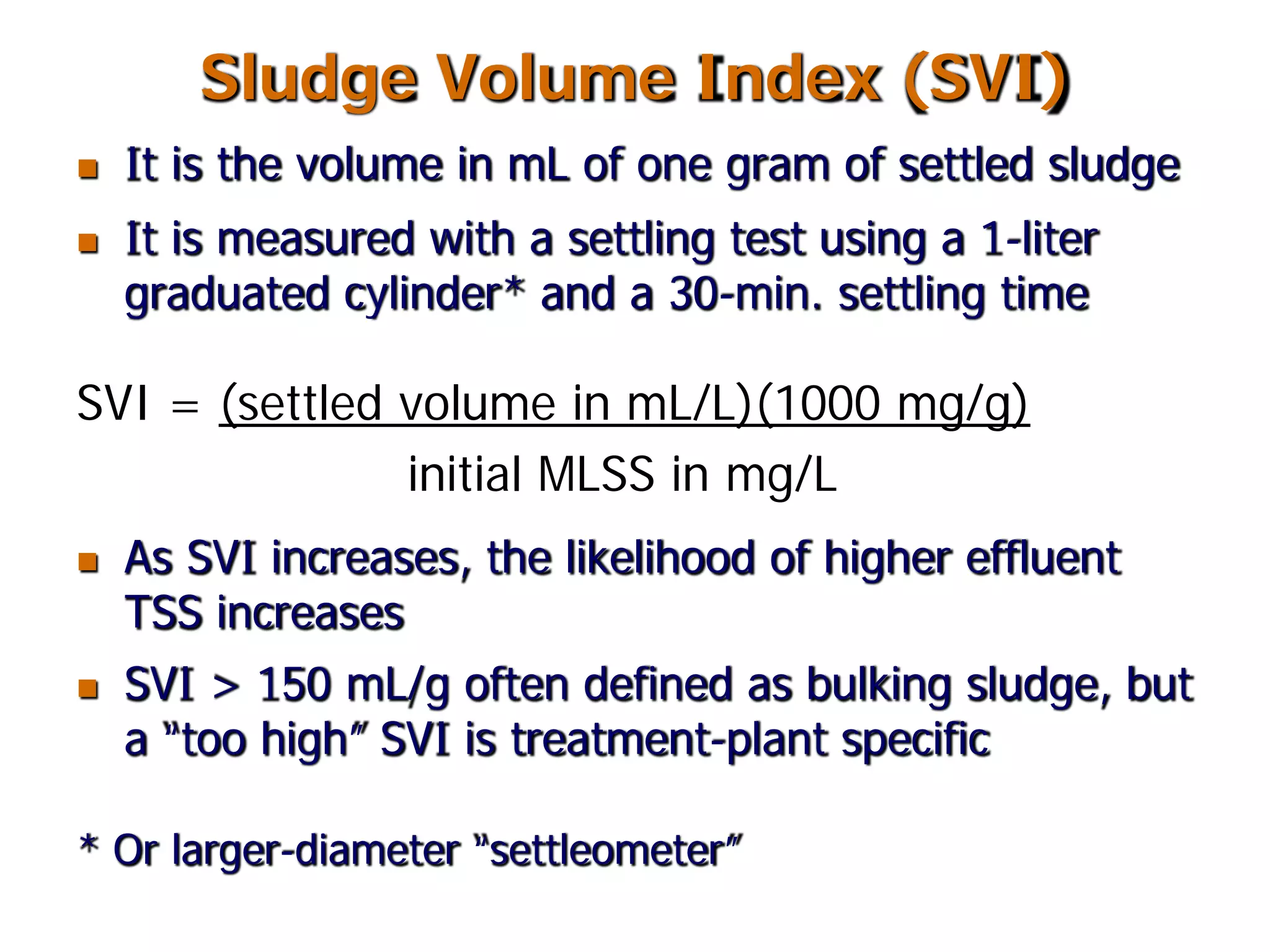
 It is the volume in mL of one gram of settled sludge
 It is measured with a settling test using a 1-liter
graduated cylinder* and a 30-min. settling time
SVI = (settled volume in mL/L)(1000 mg/g)
initial MLSS in mg/L
 As SVI increases, the likelihood of higher effluent
TSS increases
 SVI > 150 mL/g often defined as bulking sludge, but
a “too high” SVI is treatment-plant specific
* Or larger-diameter “settleometer”
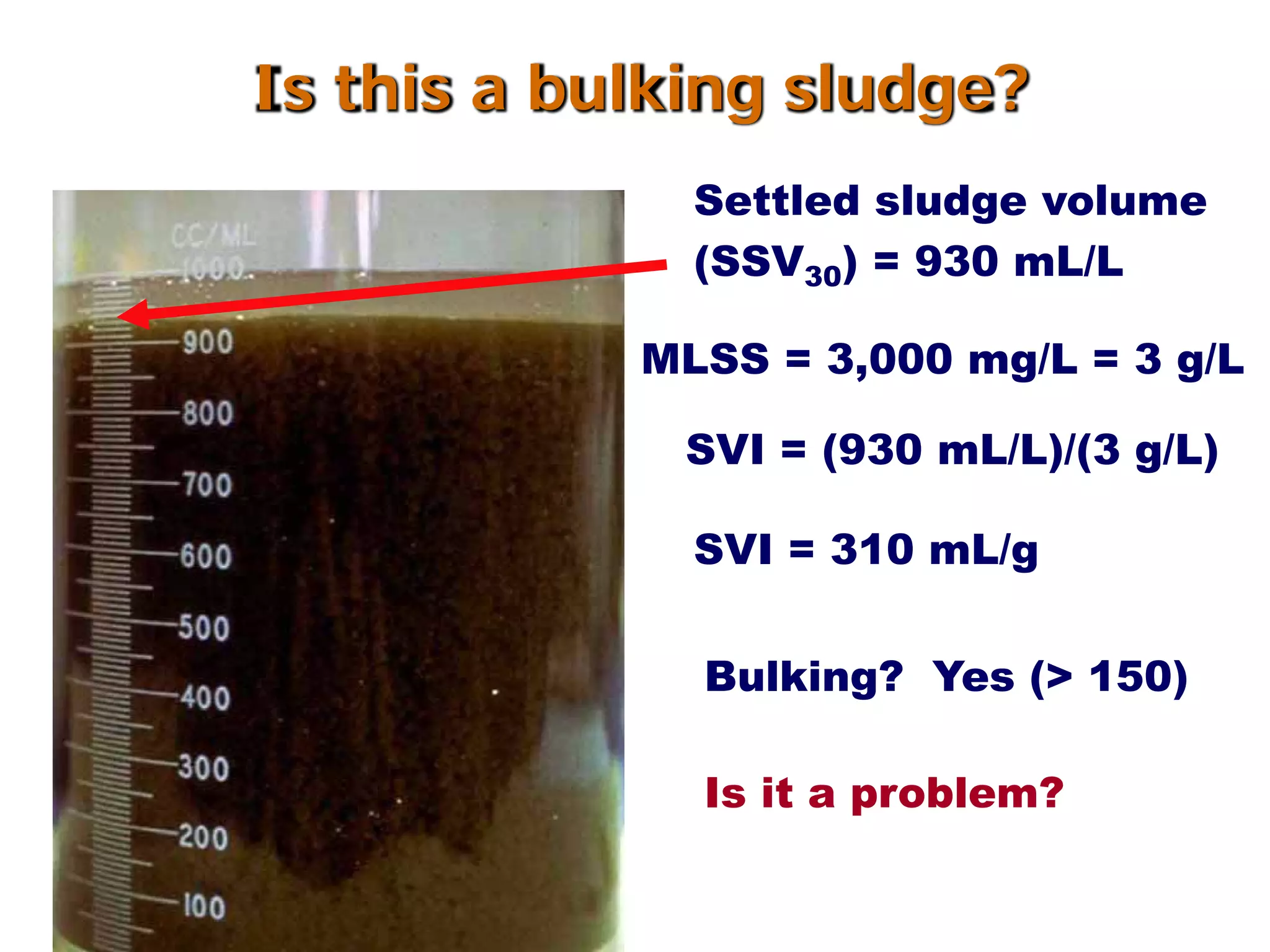
MLSS = 3,000 mg/L = 3 g/L
Bulking? Yes (> 150)
Is it a problem?
Settled sludge volume
(SSV30) = 930 mL/L
SVI = 310 mL/g
Is this a bulking sludge?
SVI = (930 mL/L)/(3 g/L)
SVI as a Function of Filaments
Palm, J.C.; Jenkins, D.; and Parker, D.S. 1980. Relationship between organic loading, dissolved oxygen
concentration and sludge settleability in the completely-mixed activated sludge process. Journal of the
Water Pollution Control Federation. 52(10):2484-2506.
Remedial Measures
Treat the symptom (may be a short-term or
long-term solution)
 Add settling or weighting aids at secondary
clarifier
□ Polymers
□ Lime
□ Ferric chloride
□ Alum
Remedial Measures
Treat the symptom (continued)
 Add toxic agents
□ Oxidants (chlorine/hypochlorite,
peroxide)
2 - 10 lb Cl2/day/1000 lb MLSS
□ Proprietary biocides
□ pH shock (usually add acid)
Remedial Measures
Eliminate the cause (longer-term solution)
 Specific conditions have been associated with the
proliferation of certain filament types
 Identify probable cause(s)/condition(s) by identifying
the predominant filamentous organisms (identification
requires expertise)
 If necessary, examine or collect other information to
confirm the probable cause(s)
 Make operational and/or equipment changes to correct
the problem
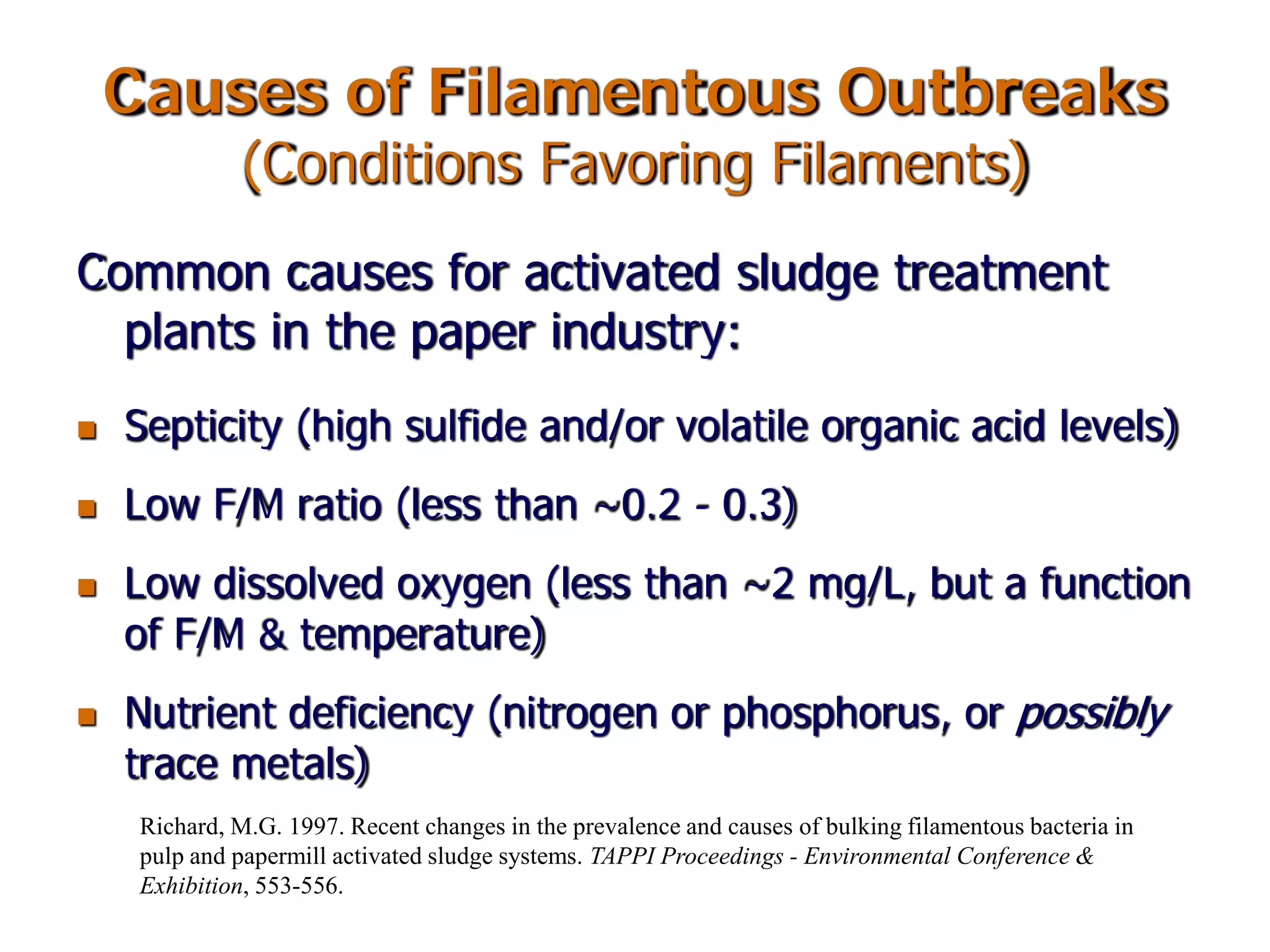
Causes of Filamentous Outbreaks
(Conditions Favoring Filaments)
Common causes for activated sludge treatment
plants in the paper industry:
 Septicity (high sulfide and/or volatile organic acid levels)
 Low F/M ratio (less than ~0.2 - 0.3)
 Low dissolved oxygen (less than ~2 mg/L, but a function
of F/M & temperature)
 Nutrient deficiency (nitrogen or phosphorus, or possibly
trace metals)
Richard, M.G. 1997. Recent changes in the prevalence and causes of bulking filamentous bacteria in
pulp and papermill activated sludge systems. TAPPI Proceedings - Environmental Conference &
Exhibition, 553-556.
Causes of Filamentous Outbreaks
(Conditions Favoring Filaments)
 Approximate minimum nutrient residuals
(measured before secondary clarifier):
Ammonia (NH4
+): ≥1 mg/L as N
Orthophosphate (PO4
3-): ≥ 0.5 mg/L as P
 Some mill treatment plants with strict permit
limits for phosphorus are able to operate
successfully at lower levels of orthophosphate
(as low as ~0.1 mg/L)
Causes of Filamentous Outbreaks
(Conditions Favoring Filaments)
Less common causes for paper industry treatment
plants:
 Low pH (<6.5) or pH swings
 Nature of the BOD (high amount of easily degraded
organic matter)
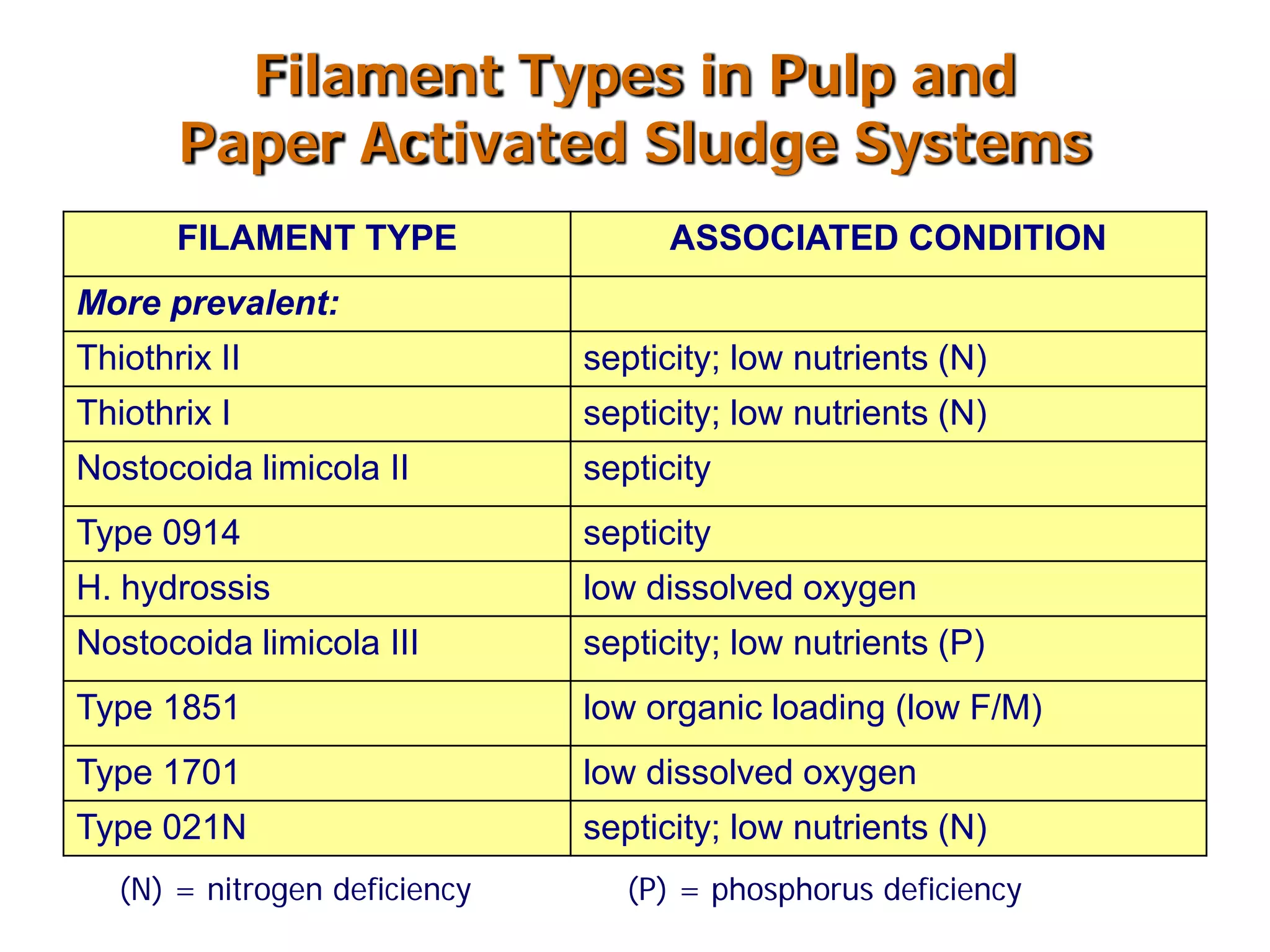
Filament Types in Pulp and
Paper Activated Sludge Systems
FILAMENT TYPE ASSOCIATED CONDITION
More prevalent:
Thiothrix II septicity; low nutrients (N)
Thiothrix I septicity; low nutrients (N)
Nostocoida limicola II septicity
Type 0914 septicity
H. hydrossis low dissolved oxygen
Nostocoida limicola III septicity; low nutrients (P)
Type 1851 low organic loading (low F/M)
Type 1701 low dissolved oxygen
Type 021N septicity; low nutrients (N)
(N) = nitrogen deficiency (P) = phosphorus deficiency
Filament Types in Pulp and
Paper Activated Sludge Systems
FILAMENT TYPE ASSOCIATED CONDITION
Less prevalent:
Type 0092 septicity
Type 0411 septicity
Type 0675 low organic loading (low F/M)
Sphaerotilus natans low dissolved oxygen
Type 0041 low organic loading (low F/M)
Type 0581 septicity
Type 0803 low organic loading (low F/M)
Type 0211 septicity
Richard, M.G. 1997. Recent changes in the prevalence and causes of bulking filamentous bacteria in pulp and
papermill activated sludge systems. TAPPI Proceedings - Environmental Conference & Exhibition, 553-556.
Eliminating the Cause
Operational and/or equipment changes
might involve:
 Add (more) nutrient
 Increase aeration
 Raise F/M
 Install a selector
Selectors
 A selector is an initial contact zone (separate tank or
sectionalized compartment) of short duration (15-60
min. HRT) where primary effluent and RAS are combined
so that the F/M ratio is high and the DO level is
controlled.
 A selector may be aerated (aerobic) or not (anaerobic or
anoxic).
 Selectors are little used in the paper industry (~dozen
mills or so in US). Most are aerobic. Generally seem to
work. NOT suitable solution for low nutrients.
This really is a clarifier
Thanks to Paul Klopping of Callahan and Brooks for permission to
use most of the photographs that appear in these lecture notes.

sludge-bulking.pdf

  • 1.
  • 2.
    Bulking Sludge General definition: Asecondary (biological) sludge with poor settling and compaction characteristics Bulking sludges are more of a concern with activated sludge treatment but also can occur in aerated stabilization basins
  • 3.
    Significance Why care?  HighTSS and associated BOD (~0.1-0.8 lb BOD/lb TSS) in effluent, possibly resulting in a permit violation  Difficulty in achieving desired solids in RAS and therefore difficulty in controlling activated sludge system
  • 4.
    Origins of HighTSS and/or Sludge Settling Problems Equipment design and condition (mechanical problems):  Uneven flow splitting (parallel clarifiers)  Inlet and outlet structures (flow distribution, velocity dissipation)  Flocculation chamber  Weir placement and condition  Sludge removal mechanism  Hydraulic overloading or surges  Solids overloading or surges  Wind-created or thermal-induced currents
  • 5.
    Origins of HighTSS and/or Sludge Settling Problems Problems related to solids characteristics:  Pin floc (from high shear/over-aeration, low F/M, toxicity)  Dispersed growth (from high F/M, low nutrients)  Rising sludge (from anaerobic gases)  Severe foam or scum (from surfactants, high F/M or low F/M filaments)  Viscous bulking  Filamentous bulking
  • 6.
    Viscous Bulking  a.k.a.slime, polysaccharide, hydrous, non-filamentous or zoogloeal bulking  Extracellular polymeric substances (EPS) surround bacterial cells and consist of carbohydrates (i.e., polysaccharides), proteins, and other substances  EPS is critical to ability of bacteria to flocculate, settle, and dewater  With viscous bulking, polysaccharide content is higher than normal, which causes the density of bacteria to be reduced (poor settling)  Generally caused by nutrient deficiency (not enough nitrogen or phosphorus)
  • 7.
    Filamentous Bulking The mostcommon of settling and compaction problems
  • 8.
    Filamentous Bulking The culprits:Filamentous organisms (bacteria, possibly fungi)  Their shape is long and narrow (length >> width)  They remove BOD (good)  In small concentrations they provide physical support to flocs (good)  At high concentrations they interfere with settling in secondary clarifiers (bad)
  • 9.
    Filamentous Bulking Characteristics Poor compaction of sludge blanket (high blanket level)  If there is a supernatant, it is usually very clear  High Sludge Volume Index (SVI)  Large, strong flocs, but they settle poorly  Filamentous bacteria predominate, as can be seen with MLSS sample and a 100x microscope
  • 10.
    Activated Sludge Underthe Microscope Good floc structure Poor floc structure
  • 11.
    Sludge Volume Index(SVI)  It is the volume in mL of one gram of settled sludge  It is measured with a settling test using a 1-liter graduated cylinder* and a 30-min. settling time SVI = (settled volume in mL/L)(1000 mg/g) initial MLSS in mg/L  As SVI increases, the likelihood of higher effluent TSS increases  SVI > 150 mL/g often defined as bulking sludge, but a “too high” SVI is treatment-plant specific * Or larger-diameter “settleometer”
  • 12.
    MLSS = 3,000mg/L = 3 g/L Bulking? Yes (> 150) Is it a problem? Settled sludge volume (SSV30) = 930 mL/L SVI = 310 mL/g Is this a bulking sludge? SVI = (930 mL/L)/(3 g/L)
  • 13.
    SVI as aFunction of Filaments Palm, J.C.; Jenkins, D.; and Parker, D.S. 1980. Relationship between organic loading, dissolved oxygen concentration and sludge settleability in the completely-mixed activated sludge process. Journal of the Water Pollution Control Federation. 52(10):2484-2506.
  • 14.
    Remedial Measures Treat thesymptom (may be a short-term or long-term solution)  Add settling or weighting aids at secondary clarifier □ Polymers □ Lime □ Ferric chloride □ Alum
  • 15.
    Remedial Measures Treat thesymptom (continued)  Add toxic agents □ Oxidants (chlorine/hypochlorite, peroxide) 2 - 10 lb Cl2/day/1000 lb MLSS □ Proprietary biocides □ pH shock (usually add acid)
  • 16.
    Remedial Measures Eliminate thecause (longer-term solution)  Specific conditions have been associated with the proliferation of certain filament types  Identify probable cause(s)/condition(s) by identifying the predominant filamentous organisms (identification requires expertise)  If necessary, examine or collect other information to confirm the probable cause(s)  Make operational and/or equipment changes to correct the problem
  • 17.
    Causes of FilamentousOutbreaks (Conditions Favoring Filaments) Common causes for activated sludge treatment plants in the paper industry:  Septicity (high sulfide and/or volatile organic acid levels)  Low F/M ratio (less than ~0.2 - 0.3)  Low dissolved oxygen (less than ~2 mg/L, but a function of F/M & temperature)  Nutrient deficiency (nitrogen or phosphorus, or possibly trace metals) Richard, M.G. 1997. Recent changes in the prevalence and causes of bulking filamentous bacteria in pulp and papermill activated sludge systems. TAPPI Proceedings - Environmental Conference & Exhibition, 553-556.
  • 18.
    Causes of FilamentousOutbreaks (Conditions Favoring Filaments)  Approximate minimum nutrient residuals (measured before secondary clarifier): Ammonia (NH4 +): ≥1 mg/L as N Orthophosphate (PO4 3-): ≥ 0.5 mg/L as P  Some mill treatment plants with strict permit limits for phosphorus are able to operate successfully at lower levels of orthophosphate (as low as ~0.1 mg/L)
  • 19.
    Causes of FilamentousOutbreaks (Conditions Favoring Filaments) Less common causes for paper industry treatment plants:  Low pH (<6.5) or pH swings  Nature of the BOD (high amount of easily degraded organic matter)
  • 20.
    Filament Types inPulp and Paper Activated Sludge Systems FILAMENT TYPE ASSOCIATED CONDITION More prevalent: Thiothrix II septicity; low nutrients (N) Thiothrix I septicity; low nutrients (N) Nostocoida limicola II septicity Type 0914 septicity H. hydrossis low dissolved oxygen Nostocoida limicola III septicity; low nutrients (P) Type 1851 low organic loading (low F/M) Type 1701 low dissolved oxygen Type 021N septicity; low nutrients (N) (N) = nitrogen deficiency (P) = phosphorus deficiency
  • 21.
    Filament Types inPulp and Paper Activated Sludge Systems FILAMENT TYPE ASSOCIATED CONDITION Less prevalent: Type 0092 septicity Type 0411 septicity Type 0675 low organic loading (low F/M) Sphaerotilus natans low dissolved oxygen Type 0041 low organic loading (low F/M) Type 0581 septicity Type 0803 low organic loading (low F/M) Type 0211 septicity Richard, M.G. 1997. Recent changes in the prevalence and causes of bulking filamentous bacteria in pulp and papermill activated sludge systems. TAPPI Proceedings - Environmental Conference & Exhibition, 553-556.
  • 22.
    Eliminating the Cause Operationaland/or equipment changes might involve:  Add (more) nutrient  Increase aeration  Raise F/M  Install a selector
  • 23.
    Selectors  A selectoris an initial contact zone (separate tank or sectionalized compartment) of short duration (15-60 min. HRT) where primary effluent and RAS are combined so that the F/M ratio is high and the DO level is controlled.  A selector may be aerated (aerobic) or not (anaerobic or anoxic).  Selectors are little used in the paper industry (~dozen mills or so in US). Most are aerobic. Generally seem to work. NOT suitable solution for low nutrients.
  • 24.
    This really isa clarifier Thanks to Paul Klopping of Callahan and Brooks for permission to use most of the photographs that appear in these lecture notes.