


SELECTION PROCESS
WHAT IS HUMAN RESOURCE
MANAGEMENT?
 Human Resource Management is the function of the management which is entirely
involved with the employees who are working in the organization and the welfare of
those employees.
 Human Resource Management is that branch of the management which deals in the
recruitment, selection, training, development, acquisition, co-ordination of the
workforce in the organization.
WHAT IS SELECTION?
 Selection, either internal or external is a deliberate effort of the organizations to
select a fixed number of personnel from a large number of applicant. The primary
aim of employee selection is to choose those person who are most likely to
perform their job with maximum effectiveness and to remain with the company.
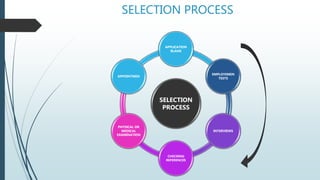
SELECTION PROCESS
SELECTION
PROCESS
APPLICATION
BLANK
EMPLOYEMEN
TESTS
INTERVIEWS
CHECKING
REFERENCES
PHYSICAL OR
MEDICAL
EXAMINATION
APPOINTMEN
APPLICATION BLANK
 In the sense, application blank is a highly structured interview in which the
questions are standardized and determined in advance. An application blank is a
traditional, widely accepted device for getting information from a perspective
applicant.
 The application blank provides the preliminary information regarding the applicant
who has so applied for the process.
EMPLOYMENT TESTS
For further assessment of the applicant’s potentials, characteristics etc., the
employment tests are conducted.
 APTITUDE TEST: Aptitude tests are conducted in order to check the potentials of
the candidate to learn a new job and the technical aspects of the job. Aptitude
tests when conducted checks the ability and skills.
 INTEREST TEST: This test is all related with checking the area of interest of a
candidate. Interest test shows and reflects the interest areas of the candidate and
not the abilities to do that job.
 INTELLIGENCE TEST: This test reveals the ability of the candidate to logically think
and reason on a particular aspect. Rather it checks the mental abilities of the
candidate and draws the perfect image of the candidate. It shows the IQ (Intelligent
Quotient) of the candidate.
 PERSONALITY TEST: It is the test through which a candidate is made to go through
in order to check the aggregate of the ways in which he behaves. It highlights the
characteristics of the candidate.
INTERVIEWS
After putting the candidate into vigorous rounds of tests, all those who clear the
rounds are then called for the interviews. The interview is perhaps the most difficult
part of the selection procedure.
The interviews are taken to meet a candidate face-to-face and check the potentials,
abilities to analyze problems, quick decision making, logical thinking, personality etc.
of the candidate.
It is one of the vital tool which is used for the selection process in any of the
organization.
TYPES OF INTERVIEWS
 PRELIMINARY INTERVIEW: These interviews are preliminary screening of applicants
to decide whether a more detailed interview will be worthwhile. The only argument
for this method is that it saves the company’s time and money.
 EXTENSIVE INTERVIEW: Extensive interviews or depth interviews cover the
complete life history of the applicant. It is semi-structured in nature and utilizes
question in key areas which have been studied in advance by the interviewer.
 STRESS INTERVIEW: Stress interviews are deliberate attempt to create pressure to
observe how an applicant performs under stress. The stress interview may have
some value for jobs where emotional balance is a key factor.
 STRUCTURAL INTERVIEW: Structural interview is based on the assumptions that, to
be most effective, every detail should be sought. Questions must be asked in a
particular order, with very little deviation. Such interviews are also called
standardized interviews because they are pre-planned to a high degree of
accuracy.
 GROUP INTERVIEW: In this type of interview, several job applicants are placed in a
leader-less discussion and interviews sit in the background to observe and evaluate
the performance of the candidates.
CHECKING REFERENCES
 The reference provided by the applicant has to be checked.
 This is to find out the past records of the candidate.
 Reference checking requires the same use of skill as required by the interviewer
and some amount of diplomacy.
 References provided must be different from the close relatives, family members,
friends.
PHYSICAL OR MEDICAL EXAMINATIONS
 The next step is getting the candidate’s medically examined if there is a need.
 In many organizations the medical and physical checking are given the importance.
 This represents the capabilities of the candidate to deal any situation which
requires the physical dominations.
APPOINTMENT
 This is the last step in the prolonged process of the selection.
 The best equipped and capable candidate is selected.
 The candidate is appointed as the employee of the said organization.
Selection process

Selection process

  • 1.
  • 2.
    WHAT IS HUMANRESOURCE MANAGEMENT?  Human Resource Management is the function of the management which is entirely involved with the employees who are working in the organization and the welfare of those employees.  Human Resource Management is that branch of the management which deals in the recruitment, selection, training, development, acquisition, co-ordination of the workforce in the organization.
  • 3.
    WHAT IS SELECTION? Selection, either internal or external is a deliberate effort of the organizations to select a fixed number of personnel from a large number of applicant. The primary aim of employee selection is to choose those person who are most likely to perform their job with maximum effectiveness and to remain with the company.
  • 4.
  • 5.
    APPLICATION BLANK  Inthe sense, application blank is a highly structured interview in which the questions are standardized and determined in advance. An application blank is a traditional, widely accepted device for getting information from a perspective applicant.  The application blank provides the preliminary information regarding the applicant who has so applied for the process.
  • 6.
    EMPLOYMENT TESTS For furtherassessment of the applicant’s potentials, characteristics etc., the employment tests are conducted.  APTITUDE TEST: Aptitude tests are conducted in order to check the potentials of the candidate to learn a new job and the technical aspects of the job. Aptitude tests when conducted checks the ability and skills.  INTEREST TEST: This test is all related with checking the area of interest of a candidate. Interest test shows and reflects the interest areas of the candidate and not the abilities to do that job.
  • 7.
     INTELLIGENCE TEST:This test reveals the ability of the candidate to logically think and reason on a particular aspect. Rather it checks the mental abilities of the candidate and draws the perfect image of the candidate. It shows the IQ (Intelligent Quotient) of the candidate.  PERSONALITY TEST: It is the test through which a candidate is made to go through in order to check the aggregate of the ways in which he behaves. It highlights the characteristics of the candidate.
  • 8.
    INTERVIEWS After putting thecandidate into vigorous rounds of tests, all those who clear the rounds are then called for the interviews. The interview is perhaps the most difficult part of the selection procedure. The interviews are taken to meet a candidate face-to-face and check the potentials, abilities to analyze problems, quick decision making, logical thinking, personality etc. of the candidate. It is one of the vital tool which is used for the selection process in any of the organization.
  • 9.
    TYPES OF INTERVIEWS PRELIMINARY INTERVIEW: These interviews are preliminary screening of applicants to decide whether a more detailed interview will be worthwhile. The only argument for this method is that it saves the company’s time and money.  EXTENSIVE INTERVIEW: Extensive interviews or depth interviews cover the complete life history of the applicant. It is semi-structured in nature and utilizes question in key areas which have been studied in advance by the interviewer.
  • 10.
     STRESS INTERVIEW:Stress interviews are deliberate attempt to create pressure to observe how an applicant performs under stress. The stress interview may have some value for jobs where emotional balance is a key factor.  STRUCTURAL INTERVIEW: Structural interview is based on the assumptions that, to be most effective, every detail should be sought. Questions must be asked in a particular order, with very little deviation. Such interviews are also called standardized interviews because they are pre-planned to a high degree of accuracy.  GROUP INTERVIEW: In this type of interview, several job applicants are placed in a leader-less discussion and interviews sit in the background to observe and evaluate the performance of the candidates.
  • 11.
    CHECKING REFERENCES  Thereference provided by the applicant has to be checked.  This is to find out the past records of the candidate.  Reference checking requires the same use of skill as required by the interviewer and some amount of diplomacy.  References provided must be different from the close relatives, family members, friends.
  • 12.
    PHYSICAL OR MEDICALEXAMINATIONS  The next step is getting the candidate’s medically examined if there is a need.  In many organizations the medical and physical checking are given the importance.  This represents the capabilities of the candidate to deal any situation which requires the physical dominations.
  • 13.
    APPOINTMENT  This isthe last step in the prolonged process of the selection.  The best equipped and capable candidate is selected.  The candidate is appointed as the employee of the said organization.