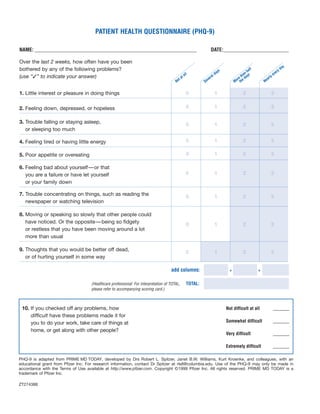
PATIENT HEALTH QUESTIONNAIRE (PHQ-9)

NAME: ______________________________________________________________                                         DATE:_________________________

Over the last 2 weeks, how often have you been
                                                                                                                                                                   y
bothered by any of the following problems?                                                                         s                   alf                   y   da
                                                                                                                 ay                 nh                    er
                                                                                               all             ld                 ha ays                ev
(use “✓” to indicate your answer)                                                        ta
                                                                                           t
                                                                                                           ve
                                                                                                             ra                  t
                                                                                                                               re e d              arly
                                                                                       No                Se                  Mo th               Ne


1. Little interest or pleasure in doing things                                                  0              1                   2                  3

2. Feeling down, depressed, or hopeless                                                         0              1                   2                  3

3. Trouble falling or staying asleep,
                                                                                                0              1                   2                  3
   or sleeping too much

4. Feeling tired or having little energy                                                        0              1                   2                  3

5. Poor appetite or overeating                                                                  0              1                   2                  3

6. Feeling bad about yourself — or that
   you are a failure or have let yourself                                                       0              1                   2                  3
   or your family down

7. Trouble concentrating on things, such as reading the
                                                                                                0              1                   2                  3
   newspaper or watching television

8. Moving or speaking so slowly that other people could
   have noticed. Or the opposite — being so fidgety
                                                                                                0              1                   2                  3
   or restless that you have been moving around a lot
   more than usual

9. Thoughts that you would be better off dead,
                                                                                                0              1                   2                  3
   or of hurting yourself in some way

                                                                                    add columns:                         +                   +


                                    (Healthcare professional: For interpretation of TOTAL,      TOTAL:
                                    please refer to accompanying scoring card.)


 10. If you checked off any problems, how                                                                              Not difficult at all             _______
     difficult have these problems made it for
     you to do your work, take care of things at                                                                       Somewhat difficult               _______
     home, or get along with other people?
                                                                                                                       Very difficult                   _______

                                                                                                                       Extremely difficult              _______

PHQ-9 is adapted from PRIME MD TODAY, developed by Drs Robert L. Spitzer, Janet B.W. Williams, Kurt Kroenke, and colleagues, with an
educational grant from Pfizer Inc. For research information, contact Dr Spitzer at rls8@columbia.edu. Use of the PHQ-9 may only be made in
accordance with the Terms of Use available at http://www.pfizer.com. Copyright ©1999 Pfizer Inc. All rights reserved. PRIME MD TODAY is a
trademark of Pfizer Inc.

ZT274388
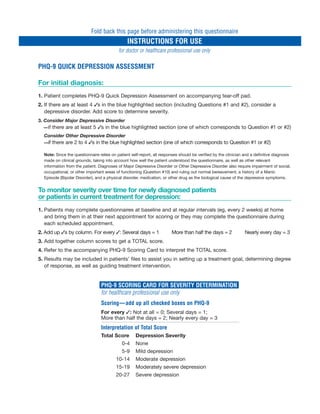
Fold back this page before administering this questionnaire
                                                INSTRUCTIONS FOR USE
                                           for doctor or healthcare professional use only

PHQ-9 QUICK DEPRESSION ASSESSMENT

For initial diagnosis:
1. Patient completes PHQ-9 Quick Depression Assessment on accompanying tear-off pad.
2. If there are at least 4 ✓s in the blue highlighted section (including Questions #1 and #2), consider a
   depressive disorder. Add score to determine severity.
3. Consider Major Depressive Disorder
  — if   there are at least 5 ✓s in the blue highlighted section (one of which corresponds to Question #1 or #2)
  Consider Other Depressive Disorder
  —if    there are 2 to 4 ✓s in the blue highlighted section (one of which corresponds to Question #1 or #2)

  Note: Since the questionnaire relies on patient self-report, all responses should be verified by the clinician and a definitive diagnosis
  made on clinical grounds, taking into account how well the patient understood the questionnaire, as well as other relevant
  information from the patient. Diagnoses of Major Depressive Disorder or Other Depressive Disorder also require impairment of social,
  occupational, or other important areas of functioning (Question #10) and ruling out normal bereavement, a history of a Manic
  Episode (Bipolar Disorder), and a physical disorder, medication, or other drug as the biological cause of the depressive symptoms.


To monitor severity over time for newly diagnosed patients
or patients in current treatment for depression:
1. Patients may complete questionnaires at baseline and at regular intervals (eg, every 2 weeks) at home
   and bring them in at their next appointment for scoring or they may complete the questionnaire during
   each scheduled appointment.
2. Add up ✓s by column. For every ✓: Several days = 1                   More than half the days = 2              Nearly every day = 3
3. Add together column scores to get a TOTAL score.
4. Refer to the accompanying PHQ-9 Scoring Card to interpret the TOTAL score.
5. Results may be included in patients’ files to assist you in setting up a treatment goal, determining degree
   of response, as well as guiding treatment intervention.


                                 PHQ-9 SCORING CARD FOR SEVERITY DETERMINATION
                                 for healthcare professional use only
                                 Scoring—add up all checked boxes on PHQ-9
                                 For every ✓: Not at all = 0; Several days = 1;
                                 More than half the days = 2; Nearly every day = 3
                                 Interpretation of Total Score
                                 Total Score        Depression Severity
                                         0-4        None
                                         5-9        Mild depression
                                       10-14        Moderate depression
                                       15-19        Moderately severe depression
                                       20-27        Severe depression

PHQ-9

  • 1.
    PATIENT HEALTH QUESTIONNAIRE(PHQ-9) NAME: ______________________________________________________________ DATE:_________________________ Over the last 2 weeks, how often have you been y bothered by any of the following problems? s alf y da ay nh er all ld ha ays ev (use “✓” to indicate your answer) ta t ve ra t re e d arly No Se Mo th Ne 1. Little interest or pleasure in doing things 0 1 2 3 2. Feeling down, depressed, or hopeless 0 1 2 3 3. Trouble falling or staying asleep, 0 1 2 3 or sleeping too much 4. Feeling tired or having little energy 0 1 2 3 5. Poor appetite or overeating 0 1 2 3 6. Feeling bad about yourself — or that you are a failure or have let yourself 0 1 2 3 or your family down 7. Trouble concentrating on things, such as reading the 0 1 2 3 newspaper or watching television 8. Moving or speaking so slowly that other people could have noticed. Or the opposite — being so fidgety 0 1 2 3 or restless that you have been moving around a lot more than usual 9. Thoughts that you would be better off dead, 0 1 2 3 or of hurting yourself in some way add columns: + + (Healthcare professional: For interpretation of TOTAL, TOTAL: please refer to accompanying scoring card.) 10. If you checked off any problems, how Not difficult at all _______ difficult have these problems made it for you to do your work, take care of things at Somewhat difficult _______ home, or get along with other people? Very difficult _______ Extremely difficult _______ PHQ-9 is adapted from PRIME MD TODAY, developed by Drs Robert L. Spitzer, Janet B.W. Williams, Kurt Kroenke, and colleagues, with an educational grant from Pfizer Inc. For research information, contact Dr Spitzer at rls8@columbia.edu. Use of the PHQ-9 may only be made in accordance with the Terms of Use available at http://www.pfizer.com. Copyright ©1999 Pfizer Inc. All rights reserved. PRIME MD TODAY is a trademark of Pfizer Inc. ZT274388
  • 2.
    Fold back thispage before administering this questionnaire INSTRUCTIONS FOR USE for doctor or healthcare professional use only PHQ-9 QUICK DEPRESSION ASSESSMENT For initial diagnosis: 1. Patient completes PHQ-9 Quick Depression Assessment on accompanying tear-off pad. 2. If there are at least 4 ✓s in the blue highlighted section (including Questions #1 and #2), consider a depressive disorder. Add score to determine severity. 3. Consider Major Depressive Disorder — if there are at least 5 ✓s in the blue highlighted section (one of which corresponds to Question #1 or #2) Consider Other Depressive Disorder —if there are 2 to 4 ✓s in the blue highlighted section (one of which corresponds to Question #1 or #2) Note: Since the questionnaire relies on patient self-report, all responses should be verified by the clinician and a definitive diagnosis made on clinical grounds, taking into account how well the patient understood the questionnaire, as well as other relevant information from the patient. Diagnoses of Major Depressive Disorder or Other Depressive Disorder also require impairment of social, occupational, or other important areas of functioning (Question #10) and ruling out normal bereavement, a history of a Manic Episode (Bipolar Disorder), and a physical disorder, medication, or other drug as the biological cause of the depressive symptoms. To monitor severity over time for newly diagnosed patients or patients in current treatment for depression: 1. Patients may complete questionnaires at baseline and at regular intervals (eg, every 2 weeks) at home and bring them in at their next appointment for scoring or they may complete the questionnaire during each scheduled appointment. 2. Add up ✓s by column. For every ✓: Several days = 1 More than half the days = 2 Nearly every day = 3 3. Add together column scores to get a TOTAL score. 4. Refer to the accompanying PHQ-9 Scoring Card to interpret the TOTAL score. 5. Results may be included in patients’ files to assist you in setting up a treatment goal, determining degree of response, as well as guiding treatment intervention. PHQ-9 SCORING CARD FOR SEVERITY DETERMINATION for healthcare professional use only Scoring—add up all checked boxes on PHQ-9 For every ✓: Not at all = 0; Several days = 1; More than half the days = 2; Nearly every day = 3 Interpretation of Total Score Total Score Depression Severity 0-4 None 5-9 Mild depression 10-14 Moderate depression 15-19 Moderately severe depression 20-27 Severe depression