OBJECTIV
ES:
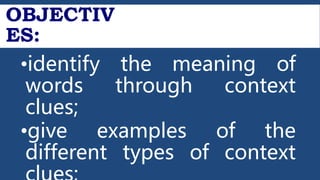
•identify the meaning of
words through context
clues;
•give examples of the
different types of context
CLASSROOM
STANDARDS:
• Sit properly.
• Listen attentively.
• Raise your hand if you want to ask or answer a
question.
• Minimize going outside of the classroom
• Do not talk when someone is talking
• Have fun in learning.
LET’S TRY THIS!
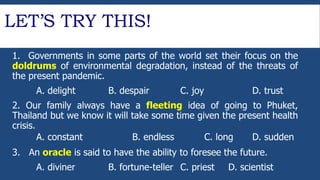
1. Governments in some parts of the world set their focus on the
doldrums of environmental degradation, instead of the threats of
the present pandemic.
A. delight B. despair C. joy D. trust
2. Our family always have a fleeting idea of going to Phuket,
Thailand but we know it will take some time given the present health
crisis.
A. constant B. endless C. long D. sudden
3. An oracle is said to have the ability to foresee the future.
A. diviner B. fortune-teller C. priest D. scientist
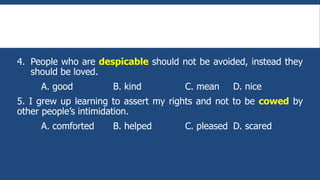
4. People who are despicable should not be avoided, instead they
should be loved.
A. good B. kind C. mean D. nice
5. I grew up learning to assert my rights and not to be cowed by
other people’s intimidation.
A. comforted B. helped C. pleased D. scared
•Have you experienced difficulty in getting the
meaning of unfamiliar words from a poem/
story?
•How do you know the meaning of these
words?
•Do you consult Google or the dictionary
immediately?
CONTEXT CLUES
CONTEXT CLUES
- are words that appear in sentences to help
understand the meanings of difficult words.
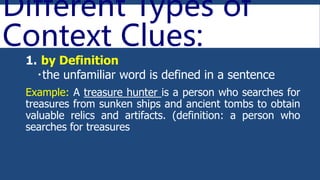
Different Types of
Context Clues:
1. by Definition
the unfamiliar word is defined in a sentence
Example: A treasure hunter is a person who searches for
treasures from sunken ships and ancient tombs to obtain
valuable relics and artifacts. (definition: a person who
searches for treasures
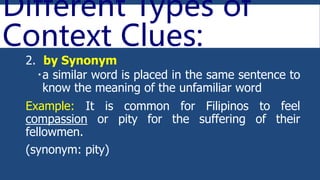
Different Types of
Context Clues:
2. by Synonym
a similar word is placed in the same sentence to
know the meaning of the unfamiliar word
Example: It is common for Filipinos to feel
compassion or pity for the suffering of their
fellowmen.
(synonym: pity)
Different Types of
Context Clues:
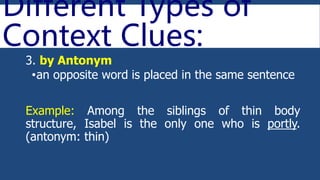
3. by Antonym
•an opposite word is placed in the same sentence
Example: Among the siblings of thin body
structure, Isabel is the only one who is portly.
(antonym: thin)
Different Types of
Context Clues:
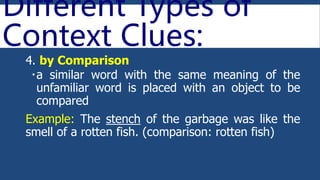
4. by Comparison
a similar word with the same meaning of the
unfamiliar word is placed with an object to be
compared
Example: The stench of the garbage was like the
smell of a rotten fish. (comparison: rotten fish)
Different Types of
Context Clues:
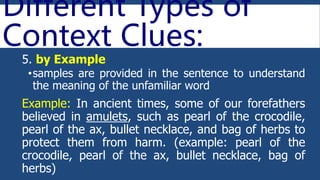
5. by Example
•samples are provided in the sentence to understand
the meaning of the unfamiliar word
Example: In ancient times, some of our forefathers
believed in amulets, such as pearl of the crocodile,
pearl of the ax, bullet necklace, and bag of herbs to
protect them from harm. (example: pearl of the
crocodile, pearl of the ax, bullet necklace, bag of
herbs)
Different Types of
Context Clues:
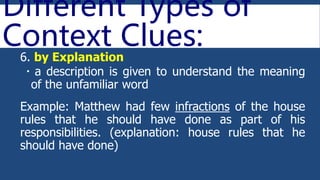
6. by Explanation
 a description is given to understand the meaning
of the unfamiliar word
Example: Matthew had few infractions of the house
rules that he should have done as part of his
responsibilities. (explanation: house rules that he
should have done)
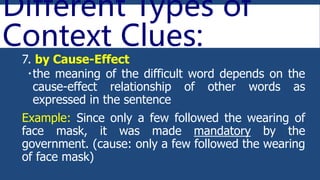
Different Types of
Context Clues:
7. by Cause-Effect
the meaning of the difficult word depends on the
cause-effect relationship of other words as
expressed in the sentence
Example: Since only a few followed the wearing of
face mask, it was made mandatory by the
government. (cause: only a few followed the wearing
of face mask)
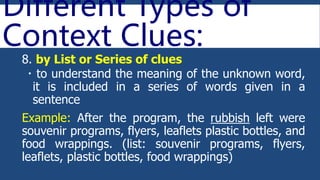
Different Types of
Context Clues:
8. by List or Series of clues
 to understand the meaning of the unknown word,
it is included in a series of words given in a
sentence
Example: After the program, the rubbish left were
souvenir programs, flyers, leaflets plastic bottles, and
food wrappings. (list: souvenir programs, flyers,
leaflets, plastic bottles, food wrappings)
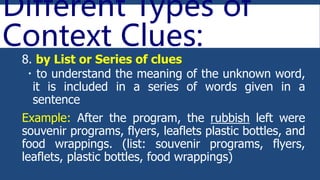
Different Types of
Context Clues:
8. by List or Series of clues
 to understand the meaning of the unknown word,
it is included in a series of words given in a
sentence
Example: After the program, the rubbish left were
souvenir programs, flyers, leaflets plastic bottles, and
food wrappings. (list: souvenir programs, flyers,
leaflets, plastic bottles, food wrappings)
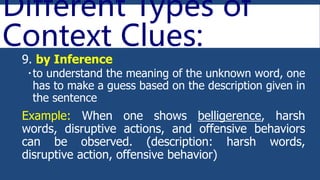
Different Types of
Context Clues:
9. by Inference
to understand the meaning of the unknown word, one
has to make a guess based on the description given in
the sentence
Example: When one shows belligerence, harsh
words, disruptive actions, and offensive behaviors
can be observed. (description: harsh words,
disruptive action, offensive behavior)
Activity Time!
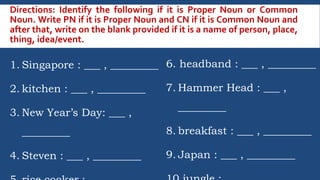
Directions: Identify the following if it is Proper Noun or Common
Noun. Write PN if it is Proper Noun and CN if it is Common Noun and
after that, write on the blank provided if it is a name of person, place,
thing, idea/event.
1. Singapore : ___ , _________
2. kitchen : ___ , _________
3. New Year’s Day: ___ ,
_________
4. Steven : ___ , _________
6. headband : ___ , _________
7. Hammer Head : ___ ,
_________
8. breakfast : ___ , _________
9. Japan : ___ , _________
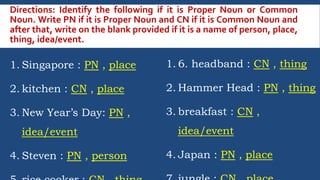
Directions: Identify the following if it is Proper Noun or Common
Noun. Write PN if it is Proper Noun and CN if it is Common Noun and
after that, write on the blank provided if it is a name of person, place,
thing, idea/event.
1. Singapore : PN , place
2. kitchen : CN , place
3. New Year’s Day: PN ,
idea/event
4. Steven : PN , person
1. 6. headband : CN , thing
2. Hammer Head : PN , thing
3. breakfast : CN ,
idea/event
4. Japan : PN , place
1. What is a noun?
2. Differentiate the two types of Noun.
3. How do you know if a noun is Proper
or Common noun?
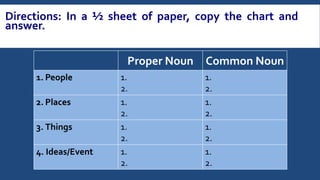
Directions: In a ½ sheet of paper, copy the chart and
answer.
Proper Noun Common Noun
1. People 1.
2.
1.
2.
2. Places 1.
2.
1.
2.
3. Things 1.
2.
1.
2.
4. Ideas/Event 1.
2.
1.
2.
ASSIGNMENT:
In your notebook, write
what is verb and its types.

Context Clues.pptx

  • 2.
    OBJECTIV ES: •identify the meaningof words through context clues; •give examples of the different types of context
  • 3.
    CLASSROOM STANDARDS: • Sit properly. •Listen attentively. • Raise your hand if you want to ask or answer a question. • Minimize going outside of the classroom • Do not talk when someone is talking • Have fun in learning.
  • 4.
    LET’S TRY THIS! 1.Governments in some parts of the world set their focus on the doldrums of environmental degradation, instead of the threats of the present pandemic. A. delight B. despair C. joy D. trust 2. Our family always have a fleeting idea of going to Phuket, Thailand but we know it will take some time given the present health crisis. A. constant B. endless C. long D. sudden 3. An oracle is said to have the ability to foresee the future. A. diviner B. fortune-teller C. priest D. scientist
  • 5.
    4. People whoare despicable should not be avoided, instead they should be loved. A. good B. kind C. mean D. nice 5. I grew up learning to assert my rights and not to be cowed by other people’s intimidation. A. comforted B. helped C. pleased D. scared
  • 6.
    •Have you experienceddifficulty in getting the meaning of unfamiliar words from a poem/ story? •How do you know the meaning of these words? •Do you consult Google or the dictionary immediately?
  • 7.
  • 8.
    CONTEXT CLUES - arewords that appear in sentences to help understand the meanings of difficult words.
  • 9.
    Different Types of ContextClues: 1. by Definition the unfamiliar word is defined in a sentence Example: A treasure hunter is a person who searches for treasures from sunken ships and ancient tombs to obtain valuable relics and artifacts. (definition: a person who searches for treasures
  • 10.
    Different Types of ContextClues: 2. by Synonym a similar word is placed in the same sentence to know the meaning of the unfamiliar word Example: It is common for Filipinos to feel compassion or pity for the suffering of their fellowmen. (synonym: pity)
  • 11.
    Different Types of ContextClues: 3. by Antonym •an opposite word is placed in the same sentence Example: Among the siblings of thin body structure, Isabel is the only one who is portly. (antonym: thin)
  • 12.
    Different Types of ContextClues: 4. by Comparison a similar word with the same meaning of the unfamiliar word is placed with an object to be compared Example: The stench of the garbage was like the smell of a rotten fish. (comparison: rotten fish)
  • 13.
    Different Types of ContextClues: 5. by Example •samples are provided in the sentence to understand the meaning of the unfamiliar word Example: In ancient times, some of our forefathers believed in amulets, such as pearl of the crocodile, pearl of the ax, bullet necklace, and bag of herbs to protect them from harm. (example: pearl of the crocodile, pearl of the ax, bullet necklace, bag of herbs)
  • 14.
    Different Types of ContextClues: 6. by Explanation  a description is given to understand the meaning of the unfamiliar word Example: Matthew had few infractions of the house rules that he should have done as part of his responsibilities. (explanation: house rules that he should have done)
  • 15.
    Different Types of ContextClues: 7. by Cause-Effect the meaning of the difficult word depends on the cause-effect relationship of other words as expressed in the sentence Example: Since only a few followed the wearing of face mask, it was made mandatory by the government. (cause: only a few followed the wearing of face mask)
  • 16.
    Different Types of ContextClues: 8. by List or Series of clues  to understand the meaning of the unknown word, it is included in a series of words given in a sentence Example: After the program, the rubbish left were souvenir programs, flyers, leaflets plastic bottles, and food wrappings. (list: souvenir programs, flyers, leaflets, plastic bottles, food wrappings)
  • 17.
    Different Types of ContextClues: 8. by List or Series of clues  to understand the meaning of the unknown word, it is included in a series of words given in a sentence Example: After the program, the rubbish left were souvenir programs, flyers, leaflets plastic bottles, and food wrappings. (list: souvenir programs, flyers, leaflets, plastic bottles, food wrappings)
  • 18.
    Different Types of ContextClues: 9. by Inference to understand the meaning of the unknown word, one has to make a guess based on the description given in the sentence Example: When one shows belligerence, harsh words, disruptive actions, and offensive behaviors can be observed. (description: harsh words, disruptive action, offensive behavior)
  • 20.
  • 21.
    Directions: Identify thefollowing if it is Proper Noun or Common Noun. Write PN if it is Proper Noun and CN if it is Common Noun and after that, write on the blank provided if it is a name of person, place, thing, idea/event. 1. Singapore : ___ , _________ 2. kitchen : ___ , _________ 3. New Year’s Day: ___ , _________ 4. Steven : ___ , _________ 6. headband : ___ , _________ 7. Hammer Head : ___ , _________ 8. breakfast : ___ , _________ 9. Japan : ___ , _________
  • 22.
    Directions: Identify thefollowing if it is Proper Noun or Common Noun. Write PN if it is Proper Noun and CN if it is Common Noun and after that, write on the blank provided if it is a name of person, place, thing, idea/event. 1. Singapore : PN , place 2. kitchen : CN , place 3. New Year’s Day: PN , idea/event 4. Steven : PN , person 1. 6. headband : CN , thing 2. Hammer Head : PN , thing 3. breakfast : CN , idea/event 4. Japan : PN , place
  • 23.
    1. What isa noun? 2. Differentiate the two types of Noun. 3. How do you know if a noun is Proper or Common noun?
  • 24.
    Directions: In a½ sheet of paper, copy the chart and answer. Proper Noun Common Noun 1. People 1. 2. 1. 2. 2. Places 1. 2. 1. 2. 3. Things 1. 2. 1. 2. 4. Ideas/Event 1. 2. 1. 2.
  • 25.
    ASSIGNMENT: In your notebook,write what is verb and its types.