MARKET ENTRY CONCEPT
OF SOLARCITY
IN BRAZILChristoph Paul Forstner
Industry Analysis SWOT Analysis: TOWS Matrix Target Country Market Analysis ConclusionMarket Entry Strategy
STRUCTURE
Market Entry Concept: SolarCity in Brazil
2
I. Industry Analysis
1. PORTER´S 5 driving forces
2. Specific Internationalization drivers
II. SWOT Analysis: TOWS Matrix
III. Target Country Market Analysis
1. PESTEL analysis: Environmental influences
2. CAGE framework: Distance analysis
3. Benchmarking: Main Competitor´s profile
III. Market Entry Strategy
1. Market attractiveness / competitive strength
matrix
2. Short list of entry options
3. Scoring model: Evaluation criteria
IV. Conclusion
1. Summary: Best Market Entry Concept
2. Future Options
INDUSTRY ANALYSIS
Industry Analysis SWOT Analysis: TOWS Matrix Target Country Market Analysis ConclusionMarket Entry Strategy
INDUSTRY ANALYSIS
SolarCity
 founded in 2006, headquartered in San Mateo, California
 Founders: Peter Rive, Lyndon Rive and Elon Musk
 Designing, financing and installment of solar power systems
 number one residential solar installer in the U.S. (2013)
 Business partners: homeowners, businesses, NPOs, government
 Operates in 17 states in the U.S., more than 75 operations centers
 Revenue: 255,03 million; EBIT: 8,33 million; equity: 1.342.37 million (USD)
4
1SolarCity
2finanzen.net
Industry Analysis SWOT Analysis: TOWS Matrix Target Country Market Analysis ConclusionMarket Entry Strategy
INDUSTRY ANALYSIS
PORTER´S 5 driving forces
Market
Competitors
New
Entrants
Buyers
Substitutes
Suppliers
5
 New Entrants (LOW)
 High entry barriers
 Huge R&D investments
 Economies of scale
necessary
 Power of Suppliers (LOW)
 High number of potential
suppliers
 Backward integration
 Buyers (MEDIUM)
 No brand loyalty
 Very price sensitive
 Rivalry (MEDIUM)
 Strong competition among few
competitors
 Few companies that make profits
 Substitutes (MEDIUM – HIGH)
 Fossil fuels, wind power etc.
 Other resources (nuclear power)
are still cheaper
 Traditional energy sources do not
generate income
3WikiSolarCity
Industry Analysis SWOT Analysis: TOWS Matrix Target Country Market Analysis ConclusionMarket Entry Strategy
INDUSTRY ANALYSIS
PORTER´S 5 driving forces
 Rivalry among existing competitors
 Strong competition among few competitors due to high innovation pressure
 Few companies that make profits
 Threat of new entrants
 High entry barriers
 Huge R&D investments
 Economies of scale necessary
6
3WikiSolarCity
Industry Analysis SWOT Analysis: TOWS Matrix Target Country Market Analysis ConclusionMarket Entry Strategy
INDUSTRY ANALYSIS
PORTER´S 5 driving forces
 Power of Suppliers
 High number of potential suppliers
 Backward integration
 Power of Buyers
 No brand loyalty
 Very price sensitive
7
3WikiSolarCity
Industry Analysis SWOT Analysis: TOWS Matrix Target Country Market Analysis ConclusionMarket Entry Strategy
INDUSTRY ANALYSIS
PORTER´S 5 driving forces
 Substitutes
 Fossil fuels, wind power etc.
 Other resources (nuclear power)
are still cheaper
 Traditional energy sources do not generate income
8
3WikiSolarCity
Industry Analysis SWOT Analysis: TOWS Matrix Target Country Market Analysis ConclusionMarket Entry Strategy
INDUSTRY ANALYSIS
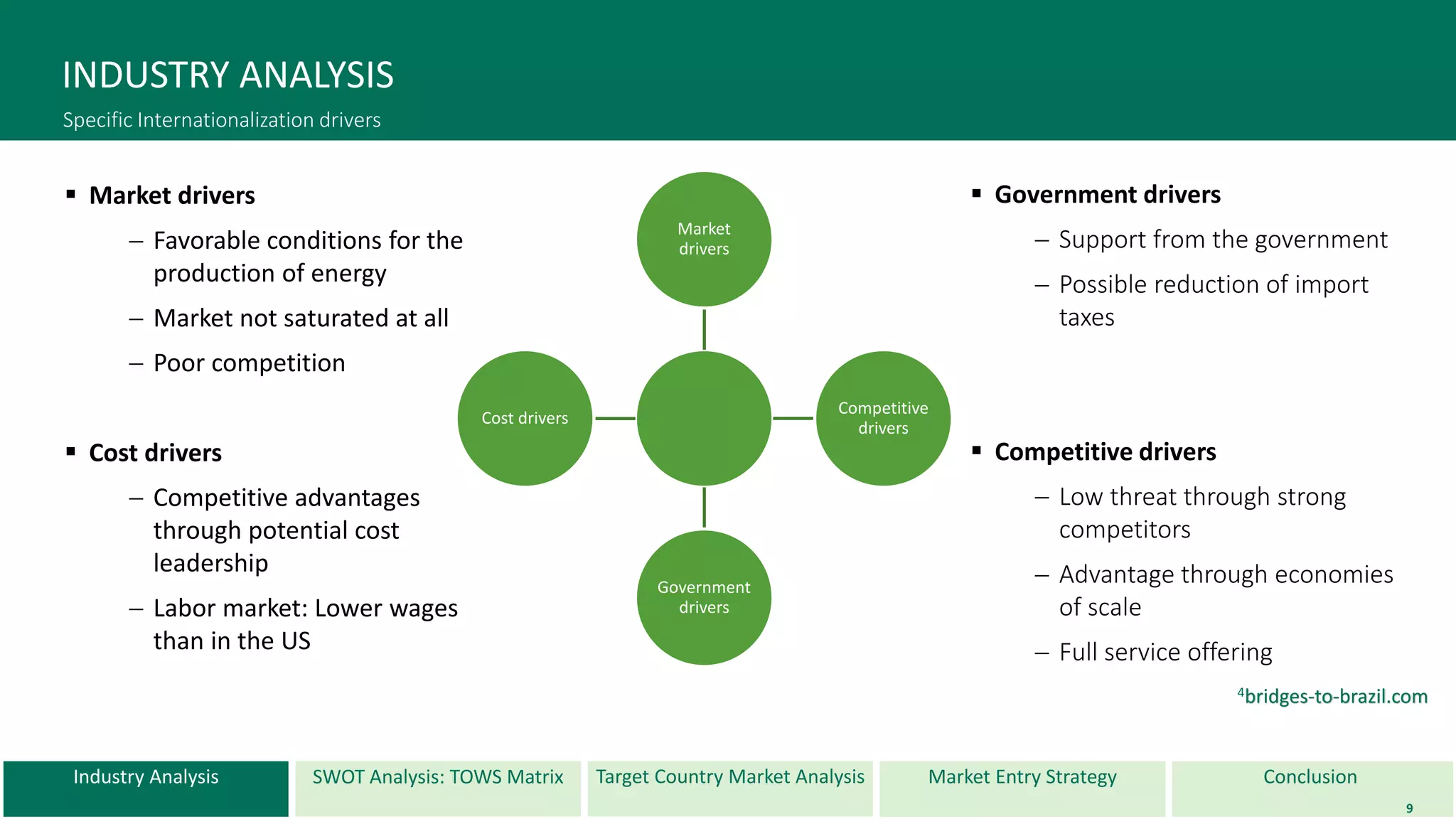
Specific Internationalization drivers
9
Market
drivers
Competitive
drivers
Government
drivers
Cost drivers
 Market drivers
 Favorable conditions for the
production of energy
 Market not saturated at all
 Poor competition
 Cost drivers
 Competitive advantages
through potential cost
leadership
 Labor market: Lower wages
than in the US
 Government drivers
 Support from the government
 Possible reduction of import
taxes
 Competitive drivers
 Low threat through strong
competitors
 Advantage through economies
of scale
 Full service offering
4bridges-to-brazil.com
Industry Analysis SWOT Analysis: TOWS Matrix Target Country Market Analysis ConclusionMarket Entry Strategy
INDUSTRY ANALYSIS
Specific internalization drivers
 Market drivers
 Favorable conditions for the production of energy
 Market not saturated at all
 Poor competition
 Cost drivers
 Competitive advantages through potential cost leadership
 Lower wages than in the US
10
4bridges-to-brazil.com
Industry Analysis SWOT Analysis: TOWS Matrix Target Country Market Analysis ConclusionMarket Entry Strategy
INDUSTRY ANALYSIS
Specific internalization drivers
 Government drivers
 Support from the government
 Possible reduction of import taxes
 Competitive drivers
 Low threat through strong competitors
 Advantage through economies of scale
 Full service offering
11
4bridges-to-brazil.com
Industry Analysis SWOT Analysis: TOWS Matrix Target Country Market Analysis ConclusionMarket Entry Strategy
INDUSTRY ANALYSIS
Specific internalization drivers
 Conclusion
We believe that Brazil is a very interesting market for foreign entrepreneurs to invest in photovoltaic energy. The
time to build and strengthen business relationships in Brazil could not be better. Sun-kissed Brazil has one of the
highest solar radiation factors in the world and plenty of land for solar farms, plus large reserves of silicon, used to
make solar panels.
12
4bridges-to-brazil.com
SWOT ANALYSIS: TOWS MATRIX
Industry Analysis SWOT Analysis: TOWS Matrix Target Country Market Analysis ConclusionMarket Entry Strategy
SWOT ANALYSIS: TOWS MATRIX
SWOT Analysis
14
Strenghts
- Large financial Resources
- High Technology
- Backward integration & Economies of scale
- Integrated full value chain process
- Large customers & strategic relationships
Weaknesses
- High dependence on government subsidies
- Not yet profitable
- High costs for acquiring customers
- Customers may not pay
- Limited knowledge of recycling
Opportunities
- Expand internationally
- „Trend to be green“
- World runs out of oil
- Manufacturing costs of panels fall
- Few competition in Brazil
- Knowledge Spillovers through new markets
Threats
- Low-cost competitors from China
- No brand loyalty
- Improving technology of other renewable
energy sources
- Shareholder might lose trust
5WikiSolarCity
Industry Analysis SWOT Analysis: TOWS Matrix Target Country Market Analysis ConclusionMarket Entry Strategy
SWOT ANALYSIS: TOWS MATRIX
TOWS Matrix
S W
O
- Multiply cost savings through economies of
scale and falling manufacturing costs
- Use large financial resources to expand
internationally
- Economies of scale, a full service chain
process and economies of scale enable
competitive advantage in Brazil
- Use „Trend to be green“ to decrease customer
acquiring costs
- International expansion reduces dependance on
subsidies in the U.S.
- Knowledge spillover from international workers
should help at recycling issue
T
- Use full service chain as USP
- Large investors bring back trust to
shareholders
- Integrate other renewable energy systems in
portfolio
- Recycling programms must be installed
- Trying to be independent of subsidies
- Care about existing customers to generate
brand loyalty (word of mouth advertising will
then reduce costs for aquiring new customers)
15
TARGET COUNTRY MARKET ANALYSIS
Industry Analysis SWOT Analysis: TOWS Matrix Target Country Market Analysis ConclusionMarket Entry Strategy
TARGET COUNTRY MARKET ANALYSIS
PESTEL analysis: Environmental influences
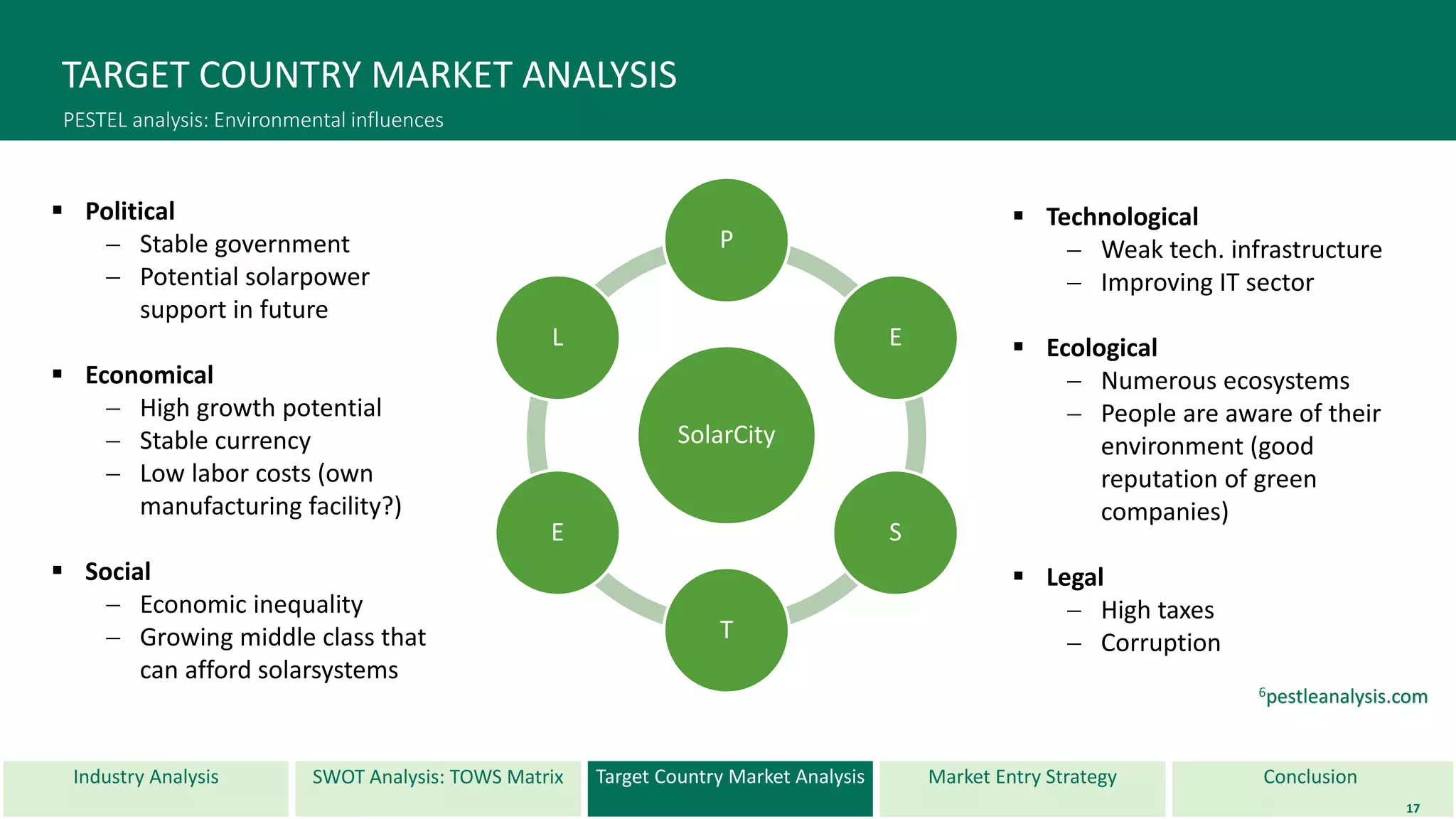
SolarCity
P
E
S
T
E
L
17
 Political
 Stable government
 Potential solarpower
support in future
 Economical
 High growth potential
 Stable currency
 Low labor costs (own
manufacturing facility?)
 Social
 Economic inequality
 Growing middle class that
can afford solarsystems
 Technological
 Weak tech. infrastructure
 Improving IT sector
 Ecological
 Numerous ecosystems
 People are aware of their
environment (good
reputation of green
companies)
 Legal
 High taxes
 Corruption
6pestleanalysis.com
Industry Analysis SWOT Analysis: TOWS Matrix Target Country Market Analysis ConclusionMarket Entry Strategy
TARGET COUNTRY MARKET ANALYSIS
PESTEL analysis: Environmental influences
 Political
 Stable government
 Potential support through subsidies in the future
 Economical
 High growth potential
 Stable currency
 Low labor costs
18
6pestleanalysis.com
Industry Analysis SWOT Analysis: TOWS Matrix Target Country Market Analysis ConclusionMarket Entry Strategy
TARGET COUNTRY MARKET ANALYSIS
PESTEL analysis: Environmental influences
 Technological
 Weak technological infrastructure
 Improving IT sector
 Social
 Economic inequality
 Growing middle class
19
6pestleanalysis.com
Industry Analysis SWOT Analysis: TOWS Matrix Target Country Market Analysis ConclusionMarket Entry Strategy
TARGET COUNTRY MARKET ANALYSIS
PESTEL analysis: Environmental influences
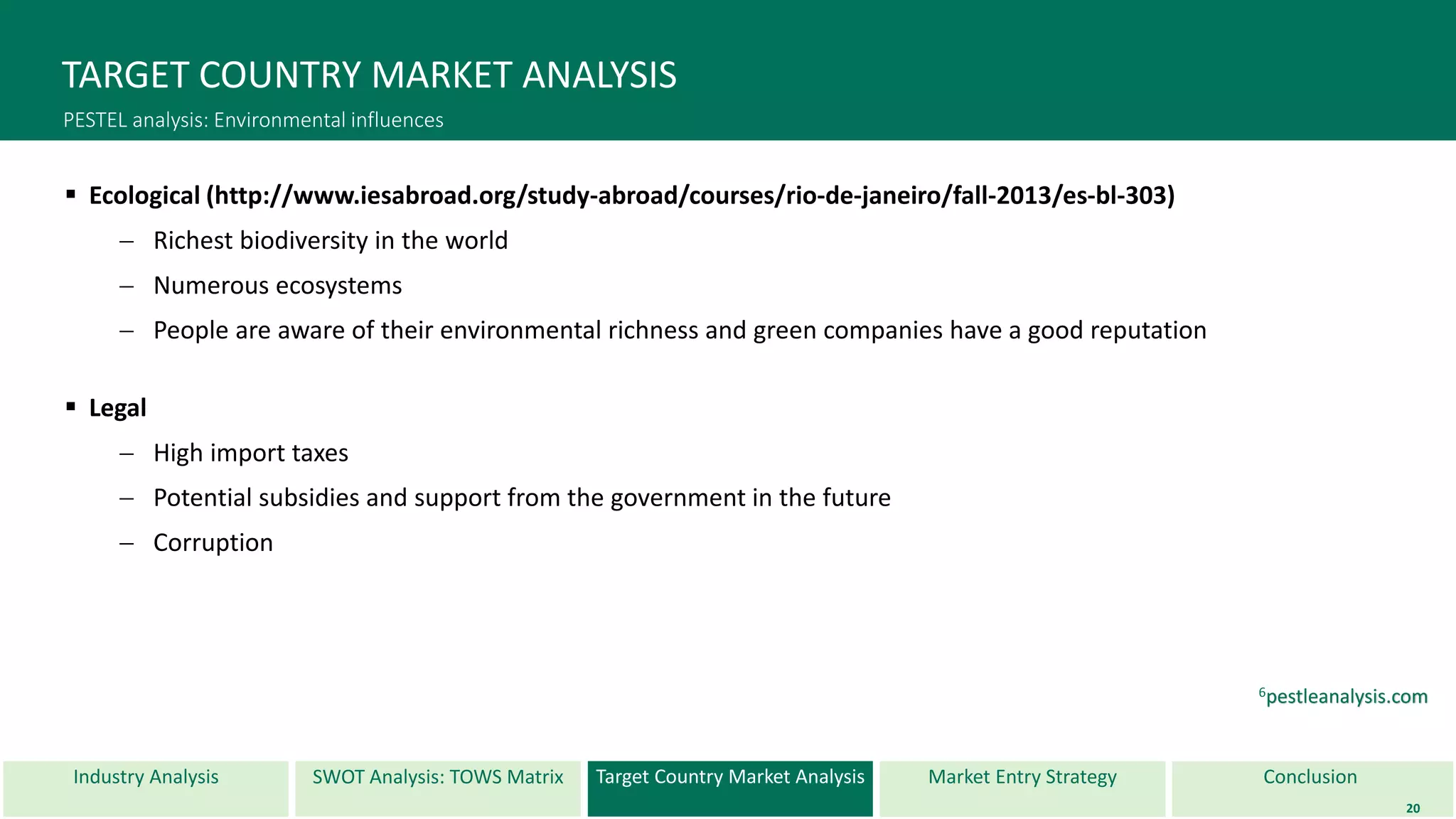
 Ecological (http://www.iesabroad.org/study-abroad/courses/rio-de-janeiro/fall-2013/es-bl-303)
 Richest biodiversity in the world
 Numerous ecosystems
 People are aware of their environmental richness and green companies have a good reputation
 Legal
 High import taxes
 Potential subsidies and support from the government in the future
 Corruption
20
6pestleanalysis.com
Industry Analysis SWOT Analysis: TOWS Matrix Target Country Market Analysis ConclusionMarket Entry Strategy
TARGET COUNTRY MARKET ANALYSIS
CAGE framework: Distance analysis
 Cultural Distance
Brazil
- They speak Portuguese
- Etnicity: white (include Portuguese, German, Italian, Polish) 55%, mixed white and black 38%, and others
- Religion: Roman Catholic 82%
- Family is the foundation of social structure and forms basis of stability for most people (Nepotism)
USA
- English is spoken by about 82% of the population
- Ethnicity: white 81.7%, black 12.9%, Asian 4.2% and others
- Religions: Protestant 52%, Roman Catholic 24%, Mormon 2%, and others
- Individualsm is prized
21
7Pankaj Ghemawat: Distance Still Matters
8kwintessential.co.uk
Industry Analysis SWOT Analysis: TOWS Matrix Target Country Market Analysis ConclusionMarket Entry Strategy
TARGET COUNTRY MARKET ANALYSIS
CAGE framework: Distance analysis
 Administrative and political distance
Brazil
- Corruption
- Institutional weaknesses, high taxes and bureaucratic burdens
- Corporate tax rate 27.5%, sales tax rate 19%
USA
- Head of country: president Barack Obama (Democratic Party)
- Corporate tax rate varies from 15% to 25%
- No national general sales tax (California: highest tax rate at 7.5%)
22
7Pankaj Ghemawat: Distance Still Matters
8kwintessential.co.uk
Industry Analysis SWOT Analysis: TOWS Matrix Target Country Market Analysis ConclusionMarket Entry Strategy
TARGET COUNTRY MARKET ANALYSIS
CAGE framework: Distance analysis
 Geographic distance
Brazil
- Air transport infrastructure is relatively well developed
- Highway system is one of the largest in the world but badly maintained
- Wealthy agglomerated areas as well as lagging areas
- Size of country: 9.511.965 square kilometres, 200.4 million habitants, capital city: brazilia
- Climate: mostly tropical, but temperate in the south
USA
- 318.9 million habitants
- U.S. transportation infrastructure requires substantial capital investments
- Border Countries: Canada, Mexico
23
7Pankaj Ghemawat: Distance Still Matters
8kwintessential.co.uk
Industry Analysis SWOT Analysis: TOWS Matrix Target Country Market Analysis ConclusionMarket Entry Strategy
TARGET COUNTRY MARKET ANALYSIS
CAGE framework: Distance analysis
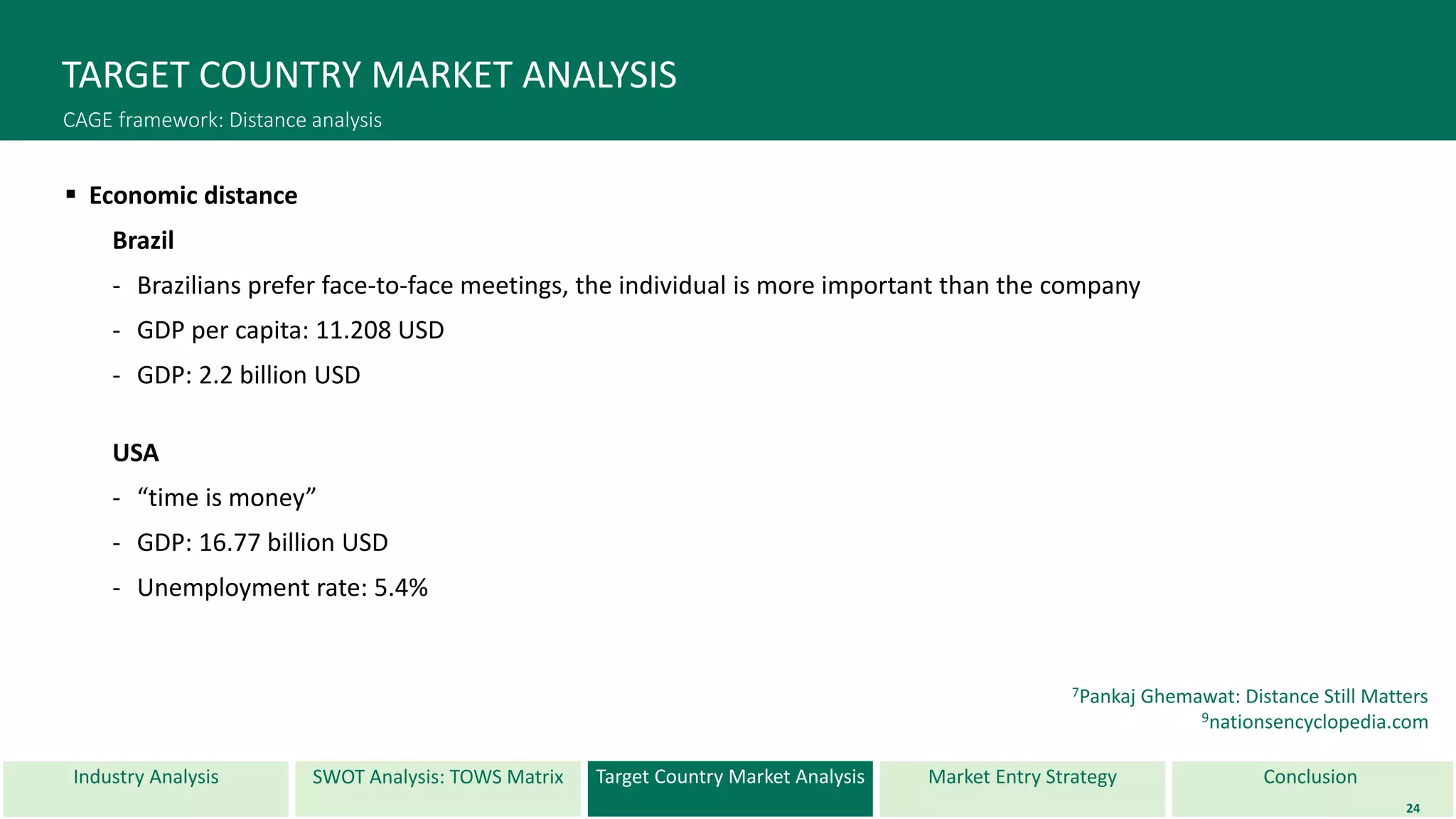
 Economic distance
Brazil
- Brazilians prefer face-to-face meetings, the individual is more important than the company
- GDP per capita: 11.208 USD
- GDP: 2.2 billion USD
USA
- “time is money”
- GDP: 16.77 billion USD
- Unemployment rate: 5.4%
24
7Pankaj Ghemawat: Distance Still Matters
9nationsencyclopedia.com
Industry Analysis SWOT Analysis: TOWS Matrix Target Country Market Analysis ConclusionMarket Entry Strategy
TARGET COUNTRY MARKET ANALYSIS
Benchmarking: Main Competitor´s profile
 SolarWorld AG, headquartered in Bonn (Germany), was founded in 1988
 German solar trading company with own manufacturing facilities
 One of the largest solar companies in the world with worldwide locations
(e.g. USA, UK, Spain, Singapore, Japan)
 Their main production facilities are located in Freiberg (Germany)
as well as in Hillsboro, Oregon (USA)
 The company employs 3.400 people worldwide
 SolarWorld AG offers integrated solar value chain process
25
10Solarworld
Industry Analysis SWOT Analysis: TOWS Matrix Target Country Market Analysis ConclusionMarket Entry Strategy
TARGET COUNTRY MARKET ANALYSIS
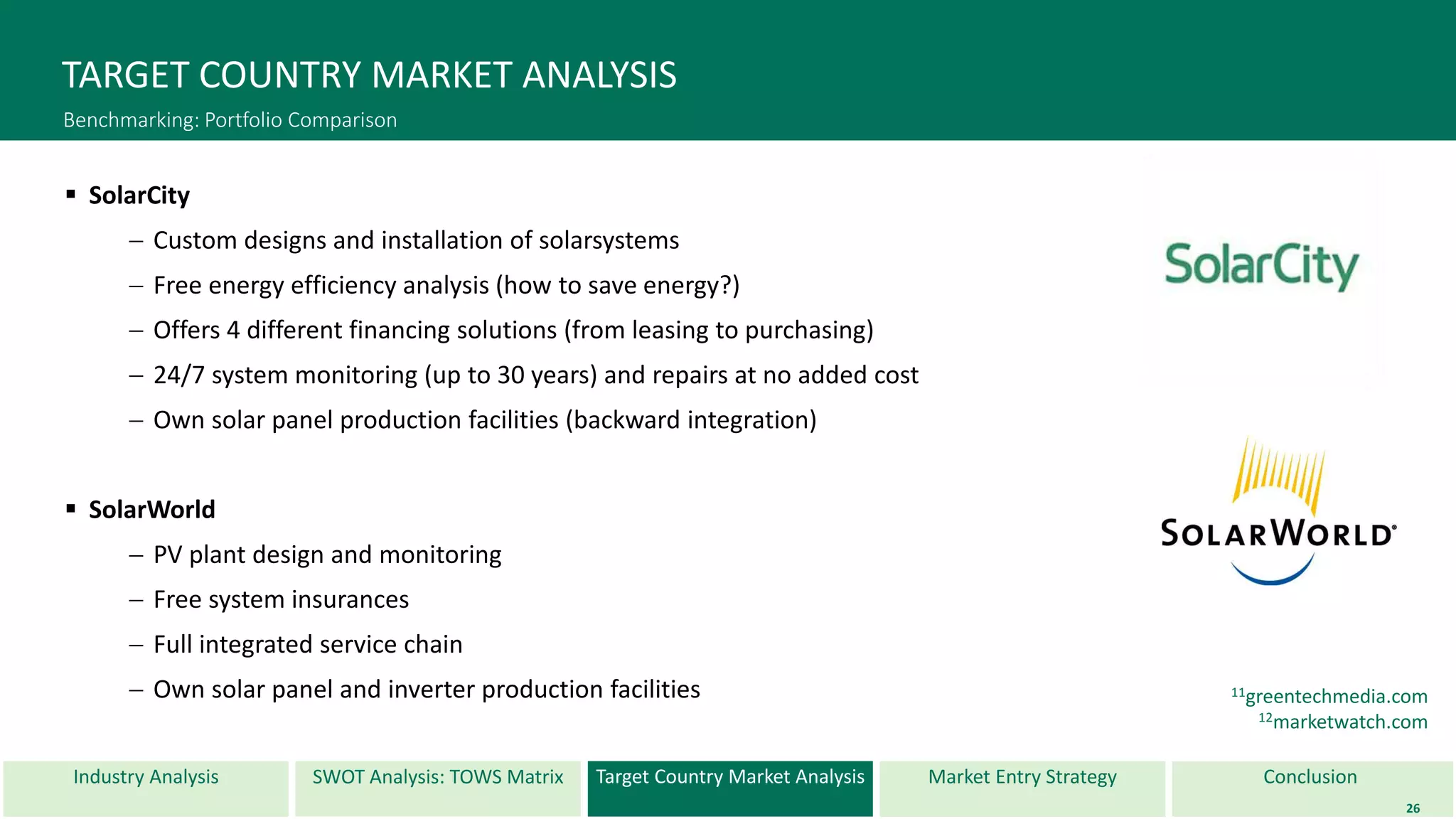
Benchmarking: Portfolio Comparison
 SolarCity
 Custom designs and installation of solarsystems
 Free energy efficiency analysis (how to save energy?)
 Offers 4 different financing solutions (from leasing to purchasing)
 24/7 system monitoring (up to 30 years) and repairs at no added cost
 Own solar panel production facilities (backward integration)
 SolarWorld
 PV plant design and monitoring
 Free system insurances
 Full integrated service chain
 Own solar panel and inverter production facilities
26
11greentechmedia.com
12marketwatch.com
Industry Analysis SWOT Analysis: TOWS Matrix Target Country Market Analysis ConclusionMarket Entry Strategy
TARGET COUNTRY MARKET ANALYSIS
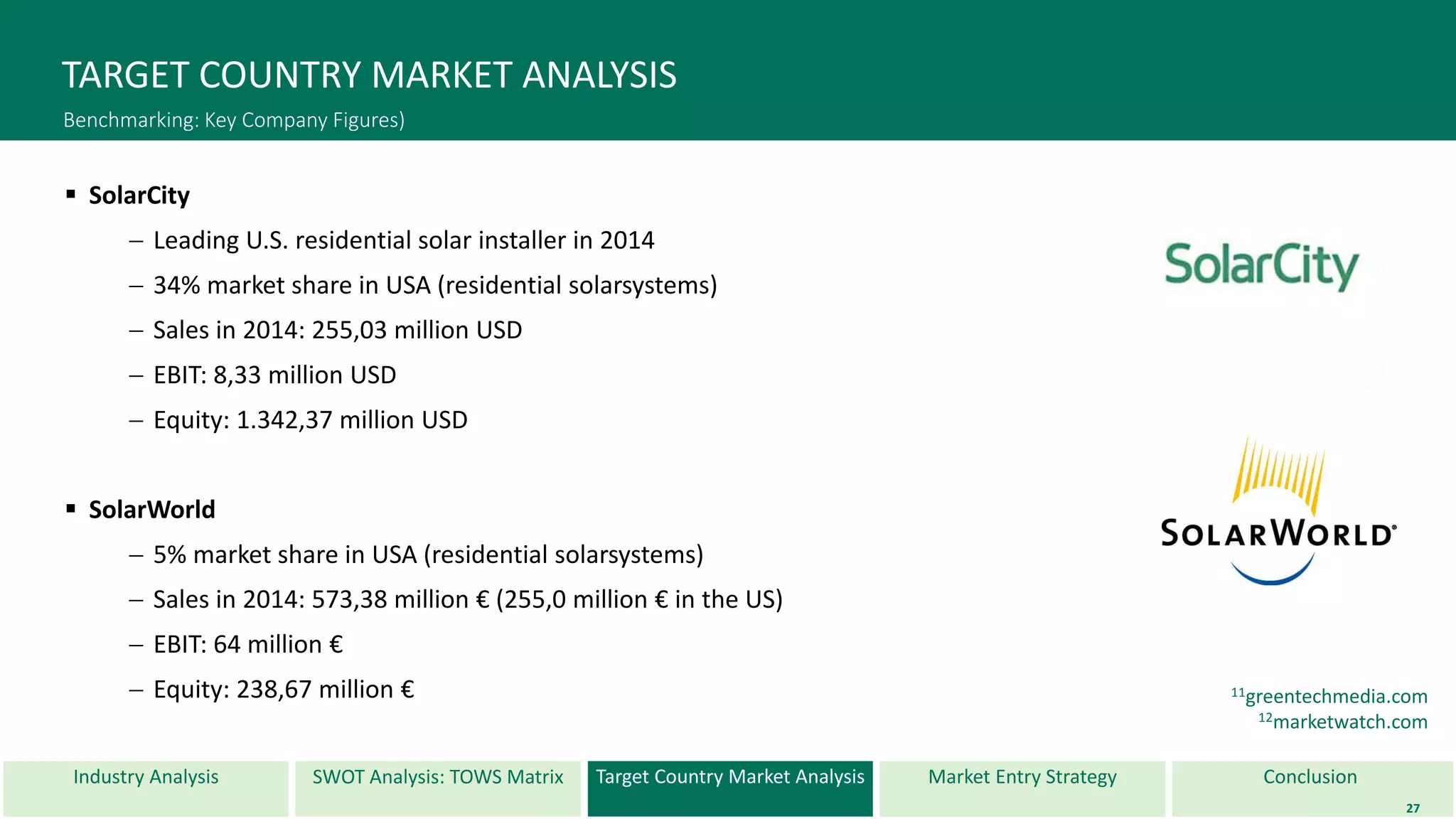
Benchmarking: Key Company Figures)
 SolarCity
 Leading U.S. residential solar installer in 2014
 34% market share in USA (residential solarsystems)
 Sales in 2014: 255,03 million USD
 EBIT: 8,33 million USD
 Equity: 1.342,37 million USD
 SolarWorld
 5% market share in USA (residential solarsystems)
 Sales in 2014: 573,38 million € (255,0 million € in the US)
 EBIT: 64 million €
 Equity: 238,67 million €
27
11greentechmedia.com
12marketwatch.com
Industry Analysis SWOT Analysis: TOWS Matrix Target Country Market Analysis ConclusionMarket Entry Strategy
TARGET COUNTRY MARKET ANALYSIS
Benchmarking: Key Company Figures
28
Criteria Weight SolarCity SolarWorld
Brand reputation 0.10 4 3
Product Quality 0.15 4 4
Technology Standards 0.10 5 5
Full service chain 0.10 5 4
Low Price 0.20 4 3
Product Variety Range 0.10 2 3
Advertising 0.10 2 2
Customer Service 0.10 4 3
CSR 0.05 3 1
Weighted overall competitive strength scores 1.00 3,75 3,1
11greentechmedia.com
12marketwatch.com
MARKET ENTRY STRATEGY
Industry Analysis SWOT Analysis: TOWS Matrix Target Country Market Analysis ConclusionMarket Entry Strategy
MARKET ENTRY STRATEGY
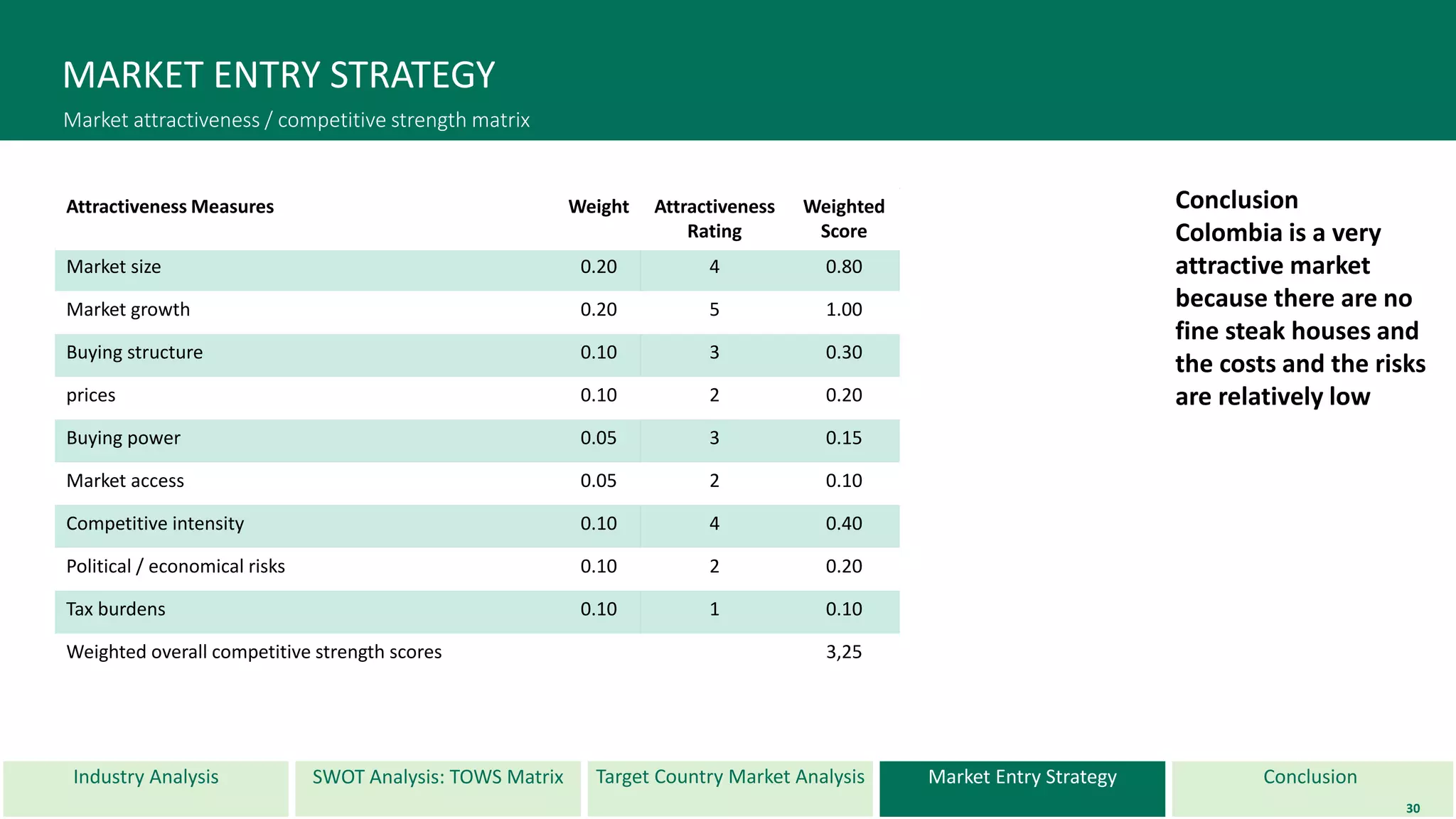
Market attractiveness / competitive strength matrix
30
Attractiveness Measures Weight Attractiveness
Rating
Weighted
Score
Market size 0.20 4 0.80
Market growth 0.20 5 1.00
Buying structure 0.10 3 0.30
prices 0.10 2 0.20
Buying power 0.05 3 0.15
Market access 0.05 2 0.10
Competitive intensity 0.10 4 0.40
Political / economical risks 0.10 2 0.20
Tax burdens 0.10 1 0.10
Weighted overall competitive strength scores 3,25
Conclusion
Colombia is a very
attractive market
because there are no
fine steak houses and
the costs and the risks
are relatively low
Industry Analysis SWOT Analysis: TOWS Matrix Target Country Market Analysis ConclusionMarket Entry Strategy
MARKET ENTRY STRATEGY
Market attractiveness / competitive strength matrix
31
Competitive strength measures Weight Attractiveness
Rating
Weighted
Score
Local experience 0.10 2 0.20
Market knowledge 0.10 4 0.40
Quality of local network 0.15 2 0.30
Products fit to market demands 0.25 5 1.25
Supply Chain Network 0.10 3 0.30
Economies of scale 0.05 5 0.25
Full Service Chain 0.10 5 0.50
Cost advantages 0.15 5 0.75
Weighted overall copetitive strength scores 3.95
Conclusion
Although there is no
real competition in
columbia at the
moment you should
establish quickly the
brand name and the
image of your company
because competitors
will follow
Industry Analysis SWOT Analysis: TOWS Matrix Target Country Market Analysis ConclusionMarket Entry Strategy
MARKET ENTRY STRATEGY
Market attractiveness / competitive strength matrix
COMPETITIVE
POSITION
MARKET ATTRACTIVENESS
32
BRAZIL
Invest
Selective strategies
Divest
Industry Analysis SWOT Analysis: TOWS Matrix Target Country Market Analysis ConclusionMarket Entry Strategy
MARKET ENTRY STRATEGY
Short list of (top three) entry options
1. Franchising
 Minimum risk and quick market entry
 Only small profits through franchise fees
 Quick geographical coverage in Brazil possible
 Potential returns from marketing may be lost
 Control over business and technology use is weakened
2. Subsidiaries
 Control remains completely at SolarCity
 No „sharing“ of profits necessary
 Higher costs but potential utilization of economies of scale
 Higher market entry burdens
33
3. Joint Venture
 Fast market entry through strategic
networks of partner
 Knowledge spillover possible
 Brazil partner is aware of political and
legal risks
 Existing client base of partner
 Reduced costs of market entry through
venture capital of both sides
 Less profits
Industry Analysis SWOT Analysis: TOWS Matrix Target Country Market Analysis ConclusionMarket Entry Strategy
MARKET ENTRY STRATEGY
Scoring model: Evaluation criteria
Criteria Importance of
the criteria
Options
Franchising Sub-
sidiaries
Joint
Venture
Control over marketing 2 2 4 1
Control over after-sales service 2 2 4 2
Required financial resurces 3 4 2 4
Requires management resources 1 3 2 3
Production costs 3 4 1 3
Custom duties to be paid 2 4 1 3
Flexibility to switch entry modes 1 2 3 2
Access to distribution channels 2 4 2 4
Risk of knowledge dissemination 3 1 4 1
Overall evaluation 59 46 49
34
Scores: 4=very positive, 3=positive, 2=negative, 1=very negative
Importance of the criteria: 3=high, 2=medium, 1=low
CONCLUSION
Industry Analysis SWOT Analysis: TOWS Matrix Target Country Market Analysis ConclusionMarket Entry Strategy
CONCLUSION
Summary: Best Market Entry Concept
 Factors
 First high class steakhouse in columbia
 Increase the geographical coverage
 Strategy
 Franchising
19 franchise restaurants allredy exist
Brings an income of $12.0 million for the
company
No developing of a business concept incl.
use of trademarks
 Risk
 Less customers because of a high price
36
Conclusion
Franchising is on of the best options for rapid
market expansion. It works well for Ruth´s because
they have a repeatable business model that can be
easily transferred into other markets. The business
model of Ruth´s is very unique and has strong brand
recognition that can be utilized internationally and
secondly it worked out well already in 19
restaurants.
Industry Analysis SWOT Analysis: TOWS Matrix Target Country Market Analysis ConclusionMarket Entry Strategy
CONCLUSION
Future Options
 Expansion strategy nationwide or internationally
 Focus on sales and profitability through marketing, cost control, monitoring of
financial statements and quality control
 Improvement of customer service and quality improvement through streamlined preparation and presentation
 Creating and adding new services like private dining
 Increasing the intensity of marketing and sales activities through websites and social media
37
Industry Analysis SWOT Analysis: TOWS Matrix Target Country Market Analysis ConclusionMarket Entry Strategy
Sources
 1SolarCity: http://www.solarcity.com
 2finanzen.net: http://www.finanzen.net/bilanz_guv/SolarCity
 3WikiSolarCity: https://sites.google.com/site/wikisolarcity/home/chapter-3/the-five-forces-model
 4bridges-to-brazil.com: http://www.bridges-to-brazil.com/en/solar-energy
 5WikiSolarCity: https://sites.google.com/site/wikisolarcity/home/internal-analysis/the-swot-analysis
 6pestleanalysis.com: http://pestleanalysis.com/pest-analysis-brazil-shows-high-potential-growth/
 7Pankaj Ghemawat: Distance Still Matters: the hard reality of global expansion
 8kwintessential.co.uk: http://www.kwintessential.co.uk/resources/global-etiquette
 9nationsencyclopedia.com: http://www.nationsencyclopedia.com/economies/Americas/Brazil.html
 10Solarworld: http://www.solarworld.de/
 11greentechmedia.com: greentechmedia.com/articles/read/Here-Are-the-Top-Five-Residential-Solar-Installers-of-2014
 12marketwatch.com: http://www.marketwatch.com/investing/stock/scty/financials
38

Christoph Forstner: Market Entry Concept of Solarcity

  • 1.
    MARKET ENTRY CONCEPT OFSOLARCITY IN BRAZILChristoph Paul Forstner
  • 2.
    Industry Analysis SWOTAnalysis: TOWS Matrix Target Country Market Analysis ConclusionMarket Entry Strategy STRUCTURE Market Entry Concept: SolarCity in Brazil 2 I. Industry Analysis 1. PORTER´S 5 driving forces 2. Specific Internationalization drivers II. SWOT Analysis: TOWS Matrix III. Target Country Market Analysis 1. PESTEL analysis: Environmental influences 2. CAGE framework: Distance analysis 3. Benchmarking: Main Competitor´s profile III. Market Entry Strategy 1. Market attractiveness / competitive strength matrix 2. Short list of entry options 3. Scoring model: Evaluation criteria IV. Conclusion 1. Summary: Best Market Entry Concept 2. Future Options
  • 3.
  • 4.
    Industry Analysis SWOTAnalysis: TOWS Matrix Target Country Market Analysis ConclusionMarket Entry Strategy INDUSTRY ANALYSIS SolarCity  founded in 2006, headquartered in San Mateo, California  Founders: Peter Rive, Lyndon Rive and Elon Musk  Designing, financing and installment of solar power systems  number one residential solar installer in the U.S. (2013)  Business partners: homeowners, businesses, NPOs, government  Operates in 17 states in the U.S., more than 75 operations centers  Revenue: 255,03 million; EBIT: 8,33 million; equity: 1.342.37 million (USD) 4 1SolarCity 2finanzen.net
  • 5.
    Industry Analysis SWOTAnalysis: TOWS Matrix Target Country Market Analysis ConclusionMarket Entry Strategy INDUSTRY ANALYSIS PORTER´S 5 driving forces Market Competitors New Entrants Buyers Substitutes Suppliers 5  New Entrants (LOW)  High entry barriers  Huge R&D investments  Economies of scale necessary  Power of Suppliers (LOW)  High number of potential suppliers  Backward integration  Buyers (MEDIUM)  No brand loyalty  Very price sensitive  Rivalry (MEDIUM)  Strong competition among few competitors  Few companies that make profits  Substitutes (MEDIUM – HIGH)  Fossil fuels, wind power etc.  Other resources (nuclear power) are still cheaper  Traditional energy sources do not generate income 3WikiSolarCity
  • 6.
    Industry Analysis SWOTAnalysis: TOWS Matrix Target Country Market Analysis ConclusionMarket Entry Strategy INDUSTRY ANALYSIS PORTER´S 5 driving forces  Rivalry among existing competitors  Strong competition among few competitors due to high innovation pressure  Few companies that make profits  Threat of new entrants  High entry barriers  Huge R&D investments  Economies of scale necessary 6 3WikiSolarCity
  • 7.
    Industry Analysis SWOTAnalysis: TOWS Matrix Target Country Market Analysis ConclusionMarket Entry Strategy INDUSTRY ANALYSIS PORTER´S 5 driving forces  Power of Suppliers  High number of potential suppliers  Backward integration  Power of Buyers  No brand loyalty  Very price sensitive 7 3WikiSolarCity
  • 8.
    Industry Analysis SWOTAnalysis: TOWS Matrix Target Country Market Analysis ConclusionMarket Entry Strategy INDUSTRY ANALYSIS PORTER´S 5 driving forces  Substitutes  Fossil fuels, wind power etc.  Other resources (nuclear power) are still cheaper  Traditional energy sources do not generate income 8 3WikiSolarCity
  • 9.
    Industry Analysis SWOTAnalysis: TOWS Matrix Target Country Market Analysis ConclusionMarket Entry Strategy INDUSTRY ANALYSIS Specific Internationalization drivers 9 Market drivers Competitive drivers Government drivers Cost drivers  Market drivers  Favorable conditions for the production of energy  Market not saturated at all  Poor competition  Cost drivers  Competitive advantages through potential cost leadership  Labor market: Lower wages than in the US  Government drivers  Support from the government  Possible reduction of import taxes  Competitive drivers  Low threat through strong competitors  Advantage through economies of scale  Full service offering 4bridges-to-brazil.com
  • 10.
    Industry Analysis SWOTAnalysis: TOWS Matrix Target Country Market Analysis ConclusionMarket Entry Strategy INDUSTRY ANALYSIS Specific internalization drivers  Market drivers  Favorable conditions for the production of energy  Market not saturated at all  Poor competition  Cost drivers  Competitive advantages through potential cost leadership  Lower wages than in the US 10 4bridges-to-brazil.com
  • 11.
    Industry Analysis SWOTAnalysis: TOWS Matrix Target Country Market Analysis ConclusionMarket Entry Strategy INDUSTRY ANALYSIS Specific internalization drivers  Government drivers  Support from the government  Possible reduction of import taxes  Competitive drivers  Low threat through strong competitors  Advantage through economies of scale  Full service offering 11 4bridges-to-brazil.com
  • 12.
    Industry Analysis SWOTAnalysis: TOWS Matrix Target Country Market Analysis ConclusionMarket Entry Strategy INDUSTRY ANALYSIS Specific internalization drivers  Conclusion We believe that Brazil is a very interesting market for foreign entrepreneurs to invest in photovoltaic energy. The time to build and strengthen business relationships in Brazil could not be better. Sun-kissed Brazil has one of the highest solar radiation factors in the world and plenty of land for solar farms, plus large reserves of silicon, used to make solar panels. 12 4bridges-to-brazil.com
  • 13.
  • 14.
    Industry Analysis SWOTAnalysis: TOWS Matrix Target Country Market Analysis ConclusionMarket Entry Strategy SWOT ANALYSIS: TOWS MATRIX SWOT Analysis 14 Strenghts - Large financial Resources - High Technology - Backward integration & Economies of scale - Integrated full value chain process - Large customers & strategic relationships Weaknesses - High dependence on government subsidies - Not yet profitable - High costs for acquiring customers - Customers may not pay - Limited knowledge of recycling Opportunities - Expand internationally - „Trend to be green“ - World runs out of oil - Manufacturing costs of panels fall - Few competition in Brazil - Knowledge Spillovers through new markets Threats - Low-cost competitors from China - No brand loyalty - Improving technology of other renewable energy sources - Shareholder might lose trust 5WikiSolarCity
  • 15.
    Industry Analysis SWOTAnalysis: TOWS Matrix Target Country Market Analysis ConclusionMarket Entry Strategy SWOT ANALYSIS: TOWS MATRIX TOWS Matrix S W O - Multiply cost savings through economies of scale and falling manufacturing costs - Use large financial resources to expand internationally - Economies of scale, a full service chain process and economies of scale enable competitive advantage in Brazil - Use „Trend to be green“ to decrease customer acquiring costs - International expansion reduces dependance on subsidies in the U.S. - Knowledge spillover from international workers should help at recycling issue T - Use full service chain as USP - Large investors bring back trust to shareholders - Integrate other renewable energy systems in portfolio - Recycling programms must be installed - Trying to be independent of subsidies - Care about existing customers to generate brand loyalty (word of mouth advertising will then reduce costs for aquiring new customers) 15
  • 16.
  • 17.
    Industry Analysis SWOTAnalysis: TOWS Matrix Target Country Market Analysis ConclusionMarket Entry Strategy TARGET COUNTRY MARKET ANALYSIS PESTEL analysis: Environmental influences SolarCity P E S T E L 17  Political  Stable government  Potential solarpower support in future  Economical  High growth potential  Stable currency  Low labor costs (own manufacturing facility?)  Social  Economic inequality  Growing middle class that can afford solarsystems  Technological  Weak tech. infrastructure  Improving IT sector  Ecological  Numerous ecosystems  People are aware of their environment (good reputation of green companies)  Legal  High taxes  Corruption 6pestleanalysis.com
  • 18.
    Industry Analysis SWOTAnalysis: TOWS Matrix Target Country Market Analysis ConclusionMarket Entry Strategy TARGET COUNTRY MARKET ANALYSIS PESTEL analysis: Environmental influences  Political  Stable government  Potential support through subsidies in the future  Economical  High growth potential  Stable currency  Low labor costs 18 6pestleanalysis.com
  • 19.
    Industry Analysis SWOTAnalysis: TOWS Matrix Target Country Market Analysis ConclusionMarket Entry Strategy TARGET COUNTRY MARKET ANALYSIS PESTEL analysis: Environmental influences  Technological  Weak technological infrastructure  Improving IT sector  Social  Economic inequality  Growing middle class 19 6pestleanalysis.com
  • 20.
    Industry Analysis SWOTAnalysis: TOWS Matrix Target Country Market Analysis ConclusionMarket Entry Strategy TARGET COUNTRY MARKET ANALYSIS PESTEL analysis: Environmental influences  Ecological (http://www.iesabroad.org/study-abroad/courses/rio-de-janeiro/fall-2013/es-bl-303)  Richest biodiversity in the world  Numerous ecosystems  People are aware of their environmental richness and green companies have a good reputation  Legal  High import taxes  Potential subsidies and support from the government in the future  Corruption 20 6pestleanalysis.com
  • 21.
    Industry Analysis SWOTAnalysis: TOWS Matrix Target Country Market Analysis ConclusionMarket Entry Strategy TARGET COUNTRY MARKET ANALYSIS CAGE framework: Distance analysis  Cultural Distance Brazil - They speak Portuguese - Etnicity: white (include Portuguese, German, Italian, Polish) 55%, mixed white and black 38%, and others - Religion: Roman Catholic 82% - Family is the foundation of social structure and forms basis of stability for most people (Nepotism) USA - English is spoken by about 82% of the population - Ethnicity: white 81.7%, black 12.9%, Asian 4.2% and others - Religions: Protestant 52%, Roman Catholic 24%, Mormon 2%, and others - Individualsm is prized 21 7Pankaj Ghemawat: Distance Still Matters 8kwintessential.co.uk
  • 22.
    Industry Analysis SWOTAnalysis: TOWS Matrix Target Country Market Analysis ConclusionMarket Entry Strategy TARGET COUNTRY MARKET ANALYSIS CAGE framework: Distance analysis  Administrative and political distance Brazil - Corruption - Institutional weaknesses, high taxes and bureaucratic burdens - Corporate tax rate 27.5%, sales tax rate 19% USA - Head of country: president Barack Obama (Democratic Party) - Corporate tax rate varies from 15% to 25% - No national general sales tax (California: highest tax rate at 7.5%) 22 7Pankaj Ghemawat: Distance Still Matters 8kwintessential.co.uk
  • 23.
    Industry Analysis SWOTAnalysis: TOWS Matrix Target Country Market Analysis ConclusionMarket Entry Strategy TARGET COUNTRY MARKET ANALYSIS CAGE framework: Distance analysis  Geographic distance Brazil - Air transport infrastructure is relatively well developed - Highway system is one of the largest in the world but badly maintained - Wealthy agglomerated areas as well as lagging areas - Size of country: 9.511.965 square kilometres, 200.4 million habitants, capital city: brazilia - Climate: mostly tropical, but temperate in the south USA - 318.9 million habitants - U.S. transportation infrastructure requires substantial capital investments - Border Countries: Canada, Mexico 23 7Pankaj Ghemawat: Distance Still Matters 8kwintessential.co.uk
  • 24.
    Industry Analysis SWOTAnalysis: TOWS Matrix Target Country Market Analysis ConclusionMarket Entry Strategy TARGET COUNTRY MARKET ANALYSIS CAGE framework: Distance analysis  Economic distance Brazil - Brazilians prefer face-to-face meetings, the individual is more important than the company - GDP per capita: 11.208 USD - GDP: 2.2 billion USD USA - “time is money” - GDP: 16.77 billion USD - Unemployment rate: 5.4% 24 7Pankaj Ghemawat: Distance Still Matters 9nationsencyclopedia.com
  • 25.
    Industry Analysis SWOTAnalysis: TOWS Matrix Target Country Market Analysis ConclusionMarket Entry Strategy TARGET COUNTRY MARKET ANALYSIS Benchmarking: Main Competitor´s profile  SolarWorld AG, headquartered in Bonn (Germany), was founded in 1988  German solar trading company with own manufacturing facilities  One of the largest solar companies in the world with worldwide locations (e.g. USA, UK, Spain, Singapore, Japan)  Their main production facilities are located in Freiberg (Germany) as well as in Hillsboro, Oregon (USA)  The company employs 3.400 people worldwide  SolarWorld AG offers integrated solar value chain process 25 10Solarworld
  • 26.
    Industry Analysis SWOTAnalysis: TOWS Matrix Target Country Market Analysis ConclusionMarket Entry Strategy TARGET COUNTRY MARKET ANALYSIS Benchmarking: Portfolio Comparison  SolarCity  Custom designs and installation of solarsystems  Free energy efficiency analysis (how to save energy?)  Offers 4 different financing solutions (from leasing to purchasing)  24/7 system monitoring (up to 30 years) and repairs at no added cost  Own solar panel production facilities (backward integration)  SolarWorld  PV plant design and monitoring  Free system insurances  Full integrated service chain  Own solar panel and inverter production facilities 26 11greentechmedia.com 12marketwatch.com
  • 27.
    Industry Analysis SWOTAnalysis: TOWS Matrix Target Country Market Analysis ConclusionMarket Entry Strategy TARGET COUNTRY MARKET ANALYSIS Benchmarking: Key Company Figures)  SolarCity  Leading U.S. residential solar installer in 2014  34% market share in USA (residential solarsystems)  Sales in 2014: 255,03 million USD  EBIT: 8,33 million USD  Equity: 1.342,37 million USD  SolarWorld  5% market share in USA (residential solarsystems)  Sales in 2014: 573,38 million € (255,0 million € in the US)  EBIT: 64 million €  Equity: 238,67 million € 27 11greentechmedia.com 12marketwatch.com
  • 28.
    Industry Analysis SWOTAnalysis: TOWS Matrix Target Country Market Analysis ConclusionMarket Entry Strategy TARGET COUNTRY MARKET ANALYSIS Benchmarking: Key Company Figures 28 Criteria Weight SolarCity SolarWorld Brand reputation 0.10 4 3 Product Quality 0.15 4 4 Technology Standards 0.10 5 5 Full service chain 0.10 5 4 Low Price 0.20 4 3 Product Variety Range 0.10 2 3 Advertising 0.10 2 2 Customer Service 0.10 4 3 CSR 0.05 3 1 Weighted overall competitive strength scores 1.00 3,75 3,1 11greentechmedia.com 12marketwatch.com
  • 29.
  • 30.
    Industry Analysis SWOTAnalysis: TOWS Matrix Target Country Market Analysis ConclusionMarket Entry Strategy MARKET ENTRY STRATEGY Market attractiveness / competitive strength matrix 30 Attractiveness Measures Weight Attractiveness Rating Weighted Score Market size 0.20 4 0.80 Market growth 0.20 5 1.00 Buying structure 0.10 3 0.30 prices 0.10 2 0.20 Buying power 0.05 3 0.15 Market access 0.05 2 0.10 Competitive intensity 0.10 4 0.40 Political / economical risks 0.10 2 0.20 Tax burdens 0.10 1 0.10 Weighted overall competitive strength scores 3,25 Conclusion Colombia is a very attractive market because there are no fine steak houses and the costs and the risks are relatively low
  • 31.
    Industry Analysis SWOTAnalysis: TOWS Matrix Target Country Market Analysis ConclusionMarket Entry Strategy MARKET ENTRY STRATEGY Market attractiveness / competitive strength matrix 31 Competitive strength measures Weight Attractiveness Rating Weighted Score Local experience 0.10 2 0.20 Market knowledge 0.10 4 0.40 Quality of local network 0.15 2 0.30 Products fit to market demands 0.25 5 1.25 Supply Chain Network 0.10 3 0.30 Economies of scale 0.05 5 0.25 Full Service Chain 0.10 5 0.50 Cost advantages 0.15 5 0.75 Weighted overall copetitive strength scores 3.95 Conclusion Although there is no real competition in columbia at the moment you should establish quickly the brand name and the image of your company because competitors will follow
  • 32.
    Industry Analysis SWOTAnalysis: TOWS Matrix Target Country Market Analysis ConclusionMarket Entry Strategy MARKET ENTRY STRATEGY Market attractiveness / competitive strength matrix COMPETITIVE POSITION MARKET ATTRACTIVENESS 32 BRAZIL Invest Selective strategies Divest
  • 33.
    Industry Analysis SWOTAnalysis: TOWS Matrix Target Country Market Analysis ConclusionMarket Entry Strategy MARKET ENTRY STRATEGY Short list of (top three) entry options 1. Franchising  Minimum risk and quick market entry  Only small profits through franchise fees  Quick geographical coverage in Brazil possible  Potential returns from marketing may be lost  Control over business and technology use is weakened 2. Subsidiaries  Control remains completely at SolarCity  No „sharing“ of profits necessary  Higher costs but potential utilization of economies of scale  Higher market entry burdens 33 3. Joint Venture  Fast market entry through strategic networks of partner  Knowledge spillover possible  Brazil partner is aware of political and legal risks  Existing client base of partner  Reduced costs of market entry through venture capital of both sides  Less profits
  • 34.
    Industry Analysis SWOTAnalysis: TOWS Matrix Target Country Market Analysis ConclusionMarket Entry Strategy MARKET ENTRY STRATEGY Scoring model: Evaluation criteria Criteria Importance of the criteria Options Franchising Sub- sidiaries Joint Venture Control over marketing 2 2 4 1 Control over after-sales service 2 2 4 2 Required financial resurces 3 4 2 4 Requires management resources 1 3 2 3 Production costs 3 4 1 3 Custom duties to be paid 2 4 1 3 Flexibility to switch entry modes 1 2 3 2 Access to distribution channels 2 4 2 4 Risk of knowledge dissemination 3 1 4 1 Overall evaluation 59 46 49 34 Scores: 4=very positive, 3=positive, 2=negative, 1=very negative Importance of the criteria: 3=high, 2=medium, 1=low
  • 35.
  • 36.
    Industry Analysis SWOTAnalysis: TOWS Matrix Target Country Market Analysis ConclusionMarket Entry Strategy CONCLUSION Summary: Best Market Entry Concept  Factors  First high class steakhouse in columbia  Increase the geographical coverage  Strategy  Franchising 19 franchise restaurants allredy exist Brings an income of $12.0 million for the company No developing of a business concept incl. use of trademarks  Risk  Less customers because of a high price 36 Conclusion Franchising is on of the best options for rapid market expansion. It works well for Ruth´s because they have a repeatable business model that can be easily transferred into other markets. The business model of Ruth´s is very unique and has strong brand recognition that can be utilized internationally and secondly it worked out well already in 19 restaurants.
  • 37.
    Industry Analysis SWOTAnalysis: TOWS Matrix Target Country Market Analysis ConclusionMarket Entry Strategy CONCLUSION Future Options  Expansion strategy nationwide or internationally  Focus on sales and profitability through marketing, cost control, monitoring of financial statements and quality control  Improvement of customer service and quality improvement through streamlined preparation and presentation  Creating and adding new services like private dining  Increasing the intensity of marketing and sales activities through websites and social media 37
  • 38.
    Industry Analysis SWOTAnalysis: TOWS Matrix Target Country Market Analysis ConclusionMarket Entry Strategy Sources  1SolarCity: http://www.solarcity.com  2finanzen.net: http://www.finanzen.net/bilanz_guv/SolarCity  3WikiSolarCity: https://sites.google.com/site/wikisolarcity/home/chapter-3/the-five-forces-model  4bridges-to-brazil.com: http://www.bridges-to-brazil.com/en/solar-energy  5WikiSolarCity: https://sites.google.com/site/wikisolarcity/home/internal-analysis/the-swot-analysis  6pestleanalysis.com: http://pestleanalysis.com/pest-analysis-brazil-shows-high-potential-growth/  7Pankaj Ghemawat: Distance Still Matters: the hard reality of global expansion  8kwintessential.co.uk: http://www.kwintessential.co.uk/resources/global-etiquette  9nationsencyclopedia.com: http://www.nationsencyclopedia.com/economies/Americas/Brazil.html  10Solarworld: http://www.solarworld.de/  11greentechmedia.com: greentechmedia.com/articles/read/Here-Are-the-Top-Five-Residential-Solar-Installers-of-2014  12marketwatch.com: http://www.marketwatch.com/investing/stock/scty/financials 38

Editor's Notes

  • #5 Founded in New Orleans in 1965, Ruth’s Hospitality Group, Inc. is a leading restaurant company focused exclusively on the upscale dining segment. In addition to Ruth’s Chris Steak House, the company owns Mitchell’s Fish Market, Mitchell’s Steakhouse, and Cameron’s Steakhouse concepts. Ruth’s Hospitality Group operates more than 150 company- and franchisee-owned locations around the world.
  • #10 Internationalization in regions such as South America is a very good option. Not only the same in countries like Colombia tastes are available and the costs are relatively low. it is also an increasingly popular region with tourists. by political changes it is an increasingly attractive market for foreign companies so we should hurry to be the first fine dining restaurant.
  • #15 SWOT Analysis Strength 1. Presence in more than 130 locations 2. Availability of Reservation facilities 3. Presence of both food and beverages in the menu 4. Presence of ‘Gift Cards’ feature 5. Availability of ‘Private Dining’ rooms 6. Not many players in the market offering a similar product 7. Economies of scale due to the niche product offering Weakness 1. Most restaurants offer only dinner 2. Despite a strong presence, the brand recall is restricted owing to low advertising and marketing exercises Opportunity 1. Inclusion of different kinds of menu for lunch and dinner 2. Avail different kinds of combos to attract more of the middle class segment 3. Avail online ordering facility 4. Focusing on advertising and marketing & also geographic expansion Threats 1. People looking to have quick fast food 2. Families with kids looking to avoid places with beverages 3. People looking to have nutritious food
  • #16 Strengths and Opportunities (SO) – How can you use your strengths to take advantage of these opportunities? Strengths and Threats (ST) – How can you take advantage of your strengths to avoid real and potential threats? Weaknesses and Opportunities (WO) – How can you use your opportunities to overcome the weaknesses you are experiencing? Weaknesses and Threats (WT) – How can you minimize your weaknesses and avoid threats?
  • #17 http://www.google.de/imgres?imgurl=http%3A%2F%2Fwww.getfilings.com%2Fsec-filings%2F120523%2FRuths-Hospitality-Group-Inc_8-K%2Fslide3.jpg&imgrefurl=http%3A%2F%2Fwww.getfilings.com%2Fsec-filings%2F120523%2FRuths-Hospitality-Group-Inc_8-K%2Fa50286858-ex991.htm&h=719&w=959&tbnid=uoFnUPsc6LPPfM%3A&zoom=1&docid=PVVnAB-aYsUmCM&ei=NQGAVcDFNsGYsgH69oDYDg&tbm=isch&iact=rc&uact=3&dur=192&page=1&start=0&ndsp=45&ved=0CFEQrQMwEGoVChMIgLTik4eUxgIVQYwsCh16OwDr
  • #26 Tabelle ändern
  • #27 Tabelle ändern
  • #28 Tabelle ändern
  • #29 Tabelle ändern
  • #38 Most of the upscale segment chain restaurants are focused on the expansion strategy nationwide or internationally. Companies strongly believe that one of the best ways to grow the revenue is opening of new units. Another strategy that is common for the segment is focus on sales and profitability through marketing, cost control, monitoring of financial statements and quality control (Del Frisco’s Restaurant Group, LLC, 2012b) (Ruth’s Hospitality Group, Inc., 2012b). One of the future objectives is improvement of customer service that is critical for fine dining overall experience and is a differentiating point in restaurant industry. Close attention to the changes in the customer’s tastes and preferences and adequate reaction to it are critical objectives in order to be attractive to the guest and generate the revenue.