Arthur Januszkiewicz Silvan B. Meier
Sebastian Lachenit Vinzent Karger
Company
Profile
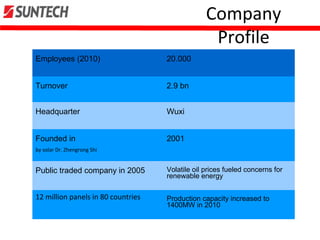
Employees (2010) 20.000
Turnover 2.9 bn
Headquarter Wuxi
Founded in
by solar Dr. Zhengrong Shi
2001
Public traded company in 2005 Volatile oil prices fueled concerns for
renewable energy
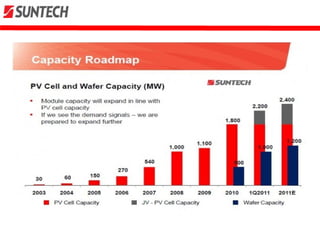
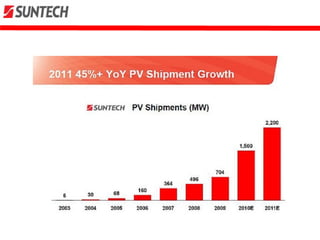
12 million panels in 80 countries Production capacity increased to
1400MW in 2010
Where is Suntech
Active?
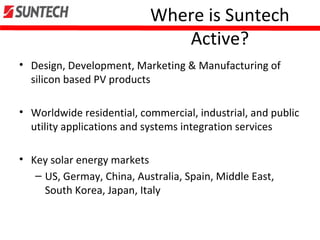
• Design, Development, Marketing & Manufacturing of
silicon based PV products
• Worldwide residential, commercial, industrial, and public
utility applications and systems integration services
• Key solar energy markets
– US, Germay, China, Australia, Spain, Middle East,
South Korea, Japan, Italy
Strategic Intent
• Suntech’s top priorities
Technology &
superior value
High quality &
low cost
Cost & scale
leadership
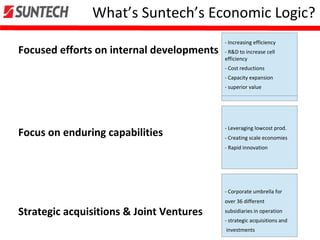
Focused efforts on internal developments
Focus on enduring capabilities
Strategic acquisitions & Joint Ventures
- Increasing efficiency
- R&D to increase cell
efficiency
- Cost reductions
- Capacity expansion
- superior value
- Leveraging lowcost prod.
- Creating scale economies
- Rapid innovation
- Increasing efficiency
- R&D to increase cell
efficiency
- Cost reductions
- Capacity expansion
- superior value
- Increasing efficiency
- R&D to increase cell
efficiency
- Cost reductions
- Capacity expansion
- superior value
- Corporate umbrella for
over 36 different
subsidiaries in operation
- strategic acquisitions and
investments
What’s Suntech’s Economic Logic?
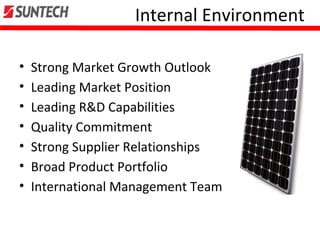
Internal Environment
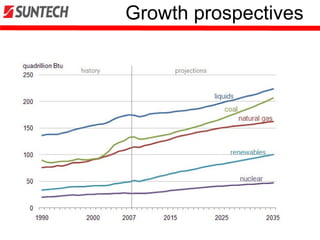
• Strong Market Growth Outlook
• Leading Market Position
• Leading R&D Capabilities
• Quality Commitment
• Strong Supplier Relationships
• Broad Product Portfolio
• International Management Team
Growth prospectives
What’s Suntech’s
Staging?
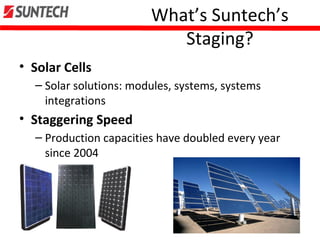
• Solar Cells
– Solar solutions: modules, systems, systems
integrations
• Staggering Speed
– Production capacities have doubled every year
since 2004
Key Mergers &
Acquisitions
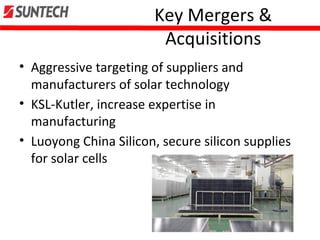
• Aggressive targeting of suppliers and
manufacturers of solar technology
• KSL-Kutler, increase expertise in
manufacturing
• Luoyong China Silicon, secure silicon supplies
for solar cells
Cooperative Strategy Analysis
Partnerships & Alliances
• Strengthen core business, solar developments,
enhance R&D, and secure supplies
– University of New South Wales: solar cell efficiency
– Calisolar Inc. to secure solar silicon manuf. facility
– Secure development of smart panel technology
International Strategy Analysis
• Adapting to local market differences
– Building relationships with customer base
– Distribution and subsidies
• Exploiting economies of global scale
• Promote adoption of solar power
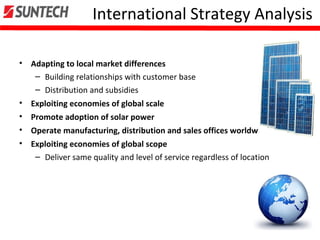
• Operate manufacturing, distribution and sales offices worldwide
• Exploiting economies of global scope
– Deliver same quality and level of service regardless of location
International Strategy Analysis
• Tapping optimal locations
– Leverage locations with access to low cost
resources and clean energy mandates
• Maximizing knowledge transfer
– 36 subsidiary organizations and 13 sales offices
– Manufacturing and R&D locations in China &
Europe
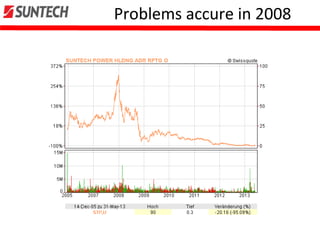
Problems accure in 2008
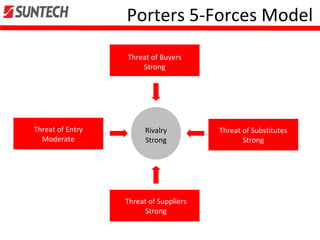
Porters 5-Forces Model
Threat of Entry
Moderate
Threat of Buyers
Strong
Threat of Substitutes
Strong
Threat of Suppliers
Strong
Rivalry
Strong
Problems
Suntech announced insolvency in march 2013
• High competition  less revenue
• EU and US accused suntech and chinese solar industry of
price dumping and unfair subsidies.
• Selling solar panels below costs in order to gain market share
• financial crisis  unpaid customer bills
• Miscalculation on ROI (bonds for investors)
• Thought globally, did not act locally
• “What (Suntech) has done is increase supply to the market so much, that they
really almost can’t sell anything at a profit now,”
• “Suntech, as a private firm, went too fast in its expansion,” said Liu Wenping, a
partner in Shanghai-based solar investment consulting firm Sapphire Capital.
• “The founder, with the role of scientist-entrepreneur, didn’t have the experience
to manage such a big company with tens of thousands of workers.”
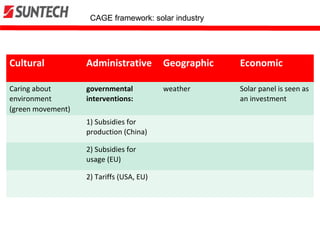
Cultural Administrative Geographic Economic
Caring about
environment
(green movement)
governmental
interventions:
weather Solar panel is seen as
an investment
1) Subsidies for
production (China)
2) Subsidies for
usage (EU)
2) Tariffs (USA, EU)
CAGE framework: solar industry
Recommendations
Expand Capacity, Reduce Supplier Dependencies
• Demand continues to increase, as costs are reduced
and efficiencies increase
• Rapidly expand into new facilities that generate
needed capacity
• Invest into sunny regions with less government
interaction
• Acquire/Partner with silicon suppliers to reduce supply
shortages and obtain cost advantages
Recommendations
• Engage gatekeepers for new energy
infrastructure and government subsidies
• Advocate renewable energy and committing
resources to gain favorable outcomes
QUESTIONS?

Suntech strategic analysis

  • 1.
    Arthur Januszkiewicz SilvanB. Meier Sebastian Lachenit Vinzent Karger
  • 2.
    Company Profile Employees (2010) 20.000 Turnover2.9 bn Headquarter Wuxi Founded in by solar Dr. Zhengrong Shi 2001 Public traded company in 2005 Volatile oil prices fueled concerns for renewable energy 12 million panels in 80 countries Production capacity increased to 1400MW in 2010
  • 3.
    Where is Suntech Active? •Design, Development, Marketing & Manufacturing of silicon based PV products • Worldwide residential, commercial, industrial, and public utility applications and systems integration services • Key solar energy markets – US, Germay, China, Australia, Spain, Middle East, South Korea, Japan, Italy
  • 4.
    Strategic Intent • Suntech’stop priorities Technology & superior value High quality & low cost Cost & scale leadership
  • 5.
    Focused efforts oninternal developments Focus on enduring capabilities Strategic acquisitions & Joint Ventures - Increasing efficiency - R&D to increase cell efficiency - Cost reductions - Capacity expansion - superior value - Leveraging lowcost prod. - Creating scale economies - Rapid innovation - Increasing efficiency - R&D to increase cell efficiency - Cost reductions - Capacity expansion - superior value - Increasing efficiency - R&D to increase cell efficiency - Cost reductions - Capacity expansion - superior value - Corporate umbrella for over 36 different subsidiaries in operation - strategic acquisitions and investments What’s Suntech’s Economic Logic?
  • 7.
    Internal Environment • StrongMarket Growth Outlook • Leading Market Position • Leading R&D Capabilities • Quality Commitment • Strong Supplier Relationships • Broad Product Portfolio • International Management Team
  • 8.
  • 9.
    What’s Suntech’s Staging? • SolarCells – Solar solutions: modules, systems, systems integrations • Staggering Speed – Production capacities have doubled every year since 2004
  • 11.
    Key Mergers & Acquisitions •Aggressive targeting of suppliers and manufacturers of solar technology • KSL-Kutler, increase expertise in manufacturing • Luoyong China Silicon, secure silicon supplies for solar cells
  • 12.
    Cooperative Strategy Analysis Partnerships& Alliances • Strengthen core business, solar developments, enhance R&D, and secure supplies – University of New South Wales: solar cell efficiency – Calisolar Inc. to secure solar silicon manuf. facility – Secure development of smart panel technology
  • 13.
    International Strategy Analysis •Adapting to local market differences – Building relationships with customer base – Distribution and subsidies • Exploiting economies of global scale • Promote adoption of solar power • Operate manufacturing, distribution and sales offices worldwide • Exploiting economies of global scope – Deliver same quality and level of service regardless of location
  • 14.
    International Strategy Analysis •Tapping optimal locations – Leverage locations with access to low cost resources and clean energy mandates • Maximizing knowledge transfer – 36 subsidiary organizations and 13 sales offices – Manufacturing and R&D locations in China & Europe
  • 15.
  • 16.
    Porters 5-Forces Model Threatof Entry Moderate Threat of Buyers Strong Threat of Substitutes Strong Threat of Suppliers Strong Rivalry Strong
  • 17.
    Problems Suntech announced insolvencyin march 2013 • High competition  less revenue • EU and US accused suntech and chinese solar industry of price dumping and unfair subsidies. • Selling solar panels below costs in order to gain market share • financial crisis  unpaid customer bills • Miscalculation on ROI (bonds for investors) • Thought globally, did not act locally
  • 18.
    • “What (Suntech)has done is increase supply to the market so much, that they really almost can’t sell anything at a profit now,” • “Suntech, as a private firm, went too fast in its expansion,” said Liu Wenping, a partner in Shanghai-based solar investment consulting firm Sapphire Capital. • “The founder, with the role of scientist-entrepreneur, didn’t have the experience to manage such a big company with tens of thousands of workers.”
  • 19.
    Cultural Administrative GeographicEconomic Caring about environment (green movement) governmental interventions: weather Solar panel is seen as an investment 1) Subsidies for production (China) 2) Subsidies for usage (EU) 2) Tariffs (USA, EU) CAGE framework: solar industry
  • 20.
    Recommendations Expand Capacity, ReduceSupplier Dependencies • Demand continues to increase, as costs are reduced and efficiencies increase • Rapidly expand into new facilities that generate needed capacity • Invest into sunny regions with less government interaction • Acquire/Partner with silicon suppliers to reduce supply shortages and obtain cost advantages
  • 21.
    Recommendations • Engage gatekeepersfor new energy infrastructure and government subsidies • Advocate renewable energy and committing resources to gain favorable outcomes
  • 22.

Editor's Notes

  • #2 BUS 890: Culminating Experience in Strategic Management, FALL 2010 The culminating project is an in-depth case analysis of Suntech Power Holdings Co., Ltd. The analysis includes multiple concepts from the course to help explain the strategies, actions and performance of the company.