CODES AND CONVENTIONS OF
FACTUAL PROGRAMMES
By Chelsie Brandrick
What are Factual Programmes?
 The genre includes news, documentary, educational,
magazine, discussion, review, chat show, special
interest (hobby, makeover, and how-to formats),
‘reality’ TV and other sub-genres.
 Examples of factual programmes are News, Bargain
Hunt, Graham Norton, Loose Women and Big Brother.
Positive Values of Factual Programmes
 Educate
 Inform
 Create Empathy
 Encourage social/political change
 Accurate, balanced and neutral material
Negative Values of Factual Programmes
 Offer a biased point of view
 No impact on society due to a niche
audience
Two Examples of Factual
Programmes in More Detail
 News: Facts and statistics and contract with
the viewer.
 Documentary: Earliest form of cinema,
feature important information on a vast
range of topics.
What Are Codes?
 Systems of signs, consist of agreed rules and can be
divided into Technical, Symbolic and Written and Audio.
 Technical codes are: camera techniques, framing,
layout, lighting, editing and sound.
 Symbolic codes are: Objects, setting, body language,
clothing, colour.
 Written and Audio codes are: Headlines, captions,
speech bubbles and language style.
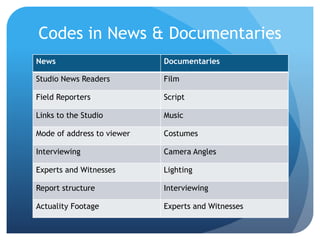
Codes in News & Documentaries
News Documentaries
Studio News Readers Film
Field Reporters Script
Links to the Studio Music
Mode of address to viewer Costumes
Interviewing Camera Angles
Experts and Witnesses Lighting
Report structure Interviewing
Actuality Footage Experts and Witnesses
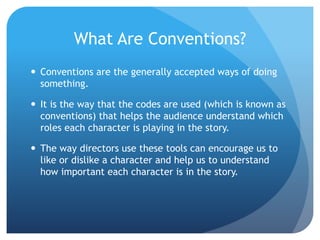
What Are Conventions?
 Conventions are the generally accepted ways of doing
something.
 It is the way that the codes are used (which is known as
conventions) that helps the audience understand which
roles each character is playing in the story.
 The way directors use these tools can encourage us to
like or dislike a character and help us to understand
how important each character is in the story.
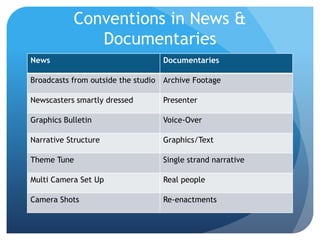
Conventions in News &
Documentaries
News Documentaries
Broadcasts from outside the studio Archive Footage
Newscasters smartly dressed Presenter
Graphics Bulletin Voice-Over
Narrative Structure Graphics/Text
Theme Tune Single strand narrative
Multi Camera Set Up Real people
Camera Shots Re-enactments
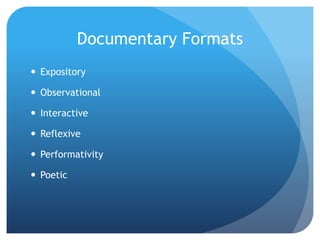
Documentary Formats
 Expository
 Observational
 Interactive
 Reflexive
 Performativity
 Poetic
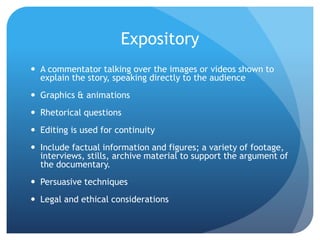
Expository
 A commentator talking over the images or videos shown to
explain the story, speaking directly to the audience
 Graphics & animations
 Rhetorical questions
 Editing is used for continuity
 Include factual information and figures; a variety of footage,
interviews, stills, archive material to support the argument of
the documentary.
 Persuasive techniques
 Legal and ethical considerations
Observational
 Filmed on Location
 Equipment is usually informal like hand held cameras
 Long takes dominate.
 Synchronous sound recording
 No interviews
 Crew are neutral observers
 No rehearsals or staged events
Interactive
 Filmmaker is sometimes visible to the audience.
 Interviews dominate
 Use of archive materials
 Location shooting
 Long takes dominate
 Synchronous sound recording
 Voice-Over
Reflective
 Borrows techniques from fiction films for an emotional
response.
 Emphasise on the expressive nature of film, anti-realist
techniques
 Voiceover is questioning and uncertain – rather than
authoritative
 Reliance on suggestion rather than fact
 Crew and equipment are clearly seen – filming process is
not hidden.
Performative
 Documentary maker (and crew) interact with subject
 An investigation or search which there may be no satisfactory
conclusion
 Addresses the audience in an emotional and direct way
 Documentary maker comments on the process of making the
documentary
 Subject matter often about identity (gender, sexuality, ethnic
minorities) rather than factual subjects
 Subjective views of the film maker
 Hypothetical re-enactments.
Poetic
 Filmmaker gives subjective view
 Not in typical narrative structure
 Particular mood/tone is created - enhanced by music
 Some light rhetoric but not always
 Events are under-developed and situations can be left
unsolved
 Unrelated shots edited together - linked by a mood/music
 Perceived as Avant-garde - innovative, experimental and
pushes boundaries
Realism
 Include an interest in the real world and show real footage.
 They are based on real life people and their lives, and show
what their lives or the people themselves are like.
 Go into detail of the subject’s experiences using re-
enactments of events to show this.
 They may include handheld camera, interviews with people
involved in the topic/accident, statistics and graphs to
support the facts. They may also show the setting up of the
equipment and camera's before the filming takes place.
 Observational, reflexive, interactive and poetic
documentaries use realism conventions.
Dramatisation
 These documentaries are also known as
‘Docudramas’
 They include cliff hangers, voice overs,
music and computer generated imagery
(CGI).
 Expository, interactive, performative and
poetic documentaries all use dramatization
conventions.
Narrative
 Communicate factual events/experiences in a narrative
form to gain a greater understanding.
 Expositional approach that details with events but keeps
the narrative in mind.
 Interactive, performative and poetic documentaries use
narrative conventions.
How documentaries use conventions to advise
or determine audience responses.
 The Verbal Conventions: Persuasive voice-overs,
compelling language, particular type of interviewees
and music or sound effects.
 The visual conventions: Presenter or interviewees
external appearance, location, body language, camera
work and editing.
 The documentary conventions: Documentary style may
affect how the audience thinks about the people
portrayed in the documentary if they are shown in a
particular way.
Codes and conventions and how I will
use them in my documentary
Codes: Expository, Interactive &
Poetic.
Conventions: Realism &
Narrativisation.

Codes and conventions of factual programming unit 27

  • 1.
    CODES AND CONVENTIONSOF FACTUAL PROGRAMMES By Chelsie Brandrick
  • 2.
    What are FactualProgrammes?  The genre includes news, documentary, educational, magazine, discussion, review, chat show, special interest (hobby, makeover, and how-to formats), ‘reality’ TV and other sub-genres.  Examples of factual programmes are News, Bargain Hunt, Graham Norton, Loose Women and Big Brother.
  • 3.
    Positive Values ofFactual Programmes  Educate  Inform  Create Empathy  Encourage social/political change  Accurate, balanced and neutral material
  • 4.
    Negative Values ofFactual Programmes  Offer a biased point of view  No impact on society due to a niche audience
  • 5.
    Two Examples ofFactual Programmes in More Detail  News: Facts and statistics and contract with the viewer.  Documentary: Earliest form of cinema, feature important information on a vast range of topics.
  • 6.
    What Are Codes? Systems of signs, consist of agreed rules and can be divided into Technical, Symbolic and Written and Audio.  Technical codes are: camera techniques, framing, layout, lighting, editing and sound.  Symbolic codes are: Objects, setting, body language, clothing, colour.  Written and Audio codes are: Headlines, captions, speech bubbles and language style.
  • 7.
    Codes in News& Documentaries News Documentaries Studio News Readers Film Field Reporters Script Links to the Studio Music Mode of address to viewer Costumes Interviewing Camera Angles Experts and Witnesses Lighting Report structure Interviewing Actuality Footage Experts and Witnesses
  • 8.
    What Are Conventions? Conventions are the generally accepted ways of doing something.  It is the way that the codes are used (which is known as conventions) that helps the audience understand which roles each character is playing in the story.  The way directors use these tools can encourage us to like or dislike a character and help us to understand how important each character is in the story.
  • 9.
    Conventions in News& Documentaries News Documentaries Broadcasts from outside the studio Archive Footage Newscasters smartly dressed Presenter Graphics Bulletin Voice-Over Narrative Structure Graphics/Text Theme Tune Single strand narrative Multi Camera Set Up Real people Camera Shots Re-enactments
  • 10.
    Documentary Formats  Expository Observational  Interactive  Reflexive  Performativity  Poetic
  • 11.
    Expository  A commentatortalking over the images or videos shown to explain the story, speaking directly to the audience  Graphics & animations  Rhetorical questions  Editing is used for continuity  Include factual information and figures; a variety of footage, interviews, stills, archive material to support the argument of the documentary.  Persuasive techniques  Legal and ethical considerations
  • 12.
    Observational  Filmed onLocation  Equipment is usually informal like hand held cameras  Long takes dominate.  Synchronous sound recording  No interviews  Crew are neutral observers  No rehearsals or staged events
  • 13.
    Interactive  Filmmaker issometimes visible to the audience.  Interviews dominate  Use of archive materials  Location shooting  Long takes dominate  Synchronous sound recording  Voice-Over
  • 14.
    Reflective  Borrows techniquesfrom fiction films for an emotional response.  Emphasise on the expressive nature of film, anti-realist techniques  Voiceover is questioning and uncertain – rather than authoritative  Reliance on suggestion rather than fact  Crew and equipment are clearly seen – filming process is not hidden.
  • 15.
    Performative  Documentary maker(and crew) interact with subject  An investigation or search which there may be no satisfactory conclusion  Addresses the audience in an emotional and direct way  Documentary maker comments on the process of making the documentary  Subject matter often about identity (gender, sexuality, ethnic minorities) rather than factual subjects  Subjective views of the film maker  Hypothetical re-enactments.
  • 16.
    Poetic  Filmmaker givessubjective view  Not in typical narrative structure  Particular mood/tone is created - enhanced by music  Some light rhetoric but not always  Events are under-developed and situations can be left unsolved  Unrelated shots edited together - linked by a mood/music  Perceived as Avant-garde - innovative, experimental and pushes boundaries
  • 17.
    Realism  Include aninterest in the real world and show real footage.  They are based on real life people and their lives, and show what their lives or the people themselves are like.  Go into detail of the subject’s experiences using re- enactments of events to show this.  They may include handheld camera, interviews with people involved in the topic/accident, statistics and graphs to support the facts. They may also show the setting up of the equipment and camera's before the filming takes place.  Observational, reflexive, interactive and poetic documentaries use realism conventions.
  • 18.
    Dramatisation  These documentariesare also known as ‘Docudramas’  They include cliff hangers, voice overs, music and computer generated imagery (CGI).  Expository, interactive, performative and poetic documentaries all use dramatization conventions.
  • 19.
    Narrative  Communicate factualevents/experiences in a narrative form to gain a greater understanding.  Expositional approach that details with events but keeps the narrative in mind.  Interactive, performative and poetic documentaries use narrative conventions.
  • 20.
    How documentaries useconventions to advise or determine audience responses.  The Verbal Conventions: Persuasive voice-overs, compelling language, particular type of interviewees and music or sound effects.  The visual conventions: Presenter or interviewees external appearance, location, body language, camera work and editing.  The documentary conventions: Documentary style may affect how the audience thinks about the people portrayed in the documentary if they are shown in a particular way.
  • 21.
    Codes and conventionsand how I will use them in my documentary Codes: Expository, Interactive & Poetic. Conventions: Realism & Narrativisation.