VIRUS VECTOR
Simian virus 40 (SV40)

Belongs to polyoma viruses group.

The virus was first isolated as a contaminant
from a monkey kidney culture
used for the production of poliovirus
vaccine.

Its genome is very small and can be easily
modified for gene therapy purpose.

Its genome has ds circular DNA wrapped up as
nucleosome with the help of
histone proteins

It is roughly 40-45 nm in diameter.

The chromosome is 5000 bp long. The
genome of SV40 is like a mini
chromosome.

The genome of SV40 consists of early
proteins, late proteins and regulatory
proteins.

Early proteins are non structural while late
proteins are structural proteins.

Regulatory region consist of promoter,

The capsid proteins are produced later
which then forms viable virus and comes
out of the cell.

The early protein coding genes can be
replaced by the gene of interest. The
mutation in p53 promoter which leads to
cancerous condition was discovered in the
SV40 virus.

Gene therapy using recombinant SV40 is
highly suitable means to transfer the gene
in a number of conditions.
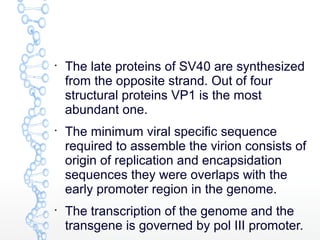
Replication of SV40 in the host cell

The late proteins of SV40 are synthesized
from the opposite strand. Out of four
structural proteins VP1 is the most
abundant one.

The minimum viral specific sequence
required to assemble the virion consists of
origin of replication and encapsidation
sequences they were overlaps with the
early promoter region in the genome.

The transcription of the genome and the
transgene is governed by pol III promoter.

Recombinant SV40 viral vectors are made
in some plasmid background such as
pGEMT plasmid vector.

The permissible cells are transfected with
the plasmid along with the support
plasmid needed to package the viral
genome.

The recombinant virus containing the
transgene is then recovered by the lysis of
transfected cell.

The recombinant virus is then further
Features of a SV40 based
vector
Some of the specific features of an SV40 vector
are as follows
• Capacity of the transgene is limited to 5 Kb.
• Both resting as well as dividing cells are
equally transduced by SV40 based vectors.
• High level of transduction efficiency.
• Long lasting transgene expression. It has
been reported that the transgene expression once
established will remain lifelong.
• Neutralizing antibody against recombinant

Sv40 virus

  • 1.
  • 2.
    Simian virus 40(SV40)  Belongs to polyoma viruses group.  The virus was first isolated as a contaminant from a monkey kidney culture used for the production of poliovirus vaccine.  Its genome is very small and can be easily modified for gene therapy purpose.  Its genome has ds circular DNA wrapped up as nucleosome with the help of histone proteins
  • 3.
     It is roughly40-45 nm in diameter.  The chromosome is 5000 bp long. The genome of SV40 is like a mini chromosome.  The genome of SV40 consists of early proteins, late proteins and regulatory proteins.  Early proteins are non structural while late proteins are structural proteins.  Regulatory region consist of promoter,
  • 4.
     The capsid proteinsare produced later which then forms viable virus and comes out of the cell.  The early protein coding genes can be replaced by the gene of interest. The mutation in p53 promoter which leads to cancerous condition was discovered in the SV40 virus.  Gene therapy using recombinant SV40 is highly suitable means to transfer the gene in a number of conditions.
  • 5.
    Replication of SV40in the host cell
  • 6.
     The late proteinsof SV40 are synthesized from the opposite strand. Out of four structural proteins VP1 is the most abundant one.  The minimum viral specific sequence required to assemble the virion consists of origin of replication and encapsidation sequences they were overlaps with the early promoter region in the genome.  The transcription of the genome and the transgene is governed by pol III promoter.
  • 7.
     Recombinant SV40 viralvectors are made in some plasmid background such as pGEMT plasmid vector.  The permissible cells are transfected with the plasmid along with the support plasmid needed to package the viral genome.  The recombinant virus containing the transgene is then recovered by the lysis of transfected cell.  The recombinant virus is then further
  • 8.
    Features of aSV40 based vector Some of the specific features of an SV40 vector are as follows • Capacity of the transgene is limited to 5 Kb. • Both resting as well as dividing cells are equally transduced by SV40 based vectors. • High level of transduction efficiency. • Long lasting transgene expression. It has been reported that the transgene expression once established will remain lifelong. • Neutralizing antibody against recombinant