HUMAN CULTURAL
VARIATION/
SOCIAL DIFFERENCES
MR. CARL PATRICK S. TADEO
Senior High School (SHS) Teacher
0907-690-2879 |carlpatricksahaguntadeo@gmail.com
Human Cultural Variation:
A Definition
•It refers to the differences in social
behaviors that different cultures
exhibit around the world. What may
be considered good etiquette in one
culture may be considered bad
etiquette in another.
(globalsociology.pbworks.com).
Social Differences:
A Definition
•The differences among the
individuals on the basis of
social characteristics and
qualities.
(http://references-
definitions.blurtit.com/316924/what-is-the-
meaning-of-social-differences)
CULTURAL VARIATION
Religion
Ethnicity
Nationality
RELIGION
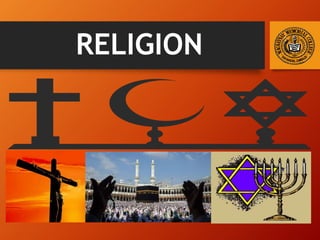
• ‘religare’ a Latin word – ‘to bind
together’
• is a system of beliefs and practices
as well as systems of actions
directed toward entities which are
above men
• is an organized system of ideas
about the spiritual sphere or the
supernatural
RELIGION
CULTURAL VARIATION
Religion
Ethnicity
Nationality
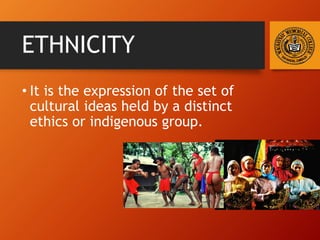
ETHNICITY
• It is the expression of the set of
cultural ideas held by a distinct
ethics or indigenous group.
ETHNICITY
CULTURAL VARIATION
Religion
Ethnicity
Nationality
NATIONALITY
• It is the legal
relationship that
binds a person
and a country.
• It allows the state
to protect and
have jurisdiction
over a person.
SOCIAL DIFFERENCES
Gender
Socio-economic Status
Exceptionality
GENDER
• It is the socially-constructed
characteristics of being male of female.
• Serve as guide on how males and
females think and act about
themselves.
• Gender vs Sex
• LGBTQi (Lesbian, Gay, Bisexual,
Transgender, Queer/Questioning,
Intersex)
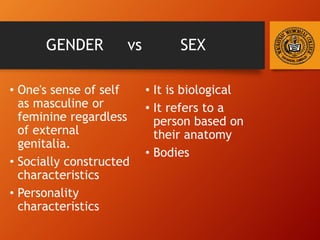
GENDER vs SEX
• One's sense of self
as masculine or
feminine regardless
of external
genitalia.
• Socially constructed
characteristics
• Personality
characteristics
• It is biological
• It refers to a
person based on
their anatomy
• Bodies
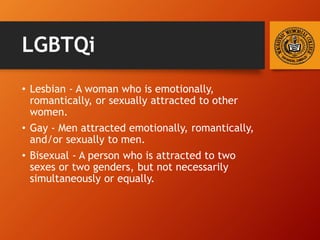
LGBTQi
• Lesbian - A woman who is emotionally,
romantically, or sexually attracted to other
women.
• Gay - Men attracted emotionally, romantically,
and/or sexually to men.
• Bisexual - A person who is attracted to two
sexes or two genders, but not necessarily
simultaneously or equally.
LGBTQi
• Transgender - Transgender (sometimes
shortened to trans or TG) people are those
whose psychological self ("gender identity")
differs from the social expectations for the
physical sex they were born with.
• Queer/Questioning - a person who is attracted
to multiple genders
• Intersex - Intersexuality is a set of medical
conditions that feature congenital anomaly of
the reproductive and sexual system.
SOCIAL DIFFERENCES
Gender
Socio-economic Status
Exceptionality
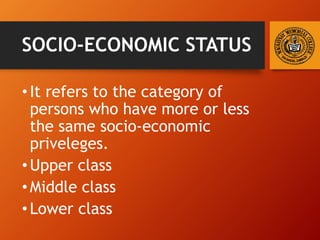
SOCIO-ECONOMIC STATUS
•It refers to the category of
persons who have more or less
the same socio-economic
priveleges.
•Upper class
•Middle class
•Lower class
SOCIO-ECONOMIC STATUS
SOCIAL DIFFERENCES
Gender
Socio-economic Status
Exceptionality
EXCEPTIONALITY
•It refers to the state of being
intellectually gifted and/or
having physically or mentally
challenged conditions
EXCEPTIONALITY
• Personality/ behavior
• Communication (learning disability, speech
impairment, and hearing problems)
• Intellect (mild intellectual & mental
development disabilities)
• Physical appearance (blind-low vision)
• Or combination of more than one specific
exceptionality/disability.
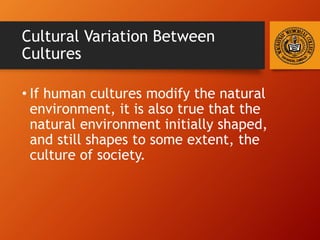
Cultural Variation Between
Cultures
• If human cultures modify the natural
environment, it is also true that the
natural environment initially shaped,
and still shapes to some extent, the
culture of society.
Variation Between Cultures
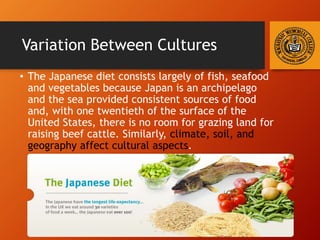
• The Japanese diet consists largely of fish, seafood
and vegetables because Japan is an archipelago
and the sea provided consistent sources of food
and, with one twentieth of the surface of the
United States, there is no room for grazing land for
raising beef cattle. Similarly, climate, soil, and
geography affect cultural aspects.
VARIATION
WITHIN
CULTURES
SUBCULTURE
1. SUBCULTURES - A segment of society
which shares a distinctive pattern of mores,
folkways, and values which differ from the
pattern of larger society. It is a culture within a
culture.
- These are groups that have specific cultural
traits that set them apart from the dominant
culture.
Example of Subculture (Activities
done during December in the United
States of America)
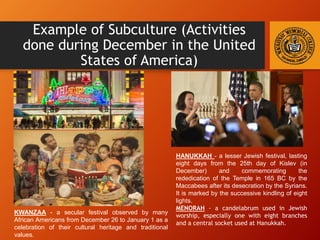
HANUKKAH - a lesser Jewish festival, lasting
eight days from the 25th day of Kislev (in
December) and commemorating the
rededication of the Temple in 165 BC by the
Maccabees after its desecration by the Syrians.
It is marked by the successive kindling of eight
lights.
MENORAH - a candelabrum used in Jewish
worship, especially one with eight branches
and a central socket used at Hanukkah.
KWANZAA - a secular festival observed by many
African Americans from December 26 to January 1 as a
celebration of their cultural heritage and traditional
values.
Example of Subculture (Activities
done during December in the United
States of America)
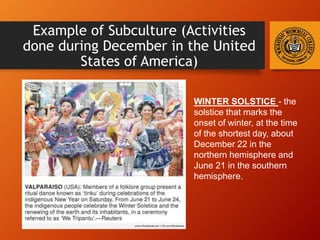
WINTER SOLSTICE - the
solstice that marks the
onset of winter, at the time
of the shortest day, about
December 22 in the
northern hemisphere and
June 21 in the southern
hemisphere.
COUNTER CULTURE
• is a group whose values and norms place it at odds
with mainstream society or a group that actively
rejects dominant cultural values and norms. In most
Western countries, the 1960s saw the rise of different
countercultural groups and social movements that
sought to dismantle the different inequalities that
were then part of the dominant culture, such as
racism (Civil Rights movement), sexism (modern
Feminist movement) and homophobia (Gay rights
movement).
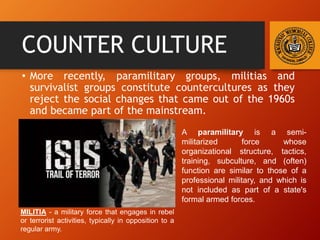
COUNTER CULTURE
• More recently, paramilitary groups, militias and
survivalist groups constitute countercultures as they
reject the social changes that came out of the 1960s
and became part of the mainstream.
A paramilitary is a semi-
militarized force whose
organizational structure, tactics,
training, subculture, and (often)
function are similar to those of a
professional military, and which is
not included as part of a state's
formal armed forces.
MILITIA - a military force that engages in rebel
or terrorist activities, typically in opposition to a
regular army.
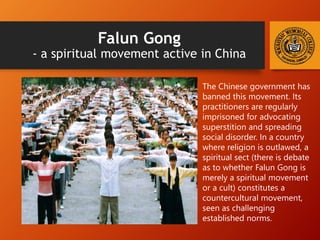
Falun Gong
- a spiritual movement active in China
The Chinese government has
banned this movement. Its
practitioners are regularly
imprisoned for advocating
superstition and spreading
social disorder. In a country
where religion is outlawed, a
spiritual sect (there is debate
as to whether Falun Gong is
merely a spiritual movement
or a cult) constitutes a
countercultural movement,
seen as challenging
established norms.
HIGH CULTURE / POPULAR
CULTURE
• "High culture" is a term now used in a number
of different ways in academic discourse,
whose most common meaning is the set of
cultural products, mainly in the arts, held in
the highest esteem by a culture.
• POPULAR CULTURE - culture based on the
tastes of ordinary people rather than an
educated elite.
References:
• https://faisal2050.wordpress.com/2008/12/16
/culture-2/
• https://globalsociology.pbworks.com/w/page/
14711170/Cultural%20Variation

Human Cultural Variation/ Social Differences

  • 1.
    HUMAN CULTURAL VARIATION/ SOCIAL DIFFERENCES MR.CARL PATRICK S. TADEO Senior High School (SHS) Teacher 0907-690-2879 |carlpatricksahaguntadeo@gmail.com
  • 2.
    Human Cultural Variation: ADefinition •It refers to the differences in social behaviors that different cultures exhibit around the world. What may be considered good etiquette in one culture may be considered bad etiquette in another. (globalsociology.pbworks.com).
  • 3.
    Social Differences: A Definition •Thedifferences among the individuals on the basis of social characteristics and qualities. (http://references- definitions.blurtit.com/316924/what-is-the- meaning-of-social-differences)
  • 4.
  • 5.
    RELIGION • ‘religare’ aLatin word – ‘to bind together’ • is a system of beliefs and practices as well as systems of actions directed toward entities which are above men • is an organized system of ideas about the spiritual sphere or the supernatural
  • 6.
  • 7.
  • 8.
    ETHNICITY • It isthe expression of the set of cultural ideas held by a distinct ethics or indigenous group.
  • 9.
  • 10.
  • 11.
    NATIONALITY • It isthe legal relationship that binds a person and a country. • It allows the state to protect and have jurisdiction over a person.
  • 12.
  • 13.
    GENDER • It isthe socially-constructed characteristics of being male of female. • Serve as guide on how males and females think and act about themselves. • Gender vs Sex • LGBTQi (Lesbian, Gay, Bisexual, Transgender, Queer/Questioning, Intersex)
  • 14.
    GENDER vs SEX •One's sense of self as masculine or feminine regardless of external genitalia. • Socially constructed characteristics • Personality characteristics • It is biological • It refers to a person based on their anatomy • Bodies
  • 16.
    LGBTQi • Lesbian -A woman who is emotionally, romantically, or sexually attracted to other women. • Gay - Men attracted emotionally, romantically, and/or sexually to men. • Bisexual - A person who is attracted to two sexes or two genders, but not necessarily simultaneously or equally.
  • 17.
    LGBTQi • Transgender -Transgender (sometimes shortened to trans or TG) people are those whose psychological self ("gender identity") differs from the social expectations for the physical sex they were born with. • Queer/Questioning - a person who is attracted to multiple genders • Intersex - Intersexuality is a set of medical conditions that feature congenital anomaly of the reproductive and sexual system.
  • 18.
  • 19.
    SOCIO-ECONOMIC STATUS •It refersto the category of persons who have more or less the same socio-economic priveleges. •Upper class •Middle class •Lower class
  • 20.
  • 21.
  • 22.
    EXCEPTIONALITY •It refers tothe state of being intellectually gifted and/or having physically or mentally challenged conditions
  • 23.
    EXCEPTIONALITY • Personality/ behavior •Communication (learning disability, speech impairment, and hearing problems) • Intellect (mild intellectual & mental development disabilities) • Physical appearance (blind-low vision) • Or combination of more than one specific exceptionality/disability.
  • 24.
    Cultural Variation Between Cultures •If human cultures modify the natural environment, it is also true that the natural environment initially shaped, and still shapes to some extent, the culture of society.
  • 25.
    Variation Between Cultures •The Japanese diet consists largely of fish, seafood and vegetables because Japan is an archipelago and the sea provided consistent sources of food and, with one twentieth of the surface of the United States, there is no room for grazing land for raising beef cattle. Similarly, climate, soil, and geography affect cultural aspects.
  • 26.
  • 27.
    SUBCULTURE 1. SUBCULTURES -A segment of society which shares a distinctive pattern of mores, folkways, and values which differ from the pattern of larger society. It is a culture within a culture. - These are groups that have specific cultural traits that set them apart from the dominant culture.
  • 28.
    Example of Subculture(Activities done during December in the United States of America) HANUKKAH - a lesser Jewish festival, lasting eight days from the 25th day of Kislev (in December) and commemorating the rededication of the Temple in 165 BC by the Maccabees after its desecration by the Syrians. It is marked by the successive kindling of eight lights. MENORAH - a candelabrum used in Jewish worship, especially one with eight branches and a central socket used at Hanukkah. KWANZAA - a secular festival observed by many African Americans from December 26 to January 1 as a celebration of their cultural heritage and traditional values.
  • 29.
    Example of Subculture(Activities done during December in the United States of America) WINTER SOLSTICE - the solstice that marks the onset of winter, at the time of the shortest day, about December 22 in the northern hemisphere and June 21 in the southern hemisphere.
  • 30.
    COUNTER CULTURE • isa group whose values and norms place it at odds with mainstream society or a group that actively rejects dominant cultural values and norms. In most Western countries, the 1960s saw the rise of different countercultural groups and social movements that sought to dismantle the different inequalities that were then part of the dominant culture, such as racism (Civil Rights movement), sexism (modern Feminist movement) and homophobia (Gay rights movement).
  • 31.
    COUNTER CULTURE • Morerecently, paramilitary groups, militias and survivalist groups constitute countercultures as they reject the social changes that came out of the 1960s and became part of the mainstream. A paramilitary is a semi- militarized force whose organizational structure, tactics, training, subculture, and (often) function are similar to those of a professional military, and which is not included as part of a state's formal armed forces. MILITIA - a military force that engages in rebel or terrorist activities, typically in opposition to a regular army.
  • 32.
    Falun Gong - aspiritual movement active in China The Chinese government has banned this movement. Its practitioners are regularly imprisoned for advocating superstition and spreading social disorder. In a country where religion is outlawed, a spiritual sect (there is debate as to whether Falun Gong is merely a spiritual movement or a cult) constitutes a countercultural movement, seen as challenging established norms.
  • 33.
    HIGH CULTURE /POPULAR CULTURE • "High culture" is a term now used in a number of different ways in academic discourse, whose most common meaning is the set of cultural products, mainly in the arts, held in the highest esteem by a culture. • POPULAR CULTURE - culture based on the tastes of ordinary people rather than an educated elite.
  • 37.