EXPLORING SOCIAL STUDIES EDUCATION AS COMMUNICATION
STRATEGY FOR PEACE BUILDING AND CONFLICT
MANAGEMENT AMONG STUDENTS OF HIGHER INSTITUTIONS IN
OGUN STATE
BY
DR. A. A. ADEDIRAN AND M.O. LIJADU
Social Studies Department
School of Arts & Social Sciences
Federal College of Education,
Abeokuta, Ogun State.
Email: speaktoa3@yahoo.com
Tel.: 08060932337
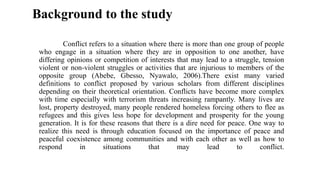
Conflict refers to a situation where there is more than one group of people
who engage in a situation where they are in opposition to one another, have
differing opinions or competition of interests that may lead to a struggle, tension
violent or non-violent struggles or activities that are injurious to members of the
opposite group (Abebe, Gbesso, Nyawalo, 2006).There exist many varied
definitions to conflict proposed by various scholars from different disciplines
depending on their theoretical orientation. Conflicts have become more complex
with time especially with terrorism threats increasing rampantly. Many lives are
lost, property destroyed, many people rendered homeless forcing others to flee as
refugees and this gives less hope for development and prosperity for the young
generation. It is for these reasons that there is a dire need for peace. One way to
realize this need is through education focused on the importance of peace and
peaceful coexistence among communities and with each other as well as how to
respond in situations that may lead to conflict.
Background to the study
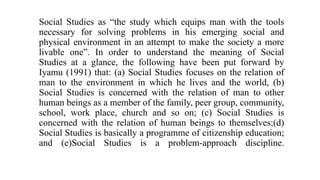
Social Studies as “the study which equips man with the tools
necessary for solving problems in his emerging social and
physical environment in an attempt to make the society a more
livable one”. In order to understand the meaning of Social
Studies at a glance, the following have been put forward by
Iyamu (1991) that: (a) Social Studies focuses on the relation of
man to the environment in which he lives and the world, (b)
Social Studies is concerned with the relation of man to other
human beings as a member of the family, peer group, community,
school, work place, church and so on; (c) Social Studies is
concerned with the relation of human beings to themselves;(d)
Social Studies is basically a programme of citizenship education;
and (e)Social Studies is a problem-approach discipline.
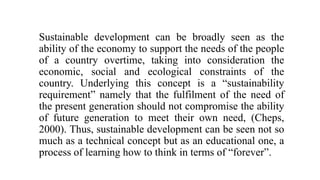
Sustainable development can be broadly seen as the
ability of the economy to support the needs of the people
of a country overtime, taking into consideration the
economic, social and ecological constraints of the
country. Underlying this concept is a “sustainability
requirement” namely that the fulfilment of the need of
the present generation should not compromise the ability
of future generation to meet their own need, (Cheps,
2000). Thus, sustainable development can be seen not so
much as a technical concept but as an educational one, a
process of learning how to think in terms of “forever”.
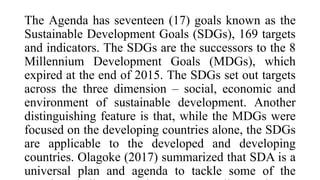
The Agenda has seventeen (17) goals known as the
Sustainable Development Goals (SDGs), 169 targets
and indicators. The SDGs are the successors to the 8
Millennium Development Goals (MDGs), which
expired at the end of 2015. The SDGs set out targets
across the three dimension – social, economic and
environment of sustainable development. Another
distinguishing feature is that, while the MDGs were
focused on the developing countries alone, the SDGs
are applicable to the developed and developing
countries. Olagoke (2017) summarized that SDA is a
universal plan and agenda to tackle some of the
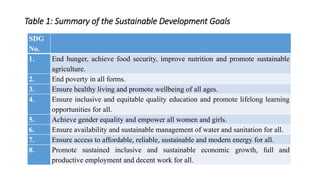
Table 1: Summary of the Sustainable Development Goals
SDG
No.
1. End hunger, achieve food security, improve nutrition and promote sustainable
agriculture.
2. End poverty in all forms.
3. Ensure healthy living and promote wellbeing of all ages.
4. Ensure inclusive and equitable quality education and promote lifelong learning
opportunities for all.
5. Achieve gender equality and empower all women and girls.
6. Ensure availability and sustainable management of water and sanitation for all.
7. Ensure access to affordable, reliable, sustainable and modern energy for all.
8. Promote sustained inclusive and sustainable economic growth, full and
productive employment and decent work for all.
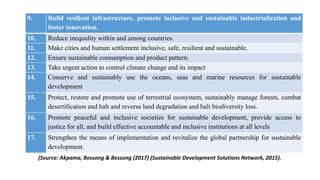
9. Build resilient infrastructure, promote inclusive and sustainable industrialization and
foster innovation.
10. Reduce inequality within and among countries.
11. Make cities and human settlement inclusive, safe, resilient and sustainable.
12. Ensure sustainable consumption and product pattern.
13. Take urgent action to control climate change and its impact
14. Conserve and sustainably use the oceans, seas and marine resources for sustainable
development
15. Protect, restore and promote use of terrestrial ecosystem, sustainably manage forests, combat
desertification and halt and reverse land degradation and halt biodiversity loss.
16. Promote peaceful and inclusive societies for sustainable development, provide access to
justice for all, and build effective accountable and inclusive institutions at all levels
17. Strengthen the means of implementation and revitalize the global partnership for sustainable
development.
(Source: Akpama, Bessong & Bessong (2017) (Sustainable Development Solutions Network, 2015).
Social Studies Education through communication
strategy for peace building and conflict management,
plays a key role in sustainable development and
equips one with skills necessary in life. Similarly, the
introduction of Peace Education Programme into the
Social Studies curriculum is aimed at fostering peace
and conflict transformation in Nigeria at the long
run. Tracing back since its inception in Nigeria in
2008, educational system has experienced challenges
in its implementation, provision of trained personnel
and the nature of its implementation at the classroom
level.
However, this study therefore seeks to analyze and
examine the role of Social Studie in the school
curriculum in conflict transformation since its
inception in Nigeria and whether having peace
education within Social Studies programme taught in
school has had an impact on conflict transformation
for peace building and conflict management in the
country.
Purpose of the Study
The purpose of this study is to explore Social Studies
education as interaction and information strategies for peace
building among students of higher institutions in ogun state.
However, the specific objectives are to:
i. Examine the level of social studies education as interaction
strategy for peace building in higher institution in Ogun State
ii. Examine if there is significant relationship in the teachers’
qualification in social studies and conflicts resolution in
Nigeria tertiary education institutions
iii. Examine if there will be significant relationship between the
teaching of peace education and conflict resolution in the
Nigerian education system.
iv. investigate the role of peace education as a medium tool in
higher institution to address the problem of violence,
insurgency and terrorism in Nigeria.
Research Hypotheses
i. There will be no significant effect on the effective
teaching of social studies education as interactive
strategies for peace building in higher institution.
ii. There will be no significant relationship in the teachers’
qualification in social studies and conflicts resolution in
Nigeria tertiary education institutions.
iii. There will be no significant relationship between the
teaching of peace education and conflict resolution in the
Nigerian education system.
iv. The role of peace education will not significantly serve as
a mean of addressing the problem of violence, insurgency
and terrorism in Nigeria.
Methodology
The study adopted a descriptive survey design. The population
for this study consists of all students selected in Four (4) higher
institutions in Ogun State. Stratified random sampling
techniques were used to select four (4) higher institutions in
Ogun State. A multistage sampling procedure was adopted for
the selection of 200 students as sample from the four (4)
selected higher institutions in Ogun State. Self-designed
questionnaire was used as a potent instrument for data
collection. a structural questions which requires that
respondent pick from options of their best choice. The option
however, ranges from Strongly Agree, Agree, Disagree and
Strongly Disagree.
The instrument was subjected to face and content
validation when it was given to expert in
measurement and evaluation department.
Reliability concern the students to which a
particular procedure gives similar result over a
number of repeated trials (Orodho, 2009). The
instruments in the category were the same for
piloting and actual study from four (4) selected
higher institutions in Ogun State. Data collected
were analyzed using chi-square statistical tool
which was used to test the accuracy of the
hypotheses used at 0.05 level of significance.
Testing of Hypotheses
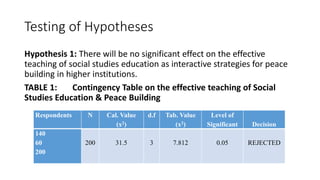
Hypothesis 1: There will be no significant effect on the effective
teaching of social studies education as interactive strategies for peace
building in higher institutions.
TABLE 1: Contingency Table on the effective teaching of Social
Studies Education & Peace Building
Respondents N Cal. Value
(x2)
d.f Tab. Value
(x2)
Level of
Significant Decision
140
60
200
200 31.5 3 7.812 0.05 REJECTED
Table 1 show that the calculated chi-square value of 31.5 at a
degree of freedom of 3 is greater than the critical value of
7.812 at 0.05 alpha level of significance. Hence, the null
hypothesis which states that there will be no significant effect
on the effective teaching of social studies education as
interactive strategies for peace building in higher institution
was rejected. This implies that there will be significant effect
on the effective teaching of social studies education as
interactive strategy for peace building in higher institution.
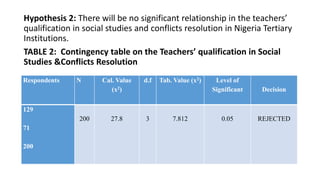
Hypothesis 2: There will be no significant relationship in the teachers’
qualification in social studies and conflicts resolution in Nigeria Tertiary
Institutions.
TABLE 2: Contingency table on the Teachers’ qualification in Social
Studies &Conflicts Resolution
Respondents N Cal. Value
(x2)
d.f Tab. Value (x2) Level of
Significant Decision
129
71
200
200 27.8 3 7.812 0.05 REJECTED
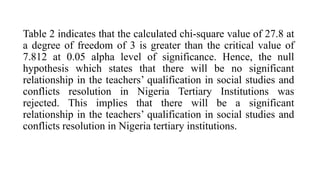
Table 2 indicates that the calculated chi-square value of 27.8 at
a degree of freedom of 3 is greater than the critical value of
7.812 at 0.05 alpha level of significance. Hence, the null
hypothesis which states that there will be no significant
relationship in the teachers’ qualification in social studies and
conflicts resolution in Nigeria Tertiary Institutions was
rejected. This implies that there will be a significant
relationship in the teachers’ qualification in social studies and
conflicts resolution in Nigeria tertiary institutions.
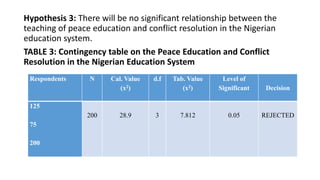
Hypothesis 3: There will be no significant relationship between the
teaching of peace education and conflict resolution in the Nigerian
education system.
TABLE 3: Contingency table on the Peace Education and Conflict
Resolution in the Nigerian Education System
Respondents N Cal. Value
(x2)
d.f Tab. Value
(x2)
Level of
Significant Decision
125
75
200
200 28.9 3 7.812 0.05 REJECTED
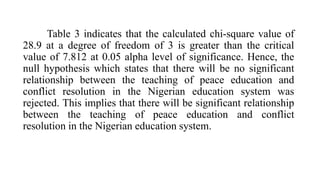
Table 3 indicates that the calculated chi-square value of
28.9 at a degree of freedom of 3 is greater than the critical
value of 7.812 at 0.05 alpha level of significance. Hence, the
null hypothesis which states that there will be no significant
relationship between the teaching of peace education and
conflict resolution in the Nigerian education system was
rejected. This implies that there will be significant relationship
between the teaching of peace education and conflict
resolution in the Nigerian education system.
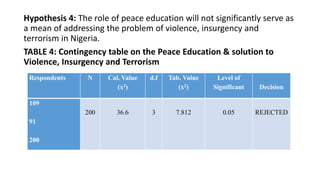
Hypothesis 4: The role of peace education will not significantly serve as
a mean of addressing the problem of violence, insurgency and
terrorism in Nigeria.
TABLE 4: Contingency table on the Peace Education & solution to
Violence, Insurgency and Terrorism
Respondents N Cal. Value
(x2)
d.f Tab. Value
(x2)
Level of
Significant Decision
109
91
200
200 36.6 3 7.812 0.05 REJECTED
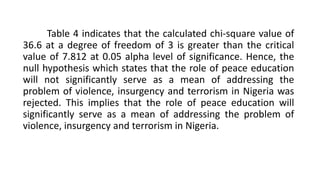
Table 4 indicates that the calculated chi-square value of
36.6 at a degree of freedom of 3 is greater than the critical
value of 7.812 at 0.05 alpha level of significance. Hence, the
null hypothesis which states that the role of peace education
will not significantly serve as a mean of addressing the
problem of violence, insurgency and terrorism in Nigeria was
rejected. This implies that the role of peace education will
significantly serve as a mean of addressing the problem of
violence, insurgency and terrorism in Nigeria.
Discussion of Findings
In research hypothesis one which states that there will be
no significant effect on the effective teaching of social studies
education as interactive strategies for peace building in Higher
Institution was rejected thus: It was indicated that there will be
significant effect on the effective teaching of social studies
education as interactive strategies for peace building in Higher
Institution. This statement was in line according to Ezeoba
(2012), as asserted that the ultimate aim of social studies is to
equip individuals with knowledge and understanding for
peaceful relationships and living.
In research hypothesis two which states that there will be no
significant relationship in the teachers’ qualification in social
studies and conflicts resolution in Nigeria Tertiary Institutions was
rejected thus: There will be significant relationship in the teachers’
qualification in social studies and conflicts resolution in Nigeria
Tertiary Education Institutions. However, this study was in support
with Owolabi (2003) submitted that a teacher as an instructor is
responsible to teach, direct, control, interpret and instruct the
learners for better attainment.
In research hypothesis three which states that there will be no
significant relationship between the teaching of peace education
and conflict resolution in the Nigerian education system was
rejected thus: There will be significant relationship between the
teaching of peace education and conflict resolution in the Nigerian
education system.
However, this statement was supported by According to
Danesh (2006), the universal presence of conflict and war in
human history has always necessitated that priority be given to
education for conflict management and war preparation, and for the
preservation of the larger community.
In research hypothesis four which states that the role of peace
education will not significantly serve as a mean of addressing the
problem of violence, insurgency and terrorism in Nigeria was
rejected thus: The role of peace education will significantly serve
as a mean of addressing the problem of violence, insurgency and
terrorism in Nigeria. Therefore, this statement was supported by
Ben-Nun (2013) peace education curriculum and its presentation
can sometimes lead to a strengthening of in group ties which may
be counter-productive and result in the entrenchment of previously
held views, traditions or stereotypes.
Conclusion
Based on the findings and discussion of this study, it was
concluded that there will be significant relationship in the teachers’
qualification in social studies and conflicts resolution in Nigeria
Tertiary Education Institutions. It was also concluded that there
will be significant relationship between the teaching of peace
education and conflict resolution in the Nigerian education system
and more also, it was established that the role of peace education
will significantly serve as a mean of addressing the problem of
violence, insurgency and terrorism in Nigeria.
Recommendations
The following are recommendations proffered based on the
findings of the study.
1. That, schools should run workshops on the development of
skills on how to solve conflict among inter-schools and more
also between educators (teachers) and the learners (students).
2. That, the Social Studies teachers/lecturers in the study area
should be encouraged to adopt the technique of that will
teaches the concept of social study for their students for
optimum academic performance.
3. That, the managements of universities should improve on
their communication network between the management and
staff on one hand and among staff on the other hand in order
to enhance administrative effectiveness.
4. Efforts should be made by the management to organize
seminars/workshops on organizational conflict management
from time to time for the employees. This will enable
employees learn about conflict and how it can be effectively
managed for individual and organization effectiveness.
THANK YOU

Exploring Social Studies Education as Communication Strategy

  • 1.
    EXPLORING SOCIAL STUDIESEDUCATION AS COMMUNICATION STRATEGY FOR PEACE BUILDING AND CONFLICT MANAGEMENT AMONG STUDENTS OF HIGHER INSTITUTIONS IN OGUN STATE BY DR. A. A. ADEDIRAN AND M.O. LIJADU Social Studies Department School of Arts & Social Sciences Federal College of Education, Abeokuta, Ogun State. Email: speaktoa3@yahoo.com Tel.: 08060932337
  • 2.
    Conflict refers toa situation where there is more than one group of people who engage in a situation where they are in opposition to one another, have differing opinions or competition of interests that may lead to a struggle, tension violent or non-violent struggles or activities that are injurious to members of the opposite group (Abebe, Gbesso, Nyawalo, 2006).There exist many varied definitions to conflict proposed by various scholars from different disciplines depending on their theoretical orientation. Conflicts have become more complex with time especially with terrorism threats increasing rampantly. Many lives are lost, property destroyed, many people rendered homeless forcing others to flee as refugees and this gives less hope for development and prosperity for the young generation. It is for these reasons that there is a dire need for peace. One way to realize this need is through education focused on the importance of peace and peaceful coexistence among communities and with each other as well as how to respond in situations that may lead to conflict. Background to the study
  • 3.
    Social Studies as“the study which equips man with the tools necessary for solving problems in his emerging social and physical environment in an attempt to make the society a more livable one”. In order to understand the meaning of Social Studies at a glance, the following have been put forward by Iyamu (1991) that: (a) Social Studies focuses on the relation of man to the environment in which he lives and the world, (b) Social Studies is concerned with the relation of man to other human beings as a member of the family, peer group, community, school, work place, church and so on; (c) Social Studies is concerned with the relation of human beings to themselves;(d) Social Studies is basically a programme of citizenship education; and (e)Social Studies is a problem-approach discipline.
  • 4.
    Sustainable development canbe broadly seen as the ability of the economy to support the needs of the people of a country overtime, taking into consideration the economic, social and ecological constraints of the country. Underlying this concept is a “sustainability requirement” namely that the fulfilment of the need of the present generation should not compromise the ability of future generation to meet their own need, (Cheps, 2000). Thus, sustainable development can be seen not so much as a technical concept but as an educational one, a process of learning how to think in terms of “forever”.
  • 5.
    The Agenda hasseventeen (17) goals known as the Sustainable Development Goals (SDGs), 169 targets and indicators. The SDGs are the successors to the 8 Millennium Development Goals (MDGs), which expired at the end of 2015. The SDGs set out targets across the three dimension – social, economic and environment of sustainable development. Another distinguishing feature is that, while the MDGs were focused on the developing countries alone, the SDGs are applicable to the developed and developing countries. Olagoke (2017) summarized that SDA is a universal plan and agenda to tackle some of the
  • 6.
    Table 1: Summaryof the Sustainable Development Goals SDG No. 1. End hunger, achieve food security, improve nutrition and promote sustainable agriculture. 2. End poverty in all forms. 3. Ensure healthy living and promote wellbeing of all ages. 4. Ensure inclusive and equitable quality education and promote lifelong learning opportunities for all. 5. Achieve gender equality and empower all women and girls. 6. Ensure availability and sustainable management of water and sanitation for all. 7. Ensure access to affordable, reliable, sustainable and modern energy for all. 8. Promote sustained inclusive and sustainable economic growth, full and productive employment and decent work for all.
  • 7.
    9. Build resilientinfrastructure, promote inclusive and sustainable industrialization and foster innovation. 10. Reduce inequality within and among countries. 11. Make cities and human settlement inclusive, safe, resilient and sustainable. 12. Ensure sustainable consumption and product pattern. 13. Take urgent action to control climate change and its impact 14. Conserve and sustainably use the oceans, seas and marine resources for sustainable development 15. Protect, restore and promote use of terrestrial ecosystem, sustainably manage forests, combat desertification and halt and reverse land degradation and halt biodiversity loss. 16. Promote peaceful and inclusive societies for sustainable development, provide access to justice for all, and build effective accountable and inclusive institutions at all levels 17. Strengthen the means of implementation and revitalize the global partnership for sustainable development. (Source: Akpama, Bessong & Bessong (2017) (Sustainable Development Solutions Network, 2015).
  • 8.
    Social Studies Educationthrough communication strategy for peace building and conflict management, plays a key role in sustainable development and equips one with skills necessary in life. Similarly, the introduction of Peace Education Programme into the Social Studies curriculum is aimed at fostering peace and conflict transformation in Nigeria at the long run. Tracing back since its inception in Nigeria in 2008, educational system has experienced challenges in its implementation, provision of trained personnel and the nature of its implementation at the classroom level.
  • 9.
    However, this studytherefore seeks to analyze and examine the role of Social Studie in the school curriculum in conflict transformation since its inception in Nigeria and whether having peace education within Social Studies programme taught in school has had an impact on conflict transformation for peace building and conflict management in the country.
  • 10.
    Purpose of theStudy The purpose of this study is to explore Social Studies education as interaction and information strategies for peace building among students of higher institutions in ogun state. However, the specific objectives are to: i. Examine the level of social studies education as interaction strategy for peace building in higher institution in Ogun State ii. Examine if there is significant relationship in the teachers’ qualification in social studies and conflicts resolution in Nigeria tertiary education institutions iii. Examine if there will be significant relationship between the teaching of peace education and conflict resolution in the Nigerian education system. iv. investigate the role of peace education as a medium tool in higher institution to address the problem of violence, insurgency and terrorism in Nigeria.
  • 11.
    Research Hypotheses i. Therewill be no significant effect on the effective teaching of social studies education as interactive strategies for peace building in higher institution. ii. There will be no significant relationship in the teachers’ qualification in social studies and conflicts resolution in Nigeria tertiary education institutions. iii. There will be no significant relationship between the teaching of peace education and conflict resolution in the Nigerian education system. iv. The role of peace education will not significantly serve as a mean of addressing the problem of violence, insurgency and terrorism in Nigeria.
  • 12.
    Methodology The study adopteda descriptive survey design. The population for this study consists of all students selected in Four (4) higher institutions in Ogun State. Stratified random sampling techniques were used to select four (4) higher institutions in Ogun State. A multistage sampling procedure was adopted for the selection of 200 students as sample from the four (4) selected higher institutions in Ogun State. Self-designed questionnaire was used as a potent instrument for data collection. a structural questions which requires that respondent pick from options of their best choice. The option however, ranges from Strongly Agree, Agree, Disagree and Strongly Disagree.
  • 13.
    The instrument wassubjected to face and content validation when it was given to expert in measurement and evaluation department. Reliability concern the students to which a particular procedure gives similar result over a number of repeated trials (Orodho, 2009). The instruments in the category were the same for piloting and actual study from four (4) selected higher institutions in Ogun State. Data collected were analyzed using chi-square statistical tool which was used to test the accuracy of the hypotheses used at 0.05 level of significance.
  • 14.
    Testing of Hypotheses Hypothesis1: There will be no significant effect on the effective teaching of social studies education as interactive strategies for peace building in higher institutions. TABLE 1: Contingency Table on the effective teaching of Social Studies Education & Peace Building Respondents N Cal. Value (x2) d.f Tab. Value (x2) Level of Significant Decision 140 60 200 200 31.5 3 7.812 0.05 REJECTED
  • 15.
    Table 1 showthat the calculated chi-square value of 31.5 at a degree of freedom of 3 is greater than the critical value of 7.812 at 0.05 alpha level of significance. Hence, the null hypothesis which states that there will be no significant effect on the effective teaching of social studies education as interactive strategies for peace building in higher institution was rejected. This implies that there will be significant effect on the effective teaching of social studies education as interactive strategy for peace building in higher institution.
  • 16.
    Hypothesis 2: Therewill be no significant relationship in the teachers’ qualification in social studies and conflicts resolution in Nigeria Tertiary Institutions. TABLE 2: Contingency table on the Teachers’ qualification in Social Studies &Conflicts Resolution Respondents N Cal. Value (x2) d.f Tab. Value (x2) Level of Significant Decision 129 71 200 200 27.8 3 7.812 0.05 REJECTED
  • 17.
    Table 2 indicatesthat the calculated chi-square value of 27.8 at a degree of freedom of 3 is greater than the critical value of 7.812 at 0.05 alpha level of significance. Hence, the null hypothesis which states that there will be no significant relationship in the teachers’ qualification in social studies and conflicts resolution in Nigeria Tertiary Institutions was rejected. This implies that there will be a significant relationship in the teachers’ qualification in social studies and conflicts resolution in Nigeria tertiary institutions.
  • 18.
    Hypothesis 3: Therewill be no significant relationship between the teaching of peace education and conflict resolution in the Nigerian education system. TABLE 3: Contingency table on the Peace Education and Conflict Resolution in the Nigerian Education System Respondents N Cal. Value (x2) d.f Tab. Value (x2) Level of Significant Decision 125 75 200 200 28.9 3 7.812 0.05 REJECTED
  • 19.
    Table 3 indicatesthat the calculated chi-square value of 28.9 at a degree of freedom of 3 is greater than the critical value of 7.812 at 0.05 alpha level of significance. Hence, the null hypothesis which states that there will be no significant relationship between the teaching of peace education and conflict resolution in the Nigerian education system was rejected. This implies that there will be significant relationship between the teaching of peace education and conflict resolution in the Nigerian education system.
  • 20.
    Hypothesis 4: Therole of peace education will not significantly serve as a mean of addressing the problem of violence, insurgency and terrorism in Nigeria. TABLE 4: Contingency table on the Peace Education & solution to Violence, Insurgency and Terrorism Respondents N Cal. Value (x2) d.f Tab. Value (x2) Level of Significant Decision 109 91 200 200 36.6 3 7.812 0.05 REJECTED
  • 21.
    Table 4 indicatesthat the calculated chi-square value of 36.6 at a degree of freedom of 3 is greater than the critical value of 7.812 at 0.05 alpha level of significance. Hence, the null hypothesis which states that the role of peace education will not significantly serve as a mean of addressing the problem of violence, insurgency and terrorism in Nigeria was rejected. This implies that the role of peace education will significantly serve as a mean of addressing the problem of violence, insurgency and terrorism in Nigeria.
  • 22.
    Discussion of Findings Inresearch hypothesis one which states that there will be no significant effect on the effective teaching of social studies education as interactive strategies for peace building in Higher Institution was rejected thus: It was indicated that there will be significant effect on the effective teaching of social studies education as interactive strategies for peace building in Higher Institution. This statement was in line according to Ezeoba (2012), as asserted that the ultimate aim of social studies is to equip individuals with knowledge and understanding for peaceful relationships and living.
  • 23.
    In research hypothesistwo which states that there will be no significant relationship in the teachers’ qualification in social studies and conflicts resolution in Nigeria Tertiary Institutions was rejected thus: There will be significant relationship in the teachers’ qualification in social studies and conflicts resolution in Nigeria Tertiary Education Institutions. However, this study was in support with Owolabi (2003) submitted that a teacher as an instructor is responsible to teach, direct, control, interpret and instruct the learners for better attainment. In research hypothesis three which states that there will be no significant relationship between the teaching of peace education and conflict resolution in the Nigerian education system was rejected thus: There will be significant relationship between the teaching of peace education and conflict resolution in the Nigerian education system.
  • 24.
    However, this statementwas supported by According to Danesh (2006), the universal presence of conflict and war in human history has always necessitated that priority be given to education for conflict management and war preparation, and for the preservation of the larger community. In research hypothesis four which states that the role of peace education will not significantly serve as a mean of addressing the problem of violence, insurgency and terrorism in Nigeria was rejected thus: The role of peace education will significantly serve as a mean of addressing the problem of violence, insurgency and terrorism in Nigeria. Therefore, this statement was supported by Ben-Nun (2013) peace education curriculum and its presentation can sometimes lead to a strengthening of in group ties which may be counter-productive and result in the entrenchment of previously held views, traditions or stereotypes.
  • 25.
    Conclusion Based on thefindings and discussion of this study, it was concluded that there will be significant relationship in the teachers’ qualification in social studies and conflicts resolution in Nigeria Tertiary Education Institutions. It was also concluded that there will be significant relationship between the teaching of peace education and conflict resolution in the Nigerian education system and more also, it was established that the role of peace education will significantly serve as a mean of addressing the problem of violence, insurgency and terrorism in Nigeria.
  • 26.
    Recommendations The following arerecommendations proffered based on the findings of the study. 1. That, schools should run workshops on the development of skills on how to solve conflict among inter-schools and more also between educators (teachers) and the learners (students). 2. That, the Social Studies teachers/lecturers in the study area should be encouraged to adopt the technique of that will teaches the concept of social study for their students for optimum academic performance. 3. That, the managements of universities should improve on their communication network between the management and staff on one hand and among staff on the other hand in order to enhance administrative effectiveness.
  • 27.
    4. Efforts shouldbe made by the management to organize seminars/workshops on organizational conflict management from time to time for the employees. This will enable employees learn about conflict and how it can be effectively managed for individual and organization effectiveness.
  • 28.