Why PIM? Why Now?
Product Information Management What you should know.
Presented by:
© 2015 R³ Consulting Partners
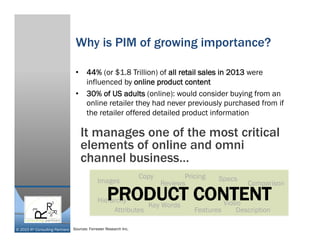
Why is PIM of growing importance?
•  44% (or $1.8 Trillion) of all retail sales in 2013 were
influenced by online product content
•  30% of US adults (online): would consider buying from an
online retailer they had never previously purchased from if
the retailer offered detailed product information
It manages one of the most critical
elements of online and omni
channel business…
Images
Attributes Features
Pricing
Description
Copy
Key Words
Comparison
Video
Reviews
Specs
HierarchyPRODUCT CONTENT
Sources: Forrester Research Inc.
© 2015 R³ Consulting Partners
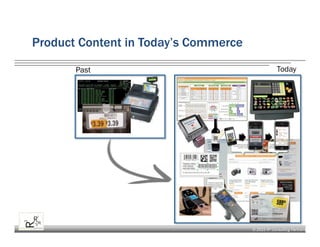
Product Content in Today’s Commerce
Past Today
© 2015 R³ Consulting Partners
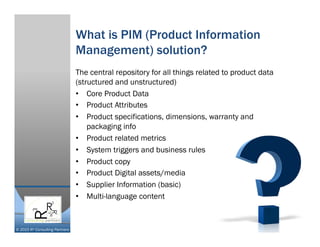
What is PIM (Product Information
Management) solution?
The central repository for all things related to product data
(structured and unstructured)
•  Core Product Data
•  Product Attributes
•  Product specifications, dimensions, warranty and
packaging info
•  Product related metrics
•  System triggers and business rules
•  Product copy
•  Product Digital assets/media
•  Supplier Information (basic)
•  Multi-language content
© 2015 R³ Consulting Partners
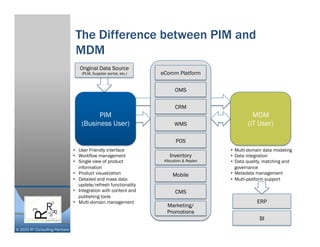
The Difference between PIM and
MDM
•  User Friendly interface
•  Workflow management
•  Single view of product
information
•  Product visualization
•  Detailed and mass data
update/refresh functionality
•  Integration with content and
publishing tools
•  Multi-domain management
PIM
(Business User)
MDM
(IT User)
eComm Platform
OMS
CRM
WMS
POS
Inventory
Allocation & Replen
Mobile
CMS
Marketing/
Promotions
Original Data Source
(PLM, Supplier portal, etc.)
ERP
BI
•  Multi-domain data modeling
•  Data integration
•  Data quality, matching and
governance
•  Metadata management
•  Multi-platform support
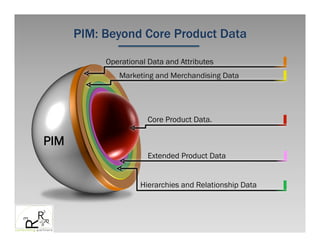
Marketing and Merchandising Data
Operational Data and Attributes
Core Product Data.
Extended Product Data
Hierarchies and Relationship Data
PIM
PIM: Beyond Core Product Data
© 2015 R³ Consulting Partners
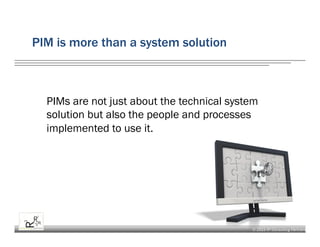
PIM is more than a system solution
PIMs are not just about the technical system
solution but also the people and processes
implemented to use it.
© 2015 R³ Consulting Partners
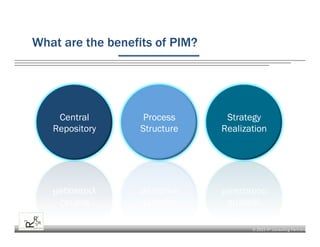
What are the benefits of PIM?
Central
Repository
Process
Structure
Strategy
Realization
© 2015 R³ Consulting Partners
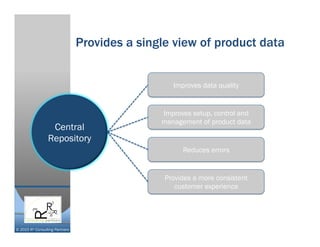
Central
Repository
Provides a single view of product data
Improves data quality
Improves setup, control and
management of product data
Reduces errors
Provides a more consistent
customer experience
© 2015 R³ Consulting Partners
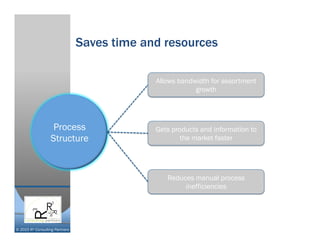
Process
Structure
Allows bandwidth for assortment
growth
Gets products and information to
the market faster
Reduces manual process
inefficiencies
Saves time and resources
© 2015 R³ Consulting Partners
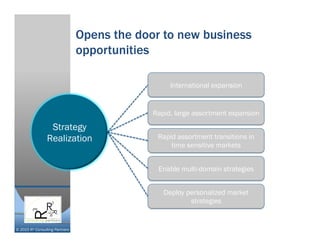
Strategy
Realization
International expansion
Rapid, large assortment expansion
Rapid assortment transitions in
time sensitive markets
Enable multi-domain strategies
Opens the door to new business
opportunities
Deploy personalized market
strategies
© 2015 R³ Consulting Partners
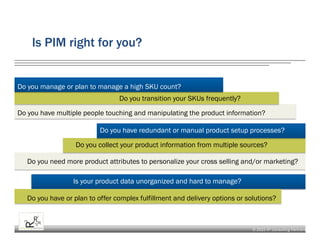
Is PIM right for you?
Do you manage or plan to manage a high SKU count?
Do you transition your SKUs frequently?
Do you have multiple people touching and manipulating the product information?
Do you have redundant or manual product setup processes?
Do you collect your product information from multiple sources?
Do you need more product attributes to personalize your cross selling and/or marketing?
Is your product data unorganized and hard to manage?
Do you have or plan to offer complex fulfillment and delivery options or solutions?
© 2015 R³ Consulting Partners
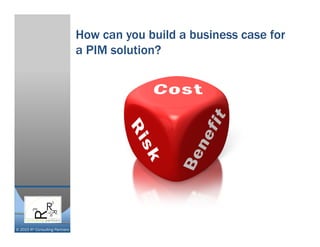
How can you build a business case for
a PIM solution?
© 2015 R³ Consulting Partners
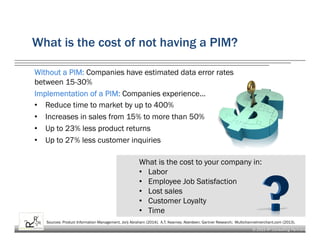
What is the cost of not having a PIM?
Without a PIM: Companies have estimated data error rates
between 15-30%
Implementation of a PIM: Companies experience…
•  Reduce time to market by up to 400%
•  Increases in sales from 15% to more than 50%
•  Up to 23% less product returns
•  Up to 27% less customer inquiries
Sources: Product Information Management, Jorij Abraham (2014); A.T. Kearney; Aberdeen; Gartner Research; Multichannelmerchant.com (2013).
What is the cost to your company in:
•  Labor
•  Employee Job Satisfaction
•  Lost sales
•  Customer Loyalty
•  Time
© 2015 R³ Consulting Partners
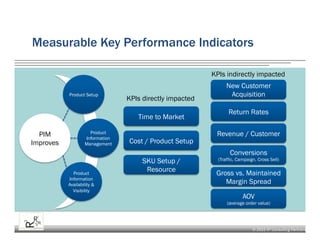
Measurable Key Performance Indicators
PIM
Improves
KPIs directly impacted
Time to Market
Cost / Product Setup
SKU Setup /
Resource
New Customer
Acquisition
Return Rates
Product
Information
Availability &
Visibility
Product
Information
Management
Product Setup
KPIs indirectly impacted
Revenue / Customer
Conversions
(Traffic, Campaign, Cross Sell)
Gross vs. Maintained
Margin Spread
AOV
(average order value)
© 2015 R³ Consulting Partners
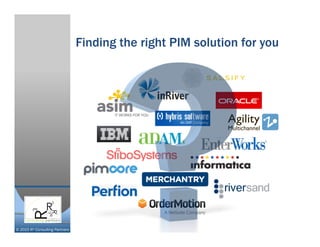
Finding the right PIM solution for you
© 2015 R³ Consulting Partners
What do I need to consider and take into
account when implementing a PIM?
Does a PIM take priority
over over system
initiatives?
© 2015 R³ Consulting Partners
What do I need to consider and take into
account when implementing a PIM?
Can I implement at the
same time as other
systems?
© 2015 R³ Consulting Partners
What do I need to consider and take into
account when implementing a PIM?
Are there systems that
should be implemented
before the PIM?
© 2015 R³ Consulting Partners
What do I need to consider and take into
account when implementing a PIM?
Do we need to clean our
product data prior to a
PIM?
© 2015 R³ Consulting Partners
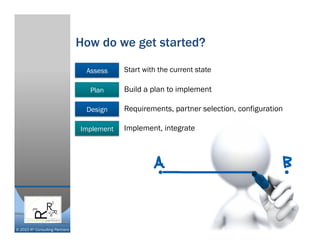
How do we get started?
Build a plan to implement
Implement
Assess
Plan
Design
Start with the current state
Requirements, partner selection, configuration
Implement, integrate
© 2015 R³ Consulting Partners
Wrap Up
Proprietary and Confidential© 2015 R³ Consulting Partners
info@r3consultingpartners.com
1-844-867-R3CP (7327)
www.r3cp.com
Heather Raines, Partner
heather@r3consultingpartners.com
Stephen Rogers, Partner
steve@r3consultingpartners.com
…strategic insight and planning to
tactical execution and delivery
R3 Consulting Partners

R3 Consulting Product Information Management (PIM) webinar

  • 1.
    Why PIM? WhyNow? Product Information Management What you should know. Presented by:
  • 2.
    © 2015 R³Consulting Partners Why is PIM of growing importance? •  44% (or $1.8 Trillion) of all retail sales in 2013 were influenced by online product content •  30% of US adults (online): would consider buying from an online retailer they had never previously purchased from if the retailer offered detailed product information It manages one of the most critical elements of online and omni channel business… Images Attributes Features Pricing Description Copy Key Words Comparison Video Reviews Specs HierarchyPRODUCT CONTENT Sources: Forrester Research Inc.
  • 3.
    © 2015 R³Consulting Partners Product Content in Today’s Commerce Past Today
  • 4.
    © 2015 R³Consulting Partners What is PIM (Product Information Management) solution? The central repository for all things related to product data (structured and unstructured) •  Core Product Data •  Product Attributes •  Product specifications, dimensions, warranty and packaging info •  Product related metrics •  System triggers and business rules •  Product copy •  Product Digital assets/media •  Supplier Information (basic) •  Multi-language content
  • 5.
    © 2015 R³Consulting Partners The Difference between PIM and MDM •  User Friendly interface •  Workflow management •  Single view of product information •  Product visualization •  Detailed and mass data update/refresh functionality •  Integration with content and publishing tools •  Multi-domain management PIM (Business User) MDM (IT User) eComm Platform OMS CRM WMS POS Inventory Allocation & Replen Mobile CMS Marketing/ Promotions Original Data Source (PLM, Supplier portal, etc.) ERP BI •  Multi-domain data modeling •  Data integration •  Data quality, matching and governance •  Metadata management •  Multi-platform support
  • 6.
    Marketing and MerchandisingData Operational Data and Attributes Core Product Data. Extended Product Data Hierarchies and Relationship Data PIM PIM: Beyond Core Product Data
  • 7.
    © 2015 R³Consulting Partners PIM is more than a system solution PIMs are not just about the technical system solution but also the people and processes implemented to use it.
  • 8.
    © 2015 R³Consulting Partners What are the benefits of PIM? Central Repository Process Structure Strategy Realization
  • 9.
    © 2015 R³Consulting Partners Central Repository Provides a single view of product data Improves data quality Improves setup, control and management of product data Reduces errors Provides a more consistent customer experience
  • 10.
    © 2015 R³Consulting Partners Process Structure Allows bandwidth for assortment growth Gets products and information to the market faster Reduces manual process inefficiencies Saves time and resources
  • 11.
    © 2015 R³Consulting Partners Strategy Realization International expansion Rapid, large assortment expansion Rapid assortment transitions in time sensitive markets Enable multi-domain strategies Opens the door to new business opportunities Deploy personalized market strategies
  • 12.
    © 2015 R³Consulting Partners Is PIM right for you? Do you manage or plan to manage a high SKU count? Do you transition your SKUs frequently? Do you have multiple people touching and manipulating the product information? Do you have redundant or manual product setup processes? Do you collect your product information from multiple sources? Do you need more product attributes to personalize your cross selling and/or marketing? Is your product data unorganized and hard to manage? Do you have or plan to offer complex fulfillment and delivery options or solutions?
  • 13.
    © 2015 R³Consulting Partners How can you build a business case for a PIM solution?
  • 14.
    © 2015 R³Consulting Partners What is the cost of not having a PIM? Without a PIM: Companies have estimated data error rates between 15-30% Implementation of a PIM: Companies experience… •  Reduce time to market by up to 400% •  Increases in sales from 15% to more than 50% •  Up to 23% less product returns •  Up to 27% less customer inquiries Sources: Product Information Management, Jorij Abraham (2014); A.T. Kearney; Aberdeen; Gartner Research; Multichannelmerchant.com (2013). What is the cost to your company in: •  Labor •  Employee Job Satisfaction •  Lost sales •  Customer Loyalty •  Time
  • 15.
    © 2015 R³Consulting Partners Measurable Key Performance Indicators PIM Improves KPIs directly impacted Time to Market Cost / Product Setup SKU Setup / Resource New Customer Acquisition Return Rates Product Information Availability & Visibility Product Information Management Product Setup KPIs indirectly impacted Revenue / Customer Conversions (Traffic, Campaign, Cross Sell) Gross vs. Maintained Margin Spread AOV (average order value)
  • 16.
    © 2015 R³Consulting Partners Finding the right PIM solution for you
  • 17.
    © 2015 R³Consulting Partners What do I need to consider and take into account when implementing a PIM? Does a PIM take priority over over system initiatives?
  • 18.
    © 2015 R³Consulting Partners What do I need to consider and take into account when implementing a PIM? Can I implement at the same time as other systems?
  • 19.
    © 2015 R³Consulting Partners What do I need to consider and take into account when implementing a PIM? Are there systems that should be implemented before the PIM?
  • 20.
    © 2015 R³Consulting Partners What do I need to consider and take into account when implementing a PIM? Do we need to clean our product data prior to a PIM?
  • 21.
    © 2015 R³Consulting Partners How do we get started? Build a plan to implement Implement Assess Plan Design Start with the current state Requirements, partner selection, configuration Implement, integrate
  • 22.
    © 2015 R³Consulting Partners Wrap Up
  • 23.
    Proprietary and Confidential©2015 R³ Consulting Partners info@r3consultingpartners.com 1-844-867-R3CP (7327) www.r3cp.com Heather Raines, Partner heather@r3consultingpartners.com Stephen Rogers, Partner steve@r3consultingpartners.com …strategic insight and planning to tactical execution and delivery R3 Consulting Partners