THINKING beyond the canopy
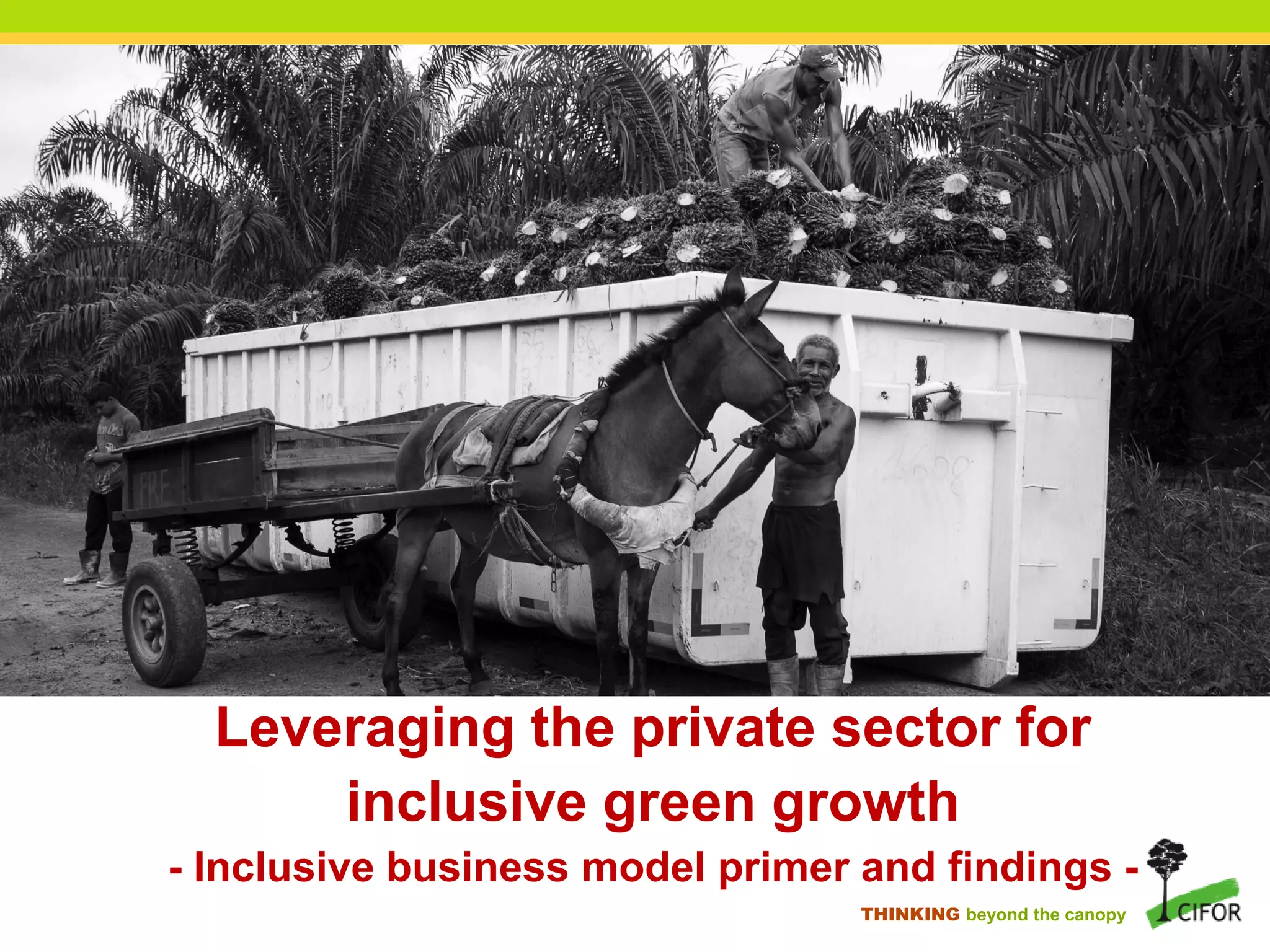
Leveraging the private sector for
inclusive green growth
- Inclusive business model primer and findings -
THINKING beyond the canopy
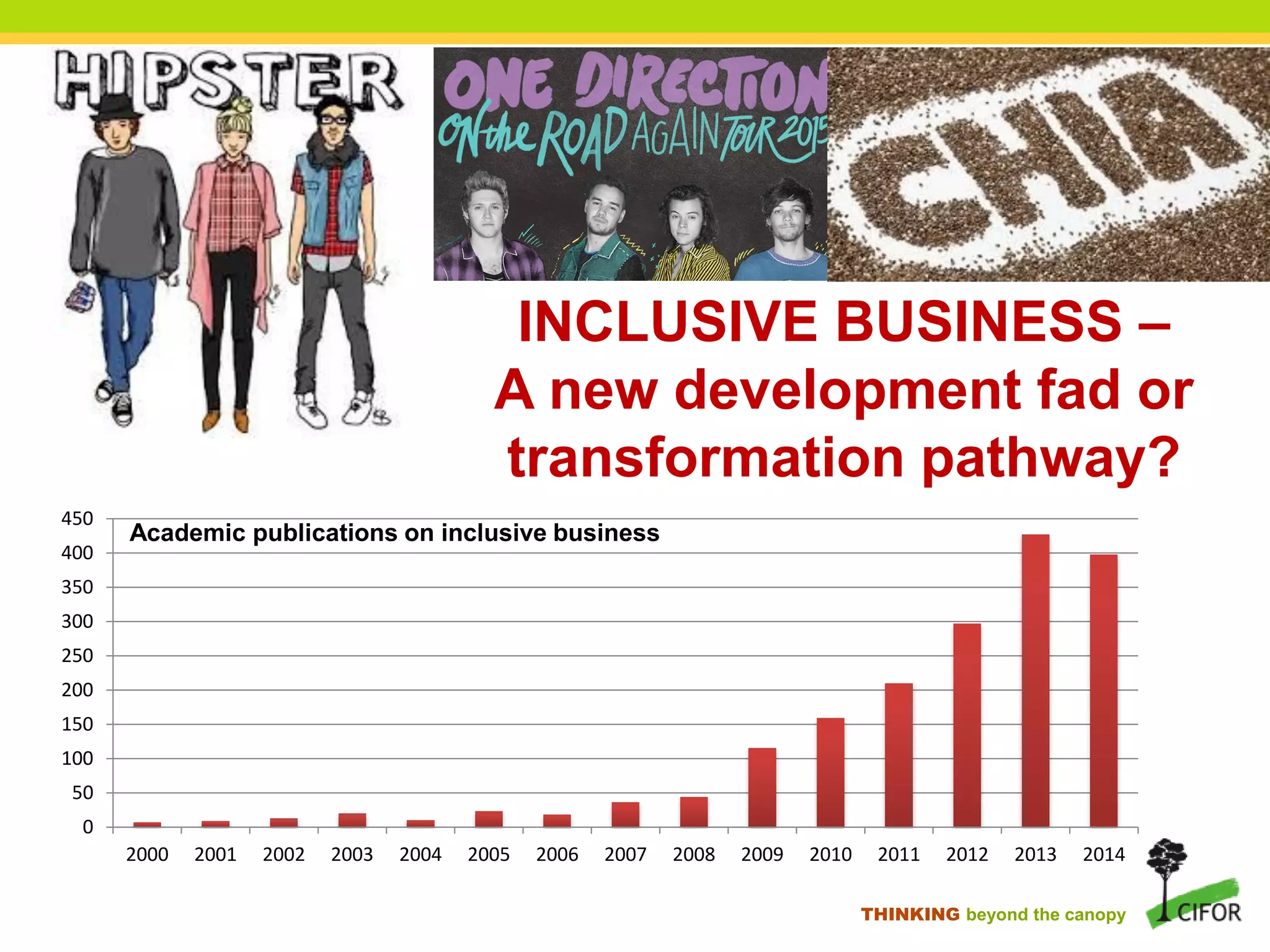
INCLUSIVE BUSINESS –
A new development fad or
transformation pathway?
0
50
100
150
200
250
300
350
400
450
2000 2001 2002 2003 2004 2005 2006 2007 2008 2009 2010 2011 2012 2013 2014
Academic publications on inclusive business
THINKING beyond the canopy
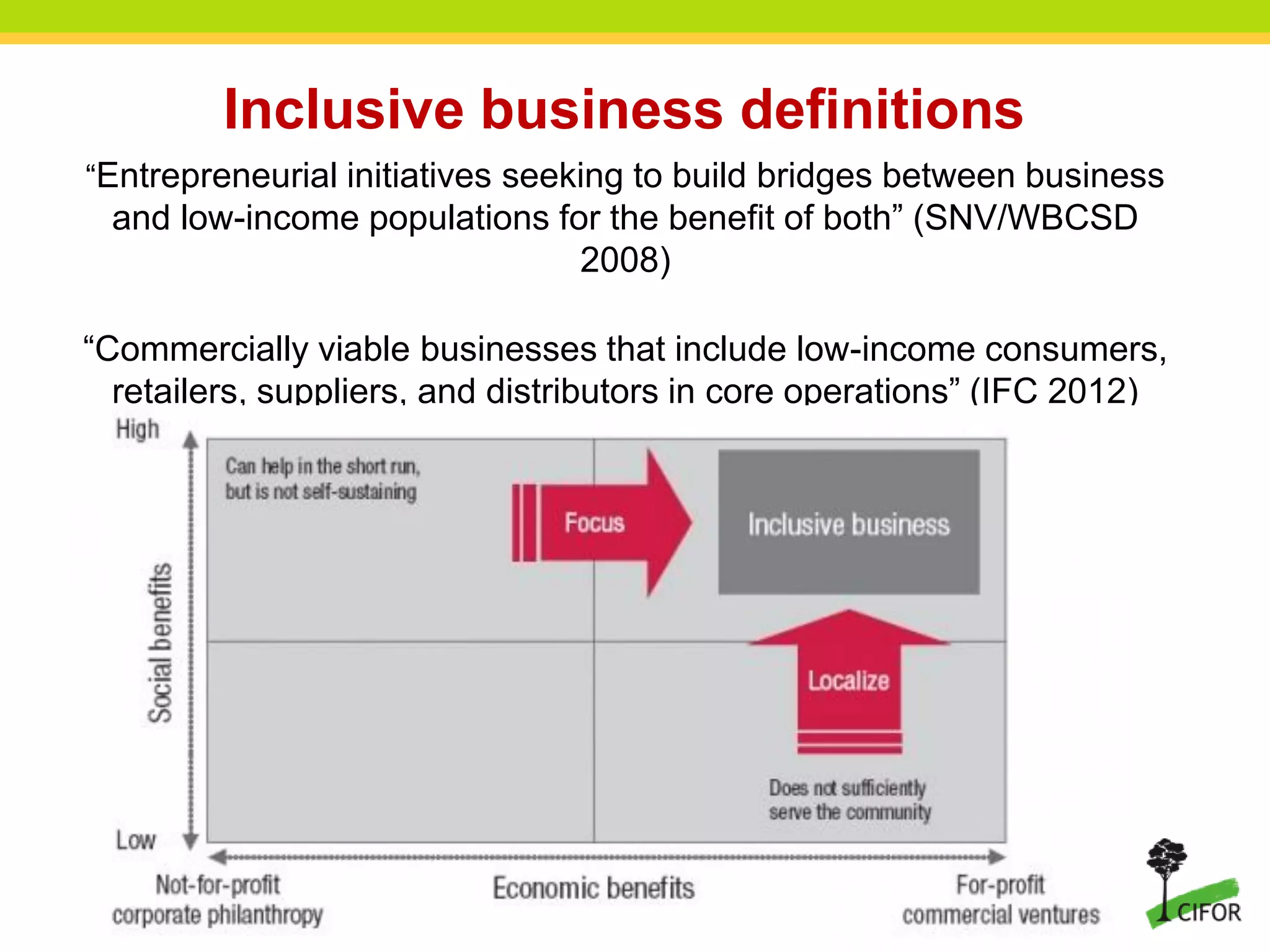
Inclusive business definitions
“Entrepreneurial initiatives seeking to build bridges between business
and low-income populations for the benefit of both” (SNV/WBCSD
2008)
“Commercially viable businesses that include low-income consumers,
retailers, suppliers, and distributors in core operations” (IFC 2012)
THINKING beyond the canopy
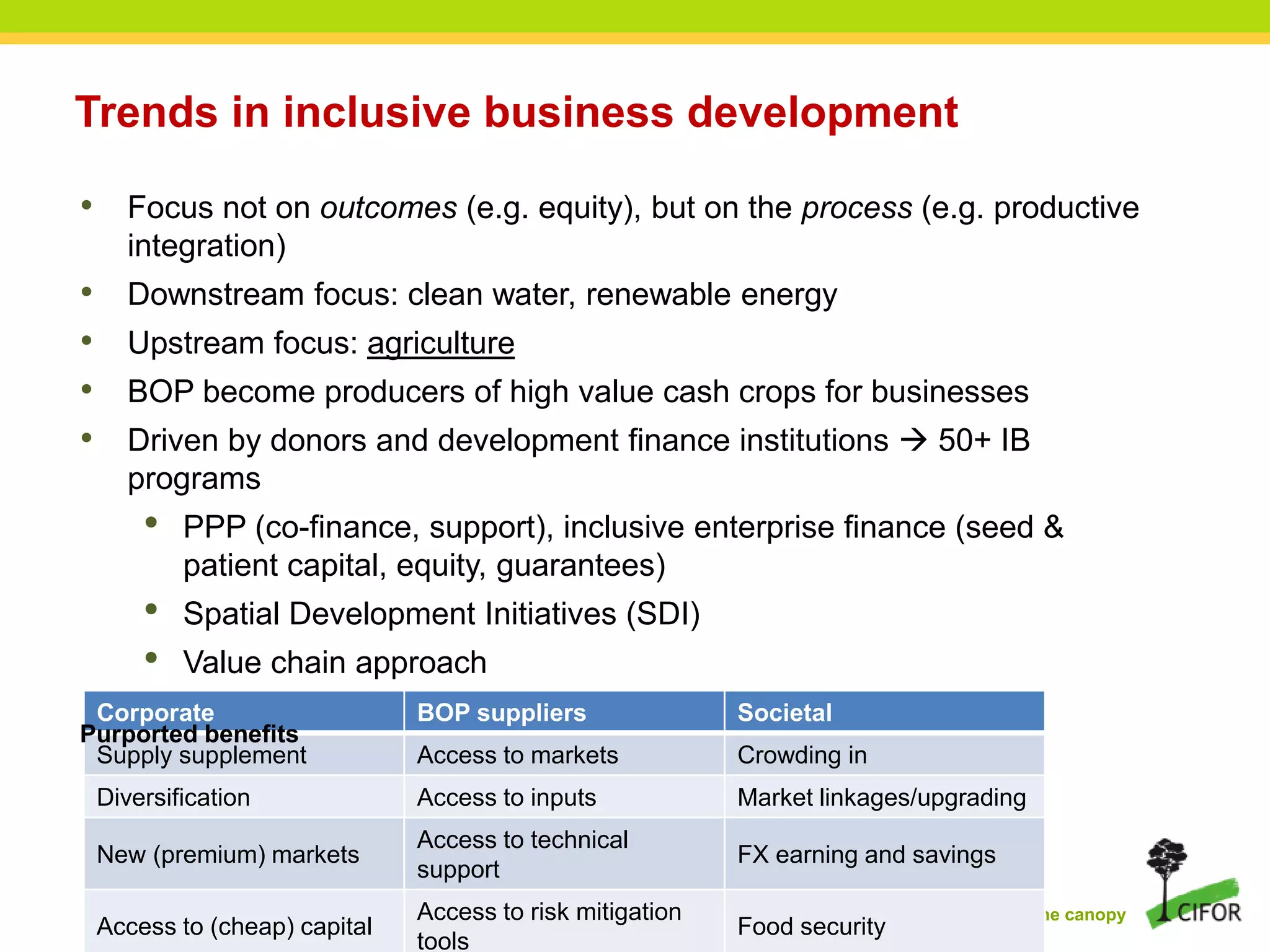
Corporate BOP suppliers Societal
Supply supplement Access to markets Crowding in
Diversification Access to inputs Market linkages/upgrading
New (premium) markets
Access to technical
support
FX earning and savings
Access to (cheap) capital
Access to risk mitigation
tools
Food security
Trends in inclusive business development
• Focus not on outcomes (e.g. equity), but on the process (e.g. productive
integration)
• Downstream focus: clean water, renewable energy
• Upstream focus: agriculture
• BOP become producers of high value cash crops for businesses
• Driven by donors and development finance institutions  50+ IB
programs
• PPP (co-finance, support), inclusive enterprise finance (seed &
patient capital, equity, guarantees)
• Spatial Development Initiatives (SDI)
• Value chain approach
Purported benefits
THINKING beyond the canopy
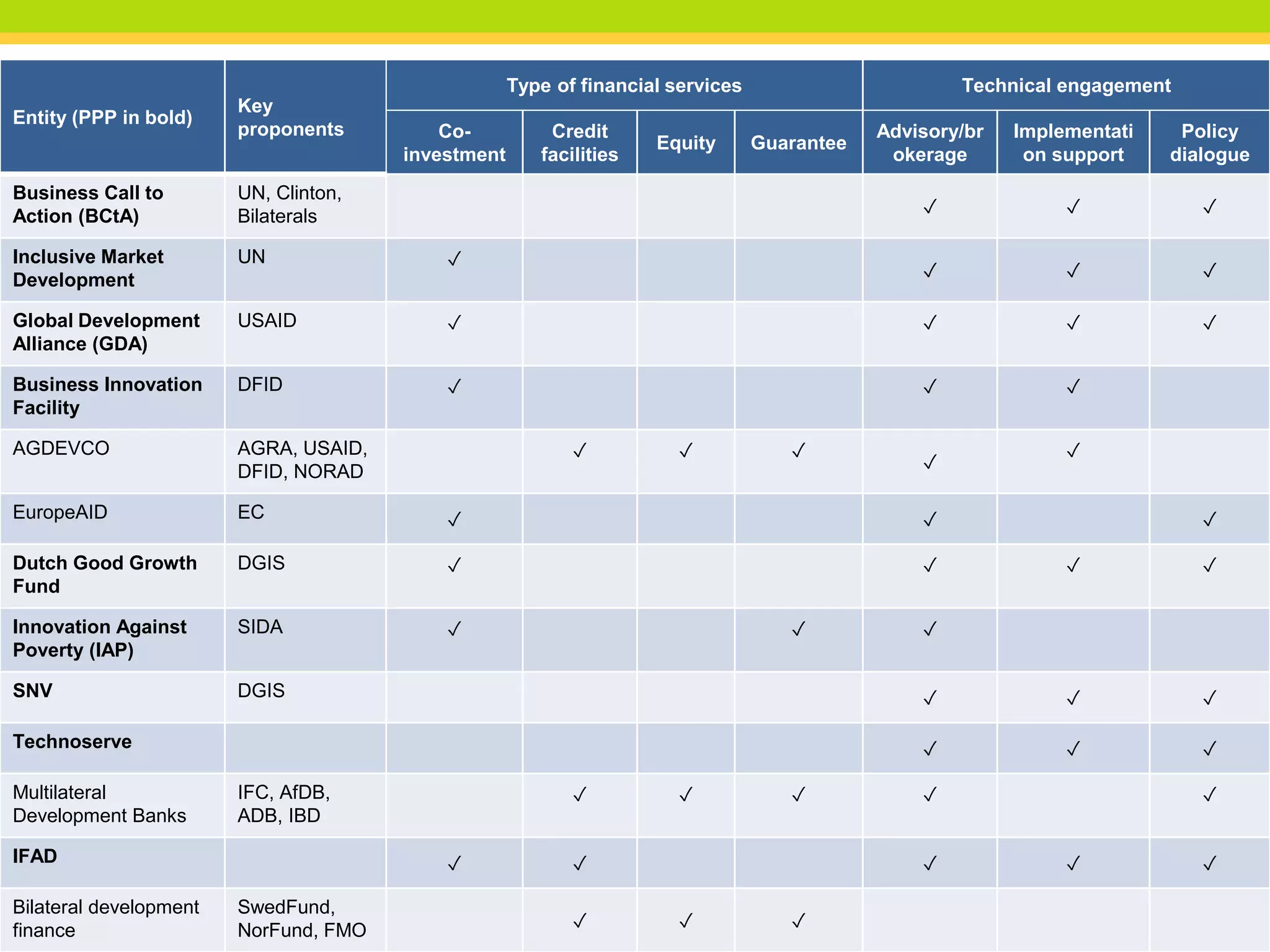
Entity (PPP in bold)
Key
proponents
Type of financial services Technical engagement
Co-
investment
Credit
facilities
Equity Guarantee
Advisory/br
okerage
Implementati
on support
Policy
dialogue
Business Call to
Action (BCtA)
UN, Clinton,
Bilaterals ✓ ✓ ✓
Inclusive Market
Development
UN ✓
✓ ✓ ✓
Global Development
Alliance (GDA)
USAID ✓ ✓ ✓ ✓
Business Innovation
Facility
DFID ✓ ✓ ✓
AGDEVCO AGRA, USAID,
DFID, NORAD
✓ ✓ ✓
✓
✓
EuropeAID EC ✓ ✓ ✓
Dutch Good Growth
Fund
DGIS ✓ ✓ ✓ ✓
Innovation Against
Poverty (IAP)
SIDA ✓ ✓ ✓
SNV DGIS ✓ ✓ ✓
Technoserve ✓ ✓ ✓
Multilateral
Development Banks
IFC, AfDB,
ADB, IBD
✓ ✓ ✓ ✓ ✓
IFAD ✓ ✓ ✓ ✓ ✓
Bilateral development
finance
SwedFund,
NorFund, FMO ✓ ✓ ✓
THINKING beyond the canopy
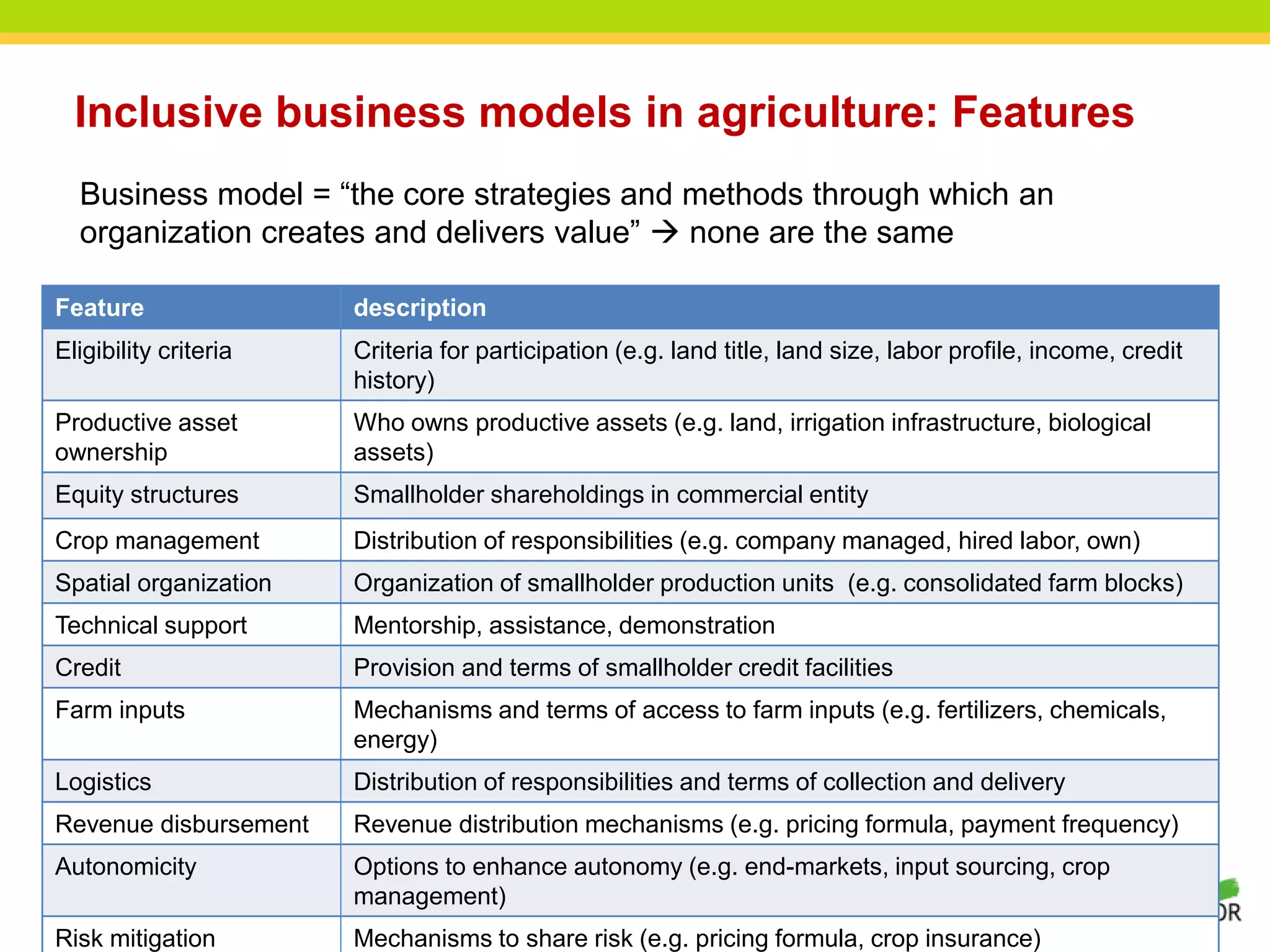
Inclusive business models in agriculture: Features
Business model = “the core strategies and methods through which an
organization creates and delivers value”  none are the same
Feature description
Eligibility criteria Criteria for participation (e.g. land title, land size, labor profile, income, credit
history)
Productive asset
ownership
Who owns productive assets (e.g. land, irrigation infrastructure, biological
assets)
Equity structures Smallholder shareholdings in commercial entity
Crop management Distribution of responsibilities (e.g. company managed, hired labor, own)
Spatial organization Organization of smallholder production units (e.g. consolidated farm blocks)
Technical support Mentorship, assistance, demonstration
Credit Provision and terms of smallholder credit facilities
Farm inputs Mechanisms and terms of access to farm inputs (e.g. fertilizers, chemicals,
energy)
Logistics Distribution of responsibilities and terms of collection and delivery
Revenue disbursement Revenue distribution mechanisms (e.g. pricing formula, payment frequency)
Autonomicity Options to enhance autonomy (e.g. end-markets, input sourcing, crop
management)
Risk mitigation Mechanisms to share risk (e.g. pricing formula, crop insurance)
THINKING beyond the canopy
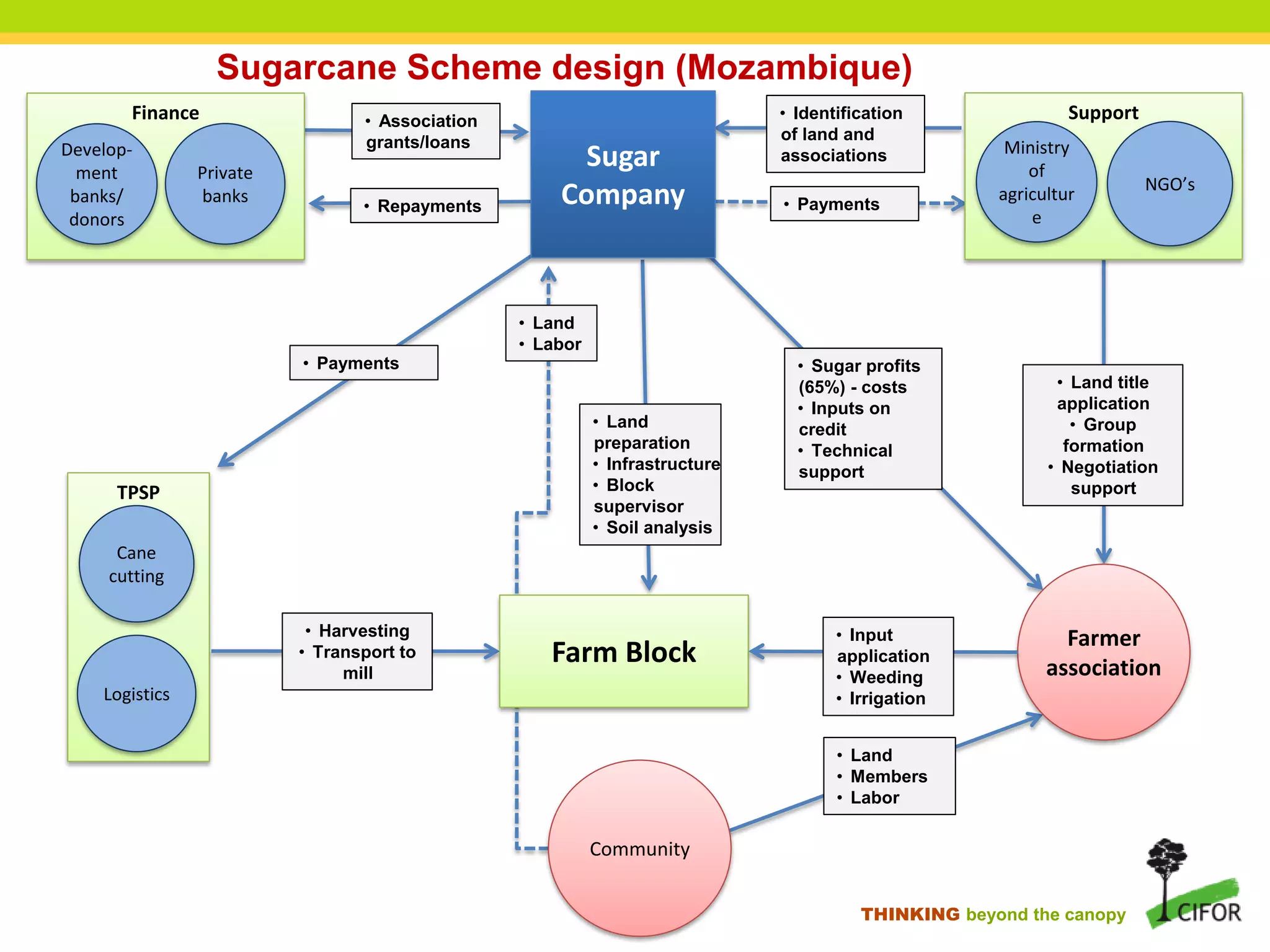
Farm Block
Farmer
association
• Land
preparation
• Infrastructure
• Block
supervisor
• Soil analysis
• Land title
application
• Group
formation
• Negotiation
supportTPSP
Logistics
Cane
cutting
• Harvesting
• Transport to
mill
• Sugar profits
(65%) - costs
• Inputs on
credit
• Technical
support
Finance
Private
banks
Develop-
ment
banks/
donors
Community
Support
NGO’s
Ministry
of
agricultur
e
• Association
grants/loans
• Repayments
• Payments
• Land
• Members
• Labor
• Identification
of land and
associations
• Payments
Sugar
Company
• Input
application
• Weeding
• Irrigation
• Land
• Labor
Sugarcane Scheme design (Mozambique)
THINKING beyond the canopy
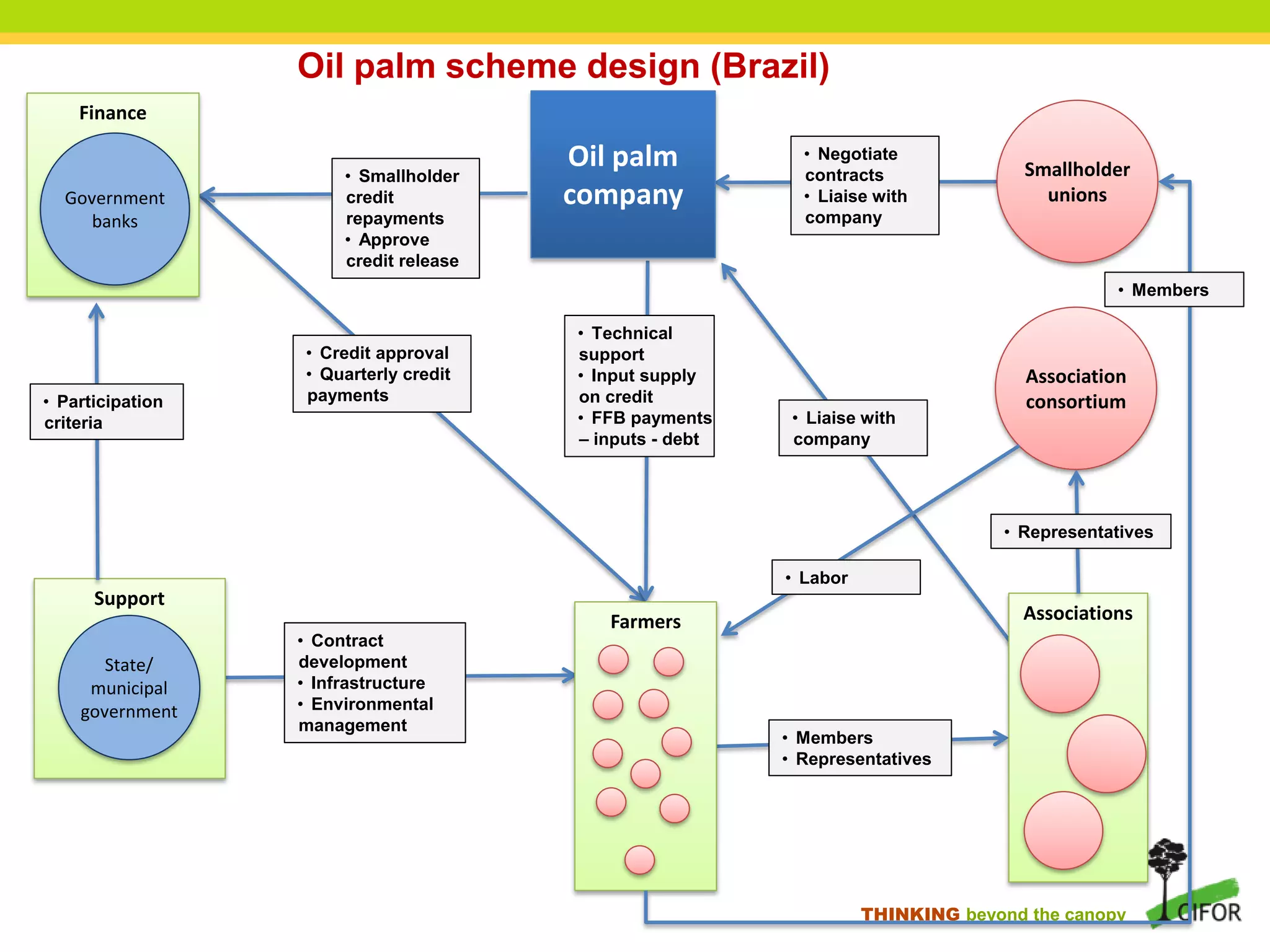
• Technical
support
• Input supply
on credit
• FFB payments
– inputs - debt
Finance
Government
banks
Support
State/
municipal
government
• Contract
development
• Infrastructure
• Environmental
management
• Smallholder
credit
repayments
• Approve
credit release
• Liaise with
company
Oil palm
company
Oil palm scheme design (Brazil)
Farmers
Smallholder
unions
Associations
• Credit approval
• Quarterly credit
payments
• Negotiate
contracts
• Liaise with
company
Association
consortium
• Labor
• Members
• Representatives
• Representatives
• Members
• Participation
criteria
THINKING beyond the canopy
Some IBM reflections from CIFOR projects (I)
Limited inclusivity  shaped by (self-) selection biases
• Companies impose participation criteria (e.g. land, title, age, labor,
income)
• Smallholder risk propensity is highly variable  rarely incorporates the
BOP
Limited impact on smallholder production systems
• Reluctance to abandon subsistence production systems
• Negligible change in subsistence crop production practices and market
orientation
• Irregular revenue flows stimulates irresponsible spending  little
reinvestment
Profound changes in local land use dynamics and land-property
relations
• Average household land area under production increases significantly
(extensification alongside intensification)  ILUC, land scarcity conflict
THINKING beyond the canopy
Some reflections from CIFOR projects (II)
Accumulation through independent specialization and employment
• Welfare impacts of participation not pronounced  no major changes in
livelihood portfolios o reinvestment in productive assets
• Independent expansion most important determinant of upwards mobility
 only small proportion (<1%) with entrepreneurial capacity
• Formal (plantation) employment more effectively produces welfare
gains
High failure rates of inclusive businesses
• Rampant side-selling discourages (further) investment in IBM
• Development of financially viable IBM takes time, resources, and
external support!
THINKING beyond the canopy
Policy challenges
Scalability and replicatability
• No business model is the same!  policy focus more on process than
design
• Adaptive capacity and learning produces locally responsive models
• Value chain support organizations critical, especially technical support and
patient capital sources  extend profit horizon and encourage LT business
planning
• Balancing need to control supply chain and enhance smallholder autonomy
• External technical support, independent service providers, and interventions
to reduce risk of side-selling (e.g. contract enforcement support, regulation
of (rogue) trading practices, concession systems)
Inclusive business and green growth interactions underexplored
• Sustainability standards and commitments threaten to alienate low
compliance capacity producers and enhance production control imperative
• IB could be effective mechanism to advance climate smart agriculture,
promote intensification, and facilitate smallholder compliance with private
standards
THINKING beyond the canopy
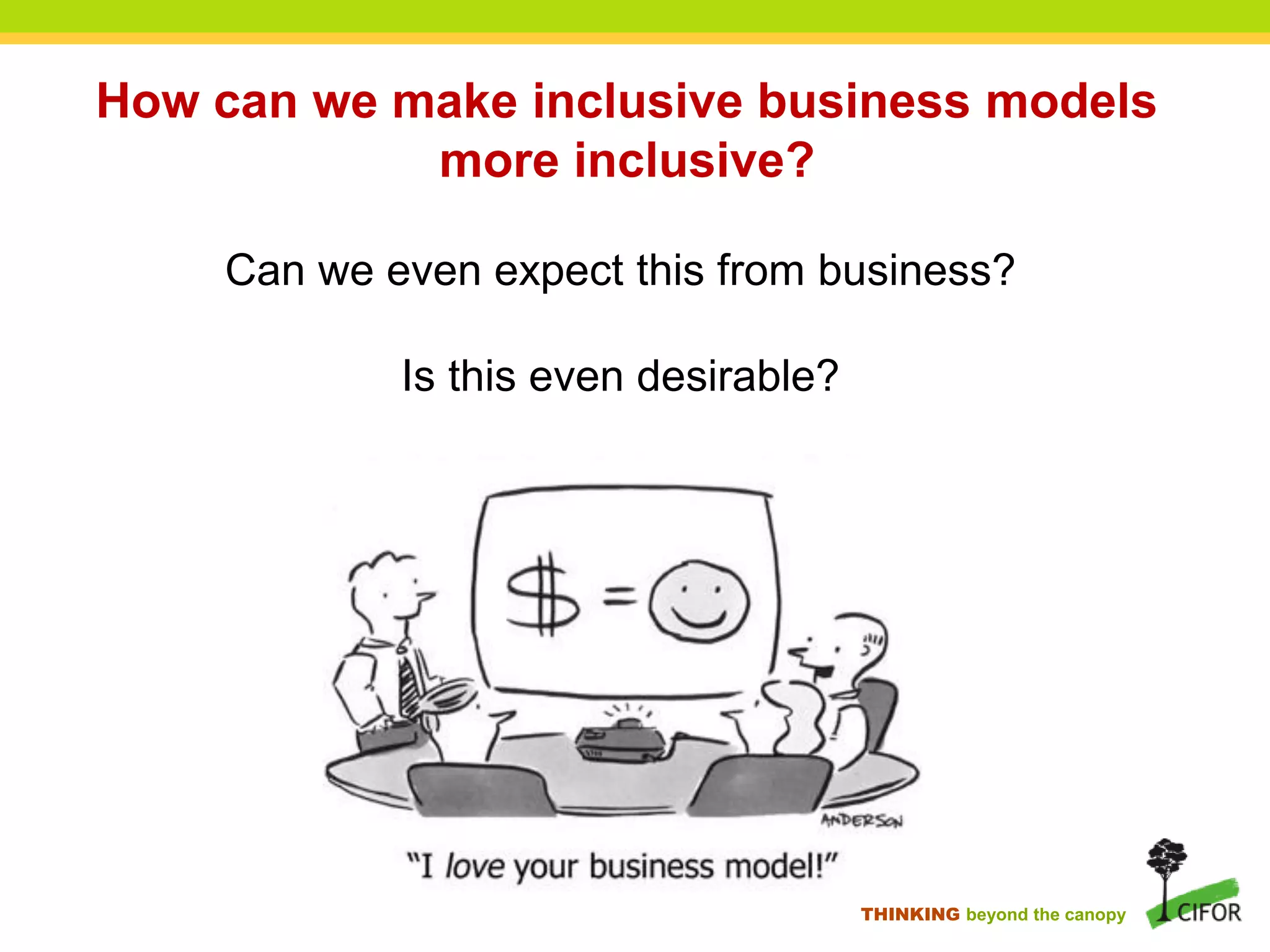
How can we make inclusive business models
more inclusive?
Can we even expect this from business?
Is this even desirable?

Leveraging the private sector for inclusive green growth: Inclusive business model primer and findings

  • 1.
    THINKING beyond thecanopy Leveraging the private sector for inclusive green growth - Inclusive business model primer and findings -
  • 2.
    THINKING beyond thecanopy INCLUSIVE BUSINESS – A new development fad or transformation pathway? 0 50 100 150 200 250 300 350 400 450 2000 2001 2002 2003 2004 2005 2006 2007 2008 2009 2010 2011 2012 2013 2014 Academic publications on inclusive business
  • 3.
    THINKING beyond thecanopy Inclusive business definitions “Entrepreneurial initiatives seeking to build bridges between business and low-income populations for the benefit of both” (SNV/WBCSD 2008) “Commercially viable businesses that include low-income consumers, retailers, suppliers, and distributors in core operations” (IFC 2012)
  • 4.
    THINKING beyond thecanopy Corporate BOP suppliers Societal Supply supplement Access to markets Crowding in Diversification Access to inputs Market linkages/upgrading New (premium) markets Access to technical support FX earning and savings Access to (cheap) capital Access to risk mitigation tools Food security Trends in inclusive business development • Focus not on outcomes (e.g. equity), but on the process (e.g. productive integration) • Downstream focus: clean water, renewable energy • Upstream focus: agriculture • BOP become producers of high value cash crops for businesses • Driven by donors and development finance institutions  50+ IB programs • PPP (co-finance, support), inclusive enterprise finance (seed & patient capital, equity, guarantees) • Spatial Development Initiatives (SDI) • Value chain approach Purported benefits
  • 5.
    THINKING beyond thecanopy Entity (PPP in bold) Key proponents Type of financial services Technical engagement Co- investment Credit facilities Equity Guarantee Advisory/br okerage Implementati on support Policy dialogue Business Call to Action (BCtA) UN, Clinton, Bilaterals ✓ ✓ ✓ Inclusive Market Development UN ✓ ✓ ✓ ✓ Global Development Alliance (GDA) USAID ✓ ✓ ✓ ✓ Business Innovation Facility DFID ✓ ✓ ✓ AGDEVCO AGRA, USAID, DFID, NORAD ✓ ✓ ✓ ✓ ✓ EuropeAID EC ✓ ✓ ✓ Dutch Good Growth Fund DGIS ✓ ✓ ✓ ✓ Innovation Against Poverty (IAP) SIDA ✓ ✓ ✓ SNV DGIS ✓ ✓ ✓ Technoserve ✓ ✓ ✓ Multilateral Development Banks IFC, AfDB, ADB, IBD ✓ ✓ ✓ ✓ ✓ IFAD ✓ ✓ ✓ ✓ ✓ Bilateral development finance SwedFund, NorFund, FMO ✓ ✓ ✓
  • 6.
    THINKING beyond thecanopy Inclusive business models in agriculture: Features Business model = “the core strategies and methods through which an organization creates and delivers value”  none are the same Feature description Eligibility criteria Criteria for participation (e.g. land title, land size, labor profile, income, credit history) Productive asset ownership Who owns productive assets (e.g. land, irrigation infrastructure, biological assets) Equity structures Smallholder shareholdings in commercial entity Crop management Distribution of responsibilities (e.g. company managed, hired labor, own) Spatial organization Organization of smallholder production units (e.g. consolidated farm blocks) Technical support Mentorship, assistance, demonstration Credit Provision and terms of smallholder credit facilities Farm inputs Mechanisms and terms of access to farm inputs (e.g. fertilizers, chemicals, energy) Logistics Distribution of responsibilities and terms of collection and delivery Revenue disbursement Revenue distribution mechanisms (e.g. pricing formula, payment frequency) Autonomicity Options to enhance autonomy (e.g. end-markets, input sourcing, crop management) Risk mitigation Mechanisms to share risk (e.g. pricing formula, crop insurance)
  • 7.
    THINKING beyond thecanopy Farm Block Farmer association • Land preparation • Infrastructure • Block supervisor • Soil analysis • Land title application • Group formation • Negotiation supportTPSP Logistics Cane cutting • Harvesting • Transport to mill • Sugar profits (65%) - costs • Inputs on credit • Technical support Finance Private banks Develop- ment banks/ donors Community Support NGO’s Ministry of agricultur e • Association grants/loans • Repayments • Payments • Land • Members • Labor • Identification of land and associations • Payments Sugar Company • Input application • Weeding • Irrigation • Land • Labor Sugarcane Scheme design (Mozambique)
  • 8.
    THINKING beyond thecanopy • Technical support • Input supply on credit • FFB payments – inputs - debt Finance Government banks Support State/ municipal government • Contract development • Infrastructure • Environmental management • Smallholder credit repayments • Approve credit release • Liaise with company Oil palm company Oil palm scheme design (Brazil) Farmers Smallholder unions Associations • Credit approval • Quarterly credit payments • Negotiate contracts • Liaise with company Association consortium • Labor • Members • Representatives • Representatives • Members • Participation criteria
  • 9.
    THINKING beyond thecanopy Some IBM reflections from CIFOR projects (I) Limited inclusivity  shaped by (self-) selection biases • Companies impose participation criteria (e.g. land, title, age, labor, income) • Smallholder risk propensity is highly variable  rarely incorporates the BOP Limited impact on smallholder production systems • Reluctance to abandon subsistence production systems • Negligible change in subsistence crop production practices and market orientation • Irregular revenue flows stimulates irresponsible spending  little reinvestment Profound changes in local land use dynamics and land-property relations • Average household land area under production increases significantly (extensification alongside intensification)  ILUC, land scarcity conflict
  • 10.
    THINKING beyond thecanopy Some reflections from CIFOR projects (II) Accumulation through independent specialization and employment • Welfare impacts of participation not pronounced  no major changes in livelihood portfolios o reinvestment in productive assets • Independent expansion most important determinant of upwards mobility  only small proportion (<1%) with entrepreneurial capacity • Formal (plantation) employment more effectively produces welfare gains High failure rates of inclusive businesses • Rampant side-selling discourages (further) investment in IBM • Development of financially viable IBM takes time, resources, and external support!
  • 11.
    THINKING beyond thecanopy Policy challenges Scalability and replicatability • No business model is the same!  policy focus more on process than design • Adaptive capacity and learning produces locally responsive models • Value chain support organizations critical, especially technical support and patient capital sources  extend profit horizon and encourage LT business planning • Balancing need to control supply chain and enhance smallholder autonomy • External technical support, independent service providers, and interventions to reduce risk of side-selling (e.g. contract enforcement support, regulation of (rogue) trading practices, concession systems) Inclusive business and green growth interactions underexplored • Sustainability standards and commitments threaten to alienate low compliance capacity producers and enhance production control imperative • IB could be effective mechanism to advance climate smart agriculture, promote intensification, and facilitate smallholder compliance with private standards
  • 12.
  • 13.
    THINKING beyond thecanopy How can we make inclusive business models more inclusive? Can we even expect this from business? Is this even desirable?