HEAD AND NECK
ANATOMY &
CLINICAL CONDITIONS

Dr S.Bola
CT1 ENT
Common exam questions
• Neck triangles
• Lymph node distribution
• Blood supply
• Neurology
• Emergency airway management

• How to examine a Thyroid and Parotid
• Facial #
• Sinuses
• Headache distribution
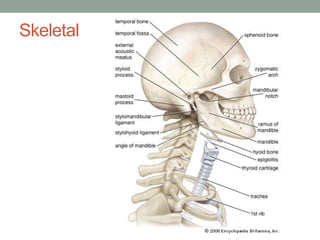
Skeletal
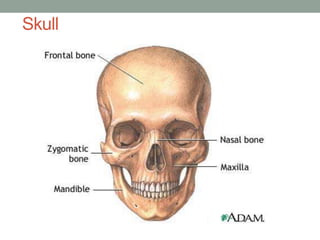
Skull
Skull
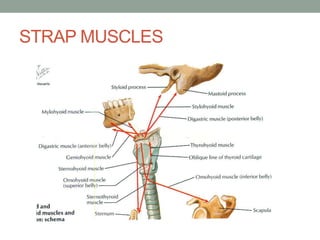
STRAP MUSCLES
Neck Triangles
• Anterior

• Posterior
Neck Triangles
What’s in the Anterior Triangle?
What’s in the Anterior triangle?
• Strap muscles: 3 further Triangles
• Common carotid artery bifurcates within the triangle

into the external and internal carotid arteries.
• The internal jugular vein also can be found within this
area. It drains blood from the head and neck.
• Facial [VII], Glossopharyngeal [IX], vagus [X],
• Accessory [XI], and Hypoglossal [XII] nerves.
• Lymph nodes

• Facial artery and vein (Submandibular traingle)
• Thyroid and Parathyroids
-Some Ancient
Lovers Find Old
Positions More
Stimulating

-Some
Anatomists Like
Fornicating,
Others Prefer S
&M

-Some angry lady figured out PMS
Facial nerve
•
•
•
•
•

To
Zanzibar
By
Motor
Car
What’s in the posterior triangle?
• Omohyoid muscle- The inferior belly crosses the

posterior triangle
• Scalene muscles

• Subclavian artery-between anterior and middle scalenes,

Crosses 1st rib=__________
• CVP lines: External jugular vein which empties

into Subclavian vein.
Nerves in Posterior triangle
• The accessory nerve (XI), descends down the neck. After

innervating the sternocleidomastoid muscle, it enters the
posterior triangle. Lies relatively superficially in the posterior
triangle, and is at danger of injury.
• The cervical plexus forms within the muscles of the floor of

the posterior triangle. A major branch of this plexus is the
phrenic nerve, which arises from the anterior divisions of
spinal nerves C3-C5. It descends down the neck, within the
prevertebral fascia, to innervate the diaphragm.
• The trunks of the brachial plexus also cross the floor of the

posterior triangle.
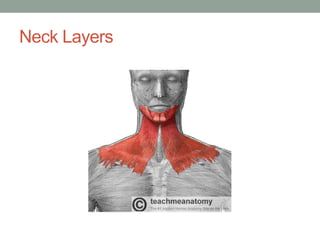
Neck Layers
Neck layers
• Investing Layer
• Most superficial of the deep cervical fascial layers.
• Surrounds all the structures in the neck.
• When it meets the trapezius and sternocleidomastoid

muscles, it splits into two to completely invest the muscle.
Investing layer
Neck layers
• Pretracheal Layer
• It envelops the trachea, oesophagus, thyroid gland,

and the infrahyoid muscles, running from the hyoid
bone down to the superior thorax, where it fuses with
the pericardium.
• This layer of fascia can be functionally split into two

parts:
-Visceral part – encloses the thyroid gland, trachea and
oesophagus.
-Muscular part – encloses the infrahyoid muscles.
Pretracheal layer
Neck layers
• Prevertebral Layer
• Surrounds the vertebral column and its associated

muscles (scalence, pre-vertebral, and deep muscles of
the back).

• In the inferior region of the neck, the fascia surrounds

the brachial plexus and subclavian artery, and here it is
known as the axillary sheath.
Prevertebral Layer
What’s in the carotid sheath?
Neck compartments
• Carotid sheaths
1. Common carotid artery (bifurcates within the carotid

sheath into the external and internal carotid arteries)
2. Internal jugular vein
3. Vagus nerve
• Cervical lymph nodes
• Column that descends from the base of the skull to the

thorax. This represents a pathway for the spread of
infection, and it clinically very important.
Infection
• Clinical Relevance: Spread of Infections
• A superficial skin abscess is prevented from spreading

further into the neck by the investing layer of fascia.

Problem areas
• 1. Erosion through the prevertebral fascia and drainage
into the retropharyngeal space can cause extension into
the thorax +/-affect pericardium.
• 2. Between the investing fascia and pretracheal fascia This can spread inferiorly into the chest, causing infection
anterior to the pericardium.
Sinuses
Sinuses
• Air filled extensions of the respiratory part of the nasal

cavity.
• There are four paired sinuses, named according to the

bone they are located in; maxillary, frontal, sphenoid and
ethmoid.
• Contribute to the humidifying of the inspired air. They also

reduce the weight of the skull.
• As they are outgrowths of the nasal cavity, they all drain

back into it.
Sinuses
• Frontal Sinuses: Drain into the nasal cavity via the frontonasal duct.
• Sphenoid Sinuses: Drain out onto the roof of the nasal cavity. This relations of this

sinus are of clinical importance – the pituitary gland can be surgically accessed via
passing through the nasal roof, into the sphenoid sinus and through the sphenoid bone.

• Ethmoidal Sinuses: Empty into nasal cavity at different places
• Maxillary Sinuses: The largest. Located laterally and slightly inferiorly to the nasal

cavities. It drains into the nasal cavity underneath the frontal sinus opening. This is a
potential pathway for spread of infection – fluid draining from the frontal sinus can enter
the maxillary sinus.
Clinical Relevance: Sinusitis
• Sinusitis

As the paranasal sinuses are continuous with the nasal cavity, an upper respiratory tract
infection can spread to the sinuses. Infection of the sinuses causes inflammation
(particularly pain and swelling) of the mucosa.
• Toothache.

The maxillary nerve supplies both the maxillary sinus and maxillary teeth, and so
inflammation of that sinus can present with
Lymph nodes
Clinical Relevance
Facial muscles
Exam: What is this lump?
• History-Slow/Fast/Pain/Associated red flags

-Smoking
-Hoarseness of voice
-Weight loss
-Family history
-Other primary cancer of head and neck
• Examination

-Fixed? Mobile?
-Punctum?
-Discharge?
-Red/Yellow/Black
-Position-gland, LN, BCC
-Inside mouth
-Neurology: Palsy/Parasthesia/Weakness
Midline lump
Thyroid
Thyroid swelling
• A goitre is a swelling of the neck or larynx resulting from

enlargement of the thyroid gland, associated with a
thyroid gland that is functioning properly or not.
• Thyroid function may be normal (nontoxic goiter),

overactive (toxic goiter), or underactive (hypothyroid).
• Why operate?
Lumps in the anterior triangle
• Lymphadenopathy
• Salivary gland pathology (stone, tumour, infection)
• Branchial cyst
• Laryngocoele
• Parotid gland swelling

• Carotid body tumour/ Carotid aneurysm
Parotid Swellings
UNILATERAL vs BILATERAL:

Main
•
•
•
•
•

Mumps
Parotitis
Sialectasis - especially if related to eating
Sjogren's syndrome
Tumour infiltration

Systemic disease:
•
•
•
•

Sarcoidosis
Tuberculosis
Alcoholism
Malnutrition

Drugs:
• Thiouracil
• Isoprenaline
• High oestrogen contraceptive pills
Lumps in the posterior triangle
• Lymphadenopathy
• Cervical rib
• Pharyngeal pouch
• Cystic hygroma (usually on the left)
Investigating a lump
• History
• Examination
• Decide on urgency (2WW)
• Blood tests:

Imaging
• FNA/Biopsy –Clinic or Theatre
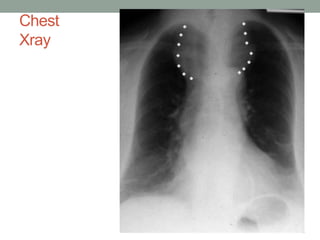
• Cervical/Chest Xrays
• CT or MRI
• ?PET
Chest
Xray
Spot Diagnosis
What’s the diagnosis
• Sjogrens
• Normal WCC
• CRP 10

-Investigations?
-Management?
Spot diagnosis
Spot the diagnosis
Enlarged lymph nodes

• Are you concerned?
More lymph nodes
What operation has been done?
Spot the diagnosis
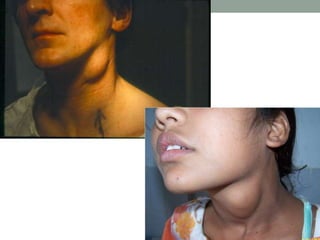
Hepatojugular reflux.
• External Jugular Vein Distention:

This is the result of elevated central venous pressure
(CVP).
In practice the EJV is not as reliable in determining CVP as
the internal jugular vein
Why?
Branchial Cyst
• Congenital

• Failure obliteration of

second branchial cleft
in embryo
• Anterior border of SCM
Spot diagnosis
Cystic hygroma
• Congenital multiloculated

lymphatic lesion that can
arise anywhere, but
classically found in the left
posterior triangle of the
neck
• Benign but can be

disfiguring
• Associated with Turners ad

Noonan Syndrome
Spot diagnosis
• A 55-year-old

man presented
with a 8-month
history of
epigastric pain,
weight loss, and
nausea.
• In the previous 3
months, he had
lost 10 kg
Virchow’s Node
• Strong indication of abdominal cancer

• Lymphatic drainage of most of the body (from the thoracic duct)

enters the venous circulation via the left subclavian vein.
• The metastasis blocks the thoracic duct leading to regurgitation

into the surrounding
• Differential diagnosis: lymphoma, breast cancer, infection
• Enlarged right supraclavicular lymph node tends to drain

thoracic malignancies such as lung and oesphageal cancer
-Arrange bloods, CXR, Urgent Endoscopy +/-CT Scan for mets
Which nerve?
Both have left sided facial weakness…
But which has had a stroke?
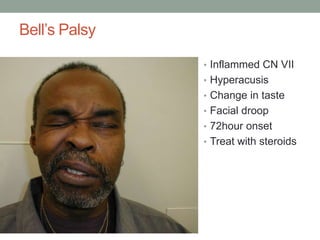
Bell’s Palsy
• Inflammed CN VII
• Hyperacusis
• Change in taste
• Facial droop
• 72hour onset

• Treat with steroids
Ophthalmology referral: Give eye drops
Eyes
• How far does

the cellulitis
go?
• Is there an

abscess?

• Refer early
Emergency Airways
Know
• Neck triangles
• Lymph node distribution
• Blood supply
• Neurology
• Emergency airway management

• How to examine a thyroid and Parotid
• Common Skull/Face #
• Sinuses
• Headache distribution
QUESTIONS?

Head and neck anatomy

  • 1.
    HEAD AND NECK ANATOMY& CLINICAL CONDITIONS Dr S.Bola CT1 ENT
  • 2.
    Common exam questions •Neck triangles • Lymph node distribution • Blood supply • Neurology • Emergency airway management • How to examine a Thyroid and Parotid • Facial # • Sinuses • Headache distribution
  • 3.
  • 4.
  • 5.
  • 6.
  • 8.
  • 9.
  • 10.
    What’s in theAnterior Triangle?
  • 11.
    What’s in theAnterior triangle? • Strap muscles: 3 further Triangles • Common carotid artery bifurcates within the triangle into the external and internal carotid arteries. • The internal jugular vein also can be found within this area. It drains blood from the head and neck. • Facial [VII], Glossopharyngeal [IX], vagus [X], • Accessory [XI], and Hypoglossal [XII] nerves. • Lymph nodes • Facial artery and vein (Submandibular traingle) • Thyroid and Parathyroids
  • 12.
    -Some Ancient Lovers FindOld Positions More Stimulating -Some Anatomists Like Fornicating, Others Prefer S &M -Some angry lady figured out PMS
  • 13.
  • 14.
    What’s in theposterior triangle?
  • 15.
    What’s in theposterior triangle? • Omohyoid muscle- The inferior belly crosses the posterior triangle • Scalene muscles • Subclavian artery-between anterior and middle scalenes, Crosses 1st rib=__________ • CVP lines: External jugular vein which empties into Subclavian vein.
  • 16.
    Nerves in Posteriortriangle • The accessory nerve (XI), descends down the neck. After innervating the sternocleidomastoid muscle, it enters the posterior triangle. Lies relatively superficially in the posterior triangle, and is at danger of injury. • The cervical plexus forms within the muscles of the floor of the posterior triangle. A major branch of this plexus is the phrenic nerve, which arises from the anterior divisions of spinal nerves C3-C5. It descends down the neck, within the prevertebral fascia, to innervate the diaphragm. • The trunks of the brachial plexus also cross the floor of the posterior triangle.
  • 17.
  • 18.
    Neck layers • InvestingLayer • Most superficial of the deep cervical fascial layers. • Surrounds all the structures in the neck. • When it meets the trapezius and sternocleidomastoid muscles, it splits into two to completely invest the muscle.
  • 19.
  • 20.
    Neck layers • PretrachealLayer • It envelops the trachea, oesophagus, thyroid gland, and the infrahyoid muscles, running from the hyoid bone down to the superior thorax, where it fuses with the pericardium. • This layer of fascia can be functionally split into two parts: -Visceral part – encloses the thyroid gland, trachea and oesophagus. -Muscular part – encloses the infrahyoid muscles.
  • 21.
  • 22.
    Neck layers • PrevertebralLayer • Surrounds the vertebral column and its associated muscles (scalence, pre-vertebral, and deep muscles of the back). • In the inferior region of the neck, the fascia surrounds the brachial plexus and subclavian artery, and here it is known as the axillary sheath.
  • 23.
  • 24.
    What’s in thecarotid sheath?
  • 25.
    Neck compartments • Carotidsheaths 1. Common carotid artery (bifurcates within the carotid sheath into the external and internal carotid arteries) 2. Internal jugular vein 3. Vagus nerve • Cervical lymph nodes • Column that descends from the base of the skull to the thorax. This represents a pathway for the spread of infection, and it clinically very important.
  • 26.
    Infection • Clinical Relevance:Spread of Infections • A superficial skin abscess is prevented from spreading further into the neck by the investing layer of fascia. Problem areas • 1. Erosion through the prevertebral fascia and drainage into the retropharyngeal space can cause extension into the thorax +/-affect pericardium. • 2. Between the investing fascia and pretracheal fascia This can spread inferiorly into the chest, causing infection anterior to the pericardium.
  • 27.
  • 28.
    Sinuses • Air filledextensions of the respiratory part of the nasal cavity. • There are four paired sinuses, named according to the bone they are located in; maxillary, frontal, sphenoid and ethmoid. • Contribute to the humidifying of the inspired air. They also reduce the weight of the skull. • As they are outgrowths of the nasal cavity, they all drain back into it.
  • 29.
    Sinuses • Frontal Sinuses:Drain into the nasal cavity via the frontonasal duct. • Sphenoid Sinuses: Drain out onto the roof of the nasal cavity. This relations of this sinus are of clinical importance – the pituitary gland can be surgically accessed via passing through the nasal roof, into the sphenoid sinus and through the sphenoid bone. • Ethmoidal Sinuses: Empty into nasal cavity at different places • Maxillary Sinuses: The largest. Located laterally and slightly inferiorly to the nasal cavities. It drains into the nasal cavity underneath the frontal sinus opening. This is a potential pathway for spread of infection – fluid draining from the frontal sinus can enter the maxillary sinus. Clinical Relevance: Sinusitis • Sinusitis As the paranasal sinuses are continuous with the nasal cavity, an upper respiratory tract infection can spread to the sinuses. Infection of the sinuses causes inflammation (particularly pain and swelling) of the mucosa. • Toothache. The maxillary nerve supplies both the maxillary sinus and maxillary teeth, and so inflammation of that sinus can present with
  • 31.
  • 32.
  • 33.
  • 34.
    Exam: What isthis lump? • History-Slow/Fast/Pain/Associated red flags -Smoking -Hoarseness of voice -Weight loss -Family history -Other primary cancer of head and neck • Examination -Fixed? Mobile? -Punctum? -Discharge? -Red/Yellow/Black -Position-gland, LN, BCC -Inside mouth -Neurology: Palsy/Parasthesia/Weakness
  • 36.
  • 38.
  • 39.
    Thyroid swelling • Agoitre is a swelling of the neck or larynx resulting from enlargement of the thyroid gland, associated with a thyroid gland that is functioning properly or not. • Thyroid function may be normal (nontoxic goiter), overactive (toxic goiter), or underactive (hypothyroid). • Why operate?
  • 40.
    Lumps in theanterior triangle • Lymphadenopathy • Salivary gland pathology (stone, tumour, infection) • Branchial cyst • Laryngocoele • Parotid gland swelling • Carotid body tumour/ Carotid aneurysm
  • 42.
    Parotid Swellings UNILATERAL vsBILATERAL: Main • • • • • Mumps Parotitis Sialectasis - especially if related to eating Sjogren's syndrome Tumour infiltration Systemic disease: • • • • Sarcoidosis Tuberculosis Alcoholism Malnutrition Drugs: • Thiouracil • Isoprenaline • High oestrogen contraceptive pills
  • 43.
    Lumps in theposterior triangle • Lymphadenopathy • Cervical rib • Pharyngeal pouch • Cystic hygroma (usually on the left)
  • 44.
    Investigating a lump •History • Examination • Decide on urgency (2WW) • Blood tests: Imaging • FNA/Biopsy –Clinic or Theatre • Cervical/Chest Xrays • CT or MRI • ?PET
  • 45.
  • 46.
  • 47.
    What’s the diagnosis •Sjogrens • Normal WCC • CRP 10 -Investigations? -Management?
  • 48.
  • 49.
  • 50.
    Enlarged lymph nodes •Are you concerned?
  • 51.
  • 52.
  • 53.
  • 56.
    Hepatojugular reflux. • ExternalJugular Vein Distention: This is the result of elevated central venous pressure (CVP). In practice the EJV is not as reliable in determining CVP as the internal jugular vein Why?
  • 58.
    Branchial Cyst • Congenital •Failure obliteration of second branchial cleft in embryo • Anterior border of SCM
  • 59.
  • 60.
    Cystic hygroma • Congenitalmultiloculated lymphatic lesion that can arise anywhere, but classically found in the left posterior triangle of the neck • Benign but can be disfiguring • Associated with Turners ad Noonan Syndrome
  • 61.
    Spot diagnosis • A55-year-old man presented with a 8-month history of epigastric pain, weight loss, and nausea. • In the previous 3 months, he had lost 10 kg
  • 62.
    Virchow’s Node • Strongindication of abdominal cancer • Lymphatic drainage of most of the body (from the thoracic duct) enters the venous circulation via the left subclavian vein. • The metastasis blocks the thoracic duct leading to regurgitation into the surrounding • Differential diagnosis: lymphoma, breast cancer, infection • Enlarged right supraclavicular lymph node tends to drain thoracic malignancies such as lung and oesphageal cancer -Arrange bloods, CXR, Urgent Endoscopy +/-CT Scan for mets
  • 63.
  • 64.
    Both have leftsided facial weakness… But which has had a stroke?
  • 65.
    Bell’s Palsy • InflammedCN VII • Hyperacusis • Change in taste • Facial droop • 72hour onset • Treat with steroids
  • 66.
  • 67.
    Eyes • How fardoes the cellulitis go? • Is there an abscess? • Refer early
  • 70.
  • 71.
    Know • Neck triangles •Lymph node distribution • Blood supply • Neurology • Emergency airway management • How to examine a thyroid and Parotid • Common Skull/Face # • Sinuses • Headache distribution
  • 72.