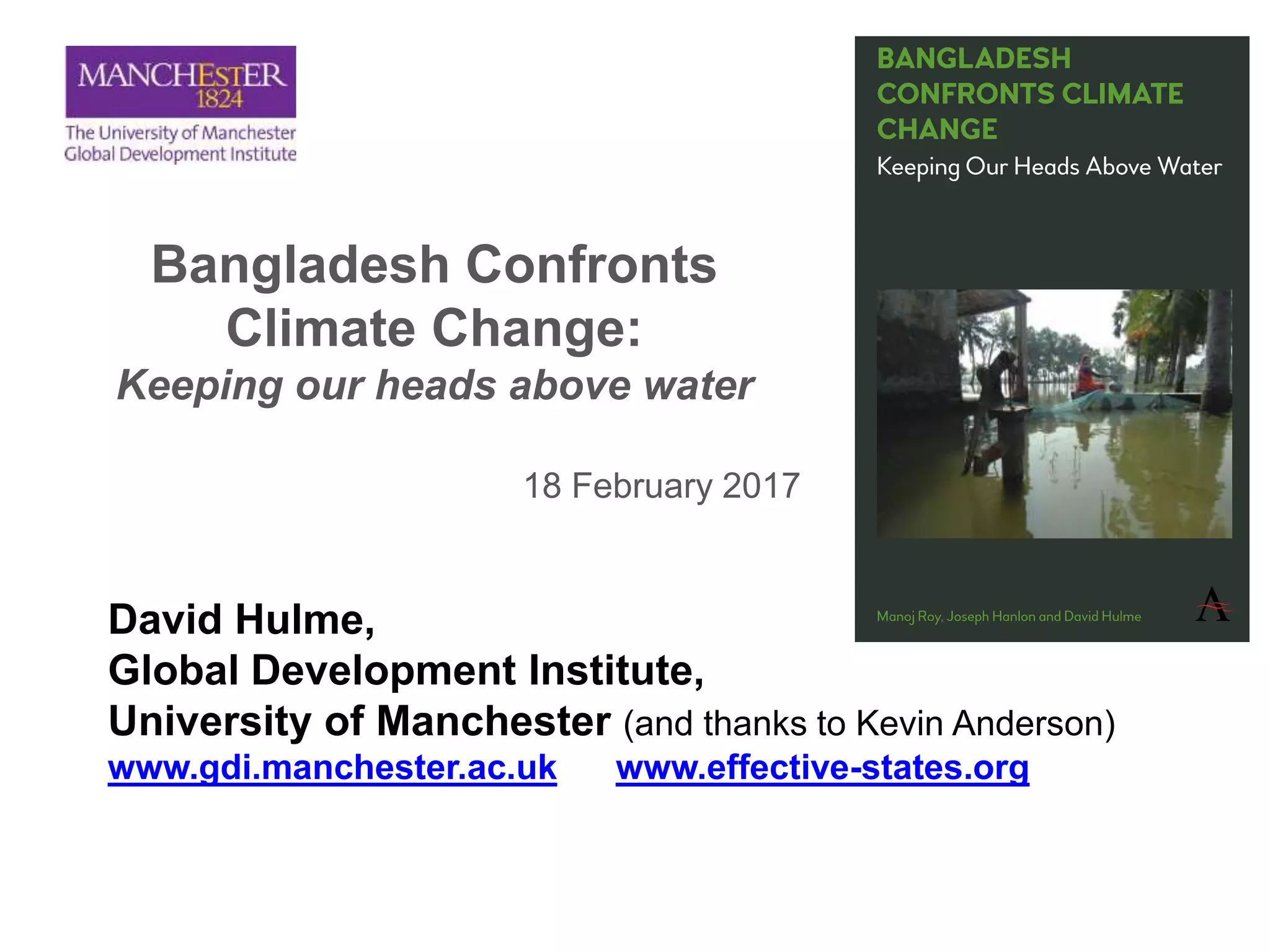


Bangladesh Confronts
Climate Change:
Keeping our heads above water
18 February 2017
David Hulme,
Global Development Institute,
University of Manchester (and thanks to Kevin Anderson)
www.gdi.manchester.ac.uk www.effective-states.org
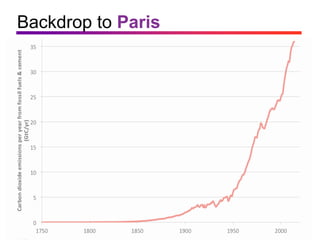
Backdrop to Paris
IPCC (Intergovernmental Panel on Climate Change)
predicts climate change will make
Bangladeshi environment more harsh:
• Stronger cyclones (but no increase in number)
• Increased and more intense rainfall.
• Increased river flooding
• Sea level rise
Can Bangladesh cope?
Until 2055, Bangladesh can cope – at high cost.
After that, temperature matters:
• 1.5°C (over pre-industrial levels). (Now 1.2 °C)
global warming peaks in 2050 and Bangladesh copes
• 2.0°C – global warming peaks in 2100 –
much higher cost but Bangladesh could cope.
• 2.7°C – promised in Paris last year  >3.0°C next century.
A different world – parts of Bangladesh drown
Bangladeshi scientists leading on
climate change for 30 years.
 Bangladeshis know what is coming
 
International negotiation to More
Reduce carbon emissions Adaptation
Agreements so far are not enough
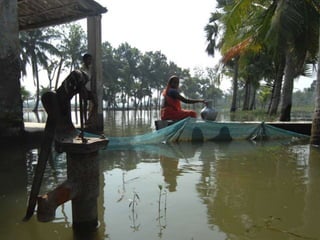
Bangladesh is one of most vulnerable
countries in the world –
but refuses to be a helpless victim
• Taking the lead for LDCs in global negotiations –
pushing for 1.5°C limit to global warming.
• Climate Vulnerable Forum and V20
• Using its own expertise to adapt to climate
change – often building on vast experience of
living in a challenging environment.
Ideally images
• Should fill the screen
• With minimum or no text
Starting point:
a living delta
Water from the Himalayas + 1 billion tonnes/year of
sediment create the delta.
Annual floods & monsoon rain create rich farmland.
But
• Erosion - rivers shift, banks eroded, new islands.
• Catastrophic floods, roughly once a decade.
Plus annual cyclones.
And 1/3 of Bangladesh < 3m above sea level
Basket case to
development success
1971 – independence – Kissinger aide:
Bangladesh is a “basket case”
Now – Feeds itself
Better health standards than India
Fertility rate 2.2 births/woman
How? – Economic growth (6% for 20 years)
Demographic dividend + human dev’t
Innovation, adaptation, research – eg local
improved boro rice, microfinance, solar
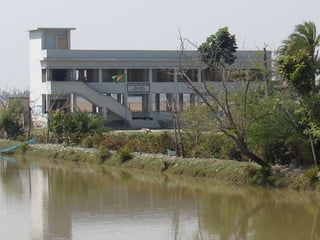
Cyclone deaths down 99%
Three “super cyclones” How?
1970 – 500,000 dead Shelters
1991 – 138,000 dead Early warning
2007 – 3,363 dead 50,000 volunteers
BUT, megacities are a challenge
to understanding and action
• Climate change has profound implications for Dhaka and
Chittagong and especially their poor and low income households
– more than 40% of city populations
• What climate changes means for people who live in bustees
(informal settlements) and work informally is not well understood
• They live in highly vulnerable locations in housing without building
standards…flooding, cyclone damage, disrupted livelihoods
• Bangladesh’s Climate Change Strategy and Action Plan identifies
20 priority actions, none related to the deepening problems of
earning a living, accessing water and sanitation services, keeping
healthy and raising children in poor urban communities in an era
of climate change
Raising the land to
match sea level rise
Complex living delta.
Annual floods bring 1 billion tonnes of sediment
from the Himalayas. Most to Bay of Bengal.
Sediment builds new islands in rivers & on coast.
Sediment compacts and land level falls.
But land same level above sea as centuries ago.
What is happening?
Monsoon – keeps sea water out.
Dry season – tides reach 300 km inland –
bringing sediment & raising the land
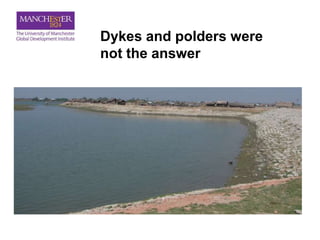
Dykes and polders were
not the answer
Tidal river management
to raise the land
• Historic system of temporary embankments – keep in
monsoon rains for rice crop, then cut to allow tidal
flooding.
• 1980s local people cut the embankments. Dry season
tidal floods raised land 1.5m in 2 years.
• Communities worked with government engineers &
scientists to develop ‘Tidal River Management’ – flood
polder for 3 years every 30 years.
• Perhaps land rise can be managed to match sea level
rise – But who will pay?
Bangladesh did not cause
global warming
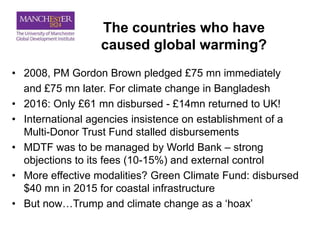
• Bangladeshis know what is coming – worse
floods, more devastating cyclones, sea level rise
• Strong understanding of what must be done
• Already spending $1 bn/year on climate –
¾ own funds & much of rest World Bank loans
• Who will pay for more & stronger cyclone
shelters, research, raising the land?
The countries who have
caused global warming?
• 2008, PM Gordon Brown pledged £75 mn immediately
and £75 mn later. For climate change in Bangladesh
• 2016: Only £61 mn disbursed - £14mn returned to UK!
• International agencies insistence on establishment of a
Multi-Donor Trust Fund stalled disbursements
• MDTF was to be managed by World Bank – strong
objections to its fees (10-15%) and external control
• More effective modalities? Green Climate Fund: disbursed
$40 mn in 2015 for coastal infrastructure
• But now…Trump and climate change as a ‘hoax’
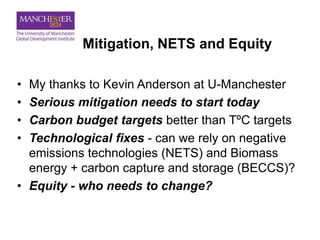
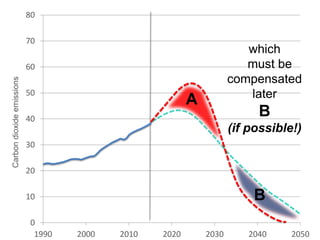
Mitigation, NETS and Equity
• My thanks to Kevin Anderson at U-Manchester
• Serious mitigation needs to start today
• Carbon budget targets better than TºC targets
• Technological fixes - can we rely on negative
emissions technologies (NETS) and Biomass
energy + carbon capture and storage (BECCS)?
• Equity - who needs to change?
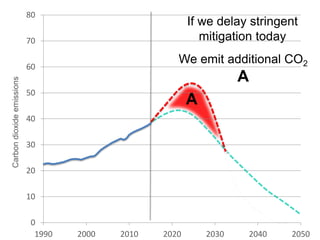
0
10
20
30
40
50
60
70
80
1990 2000 2010 2020 2030 2040 2050
CO2emissions(GtCO2/yr)Carbondioxideemissions
A
We emit additional CO2
A
If we delay stringent
mitigation today
0
10
20
30
40
50
60
70
80
1990 2000 2010 2020 2030 2040 2050
CO2emissions(GtCO2/yr)
which
must be
compensated
later
B
(if possible!)
Carbondioxideemissions
A
B
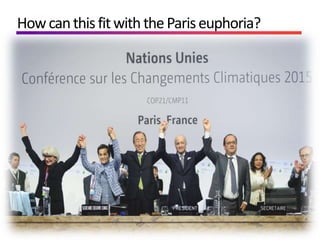
HowcanthisfitwiththePariseuphoria?
… by pulling a rabbit from the magician’s hat
NETS and BECCS 1
• NETS - Negative emissions technologies
• BECCS – Biomass energy with carbon
capture and storage
• Grow trees, harvest, burn in power stations,
capture CO2, liquefy CO2, pump underground
NETS and BECCS 2
• But, this has never been done at scale, huge
technical and economic unknowns, profound
implications for food supply and biodiversity
• Means planting an area the size of India
(perhaps 2 or 3 times the size) every year…year
after year…and secure underground storage
• Means ‘Paris’ can pretend mitigation not urgent
Emissions and equity
• 50% of global CO2 is from 10% of population
• Top 10% of emitters have a carbon footprint
2500 x higher than bottom 10%
• If top 10% of global emitters reduced their
carbon footprint to the EU average…
• Global emissions cut by around 33%
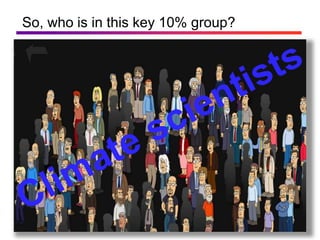
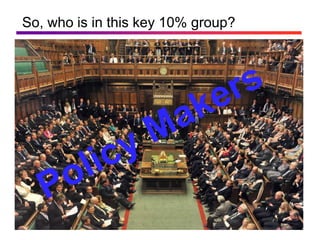
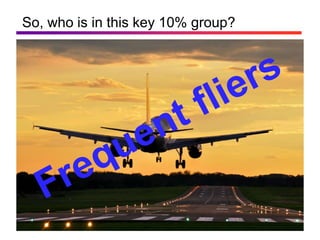
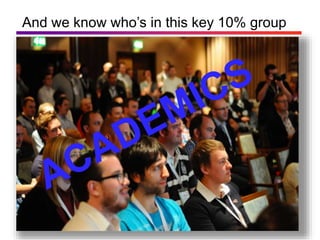
So, who is in this key 10% group?
And we know who’s in this key 10% group
Conclusions
• Serious mitigation has to start now
• Top 10% of emitters have to change…now
GDI RCs – 50% of international meetings virtual
Kevin Anderson – zero flying, no car, no fridge
• CVF and G77 countries, such as Bangladesh, are not
waiting to be saved by rich countries – already
adapting and financing adaptation
Bangladesh is not the
helpless victim presented
in the West
• Rich countries and richer people (including
Donald Trump) must cut carbon emissions now.
• Bangladesh is adaptating – cyclone shelters,
flood protection, raising the land, improved
crops. But who pays?
And who
decides
what to
do?
THANK YOU
• Anderson, K. (2015) “Talks in the city of light generate
more heat” Nature Vol.528.
• Anderson, K. and Peters, G. (2016) “The trouble with
negative emissions” Science Vol.354 (6309): 182-183.
• Anderson, K. and Bows, A. (2012) “A new paradigm for
climate change”, Nature Climate Change Vol.2: 639–640
• Roy, M. Hanlon, J. and Hulme, D. (2017) Bangladesh
Confronts Climate Change: Keeping Our Heads Above
Water, London, Anthem Press.

Bangladesh Confronts Climate Change

  • 1.
    Bangladesh Confronts Climate Change: Keepingour heads above water 18 February 2017 David Hulme, Global Development Institute, University of Manchester (and thanks to Kevin Anderson) www.gdi.manchester.ac.uk www.effective-states.org
  • 2.
  • 3.
    IPCC (Intergovernmental Panelon Climate Change) predicts climate change will make Bangladeshi environment more harsh: • Stronger cyclones (but no increase in number) • Increased and more intense rainfall. • Increased river flooding • Sea level rise
  • 4.
    Can Bangladesh cope? Until2055, Bangladesh can cope – at high cost. After that, temperature matters: • 1.5°C (over pre-industrial levels). (Now 1.2 °C) global warming peaks in 2050 and Bangladesh copes • 2.0°C – global warming peaks in 2100 – much higher cost but Bangladesh could cope. • 2.7°C – promised in Paris last year  >3.0°C next century. A different world – parts of Bangladesh drown
  • 5.
    Bangladeshi scientists leadingon climate change for 30 years.  Bangladeshis know what is coming   International negotiation to More Reduce carbon emissions Adaptation Agreements so far are not enough
  • 6.
    Bangladesh is oneof most vulnerable countries in the world – but refuses to be a helpless victim • Taking the lead for LDCs in global negotiations – pushing for 1.5°C limit to global warming. • Climate Vulnerable Forum and V20 • Using its own expertise to adapt to climate change – often building on vast experience of living in a challenging environment.
  • 7.
    Ideally images • Shouldfill the screen • With minimum or no text
  • 8.
    Starting point: a livingdelta Water from the Himalayas + 1 billion tonnes/year of sediment create the delta. Annual floods & monsoon rain create rich farmland. But • Erosion - rivers shift, banks eroded, new islands. • Catastrophic floods, roughly once a decade. Plus annual cyclones. And 1/3 of Bangladesh < 3m above sea level
  • 9.
    Basket case to developmentsuccess 1971 – independence – Kissinger aide: Bangladesh is a “basket case” Now – Feeds itself Better health standards than India Fertility rate 2.2 births/woman How? – Economic growth (6% for 20 years) Demographic dividend + human dev’t Innovation, adaptation, research – eg local improved boro rice, microfinance, solar
  • 10.
    Cyclone deaths down99% Three “super cyclones” How? 1970 – 500,000 dead Shelters 1991 – 138,000 dead Early warning 2007 – 3,363 dead 50,000 volunteers
  • 12.
    BUT, megacities area challenge to understanding and action • Climate change has profound implications for Dhaka and Chittagong and especially their poor and low income households – more than 40% of city populations • What climate changes means for people who live in bustees (informal settlements) and work informally is not well understood • They live in highly vulnerable locations in housing without building standards…flooding, cyclone damage, disrupted livelihoods • Bangladesh’s Climate Change Strategy and Action Plan identifies 20 priority actions, none related to the deepening problems of earning a living, accessing water and sanitation services, keeping healthy and raising children in poor urban communities in an era of climate change
  • 13.
    Raising the landto match sea level rise Complex living delta. Annual floods bring 1 billion tonnes of sediment from the Himalayas. Most to Bay of Bengal. Sediment builds new islands in rivers & on coast. Sediment compacts and land level falls. But land same level above sea as centuries ago. What is happening? Monsoon – keeps sea water out. Dry season – tides reach 300 km inland – bringing sediment & raising the land
  • 14.
    Dykes and polderswere not the answer
  • 15.
    Tidal river management toraise the land • Historic system of temporary embankments – keep in monsoon rains for rice crop, then cut to allow tidal flooding. • 1980s local people cut the embankments. Dry season tidal floods raised land 1.5m in 2 years. • Communities worked with government engineers & scientists to develop ‘Tidal River Management’ – flood polder for 3 years every 30 years. • Perhaps land rise can be managed to match sea level rise – But who will pay?
  • 16.
    Bangladesh did notcause global warming • Bangladeshis know what is coming – worse floods, more devastating cyclones, sea level rise • Strong understanding of what must be done • Already spending $1 bn/year on climate – ¾ own funds & much of rest World Bank loans • Who will pay for more & stronger cyclone shelters, research, raising the land?
  • 17.
    The countries whohave caused global warming? • 2008, PM Gordon Brown pledged £75 mn immediately and £75 mn later. For climate change in Bangladesh • 2016: Only £61 mn disbursed - £14mn returned to UK! • International agencies insistence on establishment of a Multi-Donor Trust Fund stalled disbursements • MDTF was to be managed by World Bank – strong objections to its fees (10-15%) and external control • More effective modalities? Green Climate Fund: disbursed $40 mn in 2015 for coastal infrastructure • But now…Trump and climate change as a ‘hoax’
  • 18.
    Mitigation, NETS andEquity • My thanks to Kevin Anderson at U-Manchester • Serious mitigation needs to start today • Carbon budget targets better than TºC targets • Technological fixes - can we rely on negative emissions technologies (NETS) and Biomass energy + carbon capture and storage (BECCS)? • Equity - who needs to change?
  • 19.
    0 10 20 30 40 50 60 70 80 1990 2000 20102020 2030 2040 2050 CO2emissions(GtCO2/yr)Carbondioxideemissions A We emit additional CO2 A If we delay stringent mitigation today
  • 20.
    0 10 20 30 40 50 60 70 80 1990 2000 20102020 2030 2040 2050 CO2emissions(GtCO2/yr) which must be compensated later B (if possible!) Carbondioxideemissions A B
  • 21.
  • 22.
    … by pullinga rabbit from the magician’s hat
  • 23.
    NETS and BECCS1 • NETS - Negative emissions technologies • BECCS – Biomass energy with carbon capture and storage • Grow trees, harvest, burn in power stations, capture CO2, liquefy CO2, pump underground
  • 24.
    NETS and BECCS2 • But, this has never been done at scale, huge technical and economic unknowns, profound implications for food supply and biodiversity • Means planting an area the size of India (perhaps 2 or 3 times the size) every year…year after year…and secure underground storage • Means ‘Paris’ can pretend mitigation not urgent
  • 25.
    Emissions and equity •50% of global CO2 is from 10% of population • Top 10% of emitters have a carbon footprint 2500 x higher than bottom 10% • If top 10% of global emitters reduced their carbon footprint to the EU average… • Global emissions cut by around 33%
  • 26.
    So, who isin this key 10% group?
  • 27.
    So, who isin this key 10% group?
  • 28.
    So, who isin this key 10% group?
  • 29.
    So, who isin this key 10% group?
  • 30.
    And we knowwho’s in this key 10% group
  • 31.
    Conclusions • Serious mitigationhas to start now • Top 10% of emitters have to change…now GDI RCs – 50% of international meetings virtual Kevin Anderson – zero flying, no car, no fridge • CVF and G77 countries, such as Bangladesh, are not waiting to be saved by rich countries – already adapting and financing adaptation
  • 32.
    Bangladesh is notthe helpless victim presented in the West • Rich countries and richer people (including Donald Trump) must cut carbon emissions now. • Bangladesh is adaptating – cyclone shelters, flood protection, raising the land, improved crops. But who pays? And who decides what to do?
  • 33.
    THANK YOU • Anderson,K. (2015) “Talks in the city of light generate more heat” Nature Vol.528. • Anderson, K. and Peters, G. (2016) “The trouble with negative emissions” Science Vol.354 (6309): 182-183. • Anderson, K. and Bows, A. (2012) “A new paradigm for climate change”, Nature Climate Change Vol.2: 639–640 • Roy, M. Hanlon, J. and Hulme, D. (2017) Bangladesh Confronts Climate Change: Keeping Our Heads Above Water, London, Anthem Press.