Product Ownership
General Manager
Vladimir Gorshunov
Agile Project
Vs
Agile Product
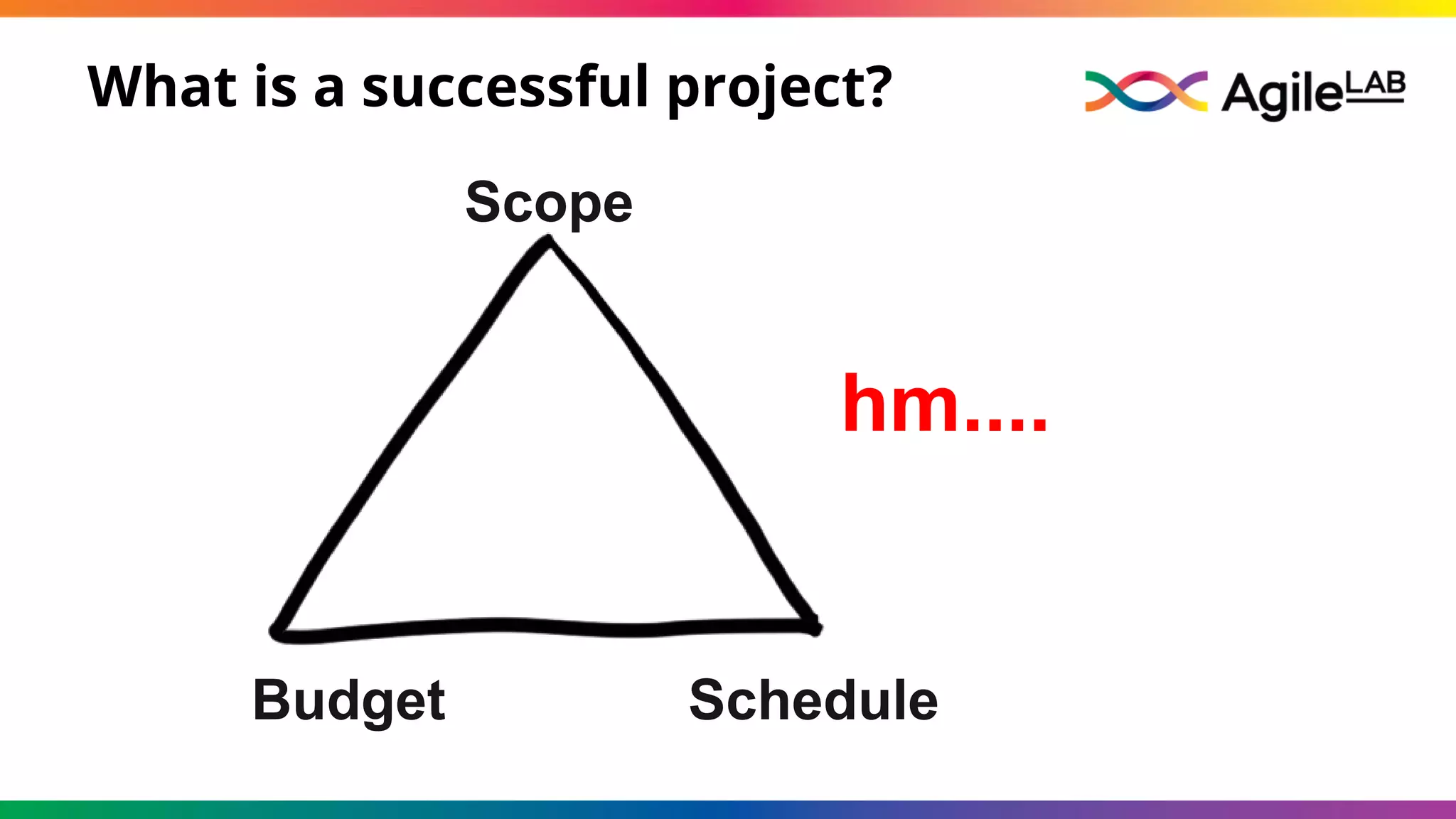
hm....
Budget Schedule
Scope
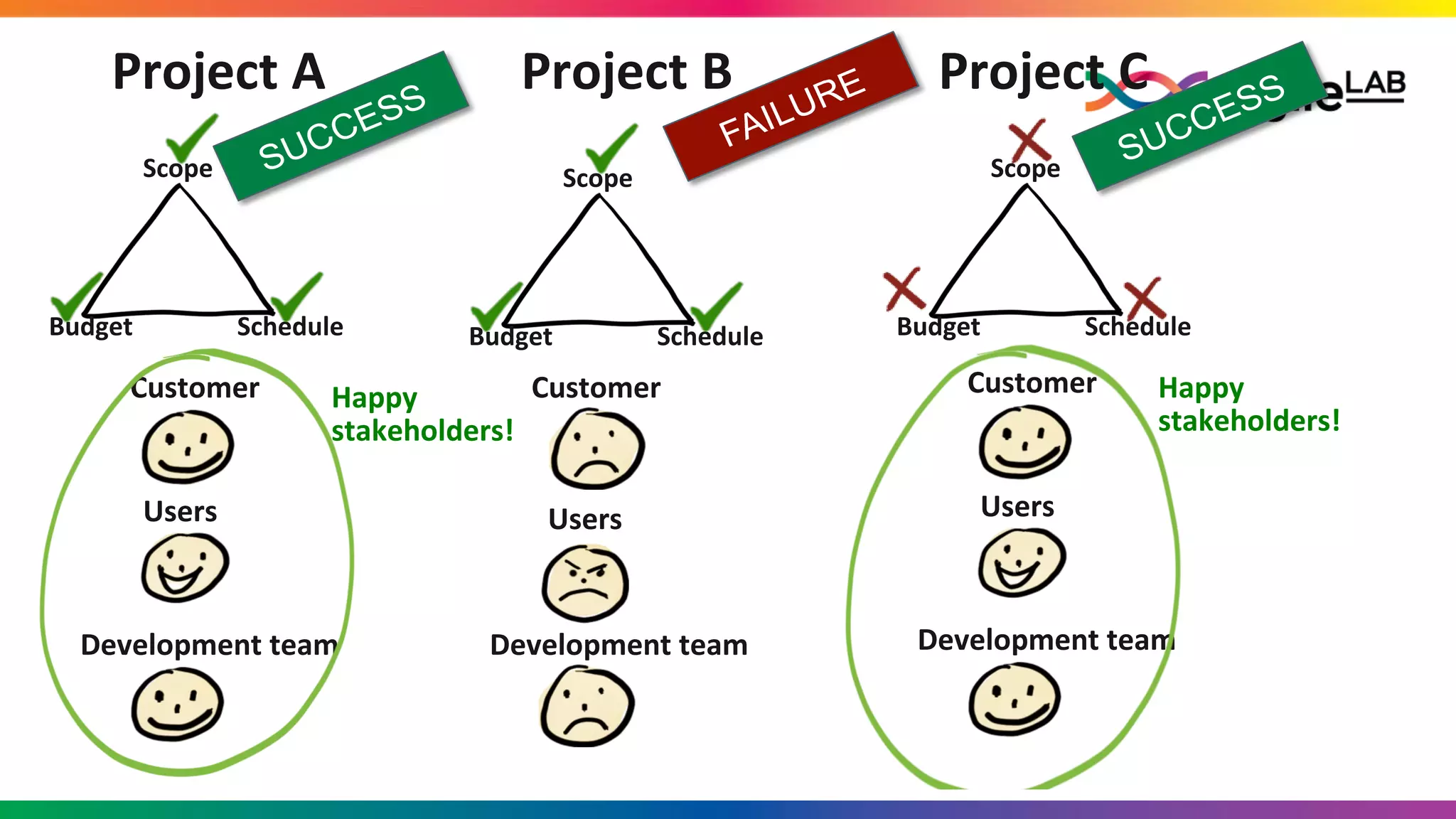
What is a successful project?
Project A Project B Project C
Scope
Budget Schedule
Scope
Budget Schedule
Customer
Users
Development team
Customer
Users
Development team
Customer
Users
Development team
Scope
Budget Schedule
Happy
stakeholders!
Happy
stakeholders!
Measuring success
Happy
development
team
Happy
users
Surveys
Do they
come back
more often?
Do they
stay longer?
Happy
stakeholders
Measure the stuff
that really matters!
Proxy
metrics
Do they listen to
more music?
Do they share
more music?
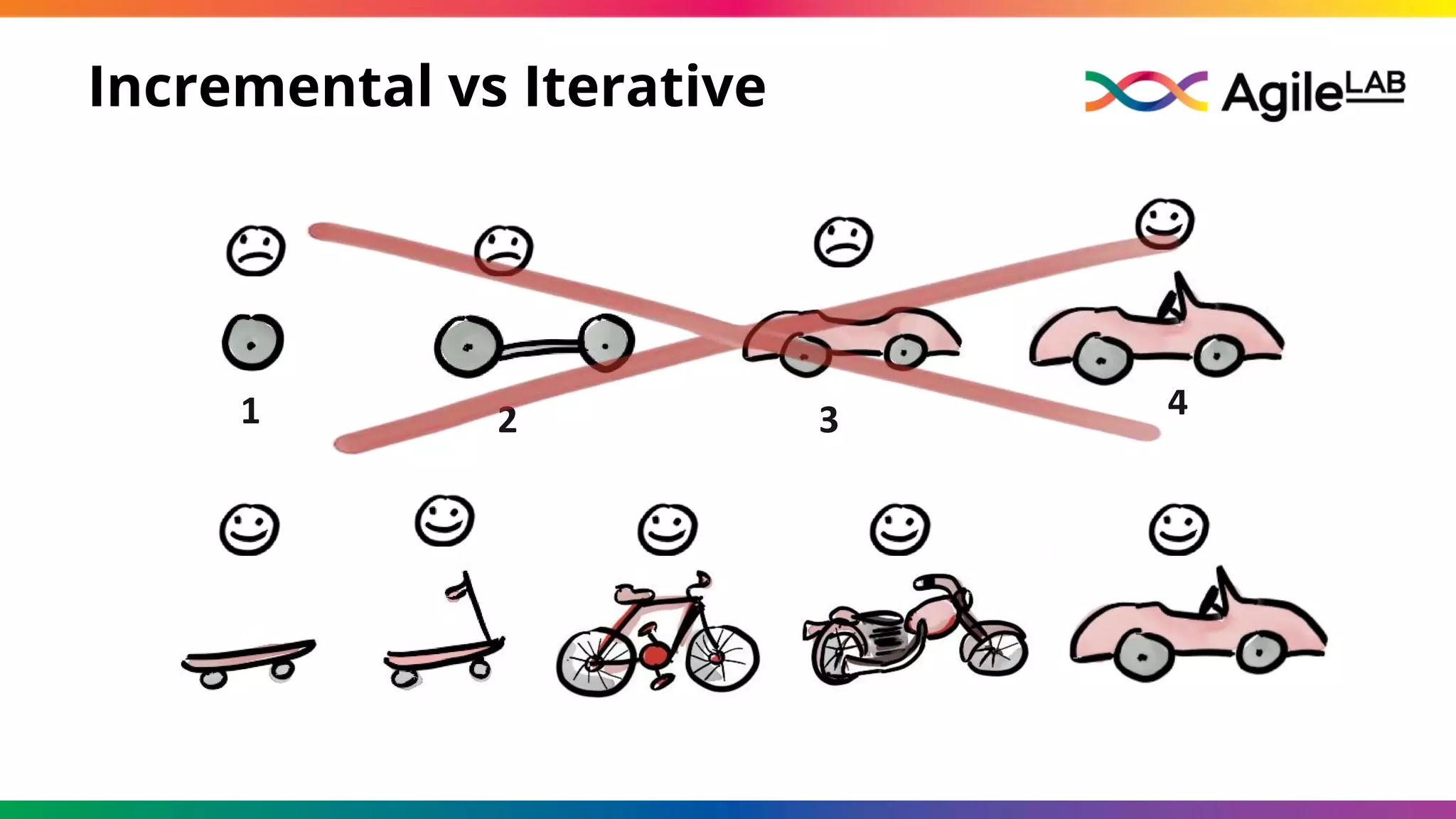
Incremental vs Iterative
1 2 3 4
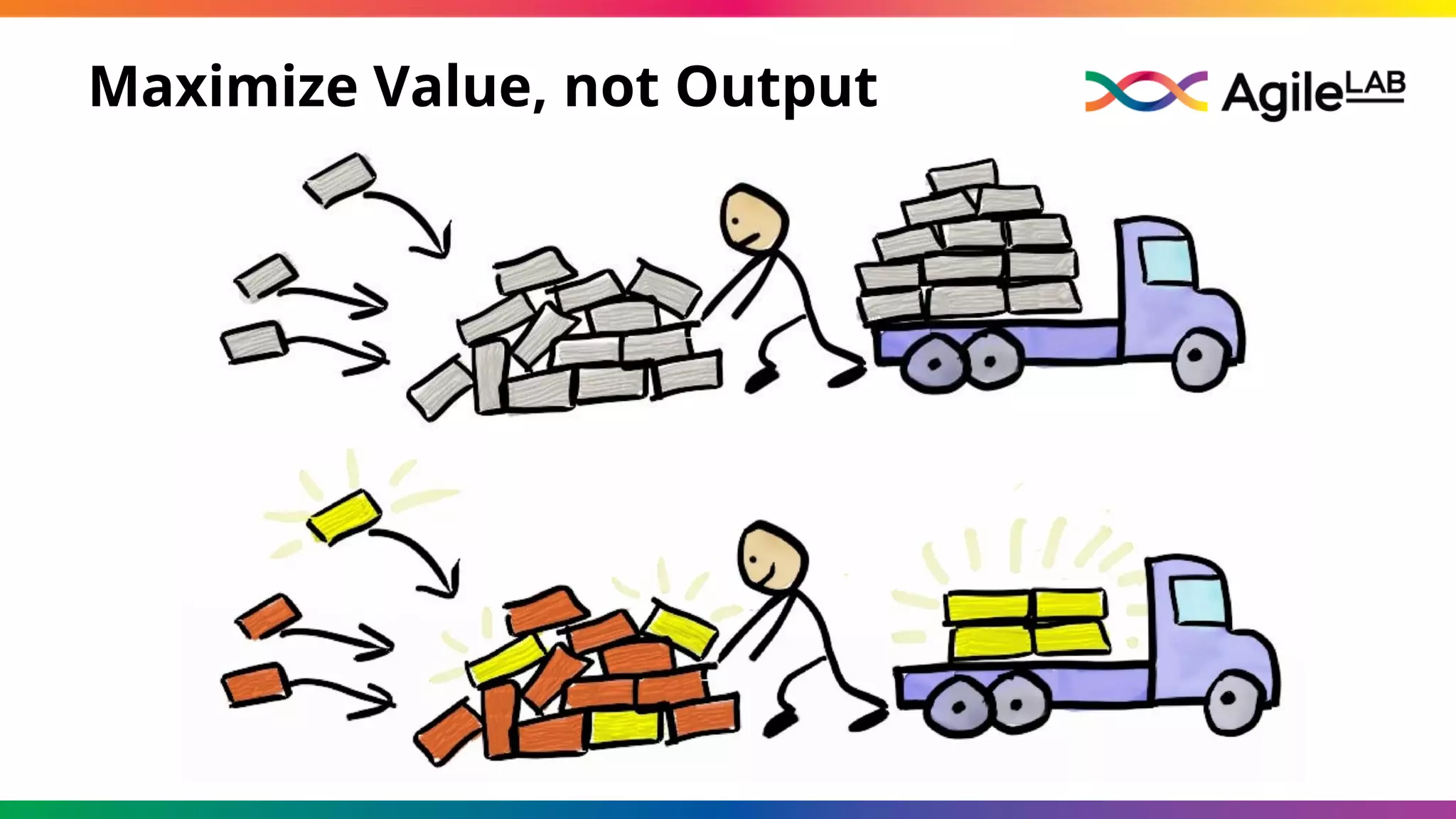
Maximize Value, not Output
Agile
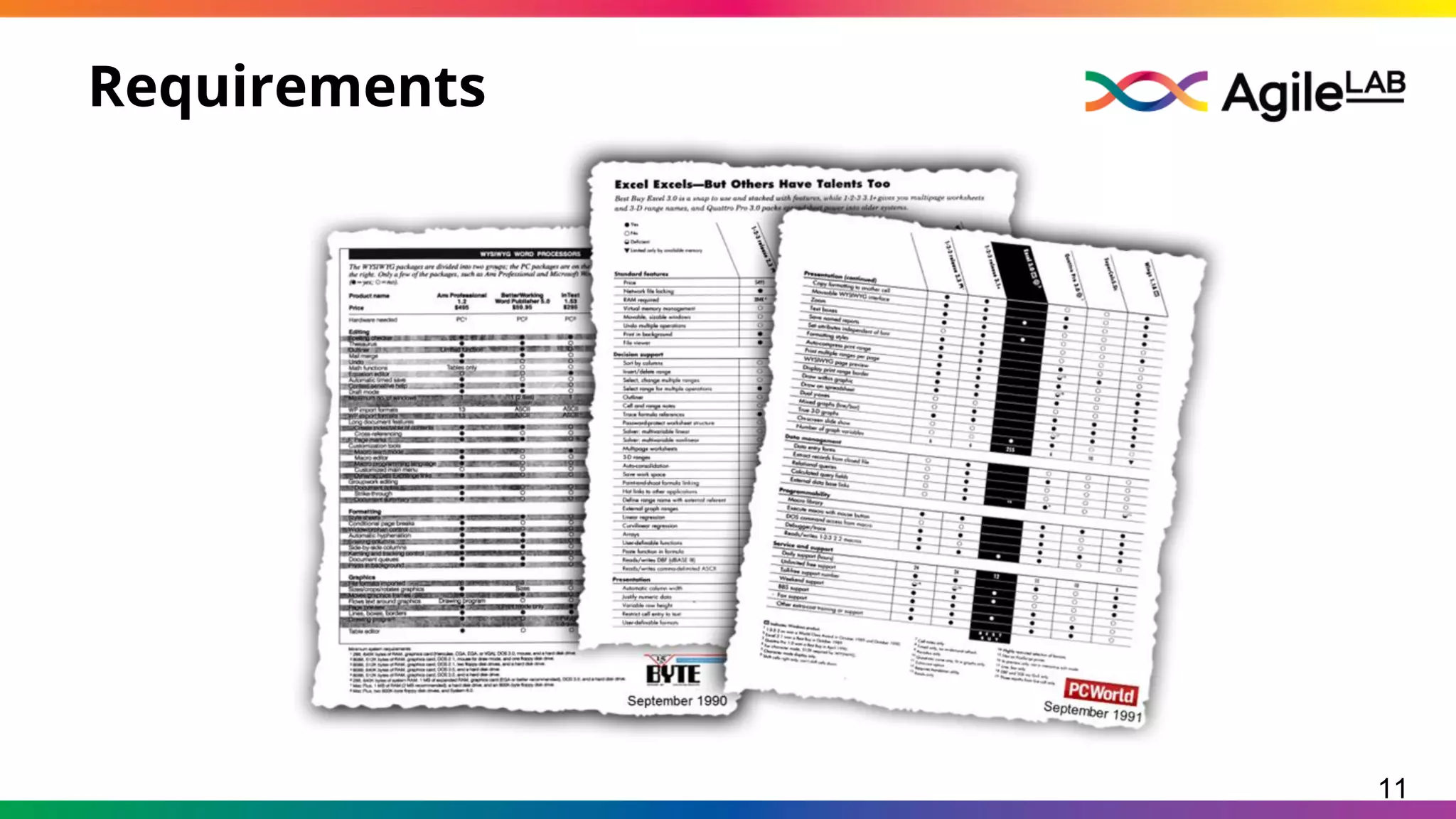
Requirements
What products do you recommend
without even being asked?
Software?
Devices?
Services?
What do they have in common?
11
Requirements
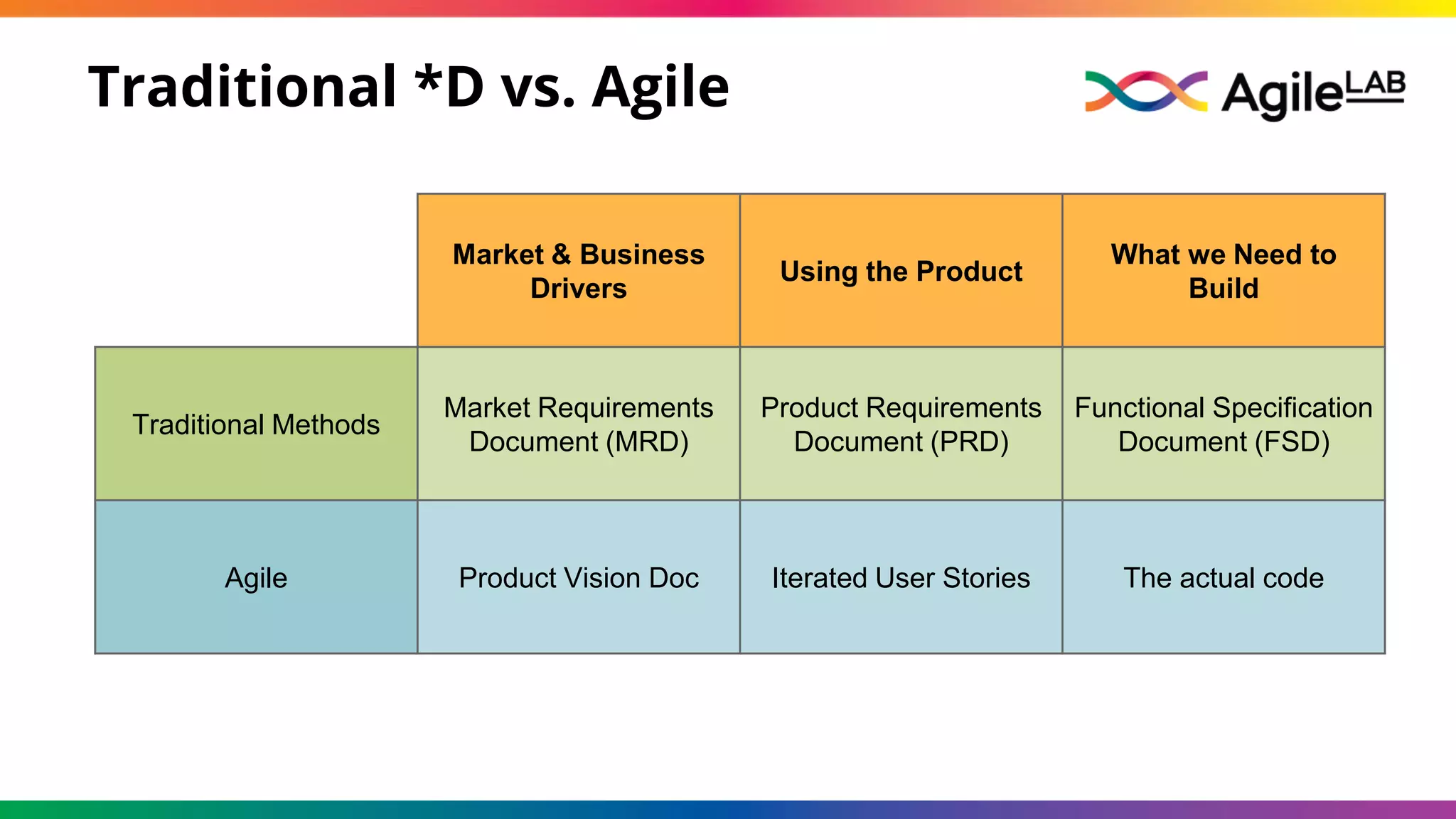
Traditional *D vs. Agile
Market & Business
Drivers
Using the Product
What we Need to
Build
Traditional Methods
Market Requirements
Document (MRD)
Product Requirements
Document (PRD)
Functional Specification
Document (FSD)
Agile Product Vision Doc Iterated User Stories The actual code
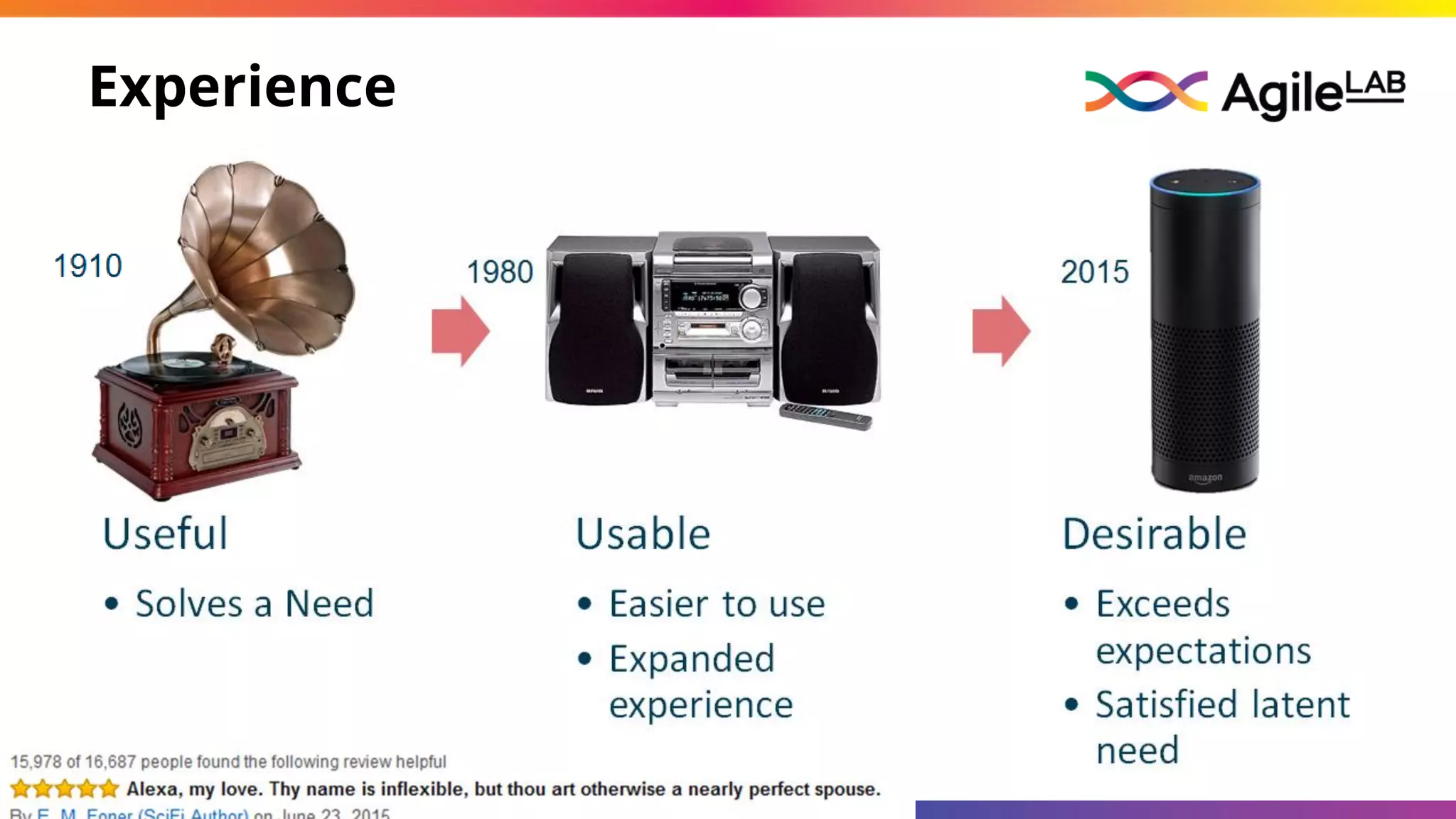
Experience
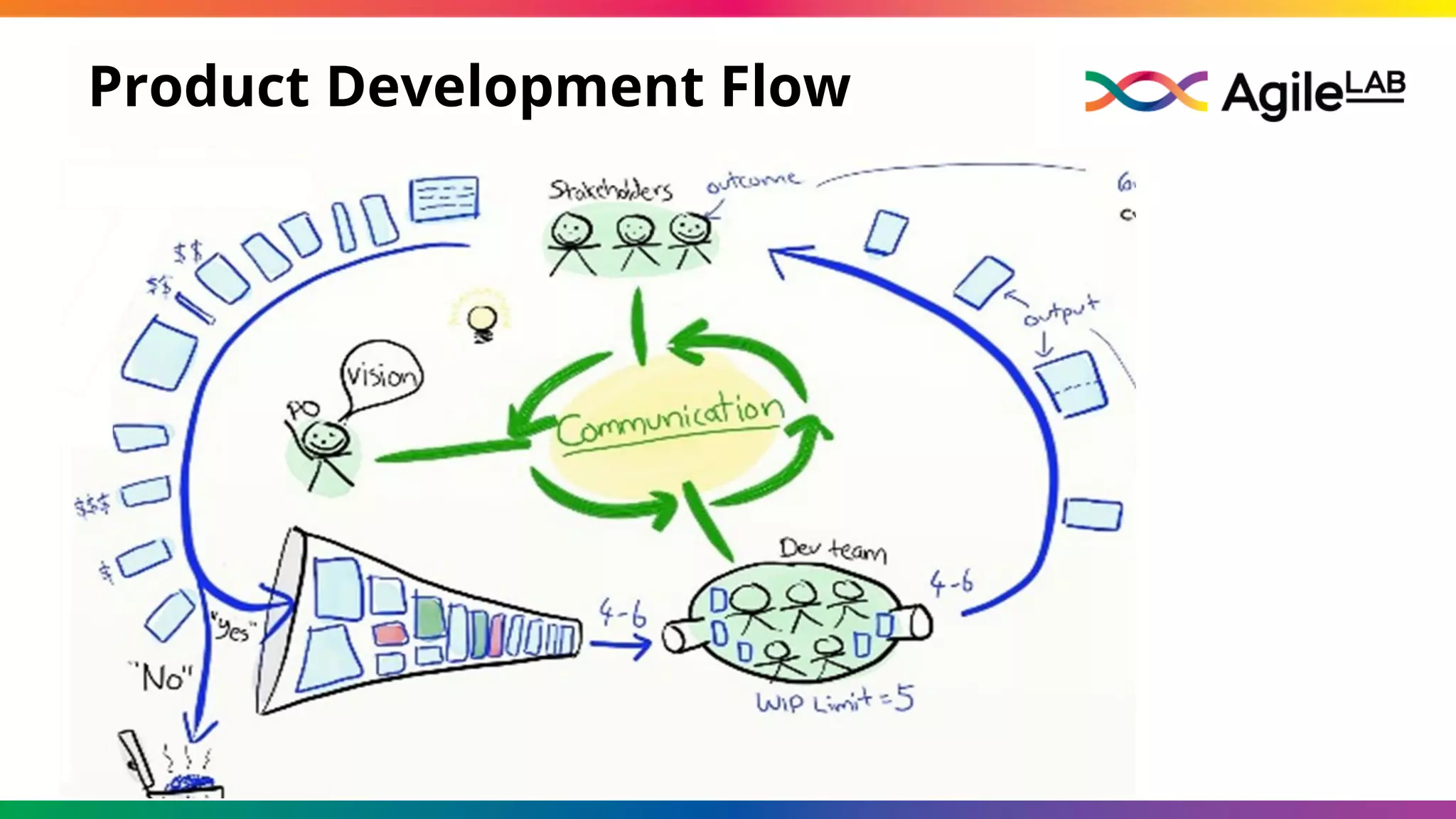
Product Development Flow
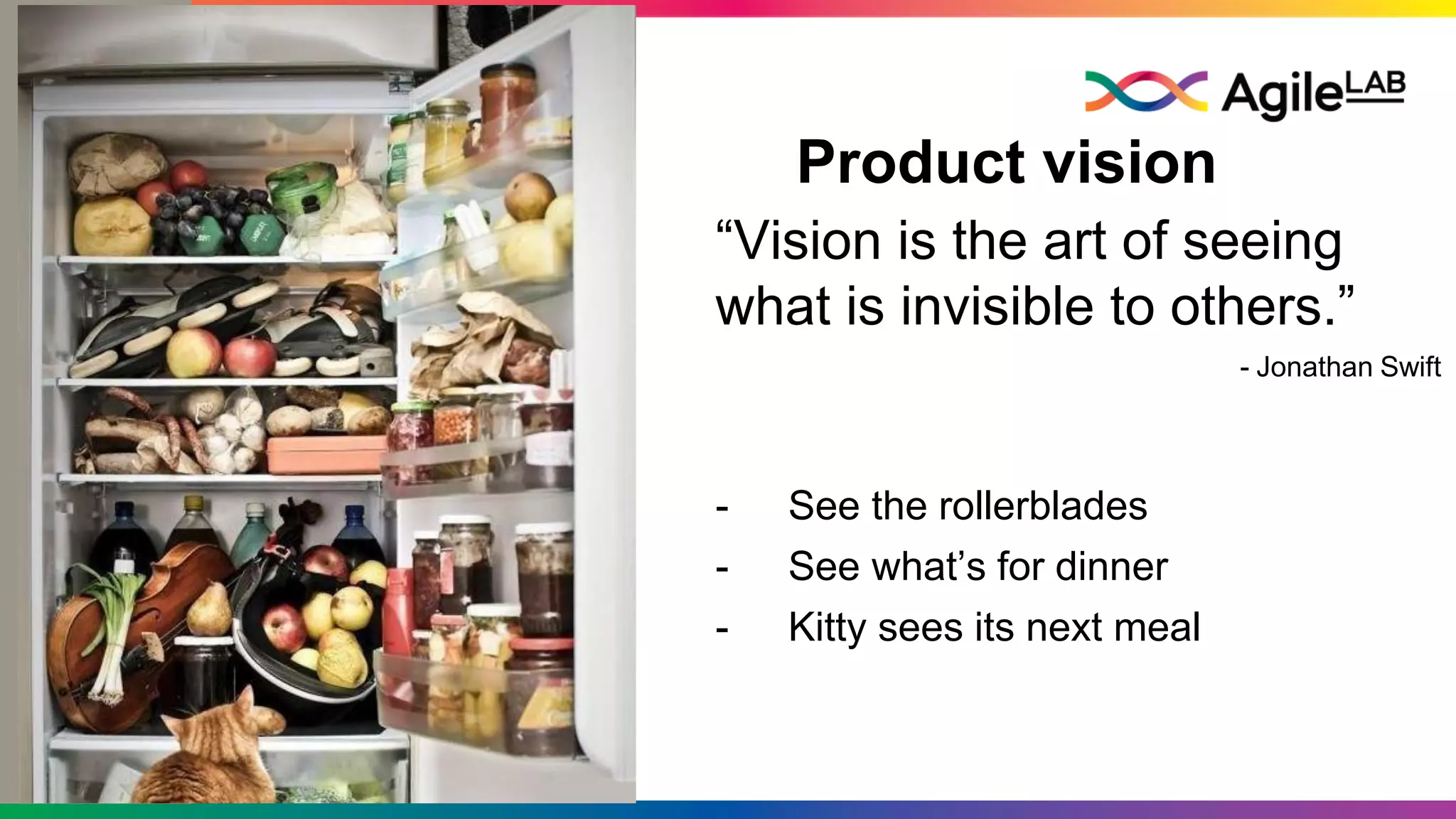
Product vision
“Vision is the art of seeing
what is invisible to others.”
- Jonathan Swift
- See the rollerblades
- See what’s for dinner
- Kitty sees its next meal
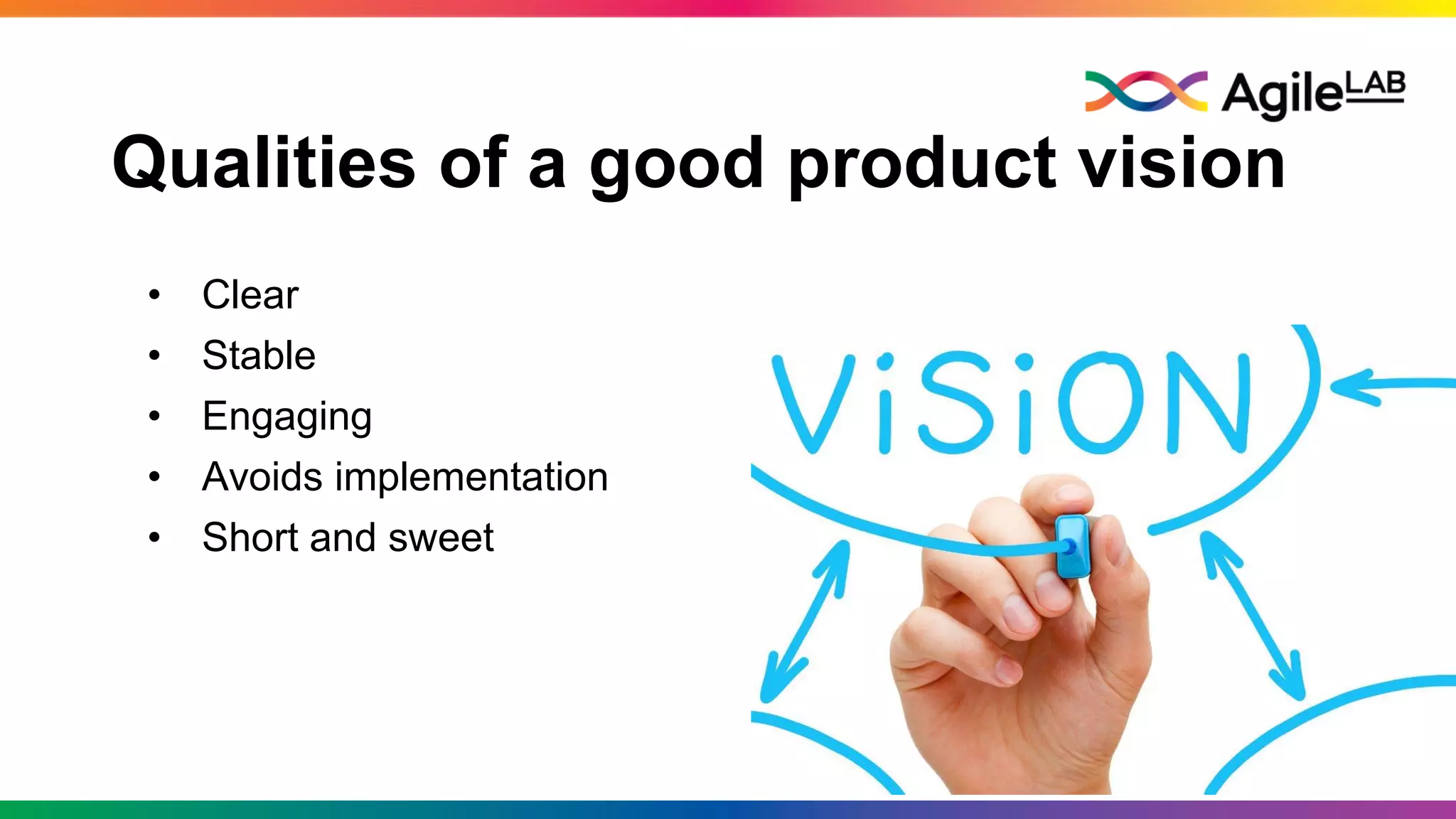
Qualities of a good product vision
• Clear
• Stable
• Engaging
• Avoids implementation
• Short and sweet
Vision: a Postcard From the
Future
- Aspirational, yet realistic and achievable
- Motivational enough to engage others on
the journey
Result: The teams start thinking about how to apply their strengths in
order to get there
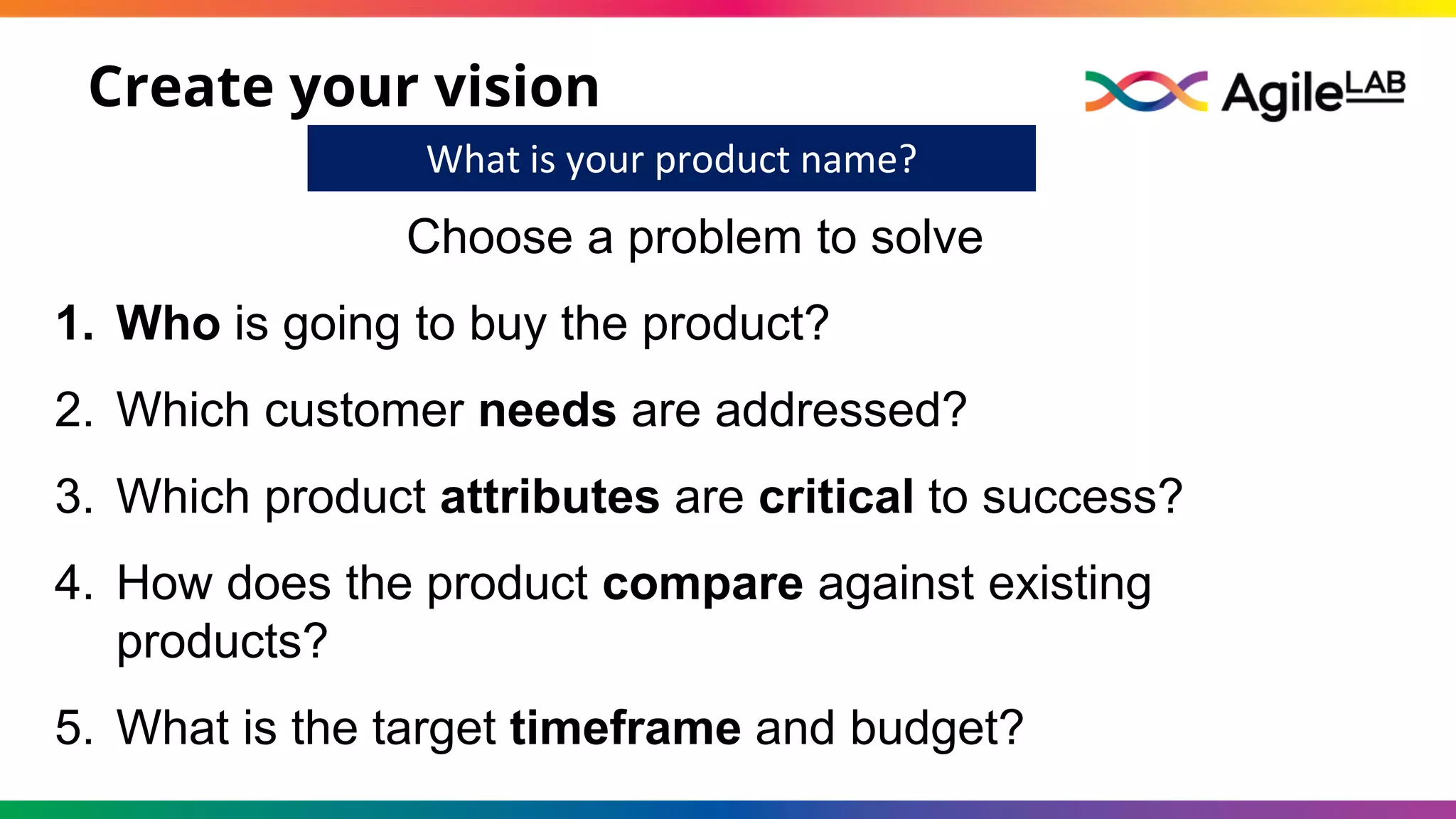
Create your vision
Choose a problem to solve
1. Who is going to buy the product?
2. Which customer needs are addressed?
3. Which product attributes are critical to success?
4. How does the product compare against existing
products?
5. What is the target timeframe and budget?
What is your product name?
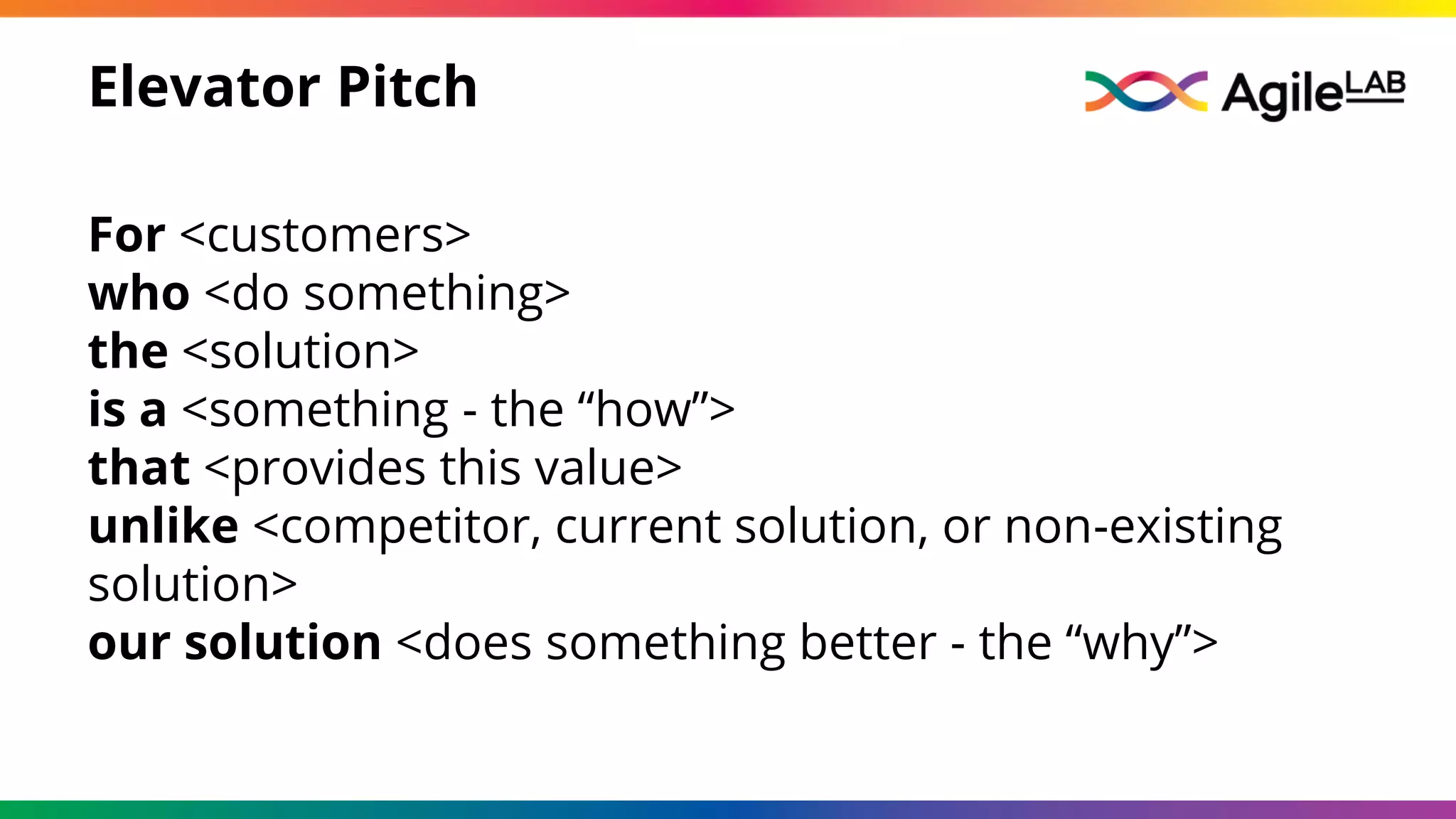
Elevator Pitch
For <customers>
who <do something>
the <solution>
is a <something - the “how”>
that <provides this value>
unlike <competitor, current solution, or non-existing
solution>
our solution <does something better - the “why”>
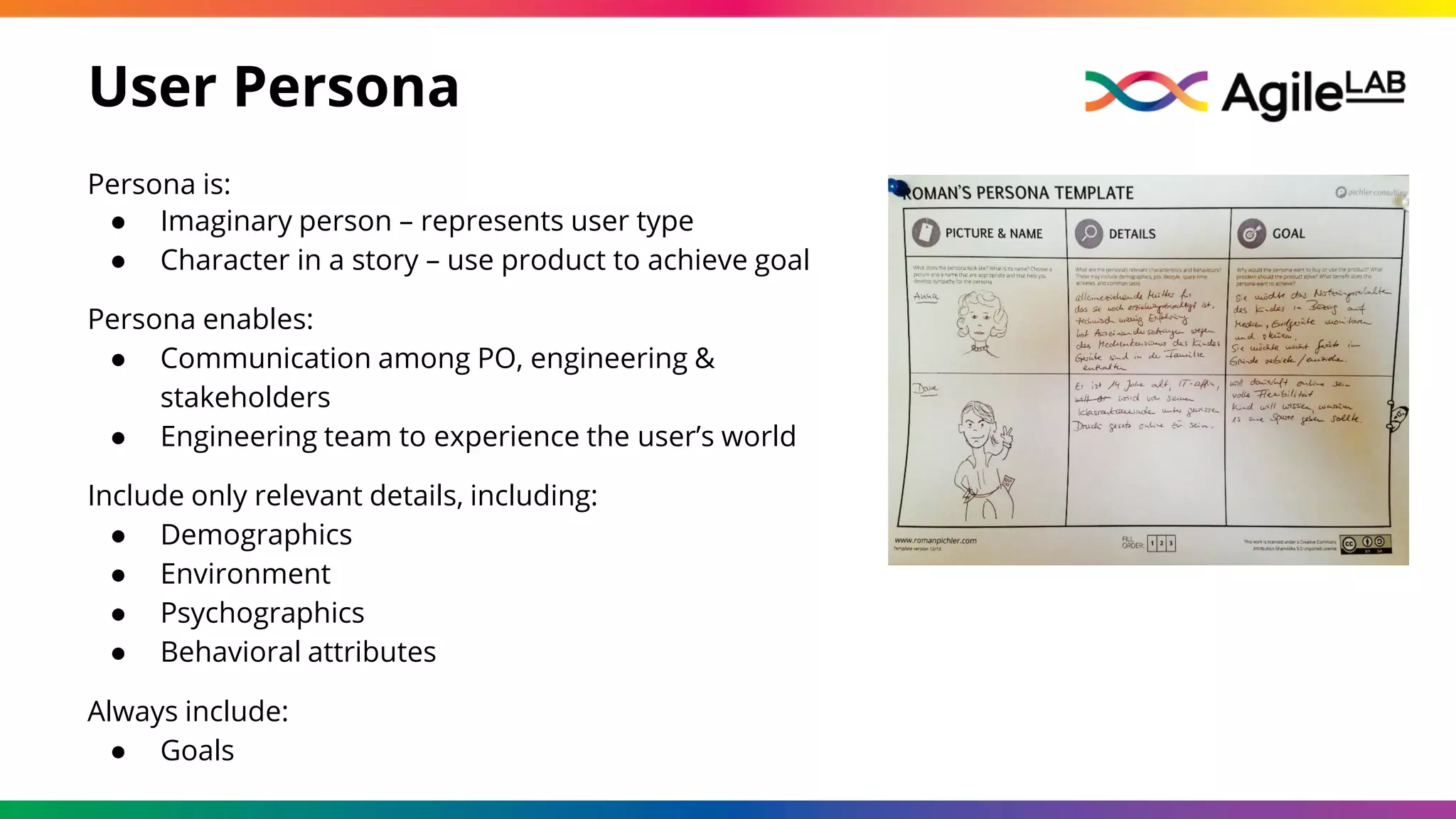
User Persona
Persona is:
● Imaginary person – represents user type
● Character in a story – use product to achieve goal
Persona enables:
● Communication among PO, engineering &
stakeholders
● Engineering team to experience the user’s world
Include only relevant details, including:
● Demographics
● Environment
● Psychographics
● Behavioral attributes
Always include:
● Goals
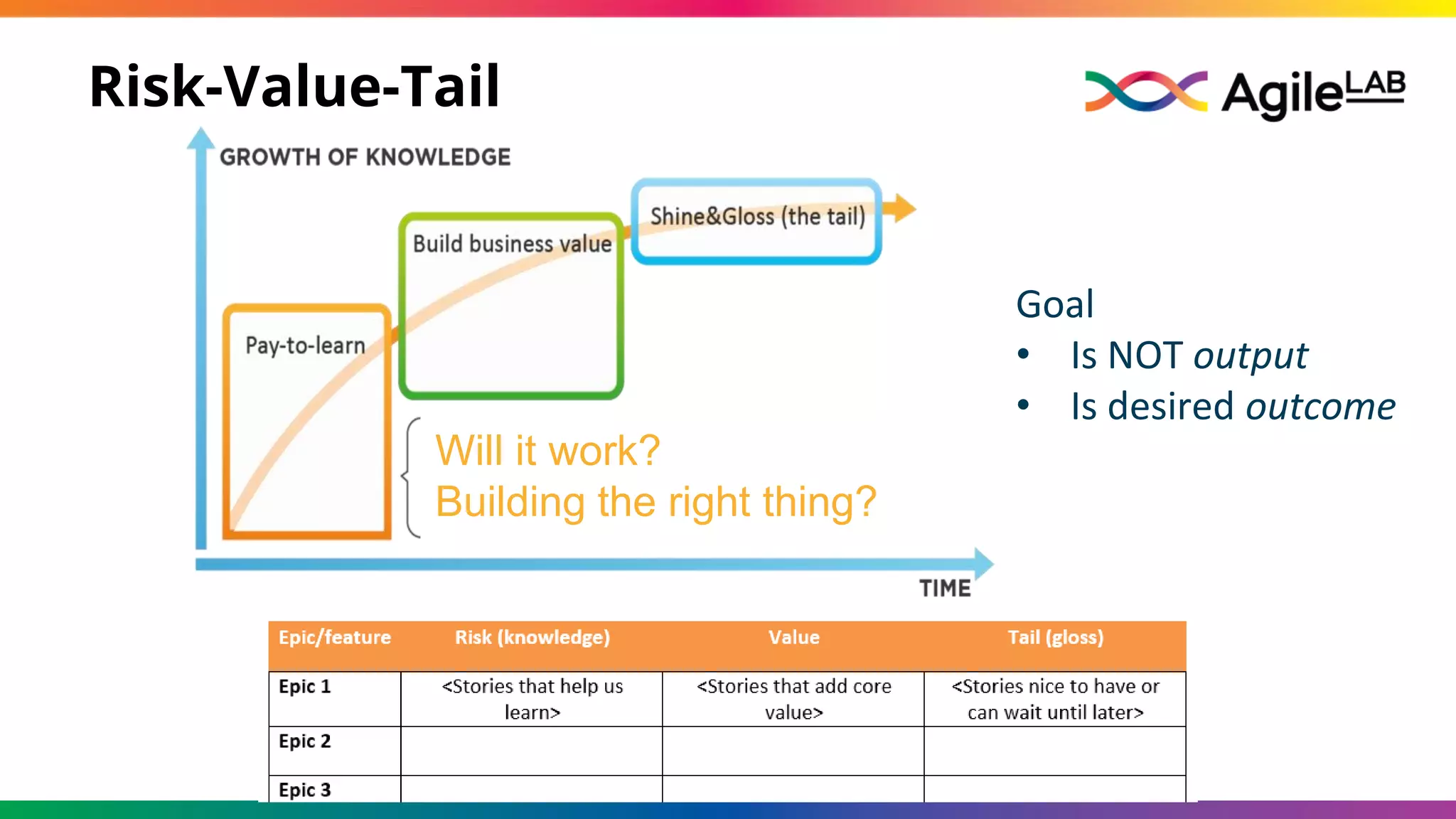
Risk-Value-Tail
Will it work?
Building the right thing?
Goal
• Is NOT output
• Is desired outcome
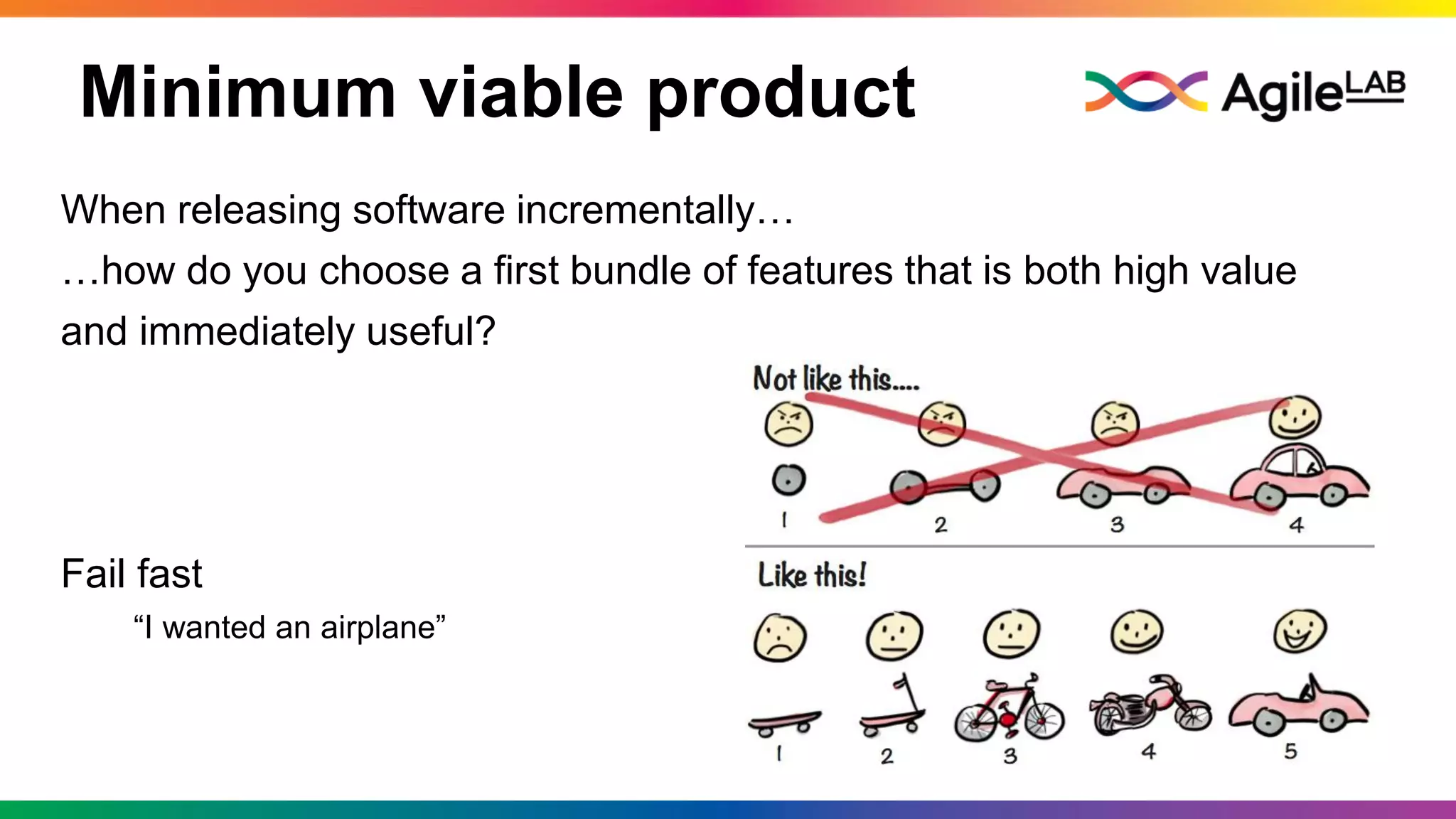
Minimum viable product
When releasing software incrementally…
…how do you choose a first bundle of features that is both high value
and immediately useful?
Fail fast
“I wanted an airplane”
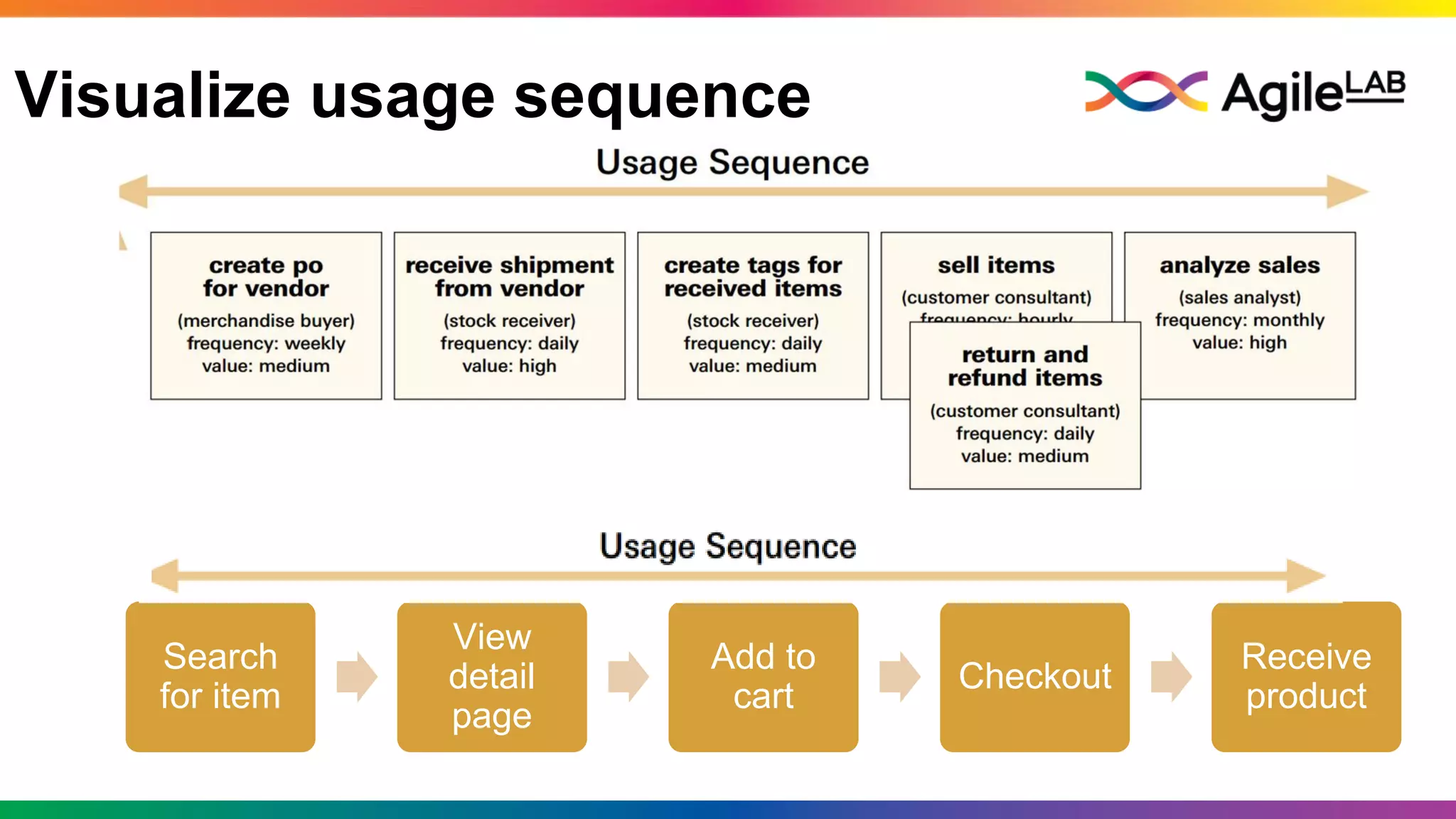
Visualize usage sequence
Search
for item
View
detail
page
Add to
cart
Checkout
Receive
product
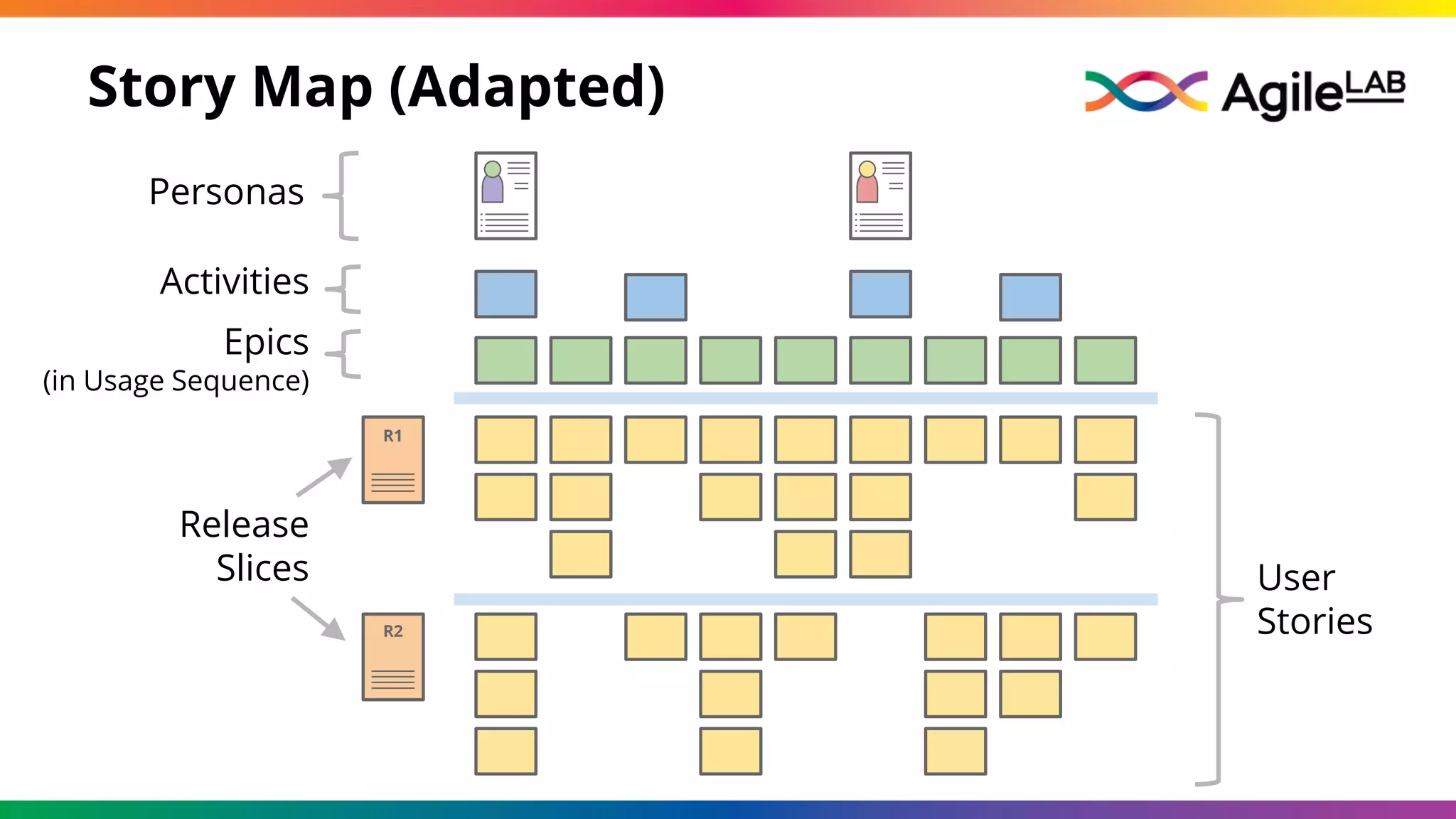
Story Map (Adapted)
Activities
Epics
(in Usage Sequence)
Release
Slices User
Stories
Personas
R1
R2
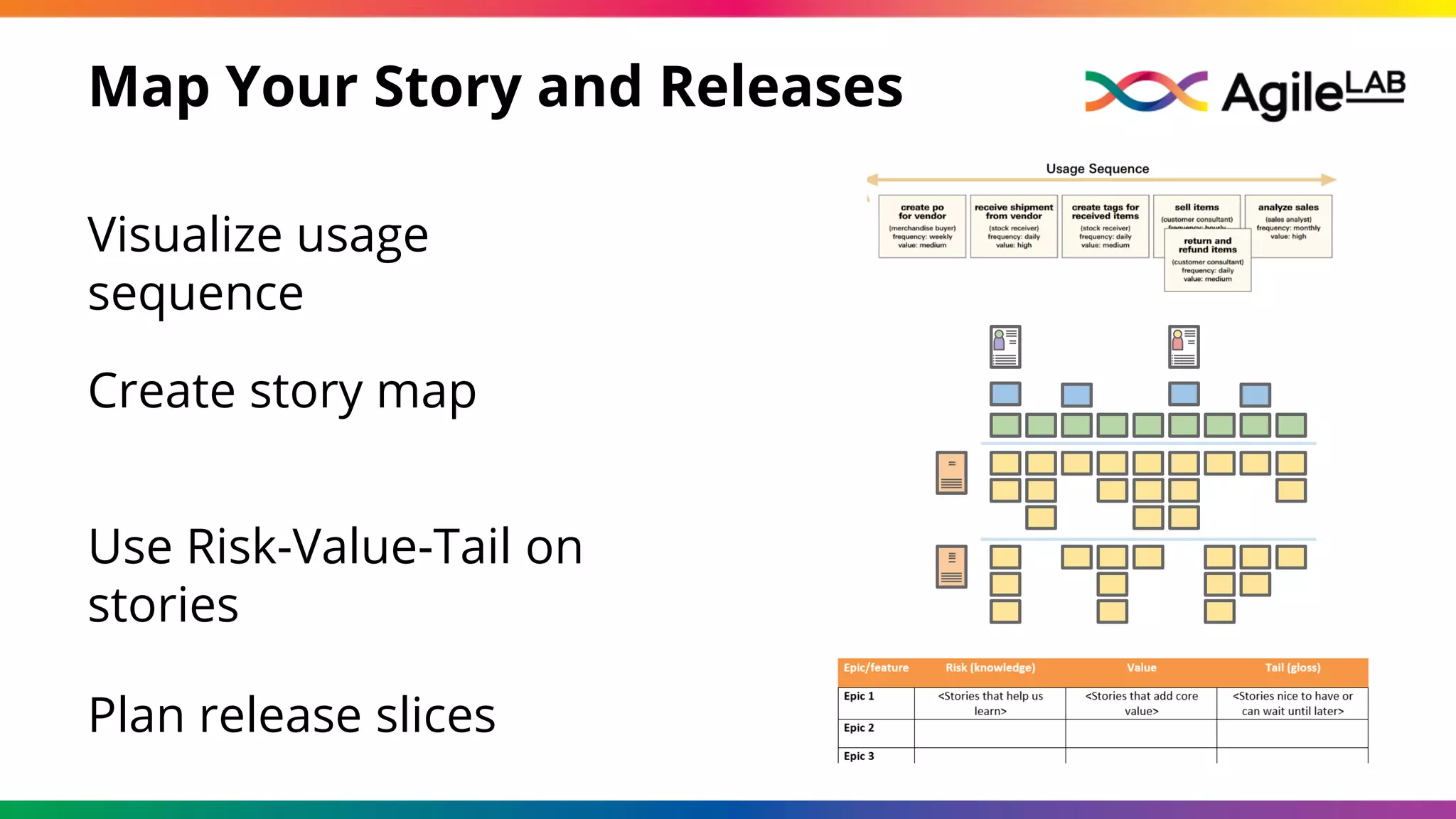
Map Your Story and Releases
Visualize usage
sequence
Create story map
Use Risk-Value-Tail on
stories
Plan release slices
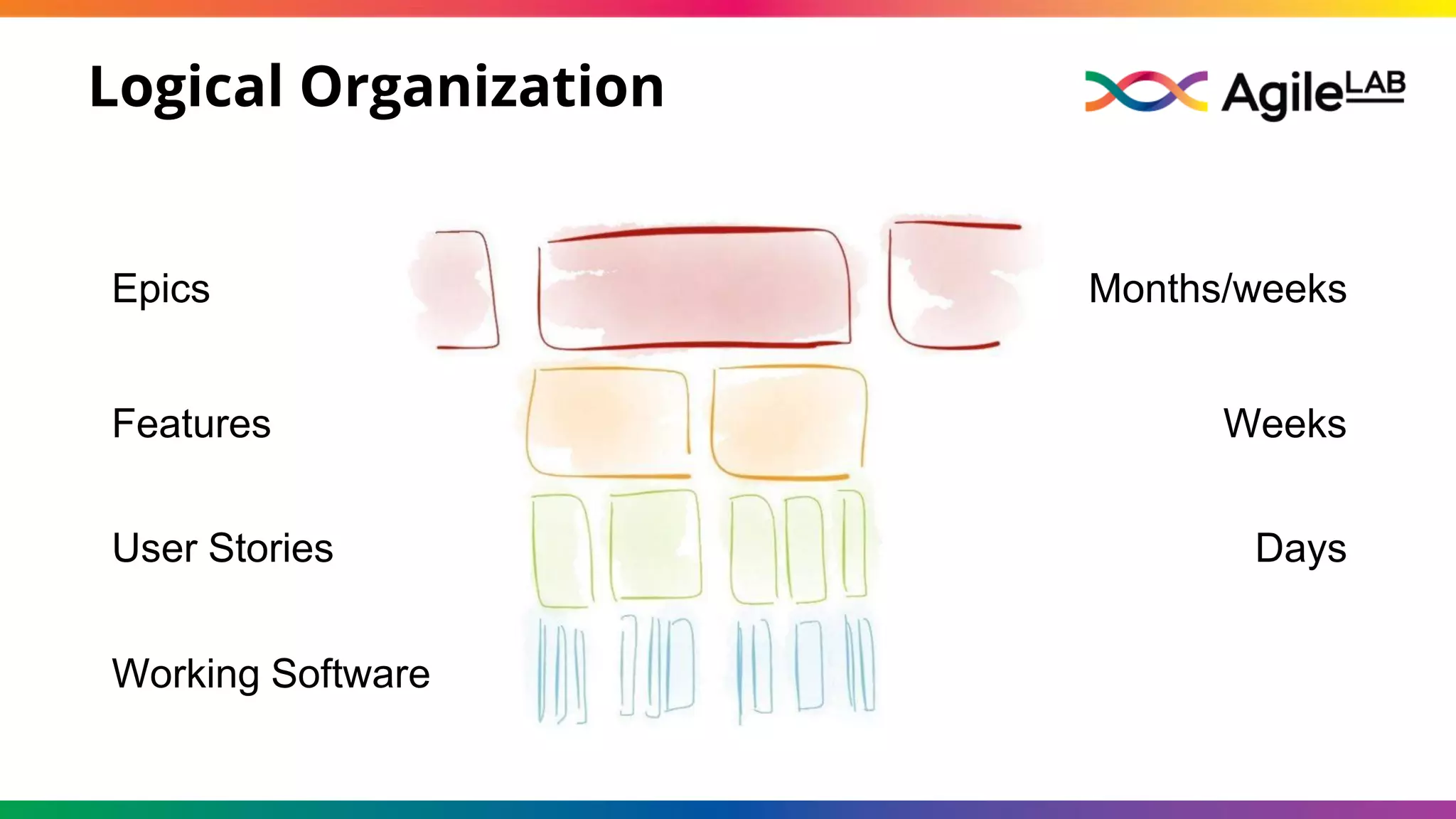
Logical Organization
Features
User Stories
Working Software
Epics
Weeks
Days
Months/weeks
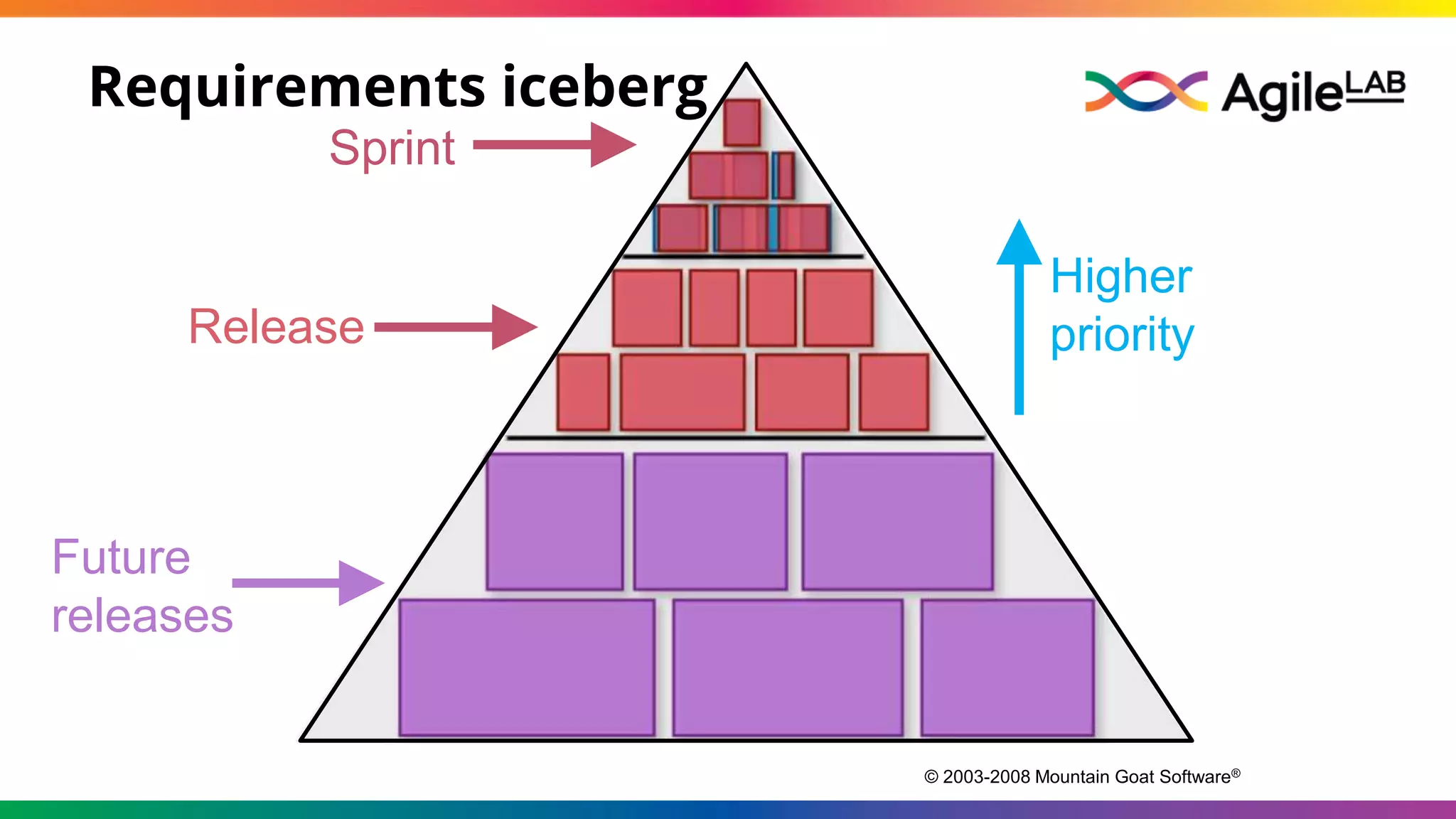
Requirements iceberg
© 2003-2008 Mountain Goat Software®
Sprint
Release
Future
releases
Higher
priority
More about the license: http://creativecommons.org/licenses/by-nc-nd/3.0/
This workbook is comprised of materials from different sources, including, but not limited to:
Henrik Kniberg; Mike Cohn; Alistair Cockburn; Ken Schwaber; Jeff Sutherland; David Andersen;
Ester Derby
Copyrights

04 Горшунов Владимир - AgileLAB: Product Ownership