Efficacy of Ocrelizumab in Patients With PPMS
With and Without T1 Gadolinium-Enhancing Lesions
at Baseline in a Phase III, Placebo-Controlled Trial
J Wolinsky, DL Arnold, A Bar-Or, J de Seze, G Giovannoni, B Hemmer, K Rammohan,
A Sauter, D Masterman, P Fontoura, H Garren, P Chin, X Montalban,
on behalf of the ORATORIO clinical investigators
NCT01194570
Americas Committee for Treatment and Research in
Multiple Sclerosis 2016
Platform presentation number LB1.3
Disclosures
Jerry Wolinsky has received compensation for service on steering
committees or data monitoring boards for Novartis, F. Hoffmann-La
Roche Ltd., Genzyme and Teva Pharmaceuticals; consultant fees
from AbbVie, Actelion, Alkermes, Athersys, Inc., EMD Serono, Forward
Pharma, Genentech, Inc., Genzyme (Sanofi), Novartis, F. Hoffmann-
La Roche Ltd., Teva, and XenoPort; research support from Genzyme,
Sanofi, the NIH and the NMSS through the University of Texas Health
Science Center at Houston (UTHSCH) and royalties for monoclonal
antibodies out-licensed to Chemicon International through UTHSCH.
Douglas Arnold reports equity interest in NeuroRx Research, which
performed the MRI analysis for the trial, and consultation fees from
Acorda Therapeutics, Biogen, Genzyme, F. Hoffmann-La Roche Ltd,
Innate Immunotherapeutics, MedImmune, Mitsubishi Pharma,
Novartis, Receptos, Sanofi Aventis, and Teva.
Amit Bar-Or has received personal compensation for consulting,
serving on scientific advisory boards and/or speaking activities from:
Bayer, Bayhill Therapeutics, Berlex, Biogen, BioMS, Diogenix, Eli Lilly,
Genentech, Inc., GSK, Guthy-Jackson/GGF, Merck Serono, Novartis,
Ono Pharmacia, F. Hoffmann-La Roche Ltd, Sanofi-Aventis, Teva
Neuroscience and Wyeth.
Jérôme de Seze has received consultancy fees and served as an
expert for advisory boards for Alexion, Allergan, Almiral, Bayer,
Biogen, Chugai, CSL Behring, Genzyme, LFB, Merck, Novartis, Roche,
and Teva.
Gavin Giovannoni has received honoraria from AbbVie, Bayer
HealthCare, Biogen, Canbex Therapeutics, Five Prime Therapeutics,
Genzyme, GSK, GW Pharma, Merck, Merck Serono, Novartis, Protein
Discovery Laboratories, F. Hoffmann-La Roche Ltd., Synthon, Teva
Neuroscience, UCB and Vertex; research grant support from Biogen,
Ironwood, Merck Serono, Merz and Novartis; and compensation from
Elsevier.
Bernhard Hemmer has served on scientific advisory boards for F.
Hoffmann-La Roche Ltd., Novartis, Bayer Schering, Merck Serono,
Biogen, GSK, Chugai Pharmaceuticals, Micromet, Genentech, Inc.
and Genzyme Corporation; serves on the international advisory
board of Archives of Neurology , Multiple Sclerosis Journal and
Experimental Neurology; has received speaker honoraria from Bayer
Schering, Novartis, Biogen, Merck Serono, F. Hoffmann-La Roche Ltd.,
and Teva Pharmaceutical Industries Ltd; and has received research
support from Biogen, Bayer Schering, Merck Serono, Five prime,
Metanomics, Chugai Pharmaceuticals and Novartis; he has also filed
a patent for the detection of antibodies and T cells against KIR4.1 in a
subpopulation of patients with MS and genetic determinants of
neutralizing antibodies to interferon-beta.
Kottil Rammohan has received honoraria for participating in advisory
boards and consulting for Acorda, Biogen, EMD Serono, Genentech,
Inc/F. Hoffmann-La Roche Ltd, Genzyme, and Teva. He had also
received grants from Accera.
Annette Sauter is an employee and shareholder of F. Hoffmann-La
Roche Ltd.
Paulo Fontura is an employee and shareholder of F. Hoffmann-La
Roche Ltd.
Donna Masterman is an employee and/or shareholder of
Genentech, Inc. Group, a member of the Roche Group.
Hideki Garren is an employee and shareholder of F. Hoffmann-La
Roche Ltd.
Peter Chin is an employee and/or shareholder of Genentech, Inc., a
member of the Roche Group.
Xavier Montalban has received speaking honoraria and travel
expense reimbursement for participation in scientific meetings, has
been a steering committee member of clinical trials or participated in
advisory boards of clinical trials in the past years with Actelion,
Almirall, Bayer, Biogen, Genzyme, Merck, Novartis, Octapharma,
Receptos, F. Hoffmann-La Roche Ltd., Sanofi, Teva and Trophos.
The study was funded by F. Hoffmann-La Roche Ltd.
Support for third-party writing assistance for this presentation was provided by F. Hoffmann-La Roche Ltd.
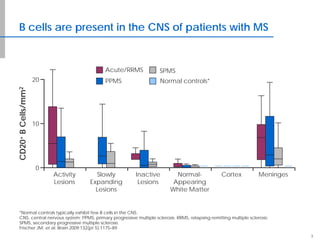
B cells are present in the CNS of patients with MS
3
*Normal controls typically exhibit few B cells in the CNS.
CNS, central nervous system; PPMS, primary progressive multiple sclerosis; RRMS, relapsing remitting multiple sclerosis;
SPMS, secondary progressive multiple sclerosis.
Frischer JM, et al. Brain 2009;132(pt 5):1175–89.
Activity
Lesions
Slowly
Expanding
Lesions
Normal-
Appearing
White Matter
Inactive
Lesions
Cortex Meninges
CD20+BCells/mm2
20
10
0
Acute/RRMS
PPMS
SPMS
Normal controls*
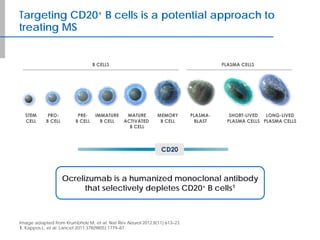
Targeting CD20+ B cells is a potential approach to
treating MS
Image adapted from Krumbholz M, et al. Nat Rev Neurol 2012;8(11):613–23.
1. Kappos L, et al. Lancet 2011;378(9805):1779–87.
Ocrelizumab is a humanized monoclonal antibody
that selectively depletes CD20+ B cells1
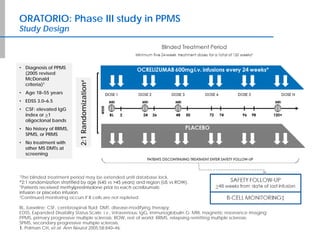
ORATORIO: Phase III study in PPMS
Study Design
†The blinded treatment period may be extended until database lock.
#2:1 randomization stratified by age (≤45 vs >45 years) and region (US vs ROW).
*Patients received methylprednisolone prior to each ocrelizumab
infusion or placebo infusion.
‡Continued monitoring occurs if B cells are not repleted.
BL, baseline; CSF, cerebrospinal fluid; DMT, disease-modifying therapy;
EDSS, Expanded Disability Status Scale; i.v., intravenous; IgG, immunoglobulin G; MRI, magnetic resonance imaging;
PPMS, primary progressive multiple sclerosis; ROW, rest of world; RRMS, relapsing remitting multiple sclerosis;
SPMS, secondary progressive multiple sclerosis.
1. Polman CH, et al. Ann Neurol 2005;58:840–46.
• Diagnosis of PPMS
(2005 revised
McDonald
criteria)1
• Age 18–55 years
• EDSS 3.0–6.5
• CSF: elevated IgG
index or >1
oligoclonal bands
• No history of RRMS,
SPMS, or PRMS
• No treatment with
other MS DMTs at
screening
2:1Randomization#
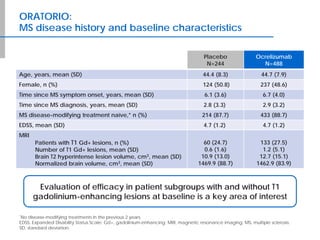
ORATORIO:
MS disease history and baseline characteristics
Placebo
N=244
Ocrelizumab
N=488
Age, years, mean (SD) 44.4 (8.3) 44.7 (7.9)
Female, n (%) 124 (50.8) 237 (48.6)
Time since MS symptom onset, years, mean (SD) 6.1 (3.6) 6.7 (4.0)
Time since MS diagnosis, years, mean (SD) 2.8 (3.3) 2.9 (3.2)
MS disease-modifying treatment naïve,* n (%) 214 (87.7) 433 (88.7)
EDSS, mean (SD) 4.7 (1.2) 4.7 (1.2)
MRI
Patients with T1 Gd+ lesions, n (%)
Number of T1 Gd+ lesions, mean (SD)
Brain T2 hyperintense lesion volume, cm3, mean (SD)
Normalized brain volume, cm3, mean (SD)
60 (24.7)
0.6 (1.6)
10.9 (13.0)
1469.9 (88.7)
133 (27.5)
1.2 (5.1)
12.7 (15.1)
1462.9 (83.9)
*No disease-modifying treatments in the previous 2 years.
EDSS, Expanded Disability Status Scale; Gd+, gadolinium-enhancing; MRI, magnetic resonance imaging; MS, multiple sclerosis;
SD, standard deviation.
Evaluation of efficacy in patient subgroups with and without T1
gadolinium-enhancing lesions at baseline is a key area of interest
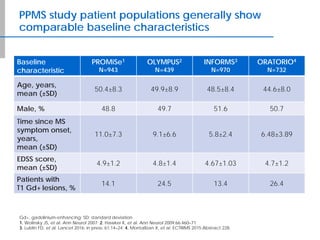
PPMS study patient populations generally show
comparable baseline characteristics
Gd+, gadolinium-enhancing; SD; standard deviation.
1. Wolinsky JS, et al. Ann Neurol 2007; 2. Hawker K, et al. Ann Neurol 2009;66:460–71;
3. Lublin FD, et al. Lancet 2016; in press; 61:14–24; 4. Montalban X, et al. ECTRIMS 2015;Abstract 228.
Baseline
characteristic
PROMiSe1
N=943
OLYMPUS2
N=439
INFORMS3
N=970
ORATORIO4
N=732
Age, years,
mean (±SD)
50.4±8.3 49.9±8.9 48.5±8.4 44.6±8.0
Male, % 48.8 49.7 51.6 50.7
Time since MS
symptom onset,
years,
mean (±SD)
11.0±7.3 9.1±6.6 5.8±2.4 6.48±3.89
EDSS score,
mean (±SD)
4.9±1.2 4.8±1.4 4.67±1.03 4.7±1.2
Patients with
T1 Gd+ lesions, %
14.1 24.5 13.4 26.4
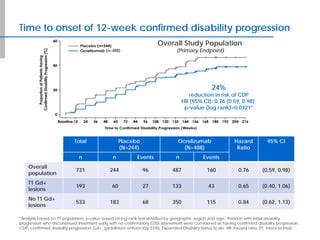
Time to onset of 12-week confirmed disability progression
*Analysis based on ITT population; p-value based on log-rank test stratified by geographic region and age. Patients with initial disability
progression who discontinued treatment early with no confirmatory EDSS assessment were considered as having confirmed disability progression.
CDP, confirmed disability progression; Gd+, gadolinium-enhancing; EDSS, Expanded Disability Status Scale; HR, hazard ratio; ITT, intent to treat.
Overall Study Population
(Primary Endpoint)
Total Placebo
(N=244)
Ocrelizumab
(N=488)
Hazard
Ratio
95% CI
n n Events n Events
Overall
population
731 244 96 487 160 0.76 (0.59, 0.98)
T1 Gd+
lesions
193 60 27 133 43 0.65 (0.40, 1.06)
No T1 Gd+
lesions
533 183 68 350 115 0.84 (0.62, 1.13)
24%
reduction in risk of CDP
HR (95% CI): 0.76 (0.59, 0.98);
p-value (log rank)=0.0321*
(n=488)
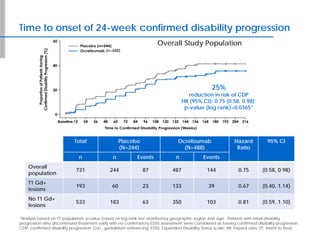
Time to onset of 24-week confirmed disability progression
*Analysis based on ITT population; p-value based on log-rank test stratified by geographic region and age. Patients with initial disability
progression who discontinued treatment early with no confirmatory EDSS assessment were considered as having confirmed disability progression.
CDP, confirmed disability progression; Gd+, gadolinium-enhancing; EDSS, Expanded Disability Status Scale; HR, hazard ratio; ITT, intent to treat.
Overall Study Population
Total Placebo
(N=244)
Ocrelizumab
(N=488)
Hazard
Ratio
95% CI
n n Events n Events
Overall
population
731 244 87 487 144 0.75 (0.58, 0.98)
T1 Gd+
lesions
193 60 23 133 39 0.67 (0.40, 1.14)
No T1 Gd+
lesions
533 183 63 350 103 0.81 (0.59, 1.10)
(n=488)
25%
reduction in risk of CDP
HR (95% CI): 0.75 (0.58, 0.98);
p-value (log rank)=0.0365*
0
20
40
60
80
100
120
Placebo n=134 Ocrelizumab n=288
Patients Without T1 Gd+ Lesions
at Baseline
%ChangeFromBaseline
WalkingTime
(Mean,95%CI)0
20
40
60
80
100
120
Placebo n=39 Ocrelizumab n=106
Patients With T1 Gd+ Lesions
at Baseline
%ChangeFromBaseline
WalkingTime
(Mean,95%CI)
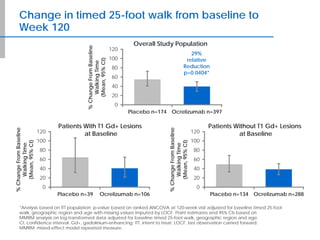
Change in timed 25-foot walk from baseline to
Week 120
*Analysis based on ITT population; p-value based on ranked ANCOVA at 120-week visit adjusted for baseline timed 25-foot
walk, geographic region and age with missing values imputed by LOCF. Point estimates and 95% CIs based on
MMRM analysis on log-transformed data adjusted for baseline timed 25-foot walk, geographic region and age.
CI, confidence interval; Gd+, gadolinium-enhancing; ITT, intent to treat; LOCF, last observation carried forward;
MMRM; mixed-effect model repeated measure.
0
20
40
60
80
100
120
Placebo n=174 Ocrelizumab n=397
Overall Study Population
%ChangeFromBaseline
WalkingTime
(Mean,95%CI)
29%
relative
Reduction
p=0.0404*
-10
-5
0
5
10
15
20
Patients Without T1 Gd+ Lesions
at Baseline
%ChangeFromBaseline
T2LesionVolume
(Mean,95%CI) Placebo n=144 Ocrelizumab n=291
-10
-5
0
5
10
15
20
Overall Study Population
%ChangeFromBaseline
T2LesionVolume
(Mean,95%CI)
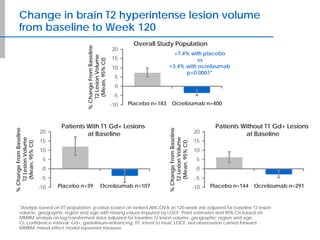
+7.4% with placebo
vs
−3.4% with ocrelizumab
p<0.0001*
Change in brain T2 hyperintense lesion volume
from baseline to Week 120
*Analysis based on ITT population; p-value based on ranked ANCOVA at 120-week visit adjusted for baseline T2 lesion
volume, geographic region and age with missing values imputed by LOCF. Point estimates and 95% CIs based on
MMRM analysis on log-transformed data adjusted for baseline T2 lesion volume, geographic region and age.
CI, confidence interval; Gd+, gadolinium-enhancing; ITT, intent to treat; LOCF, last observation carried forward;
MMRM; mixed-effect model repeated measure.
Placebo n=183 Ocrelizumab n=400
-10
-5
0
5
10
15
20
Patients With T1 Gd+ Lesions
at Baseline
%ChangeFromBaseline
T2LesionVolume
(Mean,95%CI)
Placebo n=39 Ocrelizumab n=107
-2.0
-1.8
-1.6
-1.4
-1.2
-1.0
-0.8
-0.6
-0.4
-0.2
0.0
Patients Without T1 Gd+ Lesions
at Baseline
%ChangeinWholeBrain
VolumeFromWeek24
(Mean,95%CI)-2.0
-1.8
-1.6
-1.4
-1.2
-1.0
-0.8
-0.6
-0.4
-0.2
0.0
Patients With T1 Gd+ Lesions
at Baseline
%ChangeinWholeBrain
VolumeFromWeek24
(Mean,95%CI)
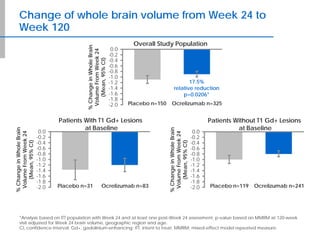
Change of whole brain volume from Week 24 to
Week 120
*Analysis based on ITT population with Week 24 and at least one post-Week 24 assessment; p-value based on MMRM at 120-week
visit adjusted for Week 24 brain volume, geographic region and age.
CI, confidence interval; Gd+, gadolinium-enhancing; ITT, intent to treat; MMRM; mixed-effect model repeated measure.
-2.0
-1.8
-1.6
-1.4
-1.2
-1.0
-0.8
-0.6
-0.4
-0.2
0.0
Overall Study Population
%ChangeinWholeBrain
VolumeFromWeek24
(Mean,95%CI)
17.5%
relative reduction
p=0.0206*
Placebo n=150 Ocrelizumab n=325
Placebo n=31 Ocrelizumab n=83 Placebo n=119 Ocrelizumab n=241
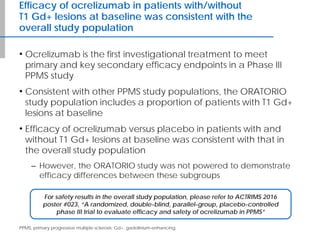
Efficacy of ocrelizumab in patients with/without
T1 Gd+ lesions at baseline was consistent with the
overall study population
• Ocrelizumab is the first investigational treatment to meet
primary and key secondary efficacy endpoints in a Phase III
PPMS study
• Consistent with other PPMS study populations, the ORATORIO
study population includes a proportion of patients with T1 Gd+
lesions at baseline
• Efficacy of ocrelizumab versus placebo in patients with and
without T1 Gd+ lesions at baseline was consistent with that in
the overall study population
– However, the ORATORIO study was not powered to demonstrate
efficacy differences between these subgroups
PPMS, primary progressive multiple sclerosis; Gd+, gadolinium-enhancing.
For safety results in the overall study population, please refer to ACTRIMS 2016
poster #023, “A randomized, double-blind, parallel-group, placebo-controlled
phase III trial to evaluate efficacy and safety of ocrelizumab in PPMS”
AUTRALIA
St Vincent's Hospital Melbourne
Royal Hobart Hospital
AUSTRIA
Wagner-Jauregg-Krankenhaus
Medizinische Universität Wien
Universitätsklinikum Innsbruck
Allgemeines Krankenhaus Linz
Christian-Doppler-Klinik Salzburg
BELGIUM
CHU Tivoli
AZ Alma-Sijsele
BRAZIL
União Brasileira de Educação e Assistência - Hospital São Lucas
da
PUCRS
Hospital das Clinicas da Universidade Federal de Goias
Santa Casa De Belo Horizonte
Universidade Federal do Rio de Janeiro - Hospital Universitário
Clementino Fraga Filho
BULGARIA
Multiprofile Hospital for Active Treatment “National Cardiology
Hospital”
Multiprofile Hospital for Active Treatment of Neurology and
Psychiatry
"Sv. Naum“
CANADA
Montreal Neurological Institute/Clinical Research Unit
Ottawa Hospital
Recherche Sepmus, Inc.
Health Sciences Centre
St. Michael's Hospital
University Of British Columbia Hospital
Foothills Medical Centre
CZECH REPUBLIC
Fakultni nemocnice Brno
Vseobecna fakultni nemocnice v Praze
Krajska zdravotni, a.s. - Nemocnice Teplice, o.z.
FINLAND
Turun yliopistollinen keskussairaala
Tampereen yliopisto
Helsingin yliopistollinen keskussairaala / Meilahti
FRANCE
Groupe Hospitalier Pellegrin
Hôpital Gui de Chauliac
Groupe hospitalo-universitaire Caremeau
Hopital Purpan
Hopital Gabriel Montpied
Hôpital de Hautepierre
CHRU Nancy
Hôpital Côte de Nacre
Fondation Rothschild
Hôpital de Poissy
Hôpital Guillaume et René Laënnec
Hôpital Pasteur
Groupe Hospitalier Pitié- Salpétrière
CHU de la Timone - Hôpital d'Adultes
Hôpital Maison Blanche
Hôpital Roger Salengro
Hôpital Pierre Wertheimer - Hôpital Neurologique
Acknowledgements: Investigators and patients
involved in the ORATORIO study
GERMANY
Medizinische Einrichtungen des Bezirks Oberpfalz GmbH
Justus-Liebig-University of Giessen
Universitätsklinikum Frankfurt
Heinrich Heine Universität Düsseldorf
C/O Jüdisches Krankenhaus
Charité - Universitätsmedizin Berlin
Klinikum rechts der Isar der Technische Universität München
Ruhr-Universität Bochum
Marianne-Strauß-Klinik
Deutsche Klinik für Diagnostik GmbH
Kliniken der Stadt Köln gGmbH
Universitätsklinikum Münster
Klinikum Bayreuth GmbH
Universität Heidelberg
Universitätsklinikum Leipzig
Universitätsklinikum Ulm
Universitätsklinikum Tübingen
Universitätsklinikum Carl Gustav Carus an der TU Dresden
GREECE
401 Military Hospital of Athens
"AHEPA" University General Hospital of Thessaloniki
"Georgios Papanikolaou" General Hospital of Thessaloniki
HUNGARY
Uzsoki Utcai Kórház
Pécsi Tudományegyetem
Jahn Ferenc Dél-Pesti Kórház és Rendelöintézet
Vaszary Kolos Kórház
Clinexpert Egészségügyi Szolgáltató és Kereskedelmi Kft.
Szegedi Tudományegyetem Szent-Györgyi Albert Klinikai Központ
ISRAEL
The Chaim Sheba Medical Center
Rabin Medical Center
Tel Aviv Sourasky Medical Center
Hadassah University Hospital Ein Kerem
Barzilai Medical Center
Medical Center 'Ziv' Safed
ITALY
Azienda Sanitaria Ospedaliera S. Luigi Gonzaga
Ospedale San Raffaele S.r.l.
Ospedale Binaghi
IRCCS Azienda Ospedaliera Universitaria San Martino - Istituto
Nazionale per la Ricerca sul Cancro
LITHUANIA
Klaipeda University Hospital
Hospital of Lithuanian University of Health Sciences Kaunas Clinics
Republican Siauliai Hospital
MEXICO
Grupo Médico Camino
Centro de Estudios Clinicos y Especialidades Medicas SC
Instituto Nacional de Neurologia y Neurocirugia
Instituto Biomédico de Investigación A.C.
NETHERLANDS
Erasmus MC
Orbis Medisch Centrum
NEW ZEALAND
Waikato Hospital
Wellington Hospital
NORWAY
Oslo universitetssykehus HF, Ullevål
PERU
Clinica Anglo Americana
Hospital Dos de Mayo
Hospital IV Alberto Sabogal Sologuren
POLAND
Akson Clinical Research Maciejowski-Bielecki Sp. j.
Zespol Opieki Zdrowotnej w Konskich
Niepubliczny Zaklad Opieki Zdrowotnej KENDRON
M.A. - LEK A.M. Maciejowscy SC. Centrum Terapii SM
SPZOZ Uniwersytecki Szpital Kliniczny nr 1 im. Norberta Barlickiego
Uniwersytetu Medycznego w Lodzi
Samodzielny Publiczny Szpital Kliniczny nr 4
Niepubliczny Zaklad Opieki Zdrowotnej NEURO-MEDIC
PORTUGAL
Centro Hospitalar e Universitário de Coimbra, EPE
Hospital Garcia de Orta
Centro Hospitalar Lisboa Norte, E.P.E.
Hospital Fernando Fonseca
Centro Hospitalar do Porto – Hospital de Santo António
ROMANIA
Targu Mures Emergency County Clinical Hospital
SC Clubul Sanatatii SRL
"Elias" Emergency University Hospital
Timisoara Emergency County Clinical Hospital
RUSSIA
Research Medical Complex "Vashe Zdorovie“
SPAIN
Hospital Universitario Ramón y Cajal
Hospital Clinico San Carlos
Hospital de la Santa Creu i Sant Pau
Hospital General de Malaga
Hospital Universitario Vírgen Macarena
Hospital del Mar
Hospital Universitario de La Princesa
Hospital Universitario Vall d'Hebron
Hospital Donostia
Hospital General Universitario de Alicante
Hospital Clinico Universitario de Santiago
Hospital Universitari de Girona Dr. Josep Trueta
Organización Sanitaria Integrada Bilbao Basurto
Hospital Clinic de Barcelona
SWITZERLAND
Ospedale Regionale Lugano Civico
Universitätsspital Basel
UKRAINE
Municipal Institution of Kyiv Regional Council "Kyiv Regional
Clinical
Hospital"
Municipal Institution “Odesa Regional Clinical Hospital"
State Treatment and Prevention Institution “Central Clinical
Hospital of
Ukrzaliznytsya”
SI "Ukrainian State Research Institute of Medical and Social
Problems of
Disability" MOH of Ukraine
Vinnytsya National Medical University n.a. M.I. Pyrohov
Lviv Regional Clinical Hospital
Bukovinian Medical State University
Municipal Institution “Dnipropetrovsk Regional Clinical Hospital
n.a. I.I. Mechnykov”
Volyn Regional Clinical Hospital
Kyiv City Clinical Hospital #4
"State Institution ""Institute of Neurology, Psychiatry and
Narcology of NAMS of Ukraine“
UNITED KINGDOM
King's College Hospital
Queen's Medical Centre
Royal Victoria Infirmary
Barts and the London NHS Trust
The Walton Centre For Neurology And Neurosurgery
USA
University of California, Davis
Legacy Health System
Newport Beach Clinical Research Associates, Inc.
Wayne State University
Swedish Medical Center
University of Minnesota
Mayo Clinic- Scottsdale
Henry Ford Health System
MS Center, Carolinas Medical Center
Sutter East Bay Medical Foundation
Washington University
MS Specialty Clinic University of New Mexico
Central Texas Neurology
Raleigh Neurology Associates, PA
University of Texas Southwestern
Hope Research Institute, LLC
Winthrop University Hospital
Comprehensive Multiple Sclerosis Care Center at South
Shore
Neurologic Associates, P.C.
Phoenix Neurological Associates
Maxine Mesinger MS Clinic/Baylor College of Medicine
Neurology Associates Of Stony Brook
University of Kansas Medical Center
Trustees of the University of Pennsylvania
Indiana University Medical Center
Mount Sinai School of Medicine
University of Colorado
Barrow Neurology Clinic
Weill Medical College of Cornell University
Oklahoma Medical Research Foundation
Holy Name Hospital
Ohio State University Medical Center
The Neurology Foundation, Inc.
Michigan Institute For Neurological Disorders
MidAmerica Neuroscience Institute
Neurological Associates, Inc.
MS Center of Vero Beach
University Of Miami
Neurology Clinic, P.C.
University of California San Francisco

Actrims 2016 oratorio lb platform wolinsky_lb1.3 (1)

  • 1.
    Efficacy of Ocrelizumabin Patients With PPMS With and Without T1 Gadolinium-Enhancing Lesions at Baseline in a Phase III, Placebo-Controlled Trial J Wolinsky, DL Arnold, A Bar-Or, J de Seze, G Giovannoni, B Hemmer, K Rammohan, A Sauter, D Masterman, P Fontoura, H Garren, P Chin, X Montalban, on behalf of the ORATORIO clinical investigators NCT01194570 Americas Committee for Treatment and Research in Multiple Sclerosis 2016 Platform presentation number LB1.3
  • 2.
    Disclosures Jerry Wolinsky hasreceived compensation for service on steering committees or data monitoring boards for Novartis, F. Hoffmann-La Roche Ltd., Genzyme and Teva Pharmaceuticals; consultant fees from AbbVie, Actelion, Alkermes, Athersys, Inc., EMD Serono, Forward Pharma, Genentech, Inc., Genzyme (Sanofi), Novartis, F. Hoffmann- La Roche Ltd., Teva, and XenoPort; research support from Genzyme, Sanofi, the NIH and the NMSS through the University of Texas Health Science Center at Houston (UTHSCH) and royalties for monoclonal antibodies out-licensed to Chemicon International through UTHSCH. Douglas Arnold reports equity interest in NeuroRx Research, which performed the MRI analysis for the trial, and consultation fees from Acorda Therapeutics, Biogen, Genzyme, F. Hoffmann-La Roche Ltd, Innate Immunotherapeutics, MedImmune, Mitsubishi Pharma, Novartis, Receptos, Sanofi Aventis, and Teva. Amit Bar-Or has received personal compensation for consulting, serving on scientific advisory boards and/or speaking activities from: Bayer, Bayhill Therapeutics, Berlex, Biogen, BioMS, Diogenix, Eli Lilly, Genentech, Inc., GSK, Guthy-Jackson/GGF, Merck Serono, Novartis, Ono Pharmacia, F. Hoffmann-La Roche Ltd, Sanofi-Aventis, Teva Neuroscience and Wyeth. Jérôme de Seze has received consultancy fees and served as an expert for advisory boards for Alexion, Allergan, Almiral, Bayer, Biogen, Chugai, CSL Behring, Genzyme, LFB, Merck, Novartis, Roche, and Teva. Gavin Giovannoni has received honoraria from AbbVie, Bayer HealthCare, Biogen, Canbex Therapeutics, Five Prime Therapeutics, Genzyme, GSK, GW Pharma, Merck, Merck Serono, Novartis, Protein Discovery Laboratories, F. Hoffmann-La Roche Ltd., Synthon, Teva Neuroscience, UCB and Vertex; research grant support from Biogen, Ironwood, Merck Serono, Merz and Novartis; and compensation from Elsevier. Bernhard Hemmer has served on scientific advisory boards for F. Hoffmann-La Roche Ltd., Novartis, Bayer Schering, Merck Serono, Biogen, GSK, Chugai Pharmaceuticals, Micromet, Genentech, Inc. and Genzyme Corporation; serves on the international advisory board of Archives of Neurology , Multiple Sclerosis Journal and Experimental Neurology; has received speaker honoraria from Bayer Schering, Novartis, Biogen, Merck Serono, F. Hoffmann-La Roche Ltd., and Teva Pharmaceutical Industries Ltd; and has received research support from Biogen, Bayer Schering, Merck Serono, Five prime, Metanomics, Chugai Pharmaceuticals and Novartis; he has also filed a patent for the detection of antibodies and T cells against KIR4.1 in a subpopulation of patients with MS and genetic determinants of neutralizing antibodies to interferon-beta. Kottil Rammohan has received honoraria for participating in advisory boards and consulting for Acorda, Biogen, EMD Serono, Genentech, Inc/F. Hoffmann-La Roche Ltd, Genzyme, and Teva. He had also received grants from Accera. Annette Sauter is an employee and shareholder of F. Hoffmann-La Roche Ltd. Paulo Fontura is an employee and shareholder of F. Hoffmann-La Roche Ltd. Donna Masterman is an employee and/or shareholder of Genentech, Inc. Group, a member of the Roche Group. Hideki Garren is an employee and shareholder of F. Hoffmann-La Roche Ltd. Peter Chin is an employee and/or shareholder of Genentech, Inc., a member of the Roche Group. Xavier Montalban has received speaking honoraria and travel expense reimbursement for participation in scientific meetings, has been a steering committee member of clinical trials or participated in advisory boards of clinical trials in the past years with Actelion, Almirall, Bayer, Biogen, Genzyme, Merck, Novartis, Octapharma, Receptos, F. Hoffmann-La Roche Ltd., Sanofi, Teva and Trophos. The study was funded by F. Hoffmann-La Roche Ltd. Support for third-party writing assistance for this presentation was provided by F. Hoffmann-La Roche Ltd.
  • 3.
    B cells arepresent in the CNS of patients with MS 3 *Normal controls typically exhibit few B cells in the CNS. CNS, central nervous system; PPMS, primary progressive multiple sclerosis; RRMS, relapsing remitting multiple sclerosis; SPMS, secondary progressive multiple sclerosis. Frischer JM, et al. Brain 2009;132(pt 5):1175–89. Activity Lesions Slowly Expanding Lesions Normal- Appearing White Matter Inactive Lesions Cortex Meninges CD20+BCells/mm2 20 10 0 Acute/RRMS PPMS SPMS Normal controls*
  • 4.
    Targeting CD20+ Bcells is a potential approach to treating MS Image adapted from Krumbholz M, et al. Nat Rev Neurol 2012;8(11):613–23. 1. Kappos L, et al. Lancet 2011;378(9805):1779–87. Ocrelizumab is a humanized monoclonal antibody that selectively depletes CD20+ B cells1
  • 5.
    ORATORIO: Phase IIIstudy in PPMS Study Design †The blinded treatment period may be extended until database lock. #2:1 randomization stratified by age (≤45 vs >45 years) and region (US vs ROW). *Patients received methylprednisolone prior to each ocrelizumab infusion or placebo infusion. ‡Continued monitoring occurs if B cells are not repleted. BL, baseline; CSF, cerebrospinal fluid; DMT, disease-modifying therapy; EDSS, Expanded Disability Status Scale; i.v., intravenous; IgG, immunoglobulin G; MRI, magnetic resonance imaging; PPMS, primary progressive multiple sclerosis; ROW, rest of world; RRMS, relapsing remitting multiple sclerosis; SPMS, secondary progressive multiple sclerosis. 1. Polman CH, et al. Ann Neurol 2005;58:840–46. • Diagnosis of PPMS (2005 revised McDonald criteria)1 • Age 18–55 years • EDSS 3.0–6.5 • CSF: elevated IgG index or >1 oligoclonal bands • No history of RRMS, SPMS, or PRMS • No treatment with other MS DMTs at screening 2:1Randomization#
  • 6.
    ORATORIO: MS disease historyand baseline characteristics Placebo N=244 Ocrelizumab N=488 Age, years, mean (SD) 44.4 (8.3) 44.7 (7.9) Female, n (%) 124 (50.8) 237 (48.6) Time since MS symptom onset, years, mean (SD) 6.1 (3.6) 6.7 (4.0) Time since MS diagnosis, years, mean (SD) 2.8 (3.3) 2.9 (3.2) MS disease-modifying treatment naïve,* n (%) 214 (87.7) 433 (88.7) EDSS, mean (SD) 4.7 (1.2) 4.7 (1.2) MRI Patients with T1 Gd+ lesions, n (%) Number of T1 Gd+ lesions, mean (SD) Brain T2 hyperintense lesion volume, cm3, mean (SD) Normalized brain volume, cm3, mean (SD) 60 (24.7) 0.6 (1.6) 10.9 (13.0) 1469.9 (88.7) 133 (27.5) 1.2 (5.1) 12.7 (15.1) 1462.9 (83.9) *No disease-modifying treatments in the previous 2 years. EDSS, Expanded Disability Status Scale; Gd+, gadolinium-enhancing; MRI, magnetic resonance imaging; MS, multiple sclerosis; SD, standard deviation. Evaluation of efficacy in patient subgroups with and without T1 gadolinium-enhancing lesions at baseline is a key area of interest
  • 7.
    PPMS study patientpopulations generally show comparable baseline characteristics Gd+, gadolinium-enhancing; SD; standard deviation. 1. Wolinsky JS, et al. Ann Neurol 2007; 2. Hawker K, et al. Ann Neurol 2009;66:460–71; 3. Lublin FD, et al. Lancet 2016; in press; 61:14–24; 4. Montalban X, et al. ECTRIMS 2015;Abstract 228. Baseline characteristic PROMiSe1 N=943 OLYMPUS2 N=439 INFORMS3 N=970 ORATORIO4 N=732 Age, years, mean (±SD) 50.4±8.3 49.9±8.9 48.5±8.4 44.6±8.0 Male, % 48.8 49.7 51.6 50.7 Time since MS symptom onset, years, mean (±SD) 11.0±7.3 9.1±6.6 5.8±2.4 6.48±3.89 EDSS score, mean (±SD) 4.9±1.2 4.8±1.4 4.67±1.03 4.7±1.2 Patients with T1 Gd+ lesions, % 14.1 24.5 13.4 26.4
  • 8.
    Time to onsetof 12-week confirmed disability progression *Analysis based on ITT population; p-value based on log-rank test stratified by geographic region and age. Patients with initial disability progression who discontinued treatment early with no confirmatory EDSS assessment were considered as having confirmed disability progression. CDP, confirmed disability progression; Gd+, gadolinium-enhancing; EDSS, Expanded Disability Status Scale; HR, hazard ratio; ITT, intent to treat. Overall Study Population (Primary Endpoint) Total Placebo (N=244) Ocrelizumab (N=488) Hazard Ratio 95% CI n n Events n Events Overall population 731 244 96 487 160 0.76 (0.59, 0.98) T1 Gd+ lesions 193 60 27 133 43 0.65 (0.40, 1.06) No T1 Gd+ lesions 533 183 68 350 115 0.84 (0.62, 1.13) 24% reduction in risk of CDP HR (95% CI): 0.76 (0.59, 0.98); p-value (log rank)=0.0321* (n=488)
  • 9.
    Time to onsetof 24-week confirmed disability progression *Analysis based on ITT population; p-value based on log-rank test stratified by geographic region and age. Patients with initial disability progression who discontinued treatment early with no confirmatory EDSS assessment were considered as having confirmed disability progression. CDP, confirmed disability progression; Gd+, gadolinium-enhancing; EDSS, Expanded Disability Status Scale; HR, hazard ratio; ITT, intent to treat. Overall Study Population Total Placebo (N=244) Ocrelizumab (N=488) Hazard Ratio 95% CI n n Events n Events Overall population 731 244 87 487 144 0.75 (0.58, 0.98) T1 Gd+ lesions 193 60 23 133 39 0.67 (0.40, 1.14) No T1 Gd+ lesions 533 183 63 350 103 0.81 (0.59, 1.10) (n=488) 25% reduction in risk of CDP HR (95% CI): 0.75 (0.58, 0.98); p-value (log rank)=0.0365*
  • 10.
    0 20 40 60 80 100 120 Placebo n=134 Ocrelizumabn=288 Patients Without T1 Gd+ Lesions at Baseline %ChangeFromBaseline WalkingTime (Mean,95%CI)0 20 40 60 80 100 120 Placebo n=39 Ocrelizumab n=106 Patients With T1 Gd+ Lesions at Baseline %ChangeFromBaseline WalkingTime (Mean,95%CI) Change in timed 25-foot walk from baseline to Week 120 *Analysis based on ITT population; p-value based on ranked ANCOVA at 120-week visit adjusted for baseline timed 25-foot walk, geographic region and age with missing values imputed by LOCF. Point estimates and 95% CIs based on MMRM analysis on log-transformed data adjusted for baseline timed 25-foot walk, geographic region and age. CI, confidence interval; Gd+, gadolinium-enhancing; ITT, intent to treat; LOCF, last observation carried forward; MMRM; mixed-effect model repeated measure. 0 20 40 60 80 100 120 Placebo n=174 Ocrelizumab n=397 Overall Study Population %ChangeFromBaseline WalkingTime (Mean,95%CI) 29% relative Reduction p=0.0404*
  • 11.
    -10 -5 0 5 10 15 20 Patients Without T1Gd+ Lesions at Baseline %ChangeFromBaseline T2LesionVolume (Mean,95%CI) Placebo n=144 Ocrelizumab n=291 -10 -5 0 5 10 15 20 Overall Study Population %ChangeFromBaseline T2LesionVolume (Mean,95%CI) +7.4% with placebo vs −3.4% with ocrelizumab p<0.0001* Change in brain T2 hyperintense lesion volume from baseline to Week 120 *Analysis based on ITT population; p-value based on ranked ANCOVA at 120-week visit adjusted for baseline T2 lesion volume, geographic region and age with missing values imputed by LOCF. Point estimates and 95% CIs based on MMRM analysis on log-transformed data adjusted for baseline T2 lesion volume, geographic region and age. CI, confidence interval; Gd+, gadolinium-enhancing; ITT, intent to treat; LOCF, last observation carried forward; MMRM; mixed-effect model repeated measure. Placebo n=183 Ocrelizumab n=400 -10 -5 0 5 10 15 20 Patients With T1 Gd+ Lesions at Baseline %ChangeFromBaseline T2LesionVolume (Mean,95%CI) Placebo n=39 Ocrelizumab n=107
  • 12.
    -2.0 -1.8 -1.6 -1.4 -1.2 -1.0 -0.8 -0.6 -0.4 -0.2 0.0 Patients Without T1Gd+ Lesions at Baseline %ChangeinWholeBrain VolumeFromWeek24 (Mean,95%CI)-2.0 -1.8 -1.6 -1.4 -1.2 -1.0 -0.8 -0.6 -0.4 -0.2 0.0 Patients With T1 Gd+ Lesions at Baseline %ChangeinWholeBrain VolumeFromWeek24 (Mean,95%CI) Change of whole brain volume from Week 24 to Week 120 *Analysis based on ITT population with Week 24 and at least one post-Week 24 assessment; p-value based on MMRM at 120-week visit adjusted for Week 24 brain volume, geographic region and age. CI, confidence interval; Gd+, gadolinium-enhancing; ITT, intent to treat; MMRM; mixed-effect model repeated measure. -2.0 -1.8 -1.6 -1.4 -1.2 -1.0 -0.8 -0.6 -0.4 -0.2 0.0 Overall Study Population %ChangeinWholeBrain VolumeFromWeek24 (Mean,95%CI) 17.5% relative reduction p=0.0206* Placebo n=150 Ocrelizumab n=325 Placebo n=31 Ocrelizumab n=83 Placebo n=119 Ocrelizumab n=241
  • 13.
    Efficacy of ocrelizumabin patients with/without T1 Gd+ lesions at baseline was consistent with the overall study population • Ocrelizumab is the first investigational treatment to meet primary and key secondary efficacy endpoints in a Phase III PPMS study • Consistent with other PPMS study populations, the ORATORIO study population includes a proportion of patients with T1 Gd+ lesions at baseline • Efficacy of ocrelizumab versus placebo in patients with and without T1 Gd+ lesions at baseline was consistent with that in the overall study population – However, the ORATORIO study was not powered to demonstrate efficacy differences between these subgroups PPMS, primary progressive multiple sclerosis; Gd+, gadolinium-enhancing. For safety results in the overall study population, please refer to ACTRIMS 2016 poster #023, “A randomized, double-blind, parallel-group, placebo-controlled phase III trial to evaluate efficacy and safety of ocrelizumab in PPMS”
  • 14.
    AUTRALIA St Vincent's HospitalMelbourne Royal Hobart Hospital AUSTRIA Wagner-Jauregg-Krankenhaus Medizinische Universität Wien Universitätsklinikum Innsbruck Allgemeines Krankenhaus Linz Christian-Doppler-Klinik Salzburg BELGIUM CHU Tivoli AZ Alma-Sijsele BRAZIL União Brasileira de Educação e Assistência - Hospital São Lucas da PUCRS Hospital das Clinicas da Universidade Federal de Goias Santa Casa De Belo Horizonte Universidade Federal do Rio de Janeiro - Hospital Universitário Clementino Fraga Filho BULGARIA Multiprofile Hospital for Active Treatment “National Cardiology Hospital” Multiprofile Hospital for Active Treatment of Neurology and Psychiatry "Sv. Naum“ CANADA Montreal Neurological Institute/Clinical Research Unit Ottawa Hospital Recherche Sepmus, Inc. Health Sciences Centre St. Michael's Hospital University Of British Columbia Hospital Foothills Medical Centre CZECH REPUBLIC Fakultni nemocnice Brno Vseobecna fakultni nemocnice v Praze Krajska zdravotni, a.s. - Nemocnice Teplice, o.z. FINLAND Turun yliopistollinen keskussairaala Tampereen yliopisto Helsingin yliopistollinen keskussairaala / Meilahti FRANCE Groupe Hospitalier Pellegrin Hôpital Gui de Chauliac Groupe hospitalo-universitaire Caremeau Hopital Purpan Hopital Gabriel Montpied Hôpital de Hautepierre CHRU Nancy Hôpital Côte de Nacre Fondation Rothschild Hôpital de Poissy Hôpital Guillaume et René Laënnec Hôpital Pasteur Groupe Hospitalier Pitié- Salpétrière CHU de la Timone - Hôpital d'Adultes Hôpital Maison Blanche Hôpital Roger Salengro Hôpital Pierre Wertheimer - Hôpital Neurologique Acknowledgements: Investigators and patients involved in the ORATORIO study GERMANY Medizinische Einrichtungen des Bezirks Oberpfalz GmbH Justus-Liebig-University of Giessen Universitätsklinikum Frankfurt Heinrich Heine Universität Düsseldorf C/O Jüdisches Krankenhaus Charité - Universitätsmedizin Berlin Klinikum rechts der Isar der Technische Universität München Ruhr-Universität Bochum Marianne-Strauß-Klinik Deutsche Klinik für Diagnostik GmbH Kliniken der Stadt Köln gGmbH Universitätsklinikum Münster Klinikum Bayreuth GmbH Universität Heidelberg Universitätsklinikum Leipzig Universitätsklinikum Ulm Universitätsklinikum Tübingen Universitätsklinikum Carl Gustav Carus an der TU Dresden GREECE 401 Military Hospital of Athens "AHEPA" University General Hospital of Thessaloniki "Georgios Papanikolaou" General Hospital of Thessaloniki HUNGARY Uzsoki Utcai Kórház Pécsi Tudományegyetem Jahn Ferenc Dél-Pesti Kórház és Rendelöintézet Vaszary Kolos Kórház Clinexpert Egészségügyi Szolgáltató és Kereskedelmi Kft. Szegedi Tudományegyetem Szent-Györgyi Albert Klinikai Központ ISRAEL The Chaim Sheba Medical Center Rabin Medical Center Tel Aviv Sourasky Medical Center Hadassah University Hospital Ein Kerem Barzilai Medical Center Medical Center 'Ziv' Safed ITALY Azienda Sanitaria Ospedaliera S. Luigi Gonzaga Ospedale San Raffaele S.r.l. Ospedale Binaghi IRCCS Azienda Ospedaliera Universitaria San Martino - Istituto Nazionale per la Ricerca sul Cancro LITHUANIA Klaipeda University Hospital Hospital of Lithuanian University of Health Sciences Kaunas Clinics Republican Siauliai Hospital MEXICO Grupo Médico Camino Centro de Estudios Clinicos y Especialidades Medicas SC Instituto Nacional de Neurologia y Neurocirugia Instituto Biomédico de Investigación A.C. NETHERLANDS Erasmus MC Orbis Medisch Centrum NEW ZEALAND Waikato Hospital Wellington Hospital NORWAY Oslo universitetssykehus HF, Ullevål PERU Clinica Anglo Americana Hospital Dos de Mayo Hospital IV Alberto Sabogal Sologuren POLAND Akson Clinical Research Maciejowski-Bielecki Sp. j. Zespol Opieki Zdrowotnej w Konskich Niepubliczny Zaklad Opieki Zdrowotnej KENDRON M.A. - LEK A.M. Maciejowscy SC. Centrum Terapii SM SPZOZ Uniwersytecki Szpital Kliniczny nr 1 im. Norberta Barlickiego Uniwersytetu Medycznego w Lodzi Samodzielny Publiczny Szpital Kliniczny nr 4 Niepubliczny Zaklad Opieki Zdrowotnej NEURO-MEDIC PORTUGAL Centro Hospitalar e Universitário de Coimbra, EPE Hospital Garcia de Orta Centro Hospitalar Lisboa Norte, E.P.E. Hospital Fernando Fonseca Centro Hospitalar do Porto – Hospital de Santo António ROMANIA Targu Mures Emergency County Clinical Hospital SC Clubul Sanatatii SRL "Elias" Emergency University Hospital Timisoara Emergency County Clinical Hospital RUSSIA Research Medical Complex "Vashe Zdorovie“ SPAIN Hospital Universitario Ramón y Cajal Hospital Clinico San Carlos Hospital de la Santa Creu i Sant Pau Hospital General de Malaga Hospital Universitario Vírgen Macarena Hospital del Mar Hospital Universitario de La Princesa Hospital Universitario Vall d'Hebron Hospital Donostia Hospital General Universitario de Alicante Hospital Clinico Universitario de Santiago Hospital Universitari de Girona Dr. Josep Trueta Organización Sanitaria Integrada Bilbao Basurto Hospital Clinic de Barcelona SWITZERLAND Ospedale Regionale Lugano Civico Universitätsspital Basel UKRAINE Municipal Institution of Kyiv Regional Council "Kyiv Regional Clinical Hospital" Municipal Institution “Odesa Regional Clinical Hospital" State Treatment and Prevention Institution “Central Clinical Hospital of Ukrzaliznytsya” SI "Ukrainian State Research Institute of Medical and Social Problems of Disability" MOH of Ukraine Vinnytsya National Medical University n.a. M.I. Pyrohov Lviv Regional Clinical Hospital Bukovinian Medical State University Municipal Institution “Dnipropetrovsk Regional Clinical Hospital n.a. I.I. Mechnykov” Volyn Regional Clinical Hospital Kyiv City Clinical Hospital #4 "State Institution ""Institute of Neurology, Psychiatry and Narcology of NAMS of Ukraine“ UNITED KINGDOM King's College Hospital Queen's Medical Centre Royal Victoria Infirmary Barts and the London NHS Trust The Walton Centre For Neurology And Neurosurgery USA University of California, Davis Legacy Health System Newport Beach Clinical Research Associates, Inc. Wayne State University Swedish Medical Center University of Minnesota Mayo Clinic- Scottsdale Henry Ford Health System MS Center, Carolinas Medical Center Sutter East Bay Medical Foundation Washington University MS Specialty Clinic University of New Mexico Central Texas Neurology Raleigh Neurology Associates, PA University of Texas Southwestern Hope Research Institute, LLC Winthrop University Hospital Comprehensive Multiple Sclerosis Care Center at South Shore Neurologic Associates, P.C. Phoenix Neurological Associates Maxine Mesinger MS Clinic/Baylor College of Medicine Neurology Associates Of Stony Brook University of Kansas Medical Center Trustees of the University of Pennsylvania Indiana University Medical Center Mount Sinai School of Medicine University of Colorado Barrow Neurology Clinic Weill Medical College of Cornell University Oklahoma Medical Research Foundation Holy Name Hospital Ohio State University Medical Center The Neurology Foundation, Inc. Michigan Institute For Neurological Disorders MidAmerica Neuroscience Institute Neurological Associates, Inc. MS Center of Vero Beach University Of Miami Neurology Clinic, P.C. University of California San Francisco