Professor David Baker
(david.baker@qmul.ac.uk)
ECTRIMS 2019
Stockholm
Are B cells all that
matter?
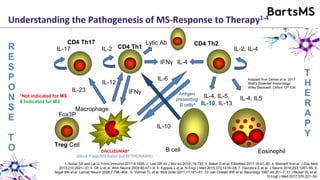
Education Session 3: B cell therapy of MS –
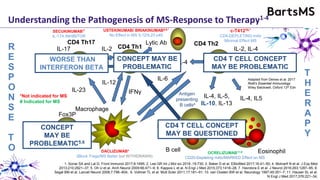
pathology, immunology, clinical effects
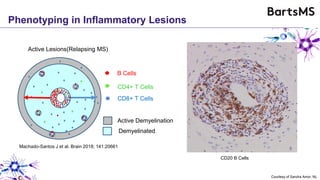
• The content and slides were all designed and made by David Baker
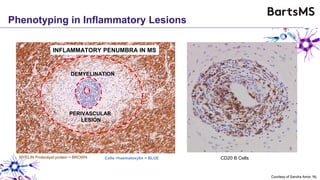
Conflict of Interest Statement
• This meeting segment was sponsored by ECTRIMS
• Although considered to be irrelevant, D. Baker has received compensation
in the past 3 years from: Canbex Therapeutics, Japan Tobacco, Merck,
• Contributor: BartsMS blog (www.ms-res.org)
Roche.
but are used here to help identify mechanisms of disease activity
• Compounds in red are not (currently) indicated for multiple sclerosis,
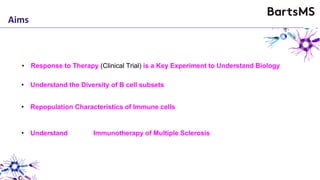
Aims
• Understand the Diversity of B cell subsets
• Response to Therapy (Clinical Trial) is a Key Experiment to Understand Biology
• Repopulation Characteristics of Immune cells
• Understand (B cell) Immunotherapy of Multiple Sclerosis
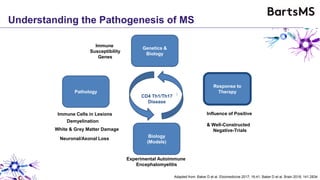
Immune-Mediated
Understanding the Pathogenesis of MS
Influence of Positive
& Well-Constructed
Negative-Trials
Genetics &
Biology
Response to
TherapyPathology
Biology
(Models)
Immune Cells in Lesions
White & Grey Matter Damage
Neuronal/Axonal Loss
Demyelination
Immune
Susceptibility
Genes
Experimental Autoimmune
Encephalomyelitis
Response to
Therapy
Adapted from: Baker D et al. Ebiomedicine 2017; 16:41; Baker D et al. Brain 2018; 141:2834
CD4 Th1/Th17
Disease
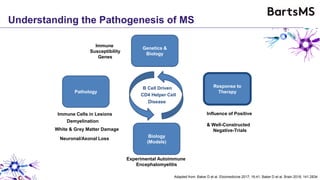
Immune-Mediated
Understanding the Pathogenesis of MS
Influence of Positive
& Well-Constructed
Negative-Trials
Genetics &
Biology
Response to
TherapyPathology
Biology
(Models)
Immune Cells in Lesions
White & Grey Matter Damage
Neuronal/Axonal Loss
Demyelination
Immune
Susceptibility
Genes
Experimental Autoimmune
Encephalomyelitis
Response to
Therapy
Adapted from: Baker D et al. Ebiomedicine 2017; 16:41; Baker D et al. Brain 2018; 141:2834
B Cell Driven
CD4 Th1/Th17
Disease
CD4 Helper Cell
CD4 Th1
CD4 Th2
IL-2, IL-4IL-2
IL-4IFNγ
IL-4, IL5IL-4, IL-5,
IL-10, IL-13
B cell Eosinophil
IL-6
IL-10
IFNγ
IL-12
CD4 Th17
IL-17
IL-23
Macrophage
Lytic Ab
Treg Cell
Fox3P
DACLIZUMAB*
(Block Tregs/MS Better but WITHDRAWN)
R
E
S
P
O
N
S
E
T
O
T
H
E
R
A
P
Y
Adapted from Delves et al. 2017
Roitt’s Essential Immunology
Wiley Balckwell, Oxford 13th Edn
1. Sonar SA and Lal G. Front Immunol 2017;8:1695; 2. Lee GR Int J Mol sci 2018 ;19:730; 3. Baker D et al. EBioMed 2017;16:41–50; 4. Molnarfi N et al. J Exp Med
2013;210:2921–37; 5. Oh U et al. Arch Neurol 2009:66:471–9; 6. Kappos L et al. N Engl J Med 2015;373;1418–28; 7. Havrdora E et al. J Neurol 2016;263:1287–95; 8.
Segal BM et al. Lancet Neurol 2008;7:796–804; 9. Vollmer TL et al. Mult Scler 2011;17:181–91; 10. van Oosten BW et al. Neurology 1997;49:351–7; 11. Hauser SL et al.
N Engl J Med 2017;376:221–34;
Antigen
presenting
B cells4
Understanding the Pathogenesis of MS-Response to Therapy1-4
*Not indicated for MS
# Indicated for MS
CD4 Th1
CD4 Th2
IL-2, IL-4IL-2
IL-4IFNγ
IL-4, IL5IL-4, IL-5,
IL-10, IL-13
B cell Eosinophil
IL-6
IL-10
IFNγ
IL-12
CD4 Th17
IL-17
IL-23
Macrophage
Lytic Ab
Treg Cell
Fox3P
DACLIZUMAB*
(Block Tregs/MS Better but WITHDRAWN)
CONCEPT
MAY BE
PROBLEMATIC5,6
CONCEPT MAY BE
PROBLEMATIC
WORSE THAN
INTERFERON BETA
USTEKINUMAB/ BRIAKINUMAB8,9,*
No Effect in MS IL12/IL23 p40
SECUKINUMAB7*
IL-17A INHIBITOR
c-T41210,*
CD4-DEPLETING mAb
Minimal Effect MS
OCRELIZUMAB11,#
CD20-Depleting mAb/MARKED Effect on MS
CD4 T CELL CONCEPT
MAY BE PROBLEMATIC
R
E
S
P
O
N
S
E
T
O
T
H
E
R
A
P
Y
Adapted from Delves et al. 2017
Roitt’s Essential Immunology
Wiley Balckwell, Oxford 13th Edn
1. Sonar SA and Lal G. Front Immunol 2017;8:1695; 2. Lee GR Int J Mol sci 2018 ;19:730; 3. Baker D et al. EBioMed 2017;16:41–50; 4. Molnarfi N et al. J Exp Med
2013;210:2921–37; 5. Oh U et al. Arch Neurol 2009:66:471–9; 6. Kappos L et al. N Engl J Med 2015;373;1418–28; 7. Havrdora E et al. J Neurol 2016;263:1287–95; 8.
Segal BM et al. Lancet Neurol 2008;7:796–804; 9. Vollmer TL et al. Mult Scler 2011;17:181–91; 10. van Oosten BW et al. Neurology 1997;49:351–7; 11. Hauser SL et al.
N Engl J Med 2017;376:221–34;
CD4 T CELL CONCEPT
MAY BE QUESTIONED
Antigen
presenting
B cells4
Understanding the Pathogenesis of MS-Response to Therapy1-4
*Not indicated for MS
# Indicated for MS
Phenotyping in Inflammatory Lesions
Courtesy of Sandra Amor, NL
CD20 B Cells
B Cells
CD4+ T Cells
CD8+ T Cells
Active Demyelination
Active Lesions(Relapsing MS)
Demyelinated
Machado-Santos J et al. Brain 2018; 141:20661
Phenotyping in Inflammatory Lesions
Courtesy of Sandra Amor, NL
CD20 B Cells
B Cells
CD4+ T Cells
CD8+ T Cells
Active Demyelination
Active Lesions(Relapsing MS)
Demyelinated
Machado-Santos J et al. Brain 2018; 141:20661
INFLAMMATORY PENUMBRA IN MS
MYELIN Proteolipid protein = BROWN
DEMYELINATION
PERIVASCULAR
LESION
RELAPSING MSCells =haematoxylin = BLUE
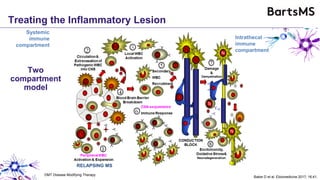
Treating the Inflammatory Lesion
Two
compartment
model
RELAPSING MS
Systemic
immune
compartment
Intrathecal
immune
compartment
DMT Disease Modifying Therapy
Baker D et al. Ebiomedicine 2017; 16:41.
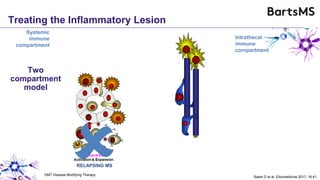
Treating the Inflammatory Lesion
Two
compartment
model
RELAPSING MS
Systemic
immune
compartment
Intrathecal
immune
compartment
DMT Disease Modifying Therapy
Baker D et al. Ebiomedicine 2017; 16:41.
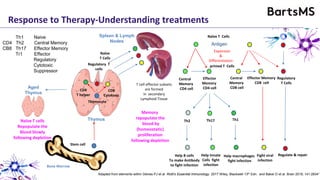
Bone Marrow
Stem cell
Th1 Naive
CD4 Th2 Central Memory
CB8 Th17 Effector Memory
Tr1 Effector
Regulatory
Cytotoxic
Suppressor
Thymocyte
CD4
T helper
Thymus
CD8
Cytotoxic
Regulatory T
cells
Spleen & Lymph
Nodes
Naïve
T Cells
Th1Th17Th2
Help B cells
To make Antibody
to fight infection
Help Innate
Cells fight
infection
Help macrophages
fight infection
Fight viral
infection
Regulate & repair
Naïve T cells
Repopulate the
Blood Slowly
following depletion
Aged
Thymus
Central
Memory
CD8 cell
Effector Memory
CD8 cell
Expansion
&
Differentiation
Effector
Memory
CD4 cell
Central
Memory
CD4 cell
Regulatory
T Cells
Antigen
Naïve T Cells
primed T Cells
Adapted from elements within Delves PJ et al Roitt’s Essential Immunology 2017 Wiley, Blackwell 13th Edn. and Baker D et al. Brain 2018; 141:28341
Memory
repopulate the
blood by
(homeostatic)
proliferation
following depletion
T cell effector subsets
are formed
in secondary
Lymphoid Tissue
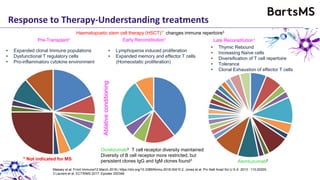
Response to Therapy-Understanding treatments
Pre-Transplant1 Early Reconstitution1
Late Reconstitution1
• Lymphopenia induced proliferation
• Expanded memory and effector T cells
(Homeostatic proliferation)
• Expanded clonal Immune populations
• Dysfunctional T regulatory cells
• Pro-inflammatory cytokine environment
• Thymic Rebound
• Increasing Naïve cells
• Diversification of T cell repertoire
• Tolerance
• Clonal Exhaustion of effector T cells
Ablativeconditioning
Massey et al. Front Immunol12 March 2018 | https://doi.org/10.3389/fimmu.2018.00410 2. Jones et al. Prc Natl Acad Sci U S A. 2013 : 110:20200,
3 Laurent et al. ECTRIMS 2017. Eposter 200348.
Alemtuzumab2
Ocrelizumab3 T cell receptor diversity maintained
Diversity of B cell receptor more restricted, but
persistent clones IgG and IgM clones found3
Haematopoetic stem cell therapy (HSCT)1* changes immune repertoire3
Response to Therapy-Understanding treatments
* Not indicated for MS
Response to Therapy-Understanding Treatments
Memory
B cell
Mature
(Naïve)
B Cell
Immature
(Transitional)
B Cell
Plasmablasts
Germinal
Centre B
Clonal
Expansion
Spleen & Lymph
Nodes
Bone Marrow
Plasma
Cells
Pre
B cell
Antibodies
Mature
(Naïve)
B Cell
Stem cell
B cell subsets are
Formed In
Bone Marrow
B cell subsets are formed
in Secondary
Lymphoid Tissue
CD19+ B Cells
Th1 Naive
CD4 Th2 Central Memory
CB8 Th17 Effector Memory
Tr1 Effector
Regulatory
Cytotoxic
Suppressor
Adapted from Baker D et al. Brain 2018; 141:28341
(protein) Antigen
Binding
Site
-S-S-
-S-S-
VH
DH
JH
VL
JL
Fc Region
Complement
Binding
Region
BINDS TO
PHAGOCYTES
INNATE HELP
INNATE
HELP
Fab Region
(Fragment Antigen
binding)
Antibody-Dependent
Cellular Cytotoxicity
Adapted from elements within Delves PJ et al Roitt’s Essential Immunology 2017 Wiley, Blackwell 13th Edn
BIND TO TARGET
DESTRUCTION
DESTRUCTION
Response to Therapy-Understanding treatments-Antibodies
Produced Early in Immune Response
Low Affinity Ab, Complement Fixation
IgM
IgA
Produced in mucosal Surfaces/Tears
Prevent entry into Body
IgD
Surface Receptor for B cells (Signalling)
IgE
Produced in Kill Parasites (allergy)
IgG High Affinity Ab. Some complement Fixing
Cross the placenta.
Class Switching & Mutation
Antibody Isotypes
IgG1
IgG2
IgG3
Activates Complement
Activates
Complement
IgG4 Does not activates
Complement
Does not activate
complement well.
Low affinity for FcR
BLOCKING ANTIBODIES
LYTIC ANTIBODIES
Adapted from Delves et al. 2017 Roitt’s Essential ImmunologyWiley Balckwell, Oxford 13th Edn
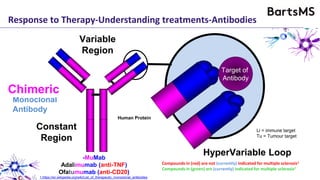
Response to Therapy-Understanding treatments-Antibodies
Constant
Region
HyperVariable Loop
Target of
Antibody
Variable
Region
-XiMab
Infliximab (anti-TNF)
Rituximab (anti-CD20)
-ZuMab
Certolizumab (anti-TNF)
Ocrelizumab (anti-CD20)
-MuMab
Adalimumab (anti-TNF)
Ofatumumab (anti-CD20)
Compounds in (red) are not (currently) indicated for multiple sclerosis1
Compounds in (green) are (currently) indicated for multiple sclerosis1
Li = immune target
Tu = Tumour target
1.https://en.wikipedia.org/wiki/List_of_therapeutic_monoclonal_antibodies
Rodent ProteinHuman Protein
Rodent
Monoclonal
Antibody
Chimeric
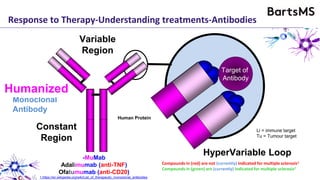
Response to Therapy-Understanding treatments-Antibodies
Constant
Region
HyperVariable Loop
Target of
Antibody
Variable
Region
-XiMab
Infliximab (anti-TNF)
Rituximab (anti-CD20)
-ZuMab
Certolizumab (anti-TNF)
Ocrelizumab (anti-CD20)
-MuMab
Adalimumab (anti-TNF)
Ofatumumab (anti-CD20)
Compounds in (red) are not (currently) indicated for multiple sclerosis1
Compounds in (green) are (currently) indicated for multiple sclerosis1
Li = immune target
Tu = Tumour target
1.https://en.wikipedia.org/wiki/List_of_therapeutic_monoclonal_antibodies
Rodent ProteinHuman Protein
Rodent
Monoclonal
Antibody
ChimericHumanized
Response to Therapy-Understanding treatments-Antibodies
Constant
Region
HyperVariable Loop
Target of
Antibody
Variable
Region
-XiMab
Infliximab (anti-TNF)
Rituximab (anti-CD20)
-ZuMab
Certolizumab (anti-TNF)
Ocrelizumab (anti-CD20)
-MuMab
Adalimumab (anti-TNF)
Ofatumumab (anti-CD20)
Compounds in (red) are not (currently) indicated for multiple sclerosis1
Compounds in (green) are (currently) indicated for multiple sclerosis1
Li = immune target
Tu = Tumour target
1.https://en.wikipedia.org/wiki/List_of_therapeutic_monoclonal_antibodies
Rodent ProteinHuman Protein
Rodent
Monoclonal
Antibody
ChimericHumanized
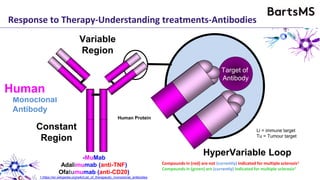
Response to Therapy-Understanding treatments-Antibodies
Constant
Region
HyperVariable Loop
Target of
Antibody
Variable
Region
-XiMab
Infliximab (anti-TNF)
Rituximab (anti-CD20)
-ZuMab
Certolizumab (anti-TNF)
Ocrelizumab (anti-CD20)
-MuMab
Adalimumab (anti-TNF)
Ofatumumab (anti-CD20)
Compounds in (red) are not (currently) indicated for multiple sclerosis1
Compounds in (green) are (currently) indicated for multiple sclerosis1
Li = immune target
Tu = Tumour target
1.https://en.wikipedia.org/wiki/List_of_therapeutic_monoclonal_antibodies
Rodent ProteinHuman Protein
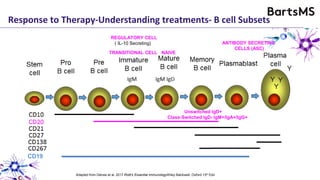
CD19
Adapted from Delves et al. 2017 Roitt’s Essential ImmunologyWiley Balckwell, Oxford 13th Edn
Response to Therapy-Understanding treatments- B cell Subsets
REGULATORY CELL
( IL-10 Secreting)
TRANSITIONAL CELL NAIVE
ANTIBODY SECRETING
CELLS (ASC)
Unswitched IgD+
Class-Switched IgD- IgM+/IgA+/IgG+
Response to Therapy-Understanding Treatments
Memory
B cell
Mature
(Naïve)
B Cell
Immature
(Transitional)
B Cell
Plasmablasts
Germinal
Centre B
Clonal
Expansion
Spleen & Lymph
Nodes
Bone Marrow
Plasma
Cells
Pre
B cell
Antibodies
Mature
(Naïve)
B Cell
Stem cell
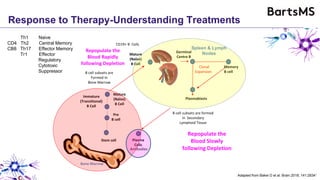
B cell subsets are
Formed In
Bone Marrow
B cell subsets are formed
in Secondary
Lymphoid Tissue
Repopulate the
Blood Rapidly
following Depletion
Repopulate the
Blood Slowly
following Depletion
CD19+ B Cells
Th1 Naive
CD4 Th2 Central Memory
CB8 Th17 Effector Memory
Tr1 Effector
Regulatory
Cytotoxic
Suppressor
Adapted from Baker D et al. Brain 2018; 141:28341
Time Post-Administration (Months)
0 3 6 9 12 15 18 21 24
MeanPercentageChangefromBaseline
-100
-90
-80
-70
-60
-50
-40
-30
-20
-10
0
10
20
30
40
Time Post-Administration (Months)
0 3 6 9 12 15 18 21 24
MeanPercentageChangefromBaseline
0
20
40
60
80
100
120
140
160
180
200
Immatute B cells
CD19 B cells
Time Post-Administration (Months)
0 3 6 9 12 15 18 21 24
MeanPercentageChangefromBaseline
-100
-80
-60
-40
-20
0
20
40
60
80
100
120
140
Mature
Naive B cells
Time Post-Administration (Months)
0 3 6 9 12 15 18 21 24
MeanPercentageChangefromBaseline
-100
-90
-80
-70
-60
-50
-40
-30
-20
-10
0
10
Memory B cells
Response to Therapy-Understanding Treatments
(From Bone Marrow)
(From Bone Marrow)
(From Lymphoid Organs)
(Slow Repopulation)
CD4 Regulatory T cells
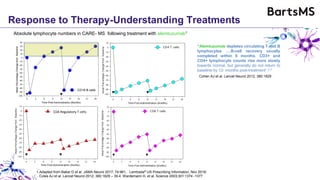
Absolute lymphocyte numbers in CARE- MS following treatment with alemtuzumab1
1.Adapted from Baker D et al. JAMA Neurol 2017; 74:961, . Lemtrada® US Prescribing Information, Nov 2018;
. Coles AJ et al. Lancet Neurol 2012; 380:1829 – 39.4. Wardemann H, et al. Science 2003;301:1374 -1377
“Alemtuzumab depletes circulating T and B
lymphocytes ….B-cell recovery usually
completed within 6 months. CD3+ and
CD4+ lymphocyte counts rise more slowly
towards normal, but generally do not return to
baseline by 12- months post-treatment”.2,3
Cohen AJ et al. Lancet Neurol 2012; 380:1829
Time Post-Administration (Months)
0 3 6 9 12 15 18 21 24
MeanPercentageChangefromBaseline
-100
-90
-80
-70
-60
-50
-40
-30
-20
-10
0
10
20
30
40
Time Post-Administration (Months)
0 3 6 9 12 15 18 21 24
MeanPercentageChangefromBaseline
0
20
40
60
80
100
120
140
160
180
200
Immatute B cells
CD19 B cells
Time Post-Administration (Months)
0 3 6 9 12 15 18 21 24
MeanPercentageChangefromBaseline
-100
-80
-60
-40
-20
0
20
40
60
80
100
120
140
Mature
Naive B cells
Time Post-Administration (Months)
0 3 6 9 12 15 18 21 24
MeanPercentageChangefromBaseline
-100
-90
-80
-70
-60
-50
-40
-30
-20
-10
0
10
Memory B cells
Response to Therapy-Understanding Treatments
(From Bone Marrow)
(From Bone Marrow)
(From Lymphoid Organs)
(Slow Repopulation)
HumanCD52
transgenic
mice treated
with
alemtuzumab
Bone marrow
Not purged
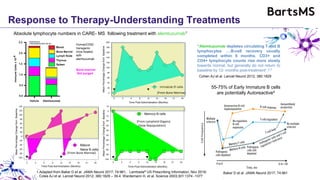
Absolute lymphocyte numbers in CARE- MS following treatment with alemtuzumab1
1.Adapted from Baker D et al. JAMA Neurol 2017; 74:961, . Lemtrada® US Prescribing Information, Nov 2018;
. Coles AJ et al. Lancet Neurol 2012; 380:1829 – 39.4. Wardemann H, et al. Science 2003;301:1374 -1377
“Alemtuzumab depletes circulating T and B
lymphocytes ….B-cell recovery usually
completed within 6 months. CD3+ and
CD4+ lymphocyte counts rise more slowly
towards normal, but generally do not return to
baseline by 12- months post-treatment”.2,3
Cohen AJ et al. Lancet Neurol 2012; 380:1829
55-75% of Early Immature B cells
are potentially Autoreactive4
Baker D et al. JAMA Neurol 2017; 74:961
.
Potential mechanism of action of Alemtuzumab1
Time Post-Administration (Months)
0 3 6 9 12 15 18 21 24
MeanPercentageChangefromBaseline
-100
-90
-80
-70
-60
-50
-40
-30
-20
-10
0
10
20
30
40
Time Post-Administration (Months)
0 3 6 9 12 15 18 21 24
MeanPercentageChangefromBaseline
0
20
40
60
80
100
120
140
160
180
200
Immatute B cells
CD19 B cells
Time Post-Administration (Months)
0 3 6 9 12 15 18 21 24
MeanPercentageChangefromBaseline
-100
-80
-60
-40
-20
0
20
40
60
80
100
120
140
Mature
Naive B cells
Time Post-Administration (Months)
0 3 6 9 12 15 18 21 24
MeanPercentageChangefromBaseline
-100
-90
-80
-70
-60
-50
-40
-30
-20
-10
0
10
Memory B cells
Response to Therapy-Understanding Treatments
(From Bone Marrow)
(From Bone Marrow)
(From Lymphoid Organs)
(Slow Repopulation)
HumanCD52
transgenic
mice treated
with
alemtuzumab
Bone marrow
Not purged
Absolute lymphocyte numbers in CARE- MS following treatment with alemtuzumab1
“Alemtuzumab depletes circulating T and B
lymphocytes ….B-cell recovery usually
completed within 6 months. CD3+ and
CD4+ lymphocyte counts rise more slowly
towards normal, but generally do not return to
baseline by 12- months post-treatment”.2,3
Cohen AJ et al. Lancet Neurol 2012; 380:1829
55-75% of Early Immature B cells
are potentially Autoreactive4
Anti-Drug
Antibodies
(60% within
1 month)1
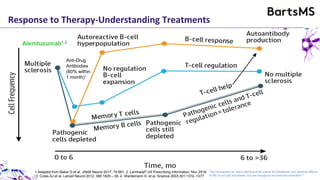
The mechanism by which alemtuzumab exerts its therapeutic and adverse effects
in MS is not fully elucidated, but are thought to be immune-controlled1,2
1.Adapted from Baker D et al. JAMA Neurol 2017; 74:961, 2. Lemtrada® US Prescribing Information, Nov 2018;
3. Coles AJ et al. Lancet Neurol 2012; 380:1829 – 39. 4. Wardemann H, et al. Science 2003;301:1374 -1377
Alemtuzumab1,2
1. Baker et al. Neurol Neuroimmunol Neuroinflamm. 2017; 5;4:e360, 2, Baker et al. Mul Scler Rel Disord 2019 30:176, 3 . Comi et al. J neurol 2013:260:1136,Giovannoni et al. N Eng J med 2010:362:416
Time post-administration (weeks)
0 10 20 30 40 50 60 70 80 90 100
ChangeinCD4Helper/InducerTcells(%)
-100
-90
-80
-70
-60
-50
-40
-30
-20
-10
0
10
20
Placebo
Cladribine 3.5mg/kg
CD3 T cells
Time post-administration (Weeks)
0 10 20 30 40 50 60 70 80 90 100
ChangeinCD3Tcells(%
-100
-90
-80
-70
-60
-50
-40
-30
-20
-10
0
10
20
CD4 T cells
Time post-administration (weeks)
0 10 20 30 40 50 60 70 80 90 100
ChangeinCD8Suppressor.CytotoxicTcells(%)
-100
-90
-80
-70
-60
-50
-40
-30
-20
-10
0
10
20
Placebo
Cladribine 3.5mg/kg
CD8 T cells
Time Post-Administration (Weeks)
0 10 20 30 40 50 60 70 80 90 100
ChangeinCD19Bcells(%)
-100
-90
-80
-70
-60
-50
-40
-30
-20
-10
0
10
20
Placebo
Cladribine.5mg/kg
CD19 B cells
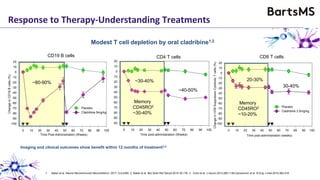
Modest T cell depletion by oral cladribine1,2
~30-40% 20-30%
30-40%
~40-50%
~80-90%
Response to Therapy-Understanding Treatments
Memory
CD45RO2
~30-40%
Memory
CD45RO2
~10-20%
Imaging and clinical outcomes show benefit within 12 months of treatment3,4
MS multiple sclerosisMOA mechanism of action. DCK deoxycytidine kinase, NT5C1A/NT5C1B Cytoplasmic 5’ nucleotidase one A/One B, RNA Ribonucelic
acid
11. Ceronie B et al. J Neurol 2018: 2, Baker et al. Mul Scler Rel Disord 2019 30:176 3.,Ruggieri et al. EPO1241 EAN 2019.
Response to Therapy-Understanding Treatments
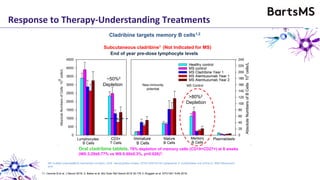
~50%2
Depletion
>80%2
Depletion
Subcutaneous cladribine1 (Not Indicated for MS)
New immunity
potential
MS Control
End of year pre-dose lymphocyte levels
Oral cladribine tablets. 79% depletion of memory cells (CD19+CD27+) at 8 weeks
(W0:3.29±0.77% vs W8:0.69±0.3%, p=0.028)3.
Cladribine targets memory B cells1,2
Treatment B Memory Cell
in Blood
Availability to Enter
the CNS
Relapse Rate Reference
Atacicept
Tabalumab
Glatiramer acetate
IFN β
Teriflunomide
Daclizumab*
Dimethyl fumarate
Fingolimod
Mitoxantrone
Natalizumab
rituximab
Ocrelizumab
Cladribine
Alemtuzumab
HSCT
Increased
Increased
Reduced
Reduced
Reduced
Reduced*
Reduced
Reduced
Reduced
Increased
Reduced
Reduced
Reduced
Reduced
Reduced
Increased
Increased
Reduced
Reduced
Reduced
Reduced
Reduced
Reduced
Reduced
Reduced
Reduced
Reduced
Reduced
Reduced
Reduced
Increased/No Effect
No Effect
Reduced
Reduced
Reduced
Reduced
Reduced
Reduced
Reduced
Reduced
Reduced
Reduced
Reduced
Reduced
Reduced
Sergott RC et al. Neurol Sci 2015; 15:175
Silk & Nantz Neurol 2018 90 (Suppl 15) P3.397 (NCT00882999)
Ireland SJ et al. JAMA Neurol 2014;71:1421
Rizzo F et al. J. Immunol Cell Biol 2016; 94:886
Gandoglia I et al. Neurol Neuroimmunol and Neuroinflamm 2017; 4:e403
Gold et al. BMC Neurol 2016;16:117
Lundy SK et al. Neurol Neuroimmunol and Neuroinflamm 2016; 3:e211Hh
Grutzke B et al Ann Clin Transl Neurol 215; 2: 119
Duddy M et al. J. Immunol 2007; 178;6092
Planas R et al. Eur J Immunol 2012;42;790
Palanichamy A et al. J. Immunol 2014;193:580
Fernandez Velasco et al. Mult scler 25 (S2) P686 ECTRIMS 2019
Ceronie B et al. J Neurol 2018;265:1199, Ruggieri et al. EPO1241 EAN 2019
Thompson et al. J Clin Immunol 2010;30;99
Storek J et al. Biol Blood Marrow Transplant 2008; 14:1379
Adapted from Baker D et al. EBioMed 2017 16:41.
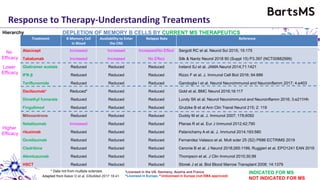
DEPLETION OF MEMORY B CELLS BY CURRENT MS THERAPEUTICS
* Data not from multiple sclerosis.
Response to Therapy-Understanding Treatments
*Licensed in the US, Germany, Austria and France
^Licensed in Europe, # Unlicensed in Europe (not EMA approved)
INDICATED FOR MS
NOT INDICATED FOR MS
Lower
Efficacy
Higher
Efficacy
No
Efficacy
Hierarchy
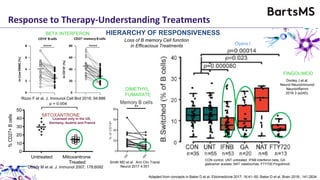
CON control, UNT untreated IFNB interferon beta, GA
glatiramer acetate, NAT natalizumab, FTY720 Fingolimod
MITOXANTRONE
FINGOLIMOD
BETA INTERFERON
Loss of B memory Cell function
in Efficacious Treatments
Dooley J et al.
Neurol Neuroimmunol
Neuroinflamm
2016 3 (e240).
Duddy M et al. J. Immunol 2007; 178;6092
Rizzo F et al. J. Immunol Cell Biol 2016; 94:886
Adapted from concepts in Baker D et al. Ebiomedicine 2017; 16:41–50; Baker D et al. Brain 2018:; 141:2834.
DIMETHYL
FUMARATE
Smith MD et al. Ann Clin Transl
Neurol 2017 4:351
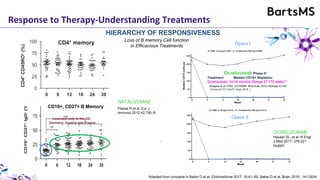
HIERARCHY OF RESPONSIVENESS
Response to Therapy-Understanding Treatments
Opera I
Licensed only in the US,
Germany, Austria and France
CON control, UNT untreated IFNB interferon beta, GA
glatiramer acetate, NAT natalizumab, FTY720 Fingolimod
MITOXANTRONE
FINGOLIMOD
BETA INTERFERON
Loss of B memory Cell function
in Efficacious Treatments
Dooley J et al.
Neurol Neuroimmunol
Neuroinflamm
2016 3 (e240).
Duddy M et al. J. Immunol 2007; 178;6092
Rizzo F et al. J. Immunol Cell Biol 2016; 94:886
Adapted from concepts in Baker D et al. Ebiomedicine 2017; 16:41–50; Baker D et al. Brain 2018:; 141:2834.
DIMETHYL
FUMARATE
Smith MD et al. Ann Clin Transl
Neurol 2017 4:351
CD19+, CD27+ B Memory Planas R et al. Eur J
Immunol 2012;42;790–8
NATALIZUMAB
Planas R et al. Eur J
Immunol 2012;42;790–8
HIERARCHY OF RESPONSIVENESS
Response to Therapy-Understanding Treatments
Opera I
Opera II
Ocrelizumab Phase II1
Treatment Median CD19+ Repletion
Ocrelizumab 15-18 months (Range 27-175 week)1,1
OCRELIZUMAB
Hauser SL, et al. N Engl
J Med 2017; 376:221
(suppl).
(Kappos et al. P352. ECTRIMS. Mult Scler 2012;18(Suppl.4):140.
(Ocrevus® EU SmPC Sept 2018. )
Licensed only in the US,
Germany, Austria and France
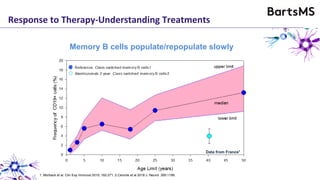
Memory B cells populate/repopulate slowly
1
2
1. Morback et al. Clin Exp Immunol 2010; 162:271. 2.Ceronie et al 2018 J. Neurol 265:1199.
Data from France1
Response to Therapy-Understanding Treatments
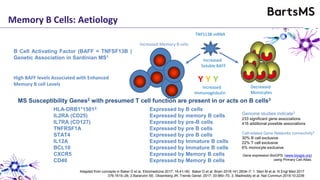
Memory B Cells: Aetiology
B Cell Activating Factor (BAFF = TNFSF13B )
Genetic Association in Sardinian MS1
High BAFF levels Associated with Enhanced
Memory B cell Levels
MS Susceptibility Genes2 with presumed T cell function are present in or acts on B cells3
HLA-DRB1*15012: Expressed by B cells
IL2RA (CD25) Expressed by memory B cells
IL7RA (CD127) Expressed by pre-B cells
TNFRSF1A Expressed by pre B cells
STAT4 Expressed by pre B cells
IL12A Expressed by Immature B cells
BCL10 Expressed by Immature B cells
CXCR5 Expressed by Memory B cells
CD40 Expressed by Memory B cells
Monocytes
Increased
Immunoglobulin
Decreased
Monocytes
Increased Memory B cells
Increased
Soluble BAFF
Y Y Y
TNFS13B mRNA
Gene expression BioGPS: (www.biogps.org)
using Primary Cell Atlas.
Adapted from concepts in Baker D et al. Ebiomedicine 2017; 16:41–50; Baker D et al. Brain 2018;141:2834–7; 1. Steri M et al. N Engl Med 2017
376;1615–26; 2.Baranzini SE, Oksenberg JR. Trends Genet. 2017; 33:960–70. 3. Madireddy et al. Nat Commun 2019:10:2236
Genome studies indicate3
233 significant gene associations
416 additional possible associations
Cell-related Gene Networks connectivity3
30% B cell exclusive
22% T cell exclusive
6% monocyte exclusive
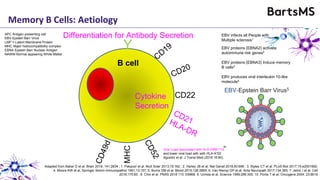
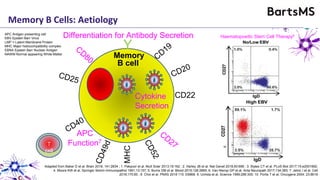
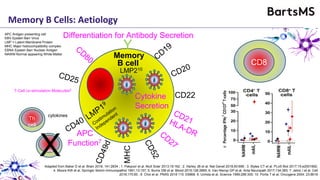
Differentiation for Antibody Secretion
Cytokine
Secretion
B cell
CD22
MHC
Y
EBV-Epstein Barr Virus5
EBV infects all People with
Multiple sclerosis1
EBV proteins (EBNA2) activate
autoimmune risk genes2
EBV proteins (EBNA3) Induce memory
B cells3
EBV produces viral interleukin 10-like
molecule4
APC Antigen presenting cell
EBV Epstein Barr Virus
LMP = Latent Membrane Protein
MHC Major histocompatibility complex
EBNA Epstein Barr Nuclear Antigen
NAWM Normal appearing White Matter
Adapted from Baker D et al. Brain 2018; 141:2834 ; 1. Pakpoor et al. Mult Scler 2013;19:162 ; 2. Harley JB et al. Nat Genet 2018;50:699 ; 3. Styles CT et al. PLoS Biol 2017;15:e2001992;
4. Moore KW et al. Springer Semin Immunopathol 1991;13:157; 5. Burns DM et al. Blood 2015;126:2665; 6. Van Nierop GP et al. Acta Neuropath 2017;134:383; 7. Jelcic I et al. Cell
2018;175:85 ; 8 Choi et al. PNAS 2018 115: E6868. 9. Uchida et al. Science 1999;286:300; 10. Portis T et al. Oncogene 2004; 23:8619
6
Memory B Cells: Aetiology
Viral Load associated with HLA-DRB1*15
and lower viral load with with HLA-A*02
Agostini et al. J Transl Med (2018 16:80)
Haematopoeitic Stem Cell Therapy5Differentiation for Antibody Secretion
Cytokine
Secretion
B cell
CD22
MHC
Y
APC Antigen presenting cell
EBV Epstein Barr Virus
LMP = Latent Membrane Protein
MHC Major histocompatibility complex
EBNA Epstein Barr Nuclear Antigen
NAWM Normal appearing White Matter
Adapted from Baker D et al. Brain 2018; 141:2834 ; 1. Pakpoor et al. Mult Scler 2013;19:162 ; 2. Harley JB et al. Nat Genet 2018;50:699 ; 3. Styles CT et al. PLoS Biol 2017;15:e2001992;
4. Moore KW et al. Springer Semin Immunopathol 1991;13:157; 5. Burns DM et al. Blood 2015;126:2665; 6. Van Nierop GP et al. Acta Neuropath 2017;134:383; 7. Jelcic I et al. Cell
2018;175:85 ; 8 Choi et al. PNAS 2018 115: E6868. 9. Uchida et al. Science 1999;286:300; 10. Portis T et al. Oncogene 2004; 23:8619
6
Memory B Cells: Aetiology
Memory
APC
Function7
T
cell
Differentiation for Antibody Secretion
Cytokine
Secretion
APC
Function7
B cell
CD22
MHC
Y
Memory
LMP210
T
cell
X
APC Antigen presenting cell
EBV Epstein Barr Virus
LMP = Latent Membrane Protein
MHC Major histocompatibility complex
EBNA Epstein Barr Nuclear Antigen
NAWM Normal appearing White Matter
Th
cell
cytokines
Adapted from Baker D et al. Brain 2018; 141:2834 ; 1. Pakpoor et al. Mult Scler 2013;19:162 ; 2. Harley JB et al. Nat Genet 2018;50:699 ; 3. Styles CT et al. PLoS Biol 2017;15:e2001992;
4. Moore KW et al. Springer Semin Immunopathol 1991;13:157; 5. Burns DM et al. Blood 2015;126:2665; 6. Van Nierop GP et al. Acta Neuropath 2017;134:383; 7. Jelcic I et al. Cell
2018;175:85 ; 8 Choi et al. PNAS 2018 115: E6868. 9. Uchida et al. Science 1999;286:300; 10. Portis T et al. Oncogene 2004; 23:8619
6
Memory B Cells: Aetiology
T-Cell co-stimulation Molecules8
CD8
Memory B Cells: Biology
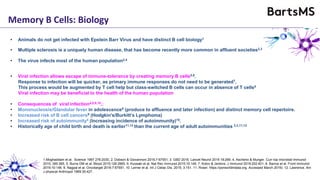
• Animals do not get infected with Epstein Barr Virus and have distinct B cell biology1
• Multiple sclerosis is a uniquely human disease, that has become recently more common in affluent societies2,3
• Viral infection allows escape of immune-tolerance by creating memory B cells5,6.
Response to infection will be quicker, as primary immune responses do not need to be generated7.
This process would be augmented by T cell help but class-switched B cells can occur in absence of T cells8
Viral infection may be beneficial to the health of the human population
• The virus infects most of the human population2,4
• Consequences of viral infection4,8,9,10,:
• Mononucleosis/Glandular fever in adolescence8 (produce to affluence and later infection) and distinct memory cell repertoire.
• Increased risk of B cell cancers9 (Hodgkin's/Burkitt’s Lymphoma)
• Increased risk of autoimmunity4 (Increasing incidence of autoimmunity)10.
• Historically age of child birth and death is earlier11,12 than the current age of adult autoimmunities 2,3,11,12
1.Moghaddam et al. Science 1997 276:2030, 2. Dobson & Giovannoni 2016;7:67551, 3. GBD 2016. Lancet Neurol 2019 18:269. 4. Ascherio & Munger. Curr top microbial Immunol
2015; 390:365, 5. Burns DM et al. Blood 2015;126:2665. 6. Kuosaki et al. Nat Rev Immunol 2015;15:149. 7. Kotov & Jenkins. J Immunol 2019;202:401, 8. Barros et al. Front Immunol
2019;10:146. 9. Nagpal et al. Oncotarget 2016:7:67551, 10. Lerner et al. Int J Celiac Dis. 2015; 3:151. 11. Roser. https://porworldindata.org. Accessed March 2019). 12. Lawrence. Am
J physical Anthropol 1969:30:427.
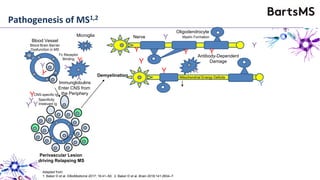
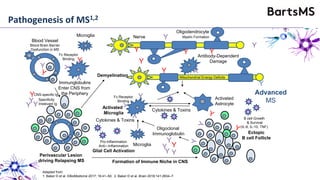
Perivascular Lesion
driving Relapsing MS
Blood Vessel
Blood Brain Barrier
Dysfunction in MS
Immunglobulins
Enter CNS from
the Periphery
Y
Y
YY
Y
Y
Y
Y
Antibody-Dependent
Damage
Y
Microglia
Y
Y
Y
Y
Y
CNS-specific Ig
Specificity
Irrelevant Ig
Mitochondrial Energy DeficitsDemyelination
Nerve
Oligodendrocyte
Myelin Formation
Y
Y
Y
Fc Receptor
Binding
Adapted from:
1. Baker D et al. EBioMedicine 2017; 16:41–50; 2. Baker D et al. Brain 2018;141:2834–7.
Pathogenesis of MS1,2
Perivascular Lesion
driving Relapsing MS
Blood Vessel
Blood Brain Barrier
Dysfunction in MS
Immunglobulins
Enter CNS from
the Periphery
Y
Y
YY
Y
Y
Y
Y
Antibody-Dependent
Damage
Y
Microglia
Y
Y
Y
Y
Y
CNS-specific Ig
Specificity
Irrelevant Ig
Mitochondrial Energy DeficitsDemyelination
Nerve
Oligodendrocyte
Myelin Formation
Y
Y
Y
Fc Receptor
Binding
Advanced
MS
Adapted from:
1. Baker D et al. EBioMedicine 2017; 16:41–50; 2. Baker D et al. Brain 2018;141:2834–7.
Y
Y
Y
Activated
Microglia
Pro-Inflammation
Anti—Inflammation
Glial Cell Activation
Cytokines & Toxins
Cytokines & Toxins
Activated
Astrocyte
Fc Receptor
Binding
Microglia
Ectopic
B cell Follicle
B cell Growth
& Survival
(IL-6, IL-10, TNF)
Y
YY
Y Y
Oligoclonal
Immunoglobulin
Formation of Immune Niche in CNS
Pathogenesis of MS1,2
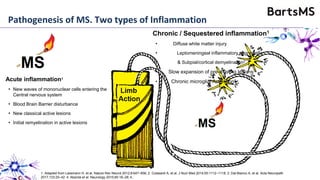
Pathogenesis of MS. Two types of Inflammation
Acute inflammation1
• New waves of mononuclear cells entering the
Central nervous system
• Blood Brain Barrier disturbance
• New classical active lesions
• Initial remyelination in active lesions
Chronic / Sequestered inflammation1
• Diffuse white matter injury
• Leptomeningeal inflammatory aggregates
& Subpial/cortical demyelination2
• Slow expansion of pre-existing lesions3
• Chronic microglial Activation4
1. Adapted from Lassmann H, et al. Nature Rev Neurol 2012;8:647–656; 2. Colasanti A, et al. J Nucl Med 2014;55:1112–1118; 3. Dal-Bianco A, et al. Acta Neuropath
2017;133:25–42 4. Absinta et al. Neurology 2015;85:18–28; 4..
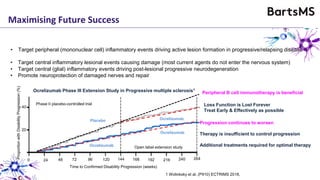
Maximising Future Success
Ocrelizumab
Open label extension study
ProportionwithDisabilityProgression(%)
20
40
0 14424 48 72 96 120 168 192 216 240 264
Time to Confirmed Disability Progression (weeks)
Progression continues to worsen
Therapy is insufficient to control progression
Additional treatments required for optimal therapy
Peripheral B cell immunotherapy is beneficial
Loss Function is Lost Forever
Treat Early & Effectively as possible
Ocrelizumab Phase III Extension Study in Progressive multiple sclerosis1
Ocrelizumab
Ocrelizumab
Placebo
Phase II placebo-controlled trial
• Target peripheral (mononuclear cell) inflammatory events driving active lesion formation in progressive/relapsing disease
• Target central inflammatory lesional events causing damage (most current agents do not enter the nervous system)
• Target central (glial) inflammatory events driving post-lesional progressive neurodegeneration
• Promote neuroprotection of damaged nerves and repair
1 Wolinksky et al. (P910) ECTRIMS 2018,
Summary
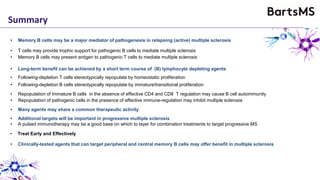
• Memory B cells may be a major mediator of pathogenesis in relapsing (active) multiple sclerosis
• Long-term benefit can be achieved by a short term course of (B) lymphocyte depleting agents
• Memory B cells may present antigen to pathogenic T cells to mediate multiple sclerosis
• T cells may provide trophic support for pathogenic B cells to mediate multiple sclerosis
• Additional targets will be important in progressive multiple sclerosis
• A pulsed immunotherapy may be a good base on which to layer for combination treatments to target progressive MS
• Repopulation of Immature B cells in the absence of effective CD4 and CD8 T regulation may cause B cell autoimmunity
• Repopulation of pathogenic cells in the presence of effective immune-regulation may inhibit multiple sclerosis
• Following-depletion T cells stereotypically repopulate by homeostatic proliferation
• Following-depletion B cells stereotypically repopulate by immature/transitional proliferation
• Many agents may share a common therapeutic activity
• Treat Early and Effectively
• Clinically-tested agents that can target peripheral and central memory B cells may offer benefit in multiple sclerosis
Thank you for Listening
Are B cells All that Matter?........No
But, B subsets are important targets

Baker ectrims teaching slides

  • 1.
    Professor David Baker (david.baker@qmul.ac.uk) ECTRIMS2019 Stockholm Are B cells all that matter? Education Session 3: B cell therapy of MS – pathology, immunology, clinical effects
  • 2.
    • The contentand slides were all designed and made by David Baker Conflict of Interest Statement • This meeting segment was sponsored by ECTRIMS • Although considered to be irrelevant, D. Baker has received compensation in the past 3 years from: Canbex Therapeutics, Japan Tobacco, Merck, • Contributor: BartsMS blog (www.ms-res.org) Roche. but are used here to help identify mechanisms of disease activity • Compounds in red are not (currently) indicated for multiple sclerosis,
  • 3.
    Aims • Understand theDiversity of B cell subsets • Response to Therapy (Clinical Trial) is a Key Experiment to Understand Biology • Repopulation Characteristics of Immune cells • Understand (B cell) Immunotherapy of Multiple Sclerosis
  • 4.
    Immune-Mediated Understanding the Pathogenesisof MS Influence of Positive & Well-Constructed Negative-Trials Genetics & Biology Response to TherapyPathology Biology (Models) Immune Cells in Lesions White & Grey Matter Damage Neuronal/Axonal Loss Demyelination Immune Susceptibility Genes Experimental Autoimmune Encephalomyelitis Response to Therapy Adapted from: Baker D et al. Ebiomedicine 2017; 16:41; Baker D et al. Brain 2018; 141:2834 CD4 Th1/Th17 Disease
  • 5.
    Immune-Mediated Understanding the Pathogenesisof MS Influence of Positive & Well-Constructed Negative-Trials Genetics & Biology Response to TherapyPathology Biology (Models) Immune Cells in Lesions White & Grey Matter Damage Neuronal/Axonal Loss Demyelination Immune Susceptibility Genes Experimental Autoimmune Encephalomyelitis Response to Therapy Adapted from: Baker D et al. Ebiomedicine 2017; 16:41; Baker D et al. Brain 2018; 141:2834 B Cell Driven CD4 Th1/Th17 Disease CD4 Helper Cell
  • 6.
    CD4 Th1 CD4 Th2 IL-2,IL-4IL-2 IL-4IFNγ IL-4, IL5IL-4, IL-5, IL-10, IL-13 B cell Eosinophil IL-6 IL-10 IFNγ IL-12 CD4 Th17 IL-17 IL-23 Macrophage Lytic Ab Treg Cell Fox3P DACLIZUMAB* (Block Tregs/MS Better but WITHDRAWN) R E S P O N S E T O T H E R A P Y Adapted from Delves et al. 2017 Roitt’s Essential Immunology Wiley Balckwell, Oxford 13th Edn 1. Sonar SA and Lal G. Front Immunol 2017;8:1695; 2. Lee GR Int J Mol sci 2018 ;19:730; 3. Baker D et al. EBioMed 2017;16:41–50; 4. Molnarfi N et al. J Exp Med 2013;210:2921–37; 5. Oh U et al. Arch Neurol 2009:66:471–9; 6. Kappos L et al. N Engl J Med 2015;373;1418–28; 7. Havrdora E et al. J Neurol 2016;263:1287–95; 8. Segal BM et al. Lancet Neurol 2008;7:796–804; 9. Vollmer TL et al. Mult Scler 2011;17:181–91; 10. van Oosten BW et al. Neurology 1997;49:351–7; 11. Hauser SL et al. N Engl J Med 2017;376:221–34; Antigen presenting B cells4 Understanding the Pathogenesis of MS-Response to Therapy1-4 *Not indicated for MS # Indicated for MS
  • 7.
    CD4 Th1 CD4 Th2 IL-2,IL-4IL-2 IL-4IFNγ IL-4, IL5IL-4, IL-5, IL-10, IL-13 B cell Eosinophil IL-6 IL-10 IFNγ IL-12 CD4 Th17 IL-17 IL-23 Macrophage Lytic Ab Treg Cell Fox3P DACLIZUMAB* (Block Tregs/MS Better but WITHDRAWN) CONCEPT MAY BE PROBLEMATIC5,6 CONCEPT MAY BE PROBLEMATIC WORSE THAN INTERFERON BETA USTEKINUMAB/ BRIAKINUMAB8,9,* No Effect in MS IL12/IL23 p40 SECUKINUMAB7* IL-17A INHIBITOR c-T41210,* CD4-DEPLETING mAb Minimal Effect MS OCRELIZUMAB11,# CD20-Depleting mAb/MARKED Effect on MS CD4 T CELL CONCEPT MAY BE PROBLEMATIC R E S P O N S E T O T H E R A P Y Adapted from Delves et al. 2017 Roitt’s Essential Immunology Wiley Balckwell, Oxford 13th Edn 1. Sonar SA and Lal G. Front Immunol 2017;8:1695; 2. Lee GR Int J Mol sci 2018 ;19:730; 3. Baker D et al. EBioMed 2017;16:41–50; 4. Molnarfi N et al. J Exp Med 2013;210:2921–37; 5. Oh U et al. Arch Neurol 2009:66:471–9; 6. Kappos L et al. N Engl J Med 2015;373;1418–28; 7. Havrdora E et al. J Neurol 2016;263:1287–95; 8. Segal BM et al. Lancet Neurol 2008;7:796–804; 9. Vollmer TL et al. Mult Scler 2011;17:181–91; 10. van Oosten BW et al. Neurology 1997;49:351–7; 11. Hauser SL et al. N Engl J Med 2017;376:221–34; CD4 T CELL CONCEPT MAY BE QUESTIONED Antigen presenting B cells4 Understanding the Pathogenesis of MS-Response to Therapy1-4 *Not indicated for MS # Indicated for MS
  • 8.
    Phenotyping in InflammatoryLesions Courtesy of Sandra Amor, NL CD20 B Cells B Cells CD4+ T Cells CD8+ T Cells Active Demyelination Active Lesions(Relapsing MS) Demyelinated Machado-Santos J et al. Brain 2018; 141:20661
  • 9.
    Phenotyping in InflammatoryLesions Courtesy of Sandra Amor, NL CD20 B Cells B Cells CD4+ T Cells CD8+ T Cells Active Demyelination Active Lesions(Relapsing MS) Demyelinated Machado-Santos J et al. Brain 2018; 141:20661 INFLAMMATORY PENUMBRA IN MS MYELIN Proteolipid protein = BROWN DEMYELINATION PERIVASCULAR LESION RELAPSING MSCells =haematoxylin = BLUE
  • 10.
    Treating the InflammatoryLesion Two compartment model RELAPSING MS Systemic immune compartment Intrathecal immune compartment DMT Disease Modifying Therapy Baker D et al. Ebiomedicine 2017; 16:41.
  • 11.
    Treating the InflammatoryLesion Two compartment model RELAPSING MS Systemic immune compartment Intrathecal immune compartment DMT Disease Modifying Therapy Baker D et al. Ebiomedicine 2017; 16:41.
  • 12.
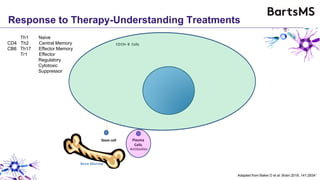
    Bone Marrow Stem cell Th1Naive CD4 Th2 Central Memory CB8 Th17 Effector Memory Tr1 Effector Regulatory Cytotoxic Suppressor Thymocyte CD4 T helper Thymus CD8 Cytotoxic Regulatory T cells Spleen & Lymph Nodes Naïve T Cells Th1Th17Th2 Help B cells To make Antibody to fight infection Help Innate Cells fight infection Help macrophages fight infection Fight viral infection Regulate & repair Naïve T cells Repopulate the Blood Slowly following depletion Aged Thymus Central Memory CD8 cell Effector Memory CD8 cell Expansion & Differentiation Effector Memory CD4 cell Central Memory CD4 cell Regulatory T Cells Antigen Naïve T Cells primed T Cells Adapted from elements within Delves PJ et al Roitt’s Essential Immunology 2017 Wiley, Blackwell 13th Edn. and Baker D et al. Brain 2018; 141:28341 Memory repopulate the blood by (homeostatic) proliferation following depletion T cell effector subsets are formed in secondary Lymphoid Tissue Response to Therapy-Understanding treatments
  • 13.
    Pre-Transplant1 Early Reconstitution1 LateReconstitution1 • Lymphopenia induced proliferation • Expanded memory and effector T cells (Homeostatic proliferation) • Expanded clonal Immune populations • Dysfunctional T regulatory cells • Pro-inflammatory cytokine environment • Thymic Rebound • Increasing Naïve cells • Diversification of T cell repertoire • Tolerance • Clonal Exhaustion of effector T cells Ablativeconditioning Massey et al. Front Immunol12 March 2018 | https://doi.org/10.3389/fimmu.2018.00410 2. Jones et al. Prc Natl Acad Sci U S A. 2013 : 110:20200, 3 Laurent et al. ECTRIMS 2017. Eposter 200348. Alemtuzumab2 Ocrelizumab3 T cell receptor diversity maintained Diversity of B cell receptor more restricted, but persistent clones IgG and IgM clones found3 Haematopoetic stem cell therapy (HSCT)1* changes immune repertoire3 Response to Therapy-Understanding treatments * Not indicated for MS
  • 14.
    Response to Therapy-UnderstandingTreatments Memory B cell Mature (Naïve) B Cell Immature (Transitional) B Cell Plasmablasts Germinal Centre B Clonal Expansion Spleen & Lymph Nodes Bone Marrow Plasma Cells Pre B cell Antibodies Mature (Naïve) B Cell Stem cell B cell subsets are Formed In Bone Marrow B cell subsets are formed in Secondary Lymphoid Tissue CD19+ B Cells Th1 Naive CD4 Th2 Central Memory CB8 Th17 Effector Memory Tr1 Effector Regulatory Cytotoxic Suppressor Adapted from Baker D et al. Brain 2018; 141:28341
  • 15.
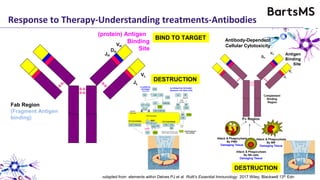
    (protein) Antigen Binding Site -S-S- -S-S- VH DH JH VL JL Fc Region Complement Binding Region BINDSTO PHAGOCYTES INNATE HELP INNATE HELP Fab Region (Fragment Antigen binding) Antibody-Dependent Cellular Cytotoxicity Adapted from elements within Delves PJ et al Roitt’s Essential Immunology 2017 Wiley, Blackwell 13th Edn BIND TO TARGET DESTRUCTION DESTRUCTION Response to Therapy-Understanding treatments-Antibodies
  • 16.
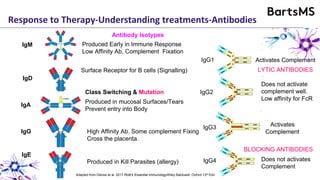
    Produced Early inImmune Response Low Affinity Ab, Complement Fixation IgM IgA Produced in mucosal Surfaces/Tears Prevent entry into Body IgD Surface Receptor for B cells (Signalling) IgE Produced in Kill Parasites (allergy) IgG High Affinity Ab. Some complement Fixing Cross the placenta. Class Switching & Mutation Antibody Isotypes IgG1 IgG2 IgG3 Activates Complement Activates Complement IgG4 Does not activates Complement Does not activate complement well. Low affinity for FcR BLOCKING ANTIBODIES LYTIC ANTIBODIES Adapted from Delves et al. 2017 Roitt’s Essential ImmunologyWiley Balckwell, Oxford 13th Edn Response to Therapy-Understanding treatments-Antibodies
  • 17.
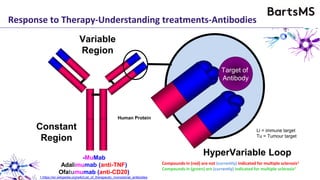
    Response to Therapy-Understandingtreatments-Antibodies Constant Region HyperVariable Loop Target of Antibody Variable Region -XiMab Infliximab (anti-TNF) Rituximab (anti-CD20) -ZuMab Certolizumab (anti-TNF) Ocrelizumab (anti-CD20) -MuMab Adalimumab (anti-TNF) Ofatumumab (anti-CD20) Compounds in (red) are not (currently) indicated for multiple sclerosis1 Compounds in (green) are (currently) indicated for multiple sclerosis1 Li = immune target Tu = Tumour target 1.https://en.wikipedia.org/wiki/List_of_therapeutic_monoclonal_antibodies Rodent ProteinHuman Protein
  • 18.
    Rodent Monoclonal Antibody Chimeric Response to Therapy-Understandingtreatments-Antibodies Constant Region HyperVariable Loop Target of Antibody Variable Region -XiMab Infliximab (anti-TNF) Rituximab (anti-CD20) -ZuMab Certolizumab (anti-TNF) Ocrelizumab (anti-CD20) -MuMab Adalimumab (anti-TNF) Ofatumumab (anti-CD20) Compounds in (red) are not (currently) indicated for multiple sclerosis1 Compounds in (green) are (currently) indicated for multiple sclerosis1 Li = immune target Tu = Tumour target 1.https://en.wikipedia.org/wiki/List_of_therapeutic_monoclonal_antibodies Rodent ProteinHuman Protein
  • 19.
    Rodent Monoclonal Antibody ChimericHumanized Response to Therapy-Understandingtreatments-Antibodies Constant Region HyperVariable Loop Target of Antibody Variable Region -XiMab Infliximab (anti-TNF) Rituximab (anti-CD20) -ZuMab Certolizumab (anti-TNF) Ocrelizumab (anti-CD20) -MuMab Adalimumab (anti-TNF) Ofatumumab (anti-CD20) Compounds in (red) are not (currently) indicated for multiple sclerosis1 Compounds in (green) are (currently) indicated for multiple sclerosis1 Li = immune target Tu = Tumour target 1.https://en.wikipedia.org/wiki/List_of_therapeutic_monoclonal_antibodies Rodent ProteinHuman Protein
  • 20.
    Rodent Monoclonal Antibody ChimericHumanized Response to Therapy-Understandingtreatments-Antibodies Constant Region HyperVariable Loop Target of Antibody Variable Region -XiMab Infliximab (anti-TNF) Rituximab (anti-CD20) -ZuMab Certolizumab (anti-TNF) Ocrelizumab (anti-CD20) -MuMab Adalimumab (anti-TNF) Ofatumumab (anti-CD20) Compounds in (red) are not (currently) indicated for multiple sclerosis1 Compounds in (green) are (currently) indicated for multiple sclerosis1 Li = immune target Tu = Tumour target 1.https://en.wikipedia.org/wiki/List_of_therapeutic_monoclonal_antibodies Rodent ProteinHuman Protein
  • 21.
    CD19 Adapted from Delveset al. 2017 Roitt’s Essential ImmunologyWiley Balckwell, Oxford 13th Edn Response to Therapy-Understanding treatments- B cell Subsets REGULATORY CELL ( IL-10 Secreting) TRANSITIONAL CELL NAIVE ANTIBODY SECRETING CELLS (ASC) Unswitched IgD+ Class-Switched IgD- IgM+/IgA+/IgG+
  • 22.
    Response to Therapy-UnderstandingTreatments Memory B cell Mature (Naïve) B Cell Immature (Transitional) B Cell Plasmablasts Germinal Centre B Clonal Expansion Spleen & Lymph Nodes Bone Marrow Plasma Cells Pre B cell Antibodies Mature (Naïve) B Cell Stem cell B cell subsets are Formed In Bone Marrow B cell subsets are formed in Secondary Lymphoid Tissue Repopulate the Blood Rapidly following Depletion Repopulate the Blood Slowly following Depletion CD19+ B Cells Th1 Naive CD4 Th2 Central Memory CB8 Th17 Effector Memory Tr1 Effector Regulatory Cytotoxic Suppressor Adapted from Baker D et al. Brain 2018; 141:28341
  • 23.
    Time Post-Administration (Months) 03 6 9 12 15 18 21 24 MeanPercentageChangefromBaseline -100 -90 -80 -70 -60 -50 -40 -30 -20 -10 0 10 20 30 40 Time Post-Administration (Months) 0 3 6 9 12 15 18 21 24 MeanPercentageChangefromBaseline 0 20 40 60 80 100 120 140 160 180 200 Immatute B cells CD19 B cells Time Post-Administration (Months) 0 3 6 9 12 15 18 21 24 MeanPercentageChangefromBaseline -100 -80 -60 -40 -20 0 20 40 60 80 100 120 140 Mature Naive B cells Time Post-Administration (Months) 0 3 6 9 12 15 18 21 24 MeanPercentageChangefromBaseline -100 -90 -80 -70 -60 -50 -40 -30 -20 -10 0 10 Memory B cells Response to Therapy-Understanding Treatments (From Bone Marrow) (From Bone Marrow) (From Lymphoid Organs) (Slow Repopulation) CD4 Regulatory T cells Absolute lymphocyte numbers in CARE- MS following treatment with alemtuzumab1 1.Adapted from Baker D et al. JAMA Neurol 2017; 74:961, . Lemtrada® US Prescribing Information, Nov 2018; . Coles AJ et al. Lancet Neurol 2012; 380:1829 – 39.4. Wardemann H, et al. Science 2003;301:1374 -1377 “Alemtuzumab depletes circulating T and B lymphocytes ….B-cell recovery usually completed within 6 months. CD3+ and CD4+ lymphocyte counts rise more slowly towards normal, but generally do not return to baseline by 12- months post-treatment”.2,3 Cohen AJ et al. Lancet Neurol 2012; 380:1829
  • 24.
    Time Post-Administration (Months) 03 6 9 12 15 18 21 24 MeanPercentageChangefromBaseline -100 -90 -80 -70 -60 -50 -40 -30 -20 -10 0 10 20 30 40 Time Post-Administration (Months) 0 3 6 9 12 15 18 21 24 MeanPercentageChangefromBaseline 0 20 40 60 80 100 120 140 160 180 200 Immatute B cells CD19 B cells Time Post-Administration (Months) 0 3 6 9 12 15 18 21 24 MeanPercentageChangefromBaseline -100 -80 -60 -40 -20 0 20 40 60 80 100 120 140 Mature Naive B cells Time Post-Administration (Months) 0 3 6 9 12 15 18 21 24 MeanPercentageChangefromBaseline -100 -90 -80 -70 -60 -50 -40 -30 -20 -10 0 10 Memory B cells Response to Therapy-Understanding Treatments (From Bone Marrow) (From Bone Marrow) (From Lymphoid Organs) (Slow Repopulation) HumanCD52 transgenic mice treated with alemtuzumab Bone marrow Not purged Absolute lymphocyte numbers in CARE- MS following treatment with alemtuzumab1 1.Adapted from Baker D et al. JAMA Neurol 2017; 74:961, . Lemtrada® US Prescribing Information, Nov 2018; . Coles AJ et al. Lancet Neurol 2012; 380:1829 – 39.4. Wardemann H, et al. Science 2003;301:1374 -1377 “Alemtuzumab depletes circulating T and B lymphocytes ….B-cell recovery usually completed within 6 months. CD3+ and CD4+ lymphocyte counts rise more slowly towards normal, but generally do not return to baseline by 12- months post-treatment”.2,3 Cohen AJ et al. Lancet Neurol 2012; 380:1829 55-75% of Early Immature B cells are potentially Autoreactive4 Baker D et al. JAMA Neurol 2017; 74:961 .
  • 25.
    Potential mechanism ofaction of Alemtuzumab1 Time Post-Administration (Months) 0 3 6 9 12 15 18 21 24 MeanPercentageChangefromBaseline -100 -90 -80 -70 -60 -50 -40 -30 -20 -10 0 10 20 30 40 Time Post-Administration (Months) 0 3 6 9 12 15 18 21 24 MeanPercentageChangefromBaseline 0 20 40 60 80 100 120 140 160 180 200 Immatute B cells CD19 B cells Time Post-Administration (Months) 0 3 6 9 12 15 18 21 24 MeanPercentageChangefromBaseline -100 -80 -60 -40 -20 0 20 40 60 80 100 120 140 Mature Naive B cells Time Post-Administration (Months) 0 3 6 9 12 15 18 21 24 MeanPercentageChangefromBaseline -100 -90 -80 -70 -60 -50 -40 -30 -20 -10 0 10 Memory B cells Response to Therapy-Understanding Treatments (From Bone Marrow) (From Bone Marrow) (From Lymphoid Organs) (Slow Repopulation) HumanCD52 transgenic mice treated with alemtuzumab Bone marrow Not purged Absolute lymphocyte numbers in CARE- MS following treatment with alemtuzumab1 “Alemtuzumab depletes circulating T and B lymphocytes ….B-cell recovery usually completed within 6 months. CD3+ and CD4+ lymphocyte counts rise more slowly towards normal, but generally do not return to baseline by 12- months post-treatment”.2,3 Cohen AJ et al. Lancet Neurol 2012; 380:1829 55-75% of Early Immature B cells are potentially Autoreactive4 Anti-Drug Antibodies (60% within 1 month)1 The mechanism by which alemtuzumab exerts its therapeutic and adverse effects in MS is not fully elucidated, but are thought to be immune-controlled1,2 1.Adapted from Baker D et al. JAMA Neurol 2017; 74:961, 2. Lemtrada® US Prescribing Information, Nov 2018; 3. Coles AJ et al. Lancet Neurol 2012; 380:1829 – 39. 4. Wardemann H, et al. Science 2003;301:1374 -1377 Alemtuzumab1,2
  • 26.
    1. Baker etal. Neurol Neuroimmunol Neuroinflamm. 2017; 5;4:e360, 2, Baker et al. Mul Scler Rel Disord 2019 30:176, 3 . Comi et al. J neurol 2013:260:1136,Giovannoni et al. N Eng J med 2010:362:416 Time post-administration (weeks) 0 10 20 30 40 50 60 70 80 90 100 ChangeinCD4Helper/InducerTcells(%) -100 -90 -80 -70 -60 -50 -40 -30 -20 -10 0 10 20 Placebo Cladribine 3.5mg/kg CD3 T cells Time post-administration (Weeks) 0 10 20 30 40 50 60 70 80 90 100 ChangeinCD3Tcells(% -100 -90 -80 -70 -60 -50 -40 -30 -20 -10 0 10 20 CD4 T cells Time post-administration (weeks) 0 10 20 30 40 50 60 70 80 90 100 ChangeinCD8Suppressor.CytotoxicTcells(%) -100 -90 -80 -70 -60 -50 -40 -30 -20 -10 0 10 20 Placebo Cladribine 3.5mg/kg CD8 T cells Time Post-Administration (Weeks) 0 10 20 30 40 50 60 70 80 90 100 ChangeinCD19Bcells(%) -100 -90 -80 -70 -60 -50 -40 -30 -20 -10 0 10 20 Placebo Cladribine.5mg/kg CD19 B cells Modest T cell depletion by oral cladribine1,2 ~30-40% 20-30% 30-40% ~40-50% ~80-90% Response to Therapy-Understanding Treatments Memory CD45RO2 ~30-40% Memory CD45RO2 ~10-20% Imaging and clinical outcomes show benefit within 12 months of treatment3,4
  • 27.
    MS multiple sclerosisMOAmechanism of action. DCK deoxycytidine kinase, NT5C1A/NT5C1B Cytoplasmic 5’ nucleotidase one A/One B, RNA Ribonucelic acid 11. Ceronie B et al. J Neurol 2018: 2, Baker et al. Mul Scler Rel Disord 2019 30:176 3.,Ruggieri et al. EPO1241 EAN 2019. Response to Therapy-Understanding Treatments ~50%2 Depletion >80%2 Depletion Subcutaneous cladribine1 (Not Indicated for MS) New immunity potential MS Control End of year pre-dose lymphocyte levels Oral cladribine tablets. 79% depletion of memory cells (CD19+CD27+) at 8 weeks (W0:3.29±0.77% vs W8:0.69±0.3%, p=0.028)3. Cladribine targets memory B cells1,2
  • 28.
    Treatment B MemoryCell in Blood Availability to Enter the CNS Relapse Rate Reference Atacicept Tabalumab Glatiramer acetate IFN β Teriflunomide Daclizumab* Dimethyl fumarate Fingolimod Mitoxantrone Natalizumab rituximab Ocrelizumab Cladribine Alemtuzumab HSCT Increased Increased Reduced Reduced Reduced Reduced* Reduced Reduced Reduced Increased Reduced Reduced Reduced Reduced Reduced Increased Increased Reduced Reduced Reduced Reduced Reduced Reduced Reduced Reduced Reduced Reduced Reduced Reduced Reduced Increased/No Effect No Effect Reduced Reduced Reduced Reduced Reduced Reduced Reduced Reduced Reduced Reduced Reduced Reduced Reduced Sergott RC et al. Neurol Sci 2015; 15:175 Silk & Nantz Neurol 2018 90 (Suppl 15) P3.397 (NCT00882999) Ireland SJ et al. JAMA Neurol 2014;71:1421 Rizzo F et al. J. Immunol Cell Biol 2016; 94:886 Gandoglia I et al. Neurol Neuroimmunol and Neuroinflamm 2017; 4:e403 Gold et al. BMC Neurol 2016;16:117 Lundy SK et al. Neurol Neuroimmunol and Neuroinflamm 2016; 3:e211Hh Grutzke B et al Ann Clin Transl Neurol 215; 2: 119 Duddy M et al. J. Immunol 2007; 178;6092 Planas R et al. Eur J Immunol 2012;42;790 Palanichamy A et al. J. Immunol 2014;193:580 Fernandez Velasco et al. Mult scler 25 (S2) P686 ECTRIMS 2019 Ceronie B et al. J Neurol 2018;265:1199, Ruggieri et al. EPO1241 EAN 2019 Thompson et al. J Clin Immunol 2010;30;99 Storek J et al. Biol Blood Marrow Transplant 2008; 14:1379 Adapted from Baker D et al. EBioMed 2017 16:41. DEPLETION OF MEMORY B CELLS BY CURRENT MS THERAPEUTICS * Data not from multiple sclerosis. Response to Therapy-Understanding Treatments *Licensed in the US, Germany, Austria and France ^Licensed in Europe, # Unlicensed in Europe (not EMA approved) INDICATED FOR MS NOT INDICATED FOR MS Lower Efficacy Higher Efficacy No Efficacy Hierarchy
  • 29.
    CON control, UNTuntreated IFNB interferon beta, GA glatiramer acetate, NAT natalizumab, FTY720 Fingolimod MITOXANTRONE FINGOLIMOD BETA INTERFERON Loss of B memory Cell function in Efficacious Treatments Dooley J et al. Neurol Neuroimmunol Neuroinflamm 2016 3 (e240). Duddy M et al. J. Immunol 2007; 178;6092 Rizzo F et al. J. Immunol Cell Biol 2016; 94:886 Adapted from concepts in Baker D et al. Ebiomedicine 2017; 16:41–50; Baker D et al. Brain 2018:; 141:2834. DIMETHYL FUMARATE Smith MD et al. Ann Clin Transl Neurol 2017 4:351 HIERARCHY OF RESPONSIVENESS Response to Therapy-Understanding Treatments Opera I Licensed only in the US, Germany, Austria and France
  • 30.
    CON control, UNTuntreated IFNB interferon beta, GA glatiramer acetate, NAT natalizumab, FTY720 Fingolimod MITOXANTRONE FINGOLIMOD BETA INTERFERON Loss of B memory Cell function in Efficacious Treatments Dooley J et al. Neurol Neuroimmunol Neuroinflamm 2016 3 (e240). Duddy M et al. J. Immunol 2007; 178;6092 Rizzo F et al. J. Immunol Cell Biol 2016; 94:886 Adapted from concepts in Baker D et al. Ebiomedicine 2017; 16:41–50; Baker D et al. Brain 2018:; 141:2834. DIMETHYL FUMARATE Smith MD et al. Ann Clin Transl Neurol 2017 4:351 CD19+, CD27+ B Memory Planas R et al. Eur J Immunol 2012;42;790–8 NATALIZUMAB Planas R et al. Eur J Immunol 2012;42;790–8 HIERARCHY OF RESPONSIVENESS Response to Therapy-Understanding Treatments Opera I Opera II Ocrelizumab Phase II1 Treatment Median CD19+ Repletion Ocrelizumab 15-18 months (Range 27-175 week)1,1 OCRELIZUMAB Hauser SL, et al. N Engl J Med 2017; 376:221 (suppl). (Kappos et al. P352. ECTRIMS. Mult Scler 2012;18(Suppl.4):140. (Ocrevus® EU SmPC Sept 2018. ) Licensed only in the US, Germany, Austria and France
  • 31.
    Memory B cellspopulate/repopulate slowly 1 2 1. Morback et al. Clin Exp Immunol 2010; 162:271. 2.Ceronie et al 2018 J. Neurol 265:1199. Data from France1 Response to Therapy-Understanding Treatments
  • 32.
    Memory B Cells:Aetiology B Cell Activating Factor (BAFF = TNFSF13B ) Genetic Association in Sardinian MS1 High BAFF levels Associated with Enhanced Memory B cell Levels MS Susceptibility Genes2 with presumed T cell function are present in or acts on B cells3 HLA-DRB1*15012: Expressed by B cells IL2RA (CD25) Expressed by memory B cells IL7RA (CD127) Expressed by pre-B cells TNFRSF1A Expressed by pre B cells STAT4 Expressed by pre B cells IL12A Expressed by Immature B cells BCL10 Expressed by Immature B cells CXCR5 Expressed by Memory B cells CD40 Expressed by Memory B cells Monocytes Increased Immunoglobulin Decreased Monocytes Increased Memory B cells Increased Soluble BAFF Y Y Y TNFS13B mRNA Gene expression BioGPS: (www.biogps.org) using Primary Cell Atlas. Adapted from concepts in Baker D et al. Ebiomedicine 2017; 16:41–50; Baker D et al. Brain 2018;141:2834–7; 1. Steri M et al. N Engl Med 2017 376;1615–26; 2.Baranzini SE, Oksenberg JR. Trends Genet. 2017; 33:960–70. 3. Madireddy et al. Nat Commun 2019:10:2236 Genome studies indicate3 233 significant gene associations 416 additional possible associations Cell-related Gene Networks connectivity3 30% B cell exclusive 22% T cell exclusive 6% monocyte exclusive
  • 33.
    Differentiation for AntibodySecretion Cytokine Secretion B cell CD22 MHC Y EBV-Epstein Barr Virus5 EBV infects all People with Multiple sclerosis1 EBV proteins (EBNA2) activate autoimmune risk genes2 EBV proteins (EBNA3) Induce memory B cells3 EBV produces viral interleukin 10-like molecule4 APC Antigen presenting cell EBV Epstein Barr Virus LMP = Latent Membrane Protein MHC Major histocompatibility complex EBNA Epstein Barr Nuclear Antigen NAWM Normal appearing White Matter Adapted from Baker D et al. Brain 2018; 141:2834 ; 1. Pakpoor et al. Mult Scler 2013;19:162 ; 2. Harley JB et al. Nat Genet 2018;50:699 ; 3. Styles CT et al. PLoS Biol 2017;15:e2001992; 4. Moore KW et al. Springer Semin Immunopathol 1991;13:157; 5. Burns DM et al. Blood 2015;126:2665; 6. Van Nierop GP et al. Acta Neuropath 2017;134:383; 7. Jelcic I et al. Cell 2018;175:85 ; 8 Choi et al. PNAS 2018 115: E6868. 9. Uchida et al. Science 1999;286:300; 10. Portis T et al. Oncogene 2004; 23:8619 6 Memory B Cells: Aetiology Viral Load associated with HLA-DRB1*15 and lower viral load with with HLA-A*02 Agostini et al. J Transl Med (2018 16:80)
  • 34.
    Haematopoeitic Stem CellTherapy5Differentiation for Antibody Secretion Cytokine Secretion B cell CD22 MHC Y APC Antigen presenting cell EBV Epstein Barr Virus LMP = Latent Membrane Protein MHC Major histocompatibility complex EBNA Epstein Barr Nuclear Antigen NAWM Normal appearing White Matter Adapted from Baker D et al. Brain 2018; 141:2834 ; 1. Pakpoor et al. Mult Scler 2013;19:162 ; 2. Harley JB et al. Nat Genet 2018;50:699 ; 3. Styles CT et al. PLoS Biol 2017;15:e2001992; 4. Moore KW et al. Springer Semin Immunopathol 1991;13:157; 5. Burns DM et al. Blood 2015;126:2665; 6. Van Nierop GP et al. Acta Neuropath 2017;134:383; 7. Jelcic I et al. Cell 2018;175:85 ; 8 Choi et al. PNAS 2018 115: E6868. 9. Uchida et al. Science 1999;286:300; 10. Portis T et al. Oncogene 2004; 23:8619 6 Memory B Cells: Aetiology Memory APC Function7 T cell
  • 35.
    Differentiation for AntibodySecretion Cytokine Secretion APC Function7 B cell CD22 MHC Y Memory LMP210 T cell X APC Antigen presenting cell EBV Epstein Barr Virus LMP = Latent Membrane Protein MHC Major histocompatibility complex EBNA Epstein Barr Nuclear Antigen NAWM Normal appearing White Matter Th cell cytokines Adapted from Baker D et al. Brain 2018; 141:2834 ; 1. Pakpoor et al. Mult Scler 2013;19:162 ; 2. Harley JB et al. Nat Genet 2018;50:699 ; 3. Styles CT et al. PLoS Biol 2017;15:e2001992; 4. Moore KW et al. Springer Semin Immunopathol 1991;13:157; 5. Burns DM et al. Blood 2015;126:2665; 6. Van Nierop GP et al. Acta Neuropath 2017;134:383; 7. Jelcic I et al. Cell 2018;175:85 ; 8 Choi et al. PNAS 2018 115: E6868. 9. Uchida et al. Science 1999;286:300; 10. Portis T et al. Oncogene 2004; 23:8619 6 Memory B Cells: Aetiology T-Cell co-stimulation Molecules8 CD8
  • 36.
    Memory B Cells:Biology • Animals do not get infected with Epstein Barr Virus and have distinct B cell biology1 • Multiple sclerosis is a uniquely human disease, that has become recently more common in affluent societies2,3 • Viral infection allows escape of immune-tolerance by creating memory B cells5,6. Response to infection will be quicker, as primary immune responses do not need to be generated7. This process would be augmented by T cell help but class-switched B cells can occur in absence of T cells8 Viral infection may be beneficial to the health of the human population • The virus infects most of the human population2,4 • Consequences of viral infection4,8,9,10,: • Mononucleosis/Glandular fever in adolescence8 (produce to affluence and later infection) and distinct memory cell repertoire. • Increased risk of B cell cancers9 (Hodgkin's/Burkitt’s Lymphoma) • Increased risk of autoimmunity4 (Increasing incidence of autoimmunity)10. • Historically age of child birth and death is earlier11,12 than the current age of adult autoimmunities 2,3,11,12 1.Moghaddam et al. Science 1997 276:2030, 2. Dobson & Giovannoni 2016;7:67551, 3. GBD 2016. Lancet Neurol 2019 18:269. 4. Ascherio & Munger. Curr top microbial Immunol 2015; 390:365, 5. Burns DM et al. Blood 2015;126:2665. 6. Kuosaki et al. Nat Rev Immunol 2015;15:149. 7. Kotov & Jenkins. J Immunol 2019;202:401, 8. Barros et al. Front Immunol 2019;10:146. 9. Nagpal et al. Oncotarget 2016:7:67551, 10. Lerner et al. Int J Celiac Dis. 2015; 3:151. 11. Roser. https://porworldindata.org. Accessed March 2019). 12. Lawrence. Am J physical Anthropol 1969:30:427.
  • 37.
    Perivascular Lesion driving RelapsingMS Blood Vessel Blood Brain Barrier Dysfunction in MS Immunglobulins Enter CNS from the Periphery Y Y YY Y Y Y Y Antibody-Dependent Damage Y Microglia Y Y Y Y Y CNS-specific Ig Specificity Irrelevant Ig Mitochondrial Energy DeficitsDemyelination Nerve Oligodendrocyte Myelin Formation Y Y Y Fc Receptor Binding Adapted from: 1. Baker D et al. EBioMedicine 2017; 16:41–50; 2. Baker D et al. Brain 2018;141:2834–7. Pathogenesis of MS1,2
  • 38.
    Perivascular Lesion driving RelapsingMS Blood Vessel Blood Brain Barrier Dysfunction in MS Immunglobulins Enter CNS from the Periphery Y Y YY Y Y Y Y Antibody-Dependent Damage Y Microglia Y Y Y Y Y CNS-specific Ig Specificity Irrelevant Ig Mitochondrial Energy DeficitsDemyelination Nerve Oligodendrocyte Myelin Formation Y Y Y Fc Receptor Binding Advanced MS Adapted from: 1. Baker D et al. EBioMedicine 2017; 16:41–50; 2. Baker D et al. Brain 2018;141:2834–7. Y Y Y Activated Microglia Pro-Inflammation Anti—Inflammation Glial Cell Activation Cytokines & Toxins Cytokines & Toxins Activated Astrocyte Fc Receptor Binding Microglia Ectopic B cell Follicle B cell Growth & Survival (IL-6, IL-10, TNF) Y YY Y Y Oligoclonal Immunoglobulin Formation of Immune Niche in CNS Pathogenesis of MS1,2
  • 39.
    Pathogenesis of MS.Two types of Inflammation Acute inflammation1 • New waves of mononuclear cells entering the Central nervous system • Blood Brain Barrier disturbance • New classical active lesions • Initial remyelination in active lesions Chronic / Sequestered inflammation1 • Diffuse white matter injury • Leptomeningeal inflammatory aggregates & Subpial/cortical demyelination2 • Slow expansion of pre-existing lesions3 • Chronic microglial Activation4 1. Adapted from Lassmann H, et al. Nature Rev Neurol 2012;8:647–656; 2. Colasanti A, et al. J Nucl Med 2014;55:1112–1118; 3. Dal-Bianco A, et al. Acta Neuropath 2017;133:25–42 4. Absinta et al. Neurology 2015;85:18–28; 4..
  • 40.
    Maximising Future Success Ocrelizumab Openlabel extension study ProportionwithDisabilityProgression(%) 20 40 0 14424 48 72 96 120 168 192 216 240 264 Time to Confirmed Disability Progression (weeks) Progression continues to worsen Therapy is insufficient to control progression Additional treatments required for optimal therapy Peripheral B cell immunotherapy is beneficial Loss Function is Lost Forever Treat Early & Effectively as possible Ocrelizumab Phase III Extension Study in Progressive multiple sclerosis1 Ocrelizumab Ocrelizumab Placebo Phase II placebo-controlled trial • Target peripheral (mononuclear cell) inflammatory events driving active lesion formation in progressive/relapsing disease • Target central inflammatory lesional events causing damage (most current agents do not enter the nervous system) • Target central (glial) inflammatory events driving post-lesional progressive neurodegeneration • Promote neuroprotection of damaged nerves and repair 1 Wolinksky et al. (P910) ECTRIMS 2018,
  • 41.
    Summary • Memory Bcells may be a major mediator of pathogenesis in relapsing (active) multiple sclerosis • Long-term benefit can be achieved by a short term course of (B) lymphocyte depleting agents • Memory B cells may present antigen to pathogenic T cells to mediate multiple sclerosis • T cells may provide trophic support for pathogenic B cells to mediate multiple sclerosis • Additional targets will be important in progressive multiple sclerosis • A pulsed immunotherapy may be a good base on which to layer for combination treatments to target progressive MS • Repopulation of Immature B cells in the absence of effective CD4 and CD8 T regulation may cause B cell autoimmunity • Repopulation of pathogenic cells in the presence of effective immune-regulation may inhibit multiple sclerosis • Following-depletion T cells stereotypically repopulate by homeostatic proliferation • Following-depletion B cells stereotypically repopulate by immature/transitional proliferation • Many agents may share a common therapeutic activity • Treat Early and Effectively • Clinically-tested agents that can target peripheral and central memory B cells may offer benefit in multiple sclerosis
  • 42.
    Thank you forListening Are B cells All that Matter?........No But, B subsets are important targets