



Business Analysis
“To thrive in an ever-changing world you need
to make the right decisions. This is only
achievable if you have the right information.
“Business Analysis is vital in helping the
organisation obtain this detail and effectively
manage business change.”
BCS, The Chartered Institute for IT
What is a business analyst?
The business analyst is an advisory role that
has responsibility for:
• Investigating and analysing business situations.
• Identifying and evaluating options for improving business
systems.
• Elaborating and defining requirements.
• Ensuring the effective implementation and use of
information systems in line with the needs of the business.
Core responsibilities of a BA
Although there are different role definitions,
depending on the organisation there is an
area of common ground where most
business analysts work.
Core responsibilities include:
• Investigate business systems taking a holistic view of the
situation; this may include examining elements of the
organisation structures and staff development issues as
well as current processes and IT systems.
Core responsibilities of a BA
• Evaluate actions to improve the operation of a business
system. Again, this may require an examination of
organisational structure and staff development needs, to
ensure that they are in line with any proposed process
redesign and IT system development.
• Document the business requirements for the IT system
support using appropriate documentation standards.
• Elaborate requirements, in support of the business users,
during evolutionary system development.
What can we do for you?
Business Analysis
Professional Certification
bcs.org/businessanalysis
BCS Business Analysis Certification
Scheme
Foundation level
•Business Change
–Incorporate the techniques, frameworks and models used
in business change activities.
•Business Analysis
–Covers the range of concepts, approaches and techniques
for business analysis.
•Commercial Awareness
–Structured around business finance and organisation
behaviour for business analysis work.
bcs.org/businessanalysis
Practitioner level
•Benefits Management & Business Acceptance
–Delivery of successful software solutions.
•Business Analysis Practice
–The development of effective business solutions.
•Data Management Essentials
–Procedures for managing corporate data resource.
•Modelling Business Practice
–Leading to the improvement of business processes.
•Requirements Engineering
–A systematic approach from analysis to management.
bcs.org/businessanalysis
Practitioner level
bcs.org/businessanalysis
Note:
The practitioner level modules can be taken
individually or as a learning pathway to the
BCS International Diploma in Business
Analysis.
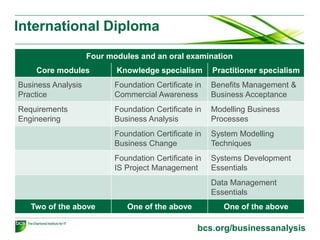
BCS International Diploma
Four modules and an oral examination
Core modules Knowledge specialism Practitioner specialism
Business Analysis
Practice
Foundation Certificate in
Commercial Awareness
Benefits Management &
Business Acceptance
Requirements
Engineering
Foundation Certificate in
Business Analysis
Modelling Business
Processes
Foundation Certificate in
Business Change
System Modelling
Techniques
Foundation Certificate in
IS Project Management
Systems Development
Essentials
Data Management
Essentials
Two of the above One of the above One of the above
bcs.org/businessanalysis
Professional level
•Agile Business Analysis
–Adopt an agile approach to business analysis.
•Business Architecture
–Ensure the effectiveness of business change
programmes.
•Data Analysis
–Understand a range of data analysis and modelling
techniques.
•Benefits Planning and Realisation
–Manage the change lifecycle to realise business benefits.
bcs.org/businessanalysis
International Advanced Diploma
bcs.org/businessanalysis
•Designed for senior business analysts who:
–Hold the BCS International Diploma in Business Analysis
–Have a minimum of five years’ experience in business
analysis
–Hold a range of BCS professional certifications
–Plus, interested applicants should be able to demonstrate
ongoing personal development in the profession and
active contributions within business analysis communities.
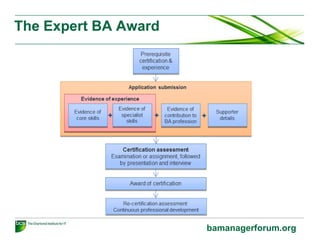
The Expert BA Award
•Established by the BA Manager Forum
•Joint awarding bodies are:
– BCS for their experience in the professional development
of business analysts
– CMI (Chartered Management Institute) for their expertise
and heritage in leadership and consultancy
•Developed to recognise the Business Analyst
working at consultant level
•A career development path for senior BAs
bamanagerforum.org
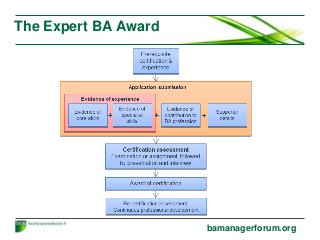
The Expert BA Award
bamanagerforum.org
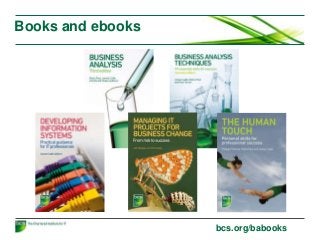
Publishing
bcs.org/babooks
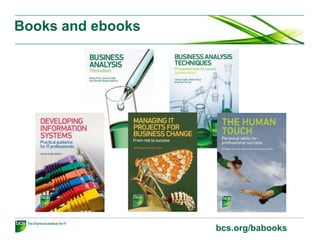
Books and ebooks
bcs.org/babooks
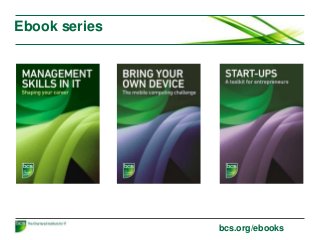
Ebook series
bcs.org/ebooks
Business Analysis

Business Analysis

  • 2.
    Business Analysis “To thrivein an ever-changing world you need to make the right decisions. This is only achievable if you have the right information. “Business Analysis is vital in helping the organisation obtain this detail and effectively manage business change.” BCS, The Chartered Institute for IT
  • 3.
    What is abusiness analyst? The business analyst is an advisory role that has responsibility for: • Investigating and analysing business situations. • Identifying and evaluating options for improving business systems. • Elaborating and defining requirements. • Ensuring the effective implementation and use of information systems in line with the needs of the business.
  • 4.
    Core responsibilities ofa BA Although there are different role definitions, depending on the organisation there is an area of common ground where most business analysts work. Core responsibilities include: • Investigate business systems taking a holistic view of the situation; this may include examining elements of the organisation structures and staff development issues as well as current processes and IT systems.
  • 5.
    Core responsibilities ofa BA • Evaluate actions to improve the operation of a business system. Again, this may require an examination of organisational structure and staff development needs, to ensure that they are in line with any proposed process redesign and IT system development. • Document the business requirements for the IT system support using appropriate documentation standards. • Elaborate requirements, in support of the business users, during evolutionary system development.
  • 6.
    What can wedo for you? Business Analysis
  • 7.
  • 8.
    BCS Business AnalysisCertification Scheme
  • 9.
    Foundation level •Business Change –Incorporatethe techniques, frameworks and models used in business change activities. •Business Analysis –Covers the range of concepts, approaches and techniques for business analysis. •Commercial Awareness –Structured around business finance and organisation behaviour for business analysis work. bcs.org/businessanalysis
  • 10.
    Practitioner level •Benefits Management& Business Acceptance –Delivery of successful software solutions. •Business Analysis Practice –The development of effective business solutions. •Data Management Essentials –Procedures for managing corporate data resource. •Modelling Business Practice –Leading to the improvement of business processes. •Requirements Engineering –A systematic approach from analysis to management. bcs.org/businessanalysis
  • 11.
    Practitioner level bcs.org/businessanalysis Note: The practitionerlevel modules can be taken individually or as a learning pathway to the BCS International Diploma in Business Analysis.
  • 12.
    BCS International Diploma Fourmodules and an oral examination Core modules Knowledge specialism Practitioner specialism Business Analysis Practice Foundation Certificate in Commercial Awareness Benefits Management & Business Acceptance Requirements Engineering Foundation Certificate in Business Analysis Modelling Business Processes Foundation Certificate in Business Change System Modelling Techniques Foundation Certificate in IS Project Management Systems Development Essentials Data Management Essentials Two of the above One of the above One of the above bcs.org/businessanalysis
  • 13.
    Professional level •Agile BusinessAnalysis –Adopt an agile approach to business analysis. •Business Architecture –Ensure the effectiveness of business change programmes. •Data Analysis –Understand a range of data analysis and modelling techniques. •Benefits Planning and Realisation –Manage the change lifecycle to realise business benefits. bcs.org/businessanalysis
  • 14.
    International Advanced Diploma bcs.org/businessanalysis •Designedfor senior business analysts who: –Hold the BCS International Diploma in Business Analysis –Have a minimum of five years’ experience in business analysis –Hold a range of BCS professional certifications –Plus, interested applicants should be able to demonstrate ongoing personal development in the profession and active contributions within business analysis communities.
  • 15.
    The Expert BAAward •Established by the BA Manager Forum •Joint awarding bodies are: – BCS for their experience in the professional development of business analysts – CMI (Chartered Management Institute) for their expertise and heritage in leadership and consultancy •Developed to recognise the Business Analyst working at consultant level •A career development path for senior BAs bamanagerforum.org
  • 16.
    The Expert BAAward bamanagerforum.org
  • 17.
  • 18.
  • 19.