Summarizing
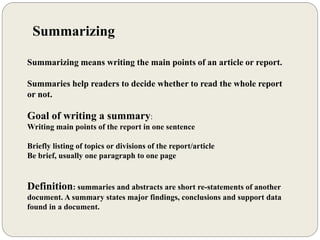
Summarizing means writing the main points of an article or report.
Summaries help readers to decide whether to read the whole report
or not.
Goal of writing a summary:
Writing main points of the report in one sentence
Briefly listing of topics or divisions of the report/article
Be brief, usually one paragraph to one page
Definition: summaries and abstracts are short re-statements of another
document. A summary states major findings, conclusions and support data
found in a document.
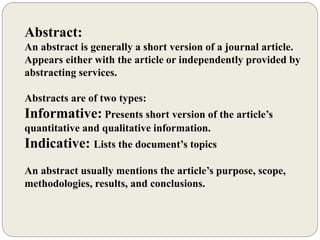
Abstract:
An abstract is generally a short version of a journal article.
Appears either with the article or independently provided by
abstracting services.
Abstracts are of two types:
Informative: Presents short version of the article’s
quantitative and qualitative information.
Indicative: Lists the document’s topics
An abstract usually mentions the article’s purpose, scope,
methodologies, results, and conclusions.
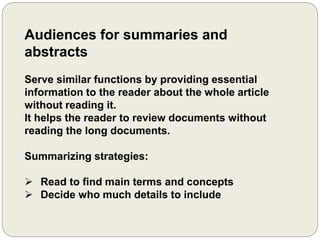
Audiences for summaries and
abstracts
Serve similar functions by providing essential
information to the reader about the whole article
without reading it.
It helps the reader to review documents without
reading the long documents.
Summarizing strategies:
 Read to find main terms and concepts
 Decide who much details to include
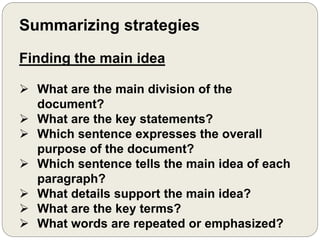
Summarizing strategies
Finding the main idea
 What are the main division of the
document?
 What are the key statements?
 Which sentence expresses the overall
purpose of the document?
 Which sentence tells the main idea of each
paragraph?
 What details support the main idea?
 What are the key terms?
 What words are repeated or emphasized?
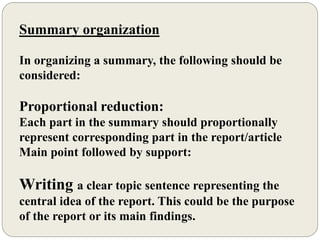
Summary organization
In organizing a summary, the following should be
considered:
Proportional reduction:
Each part in the summary should proportionally
represent corresponding part in the report/article
Main point followed by support:
Writing a clear topic sentence representing the
central idea of the report. This could be the purpose
of the report or its main findings.
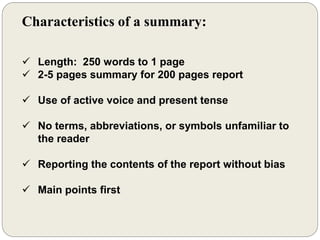
Characteristics of a summary:
 Length: 250 words to 1 page
 2-5 pages summary for 200 pages report
 Use of active voice and present tense
 No terms, abbreviations, or symbols unfamiliar to
the reader
 Reporting the contents of the report without bias
 Main points first
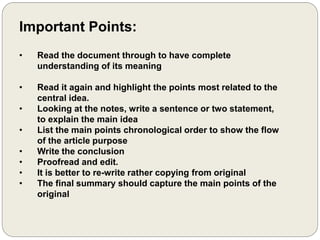
Important Points:
• Read the document through to have complete
understanding of its meaning
• Read it again and highlight the points most related to the
central idea.
• Looking at the notes, write a sentence or two statement,
to explain the main idea
• List the main points chronological order to show the flow
of the article purpose
• Write the conclusion
• Proofread and edit.
• It is better to re-write rather copying from original
• The final summary should capture the main points of the
original

Presentation-summaries.ppt

  • 1.
    Summarizing Summarizing means writingthe main points of an article or report. Summaries help readers to decide whether to read the whole report or not. Goal of writing a summary: Writing main points of the report in one sentence Briefly listing of topics or divisions of the report/article Be brief, usually one paragraph to one page Definition: summaries and abstracts are short re-statements of another document. A summary states major findings, conclusions and support data found in a document.
  • 2.
    Abstract: An abstract isgenerally a short version of a journal article. Appears either with the article or independently provided by abstracting services. Abstracts are of two types: Informative: Presents short version of the article’s quantitative and qualitative information. Indicative: Lists the document’s topics An abstract usually mentions the article’s purpose, scope, methodologies, results, and conclusions.
  • 3.
    Audiences for summariesand abstracts Serve similar functions by providing essential information to the reader about the whole article without reading it. It helps the reader to review documents without reading the long documents. Summarizing strategies:  Read to find main terms and concepts  Decide who much details to include
  • 4.
    Summarizing strategies Finding themain idea  What are the main division of the document?  What are the key statements?  Which sentence expresses the overall purpose of the document?  Which sentence tells the main idea of each paragraph?  What details support the main idea?  What are the key terms?  What words are repeated or emphasized?
  • 5.
    Summary organization In organizinga summary, the following should be considered: Proportional reduction: Each part in the summary should proportionally represent corresponding part in the report/article Main point followed by support: Writing a clear topic sentence representing the central idea of the report. This could be the purpose of the report or its main findings.
  • 6.
    Characteristics of asummary:  Length: 250 words to 1 page  2-5 pages summary for 200 pages report  Use of active voice and present tense  No terms, abbreviations, or symbols unfamiliar to the reader  Reporting the contents of the report without bias  Main points first
  • 7.
    Important Points: • Readthe document through to have complete understanding of its meaning • Read it again and highlight the points most related to the central idea. • Looking at the notes, write a sentence or two statement, to explain the main idea • List the main points chronological order to show the flow of the article purpose • Write the conclusion • Proofread and edit. • It is better to re-write rather copying from original • The final summary should capture the main points of the original