Shifting Cultivation
(Slash and Burn Agriculture)
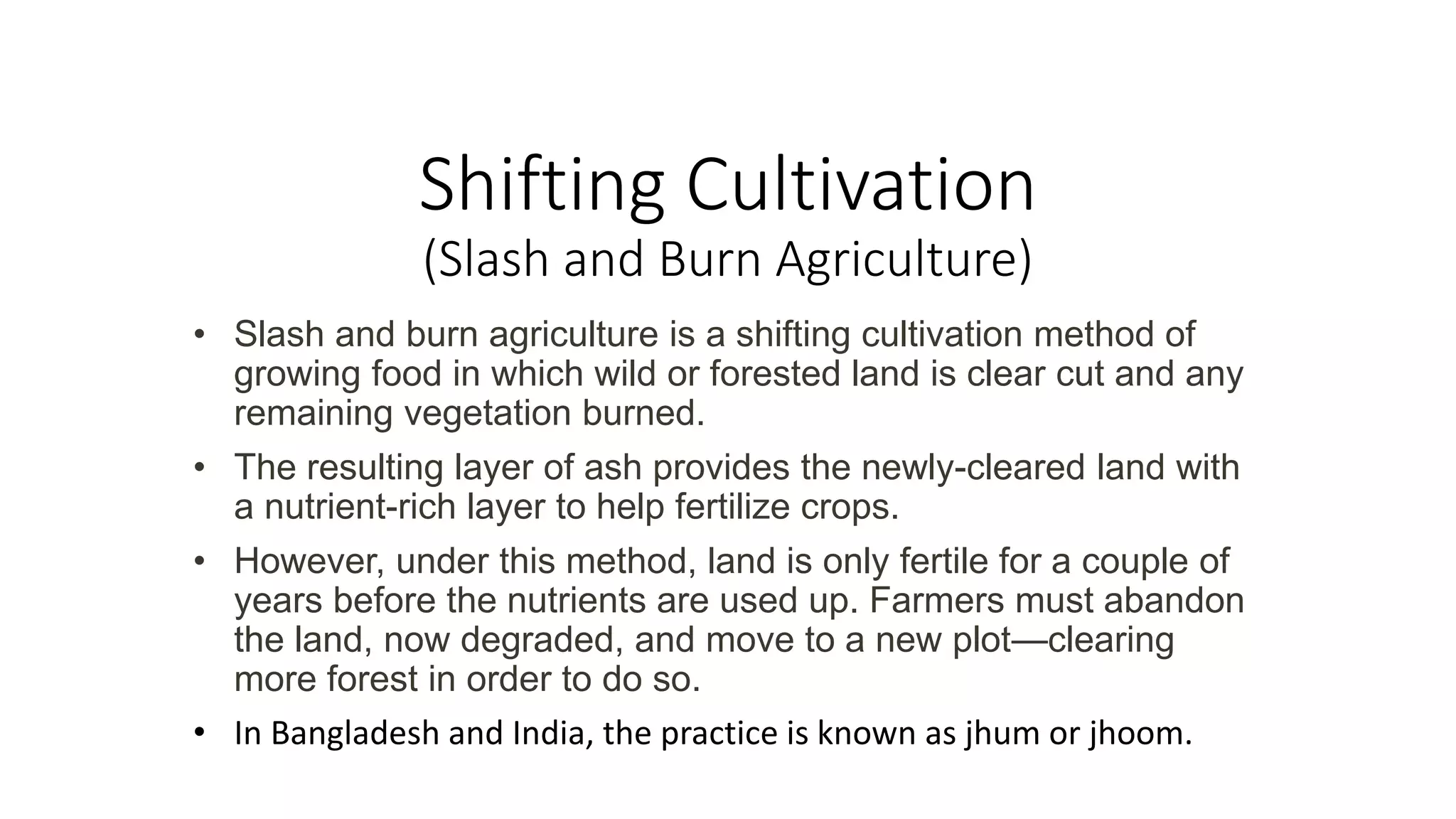
• Slash and burn agriculture is a shifting cultivation method of
growing food in which wild or forested land is clear cut and any
remaining vegetation burned.
• The resulting layer of ash provides the newly-cleared land with
a nutrient-rich layer to help fertilize crops.
• However, under this method, land is only fertile for a couple of
years before the nutrients are used up. Farmers must abandon
the land, now degraded, and move to a new plot—clearing
more forest in order to do so.
• In Bangladesh and India, the practice is known as jhum or jhoom.
Purpose of Slash and Burn
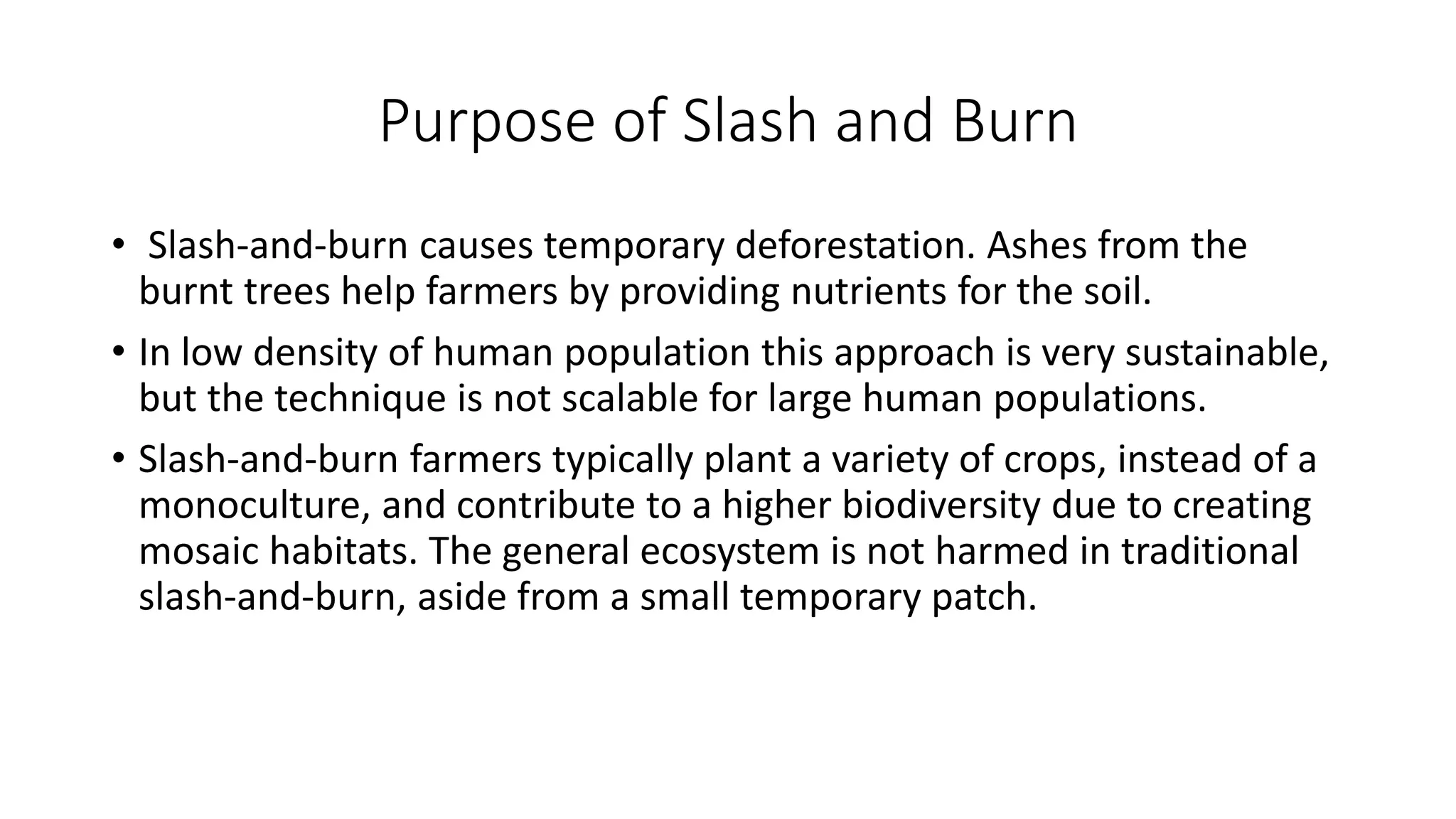
• Slash-and-burn causes temporary deforestation. Ashes from the
burnt trees help farmers by providing nutrients for the soil.
• In low density of human population this approach is very sustainable,
but the technique is not scalable for large human populations.
• Slash-and-burn farmers typically plant a variety of crops, instead of a
monoculture, and contribute to a higher biodiversity due to creating
mosaic habitats. The general ecosystem is not harmed in traditional
slash-and-burn, aside from a small temporary patch.
Slash and Burn in India
Effects of Slash and Burn
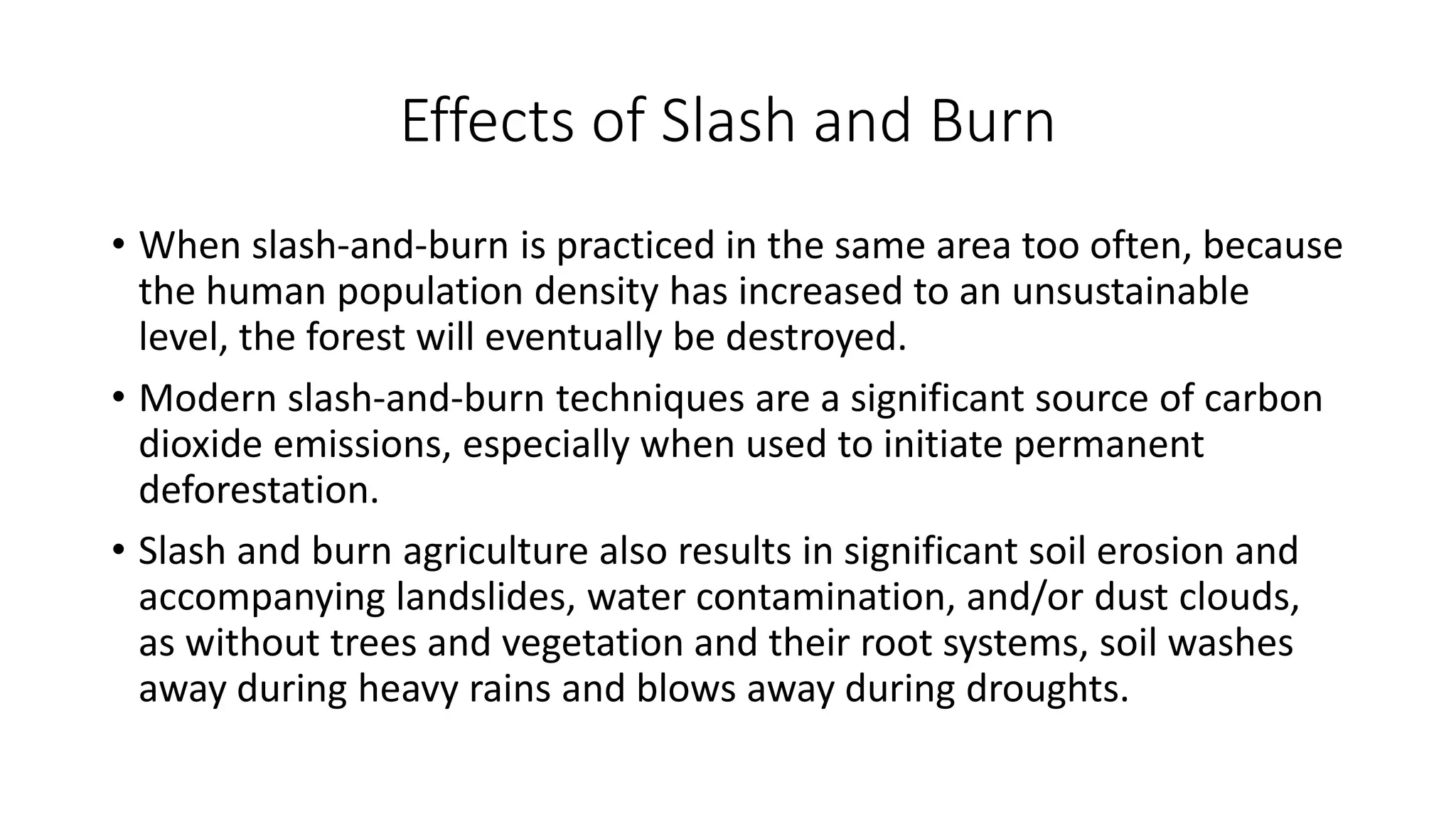
• When slash-and-burn is practiced in the same area too often, because
the human population density has increased to an unsustainable
level, the forest will eventually be destroyed.
• Modern slash-and-burn techniques are a significant source of carbon
dioxide emissions, especially when used to initiate permanent
deforestation.
• Slash and burn agriculture also results in significant soil erosion and
accompanying landslides, water contamination, and/or dust clouds,
as without trees and vegetation and their root systems, soil washes
away during heavy rains and blows away during droughts.

Shifting Cultivation-1.pptx

  • 1.
    Shifting Cultivation (Slash andBurn Agriculture) • Slash and burn agriculture is a shifting cultivation method of growing food in which wild or forested land is clear cut and any remaining vegetation burned. • The resulting layer of ash provides the newly-cleared land with a nutrient-rich layer to help fertilize crops. • However, under this method, land is only fertile for a couple of years before the nutrients are used up. Farmers must abandon the land, now degraded, and move to a new plot—clearing more forest in order to do so. • In Bangladesh and India, the practice is known as jhum or jhoom.
  • 2.
    Purpose of Slashand Burn • Slash-and-burn causes temporary deforestation. Ashes from the burnt trees help farmers by providing nutrients for the soil. • In low density of human population this approach is very sustainable, but the technique is not scalable for large human populations. • Slash-and-burn farmers typically plant a variety of crops, instead of a monoculture, and contribute to a higher biodiversity due to creating mosaic habitats. The general ecosystem is not harmed in traditional slash-and-burn, aside from a small temporary patch.
  • 3.
  • 4.
    Effects of Slashand Burn • When slash-and-burn is practiced in the same area too often, because the human population density has increased to an unsustainable level, the forest will eventually be destroyed. • Modern slash-and-burn techniques are a significant source of carbon dioxide emissions, especially when used to initiate permanent deforestation. • Slash and burn agriculture also results in significant soil erosion and accompanying landslides, water contamination, and/or dust clouds, as without trees and vegetation and their root systems, soil washes away during heavy rains and blows away during droughts.