AI in Marketing
ANOOP TIWARI
ECE/16/15
Title and content layout with list
▪ Introduction
 AI
 Marketing
▪ AI implement process in Marketing
 Why is AI Marketing important
 How AI Support
 How to use AI for Marketing
 Application of AI
 Types
 Features
 Benefits
▪ Conclusion
Introduction
AI in marketing is the use of customer data, machine learning and other
computational concepts to predict a person's action or inaction. It can take on huge
amounts of data and help marketers easily segment them. As such, marketers can
further break down data to create customized content for their audiences.
AI solutions provide marketers with deeper knowledge of consumers and
prospective clients, enabling them to deliver the right message, to the right person,
at the right time. ... Marketers can use AI solutions to take these profiles a step
further, refine marketing campaigns, and create highly personalized content
Artificial intelligence (AI) in marketing is the process of utilizing data models,
mathematics and algorithms to generate insights that can be used by marketers.
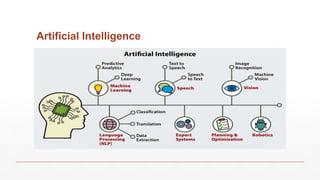
Artificial Intelligence
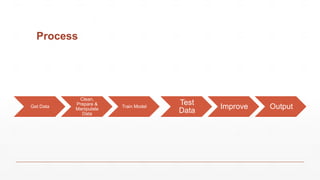
Process
Get Data
Clean,
Prepare &
Manipulate
Data
Train Model
Test
Data
Improve Output
Artificial intelligence (AI) is the ability of a computer program or a machine to think
and learn. It is also a field of study which tries to make computers "smart". They
work on their own without being encoded with commands. John McCarthy came up
with the name "artificial intelligence" in 1955.
Marketing
Marketing is the link between a society's material requirements and its economic
patterns of response. Marketing satisfies these needs and wants through
exchange processes and building long term relationships. It is the process of
communicating the value of a product or service through positioning to customers
“Marketing is the activity, set of institutions, and processes for creating,
communicating, delivering, and exchanging offerings that have value for customers,
clients, partners, and society at large.” Marketing refers to the activities of a
business related to buying and selling a product or service.
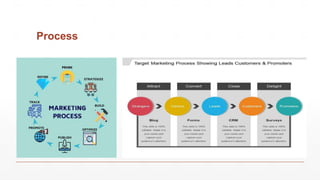
Process
AI implement process in Marketing
AI marketing is a method of leveraging technology to improve the customer
journey. It can also be used to boost the return on investment (ROI)
of marketing campaigns. This is accomplished by using big data analytics,
machine learning, and other processes to gain insight into your target audience
AI in marketing is the use of customer data, machine learning and other
computational concepts to predict a person’s action or inaction. It can take on huge
amounts of data and help marketers easily segment them. As such, marketers can
further break down data to create customized content for their audiences. With AI,
businesses can craft great marketing analytics technique to target the right potential
customers. This will help digital marketers feed customers with the right content on
the right channel at the right time.
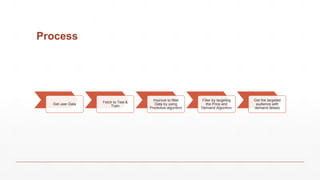
Process
Get user Data
Fetch to Test &
Train
Improve to filter
Data by using
Predictive algorithm
Filter by targeting
the Price and
Demand Algorithm
Get the targeted
audience with
demand details
Why is AI Marketing important
▪ The impact of artificial intelligence on digital marketing is huge. A study by Smart
Insights shows that out of 100 senior marketers from different industries, 55
percent of companies are implementing or already considering using AI in their
marketing practices
▪ AI Marketing (AIM) allows marketers to crunch huge amounts of marketing data
analytics from social media, emails, and the Web in a relatively faster time.
Moreover, the insights they get in a shorter time frame will help marketers boost
campaign performance and return on investment (ROI) faster. This gives
marketers and businesses more time to focus on other equally important tasks.
▪ Another reason why AI in marketing campaigns in 2020 is important is that 76
percent of customers expect companies to understand their needs and
expectations. AIM will help content marketers understand who exactly their target
audience is, thereby creating a personal experience for customers/users.
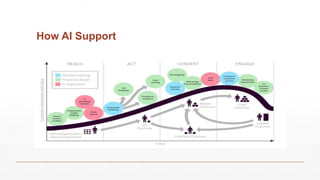
How AI Support
How to use AI for Marketing
Sales Forcasting
• You can use AI Marketing for gathering data about
past deals. It will study the data from emails,
meetings, and on some occasions phone calls. AIM
can relate the data to the outcome of the possible
sales of your current and future campaigns.
Understand
Customers
• Through the data gathered by AIM solutions, it can
be easier for marketers to understand what their
customer’s needs are as well as how and when
they want it. Marketers can also create customer
profiles to make it easier for them to segregate
people who are interested in their product from
those who are still considering or will not purchase.
Find the Trend
• AI Marketing and its ability to analyze large chunks
of data can be used to detect upcoming trends by
“joining in” real-time conversations or events of your
users.
Programmatic Ad
Targeting
• Basically, programmatic ad targeting is automating
all or parts of the ad-buying process using software-
driven technology. The traditional way of
buying/selling ads is a long, tedious process that
starts with talking to a salesperson, setting up the
terms of a contract and then having it executed.
The future of AI in digital marketing changes that
into a simpler automated process.
Chatbots
• Be it for inquiring, buying, or complaining,
messaging apps such as Facebook Messenger,
Viber, and WhatsApp have made it easier for a
customer to reach out to companies and tell them
what’s on their mind. It’s free and easy to use for a
lot of people.
Content
Generation
• If you need help in generating personalized content
for your website, there’s another way to do it called
content intelligence. Unlike content generation, this
provides creators with data-driven feedback and
insights for more effective content that will yield
better results.
Dynamic Pricing
• This AI is often referred to as personalized pricing. It’s a pricing
strategy wherein a product’s price is determined by demand
and/or supply. A good example is the prices of ride-sharing apps
that increase as demand rises or when you can’t find a discount
when you need to purchase a product online.
• An application’s or website’s bot can monitor your predictive
analytics use cases such as cookies, history, searches, and
other activities, to provide you with real-time pricing. This means
you get fewer discounts and/or higher prices for the
product/service you need at the moment. It sounds unfair,
doesn’t it? But there are always two sides to a story
• Customers can benefit from dynamic pricing when the demand
for a product is down. A good example of this is when hotel
rooms go unsold. To help decrease the chances of a vacancy,
dynamic pricing can offer competitive pricing to attract
customers.
Application of AI
Types
▪ Automated Programs
Automatically trigger marketing messages and actions based on behavior, logic, and AI
recommendations.
▪ Message Composer
Drag and drop message builder for email, mobile, advertising, and more.
▪ Mobile Marketing
Build engaging mobile customer experiences and campaigns.
▪ Location Marketing
Engage with customers based on marketer-set locations, or customer-defined locations based
on preferences.
Some Key Features
▪ Content Curation And Generation
▪ AI-Enhanced Digital Advertising
▪ Chatbots
▪ Behavior Analysis And Predictive Analytics
Some Key Benefits
▪ Take Sales Forecasting to the Next Level
▪ Gain a Deeper Understanding of Your Consumers
▪ Optimize Digital Advertising Campaigns
▪ Create Detailed Consumer Profiles
▪ Join Real-Time Conversations with Consumers
Benefits
▪ Improve Customer Engagement
Boost customer engagement and conversion with personalized experiences and offers that
connect with your customers, when and where they expect it.
▪ Work Faster
Drive to insights lightning fast. Use insights to optimize campaigns, messages and offers.
By doing your job faster, you'll have more time to be creative and strategic.
▪ Increase Customer Loyalty
Leverage AI-powered insights and capabilities to deliver the right message and offer at the
right time in the right channel to grow customer loyalty and revenue
Conclusion
There’s no better time for marketers to begin testing how Artificial Intelligence
strategies can help create highly personalized experiences for their consumers.
With AI poised to continue growing across all industries and segments, marketers
should dedicate time and resources to experimenting with strategies and ensure
their marketing organization is set up for continued success, both now and in the
future.
AI in marketing is a very powerful tool that marketers need to be using now. It’s
something marketers must adopt in their marketing analytics techniques to achieve
better results and, possibly, boost the business’s ROI.
Thank
you!

Artificial intelligence in Marketing

  • 1.
    AI in Marketing ANOOPTIWARI ECE/16/15
  • 2.
    Title and contentlayout with list ▪ Introduction  AI  Marketing ▪ AI implement process in Marketing  Why is AI Marketing important  How AI Support  How to use AI for Marketing  Application of AI  Types  Features  Benefits ▪ Conclusion
  • 3.
    Introduction AI in marketingis the use of customer data, machine learning and other computational concepts to predict a person's action or inaction. It can take on huge amounts of data and help marketers easily segment them. As such, marketers can further break down data to create customized content for their audiences.
  • 4.
    AI solutions providemarketers with deeper knowledge of consumers and prospective clients, enabling them to deliver the right message, to the right person, at the right time. ... Marketers can use AI solutions to take these profiles a step further, refine marketing campaigns, and create highly personalized content Artificial intelligence (AI) in marketing is the process of utilizing data models, mathematics and algorithms to generate insights that can be used by marketers.
  • 5.
  • 6.
  • 7.
    Artificial intelligence (AI)is the ability of a computer program or a machine to think and learn. It is also a field of study which tries to make computers "smart". They work on their own without being encoded with commands. John McCarthy came up with the name "artificial intelligence" in 1955.
  • 8.
    Marketing Marketing is thelink between a society's material requirements and its economic patterns of response. Marketing satisfies these needs and wants through exchange processes and building long term relationships. It is the process of communicating the value of a product or service through positioning to customers “Marketing is the activity, set of institutions, and processes for creating, communicating, delivering, and exchanging offerings that have value for customers, clients, partners, and society at large.” Marketing refers to the activities of a business related to buying and selling a product or service.
  • 9.
  • 10.
    AI implement processin Marketing AI marketing is a method of leveraging technology to improve the customer journey. It can also be used to boost the return on investment (ROI) of marketing campaigns. This is accomplished by using big data analytics, machine learning, and other processes to gain insight into your target audience
  • 11.
    AI in marketingis the use of customer data, machine learning and other computational concepts to predict a person’s action or inaction. It can take on huge amounts of data and help marketers easily segment them. As such, marketers can further break down data to create customized content for their audiences. With AI, businesses can craft great marketing analytics technique to target the right potential customers. This will help digital marketers feed customers with the right content on the right channel at the right time.
  • 12.
    Process Get user Data Fetchto Test & Train Improve to filter Data by using Predictive algorithm Filter by targeting the Price and Demand Algorithm Get the targeted audience with demand details
  • 13.
    Why is AIMarketing important ▪ The impact of artificial intelligence on digital marketing is huge. A study by Smart Insights shows that out of 100 senior marketers from different industries, 55 percent of companies are implementing or already considering using AI in their marketing practices ▪ AI Marketing (AIM) allows marketers to crunch huge amounts of marketing data analytics from social media, emails, and the Web in a relatively faster time. Moreover, the insights they get in a shorter time frame will help marketers boost campaign performance and return on investment (ROI) faster. This gives marketers and businesses more time to focus on other equally important tasks.
  • 14.
    ▪ Another reasonwhy AI in marketing campaigns in 2020 is important is that 76 percent of customers expect companies to understand their needs and expectations. AIM will help content marketers understand who exactly their target audience is, thereby creating a personal experience for customers/users.
  • 15.
  • 16.
    How to useAI for Marketing Sales Forcasting • You can use AI Marketing for gathering data about past deals. It will study the data from emails, meetings, and on some occasions phone calls. AIM can relate the data to the outcome of the possible sales of your current and future campaigns. Understand Customers • Through the data gathered by AIM solutions, it can be easier for marketers to understand what their customer’s needs are as well as how and when they want it. Marketers can also create customer profiles to make it easier for them to segregate people who are interested in their product from those who are still considering or will not purchase.
  • 17.
    Find the Trend •AI Marketing and its ability to analyze large chunks of data can be used to detect upcoming trends by “joining in” real-time conversations or events of your users. Programmatic Ad Targeting • Basically, programmatic ad targeting is automating all or parts of the ad-buying process using software- driven technology. The traditional way of buying/selling ads is a long, tedious process that starts with talking to a salesperson, setting up the terms of a contract and then having it executed. The future of AI in digital marketing changes that into a simpler automated process.
  • 18.
    Chatbots • Be itfor inquiring, buying, or complaining, messaging apps such as Facebook Messenger, Viber, and WhatsApp have made it easier for a customer to reach out to companies and tell them what’s on their mind. It’s free and easy to use for a lot of people. Content Generation • If you need help in generating personalized content for your website, there’s another way to do it called content intelligence. Unlike content generation, this provides creators with data-driven feedback and insights for more effective content that will yield better results.
  • 19.
    Dynamic Pricing • ThisAI is often referred to as personalized pricing. It’s a pricing strategy wherein a product’s price is determined by demand and/or supply. A good example is the prices of ride-sharing apps that increase as demand rises or when you can’t find a discount when you need to purchase a product online. • An application’s or website’s bot can monitor your predictive analytics use cases such as cookies, history, searches, and other activities, to provide you with real-time pricing. This means you get fewer discounts and/or higher prices for the product/service you need at the moment. It sounds unfair, doesn’t it? But there are always two sides to a story • Customers can benefit from dynamic pricing when the demand for a product is down. A good example of this is when hotel rooms go unsold. To help decrease the chances of a vacancy, dynamic pricing can offer competitive pricing to attract customers.
  • 20.
  • 21.
    Types ▪ Automated Programs Automaticallytrigger marketing messages and actions based on behavior, logic, and AI recommendations. ▪ Message Composer Drag and drop message builder for email, mobile, advertising, and more. ▪ Mobile Marketing Build engaging mobile customer experiences and campaigns. ▪ Location Marketing Engage with customers based on marketer-set locations, or customer-defined locations based on preferences.
  • 22.
    Some Key Features ▪Content Curation And Generation ▪ AI-Enhanced Digital Advertising ▪ Chatbots ▪ Behavior Analysis And Predictive Analytics
  • 23.
    Some Key Benefits ▪Take Sales Forecasting to the Next Level ▪ Gain a Deeper Understanding of Your Consumers ▪ Optimize Digital Advertising Campaigns ▪ Create Detailed Consumer Profiles ▪ Join Real-Time Conversations with Consumers
  • 24.
    Benefits ▪ Improve CustomerEngagement Boost customer engagement and conversion with personalized experiences and offers that connect with your customers, when and where they expect it. ▪ Work Faster Drive to insights lightning fast. Use insights to optimize campaigns, messages and offers. By doing your job faster, you'll have more time to be creative and strategic. ▪ Increase Customer Loyalty Leverage AI-powered insights and capabilities to deliver the right message and offer at the right time in the right channel to grow customer loyalty and revenue
  • 25.
    Conclusion There’s no bettertime for marketers to begin testing how Artificial Intelligence strategies can help create highly personalized experiences for their consumers. With AI poised to continue growing across all industries and segments, marketers should dedicate time and resources to experimenting with strategies and ensure their marketing organization is set up for continued success, both now and in the future. AI in marketing is a very powerful tool that marketers need to be using now. It’s something marketers must adopt in their marketing analytics techniques to achieve better results and, possibly, boost the business’s ROI.
  • 26.