Atkinson cycle
Introduction
• Discovery of cycle
• Ideal thermodynamic cycle process
• Otto cycle vs. Atkinson cycle
• Types of engines that use this cycle
• Who uses these engines?
• Cost analysis of Gas Engine
Discovery of cycle
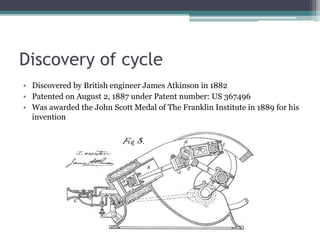
• Discovered by British engineer James Atkinson in 1882
• Patented on August 2, 1887 under Patent number: US 367496
• Was awarded the John Scott Medal of The Franklin Institute in 1889 for his
invention
The true Atkinson cycle and the
modern Atkinson cycle
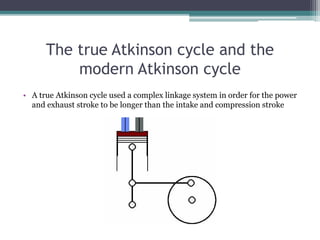
• A true Atkinson cycle used a complex linkage system in order for the power
and exhaust stroke to be longer than the intake and compression stroke
The true Atkinson cycle and the modern
Atkinson cycle
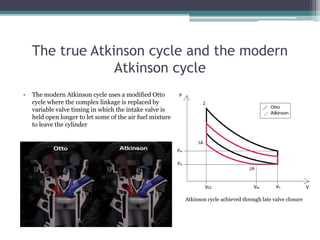
Atkinson cycle achieved through late valve closure
• The modern Atkinson cycle uses a modified Otto
cycle where the complex linkage is replaced by
variable valve timing in which the intake valve is
held open longer to let some of the air fuel mixture
to leave the cylinder
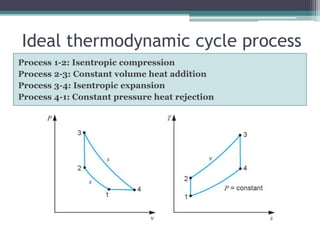
Ideal thermodynamic cycle process
Process 1-2: Isentropic compression
Process 2-3: Constant volume heat addition
Process 3-4: Isentropic expansion
Process 4-1: Constant pressure heat rejection
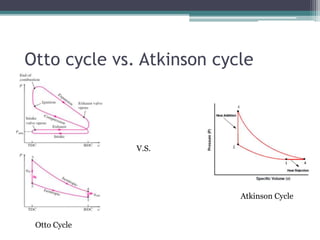
Otto cycle vs. Atkinson cycle
Otto Cycle
V.S.
Atkinson Cycle
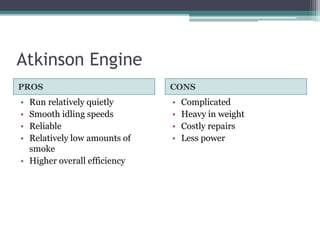
Atkinson Engine
PROS CONS
• Run relatively quietly
• Smooth idling speeds
• Reliable
• Relatively low amounts of
smoke
• Higher overall efficiency
• Complicated
• Heavy in weight
• Costly repairs
• Less power
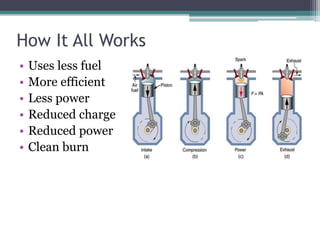
How It All Works
• Uses less fuel
• More efficient
• Less power
• Reduced charge
• Reduced power
• Clean burn
Types of engines that use this cycle
• Differential engine
• Gas engine
• Rotary Atkinson-cycle engine
• Hybrid System Engine
Who uses these engines?
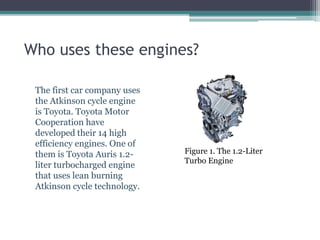
Figure 1. The 1.2-Liter
Turbo Engine
The first car company uses
the Atkinson cycle engine
is Toyota. Toyota Motor
Cooperation have
developed their 14 high
efficiency engines. One of
them is Toyota Auris 1.2-
liter turbocharged engine
that uses lean burning
Atkinson cycle technology.
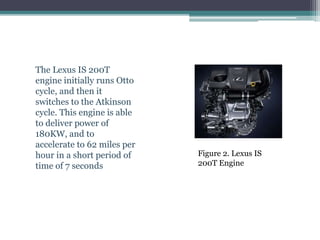
Figure 2. Lexus IS
200T Engine
The Lexus IS 200T
engine initially runs Otto
cycle, and then it
switches to the Atkinson
cycle. This engine is able
to deliver power of
180KW, and to
accelerate to 62 miles per
hour in a short period of
time of 7 seconds
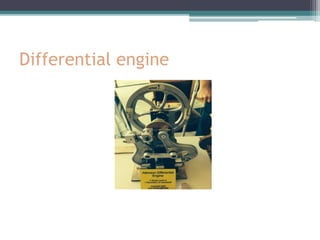
Differential engine
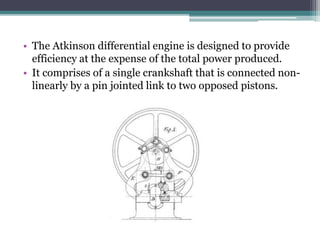
• The Atkinson differential engine is designed to provide
efficiency at the expense of the total power produced.
• It comprises of a single crankshaft that is connected non-
linearly by a pin jointed link to two opposed pistons.
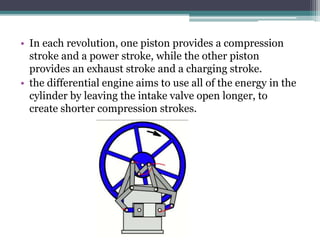
• In each revolution, one piston provides a compression
stroke and a power stroke, while the other piston
provides an exhaust stroke and a charging stroke.
• the differential engine aims to use all of the energy in the
cylinder by leaving the intake valve open longer, to
create shorter compression strokes.
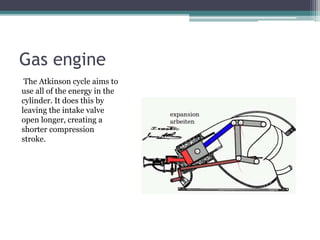
Gas engine
The Atkinson cycle aims to
use all of the energy in the
cylinder. It does this by
leaving the intake valve
open longer, creating a
shorter compression
stroke.
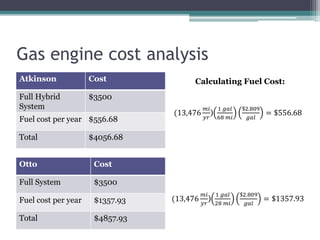
Gas engine cost analysis
Atkinson Cost
Full Hybrid
System
$3500
Fuel cost per year $556.68
Total $4056.68
Otto Cost
Full System $3500
Fuel cost per year $1357.93
Total $4857.93
Calculating Fuel Cost:
(13,476
𝑚𝑖
𝑦𝑟
)
1 𝑔𝑎𝑙
68 𝑚𝑖
$2.809
𝑔𝑎𝑙
= $556.68
(13,476
𝑚𝑖
𝑦𝑟
)
1 𝑔𝑎𝑙
28 𝑚𝑖
$2.809
𝑔𝑎𝑙
= $1357.93
Questions?

Atkinson cycle final

  • 1.
  • 2.
    Introduction • Discovery ofcycle • Ideal thermodynamic cycle process • Otto cycle vs. Atkinson cycle • Types of engines that use this cycle • Who uses these engines? • Cost analysis of Gas Engine
  • 3.
    Discovery of cycle •Discovered by British engineer James Atkinson in 1882 • Patented on August 2, 1887 under Patent number: US 367496 • Was awarded the John Scott Medal of The Franklin Institute in 1889 for his invention
  • 4.
    The true Atkinsoncycle and the modern Atkinson cycle • A true Atkinson cycle used a complex linkage system in order for the power and exhaust stroke to be longer than the intake and compression stroke
  • 5.
    The true Atkinsoncycle and the modern Atkinson cycle Atkinson cycle achieved through late valve closure • The modern Atkinson cycle uses a modified Otto cycle where the complex linkage is replaced by variable valve timing in which the intake valve is held open longer to let some of the air fuel mixture to leave the cylinder
  • 6.
    Ideal thermodynamic cycleprocess Process 1-2: Isentropic compression Process 2-3: Constant volume heat addition Process 3-4: Isentropic expansion Process 4-1: Constant pressure heat rejection
  • 7.
    Otto cycle vs.Atkinson cycle Otto Cycle V.S. Atkinson Cycle
  • 8.
    Atkinson Engine PROS CONS •Run relatively quietly • Smooth idling speeds • Reliable • Relatively low amounts of smoke • Higher overall efficiency • Complicated • Heavy in weight • Costly repairs • Less power
  • 9.
    How It AllWorks • Uses less fuel • More efficient • Less power • Reduced charge • Reduced power • Clean burn
  • 10.
    Types of enginesthat use this cycle • Differential engine • Gas engine • Rotary Atkinson-cycle engine • Hybrid System Engine
  • 11.
    Who uses theseengines? Figure 1. The 1.2-Liter Turbo Engine The first car company uses the Atkinson cycle engine is Toyota. Toyota Motor Cooperation have developed their 14 high efficiency engines. One of them is Toyota Auris 1.2- liter turbocharged engine that uses lean burning Atkinson cycle technology.
  • 12.
    Figure 2. LexusIS 200T Engine The Lexus IS 200T engine initially runs Otto cycle, and then it switches to the Atkinson cycle. This engine is able to deliver power of 180KW, and to accelerate to 62 miles per hour in a short period of time of 7 seconds
  • 13.
  • 14.
    • The Atkinsondifferential engine is designed to provide efficiency at the expense of the total power produced. • It comprises of a single crankshaft that is connected non- linearly by a pin jointed link to two opposed pistons.
  • 15.
    • In eachrevolution, one piston provides a compression stroke and a power stroke, while the other piston provides an exhaust stroke and a charging stroke. • the differential engine aims to use all of the energy in the cylinder by leaving the intake valve open longer, to create shorter compression strokes.
  • 16.
    Gas engine The Atkinsoncycle aims to use all of the energy in the cylinder. It does this by leaving the intake valve open longer, creating a shorter compression stroke.
  • 17.
    Gas engine costanalysis Atkinson Cost Full Hybrid System $3500 Fuel cost per year $556.68 Total $4056.68 Otto Cost Full System $3500 Fuel cost per year $1357.93 Total $4857.93 Calculating Fuel Cost: (13,476 𝑚𝑖 𝑦𝑟 ) 1 𝑔𝑎𝑙 68 𝑚𝑖 $2.809 𝑔𝑎𝑙 = $556.68 (13,476 𝑚𝑖 𝑦𝑟 ) 1 𝑔𝑎𝑙 28 𝑚𝑖 $2.809 𝑔𝑎𝑙 = $1357.93
  • 18.