CONCEPTUAL
FRAMEWORK OF
MATHEMATICS
Introduction
+ “Trough thew experiences that teachers provide,
students learn mathematics. Hence, the way
students understand mathematics. Solve problems,
and even their disposition towards the subject are
being shaped by the mathematics teaching they
encounter in school” (NCTM, 200, p. 16)
Objectives:
 Understand the conceptual framework of mathematics
education in the Philippines.
 Identify the different skills need to develop critical thinking and
problem solving.
 Define and understand the different theories to learn the
different skills in mathematics.
 Compare the different standards from kinder level to grade
level.
K to 12 Mathematics
Mathematics is one of the
subject that pervades life at
any age and in any
circumstance.
 Mathematics from k-10 is a skills subject.
 By itself, it is all about quantitates, shapes and figures,
functions, logic, and reasoning.
 Mathematics is also a tool of science and a language
complete with its own notations and symbols and
“grammar” rules, with which concepts and ideas are
effectively expressed.
Twin goals of mathematics in the
basic education levels, K-10, are
Critical thinking and Problem
Solving.
 Critical thinking, according to Scrivin and Paul
(1987) is the intellectually disciplined process of
actively and skillfully conceptualizing, applying,
analyzing, synthesizing, and/or evaluating
information gathered from, or generated by,
observation, experience, reflection, reasoning,
or communication, as a guide to belief and
action.
 According to Polya (1945 & 1962 )
mathematical problem solving is finding
a way around a difficulty, around an
obstacle, and finding a solution to a
problem solving
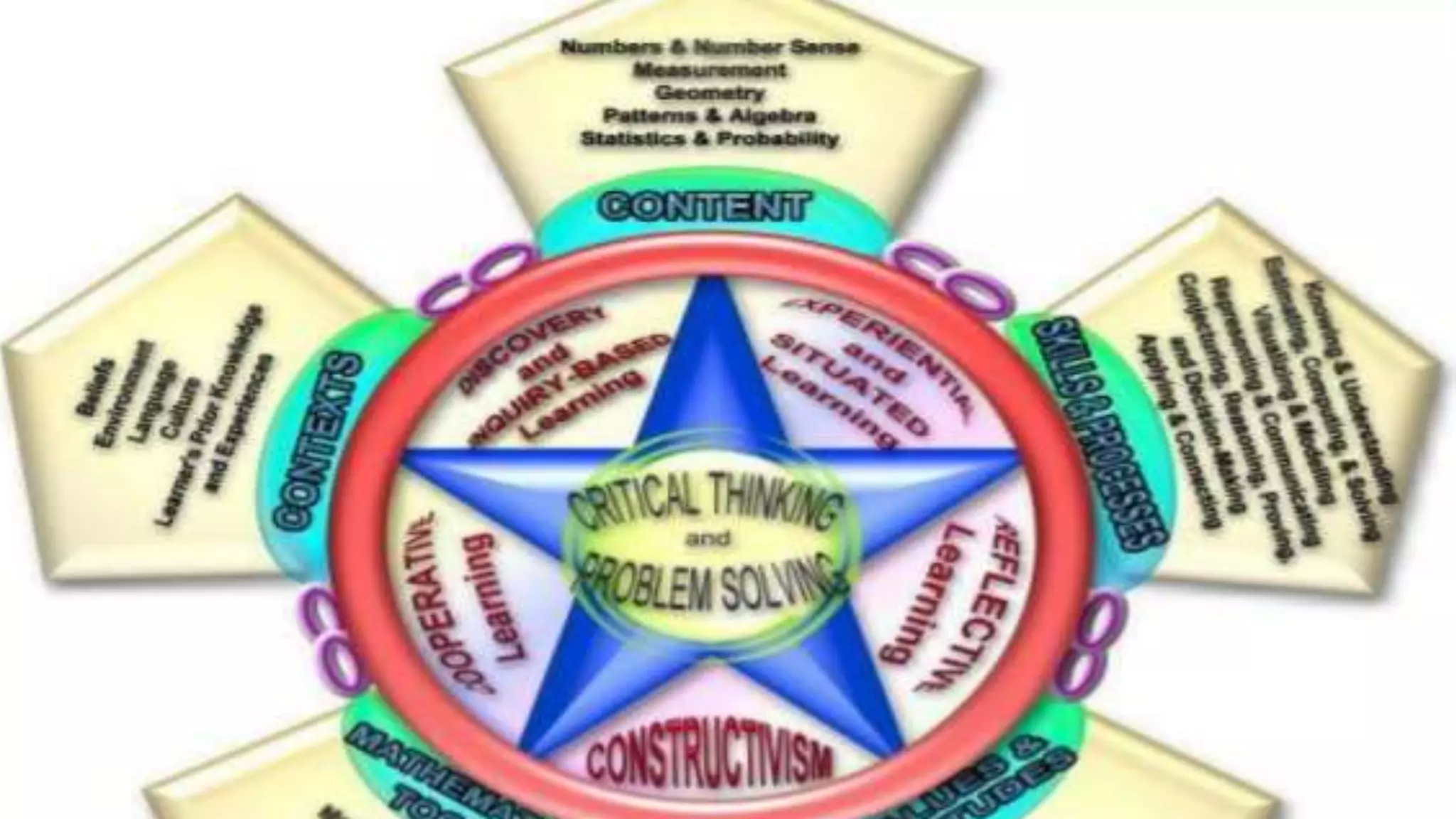
 There are five content areas in the curriculum,
adopted from the framework prepared by
MATHTED & SEI (2020).
Numbers and Number Sense
Measurement
Geometry
Patterns and Algebra
Probability and Statistics
 Numbers and number sense as a strand include
concepts of numbers, properties, operations,
estimation, and their application.
 Measurement as a strand includes the use of numbers
and measures to describe, understand, and compare
mathematical and concrete objects.
It focuses on attributes such as length, mass and
weight, capacity, time, money, and temperature, as well
as applications involving perimeter, area, surface area
volume, and angle measure.
 Geometry as a strand includes properties of two and
three-dimensional figures and their relationships, spatial
visualization, reasoning, and geometric modelling and
proofs.
 Patterns and Algebra as a strands studies patterns,
relationships, and changes among shapes and
quantities.
It includes the use of algebraic notations and symbols,
equations, and most importantly, functions, to represent
and analyze relationships.
 Statistics and Probability as a strand is all
about developing skills in collecting and
organizing data using charts, tables, and
graphs; understanding, analyzing and
interpreting data; dealing with uncertainly;
and making predictions about outcomes.
The specific skills and processes to be
developed are:
 Knowing and understanding
 Estimating, computing and solving; visualizing and
modelling;
 Representing and communicating;
 Conjecturing, reasoning, proving, and decision-
making
 Applying and connecting.
The following values and attitudes
are to be honed as well:
 Accuracy
 Creativity
 Objectively
 Perseverance
 productivity
We recognize that the use of appropriate tools is
necessary in teaching mathematics.
 Manipulate objects
 Measuring devices
 Calculators and computers
 Smart phones and tablet PCs
 The internet
The framework is supported by the following
underlying learning principles and theories:
 Experiential and Situated Learning
 Reflective Learning
 Constructivism
 Cooperative Learning
 Discovery and Inquiry-based Learning
 Experiential Learning as advocated by David Kolb is learning that
occurs by making sense of direct everyday experiences.
 Experiential Learning theory defines learning as : the process
whereby knowledge is created through the transformation of
experience.
 Knowledge results from the combination of grasping and
transforming experience: ( Kolb 1984,p. 41)
 Situated Learning, theorized by Lave and Wenger, is learning in the
same context in which concepts and theories are applied.
 Reflective Learning refers to learning that is
facilitated by reflective thinking.
 It is not enough that learners encounter real-life
situations.
 Deeper learning occurs when learners are able to
think about their experiences and process, these
allowing them the opportunity to make sense of
and derive meaning from their experiences.
 Constructivism is the theory that argues that knowledge
is constructed when the learner is able to draw ideas
from his/her own experiences and connect to new
ideas.
 Cooperative Learning puts premium on active learning
achieved by working with fellow learners as they all
engage in a shared task.
 Discovery Learning and Inquiry-based Learning (Bruner,
1961) support the idea that students learn when they
make use of personal experiences to discover facts,
relationships, and concepts.
Conceptual framework of mathematics

Conceptual framework of mathematics

  • 1.
  • 2.
    Introduction + “Trough thewexperiences that teachers provide, students learn mathematics. Hence, the way students understand mathematics. Solve problems, and even their disposition towards the subject are being shaped by the mathematics teaching they encounter in school” (NCTM, 200, p. 16)
  • 3.
    Objectives:  Understand theconceptual framework of mathematics education in the Philippines.  Identify the different skills need to develop critical thinking and problem solving.  Define and understand the different theories to learn the different skills in mathematics.  Compare the different standards from kinder level to grade level.
  • 4.
    K to 12Mathematics
  • 5.
    Mathematics is oneof the subject that pervades life at any age and in any circumstance.
  • 6.
     Mathematics fromk-10 is a skills subject.  By itself, it is all about quantitates, shapes and figures, functions, logic, and reasoning.  Mathematics is also a tool of science and a language complete with its own notations and symbols and “grammar” rules, with which concepts and ideas are effectively expressed.
  • 7.
    Twin goals ofmathematics in the basic education levels, K-10, are Critical thinking and Problem Solving.
  • 8.
     Critical thinking,according to Scrivin and Paul (1987) is the intellectually disciplined process of actively and skillfully conceptualizing, applying, analyzing, synthesizing, and/or evaluating information gathered from, or generated by, observation, experience, reflection, reasoning, or communication, as a guide to belief and action.
  • 9.
     According toPolya (1945 & 1962 ) mathematical problem solving is finding a way around a difficulty, around an obstacle, and finding a solution to a problem solving
  • 10.
     There arefive content areas in the curriculum, adopted from the framework prepared by MATHTED & SEI (2020). Numbers and Number Sense Measurement Geometry Patterns and Algebra Probability and Statistics
  • 11.
     Numbers andnumber sense as a strand include concepts of numbers, properties, operations, estimation, and their application.  Measurement as a strand includes the use of numbers and measures to describe, understand, and compare mathematical and concrete objects. It focuses on attributes such as length, mass and weight, capacity, time, money, and temperature, as well as applications involving perimeter, area, surface area volume, and angle measure.
  • 12.
     Geometry asa strand includes properties of two and three-dimensional figures and their relationships, spatial visualization, reasoning, and geometric modelling and proofs.  Patterns and Algebra as a strands studies patterns, relationships, and changes among shapes and quantities. It includes the use of algebraic notations and symbols, equations, and most importantly, functions, to represent and analyze relationships.
  • 13.
     Statistics andProbability as a strand is all about developing skills in collecting and organizing data using charts, tables, and graphs; understanding, analyzing and interpreting data; dealing with uncertainly; and making predictions about outcomes.
  • 14.
    The specific skillsand processes to be developed are:  Knowing and understanding  Estimating, computing and solving; visualizing and modelling;  Representing and communicating;  Conjecturing, reasoning, proving, and decision- making  Applying and connecting.
  • 15.
    The following valuesand attitudes are to be honed as well:  Accuracy  Creativity  Objectively  Perseverance  productivity
  • 16.
    We recognize thatthe use of appropriate tools is necessary in teaching mathematics.  Manipulate objects  Measuring devices  Calculators and computers  Smart phones and tablet PCs  The internet
  • 17.
    The framework issupported by the following underlying learning principles and theories:  Experiential and Situated Learning  Reflective Learning  Constructivism  Cooperative Learning  Discovery and Inquiry-based Learning
  • 18.
     Experiential Learningas advocated by David Kolb is learning that occurs by making sense of direct everyday experiences.  Experiential Learning theory defines learning as : the process whereby knowledge is created through the transformation of experience.  Knowledge results from the combination of grasping and transforming experience: ( Kolb 1984,p. 41)  Situated Learning, theorized by Lave and Wenger, is learning in the same context in which concepts and theories are applied.
  • 19.
     Reflective Learningrefers to learning that is facilitated by reflective thinking.  It is not enough that learners encounter real-life situations.  Deeper learning occurs when learners are able to think about their experiences and process, these allowing them the opportunity to make sense of and derive meaning from their experiences.
  • 20.
     Constructivism isthe theory that argues that knowledge is constructed when the learner is able to draw ideas from his/her own experiences and connect to new ideas.  Cooperative Learning puts premium on active learning achieved by working with fellow learners as they all engage in a shared task.  Discovery Learning and Inquiry-based Learning (Bruner, 1961) support the idea that students learn when they make use of personal experiences to discover facts, relationships, and concepts.