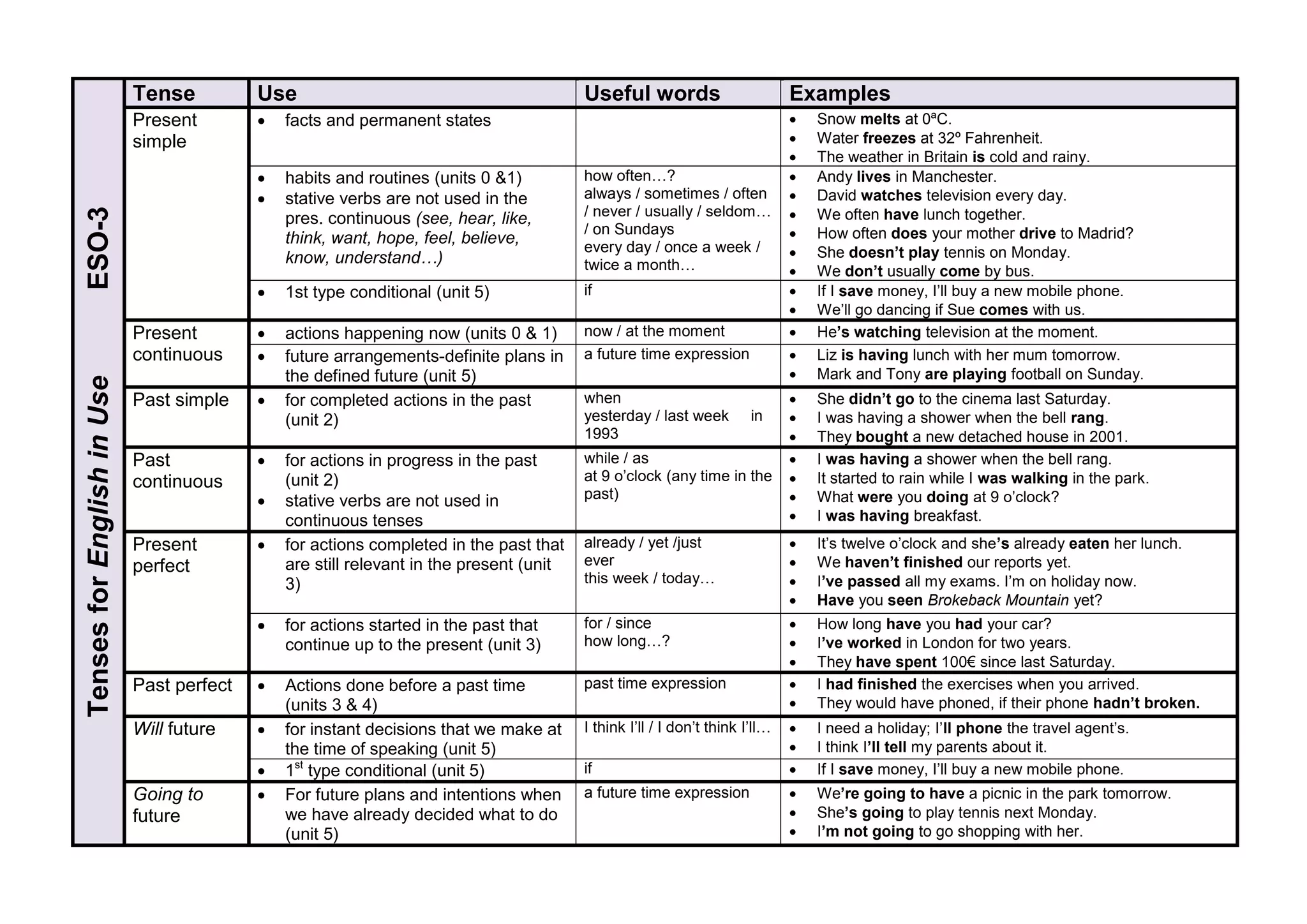
TensesforEnglishinUseESO-3 Tense Use Useful words Examples
Present
simple
 facts and permanent states  Snow melts at 0ªC.
 Water freezes at 32º Fahrenheit.
 The weather in Britain is cold and rainy.
 habits and routines (units 0 &1)
 stative verbs are not used in the
pres. continuous (see, hear, like,
think, want, hope, feel, believe,
know, understand…)
how often…?
always / sometimes / often
/ never / usually / seldom…
/ on Sundays
every day / once a week /
twice a month…
 Andy lives in Manchester.
 David watches television every day.
 We often have lunch together.
 How often does your mother drive to Madrid?
 She doesn’t play tennis on Monday.
 We don’t usually come by bus.
 1st type conditional (unit 5) if  If I save money, I’ll buy a new mobile phone.
 We’ll go dancing if Sue comes with us.
Present
continuous
 actions happening now (units 0 & 1) now / at the moment  He’s watching television at the moment.
 future arrangements-definite plans in
the defined future (unit 5)
a future time expression  Liz is having lunch with her mum tomorrow.
 Mark and Tony are playing football on Sunday.
Past simple  for completed actions in the past
(unit 2)
when
yesterday / last week in
1993
 She didn’t go to the cinema last Saturday.
 I was having a shower when the bell rang.
 They bought a new detached house in 2001.
Past
continuous
 for actions in progress in the past
(unit 2)
 stative verbs are not used in
continuous tenses
while / as
at 9 o’clock (any time in the
past)
 I was having a shower when the bell rang.
 It started to rain while I was walking in the park.
 What were you doing at 9 o’clock?
 I was having breakfast.
Present
perfect
 for actions completed in the past that
are still relevant in the present (unit
3)
already / yet /just
ever
this week / today…
 It’s twelve o’clock and she’s already eaten her lunch.
 We haven’t finished our reports yet.
 I’ve passed all my exams. I’m on holiday now.
 Have you seen Brokeback Mountain yet?
 for actions started in the past that
continue up to the present (unit 3)
for / since
how long…?
 How long have you had your car?
 I’ve worked in London for two years.
 They have spent 100€ since last Saturday.
Past perfect  Actions done before a past time
(units 3 & 4)
past time expression  I had finished the exercises when you arrived.
 They would have phoned, if their phone hadn’t broken.
Will future  for instant decisions that we make at
the time of speaking (unit 5)
I think I’ll / I don’t think I’ll…  I need a holiday; I’ll phone the travel agent’s.
 I think I’ll tell my parents about it.
 1st
type conditional (unit 5) if  If I save money, I’ll buy a new mobile phone.
Going to
future
 For future plans and intentions when
we have already decided what to do
(unit 5)
a future time expression  We’re going to have a picnic in the park tomorrow.
 She’s going to play tennis next Monday.
 I’m not going to go shopping with her.

Neiu3 0-summary of tenses

  • 1.
    TensesforEnglishinUseESO-3 Tense UseUseful words Examples Present simple  facts and permanent states  Snow melts at 0ªC.  Water freezes at 32º Fahrenheit.  The weather in Britain is cold and rainy.  habits and routines (units 0 &1)  stative verbs are not used in the pres. continuous (see, hear, like, think, want, hope, feel, believe, know, understand…) how often…? always / sometimes / often / never / usually / seldom… / on Sundays every day / once a week / twice a month…  Andy lives in Manchester.  David watches television every day.  We often have lunch together.  How often does your mother drive to Madrid?  She doesn’t play tennis on Monday.  We don’t usually come by bus.  1st type conditional (unit 5) if  If I save money, I’ll buy a new mobile phone.  We’ll go dancing if Sue comes with us. Present continuous  actions happening now (units 0 & 1) now / at the moment  He’s watching television at the moment.  future arrangements-definite plans in the defined future (unit 5) a future time expression  Liz is having lunch with her mum tomorrow.  Mark and Tony are playing football on Sunday. Past simple  for completed actions in the past (unit 2) when yesterday / last week in 1993  She didn’t go to the cinema last Saturday.  I was having a shower when the bell rang.  They bought a new detached house in 2001. Past continuous  for actions in progress in the past (unit 2)  stative verbs are not used in continuous tenses while / as at 9 o’clock (any time in the past)  I was having a shower when the bell rang.  It started to rain while I was walking in the park.  What were you doing at 9 o’clock?  I was having breakfast. Present perfect  for actions completed in the past that are still relevant in the present (unit 3) already / yet /just ever this week / today…  It’s twelve o’clock and she’s already eaten her lunch.  We haven’t finished our reports yet.  I’ve passed all my exams. I’m on holiday now.  Have you seen Brokeback Mountain yet?  for actions started in the past that continue up to the present (unit 3) for / since how long…?  How long have you had your car?  I’ve worked in London for two years.  They have spent 100€ since last Saturday. Past perfect  Actions done before a past time (units 3 & 4) past time expression  I had finished the exercises when you arrived.  They would have phoned, if their phone hadn’t broken. Will future  for instant decisions that we make at the time of speaking (unit 5) I think I’ll / I don’t think I’ll…  I need a holiday; I’ll phone the travel agent’s.  I think I’ll tell my parents about it.  1st type conditional (unit 5) if  If I save money, I’ll buy a new mobile phone. Going to future  For future plans and intentions when we have already decided what to do (unit 5) a future time expression  We’re going to have a picnic in the park tomorrow.  She’s going to play tennis next Monday.  I’m not going to go shopping with her.