
OOAD
Before we start…
• Emphasis is more on Design rather than
analysis
• The definitions I’ll use will be informal, non-
rigorous.
• I won’t go in depths of design patterns.
• My assumption is that you all know what is a
class, object, inheritance and interface.
Why is it needed
• Knowing rules of chess doesn’t make you
Vishwanathan Anand
• Similarly, knowing programming alone doesn’t
make you a good Software Engineer
• Learning “how to think in objects” is
absolutely critical
Benefits
• Comprehensibility (self-documenting)
• Extensibility
• Modifiability
• Maintainability
• Testability
Analysis & Design
• Analysis emphasises the study and research of
problem and requirements in order to gain
deeper understanding of them
• Design emphasises a “conceptual solution”
that fulfils the requirements
OO Analysis & Design
• OO Analysis:
• Find and describe the objects/entities (and
concepts) in a problem domain.
• OO Design:
• Define attributes and responsibilities of objects and
how they collaborate with each other
Perspectives
• Conceptual:
• “What do you want to do?”
• Implementation:
• “How exactly will you do?”
Cohesion and Coupling
• Cohesion:
• How strongly related methods (or responsibilities)
of that object are
• Coupling:
• How closely connected two objects are
OOP revisited
A. Objects:
1. Data with Methods Things with
Responsibilities
2. Entities: Representation of real world entities
3. Services: Model Concepts/Processes/sequence of
actions
4. Value object: For eg. Money
OOP revisited…
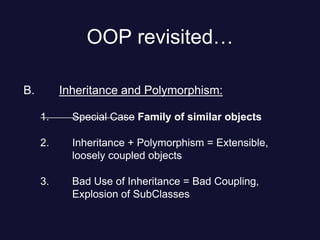
B. Inheritance and Polymorphism:
1. Special Case Family of similar objects
2. Inheritance + Polymorphism = Extensible,
loosely coupled objects
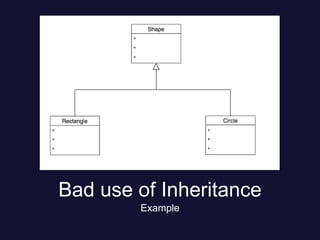
3. Bad Use of Inheritance = Bad Coupling,
Explosion of SubClasses
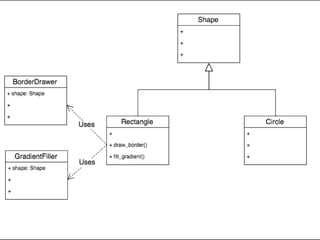
Bad use of Inheritance
Example
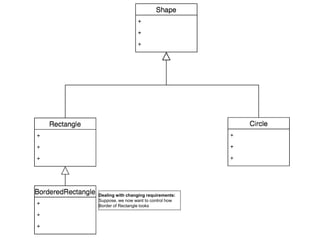
Dealing with changing requirements:
Suppose, we now want to control how
Border of Rectangle looks
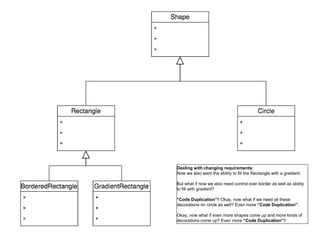
Dealing with changing requirements:
Now we also want the ability to fill the Rectangle with a gradient.
But what if now we also need control over border as well as ability
to fill with gradient?
“Code Duplication”!! Okay, now what if we need all these
decorations on circle as well? Even more “Code Duplication”.
Okay, now what if even more shapes come up and more kinds of
decorations come up? Even more “Code Duplication”!!
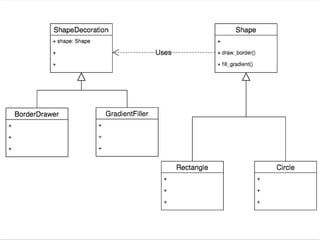
Better use of Inheritance
Favour aggregation over bad use of inheritance
OOP revisited…
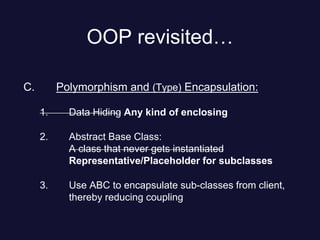
C. Polymorphism and (Type) Encapsulation:
1. Data Hiding Any kind of enclosing
2. Abstract Base Class:
A class that never gets instantiated
Representative/Placeholder for subclasses
3. Use ABC to encapsulate sub-classes from client,
thereby reducing coupling
OOP revisited…
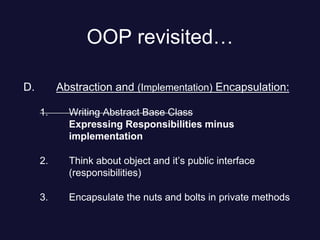
D. Abstraction and (Implementation) Encapsulation:
1. Writing Abstract Base Class
Expressing Responsibilities minus
implementation
2. Think about object and it’s public interface
(responsibilities)
3. Encapsulate the nuts and bolts in private methods
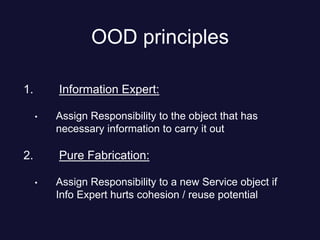
OOD principles
1. Information Expert:
• Assign Responsibility to the object that has
necessary information to carry it out
2. Pure Fabrication:
• Assign Responsibility to a new Service object if
Info Expert hurts cohesion / reuse potential
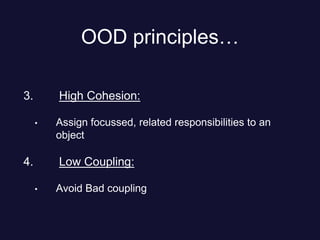
OOD principles…
3. High Cohesion:
• Assign focussed, related responsibilities to an
object
4. Low Coupling:
• Avoid Bad coupling
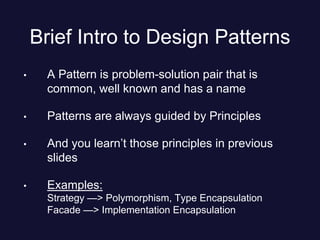
Brief Intro to Design Patterns
• A Pattern is problem-solution pair that is
common, well known and has a name
• Patterns are always guided by Principles
• And you learn’t those principles in previous
slides
• Examples:
Strategy —> Polymorphism, Type Encapsulation
Facade —> Implementation Encapsulation
Further Reading
• Applying UML and Patterns - Craig Larmann
• Design Patterns Explained - Allan Shalloway
• Domain Driven Design - Eric Evans
(for backend developers)

Brief introduction to Object Oriented Analysis and Design

  • 1.
  • 2.
    Before we start… •Emphasis is more on Design rather than analysis • The definitions I’ll use will be informal, non- rigorous. • I won’t go in depths of design patterns. • My assumption is that you all know what is a class, object, inheritance and interface.
  • 3.
    Why is itneeded • Knowing rules of chess doesn’t make you Vishwanathan Anand • Similarly, knowing programming alone doesn’t make you a good Software Engineer • Learning “how to think in objects” is absolutely critical
  • 4.
    Benefits • Comprehensibility (self-documenting) •Extensibility • Modifiability • Maintainability • Testability
  • 5.
    Analysis & Design •Analysis emphasises the study and research of problem and requirements in order to gain deeper understanding of them • Design emphasises a “conceptual solution” that fulfils the requirements
  • 6.
    OO Analysis &Design • OO Analysis: • Find and describe the objects/entities (and concepts) in a problem domain. • OO Design: • Define attributes and responsibilities of objects and how they collaborate with each other
  • 7.
    Perspectives • Conceptual: • “Whatdo you want to do?” • Implementation: • “How exactly will you do?”
  • 8.
    Cohesion and Coupling •Cohesion: • How strongly related methods (or responsibilities) of that object are • Coupling: • How closely connected two objects are
  • 9.
    OOP revisited A. Objects: 1.Data with Methods Things with Responsibilities 2. Entities: Representation of real world entities 3. Services: Model Concepts/Processes/sequence of actions 4. Value object: For eg. Money
  • 10.
    OOP revisited… B. Inheritanceand Polymorphism: 1. Special Case Family of similar objects 2. Inheritance + Polymorphism = Extensible, loosely coupled objects 3. Bad Use of Inheritance = Bad Coupling, Explosion of SubClasses
  • 11.
    Bad use ofInheritance Example
  • 12.
    Dealing with changingrequirements: Suppose, we now want to control how Border of Rectangle looks
  • 13.
    Dealing with changingrequirements: Now we also want the ability to fill the Rectangle with a gradient. But what if now we also need control over border as well as ability to fill with gradient? “Code Duplication”!! Okay, now what if we need all these decorations on circle as well? Even more “Code Duplication”. Okay, now what if even more shapes come up and more kinds of decorations come up? Even more “Code Duplication”!!
  • 14.
    Better use ofInheritance Favour aggregation over bad use of inheritance
  • 17.
    OOP revisited… C. Polymorphismand (Type) Encapsulation: 1. Data Hiding Any kind of enclosing 2. Abstract Base Class: A class that never gets instantiated Representative/Placeholder for subclasses 3. Use ABC to encapsulate sub-classes from client, thereby reducing coupling
  • 18.
    OOP revisited… D. Abstractionand (Implementation) Encapsulation: 1. Writing Abstract Base Class Expressing Responsibilities minus implementation 2. Think about object and it’s public interface (responsibilities) 3. Encapsulate the nuts and bolts in private methods
  • 19.
    OOD principles 1. InformationExpert: • Assign Responsibility to the object that has necessary information to carry it out 2. Pure Fabrication: • Assign Responsibility to a new Service object if Info Expert hurts cohesion / reuse potential
  • 20.
    OOD principles… 3. HighCohesion: • Assign focussed, related responsibilities to an object 4. Low Coupling: • Avoid Bad coupling
  • 21.
    Brief Intro toDesign Patterns • A Pattern is problem-solution pair that is common, well known and has a name • Patterns are always guided by Principles • And you learn’t those principles in previous slides • Examples: Strategy —> Polymorphism, Type Encapsulation Facade —> Implementation Encapsulation
  • 22.
    Further Reading • ApplyingUML and Patterns - Craig Larmann • Design Patterns Explained - Allan Shalloway • Domain Driven Design - Eric Evans (for backend developers)