Bio101: An Introduction
to Human Genetics
Instructional Presentation
Adam Wasilko
Amnah Albuloushi
Michaela Noakes
Genetics: The Basics
• The science of biological inheritance
• The study of heredity, how traits are
passed on from one generation to
another, and what makes each species
unique
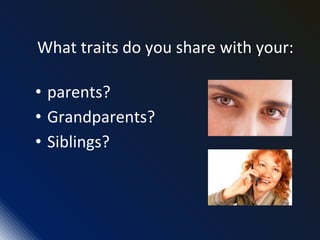
What traits do you share with your:
• parents?
• Grandparents?
• Siblings?
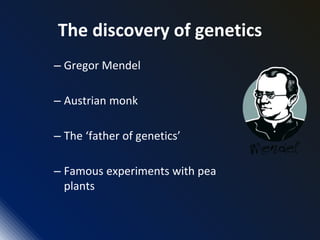
The discovery of genetics
– Gregor Mendel
– Austrian monk
– The ‘father of genetics’
– Famous experiments with pea
plants
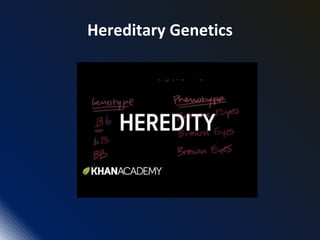
Hereditary Genetics
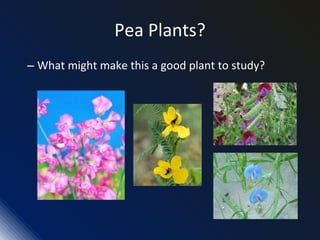
Pea Plants?
– What might make this a good plant to study?
Main reasons:
• Presence of observable traits with contrasting
forms
• Produces many offspring in one cross
• Short life cycle
• Ease in manipulating pollination (can easily cross
pollinate)
• Mendel used true-breeding plants which
means if they were left to breed with
themselves they would produce offspring
identical to themselves.
• Mendel studied 7 different traits in pea
plants.
• A trait is a specific characteristic that
varies from one individual to another.
The language of genetics
Gene:
A segment of a chromosome that
produces a particular trait.
• Each trait is produced by a pair of hereditary
factors collectively know as GENES.
• Within a chromosome, there are many genes,
each of which controls the inheritance of a
particular trait.
• A gene is a segment of a chromosome that
produces a particular trait.
• As we discussed, in pea plants, there’s a gene on
the chromosome that holds the code for seed
coat color
Alleles
A pair of hereditary factors that
make up a gene
or
(different forms of a gene)
• A gene usually consists of a pair of
hereditary factors called alleles.
• Each organism carries two alleles for a
particular trait, one from the mother and
one from the father.
• Another way to say this is that two
alleles make up a gene, which in turn
produces a particular trait.
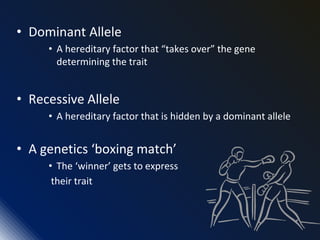
• Dominant Allele
• A hereditary factor that “takes over” the gene
determining the trait
• Recessive Allele
• A hereditary factor that is hidden by a dominant allele
• A genetics ‘boxing match’
• The ‘winner’ gets to express
their trait
• some alleles are dominant and others are
recessive.
• Dominant alleles are always expressed.
• Recessive alleles are only expressed if both
alleles are recessive.
• an allele can be DOMINANT or RECESSIVE.
• A Dominant allele – ‘wins’.
• Written with an UPPERCASE letter. T, B, N
• A Recessive allele – hidden by the dominant.
Written with a lowercase letter. t,b,n
• Homozygous
Two identical alleles for a particular trait.
BB or b
(blue eye, blue eye)
(brown eye, brown eye)
• Heterozygous
Two different alleles for a particular trait.
Bb
(brown eye, blue eye)
• Genotype
•The genetic makeup of an organism
due to the genes present
•The biological coding that expressed
your eye color, hair color, etc.
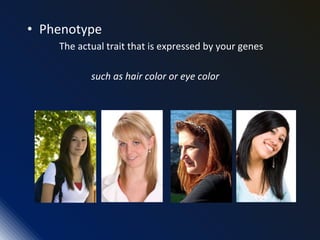
• Phenotype
The actual trait that is expressed by your genes
such as hair color or eye color
Parent vs. filial generation
• The first generation is always called the
parent or P1 GENERATION.
• The offspring of the P1 generation are called
the first filial or F1 generation.
• The offspring of the F1 generation are called
the F2 generation.
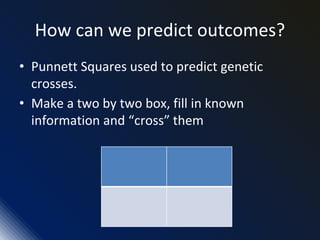
How can we predict outcomes?
• Punnett Squares used to predict genetic
crosses.
• Make a two by two box, fill in known
information and “cross” them
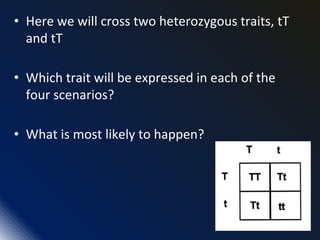
• Here we will cross two heterozygous traits, tT
and tT
• Which trait will be expressed in each of the
four scenarios?
• What is most likely to happen?
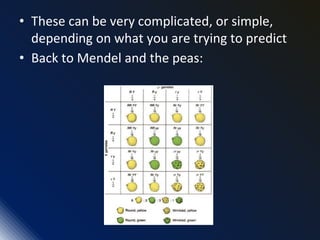
• These can be very complicated, or simple,
depending on what you are trying to predict
• Back to Mendel and the peas:
Mendel’s Laws
• Over many generations Mendel was able to observe
some things that always happened!
Here is what he said:
• The inheritance of biological characteristics are
determined by genes.
• For two or more forms of a gene, dominance and
recessive forms may exist.
• Most sexually reproductive organisms have two sets of
genes that separate during gamete formation.
• Alleles segregate independently.
It’s not always that easy!
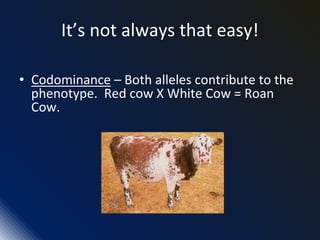
• Codominance – Both alleles contribute to the
phenotype. Red cow X White Cow = Roan
Cow.
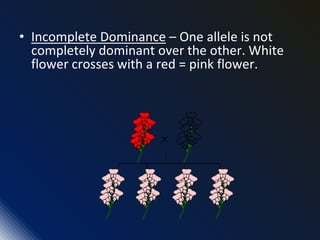
• Incomplete Dominance – One allele is not
completely dominant over the other. White
flower crosses with a red = pink flower.
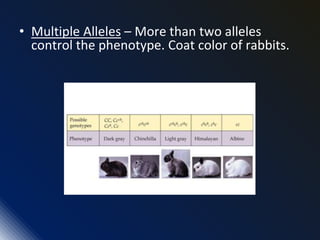
• Multiple Alleles – More than two alleles
control the phenotype. Coat color of rabbits.
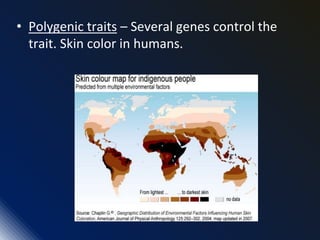
• Polygenic traits – Several genes control the
trait. Skin color in humans.
Research Assignment
• Now that we know some basics of genetics,
we can apply them to real world situations.
• Many common diseases are classified as
genetic diseases, meaning they are passed on
through family lines
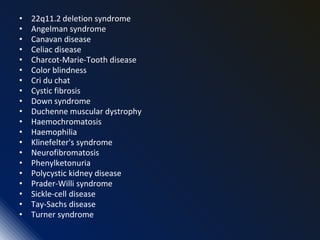
• 22q11.2 deletion syndrome
• Angelman syndrome
• Canavan disease
• Celiac disease
• Charcot-Marie-Tooth disease
• Color blindness
• Cri du chat
• Cystic fibrosis
• Down syndrome
• Duchenne muscular dystrophy
• Haemochromatosis
• Haemophilia
• Klinefelter's syndrome
• Neurofibromatosis
• Phenylketonuria
• Polycystic kidney disease
• Prader-Willi syndrome
• Sickle-cell disease
• Tay-Sachs disease
• Turner syndrome
Wiki Assignment
• Form groups of 3
• Using the blackboard wiki tool write a wiki
based on the genetic disease of your group’s
choice
• Include
– background information,
– what type is it (dominant, sex linked, recessive)
– Treatment and detection of the disease
– Current research on the disease
Supplemental Material
• Go through the flashcards a few times
• Become familiar with the vocabulary of
genetics
• This will be our “language” for the whole
semester!
http://www.flashcardexchange.com/flashcar
ds/view/1555508)

Instructional Presentation on Basic Genetics

  • 1.
    Bio101: An Introduction toHuman Genetics Instructional Presentation Adam Wasilko Amnah Albuloushi Michaela Noakes
  • 2.
    Genetics: The Basics •The science of biological inheritance • The study of heredity, how traits are passed on from one generation to another, and what makes each species unique
  • 3.
    What traits doyou share with your: • parents? • Grandparents? • Siblings?
  • 4.
    The discovery ofgenetics – Gregor Mendel – Austrian monk – The ‘father of genetics’ – Famous experiments with pea plants
  • 5.
  • 6.
    Pea Plants? – Whatmight make this a good plant to study?
  • 7.
    Main reasons: • Presenceof observable traits with contrasting forms • Produces many offspring in one cross • Short life cycle • Ease in manipulating pollination (can easily cross pollinate)
  • 8.
    • Mendel usedtrue-breeding plants which means if they were left to breed with themselves they would produce offspring identical to themselves. • Mendel studied 7 different traits in pea plants. • A trait is a specific characteristic that varies from one individual to another.
  • 9.
    The language ofgenetics Gene: A segment of a chromosome that produces a particular trait.
  • 10.
    • Each traitis produced by a pair of hereditary factors collectively know as GENES. • Within a chromosome, there are many genes, each of which controls the inheritance of a particular trait. • A gene is a segment of a chromosome that produces a particular trait. • As we discussed, in pea plants, there’s a gene on the chromosome that holds the code for seed coat color
  • 11.
    Alleles A pair ofhereditary factors that make up a gene or (different forms of a gene)
  • 12.
    • A geneusually consists of a pair of hereditary factors called alleles. • Each organism carries two alleles for a particular trait, one from the mother and one from the father. • Another way to say this is that two alleles make up a gene, which in turn produces a particular trait.
  • 13.
    • Dominant Allele •A hereditary factor that “takes over” the gene determining the trait • Recessive Allele • A hereditary factor that is hidden by a dominant allele • A genetics ‘boxing match’ • The ‘winner’ gets to express their trait
  • 14.
    • some allelesare dominant and others are recessive. • Dominant alleles are always expressed. • Recessive alleles are only expressed if both alleles are recessive.
  • 15.
    • an allelecan be DOMINANT or RECESSIVE. • A Dominant allele – ‘wins’. • Written with an UPPERCASE letter. T, B, N • A Recessive allele – hidden by the dominant. Written with a lowercase letter. t,b,n
  • 16.
    • Homozygous Two identicalalleles for a particular trait. BB or b (blue eye, blue eye) (brown eye, brown eye) • Heterozygous Two different alleles for a particular trait. Bb (brown eye, blue eye)
  • 17.
    • Genotype •The geneticmakeup of an organism due to the genes present •The biological coding that expressed your eye color, hair color, etc.
  • 18.
    • Phenotype The actualtrait that is expressed by your genes such as hair color or eye color
  • 19.
    Parent vs. filialgeneration • The first generation is always called the parent or P1 GENERATION. • The offspring of the P1 generation are called the first filial or F1 generation. • The offspring of the F1 generation are called the F2 generation.
  • 20.
    How can wepredict outcomes? • Punnett Squares used to predict genetic crosses. • Make a two by two box, fill in known information and “cross” them
  • 21.
    • Here wewill cross two heterozygous traits, tT and tT • Which trait will be expressed in each of the four scenarios? • What is most likely to happen?
  • 22.
    • These canbe very complicated, or simple, depending on what you are trying to predict • Back to Mendel and the peas:
  • 23.
    Mendel’s Laws • Overmany generations Mendel was able to observe some things that always happened! Here is what he said: • The inheritance of biological characteristics are determined by genes. • For two or more forms of a gene, dominance and recessive forms may exist. • Most sexually reproductive organisms have two sets of genes that separate during gamete formation. • Alleles segregate independently.
  • 24.
    It’s not alwaysthat easy! • Codominance – Both alleles contribute to the phenotype. Red cow X White Cow = Roan Cow.
  • 25.
    • Incomplete Dominance– One allele is not completely dominant over the other. White flower crosses with a red = pink flower.
  • 26.
    • Multiple Alleles– More than two alleles control the phenotype. Coat color of rabbits.
  • 27.
    • Polygenic traits– Several genes control the trait. Skin color in humans.
  • 28.
    Research Assignment • Nowthat we know some basics of genetics, we can apply them to real world situations. • Many common diseases are classified as genetic diseases, meaning they are passed on through family lines
  • 29.
    • 22q11.2 deletionsyndrome • Angelman syndrome • Canavan disease • Celiac disease • Charcot-Marie-Tooth disease • Color blindness • Cri du chat • Cystic fibrosis • Down syndrome • Duchenne muscular dystrophy • Haemochromatosis • Haemophilia • Klinefelter's syndrome • Neurofibromatosis • Phenylketonuria • Polycystic kidney disease • Prader-Willi syndrome • Sickle-cell disease • Tay-Sachs disease • Turner syndrome
  • 30.
    Wiki Assignment • Formgroups of 3 • Using the blackboard wiki tool write a wiki based on the genetic disease of your group’s choice • Include – background information, – what type is it (dominant, sex linked, recessive) – Treatment and detection of the disease – Current research on the disease
  • 31.
    Supplemental Material • Gothrough the flashcards a few times • Become familiar with the vocabulary of genetics • This will be our “language” for the whole semester! http://www.flashcardexchange.com/flashcar ds/view/1555508)