Lesson 1
Welcome,
Students!
Modals used in
expressing
permission, obligation,
and prohibition
Lesson
Objectives
classify the modals used in
expressing permission,
obligation, and prohibition;
express permission, obligation,
and prohibition using appropriate
modals; and
create a dialogue using
modals.
Modals used in expressing permission, obligation, and prohibition.
What is a Modal?
Modals
•Also called auxiliary or helping verbs.
•Gives additional information about how
the main verbs function in the sentence.
Modals
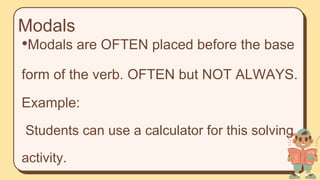
•Modals are OFTEN placed before the base
form of the verb. OFTEN but NOT ALWAYS.
Example:
Students can use a calculator for this solving
activity.
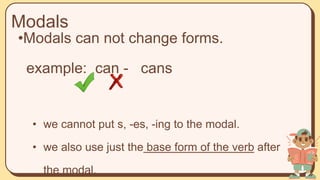
•Modals can not change forms.
example: can - cans
• we cannot put s, -es, -ing to the modal.
• we also use just the base form of the verb after
the modal.
Modals
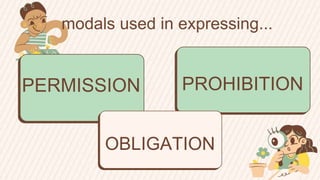
modals used in expressing...
PROHIBITION
OBLIGATION
PERMISSION
modals used in expressing PERMISSION
PERMISSION - giving consent
or authority or allowing
someone to do something.
can could may
might
modals
modals used in expressing PERMISSION
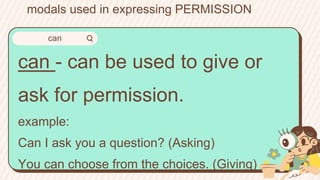
can - can be used to give or
ask for permission.
example:
Can I ask you a question? (Asking)
You can choose from the choices. (Giving)
can
modals used in expressing PERMISSION
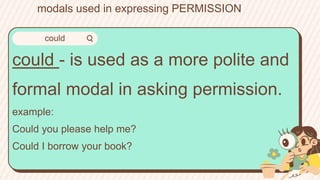
could - is used as a more polite and
formal modal in asking permission.
example:
Could you please help me?
Could I borrow your book?
could
modals used in expressing PERMISSION
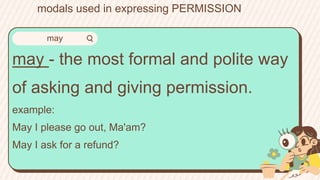
may - the most formal and polite way
of asking and giving permission.
example:
May I please go out, Ma'am?
May I ask for a refund?
may
modals used in expressing PERMISSION
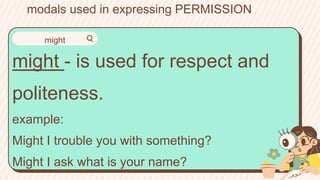
might - is used for respect and
politeness.
example:
Might I trouble you with something?
Might I ask what is your name?
might
modals used in expressing PERMISSION
modals in expressing permission
CREATE YOUR OWN
SENTENCE
modals used in expressing PROHIBITION
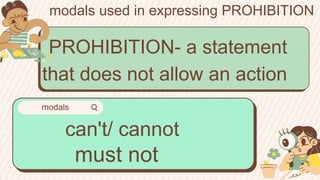
PROHIBITION- a statement
that does not allow an action
can't/ cannot
must not
modals
modals used in expressing PROHIBITION
can't - is a contraction of the word
cannot.
- used in dealing with something
that is against the rule, law, or signs
posted.
can't
modals used in expressing PROHIBITION
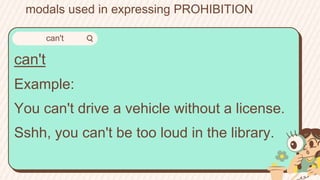
can't
Example:
You can't drive a vehicle without a license.
Sshh, you can't be too loud in the library.
can't
modals used in expressing PROHIBITION
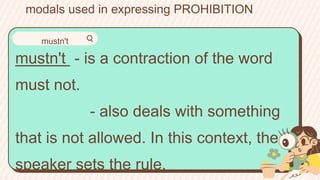
mustn't - is a contraction of the word
must not.
- also deals with something
that is not allowed. In this context, the
speaker sets the rule.
mustn't
modals used in expressing PROHIBITION
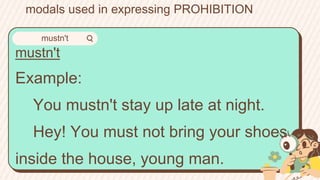
mustn't
Example:
You mustn't stay up late at night.
Hey! You must not bring your shoes
inside the house, young man.
mustn't
modals used in expressing PROHIBITION
modals in expressing prohibition
CREATE YOUR OWN
SENTENCE
modals used in expressing OBLIGATION
OBLIGATION - shows
duty or responsibility.
has/ have to
must
modals
modals used in expressing OBLIGATION
has/have to - is used when the
obligation is set by an authority, rule, or
law
- used when expressing an
obligation set by a general rule.
has/ have to
modals used in expressing OBLIGATION
has - singular
have - plural
has/ have to
modals used in expressing OBLIGATION
has/have to
example:
1. We have to implement the social
distancing rule at all times.
2. She has to hurry or she will miss the bus.
has/ have to
modals used in expressing OBLIGATION
must - is used when the obligation
comes from the speaker.
example:
I must pass my activities on time.
You must submit your outputs on time.
must
modals used in expressing
OBLIGATION
modals in expressing obligation
CREATE YOUR OWN
SENTENCE
modals used in expressing NO OBLIGATION
NO OBLIGATION - shows no
duty or no responsibility.
doesn't have to
don't have to
modals
modals used in expressing NO OBLIGATION
don't - is used when
speaking in the
second and third
person (I, you, we,
and they)
doesn't - is used
in the third
person singular
only ( he, she
and it)
modals used in expressing NO
OBLIGATION
don't have to
example:
It is an accident, you don't have
to apologize.
don't have to
modals used in expressing NO
OBLIGATION
doesn't have to
example:
She doesn't have to bring his files.
We already have a copy of it.
doesn't have to
modals used in expressing NO OBLIGATION
modals in expressing no obligation
CREATE YOUR OWN
SENTENCE
MODALS
MODALS
MODALS
PERMISSION
can could may
might
PROHIBITION
can't
mustn't
OBLIGATION / NO
OBLIGATION
has/have to
must
don't/doesn't have to
Class Recap
Make your own dialogue using
the modals used in expressing
permission, obligation, and
prohibition. Perform the dialogue
by making a video. You can be
creative in doing your video
presentation. Your video
duration must be a maximum of
2 mins only.
OUTPUT
You can choose a scenario here:
• Service in a restaurant
• Asking permission to have
a sleepover
• Prohibitions on driving a car
• Obligations on playing
basketball
• Obligations on applying for
a job
Criteria 5 pts 3pts 2 pts
Relevance to the topic The dialogue is relevant
to the topic chosen.
The dialogue has little
relevance to the topic
chosen.
The dialogue has no
relevance to the topic.
Content The dialogue contained
modals in expressing
prohibition, obligation,
and permission.
The dialogue has few
modals and was not
used to express
prohibition, obligation,
and permission.
The dialogue has no
modals.
Creativity The dialogue is unique
and well thought of and
the video presentation
is very creative and out
of the box.
The dialogue has a slight
uniqueness and a little
creativity.
The dialogue has no
uniqueness, no
creativity, and was
copied from someone
else.
OUTPUT
Deadline for
submission:
AUGUST 19, 2022
Friday
4:00 PM
SEE YOU NEXT TIME
Thank
You

Modals (3) (2).pptx

  • 1.
  • 2.
  • 3.
    Modals used in expressing permission,obligation, and prohibition
  • 4.
    Lesson Objectives classify the modalsused in expressing permission, obligation, and prohibition; express permission, obligation, and prohibition using appropriate modals; and create a dialogue using modals.
  • 5.
    Modals used inexpressing permission, obligation, and prohibition. What is a Modal?
  • 6.
    Modals •Also called auxiliaryor helping verbs. •Gives additional information about how the main verbs function in the sentence.
  • 7.
    Modals •Modals are OFTENplaced before the base form of the verb. OFTEN but NOT ALWAYS. Example: Students can use a calculator for this solving activity.
  • 8.
    •Modals can notchange forms. example: can - cans • we cannot put s, -es, -ing to the modal. • we also use just the base form of the verb after the modal. Modals
  • 9.
    modals used inexpressing... PROHIBITION OBLIGATION PERMISSION
  • 10.
    modals used inexpressing PERMISSION PERMISSION - giving consent or authority or allowing someone to do something. can could may might modals
  • 11.
    modals used inexpressing PERMISSION can - can be used to give or ask for permission. example: Can I ask you a question? (Asking) You can choose from the choices. (Giving) can
  • 12.
    modals used inexpressing PERMISSION could - is used as a more polite and formal modal in asking permission. example: Could you please help me? Could I borrow your book? could
  • 13.
    modals used inexpressing PERMISSION may - the most formal and polite way of asking and giving permission. example: May I please go out, Ma'am? May I ask for a refund? may
  • 14.
    modals used inexpressing PERMISSION might - is used for respect and politeness. example: Might I trouble you with something? Might I ask what is your name? might
  • 15.
    modals used inexpressing PERMISSION modals in expressing permission CREATE YOUR OWN SENTENCE
  • 16.
    modals used inexpressing PROHIBITION PROHIBITION- a statement that does not allow an action can't/ cannot must not modals
  • 17.
    modals used inexpressing PROHIBITION can't - is a contraction of the word cannot. - used in dealing with something that is against the rule, law, or signs posted. can't
  • 18.
    modals used inexpressing PROHIBITION can't Example: You can't drive a vehicle without a license. Sshh, you can't be too loud in the library. can't
  • 19.
    modals used inexpressing PROHIBITION mustn't - is a contraction of the word must not. - also deals with something that is not allowed. In this context, the speaker sets the rule. mustn't
  • 20.
    modals used inexpressing PROHIBITION mustn't Example: You mustn't stay up late at night. Hey! You must not bring your shoes inside the house, young man. mustn't
  • 21.
    modals used inexpressing PROHIBITION modals in expressing prohibition CREATE YOUR OWN SENTENCE
  • 22.
    modals used inexpressing OBLIGATION OBLIGATION - shows duty or responsibility. has/ have to must modals
  • 23.
    modals used inexpressing OBLIGATION has/have to - is used when the obligation is set by an authority, rule, or law - used when expressing an obligation set by a general rule. has/ have to
  • 24.
    modals used inexpressing OBLIGATION has - singular have - plural has/ have to
  • 25.
    modals used inexpressing OBLIGATION has/have to example: 1. We have to implement the social distancing rule at all times. 2. She has to hurry or she will miss the bus. has/ have to
  • 26.
    modals used inexpressing OBLIGATION must - is used when the obligation comes from the speaker. example: I must pass my activities on time. You must submit your outputs on time. must
  • 27.
    modals used inexpressing OBLIGATION modals in expressing obligation CREATE YOUR OWN SENTENCE
  • 28.
    modals used inexpressing NO OBLIGATION NO OBLIGATION - shows no duty or no responsibility. doesn't have to don't have to modals
  • 29.
    modals used inexpressing NO OBLIGATION don't - is used when speaking in the second and third person (I, you, we, and they) doesn't - is used in the third person singular only ( he, she and it)
  • 30.
    modals used inexpressing NO OBLIGATION don't have to example: It is an accident, you don't have to apologize. don't have to
  • 31.
    modals used inexpressing NO OBLIGATION doesn't have to example: She doesn't have to bring his files. We already have a copy of it. doesn't have to
  • 32.
    modals used inexpressing NO OBLIGATION modals in expressing no obligation CREATE YOUR OWN SENTENCE
  • 33.
    MODALS MODALS MODALS PERMISSION can could may might PROHIBITION can't mustn't OBLIGATION/ NO OBLIGATION has/have to must don't/doesn't have to Class Recap
  • 34.
    Make your owndialogue using the modals used in expressing permission, obligation, and prohibition. Perform the dialogue by making a video. You can be creative in doing your video presentation. Your video duration must be a maximum of 2 mins only. OUTPUT You can choose a scenario here: • Service in a restaurant • Asking permission to have a sleepover • Prohibitions on driving a car • Obligations on playing basketball • Obligations on applying for a job
  • 35.
    Criteria 5 pts3pts 2 pts Relevance to the topic The dialogue is relevant to the topic chosen. The dialogue has little relevance to the topic chosen. The dialogue has no relevance to the topic. Content The dialogue contained modals in expressing prohibition, obligation, and permission. The dialogue has few modals and was not used to express prohibition, obligation, and permission. The dialogue has no modals. Creativity The dialogue is unique and well thought of and the video presentation is very creative and out of the box. The dialogue has a slight uniqueness and a little creativity. The dialogue has no uniqueness, no creativity, and was copied from someone else.
  • 36.
  • 37.
    SEE YOU NEXTTIME Thank You