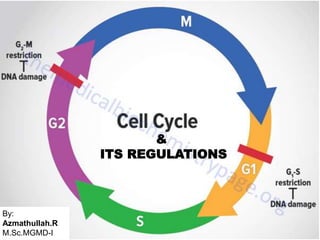
&
ITS REGULATIONS
By:
Azmathullah.R
M.Sc.MGMD-I
CELL CYCLE - DEFINITION
 Cell cycle happens in all living organism.
 A cell cycle is a series of events that a cell passes through from
the time until it reproduces its replica.
 It is the growth and division of single cell into daughter cells
and duplication (replication).
 The cell cycle is a sequence of cell growth and division.
 The division cycle of most cells consists of four co-ordinated
processes: Cell growth, DNA replication, distribution of the
duplication chromosomes to daughter cell and cell division.
 In prokaryotic cells, the cell cycle occurs via a
process termed binary fission.
In eukaryotic cells, the cell cycle can be divided in
two periods:-
a) Interphase
b) Mitosis
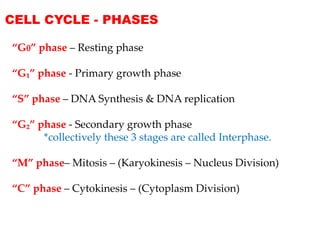
CELL CYCLE - PHASES
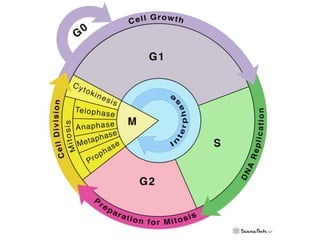
“G0” phase – Resting phase
“G₁” phase - Primary growth phase
“S” phase – DNA Synthesis & DNA replication
“G₂” phase - Secondary growth phase
*collectively these 3 stages are called Interphase.
“M” phase– Mitosis – (Karyokinesis – Nucleus Division)
“C” phase – Cytokinesis – (Cytoplasm Division)
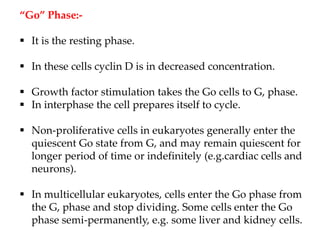
“Go” Phase:-
 It is the resting phase.
 In these cells cyclin D is in decreased concentration.
 Growth factor stimulation takes the Go cells to G, phase.
 In interphase the cell prepares itself to cycle.
 Non-proliferative cells in eukaryotes generally enter the
quiescent Go state from G, and may remain quiescent for
longer period of time or indefinitely (e.g.cardiac cells and
neurons).
 In multicellular eukaryotes, cells enter the Go phase from
the G, phase and stop dividing. Some cells enter the Go
phase semi-permanently, e.g. some liver and kidney cells.
"G1" Phase (Interphase)
 G1 Phase is also called as "Gap - 1" or Interphase
 G1 Phase is the first growth stage after Cell Division.
 Cell mature by making more Cytoplasm & Organelles.
 Cell increases in size, produce RNA & synthesize of
Protein.
"S" Phase:-
■"S" Phase is also called as Synthesis stage.
■ DNA is copied or replicated and produces two
similar daughter cells in this stage.
"G2" Phase
■ G2 Phase is also called as "Gap - 2“ ,it is a Second
growth stage.
 This phase occurs after the DNA is replicated.
- All the cell structures needed for cell division are
synthesized.
■ Both organelles & proteins are synthesized.
"M" Phase (Mitosis):-
■ Mitosis is the Asexual type of reproduction occurred
in all living organisms.
■ Mitosis results in two genetically identical cells.
Four steps are observed in Mitosis. They are
✓ Prophase
✓ Metaphase
✓ Anaphase
✓ Telophase
"C" Phase (Cytokinesis):-
■ Cytokinesis is a process of Cell Division which
divides the cytoplasm of parent cells into two daughter
cells.
■ It occurs in both Mitosis & Meiosis during the
"Telophase" stage.
CELL CYCLE REGULATION BY CYCLINS & CYCLIN
DEPENDENT KINASES
 Cyclins are Proteins that are rapidly made and broken down
that activate kinases.
 Cyclin Dependent Kinases (CDKs) are Enzymes that when
activated transfer a phosphate group from one molecule to a
target molecule.
 This gives energy or changes the shape of the target
molecule.
 CDKs (Molecular weight 34 - 40 kDa) are also involved in
regulating Transcription, mRNA processing, and
Differentiation of nerve cells. They are present in all
known Eukaryotes.
 Cyclin Dependent Kinases helps to control the Cell cycle.
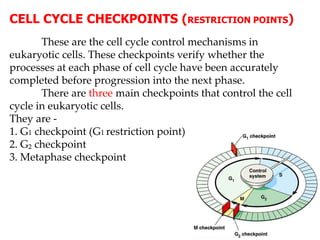
CELL CYCLE CHECKPOINTS (RESTRICTION POINTS)
These are the cell cycle control mechanisms in
eukaryotic cells. These checkpoints verify whether the
processes at each phase of cell cycle have been accurately
completed before progression into the next phase.
There are three main checkpoints that control the cell
cycle in eukaryotic cells.
They are -
1. G1 checkpoint (G1 restriction point)
2. G₂ checkpoint
3. Metaphase checkpoint
G1 checkpoint (G1 restriction point)
 This checkpoint is present at the end of the G1 phase and
before S phase.
 This checkpoint helps in taking the decision of whether
the cell should divide, delay division, or enter a resting
stage (Go phase). If there are unfavourable conditions for
the cell division, then this restriction point restrict the
progression to the next phase by passing the cell to Go
phase for an extended period of time.
 This restriction point is mainly controlled by the action of
the CKI-p16 (CDK inhibitor p16).
 The inhibited CDK not bind with cyclin D1, hence there is
no cell progression. Active cyclin D-cdk complexes
phosphorylate retinoblastoma protein (pRb) in the
nucleus.
G₂ checkpoint
 This restriction point is located at the end of the G₂ phase. This
checks the number of factors which are essential for the cell
division.
 Maturation-promoting factor or mitosis promoting factor or M-
phase promoting factor- (MPF) is a protein composed of cyclin-B &
CDK-1. This protein promotes the G₂ phase into the entrance of M-
phase. MPF is activated at the end of G₂ by a phosphatase (Chk)
which removes an inhibitory phosphate group added earlier.
 The main functions of MPF in this restriction point are
a.Triggers the formation of mitotic spindle.
b. Promotes chromosome condensation.
c. Causes nuclear envelop breakdown.
 If there are any damages are noticed in this restriction point, then
the phosphatase not activate the MPF, resulting in the arrest of cell
cycle in G₂ phase till the repair of the damaged DNA. This prevents
the transfer of defected DNA into the daughter cells.
METAPHASE CHECKPOINT
This occurs at metaphase.
Anaphase-promoting complex (APC) regulates this
checkpoint. This is also called spindle checkpoint.
This checks whether all chromosomes are properly
attached to the spindle or not. This also governs the
alignment of the chromosomes and integrity of the
spindles. If there are mistakes then it delays the cell in
entering into anaphase from metaphase.
CELL CYCLE REGULATORS:-
The cell cycle is regulated by:
1. cyclin-dependent kinases (CDKs)
2. cyclin-dependent kinase inhibitors (CDKIs).
1.CYCLINS:
Their concentration varies during the cell cycle. Cyclins are
the family of proteins which regulates the cell cycle.
There are several types of cyclins that are active in different
parts of the cell cycle and causes phosphorylation of CDK.
CYCLIN B:-
I. CYCLIN BI/CDKI
This complex is involved in the early events of mitosis
such as chromosome condensation, nuclear envelop
breakdown.
• This complex is localized in the microtubules.
2. CYCLIN B2/CDKI
This complex is localized in the Golgi apparatus.
• Cyclin B2 is also binds to a gene-transforming growth
factor (TGF beta receptor 2). This gene complex
transcribes several genes required for the cell
proliferation.
CYCLIN-DEPENDENT KINSASES
(CDKS)
These are a family of protein kinases that regulates the
cell cycle.
They are present in all known eukaryotic cells.
CYCLIN-DEPENDENT KINASE INHIBITORS (CDKIS)
CDKI is a protein which inhibits cyclin-dependent kinase
(CDK).
Cell cycle progression is negatively controlled by cyclin-
dependent kinases inhibitors (called CDIs, CKIs or CDKIs).
These are involved in cell cycle arrest at the G1phase.
POSITIVE REGULATORS
 Are those which control the changes necessary
for cell division.
 They include:-
Cyclins
Cyclin-dependent kinases(cdks)
Polo-like kinases
NEGATIVE REGULATORS
 Are those which control the positive regulators.
 They include:-
• Rb proteins
• P53 gene
• Inhibitors of cdks - which are of 2 types
1.Ink family (Inhibitors of kinases)
P 19,P 15
2.CIP family (cdks inhibitory proteins)
P21,P57
CELL CYCLE & ITS REGULATION.pptx

CELL CYCLE & ITS REGULATION.pptx

  • 1.
  • 2.
    CELL CYCLE -DEFINITION  Cell cycle happens in all living organism.  A cell cycle is a series of events that a cell passes through from the time until it reproduces its replica.  It is the growth and division of single cell into daughter cells and duplication (replication).  The cell cycle is a sequence of cell growth and division.  The division cycle of most cells consists of four co-ordinated processes: Cell growth, DNA replication, distribution of the duplication chromosomes to daughter cell and cell division.
  • 3.
     In prokaryoticcells, the cell cycle occurs via a process termed binary fission. In eukaryotic cells, the cell cycle can be divided in two periods:- a) Interphase b) Mitosis
  • 4.
    CELL CYCLE -PHASES “G0” phase – Resting phase “G₁” phase - Primary growth phase “S” phase – DNA Synthesis & DNA replication “G₂” phase - Secondary growth phase *collectively these 3 stages are called Interphase. “M” phase– Mitosis – (Karyokinesis – Nucleus Division) “C” phase – Cytokinesis – (Cytoplasm Division)
  • 6.
    “Go” Phase:-  Itis the resting phase.  In these cells cyclin D is in decreased concentration.  Growth factor stimulation takes the Go cells to G, phase.  In interphase the cell prepares itself to cycle.  Non-proliferative cells in eukaryotes generally enter the quiescent Go state from G, and may remain quiescent for longer period of time or indefinitely (e.g.cardiac cells and neurons).  In multicellular eukaryotes, cells enter the Go phase from the G, phase and stop dividing. Some cells enter the Go phase semi-permanently, e.g. some liver and kidney cells.
  • 7.
    "G1" Phase (Interphase) G1 Phase is also called as "Gap - 1" or Interphase  G1 Phase is the first growth stage after Cell Division.  Cell mature by making more Cytoplasm & Organelles.  Cell increases in size, produce RNA & synthesize of Protein.
  • 8.
    "S" Phase:- ■"S" Phaseis also called as Synthesis stage. ■ DNA is copied or replicated and produces two similar daughter cells in this stage. "G2" Phase ■ G2 Phase is also called as "Gap - 2“ ,it is a Second growth stage.  This phase occurs after the DNA is replicated. - All the cell structures needed for cell division are synthesized. ■ Both organelles & proteins are synthesized.
  • 9.
    "M" Phase (Mitosis):- ■Mitosis is the Asexual type of reproduction occurred in all living organisms. ■ Mitosis results in two genetically identical cells. Four steps are observed in Mitosis. They are ✓ Prophase ✓ Metaphase ✓ Anaphase ✓ Telophase
  • 10.
    "C" Phase (Cytokinesis):- ■Cytokinesis is a process of Cell Division which divides the cytoplasm of parent cells into two daughter cells. ■ It occurs in both Mitosis & Meiosis during the "Telophase" stage.
  • 11.
    CELL CYCLE REGULATIONBY CYCLINS & CYCLIN DEPENDENT KINASES  Cyclins are Proteins that are rapidly made and broken down that activate kinases.  Cyclin Dependent Kinases (CDKs) are Enzymes that when activated transfer a phosphate group from one molecule to a target molecule.  This gives energy or changes the shape of the target molecule.
  • 12.
     CDKs (Molecularweight 34 - 40 kDa) are also involved in regulating Transcription, mRNA processing, and Differentiation of nerve cells. They are present in all known Eukaryotes.  Cyclin Dependent Kinases helps to control the Cell cycle.
  • 13.
    CELL CYCLE CHECKPOINTS(RESTRICTION POINTS) These are the cell cycle control mechanisms in eukaryotic cells. These checkpoints verify whether the processes at each phase of cell cycle have been accurately completed before progression into the next phase. There are three main checkpoints that control the cell cycle in eukaryotic cells. They are - 1. G1 checkpoint (G1 restriction point) 2. G₂ checkpoint 3. Metaphase checkpoint
  • 14.
    G1 checkpoint (G1restriction point)  This checkpoint is present at the end of the G1 phase and before S phase.  This checkpoint helps in taking the decision of whether the cell should divide, delay division, or enter a resting stage (Go phase). If there are unfavourable conditions for the cell division, then this restriction point restrict the progression to the next phase by passing the cell to Go phase for an extended period of time.  This restriction point is mainly controlled by the action of the CKI-p16 (CDK inhibitor p16).  The inhibited CDK not bind with cyclin D1, hence there is no cell progression. Active cyclin D-cdk complexes phosphorylate retinoblastoma protein (pRb) in the nucleus.
  • 15.
    G₂ checkpoint  Thisrestriction point is located at the end of the G₂ phase. This checks the number of factors which are essential for the cell division.  Maturation-promoting factor or mitosis promoting factor or M- phase promoting factor- (MPF) is a protein composed of cyclin-B & CDK-1. This protein promotes the G₂ phase into the entrance of M- phase. MPF is activated at the end of G₂ by a phosphatase (Chk) which removes an inhibitory phosphate group added earlier.  The main functions of MPF in this restriction point are a.Triggers the formation of mitotic spindle. b. Promotes chromosome condensation. c. Causes nuclear envelop breakdown.  If there are any damages are noticed in this restriction point, then the phosphatase not activate the MPF, resulting in the arrest of cell cycle in G₂ phase till the repair of the damaged DNA. This prevents the transfer of defected DNA into the daughter cells.
  • 16.
    METAPHASE CHECKPOINT This occursat metaphase. Anaphase-promoting complex (APC) regulates this checkpoint. This is also called spindle checkpoint. This checks whether all chromosomes are properly attached to the spindle or not. This also governs the alignment of the chromosomes and integrity of the spindles. If there are mistakes then it delays the cell in entering into anaphase from metaphase.
  • 17.
    CELL CYCLE REGULATORS:- Thecell cycle is regulated by: 1. cyclin-dependent kinases (CDKs) 2. cyclin-dependent kinase inhibitors (CDKIs). 1.CYCLINS: Their concentration varies during the cell cycle. Cyclins are the family of proteins which regulates the cell cycle. There are several types of cyclins that are active in different parts of the cell cycle and causes phosphorylation of CDK.
  • 18.
    CYCLIN B:- I. CYCLINBI/CDKI This complex is involved in the early events of mitosis such as chromosome condensation, nuclear envelop breakdown. • This complex is localized in the microtubules. 2. CYCLIN B2/CDKI This complex is localized in the Golgi apparatus. • Cyclin B2 is also binds to a gene-transforming growth factor (TGF beta receptor 2). This gene complex transcribes several genes required for the cell proliferation.
  • 19.
    CYCLIN-DEPENDENT KINSASES (CDKS) These area family of protein kinases that regulates the cell cycle. They are present in all known eukaryotic cells.
  • 20.
    CYCLIN-DEPENDENT KINASE INHIBITORS(CDKIS) CDKI is a protein which inhibits cyclin-dependent kinase (CDK). Cell cycle progression is negatively controlled by cyclin- dependent kinases inhibitors (called CDIs, CKIs or CDKIs). These are involved in cell cycle arrest at the G1phase.
  • 21.
    POSITIVE REGULATORS  Arethose which control the changes necessary for cell division.  They include:- Cyclins Cyclin-dependent kinases(cdks) Polo-like kinases
  • 22.
    NEGATIVE REGULATORS  Arethose which control the positive regulators.  They include:- • Rb proteins • P53 gene • Inhibitors of cdks - which are of 2 types 1.Ink family (Inhibitors of kinases) P 19,P 15 2.CIP family (cdks inhibitory proteins) P21,P57