FDI An Economic Reform
K-MART
FOREIGN DIRECT INVESTMENT
FDI inflow plays a predominant role in
economic development
Its seen as a means of supplement to
domestic investment for achieving a higher
level of growth development
Introduction
 According to IMF, FDI or Foreign Direct Investment is that
category of international investment that reflects the
objective of obtaining a “lasting interest” by a resident entity
in one economy in an enterprise resident in another economy
 There is no specific definitions on FDI as such owing to the
presence of many authorities like IMF,IBRD,OECD, and
UNCTAD.
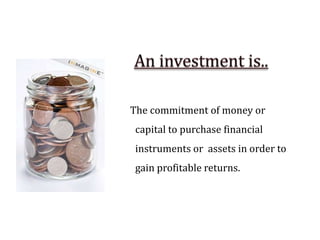
The commitment of money or
capital to purchase financial
instruments or assets in order to
gain profitable returns.
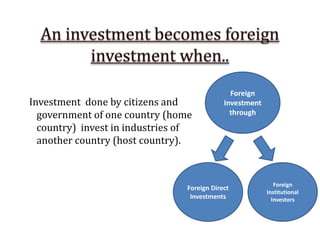
Investment done by citizens and
government of one country (home
country) invest in industries of
another country (host country).
Foreign
Investment
through
Foreign Direct
Investments
Foreign
Institutional
Investors
Inflow from Investors point of view
• Market seeking : The investors are attached by the size
of the local market , which depends on the income of
the country and its growth rate.
• Lower cost : Investors are most cost-conscious . They are
influenced by infrastructure facilities and labor costs.
• Location and other factors : Technology status of a
country , brand name , goodwill enjoyed by the local
firms , favorable location , openness of the economy ,
policies of the government and intellectual property
protection granted by the government are some of the
factors that attract investors to undertake investments
WHAT F.D.I REQUIRES ?
Important factors which foreign investors take into
consideration when entering a country are:
 Reliable access to economic information.
 The level of corruption.
 Stability of political and business environment .
 Ability to meet and comply with internationality
acceptable standards and norms .
 Character of local market (size , growth , potential) or
the distance and the access to neighboring markets.
 The existence of good and quality infrastructure.
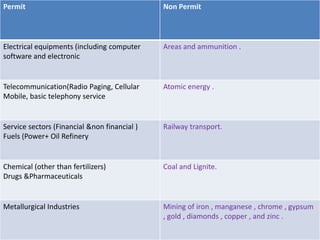
Permit Non Permit
Electrical equipments (including computer
software and electronic
Areas and ammunition .
Telecommunication(Radio Paging, Cellular
Mobile, basic telephony service
Atomic energy .
Service sectors (Financial &non financial )
Fuels (Power+ Oil Refinery
Railway transport.
Chemical (other than fertilizers)
Drugs &Pharmaceuticals
Coal and Lignite.
Metallurgical Industries Mining of iron , manganese , chrome , gypsum
, gold , diamonds , copper , and zinc .
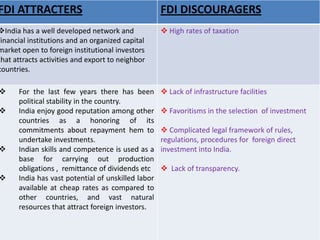
FDI ATTRACTERS FDI DISCOURAGERS
India has a well developed network and
financial institutions and an organized capital
market open to foreign institutional investors
that attracts activities and export to neighbor
countries.
 High rates of taxation
 For the last few years there has been
political stability in the country.
 India enjoy good reputation among other
countries as a honoring of its
commitments about repayment hem to
undertake investments.
 Indian skills and competence is used as a
base for carrying out production
obligations , remittance of dividends etc
 India has vast potential of unskilled labor
available at cheap rates as compared to
other countries, and vast natural
resources that attract foreign investors.
 Lack of infrastructure facilities
 Favoritisms in the selection of investment
 Complicated legal framework of rules,
regulations, procedures for foreign direct
investment into India.
 Lack of transparency.
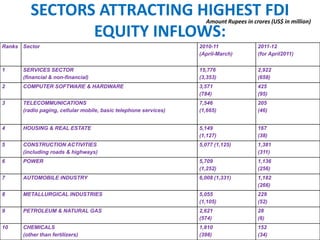
SECTORS ATTRACTING HIGHEST FDI
EQUITY INFLOWS:
Ranks Sector 2010-11
(April-March)
2011-12
(for April2011)
1 SERVICES SECTOR
(financial & non-financial)
15,776
(3,353)
2,922
(658)
2 COMPUTER SOFTWARE & HARDWARE 3,571
(784)
425
(95)
3 TELECOMMUNICATIONS
(radio paging, cellular mobile, basic telephone services)
7,546
(1,665)
205
(46)
4 HOUSING & REAL ESTATE 5,149
(1,127)
167
(38)
5 CONSTRUCTION ACTIVITIES
(including roads & highways)
5,077 (1,125) 1,381
(311)
6 POWER 5,709
(1,252)
1,136
(256)
7 AUTOMOBILE INDUSTRY 6,008 (1,331) 1,182
(266)
8 METALLURGICAL INDUSTRIES 5,055
(1,105)
229
(52)
9 PETROLEUM & NATURAL GAS 2,621
(574)
28
(6)
10 CHEMICALS
(other than fertilizers)
1,810
(398)
152
(34)
Amount Rupees in crores (US$ in million)
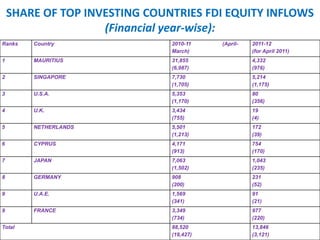
Ranks Country 2010-11 (April-
March)
2011-12
(for April 2011)
1 MAURITIUS 31,855
(6,987)
4,332
(976)
2 SINGAPORE 7,730
(1,705)
5,214
(1,175)
3 U.S.A. 5,353
(1,170)
80
(356)
4 U.K. 3,434
(755)
19
(4)
5 NETHERLANDS 5,501
(1,213)
172
(39)
6 CYPRUS 4,171
(913)
754
(170)
7 JAPAN 7,063
(1,502)
1,043
(235)
8 GERMANY 908
(200)
231
(52)
9 U.A.E. 1,569
(341)
91
(21)
9 FRANCE 3,349
(734)
977
(220)
Total 88,520
(19,427)
13,846
(3,121)
SHARE OF TOP INVESTING COUNTRIES FDI EQUITY INFLOWS
(Financial year-wise):
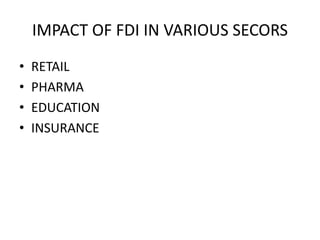
IMPACT OF FDI IN VARIOUS SECORS
• RETAIL
• PHARMA
• EDUCATION
• INSURANCE
Retail (CONTD
• As per the current regulatory regime or say Policy
Foreign Direct Investment (FDI) up to 51% is allowed with
prior Government approval, in retail trade of ‘Single Brand’
products. Guidelines notified, vide Press Note 3 (2006
Series), require:
i. Products to be sold should be of a ‘Single Brand’ only.
ii. Products should be sold under the same brand
internationally.
iii. ‘Single Brand’ product-retailing would cover only
products which are branded during manufacturing.
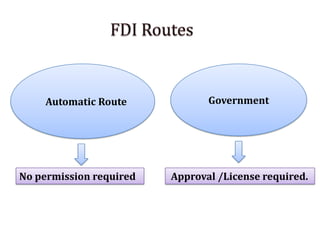
Automatic Route Government
No permission required Approval /License required.
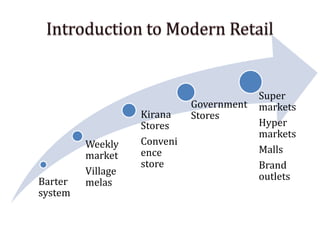
Barter
system
Weekly
market
Village
melas
Kirana
Stores
Conveni
ence
store
Government
Stores
Super
markets
Hyper
markets
Malls
Brand
outlets
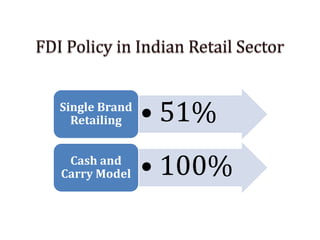
• 51%Single Brand
Retailing
• 100%Cash and
Carry Model
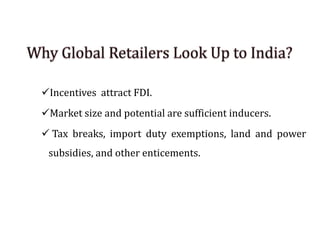
Incentives attract FDI.
Market size and potential are sufficient inducers.
 Tax breaks, import duty exemptions, land and power
subsidies, and other enticements.
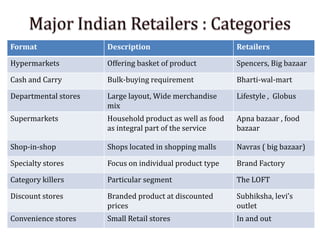
Format Description Retailers
Hypermarkets Offering basket of product Spencers, Big bazaar
Cash and Carry Bulk-buying requirement Bharti-wal-mart
Departmental stores Large layout, Wide merchandise
mix
Lifestyle , Globus
Supermarkets Household product as well as food
as integral part of the service
Apna bazaar , food
bazaar
Shop-in-shop Shops located in shopping malls Navras ( big bazaar)
Specialty stores Focus on individual product type Brand Factory
Category killers Particular segment The LOFT
Discount stores Branded product at discounted
prices
Subhiksha, levi’s
outlet
Convenience stores Small Retail stores In and out
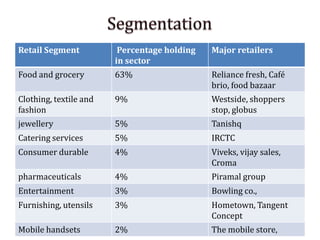
Retail Segment Percentage holding
in sector
Major retailers
Food and grocery 63% Reliance fresh, Café
brio, food bazaar
Clothing, textile and
fashion
9% Westside, shoppers
stop, globus
jewellery 5% Tanishq
Catering services 5% IRCTC
Consumer durable 4% Viveks, vijay sales,
Croma
pharmaceuticals 4% Piramal group
Entertainment 3% Bowling co.,
Furnishing, utensils 3% Hometown, Tangent
Concept
Mobile handsets 2% The mobile store,
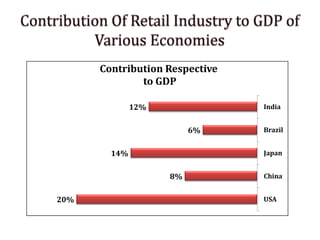
20%
8%
14%
6%
12%
USA
China
Japan
Brazil
India
Contribution Respective
to GDP
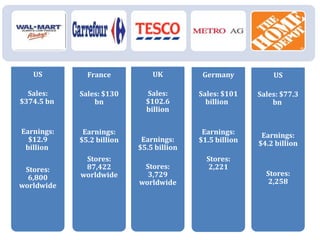
US
Sales:
$374.5 bn
Earnings:
$12.9
billion
Stores:
6,800
worldwide
France
Sales: $130
bn
Earnings:
$5.2 billion
Stores:
87,422
worldwide
UK
Sales:
$102.6
billion
Earnings:
$5.5 billion
Stores:
3,729
worldwide
Germany
Sales: $101
billion
Earnings:
$1.5 billion
Stores:
2,221
US
Sales: $77.3
bn
Earnings:
$4.2 billion
Stores:
2,258
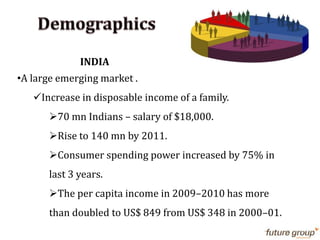
•A large emerging market .
Increase in disposable income of a family.
70 mn Indians – salary of $18,000.
Rise to 140 mn by 2011.
Consumer spending power increased by 75% in
last 3 years.
The per capita income in 2009–2010 has more
than doubled to US$ 849 from US$ 348 in 2000–01.
INDIA
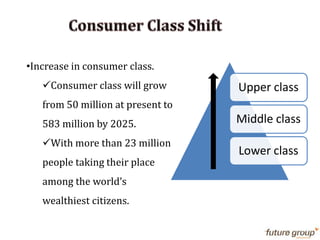
•Increase in consumer class.
Consumer class will grow
from 50 million at present to
583 million by 2025.
With more than 23 million
people taking their place
among the world’s
wealthiest citizens.
Upper class
Middle class
Lower class
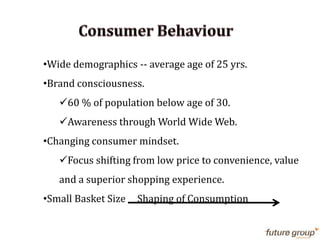
•Wide demographics -- average age of 25 yrs.
•Brand consciousness.
60 % of population below age of 30.
Awareness through World Wide Web.
•Changing consumer mindset.
Focus shifting from low price to convenience, value
and a superior shopping experience.
•Small Basket Size Shaping of Consumption
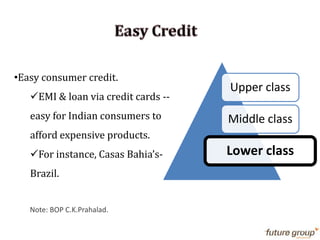
•Easy consumer credit.
EMI & loan via credit cards --
easy for Indian consumers to
afford expensive products.
For instance, Casas Bahia’s-
Brazil.
Upper class
Middle class
Lower class
Note: BOP C.K.Prahalad.
•Employment generation.
Second-largest employer after
agriculture.
Retail trade employing 35.06 million.
Wholesale trade generating an
additional employment of 5.48 million.
Additional
1.6 mn jobs .
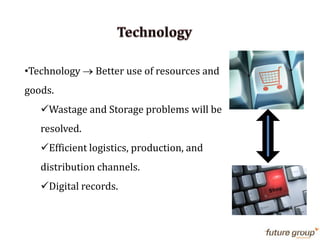
•Technology Better use of resources and
goods.
Wastage and Storage problems will be
resolved.
Efficient logistics, production, and
distribution channels.
Digital records.
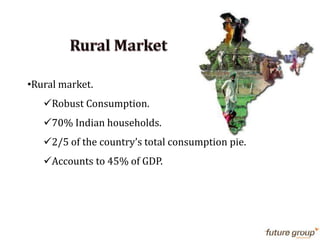
•Rural market.
Robust Consumption.
70% Indian households.
2/5 of the country’s total consumption pie.
Accounts to 45% of GDP.
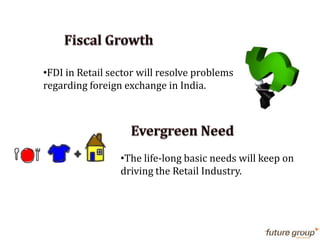
•FDI in Retail sector will resolve problems
regarding foreign exchange in India.
•The life-long basic needs will keep on
driving the Retail Industry.
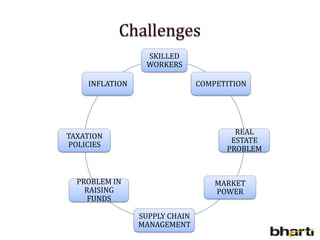
SKILLED
WORKERS
COMPETITION
REAL
ESTATE
PROBLEM
MARKET
POWER
SUPPLY CHAIN
MANAGEMENT
PROBLEM IN
RAISING
FUNDS
TAXATION
POLICIES
INFLATION
• Indian retail sector :
 Employs 8% (35 million)of the working population.
 Could yield 12 to 15 million retail jobs in the coming
five years.
• Out of which organized segment is about 0.3 million.
• Retail sector grew at 9.4% on real terms & 15.4% on
nominal terms.
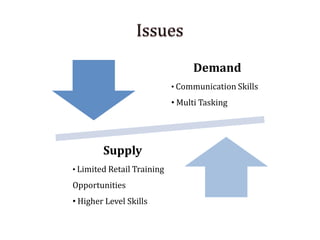
Demand
• Communication Skills
• Multi Tasking
Supply
• Limited Retail Training
Opportunities
• Higher Level Skills
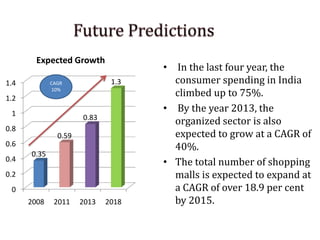
0
0.2
0.4
0.6
0.8
1
1.2
1.4
2008 2011 2013 2018
0.35
0.59
0.83
1.3
Expected Growth
CAGR
10%
• In the last four year, the
consumer spending in India
climbed up to 75%.
• By the year 2013, the
organized sector is also
expected to grow at a CAGR of
40%.
• The total number of shopping
malls is expected to expand at
a CAGR of over 18.9 per cent
by 2015.
PHARMA
• The pharma industry generally grows at about 1.5-1.6 times the
Gross Domestic Product growth
• Globally, India ranks third in terms of manufacturing pharma
products by volume and thirteenth by value
• The Indian pharmaceutical industry is expected to grow at a rate of
9.5 % till 2015
• In 2009-2010, India exported drugs worth US$7.2 billion in to the US
and Europe followed by Central and Eastern Europe, Africa and
Latin America
• The Indian vaccine market which was worth US$800 million in 2010-
11 is growing at a rate of more than 20%
• The retail pharmaceutical market in India is expected to cross US$
12-13 billion by 2012
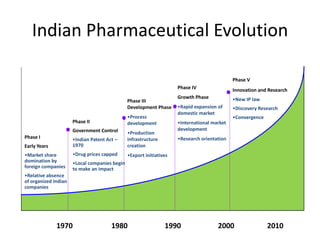
Indian Pharmaceutical Evolution
Phase II
Government Control
•Indian Patent Act –
1970
•Drug prices capped
•Local companies begin
to make an impact
Phase III
Development Phase
•Process
development
•Production
infrastructure
creation
•Export initiatives
Phase IV
Growth Phase
•Rapid expansion of
domestic market
•International market
development
•Research orientation
Phase V
Innovation and Research
•New IP law
•Discovery Research
•Convergence
1970 1980 1990 2000 2010
Phase I
Early Years
•Market share
domination by
foreign companies
•Relative absence
of organized Indian
companies
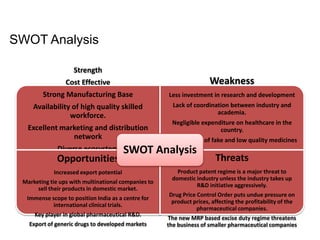
Strength
Cost Effective
Strong Manufacturing Base
Availability of high quality skilled
workforce.
Excellent marketing and distribution
network
Diverse ecosystem
Weakness
Less investment in research and development
Lack of coordination between industry and
academia.
Negligible expenditure on healthcare in the
country.
Manufacture of fake and low quality medicines
Opportunities
Increased export potential
Marketing tie ups with multinational companies to
sell their products in domestic market.
Immense scope to position India as a centre for
international clinical trials.
Key player in global pharmaceutical R&D.
Export of generic drugs to developed markets
Threats
Product patent regime is a major threat to
domestic industry unless the industry takes up
R&D initiative aggressively.
Drug Price Control Order puts undue pressure on
product prices, affecting the profitability of the
pharmaceutical companies.
The new MRP based excise duty regime threatens
the business of smaller pharmaceutical companies
SWOT Analysis
SWOT Analysis
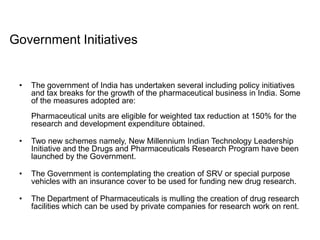
• The government of India has undertaken several including policy initiatives
and tax breaks for the growth of the pharmaceutical business in India. Some
of the measures adopted are:
Pharmaceutical units are eligible for weighted tax reduction at 150% for the
research and development expenditure obtained.
• Two new schemes namely, New Millennium Indian Technology Leadership
Initiative and the Drugs and Pharmaceuticals Research Program have been
launched by the Government.
• The Government is contemplating the creation of SRV or special purpose
vehicles with an insurance cover to be used for funding new drug research.
• The Department of Pharmaceuticals is mulling the creation of drug research
facilities which can be used by private companies for research work on rent.
Government Initiatives
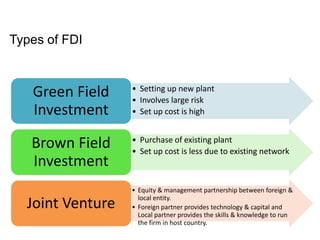
Types of FDI
• Setting up new plant
• Involves large risk
• Set up cost is high
Green Field
Investment
• Purchase of existing plant
• Set up cost is less due to existing network
Brown Field
Investment
• Equity & management partnership between foreign &
local entity.
• Foreign partner provides technology & capital and
Local partner provides the skills & knowledge to run
the firm in host country.
Joint Venture
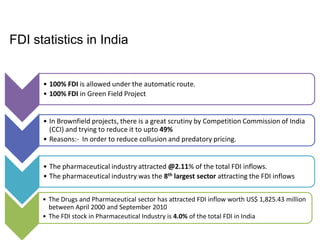
FDI statistics in India
• 100% FDI is allowed under the automatic route.
• 100% FDI in Green Field Project
• In Brownfield projects, there is a great scrutiny by Competition Commission of India
(CCI) and trying to reduce it to upto 49%
• Reasons:- In order to reduce collusion and predatory pricing.
• The pharmaceutical industry attracted @2.11% of the total FDI inflows.
• The pharmaceutical industry was the 8th largest sector attracting the FDI inflows
• The Drugs and Pharmaceutical sector has attracted FDI inflow worth US$ 1,825.43 million
between April 2000 and September 2010
• The FDI stock in Pharmaceutical Industry is 4.0% of the total FDI in India
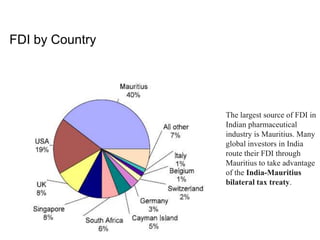
FDI by Country
The largest source of FDI in
Indian pharmaceutical
industry is Mauritius. Many
global investors in India
route their FDI through
Mauritius to take advantage
of the India-Mauritius
bilateral tax treaty.
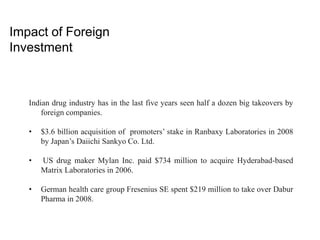
Impact of Foreign
Investment
Indian drug industry has in the last five years seen half a dozen big takeovers by
foreign companies.
• $3.6 billion acquisition of promoters’ stake in Ranbaxy Laboratories in 2008
by Japan’s Daiichi Sankyo Co. Ltd.
• US drug maker Mylan Inc. paid $734 million to acquire Hyderabad-based
Matrix Laboratories in 2006.
• German health care group Fresenius SE spent $219 million to take over Dabur
Pharma in 2008.
Impact of Foreign
Investment
• US drug and nutrition firm Abbott Laboratories paid $3.72 billion to acquire
Piramal Healthcare Ltd’s domestic drug formulation business and spent $726
million to buy out Ahmedabad-based consumer health company Paras
Pharmaceuticals.
• French drug multinational Sanofi-Aventis SA acquired a majority stake in
Indian vaccines company Shanta Biotech in 2009 for €550 million
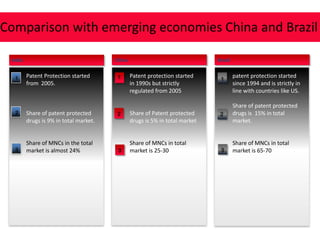
Comparison with emerging economies China and Brazil
Patent protection started
in 1990s but strictly
regulated from 2005
Share of Patent protected
drugs is 5% in total market
Share of MNCs in total
market is 25-30%
China
1
India
patent protection started
since 1994 and is strictly in
line with countries like US.
Share of patent protected
drugs is 15% in total
market.
Share of MNCs in total
market is 65-70%.
Brazil
Patent Protection started
from 2005.
Share of patent protected
drugs is 9% in total market.
Share of MNCs in the total
market is almost 24%
11
2 2 2
3 3 3
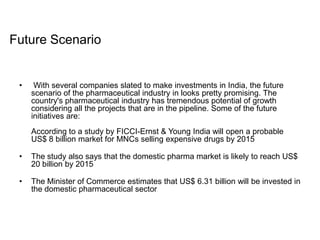
Future Outlook :
Pharmaceutical Industry
• With several companies slated to make investments in India, the future
scenario of the pharmaceutical industry in looks pretty promising. The
country's pharmaceutical industry has tremendous potential of growth
considering all the projects that are in the pipeline. Some of the future
initiatives are:
According to a study by FICCI-Ernst & Young India will open a probable
US$ 8 billion market for MNCs selling expensive drugs by 2015
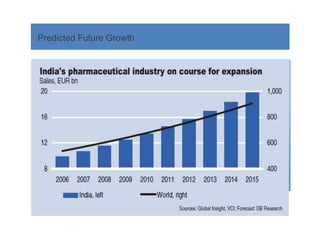
• The study also says that the domestic pharma market is likely to reach US$
20 billion by 2015
• The Minister of Commerce estimates that US$ 6.31 billion will be invested in
the domestic pharmaceutical sector
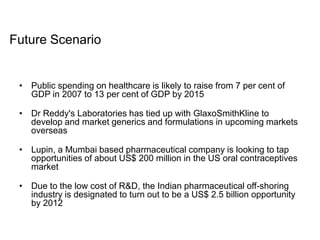
Future Scenario
• Public spending on healthcare is likely to raise from 7 per cent of
GDP in 2007 to 13 per cent of GDP by 2015
• Dr Reddy's Laboratories has tied up with GlaxoSmithKline to
develop and market generics and formulations in upcoming markets
overseas
• Lupin, a Mumbai based pharmaceutical company is looking to tap
opportunities of about US$ 200 million in the US oral contraceptives
market
• Due to the low cost of R&D, the Indian pharmaceutical off-shoring
industry is designated to turn out to be a US$ 2.5 billion opportunity
by 2012
Future Scenario
Predicted Future Growth
EDUCATION
INSURANCE
The Insurance Bill was introduced in the Rajya Sabha in March 2008
under the first UPA government, as part of its financial sector
reforms.
The Union Cabinet on September 1, 2008, approved the Bill for
Comprehensive amendment of insurance laws which proposes to
raise the FDI ceiling in insurance sector from 26% to 49 %.
The Bill also covers the following;
1. To allow foreign reinsurers like Lloyd’s of London, to open
branches in India.
2. To lower the capital requirement of standalone health insurance
companies to Rs. 50 crore from 100 crore.
3. To allow insurance companies to appoint insurance
agents, surveyors and loss assessors
The Insurance Amendment Bill
The Government has decided to review the guidelines
for foreign direct investment and has proposed
extensive changes in the guidelines. Proposals include;
1. Investment by Indian Companies in which foreign
firms have beneficial investment will be counted as
direct FDI
2. Investments by companies that are owned and
controlled by foreign entities to be considered in
calculating indirect foreign investment.
3. Investment by non-resident entities to be counted as
FDI.
Changes in FDI Rules
A well-developed and evolved insurance sector is a boon for
economic development as it provides long-term funds for
infrastructure development at the same time strengthening the
risk taking ability of the country.
Nearly 80% of the Indian population is without life, health and
non-life insurance
The insurance sector in India is a colossal one and is growing at a
rate of 15-20%. Together with banking services, insurance
services add about 7% to the country’s Gross domestic product
(GDP).
Insurance Industry in India is worth US$ 30 billion, consisted of
Life insurance worth US$ 25 billion and non-life insurance
worth US$ 5 billion.
Interesting Statistics
The Indian Insurance market is expected to be around
US$ 60 billion by the end of 2011.
Investment opportunities exist both in Life and non-life
segments as strong economic growth with increase in
affluence and rising risk awareness leading to rapid
growth in insurance sector.
The expected inflow is likely to create 3 lakh jobs in the
sector as more companies are planning to use the
additional funds mainly to execute their expansion plans
OUTLOOK
•FDI may provide better access to technologies for the
local economy.
•FDI can also lead to indirect productivity gains through
spill overs.
•Multinational firms may increase the degree of
competition in host-country markets which will force
existing inefficient firms to invest more in physical or
human capital.
•MNCs may also provide training of labour and
management which may make them become available to
the economy in general.
•The increased flow of FDI in a country has given a major
boost to the country's economy
•Hence measures must be taken in order to ensure that the
flow of FDI in both these countries continues to grow.
Foreign Direct Investment(FDI)

Foreign Direct Investment(FDI)

  • 1.
    FDI An EconomicReform K-MART
  • 2.
    FOREIGN DIRECT INVESTMENT FDIinflow plays a predominant role in economic development Its seen as a means of supplement to domestic investment for achieving a higher level of growth development
  • 3.
    Introduction  According toIMF, FDI or Foreign Direct Investment is that category of international investment that reflects the objective of obtaining a “lasting interest” by a resident entity in one economy in an enterprise resident in another economy  There is no specific definitions on FDI as such owing to the presence of many authorities like IMF,IBRD,OECD, and UNCTAD.
  • 4.
    The commitment ofmoney or capital to purchase financial instruments or assets in order to gain profitable returns.
  • 5.
    Investment done bycitizens and government of one country (home country) invest in industries of another country (host country). Foreign Investment through Foreign Direct Investments Foreign Institutional Investors
  • 6.
    Inflow from Investorspoint of view • Market seeking : The investors are attached by the size of the local market , which depends on the income of the country and its growth rate. • Lower cost : Investors are most cost-conscious . They are influenced by infrastructure facilities and labor costs. • Location and other factors : Technology status of a country , brand name , goodwill enjoyed by the local firms , favorable location , openness of the economy , policies of the government and intellectual property protection granted by the government are some of the factors that attract investors to undertake investments
  • 7.
    WHAT F.D.I REQUIRES? Important factors which foreign investors take into consideration when entering a country are:  Reliable access to economic information.  The level of corruption.  Stability of political and business environment .  Ability to meet and comply with internationality acceptable standards and norms .  Character of local market (size , growth , potential) or the distance and the access to neighboring markets.  The existence of good and quality infrastructure.
  • 8.
    Permit Non Permit Electricalequipments (including computer software and electronic Areas and ammunition . Telecommunication(Radio Paging, Cellular Mobile, basic telephony service Atomic energy . Service sectors (Financial &non financial ) Fuels (Power+ Oil Refinery Railway transport. Chemical (other than fertilizers) Drugs &Pharmaceuticals Coal and Lignite. Metallurgical Industries Mining of iron , manganese , chrome , gypsum , gold , diamonds , copper , and zinc .
  • 9.
    FDI ATTRACTERS FDIDISCOURAGERS India has a well developed network and financial institutions and an organized capital market open to foreign institutional investors that attracts activities and export to neighbor countries.  High rates of taxation  For the last few years there has been political stability in the country.  India enjoy good reputation among other countries as a honoring of its commitments about repayment hem to undertake investments.  Indian skills and competence is used as a base for carrying out production obligations , remittance of dividends etc  India has vast potential of unskilled labor available at cheap rates as compared to other countries, and vast natural resources that attract foreign investors.  Lack of infrastructure facilities  Favoritisms in the selection of investment  Complicated legal framework of rules, regulations, procedures for foreign direct investment into India.  Lack of transparency.
  • 10.
    SECTORS ATTRACTING HIGHESTFDI EQUITY INFLOWS: Ranks Sector 2010-11 (April-March) 2011-12 (for April2011) 1 SERVICES SECTOR (financial & non-financial) 15,776 (3,353) 2,922 (658) 2 COMPUTER SOFTWARE & HARDWARE 3,571 (784) 425 (95) 3 TELECOMMUNICATIONS (radio paging, cellular mobile, basic telephone services) 7,546 (1,665) 205 (46) 4 HOUSING & REAL ESTATE 5,149 (1,127) 167 (38) 5 CONSTRUCTION ACTIVITIES (including roads & highways) 5,077 (1,125) 1,381 (311) 6 POWER 5,709 (1,252) 1,136 (256) 7 AUTOMOBILE INDUSTRY 6,008 (1,331) 1,182 (266) 8 METALLURGICAL INDUSTRIES 5,055 (1,105) 229 (52) 9 PETROLEUM & NATURAL GAS 2,621 (574) 28 (6) 10 CHEMICALS (other than fertilizers) 1,810 (398) 152 (34) Amount Rupees in crores (US$ in million)
  • 11.
    Ranks Country 2010-11(April- March) 2011-12 (for April 2011) 1 MAURITIUS 31,855 (6,987) 4,332 (976) 2 SINGAPORE 7,730 (1,705) 5,214 (1,175) 3 U.S.A. 5,353 (1,170) 80 (356) 4 U.K. 3,434 (755) 19 (4) 5 NETHERLANDS 5,501 (1,213) 172 (39) 6 CYPRUS 4,171 (913) 754 (170) 7 JAPAN 7,063 (1,502) 1,043 (235) 8 GERMANY 908 (200) 231 (52) 9 U.A.E. 1,569 (341) 91 (21) 9 FRANCE 3,349 (734) 977 (220) Total 88,520 (19,427) 13,846 (3,121) SHARE OF TOP INVESTING COUNTRIES FDI EQUITY INFLOWS (Financial year-wise):
  • 12.
    IMPACT OF FDIIN VARIOUS SECORS • RETAIL • PHARMA • EDUCATION • INSURANCE
  • 14.
    Retail (CONTD • Asper the current regulatory regime or say Policy Foreign Direct Investment (FDI) up to 51% is allowed with prior Government approval, in retail trade of ‘Single Brand’ products. Guidelines notified, vide Press Note 3 (2006 Series), require: i. Products to be sold should be of a ‘Single Brand’ only. ii. Products should be sold under the same brand internationally. iii. ‘Single Brand’ product-retailing would cover only products which are branded during manufacturing.
  • 15.
    Automatic Route Government Nopermission required Approval /License required.
  • 16.
  • 17.
    • 51%Single Brand Retailing •100%Cash and Carry Model
  • 18.
    Incentives attract FDI. Marketsize and potential are sufficient inducers.  Tax breaks, import duty exemptions, land and power subsidies, and other enticements.
  • 20.
    Format Description Retailers HypermarketsOffering basket of product Spencers, Big bazaar Cash and Carry Bulk-buying requirement Bharti-wal-mart Departmental stores Large layout, Wide merchandise mix Lifestyle , Globus Supermarkets Household product as well as food as integral part of the service Apna bazaar , food bazaar Shop-in-shop Shops located in shopping malls Navras ( big bazaar) Specialty stores Focus on individual product type Brand Factory Category killers Particular segment The LOFT Discount stores Branded product at discounted prices Subhiksha, levi’s outlet Convenience stores Small Retail stores In and out
  • 21.
    Retail Segment Percentageholding in sector Major retailers Food and grocery 63% Reliance fresh, Café brio, food bazaar Clothing, textile and fashion 9% Westside, shoppers stop, globus jewellery 5% Tanishq Catering services 5% IRCTC Consumer durable 4% Viveks, vijay sales, Croma pharmaceuticals 4% Piramal group Entertainment 3% Bowling co., Furnishing, utensils 3% Hometown, Tangent Concept Mobile handsets 2% The mobile store,
  • 22.
  • 23.
    US Sales: $374.5 bn Earnings: $12.9 billion Stores: 6,800 worldwide France Sales: $130 bn Earnings: $5.2billion Stores: 87,422 worldwide UK Sales: $102.6 billion Earnings: $5.5 billion Stores: 3,729 worldwide Germany Sales: $101 billion Earnings: $1.5 billion Stores: 2,221 US Sales: $77.3 bn Earnings: $4.2 billion Stores: 2,258
  • 24.
    •A large emergingmarket . Increase in disposable income of a family. 70 mn Indians – salary of $18,000. Rise to 140 mn by 2011. Consumer spending power increased by 75% in last 3 years. The per capita income in 2009–2010 has more than doubled to US$ 849 from US$ 348 in 2000–01. INDIA
  • 25.
    •Increase in consumerclass. Consumer class will grow from 50 million at present to 583 million by 2025. With more than 23 million people taking their place among the world’s wealthiest citizens. Upper class Middle class Lower class
  • 26.
    •Wide demographics --average age of 25 yrs. •Brand consciousness. 60 % of population below age of 30. Awareness through World Wide Web. •Changing consumer mindset. Focus shifting from low price to convenience, value and a superior shopping experience. •Small Basket Size Shaping of Consumption
  • 27.
    •Easy consumer credit. EMI& loan via credit cards -- easy for Indian consumers to afford expensive products. For instance, Casas Bahia’s- Brazil. Upper class Middle class Lower class Note: BOP C.K.Prahalad.
  • 28.
    •Employment generation. Second-largest employerafter agriculture. Retail trade employing 35.06 million. Wholesale trade generating an additional employment of 5.48 million. Additional 1.6 mn jobs .
  • 29.
    •Technology Better useof resources and goods. Wastage and Storage problems will be resolved. Efficient logistics, production, and distribution channels. Digital records.
  • 30.
    •Rural market. Robust Consumption. 70%Indian households. 2/5 of the country’s total consumption pie. Accounts to 45% of GDP.
  • 31.
    •FDI in Retailsector will resolve problems regarding foreign exchange in India. •The life-long basic needs will keep on driving the Retail Industry.
  • 32.
  • 33.
    • Indian retailsector :  Employs 8% (35 million)of the working population.  Could yield 12 to 15 million retail jobs in the coming five years. • Out of which organized segment is about 0.3 million. • Retail sector grew at 9.4% on real terms & 15.4% on nominal terms.
  • 34.
    Demand • Communication Skills •Multi Tasking Supply • Limited Retail Training Opportunities • Higher Level Skills
  • 36.
    0 0.2 0.4 0.6 0.8 1 1.2 1.4 2008 2011 20132018 0.35 0.59 0.83 1.3 Expected Growth CAGR 10% • In the last four year, the consumer spending in India climbed up to 75%. • By the year 2013, the organized sector is also expected to grow at a CAGR of 40%. • The total number of shopping malls is expected to expand at a CAGR of over 18.9 per cent by 2015.
  • 37.
  • 38.
    • The pharmaindustry generally grows at about 1.5-1.6 times the Gross Domestic Product growth • Globally, India ranks third in terms of manufacturing pharma products by volume and thirteenth by value • The Indian pharmaceutical industry is expected to grow at a rate of 9.5 % till 2015 • In 2009-2010, India exported drugs worth US$7.2 billion in to the US and Europe followed by Central and Eastern Europe, Africa and Latin America • The Indian vaccine market which was worth US$800 million in 2010- 11 is growing at a rate of more than 20% • The retail pharmaceutical market in India is expected to cross US$ 12-13 billion by 2012
  • 39.
    Indian Pharmaceutical Evolution PhaseII Government Control •Indian Patent Act – 1970 •Drug prices capped •Local companies begin to make an impact Phase III Development Phase •Process development •Production infrastructure creation •Export initiatives Phase IV Growth Phase •Rapid expansion of domestic market •International market development •Research orientation Phase V Innovation and Research •New IP law •Discovery Research •Convergence 1970 1980 1990 2000 2010 Phase I Early Years •Market share domination by foreign companies •Relative absence of organized Indian companies
  • 40.
    Strength Cost Effective Strong ManufacturingBase Availability of high quality skilled workforce. Excellent marketing and distribution network Diverse ecosystem Weakness Less investment in research and development Lack of coordination between industry and academia. Negligible expenditure on healthcare in the country. Manufacture of fake and low quality medicines Opportunities Increased export potential Marketing tie ups with multinational companies to sell their products in domestic market. Immense scope to position India as a centre for international clinical trials. Key player in global pharmaceutical R&D. Export of generic drugs to developed markets Threats Product patent regime is a major threat to domestic industry unless the industry takes up R&D initiative aggressively. Drug Price Control Order puts undue pressure on product prices, affecting the profitability of the pharmaceutical companies. The new MRP based excise duty regime threatens the business of smaller pharmaceutical companies SWOT Analysis SWOT Analysis
  • 41.
    • The governmentof India has undertaken several including policy initiatives and tax breaks for the growth of the pharmaceutical business in India. Some of the measures adopted are: Pharmaceutical units are eligible for weighted tax reduction at 150% for the research and development expenditure obtained. • Two new schemes namely, New Millennium Indian Technology Leadership Initiative and the Drugs and Pharmaceuticals Research Program have been launched by the Government. • The Government is contemplating the creation of SRV or special purpose vehicles with an insurance cover to be used for funding new drug research. • The Department of Pharmaceuticals is mulling the creation of drug research facilities which can be used by private companies for research work on rent. Government Initiatives
  • 42.
    Types of FDI •Setting up new plant • Involves large risk • Set up cost is high Green Field Investment • Purchase of existing plant • Set up cost is less due to existing network Brown Field Investment • Equity & management partnership between foreign & local entity. • Foreign partner provides technology & capital and Local partner provides the skills & knowledge to run the firm in host country. Joint Venture
  • 43.
    FDI statistics inIndia • 100% FDI is allowed under the automatic route. • 100% FDI in Green Field Project • In Brownfield projects, there is a great scrutiny by Competition Commission of India (CCI) and trying to reduce it to upto 49% • Reasons:- In order to reduce collusion and predatory pricing. • The pharmaceutical industry attracted @2.11% of the total FDI inflows. • The pharmaceutical industry was the 8th largest sector attracting the FDI inflows • The Drugs and Pharmaceutical sector has attracted FDI inflow worth US$ 1,825.43 million between April 2000 and September 2010 • The FDI stock in Pharmaceutical Industry is 4.0% of the total FDI in India
  • 44.
    FDI by Country Thelargest source of FDI in Indian pharmaceutical industry is Mauritius. Many global investors in India route their FDI through Mauritius to take advantage of the India-Mauritius bilateral tax treaty.
  • 45.
    Impact of Foreign Investment Indiandrug industry has in the last five years seen half a dozen big takeovers by foreign companies. • $3.6 billion acquisition of promoters’ stake in Ranbaxy Laboratories in 2008 by Japan’s Daiichi Sankyo Co. Ltd. • US drug maker Mylan Inc. paid $734 million to acquire Hyderabad-based Matrix Laboratories in 2006. • German health care group Fresenius SE spent $219 million to take over Dabur Pharma in 2008.
  • 46.
    Impact of Foreign Investment •US drug and nutrition firm Abbott Laboratories paid $3.72 billion to acquire Piramal Healthcare Ltd’s domestic drug formulation business and spent $726 million to buy out Ahmedabad-based consumer health company Paras Pharmaceuticals. • French drug multinational Sanofi-Aventis SA acquired a majority stake in Indian vaccines company Shanta Biotech in 2009 for €550 million
  • 47.
    Comparison with emergingeconomies China and Brazil Patent protection started in 1990s but strictly regulated from 2005 Share of Patent protected drugs is 5% in total market Share of MNCs in total market is 25-30% China 1 India patent protection started since 1994 and is strictly in line with countries like US. Share of patent protected drugs is 15% in total market. Share of MNCs in total market is 65-70%. Brazil Patent Protection started from 2005. Share of patent protected drugs is 9% in total market. Share of MNCs in the total market is almost 24% 11 2 2 2 3 3 3
  • 48.
  • 49.
    • With severalcompanies slated to make investments in India, the future scenario of the pharmaceutical industry in looks pretty promising. The country's pharmaceutical industry has tremendous potential of growth considering all the projects that are in the pipeline. Some of the future initiatives are: According to a study by FICCI-Ernst & Young India will open a probable US$ 8 billion market for MNCs selling expensive drugs by 2015 • The study also says that the domestic pharma market is likely to reach US$ 20 billion by 2015 • The Minister of Commerce estimates that US$ 6.31 billion will be invested in the domestic pharmaceutical sector Future Scenario
  • 50.
    • Public spendingon healthcare is likely to raise from 7 per cent of GDP in 2007 to 13 per cent of GDP by 2015 • Dr Reddy's Laboratories has tied up with GlaxoSmithKline to develop and market generics and formulations in upcoming markets overseas • Lupin, a Mumbai based pharmaceutical company is looking to tap opportunities of about US$ 200 million in the US oral contraceptives market • Due to the low cost of R&D, the Indian pharmaceutical off-shoring industry is designated to turn out to be a US$ 2.5 billion opportunity by 2012 Future Scenario
  • 51.
  • 52.
  • 57.
  • 58.
    The Insurance Billwas introduced in the Rajya Sabha in March 2008 under the first UPA government, as part of its financial sector reforms. The Union Cabinet on September 1, 2008, approved the Bill for Comprehensive amendment of insurance laws which proposes to raise the FDI ceiling in insurance sector from 26% to 49 %. The Bill also covers the following; 1. To allow foreign reinsurers like Lloyd’s of London, to open branches in India. 2. To lower the capital requirement of standalone health insurance companies to Rs. 50 crore from 100 crore. 3. To allow insurance companies to appoint insurance agents, surveyors and loss assessors The Insurance Amendment Bill
  • 59.
    The Government hasdecided to review the guidelines for foreign direct investment and has proposed extensive changes in the guidelines. Proposals include; 1. Investment by Indian Companies in which foreign firms have beneficial investment will be counted as direct FDI 2. Investments by companies that are owned and controlled by foreign entities to be considered in calculating indirect foreign investment. 3. Investment by non-resident entities to be counted as FDI. Changes in FDI Rules
  • 60.
    A well-developed andevolved insurance sector is a boon for economic development as it provides long-term funds for infrastructure development at the same time strengthening the risk taking ability of the country. Nearly 80% of the Indian population is without life, health and non-life insurance The insurance sector in India is a colossal one and is growing at a rate of 15-20%. Together with banking services, insurance services add about 7% to the country’s Gross domestic product (GDP). Insurance Industry in India is worth US$ 30 billion, consisted of Life insurance worth US$ 25 billion and non-life insurance worth US$ 5 billion. Interesting Statistics
  • 61.
    The Indian Insurancemarket is expected to be around US$ 60 billion by the end of 2011. Investment opportunities exist both in Life and non-life segments as strong economic growth with increase in affluence and rising risk awareness leading to rapid growth in insurance sector. The expected inflow is likely to create 3 lakh jobs in the sector as more companies are planning to use the additional funds mainly to execute their expansion plans
  • 62.
    OUTLOOK •FDI may providebetter access to technologies for the local economy. •FDI can also lead to indirect productivity gains through spill overs. •Multinational firms may increase the degree of competition in host-country markets which will force existing inefficient firms to invest more in physical or human capital. •MNCs may also provide training of labour and management which may make them become available to the economy in general. •The increased flow of FDI in a country has given a major boost to the country's economy •Hence measures must be taken in order to ensure that the flow of FDI in both these countries continues to grow.

Editor's Notes

  • #54 Gross domestic product (GDP) refers to the market value of all final goods and services produced within a country in a given period.