1
Computer System
Orgnaization
Presented by
Al D. Sabiaga
Copyright College of Saint Adeline 2021
2 2
A stored program computer has the following
basic units:
>Processor-- center for manipulation and control
>Memory – storage for instructions and data for
currently executing programs
>I/O system – controller which communicate with “
external” devices: secondary memory, display
devices, networks
>Data-path & control – collection of parallel wires,
transmits data, instructions, or control signal
3 3
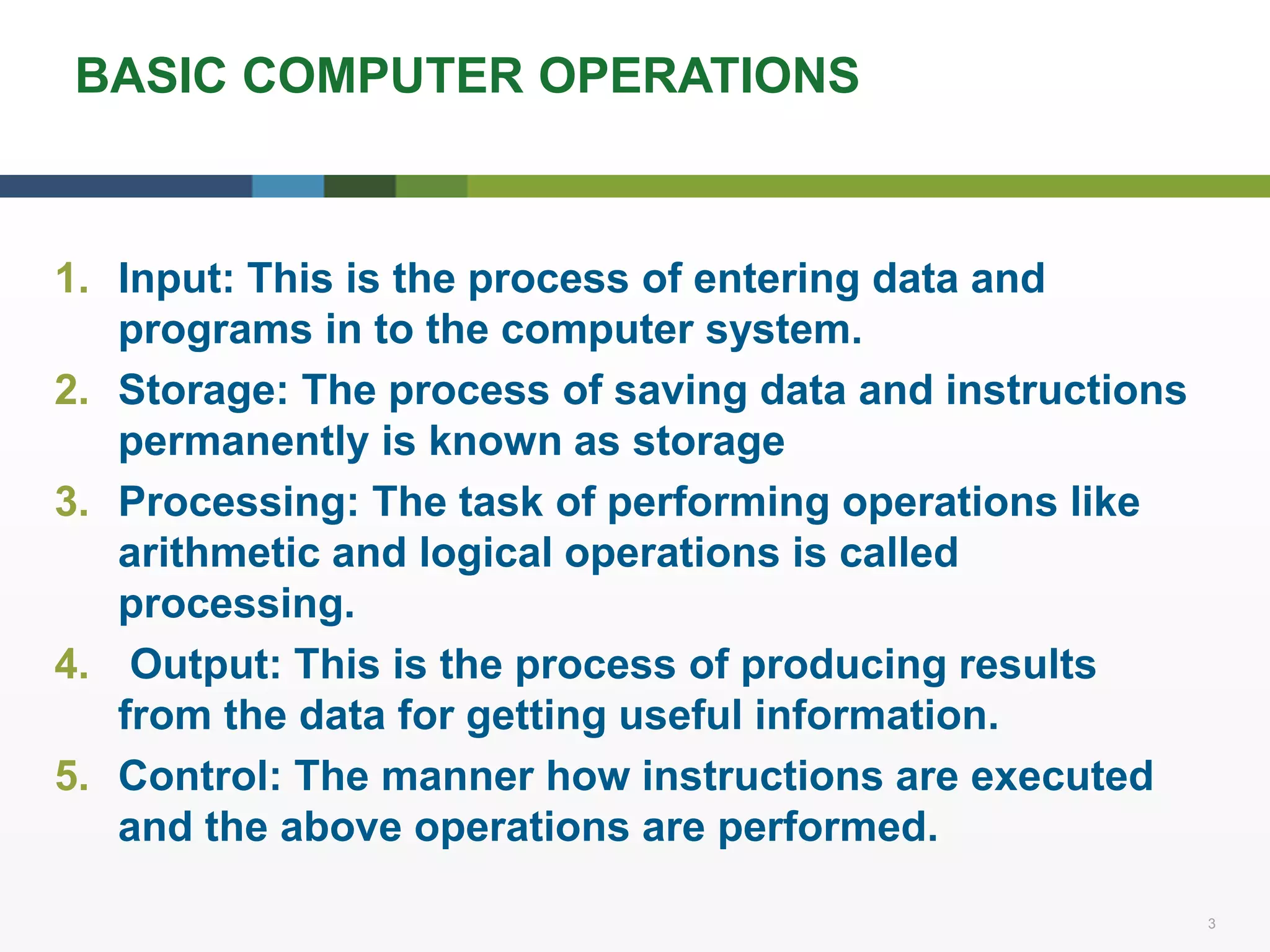
BASIC COMPUTER OPERATIONS
1. Input: This is the process of entering data and
programs in to the computer system.
2. Storage: The process of saving data and instructions
permanently is known as storage
3. Processing: The task of performing operations like
arithmetic and logical operations is called
processing.
4. Output: This is the process of producing results
from the data for getting useful information.
5. Control: The manner how instructions are executed
and the above operations are performed.
4 4
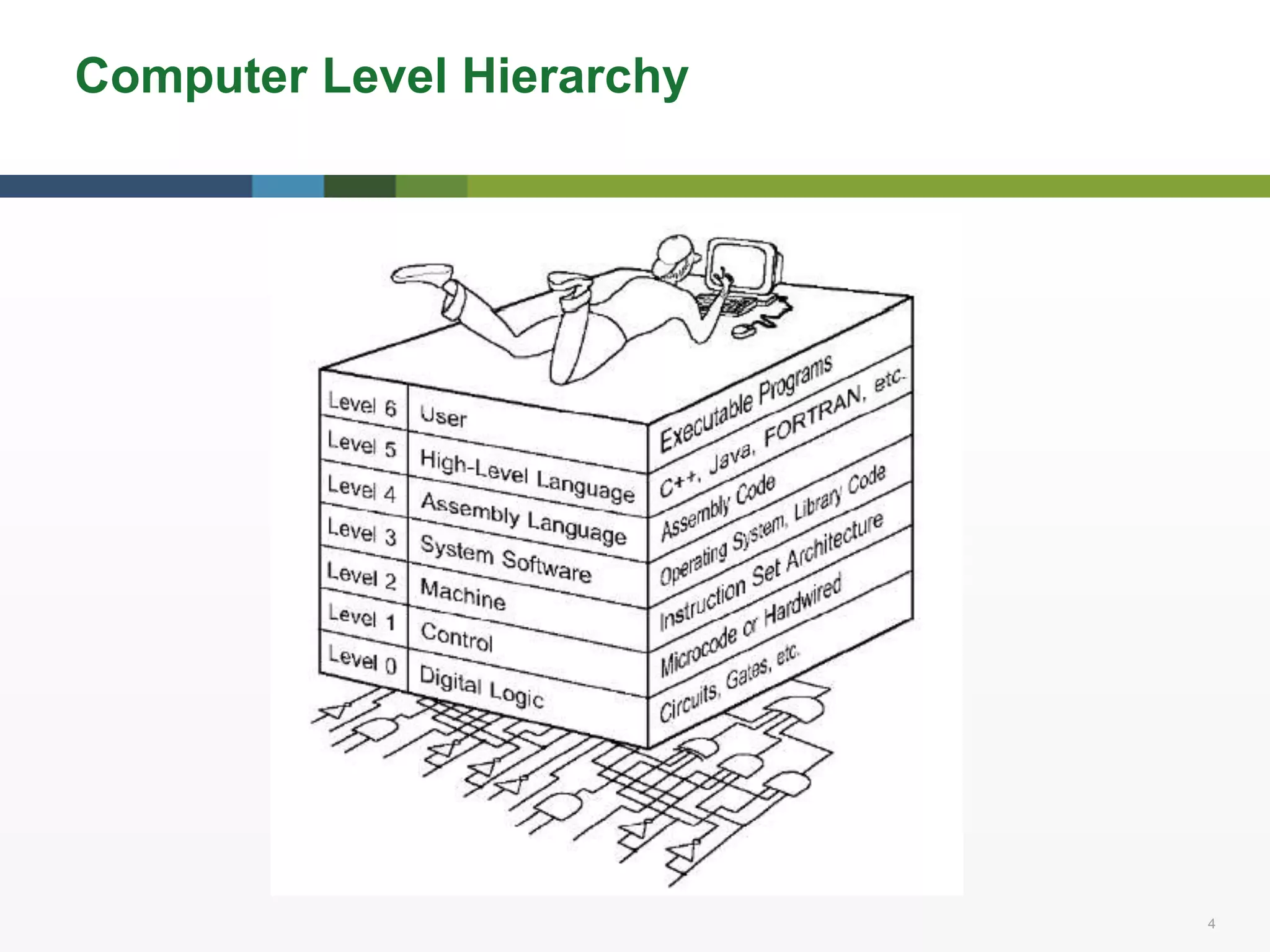
Computer Level Hierarchy
5 5
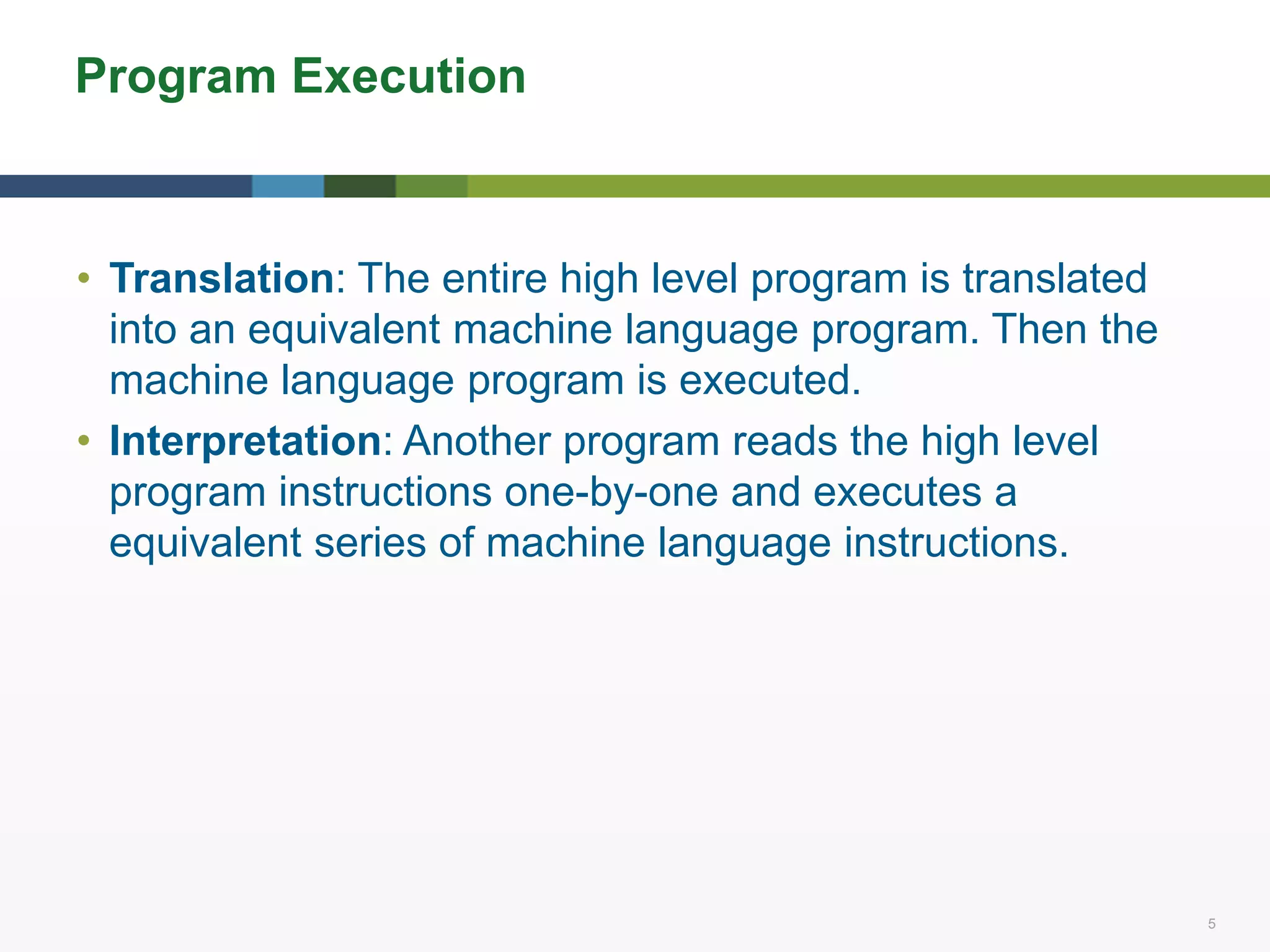
Program Execution
• Translation: The entire high level program is translated
into an equivalent machine language program. Then the
machine language program is executed.
• Interpretation: Another program reads the high level
program instructions one-by-one and executes a
equivalent series of machine language instructions.
6 6
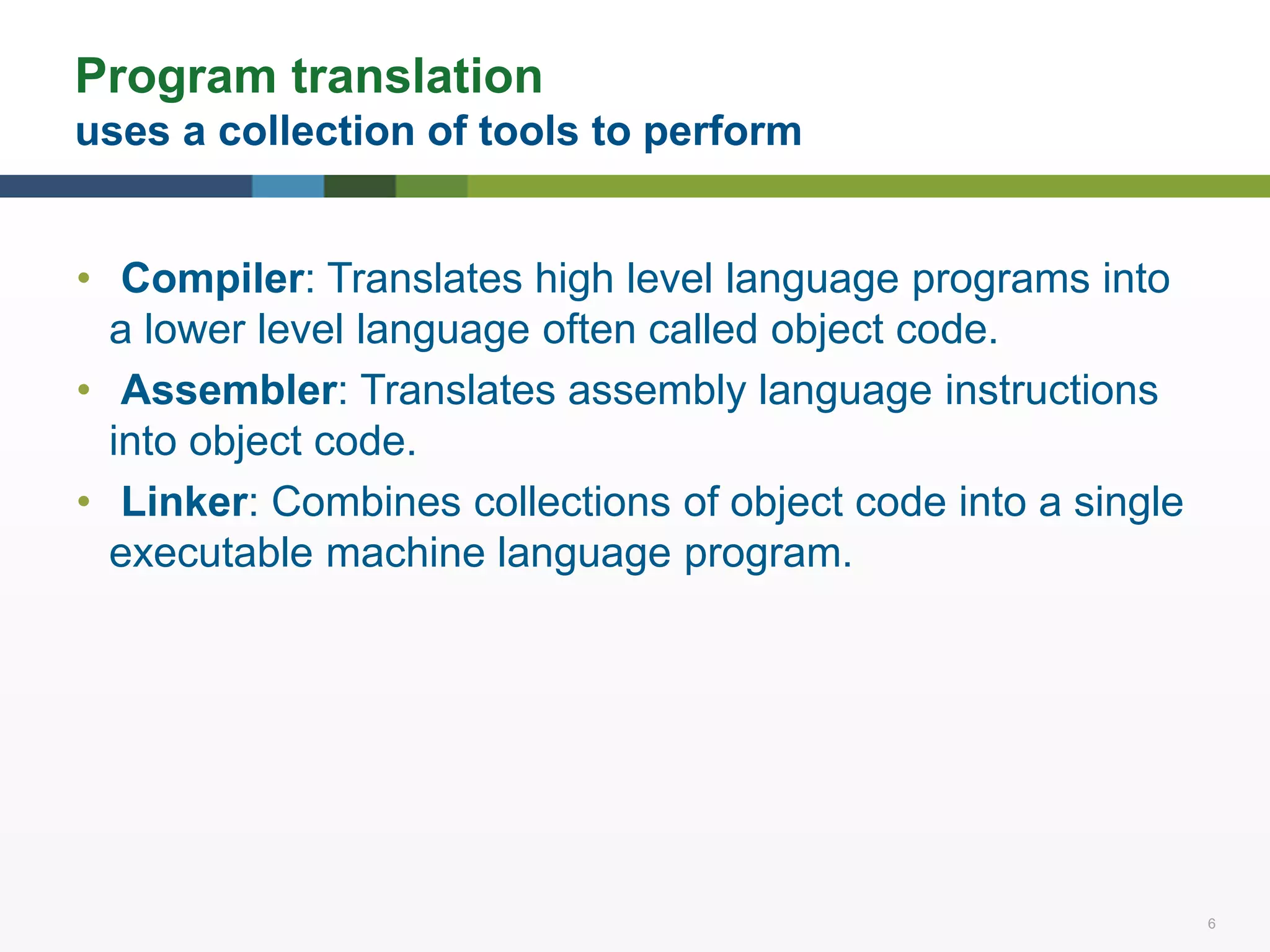
Program translation
uses a collection of tools to perform
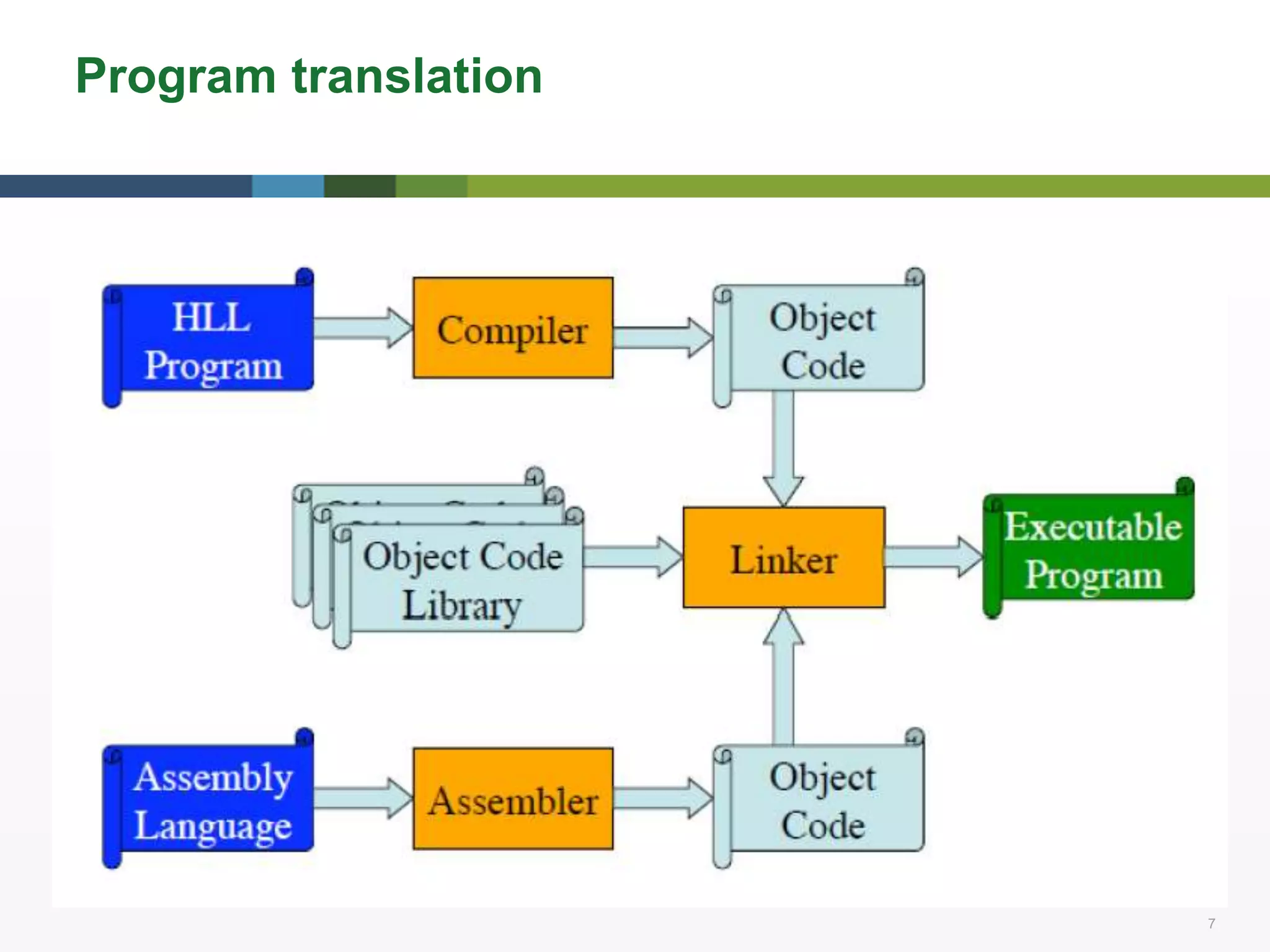
• Compiler: Translates high level language programs into
a lower level language often called object code.
• Assembler: Translates assembly language instructions
into object code.
• Linker: Combines collections of object code into a single
executable machine language program.
7 7
Program translation
8 8
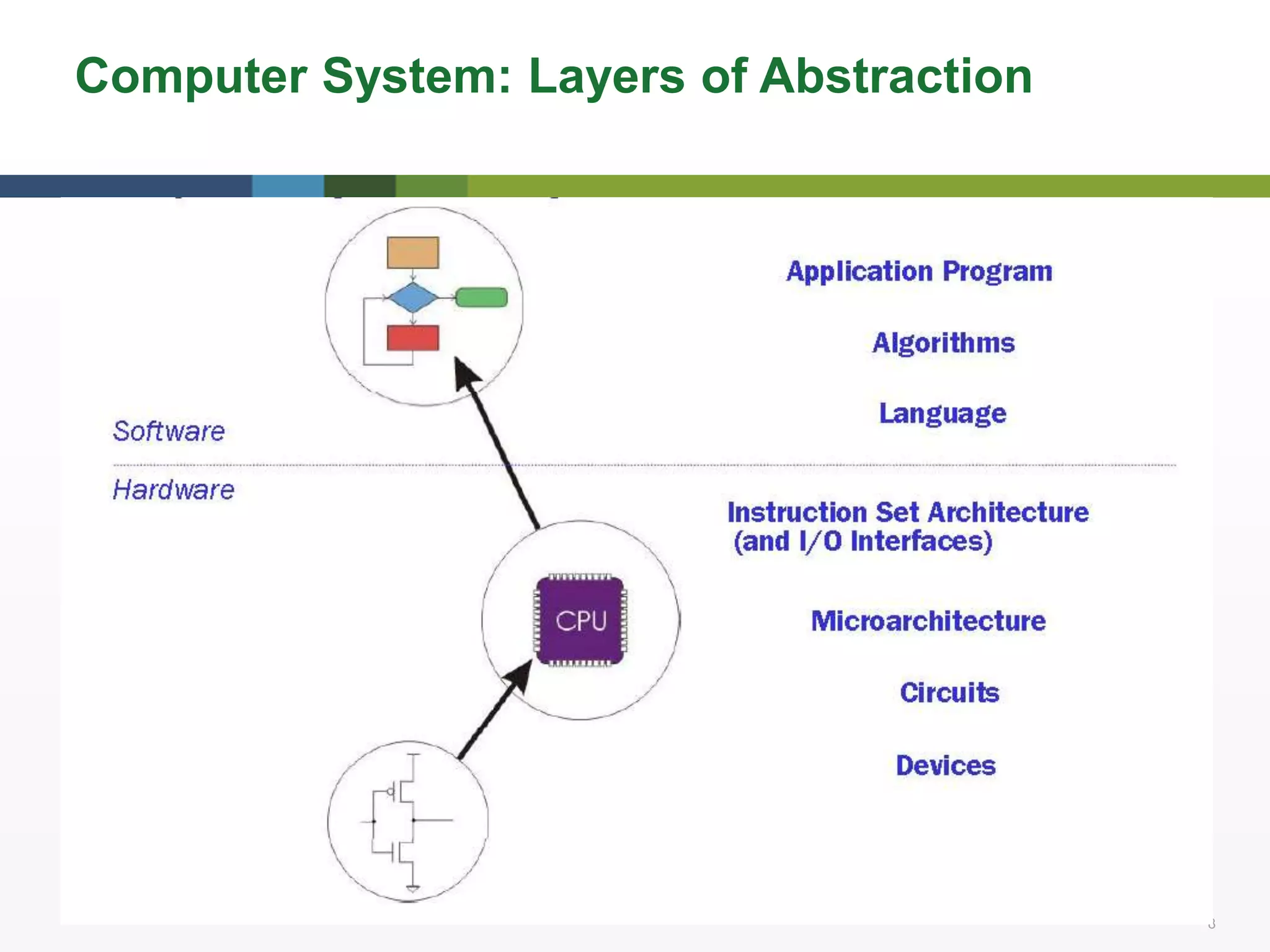
Computer System: Layers of Abstraction
9 9
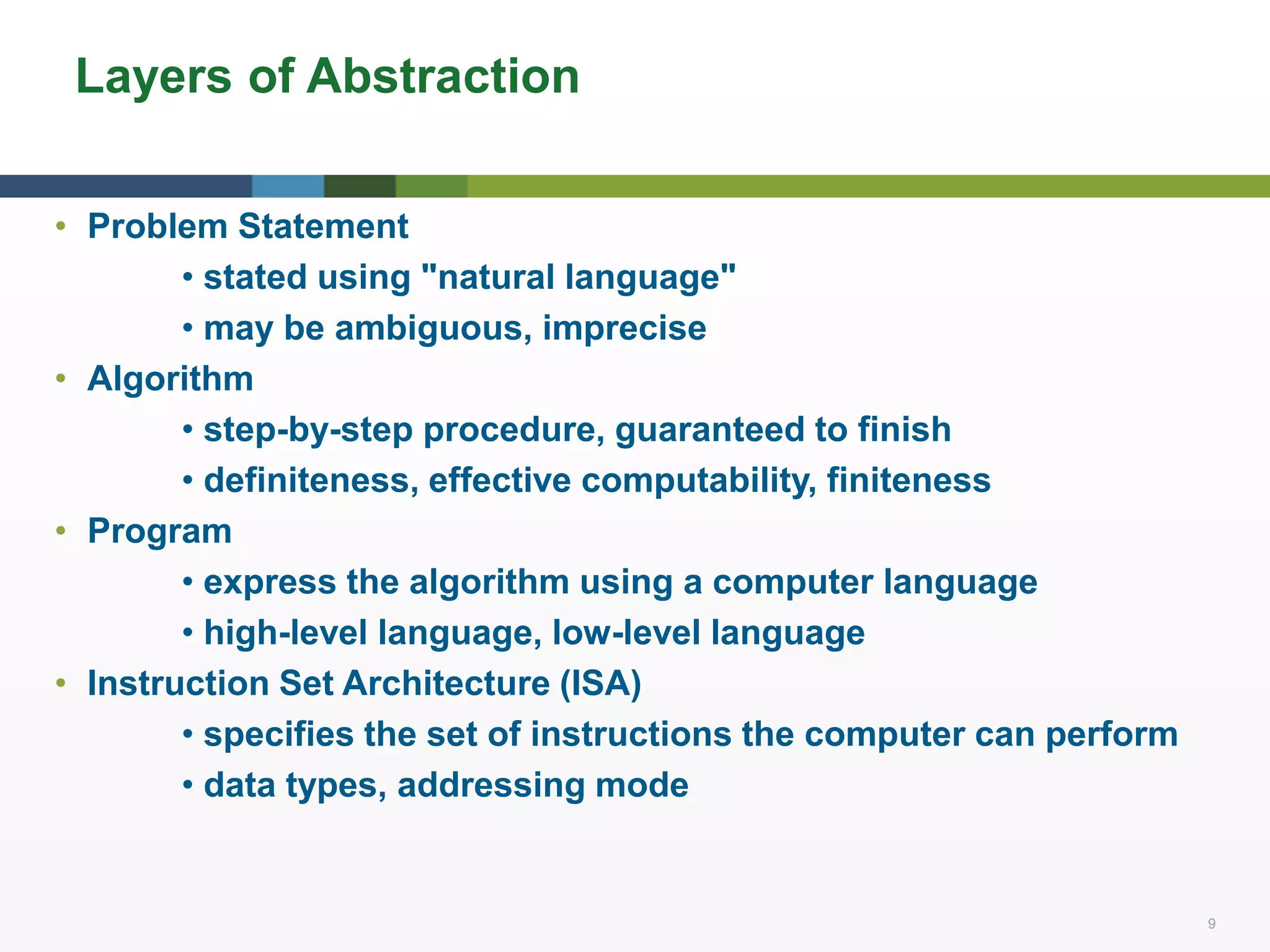
Layers of Abstraction
• Problem Statement
• stated using "natural language"
• may be ambiguous, imprecise
• Algorithm
• step-by-step procedure, guaranteed to finish
• definiteness, effective computability, finiteness
• Program
• express the algorithm using a computer language
• high-level language, low-level language
• Instruction Set Architecture (ISA)
• specifies the set of instructions the computer can perform
• data types, addressing mode
10 10
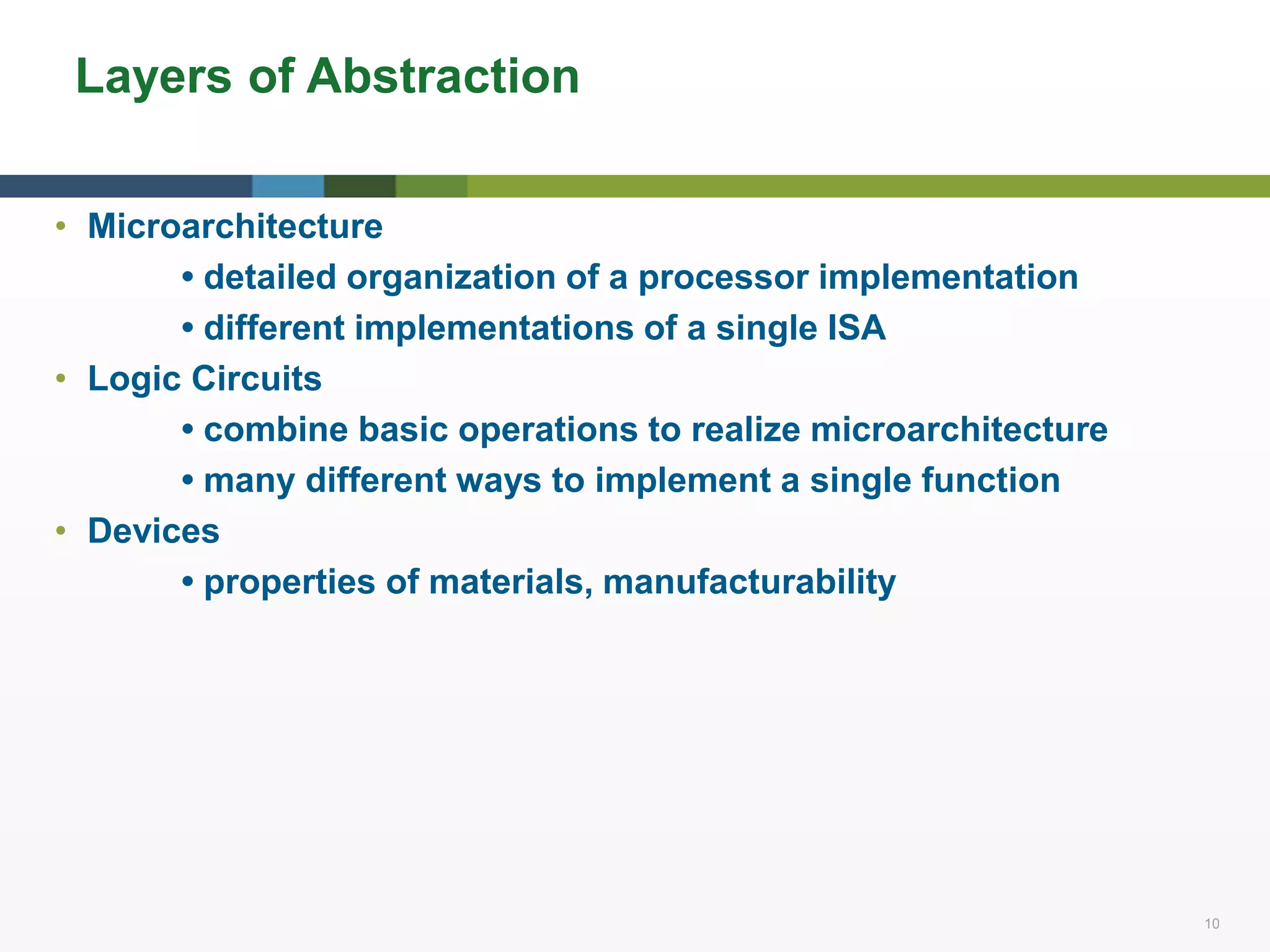
Layers of Abstraction
• Microarchitecture
• detailed organization of a processor implementation
• different implementations of a single ISA
• Logic Circuits
• combine basic operations to realize microarchitecture
• many different ways to implement a single function
• Devices
• properties of materials, manufacturability
11 11
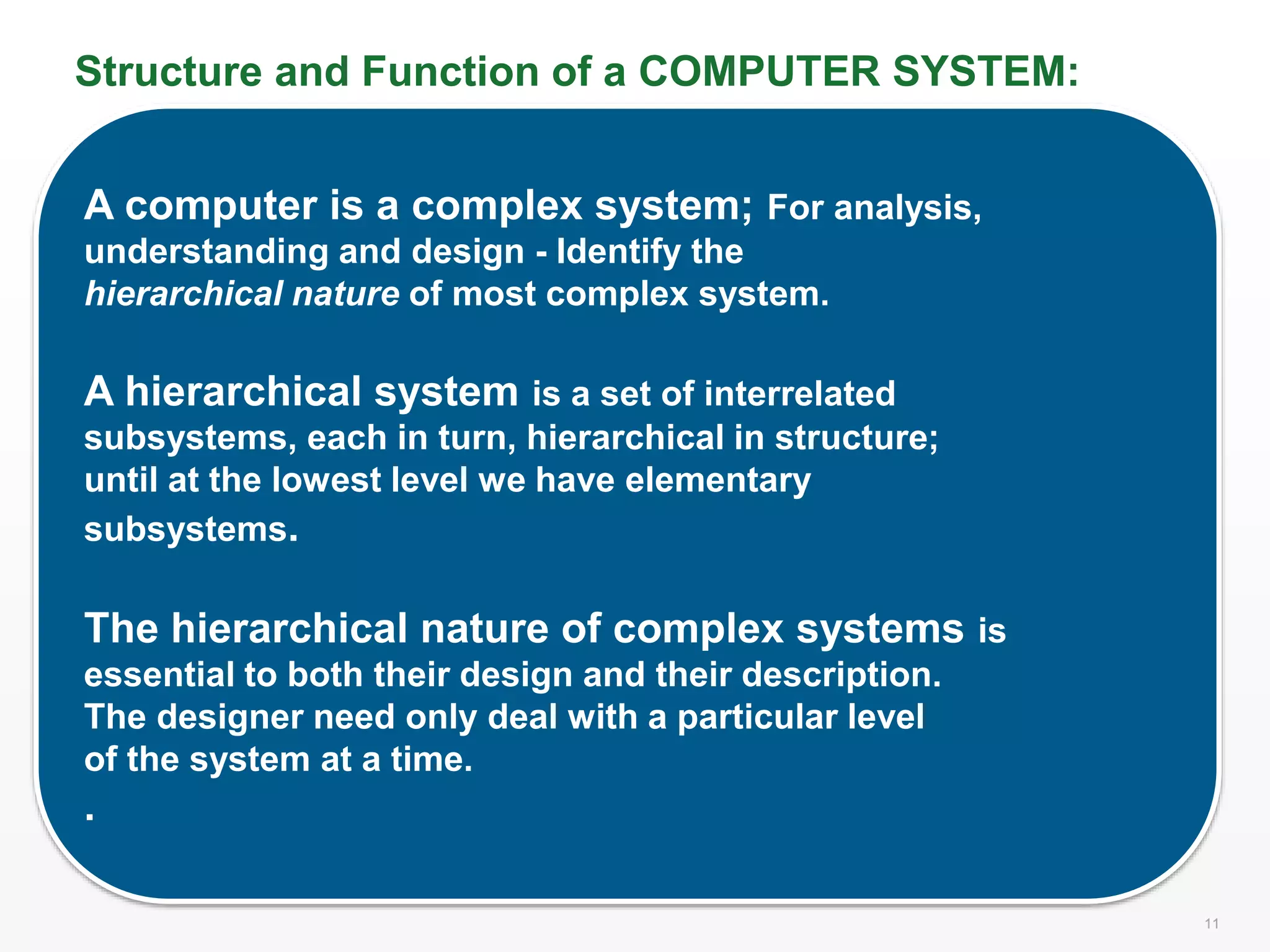
Structure and Function of a COMPUTER SYSTEM:
A computer is a complex system; For analysis,
understanding and design - Identify the
hierarchical nature of most complex system.
A hierarchical system is a set of interrelated
subsystems, each in turn, hierarchical in structure;
until at the lowest level we have elementary
subsystems.
The hierarchical nature of complex systems is
essential to both their design and their description.
The designer need only deal with a particular level
of the system at a time.
.
12 12
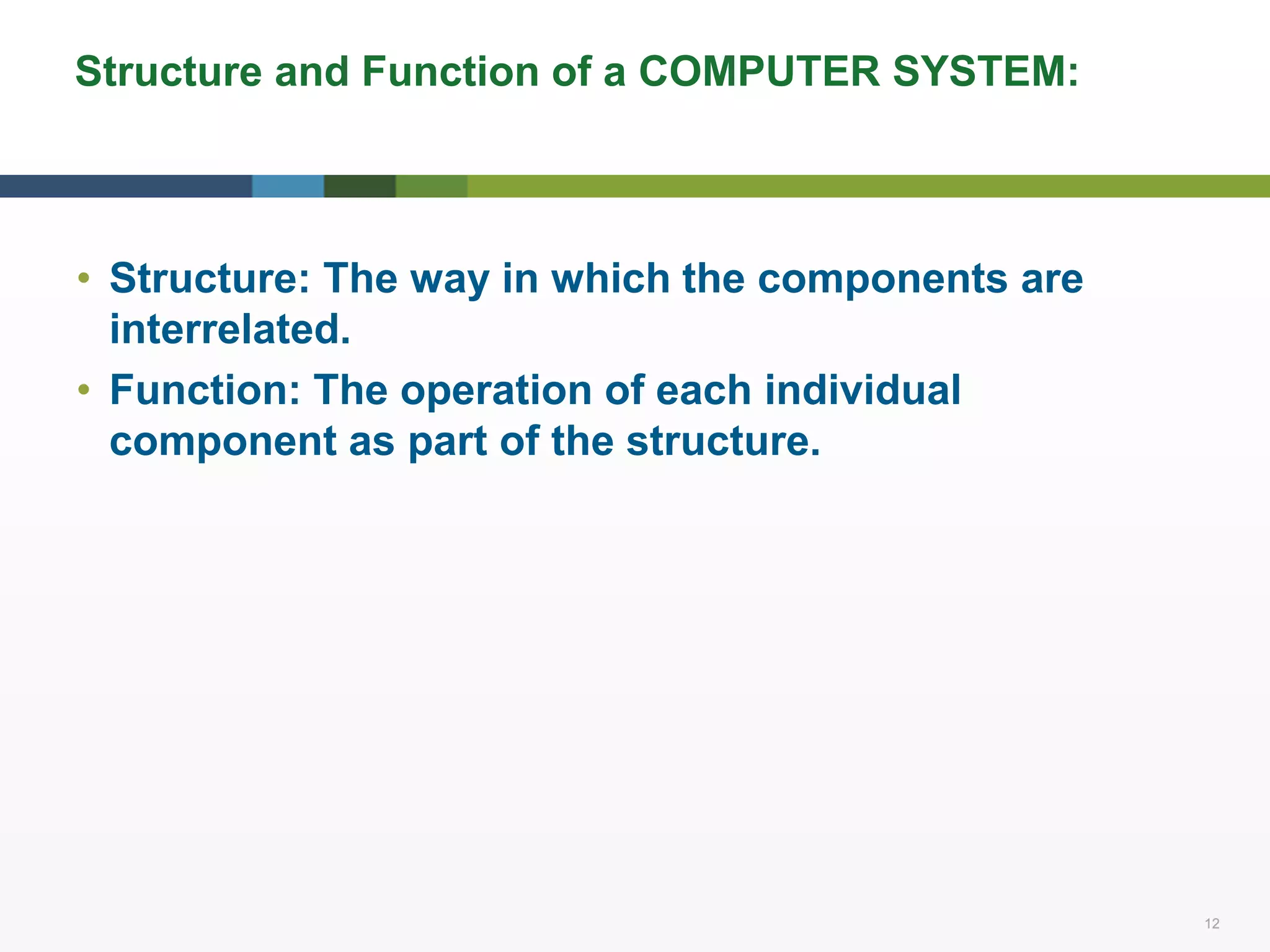
Structure and Function of a COMPUTER SYSTEM:
• Structure: The way in which the components are
interrelated.
• Function: The operation of each individual
component as part of the structure.
13 13
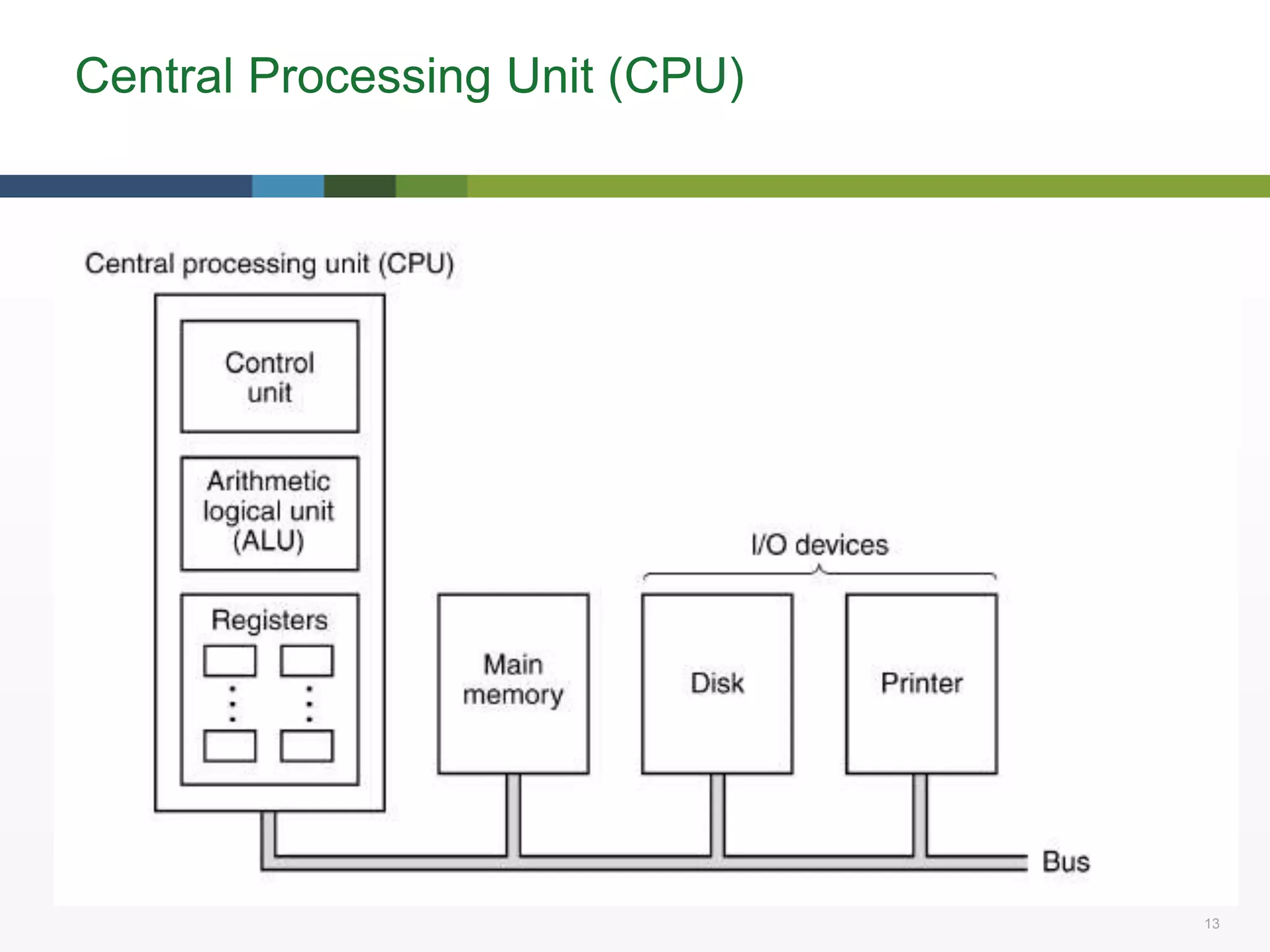
Central Processing Unit (CPU)
14 14
main functions of a computer:
• Data processing
• Data storage
• Data movement
• Control
15 15
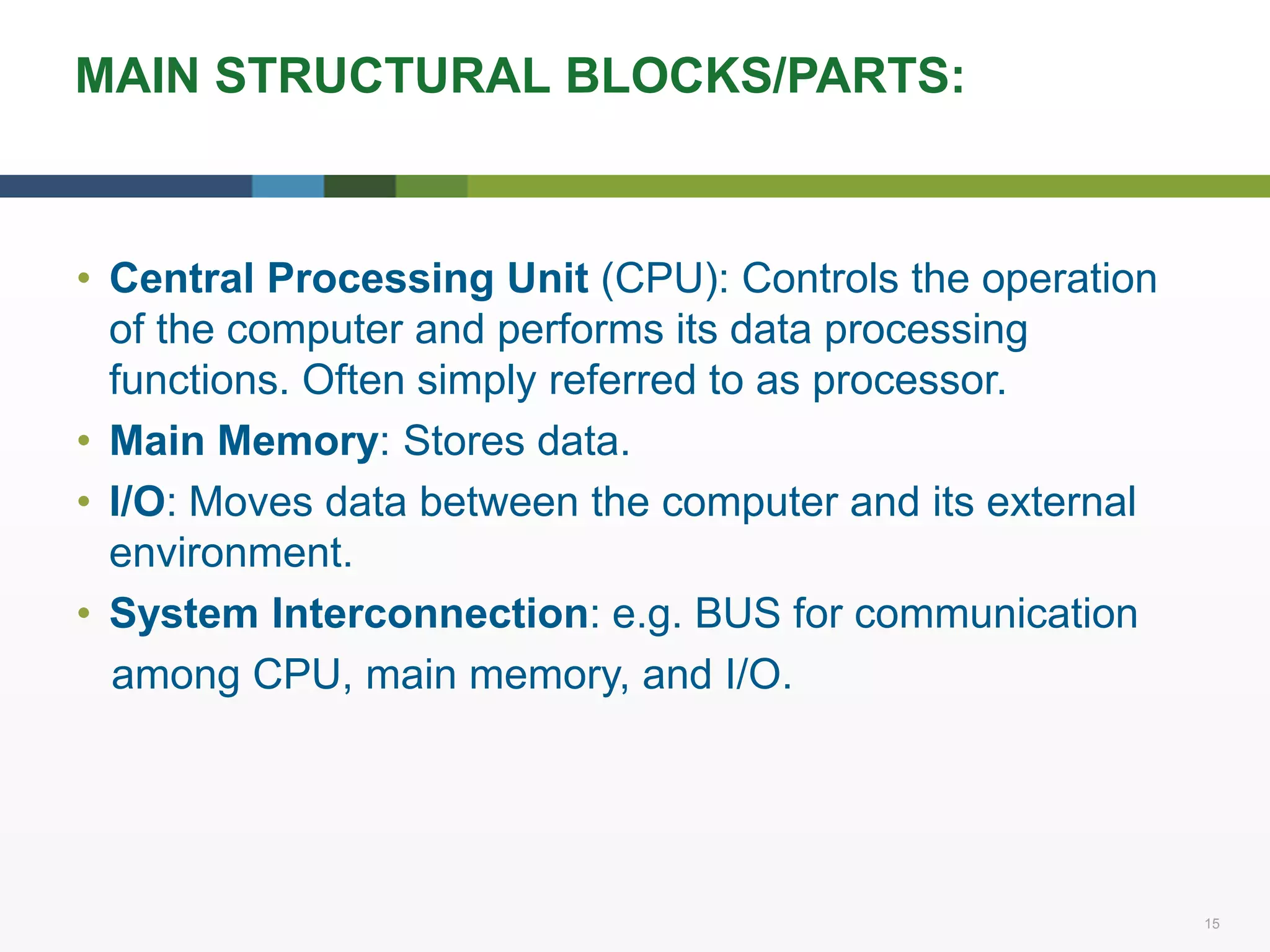
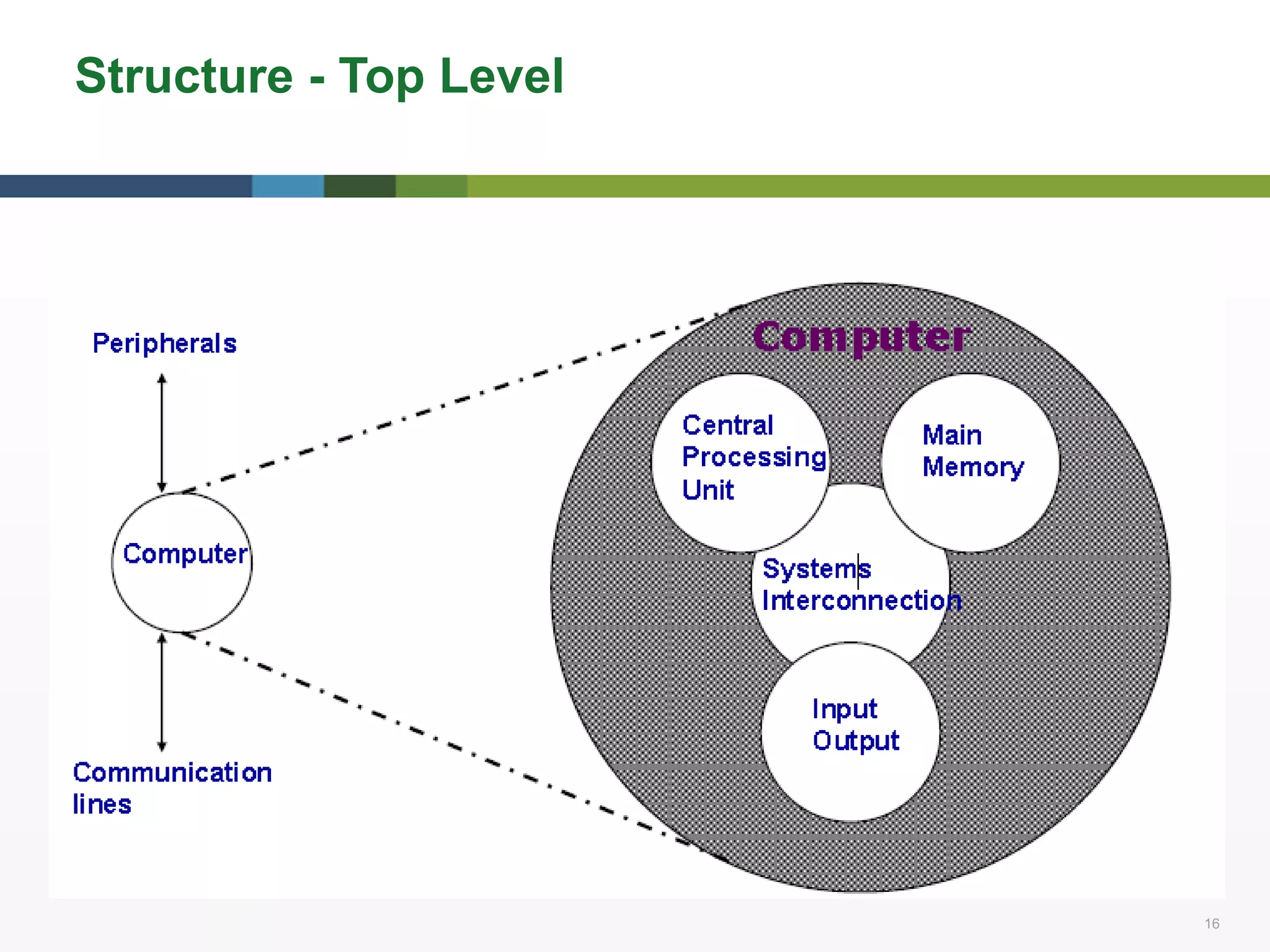
MAIN STRUCTURAL BLOCKS/PARTS:
• Central Processing Unit (CPU): Controls the operation
of the computer and performs its data processing
functions. Often simply referred to as processor.
• Main Memory: Stores data.
• I/O: Moves data between the computer and its external
environment.
• System Interconnection: e.g. BUS for communication
among CPU, main memory, and I/O.
16 16
Structure - Top Level
17 17
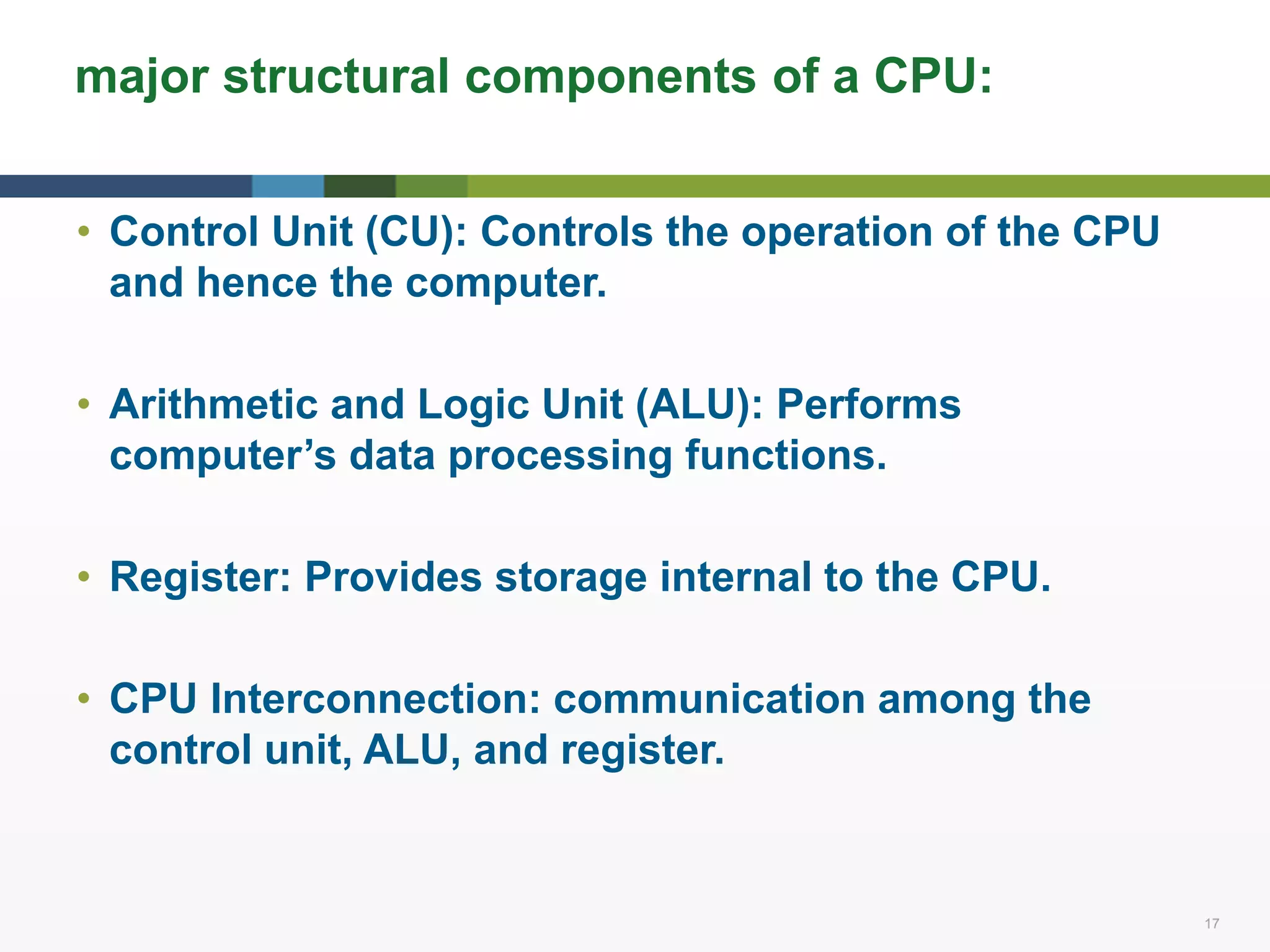
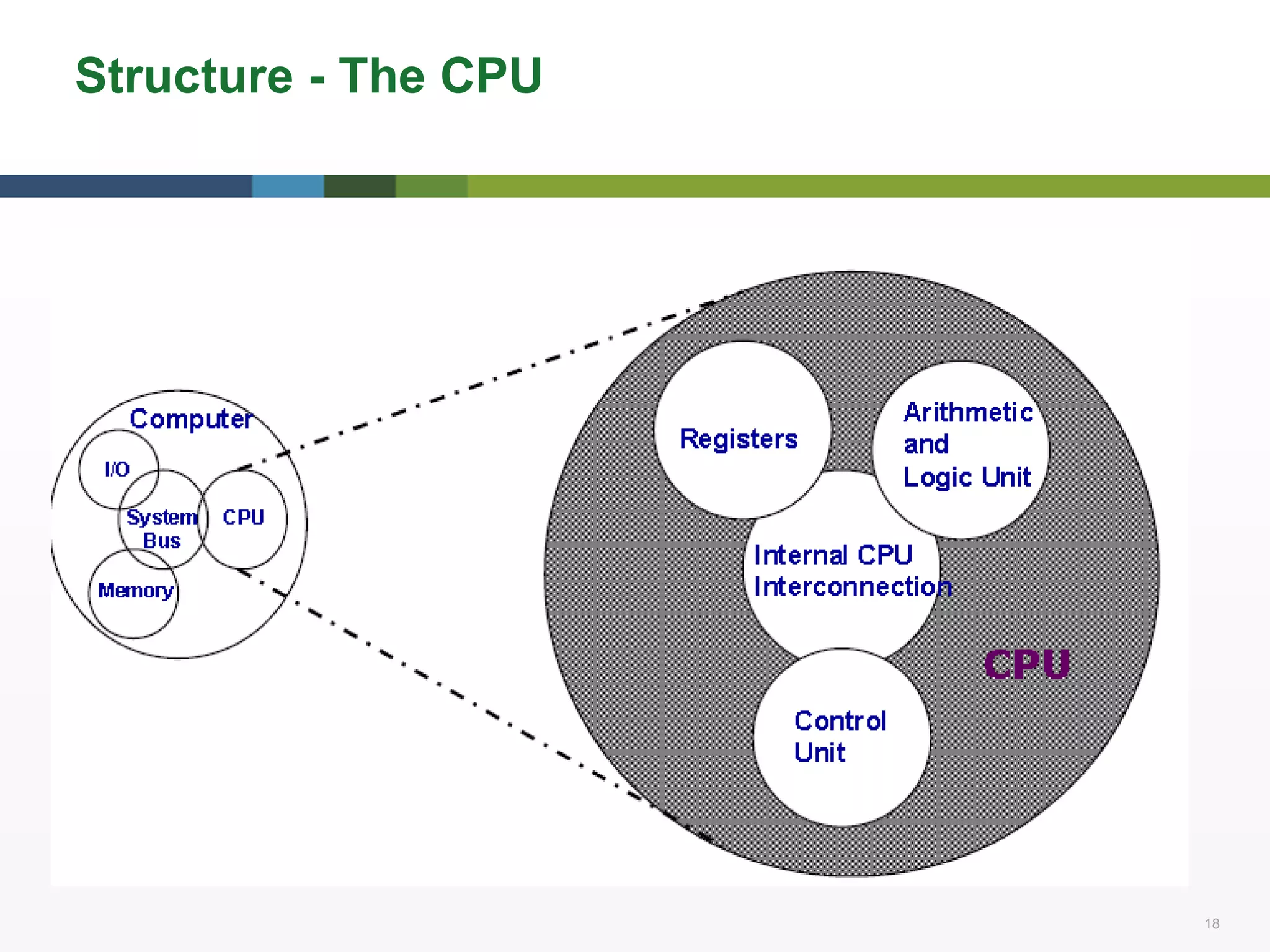
major structural components of a CPU:
• Control Unit (CU): Controls the operation of the CPU
and hence the computer.
• Arithmetic and Logic Unit (ALU): Performs
computer’s data processing functions.
• Register: Provides storage internal to the CPU.
• CPU Interconnection: communication among the
control unit, ALU, and register.
18 18
Structure - The CPU
19 19
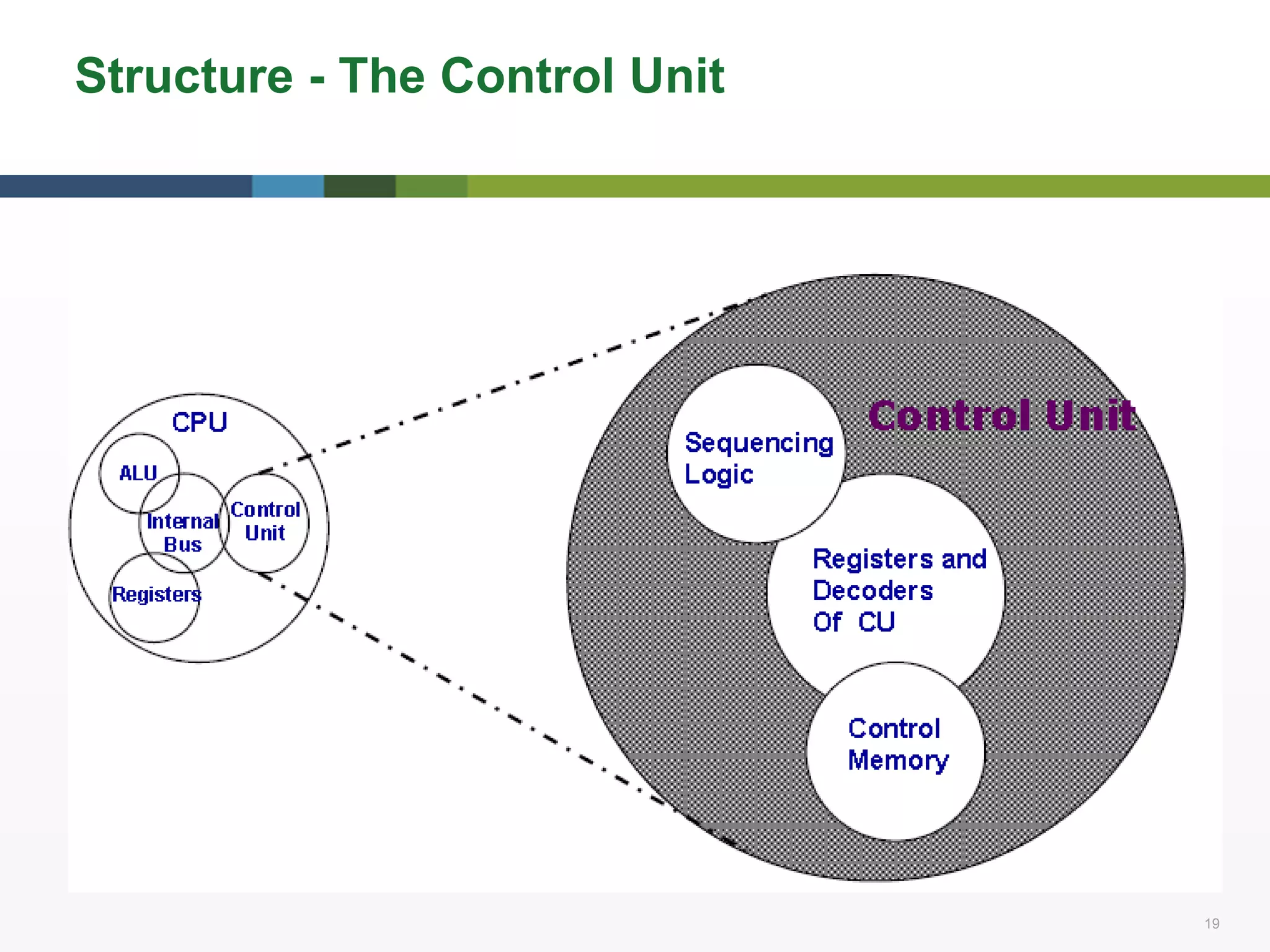
Structure - The Control Unit
20 20
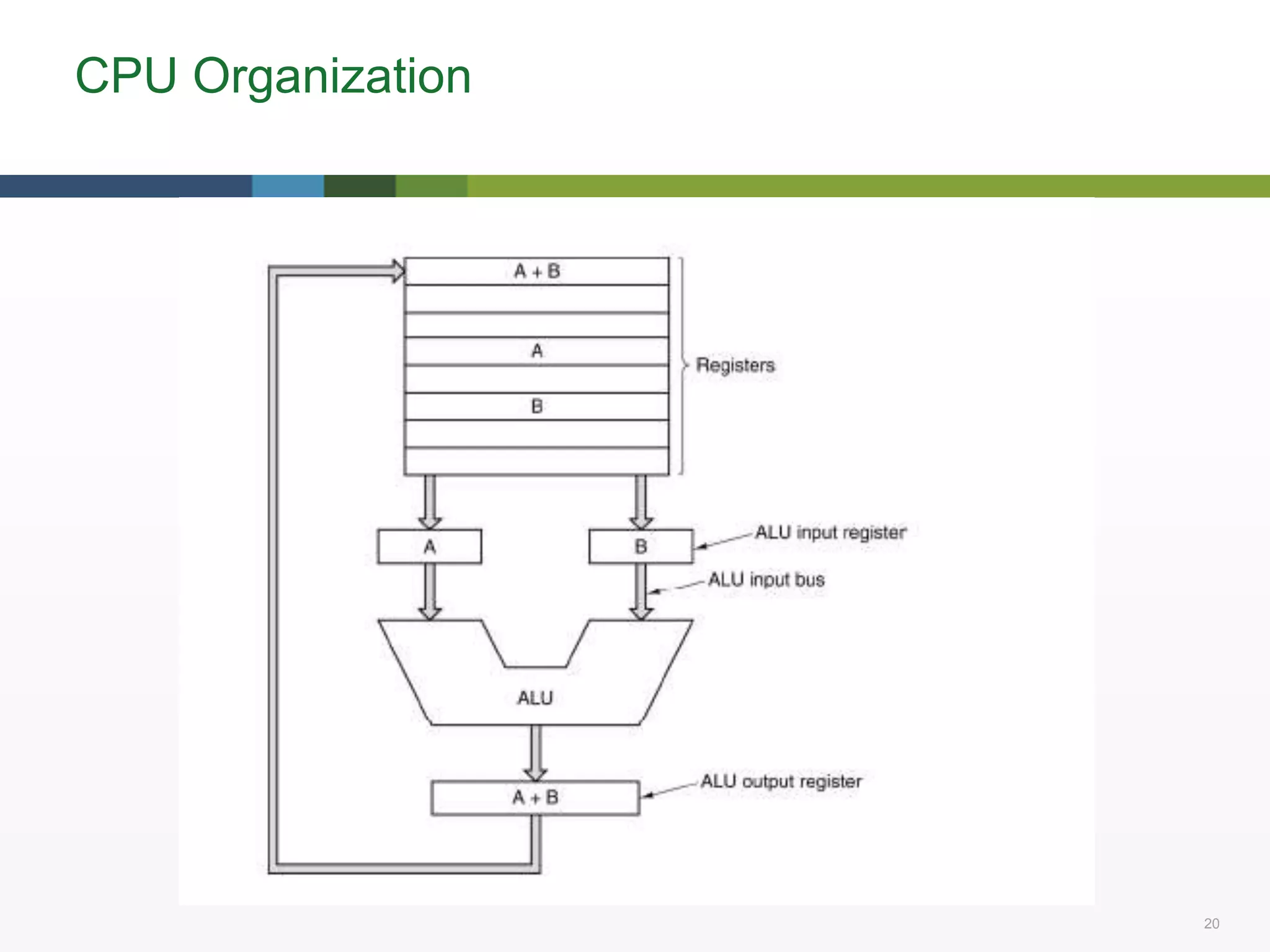
CPU Organization
21 21
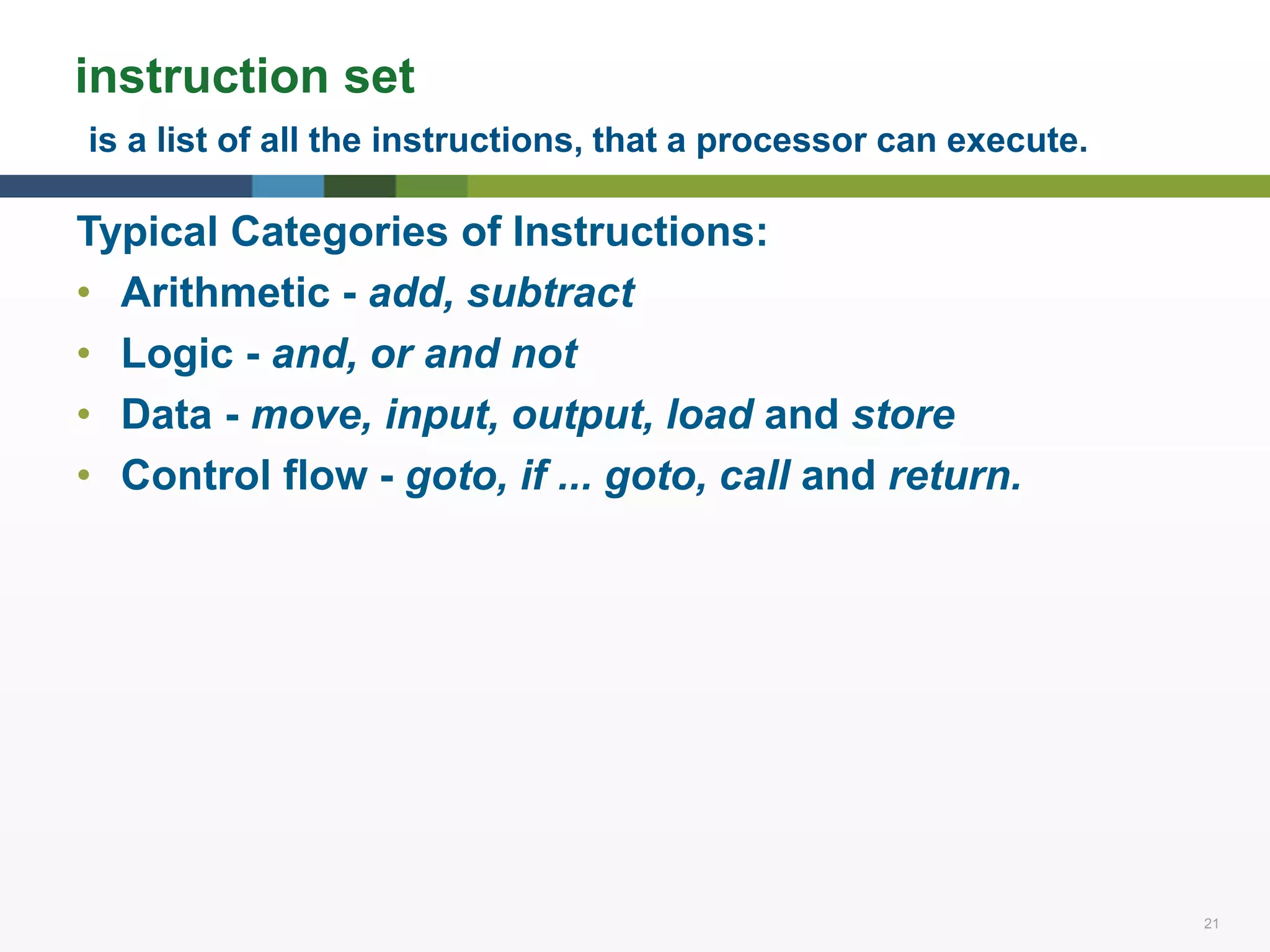
instruction set
is a list of all the instructions, that a processor can execute.
Typical Categories of Instructions:
• Arithmetic - add, subtract
• Logic - and, or and not
• Data - move, input, output, load and store
• Control flow - goto, if ... goto, call and return.
22 22
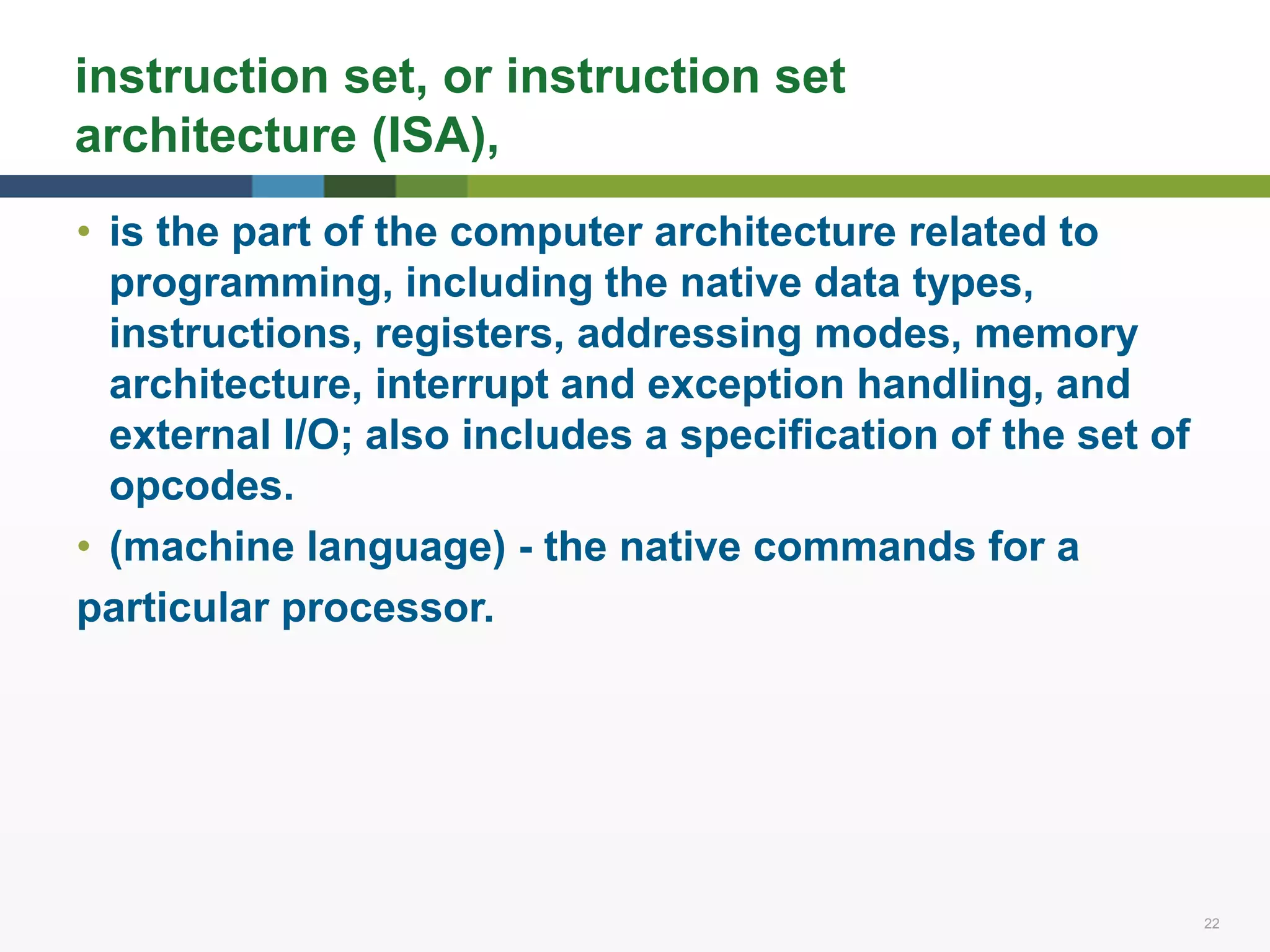
instruction set, or instruction set
architecture (ISA),
• is the part of the computer architecture related to
programming, including the native data types,
instructions, registers, addressing modes, memory
architecture, interrupt and exception handling, and
external I/O; also includes a specification of the set of
opcodes.
• (machine language) - the native commands for a
particular processor.
23 23
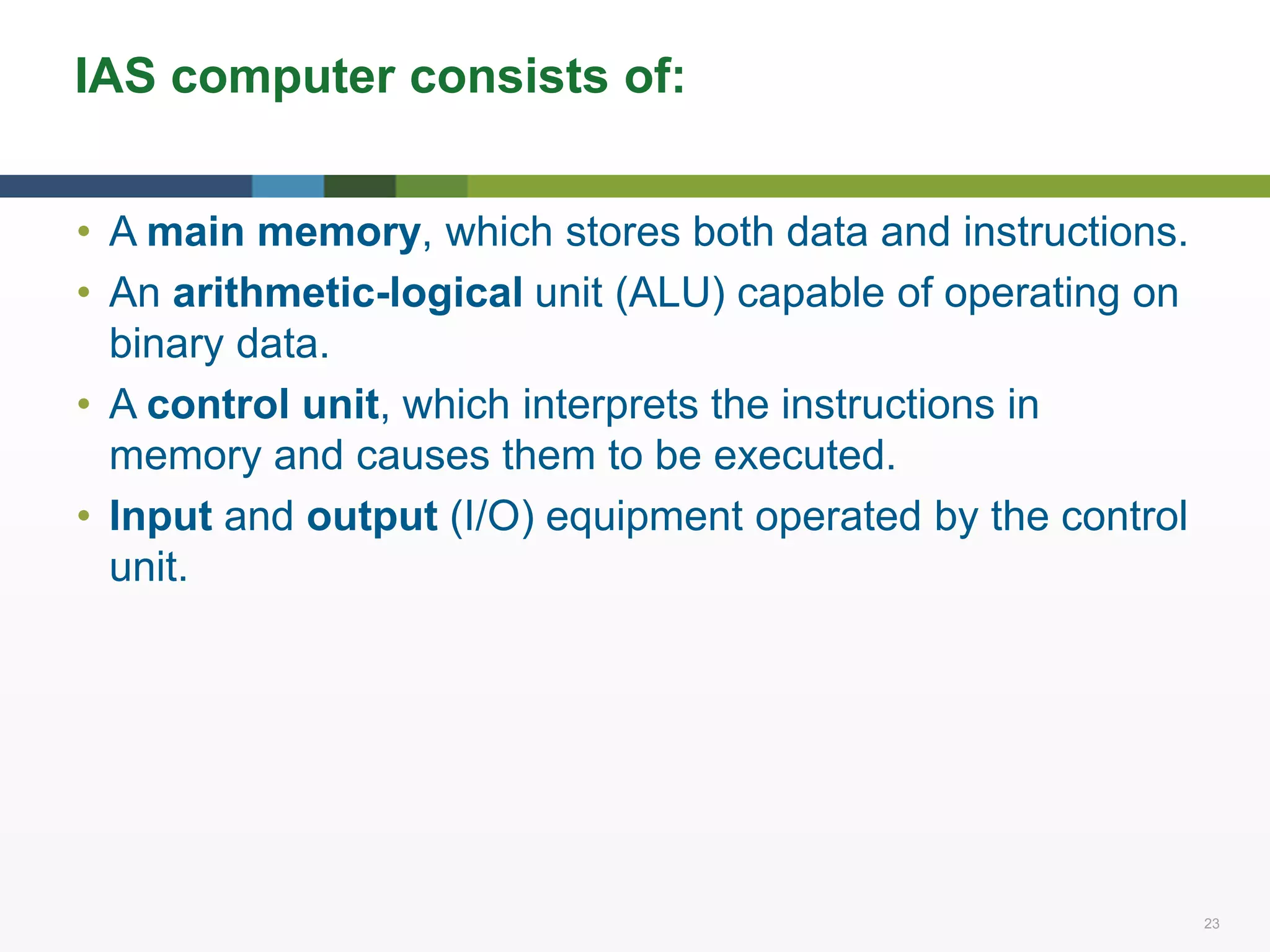
IAS computer consists of:
• A main memory, which stores both data and instructions.
• An arithmetic-logical unit (ALU) capable of operating on
binary data.
• A control unit, which interprets the instructions in
memory and causes them to be executed.
• Input and output (I/O) equipment operated by the control
unit.
24 24
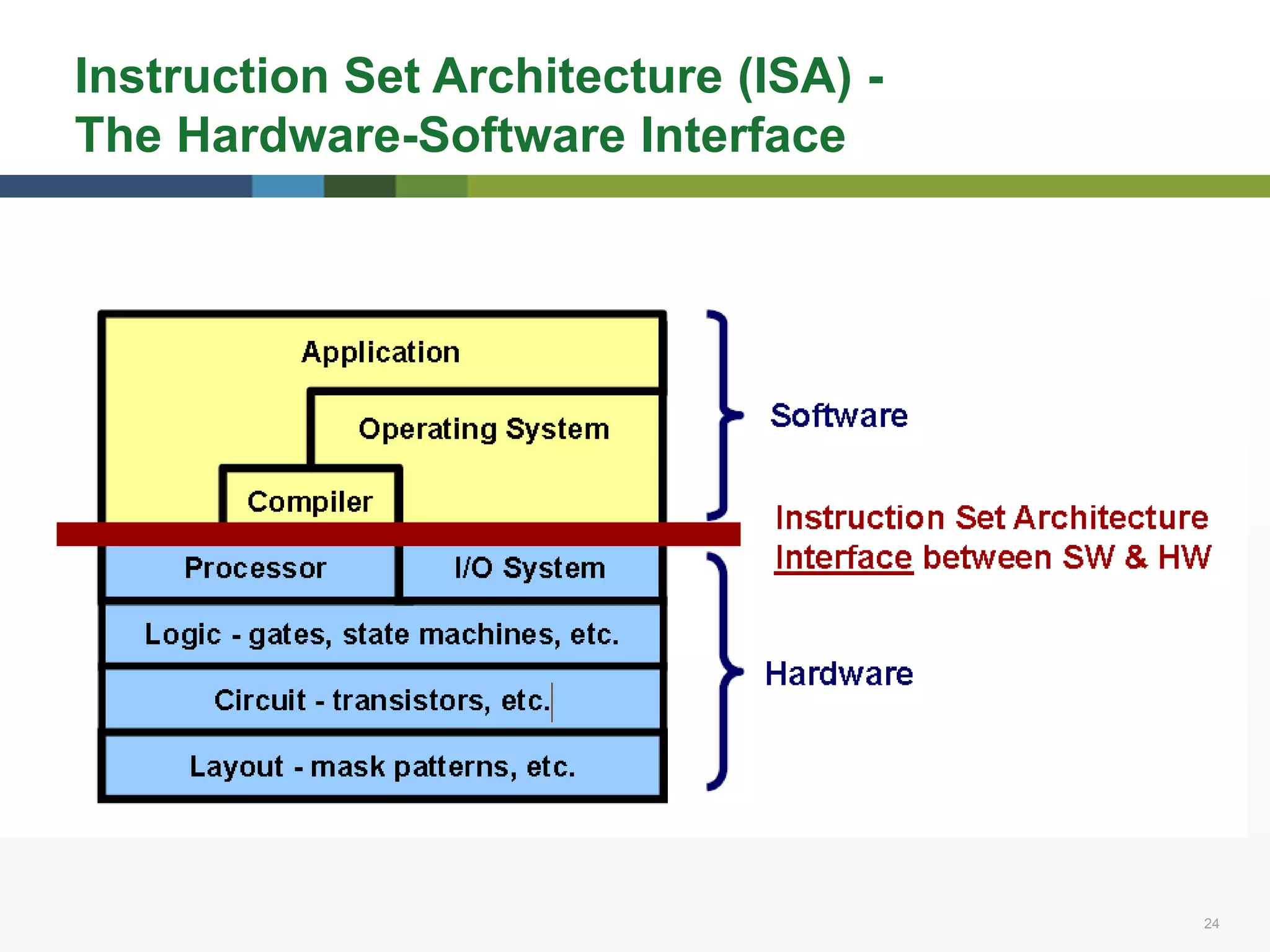
Instruction Set Architecture (ISA) -
The Hardware-Software Interface
25
26
Questions

Chapter 1 com org (student copy)

  • 1.
    1 Computer System Orgnaization Presented by AlD. Sabiaga Copyright College of Saint Adeline 2021
  • 2.
    2 2 A storedprogram computer has the following basic units: >Processor-- center for manipulation and control >Memory – storage for instructions and data for currently executing programs >I/O system – controller which communicate with “ external” devices: secondary memory, display devices, networks >Data-path & control – collection of parallel wires, transmits data, instructions, or control signal
  • 3.
    3 3 BASIC COMPUTEROPERATIONS 1. Input: This is the process of entering data and programs in to the computer system. 2. Storage: The process of saving data and instructions permanently is known as storage 3. Processing: The task of performing operations like arithmetic and logical operations is called processing. 4. Output: This is the process of producing results from the data for getting useful information. 5. Control: The manner how instructions are executed and the above operations are performed.
  • 4.
  • 5.
    5 5 Program Execution •Translation: The entire high level program is translated into an equivalent machine language program. Then the machine language program is executed. • Interpretation: Another program reads the high level program instructions one-by-one and executes a equivalent series of machine language instructions.
  • 6.
    6 6 Program translation usesa collection of tools to perform • Compiler: Translates high level language programs into a lower level language often called object code. • Assembler: Translates assembly language instructions into object code. • Linker: Combines collections of object code into a single executable machine language program.
  • 7.
  • 8.
    8 8 Computer System:Layers of Abstraction
  • 9.
    9 9 Layers ofAbstraction • Problem Statement • stated using "natural language" • may be ambiguous, imprecise • Algorithm • step-by-step procedure, guaranteed to finish • definiteness, effective computability, finiteness • Program • express the algorithm using a computer language • high-level language, low-level language • Instruction Set Architecture (ISA) • specifies the set of instructions the computer can perform • data types, addressing mode
  • 10.
    10 10 Layers ofAbstraction • Microarchitecture • detailed organization of a processor implementation • different implementations of a single ISA • Logic Circuits • combine basic operations to realize microarchitecture • many different ways to implement a single function • Devices • properties of materials, manufacturability
  • 11.
    11 11 Structure andFunction of a COMPUTER SYSTEM: A computer is a complex system; For analysis, understanding and design - Identify the hierarchical nature of most complex system. A hierarchical system is a set of interrelated subsystems, each in turn, hierarchical in structure; until at the lowest level we have elementary subsystems. The hierarchical nature of complex systems is essential to both their design and their description. The designer need only deal with a particular level of the system at a time. .
  • 12.
    12 12 Structure andFunction of a COMPUTER SYSTEM: • Structure: The way in which the components are interrelated. • Function: The operation of each individual component as part of the structure.
  • 13.
  • 14.
    14 14 main functionsof a computer: • Data processing • Data storage • Data movement • Control
  • 15.
    15 15 MAIN STRUCTURALBLOCKS/PARTS: • Central Processing Unit (CPU): Controls the operation of the computer and performs its data processing functions. Often simply referred to as processor. • Main Memory: Stores data. • I/O: Moves data between the computer and its external environment. • System Interconnection: e.g. BUS for communication among CPU, main memory, and I/O.
  • 16.
  • 17.
    17 17 major structuralcomponents of a CPU: • Control Unit (CU): Controls the operation of the CPU and hence the computer. • Arithmetic and Logic Unit (ALU): Performs computer’s data processing functions. • Register: Provides storage internal to the CPU. • CPU Interconnection: communication among the control unit, ALU, and register.
  • 18.
  • 19.
    19 19 Structure -The Control Unit
  • 20.
  • 21.
    21 21 instruction set isa list of all the instructions, that a processor can execute. Typical Categories of Instructions: • Arithmetic - add, subtract • Logic - and, or and not • Data - move, input, output, load and store • Control flow - goto, if ... goto, call and return.
  • 22.
    22 22 instruction set,or instruction set architecture (ISA), • is the part of the computer architecture related to programming, including the native data types, instructions, registers, addressing modes, memory architecture, interrupt and exception handling, and external I/O; also includes a specification of the set of opcodes. • (machine language) - the native commands for a particular processor.
  • 23.
    23 23 IAS computerconsists of: • A main memory, which stores both data and instructions. • An arithmetic-logical unit (ALU) capable of operating on binary data. • A control unit, which interprets the instructions in memory and causes them to be executed. • Input and output (I/O) equipment operated by the control unit.
  • 24.
    24 24 Instruction SetArchitecture (ISA) - The Hardware-Software Interface
  • 25.
  • 26.

Editor's Notes

  • #4 A computer performs basically five major operations or functions irrespective of their size and make. These are it accepts data or instructions by way of input, it stores data, it can process data as required by the user, it gives results in the form of output, and it controls all operations inside a computer. We discuss below each of these operations.
  • #12 At each level, the system consists of a set of components and their interrelationships The behavior at each level depends only on a simplified, abstracted characterization of the system at the next lower level.