

Metal Casting Process
Mr. Ansari Akhalakh
Ahmed
(Mech. Engineer)
History
Definition of casting
Basic features
Types of moulds
Categories of casting process
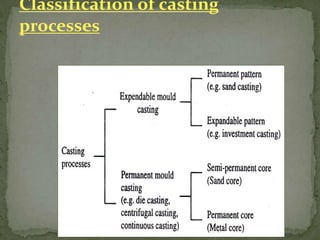
Further classification of Expendable and Permanent
mould casting
Objective
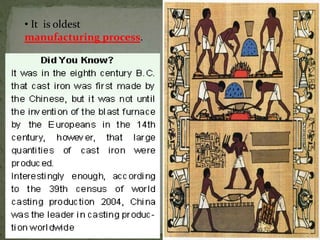
• It is oldest
manufacturing process.
 Casting is a manufacturing process by which a
liquid material is usually poured into a mold, which
contains a hollow cavity of the desired shape, and
then allowed to solidify.
 The solidified part is also known as a casting,
which is ejected or broken out of the mold to
complete the process.
Casting process
Casting process
 Casting materials are usually metals.
Almost all metals can be cast.
 Casting is most often used for making complex
shapes that would be otherwise difficult to make
by other methods.
Pattern: A pattern is made of wood or metal, is a replica of the final
product and is used for preparing mould cavity
Riser: A column of metal placed in the mold to feed the casting as it
shrinks and solidifies. Also known as a "feed head."
Runner: The channel through which the molten metal is carried from
the sprue to the gate.
Cores: A separated part of the mold, made of sand and generally baked,
which is used to create openings and various shaped cavities in the
casting.
Gate: A channel through which the molten metal enters the casting
cavity.
Basic Features
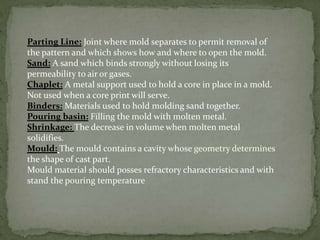
Parting Line: Joint where mold separates to permit removal of
the pattern and which shows how and where to open the mold.
Sand: A sand which binds strongly without losing its
permeability to air or gases.
Chaplet: A metal support used to hold a core in place in a mold.
Not used when a core print will serve.
Binders: Materials used to hold molding sand together.
Pouring basin: Filling the mold with molten metal.
Shrinkage: The decrease in volume when molten metal
solidifies.
Mould: The mould contains a cavity whose geometry determines
the shape of cast part.
Mould material should posses refractory characteristics and with
stand the pouring temperature
The various casting processes are classified according to
these different moulds
• open mould
• closed mould
Types of moulds
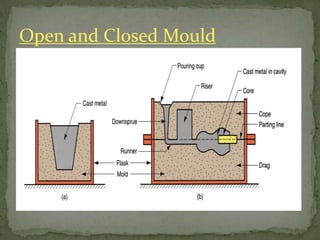
• Open mould
in which the liquid metal is simply poured until
it fills the open cavity. (fig. a)
•Closed mould
the closed mold is provided to permit the
molten metal to flow from outside the mold cavity.
(fig. b)
• the closed mold is more important categories in
production casting operation.
Types of moulds
Open and Closed Mould
Casting process divide onto two broad categories
according to types of mold used;
oExpandable mould casting
oPermanent mould casting
Categories of casting process
Expandable mould means that :
the mold in which the molten metal is solidifies
must be break or destroyed to remove the casting.
Or
After solidification of molten metal the mold is break to
remove the desired casting. (sand casting)
Expandable mould materials:
the mold are made out of sand, plaster, and
similar materials.
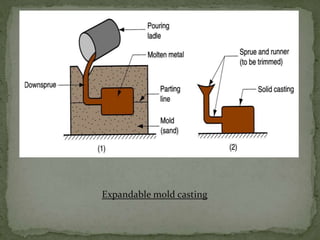
Expandable mould casting
Classification of casting
processes
Expandable mold casting
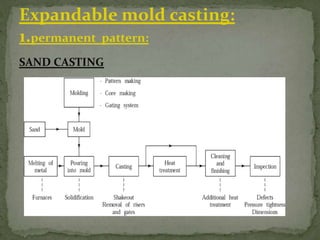
SAND CASTING
Expandable mold casting:
1.permanent pattern:
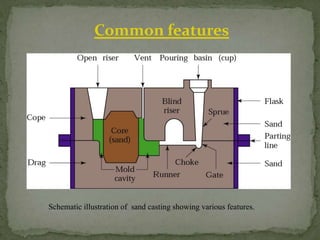
Common features
Schematic illustration of sand casting showing various features.
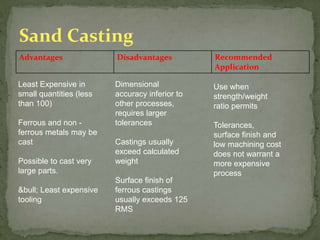
Advantages Disadvantages Recommended
Application
Sand Casting
Least Expensive in
small quantities (less
than 100)
Ferrous and non -
ferrous metals may be
cast
Possible to cast very
large parts.
• Least expensive
tooling
Dimensional
accuracy inferior to
other processes,
requires larger
tolerances
Castings usually
exceed calculated
weight
Surface finish of
ferrous castings
usually exceeds 125
RMS
Use when
strength/weight
ratio permits
Tolerances,
surface finish and
low machining cost
does not warrant a
more expensive
process
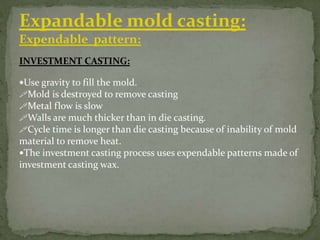
INVESTMENT CASTING:
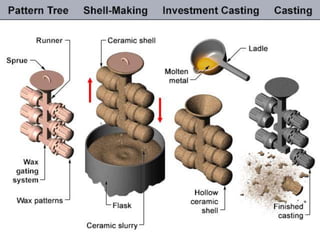
Use gravity to fill the mold.
Mold is destroyed to remove casting
Metal flow is slow
Walls are much thicker than in die casting.
Cycle time is longer than die casting because of inability of mold
material to remove heat.
The investment casting process uses expendable patterns made of
investment casting wax.
Expandable mold casting:
Expendable pattern:
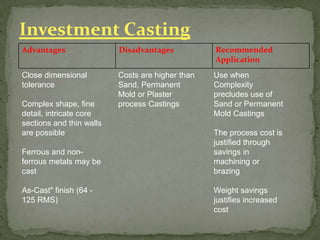
Investment Casting
Advantages Disadvantages Recommended
Application
Close dimensional
tolerance
Complex shape, fine
detail, intricate core
sections and thin walls
are possible
Ferrous and non-
ferrous metals may be
cast
As-Cast" finish (64 -
125 RMS)
Costs are higher than
Sand, Permanent
Mold or Plaster
process Castings
Use when
Complexity
precludes use of
Sand or Permanent
Mold Castings
The process cost is
justified through
savings in
machining or
brazing
Weight savings
justifies increased
cost
Permanent mold casting
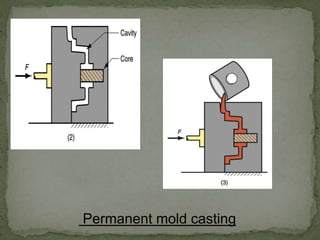
oIn permanent mold casting, the mold is
reused many times.
oThe molds are commonly made of steel or cast
iron.
oThe Metals commonly cast in the permanent
mold casting include aluminum, magnesium
and copper- based alloys( brass , bronze)
Permanent mold casting
Types permanent mold casting
Two basic two types of permanent
mold casting as under
oDie casting
oCentrifugal casting
Die casting:
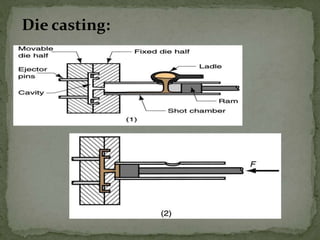
oDie casting is permanent-mold casting process
in which the molten metal is injected into mold
cavity under high pressure. The pressure is
maintained during solidification, after which the
mold is opened and part is removed.
oTypical pressures are 7 to 350 MPa.
oThe molds used in this casting operation is
called dies; hence the name die casting
Die casting:
Two types of die casting machines that
as under
oHot chamber die casting
oCold chamber die casting
Die casting machines:
oIn hot chamber die- casting machines, the molten metal is
poured into a heated chamber from an external melting
container, and piston is used to inject the molten metal
under a high pressure into die cavity.
oTypically injection pressures are 7 to 35 mpa.
oThis process only used for the low-melting-point
metals.(zinc,tin ,lead and, sometimes magnesium)
Hot chamber die casting:
oIn which the molten metal poured into an
unheated chamber, and piston is used to inject the
liquid metal under a high pressures into the die
cavity
oInjection pressures used in these machine are
typically 14 to 140 mpa.
Cold chamber die-casting :
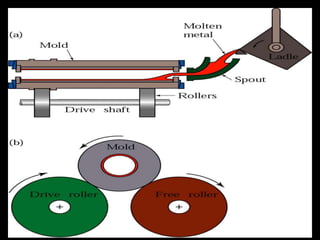
oIn centrifugal casting the mold is rotated at high
speed so that the centrifugal force is produced that
distributes the molten metal to the outer regions of
the cavity.
oExamples of parts made by this process include
pipes, tubes bushing and rings.
Centrifugal casting:
oHigh production rates possible.
oClose tolerance is possible for small parts.
oGood surface finish.
oThin sections are possible.
oRapid solidification.
Advantages of permanent mold
casting
o Only used for low melting point metals.
oMore intricate shapes are not achieved
oMold is expensive.
Note:(More intricate shapes are not achieved by the
permanent mold casting)
Limitation of permanent mold
casting
For any Metal Casting Process, selection of right alloy, size, shape,
thickness, tolerance, texture, and weight, is very vital.
Views of the Tooling Designer; Foundry / Machine House needs,
customer's exact product requirements, and secondary operations like
painting, must be taken care of before selecting the appropriate Metal
Casting Process.
Tool cost.
Economics of machining versus process costs.
Adequate protection / packaging, shipping constraints, regulations of
the final components, weights and shelf life of protective coatings also
play their part in the Metal Casting process.
Selecting the Right Metal
Casting Process
thanks
ANY
QUESTION?

Casting Process.ppt

  • 1.
    Metal Casting Process Mr.Ansari Akhalakh Ahmed (Mech. Engineer)
  • 2.
    History Definition of casting Basicfeatures Types of moulds Categories of casting process Further classification of Expendable and Permanent mould casting Objective
  • 3.
    • It isoldest manufacturing process.
  • 4.
     Casting isa manufacturing process by which a liquid material is usually poured into a mold, which contains a hollow cavity of the desired shape, and then allowed to solidify.  The solidified part is also known as a casting, which is ejected or broken out of the mold to complete the process. Casting process
  • 5.
    Casting process  Castingmaterials are usually metals. Almost all metals can be cast.  Casting is most often used for making complex shapes that would be otherwise difficult to make by other methods.
  • 7.
    Pattern: A patternis made of wood or metal, is a replica of the final product and is used for preparing mould cavity Riser: A column of metal placed in the mold to feed the casting as it shrinks and solidifies. Also known as a "feed head." Runner: The channel through which the molten metal is carried from the sprue to the gate. Cores: A separated part of the mold, made of sand and generally baked, which is used to create openings and various shaped cavities in the casting. Gate: A channel through which the molten metal enters the casting cavity. Basic Features
  • 8.
    Parting Line: Jointwhere mold separates to permit removal of the pattern and which shows how and where to open the mold. Sand: A sand which binds strongly without losing its permeability to air or gases. Chaplet: A metal support used to hold a core in place in a mold. Not used when a core print will serve. Binders: Materials used to hold molding sand together. Pouring basin: Filling the mold with molten metal. Shrinkage: The decrease in volume when molten metal solidifies. Mould: The mould contains a cavity whose geometry determines the shape of cast part. Mould material should posses refractory characteristics and with stand the pouring temperature
  • 9.
    The various castingprocesses are classified according to these different moulds • open mould • closed mould Types of moulds
  • 10.
    • Open mould inwhich the liquid metal is simply poured until it fills the open cavity. (fig. a) •Closed mould the closed mold is provided to permit the molten metal to flow from outside the mold cavity. (fig. b) • the closed mold is more important categories in production casting operation. Types of moulds
  • 11.
  • 12.
    Casting process divideonto two broad categories according to types of mold used; oExpandable mould casting oPermanent mould casting Categories of casting process
  • 13.
    Expandable mould meansthat : the mold in which the molten metal is solidifies must be break or destroyed to remove the casting. Or After solidification of molten metal the mold is break to remove the desired casting. (sand casting) Expandable mould materials: the mold are made out of sand, plaster, and similar materials. Expandable mould casting
  • 14.
  • 15.
  • 16.
    SAND CASTING Expandable moldcasting: 1.permanent pattern:
  • 17.
    Common features Schematic illustrationof sand casting showing various features.
  • 18.
    Advantages Disadvantages Recommended Application SandCasting Least Expensive in small quantities (less than 100) Ferrous and non - ferrous metals may be cast Possible to cast very large parts. • Least expensive tooling Dimensional accuracy inferior to other processes, requires larger tolerances Castings usually exceed calculated weight Surface finish of ferrous castings usually exceeds 125 RMS Use when strength/weight ratio permits Tolerances, surface finish and low machining cost does not warrant a more expensive process
  • 19.
    INVESTMENT CASTING: Use gravityto fill the mold. Mold is destroyed to remove casting Metal flow is slow Walls are much thicker than in die casting. Cycle time is longer than die casting because of inability of mold material to remove heat. The investment casting process uses expendable patterns made of investment casting wax. Expandable mold casting: Expendable pattern:
  • 21.
    Investment Casting Advantages DisadvantagesRecommended Application Close dimensional tolerance Complex shape, fine detail, intricate core sections and thin walls are possible Ferrous and non- ferrous metals may be cast As-Cast" finish (64 - 125 RMS) Costs are higher than Sand, Permanent Mold or Plaster process Castings Use when Complexity precludes use of Sand or Permanent Mold Castings The process cost is justified through savings in machining or brazing Weight savings justifies increased cost
  • 22.
    Permanent mold casting oInpermanent mold casting, the mold is reused many times. oThe molds are commonly made of steel or cast iron. oThe Metals commonly cast in the permanent mold casting include aluminum, magnesium and copper- based alloys( brass , bronze)
  • 23.
  • 24.
    Types permanent moldcasting Two basic two types of permanent mold casting as under oDie casting oCentrifugal casting
  • 25.
    Die casting: oDie castingis permanent-mold casting process in which the molten metal is injected into mold cavity under high pressure. The pressure is maintained during solidification, after which the mold is opened and part is removed. oTypical pressures are 7 to 350 MPa. oThe molds used in this casting operation is called dies; hence the name die casting
  • 26.
  • 27.
    Two types ofdie casting machines that as under oHot chamber die casting oCold chamber die casting Die casting machines:
  • 28.
    oIn hot chamberdie- casting machines, the molten metal is poured into a heated chamber from an external melting container, and piston is used to inject the molten metal under a high pressure into die cavity. oTypically injection pressures are 7 to 35 mpa. oThis process only used for the low-melting-point metals.(zinc,tin ,lead and, sometimes magnesium) Hot chamber die casting:
  • 29.
    oIn which themolten metal poured into an unheated chamber, and piston is used to inject the liquid metal under a high pressures into the die cavity oInjection pressures used in these machine are typically 14 to 140 mpa. Cold chamber die-casting :
  • 30.
    oIn centrifugal castingthe mold is rotated at high speed so that the centrifugal force is produced that distributes the molten metal to the outer regions of the cavity. oExamples of parts made by this process include pipes, tubes bushing and rings. Centrifugal casting:
  • 32.
    oHigh production ratespossible. oClose tolerance is possible for small parts. oGood surface finish. oThin sections are possible. oRapid solidification. Advantages of permanent mold casting
  • 33.
    o Only usedfor low melting point metals. oMore intricate shapes are not achieved oMold is expensive. Note:(More intricate shapes are not achieved by the permanent mold casting) Limitation of permanent mold casting
  • 34.
    For any MetalCasting Process, selection of right alloy, size, shape, thickness, tolerance, texture, and weight, is very vital. Views of the Tooling Designer; Foundry / Machine House needs, customer's exact product requirements, and secondary operations like painting, must be taken care of before selecting the appropriate Metal Casting Process. Tool cost. Economics of machining versus process costs. Adequate protection / packaging, shipping constraints, regulations of the final components, weights and shelf life of protective coatings also play their part in the Metal Casting process. Selecting the Right Metal Casting Process
  • 35.
  • 36.

Editor's Notes