Challenging the traditional
         thinking
         AgilIL2012
Yael Rabinovich
Software industry since 1998
Agile coach @ AgileSparks since 2009


                                       Agile coach, AgileSparks
                                          Mail: Yael@Agilesparks.com
Challenging the traditional
         thinking
         AgilIL2012
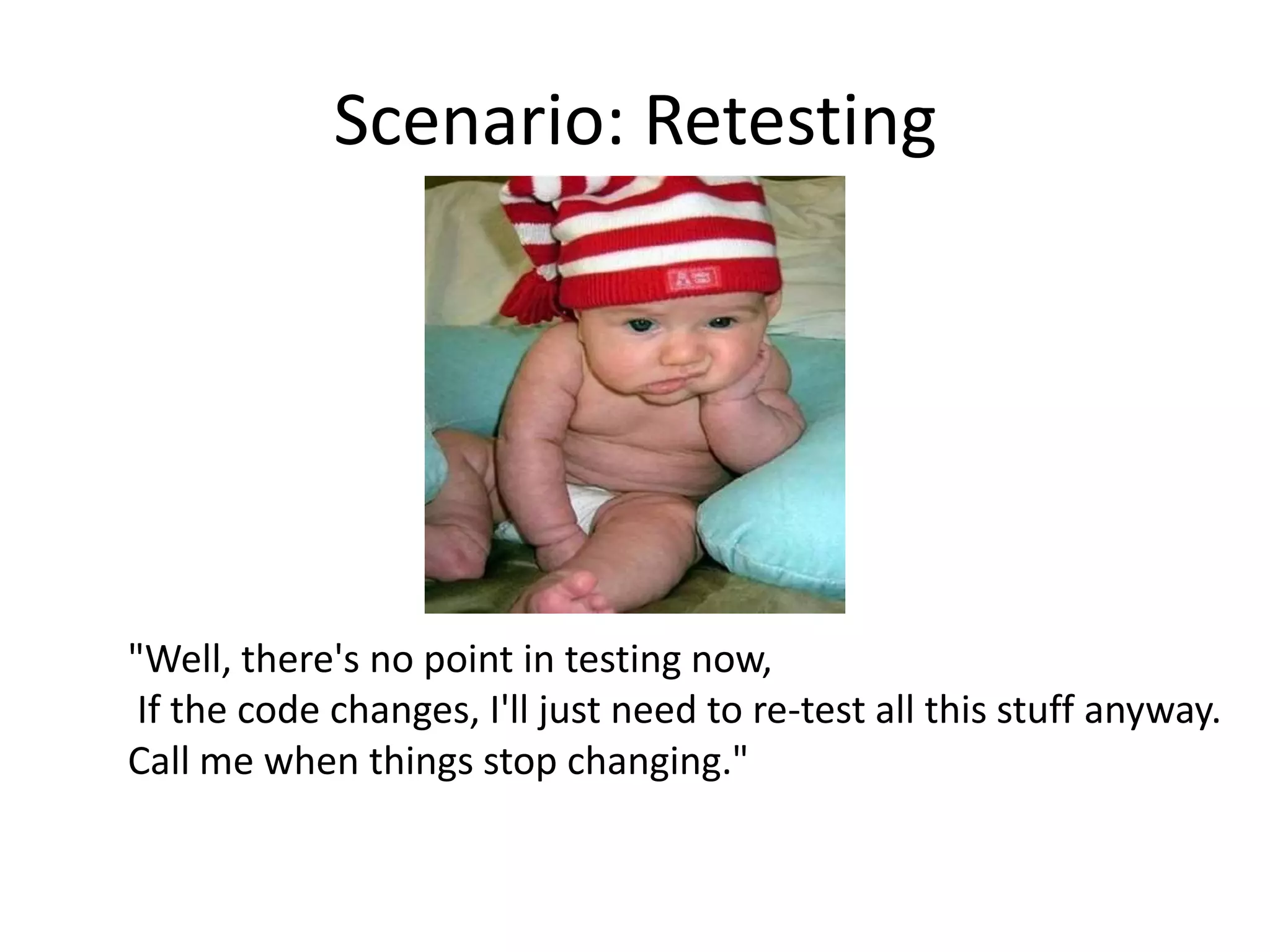
Scenario: Retesting


"Well, there's no point in testing now,
 If the code changes, I'll just need to re-test all this stuff anyway.
Call me when things stop changing."
Traditional thinking
                    Scenario: Retesting

• What's the assumption taken?
  – Things will stop changing
  – Testing time = tests execution time
  – Testing role certifying the product is ready for delivery


• The benefits
  – Test execution time potentially will be reduced
  – People motivation
  – Test coverage is easier to track
Agile thinking
                            Scenario: Retesting
• The assumption
   – Things will keep changing
   – The role of the tester is
       Improving the quality of the product
                          before it's complete
• Benefits
   – Total delivery time potentially reduced
   – Fixes are simpler (risktime)
   – Tester role is more relied on and critical – leading role
   – Progress is more reliable
   – Increase in quality
Agile thinking
                  Scenario: Retesting


• Potential challenges:
  – More testing time
  – Doing the same again and again – low motivation
  – Effort on automation
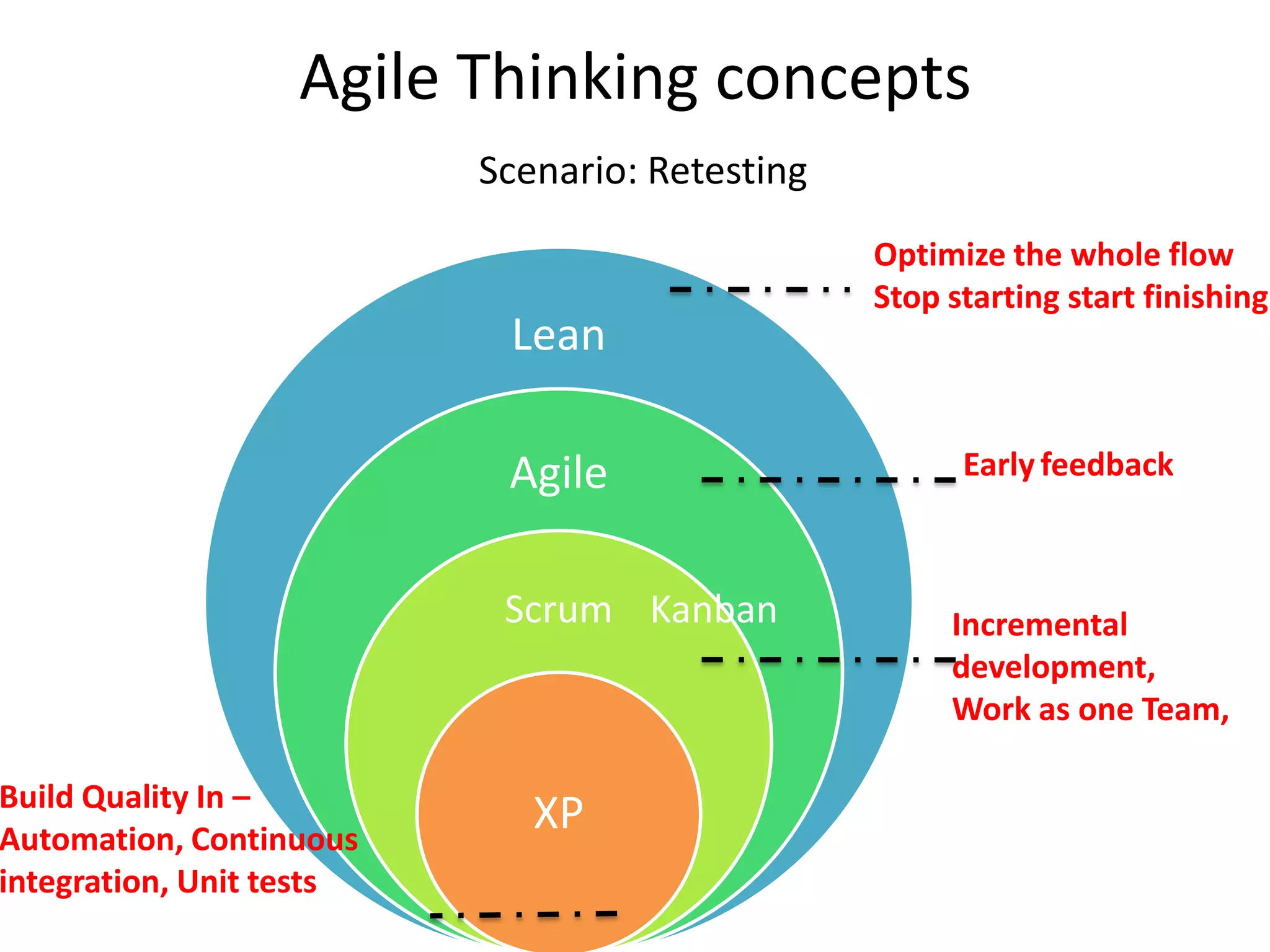
Agile Thinking concepts
                          Scenario: Retesting
                                                Optimize the whole flow
                                                Stop starting start finishing
                           Lean

                           Agile                      Early feedback


                           Scrum Kanban              Incremental
                                                     development,
                                                     Work as one Team,

Build Quality In –
Automation, Continuous
                             XP
integration, Unit tests
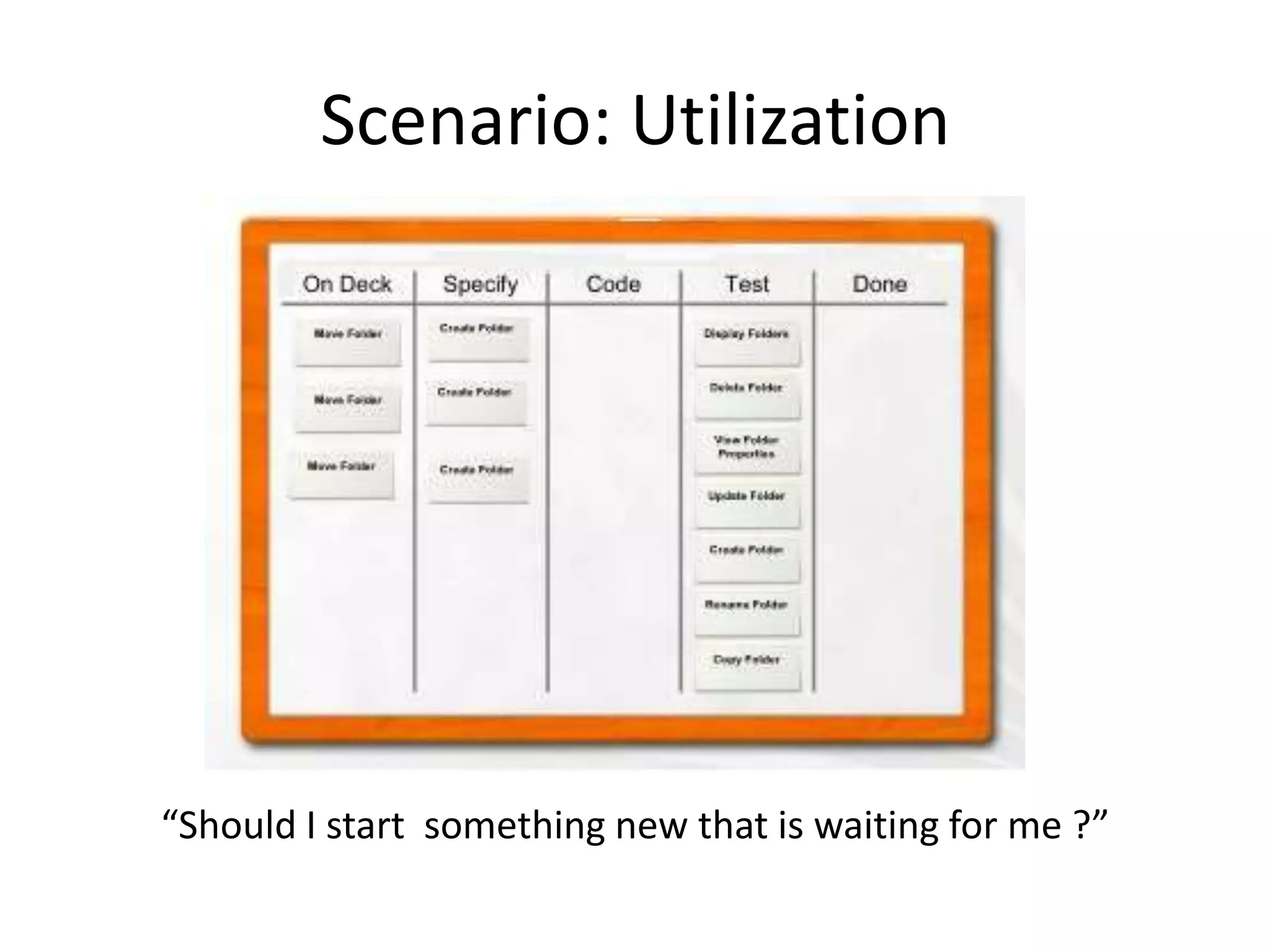
Scenario: Utilization


“Should I start something new that is waiting for me ?”
Traditional thinking
                   Scenario: Utilization

• The assumption taken
  – I’m measured as efficient by the pace I produce


• The benefits:
  – People’s skills are highly utilized
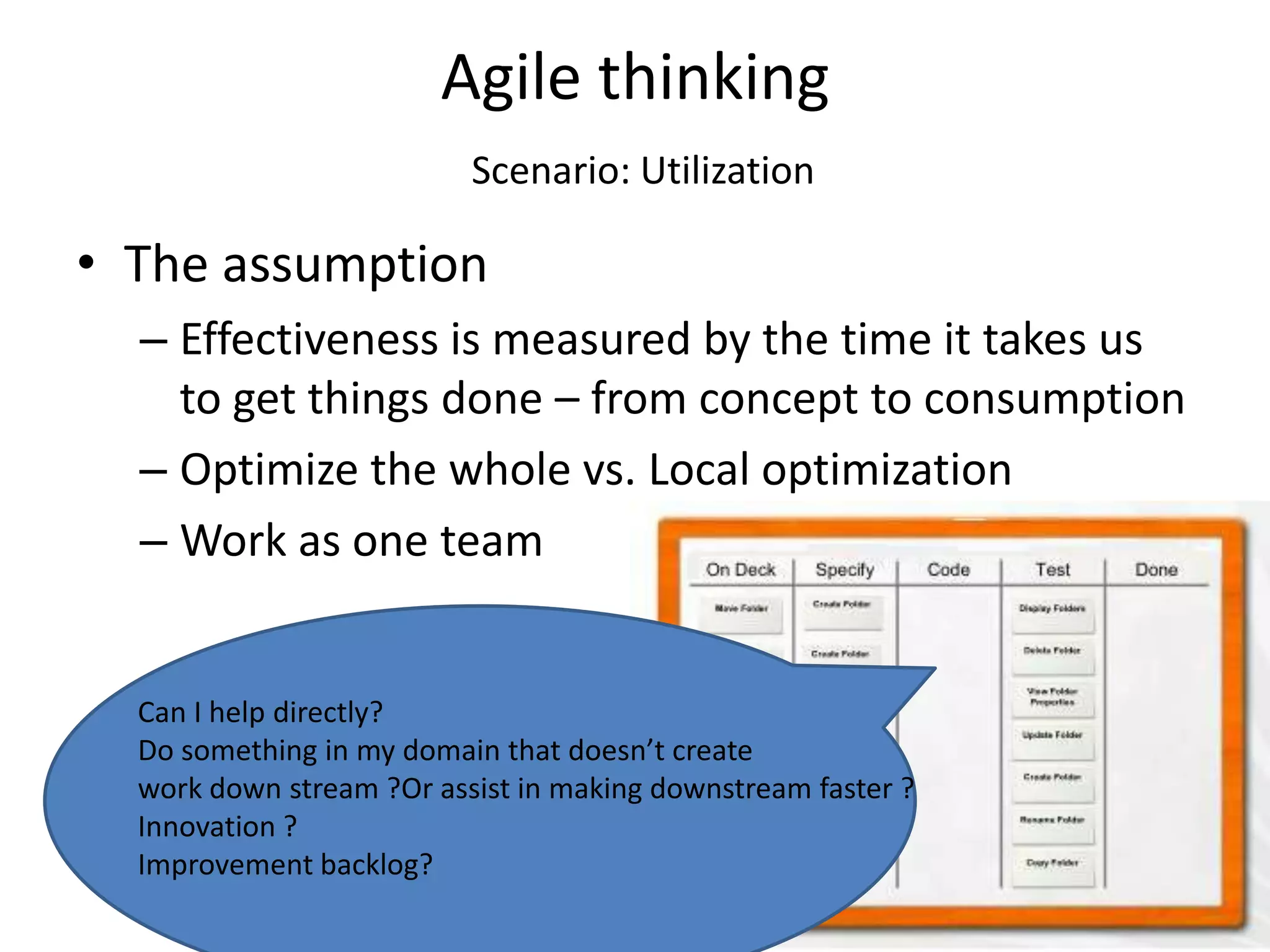
Agile thinking
                          Scenario: Utilization

• The assumption
  – Effectiveness is measured by the time it takes us
    to get things done – from concept to consumption
  – Optimize the whole vs. Local optimization
  – Work as one team


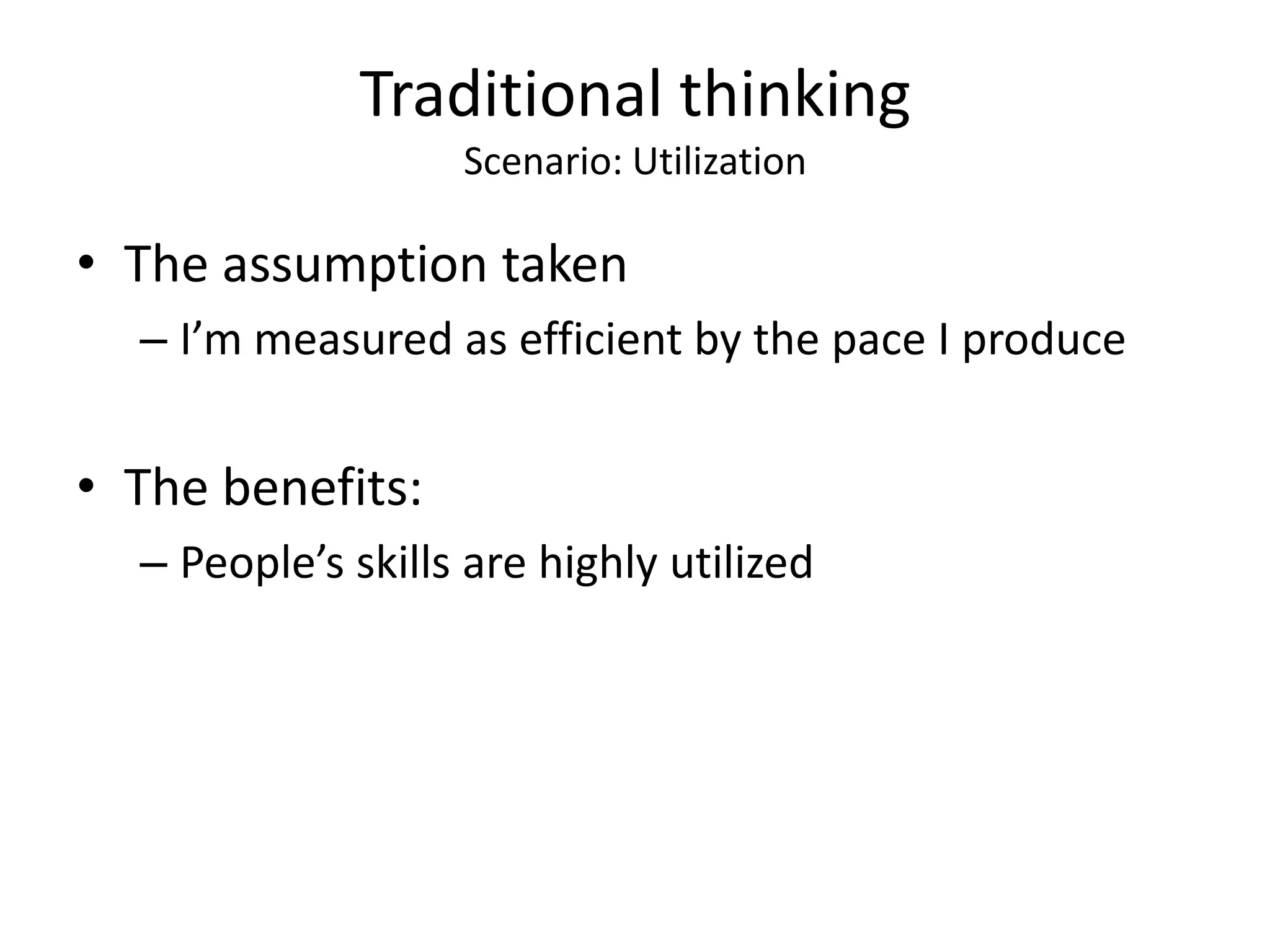
  Can I help directly?
  Do something in my domain that doesn’t create
  work down stream ?Or assist in making downstream faster ?
  Innovation ?
  Improvement backlog?
Scenario: Scope Driven


"We must include this new capability in this release, it’s strategic.
It will result with postponing in 2 -3 months the release date"
Traditional thinking
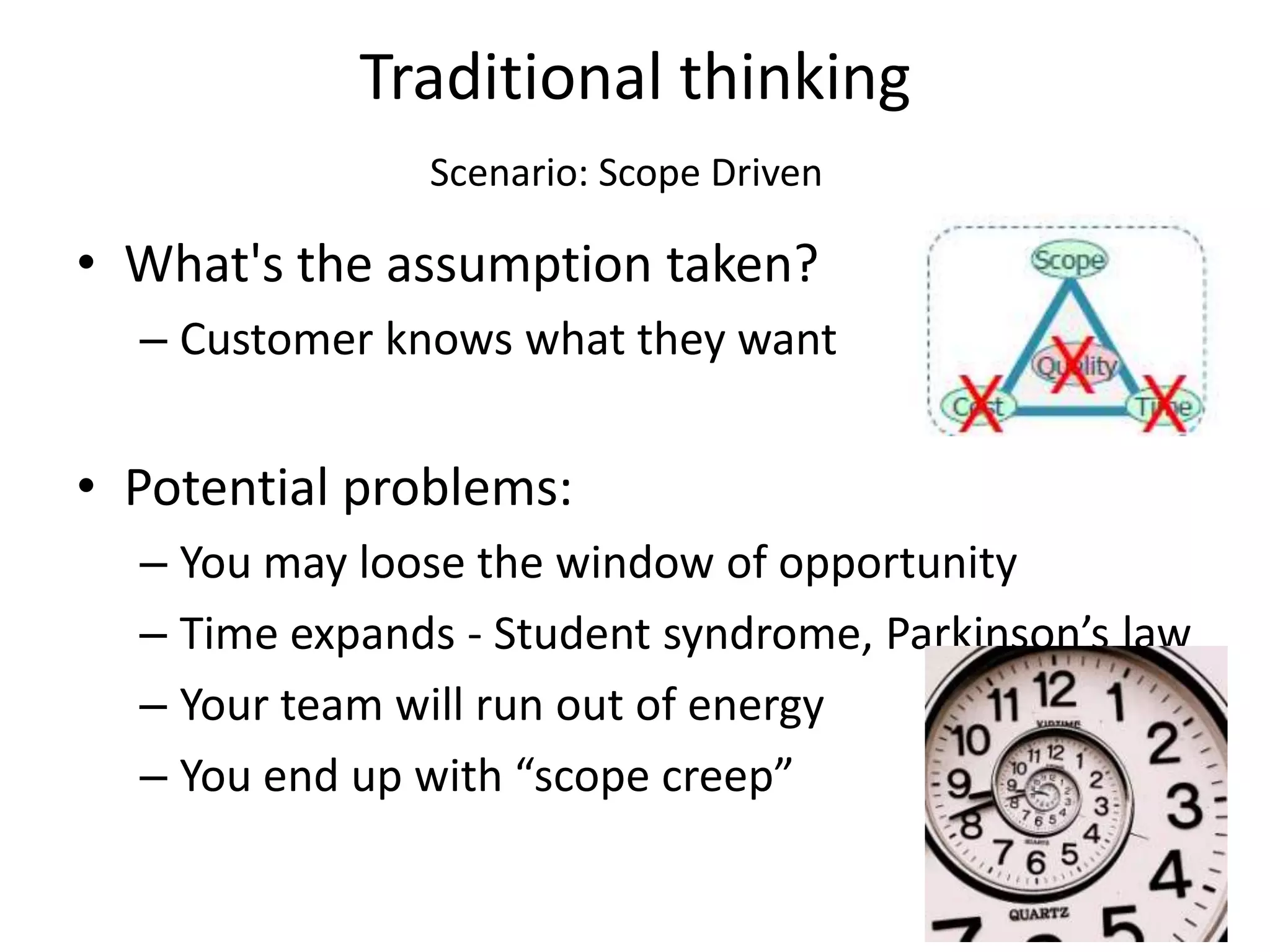
               Scenario: Scope Driven

• What's the assumption taken?
  – Customer knows what they want


• Potential problems:
  – You may loose the window of opportunity
  – Time expands - Student syndrome, Parkinson’s law
  – Your team will run out of energy
  – You end up with “scope creep”
Agile thinking
                     Scenario: Scope Driven

• The assumption
   – Early feedback – Continuous short delivery cycles
   – Customers discover what they want

• Benefits :
   –   Incremental value & ROI
   –   build customer trust
   –   Easy to plan
   –   Creates sense of urgency
   –   80/20 rule (less is more)
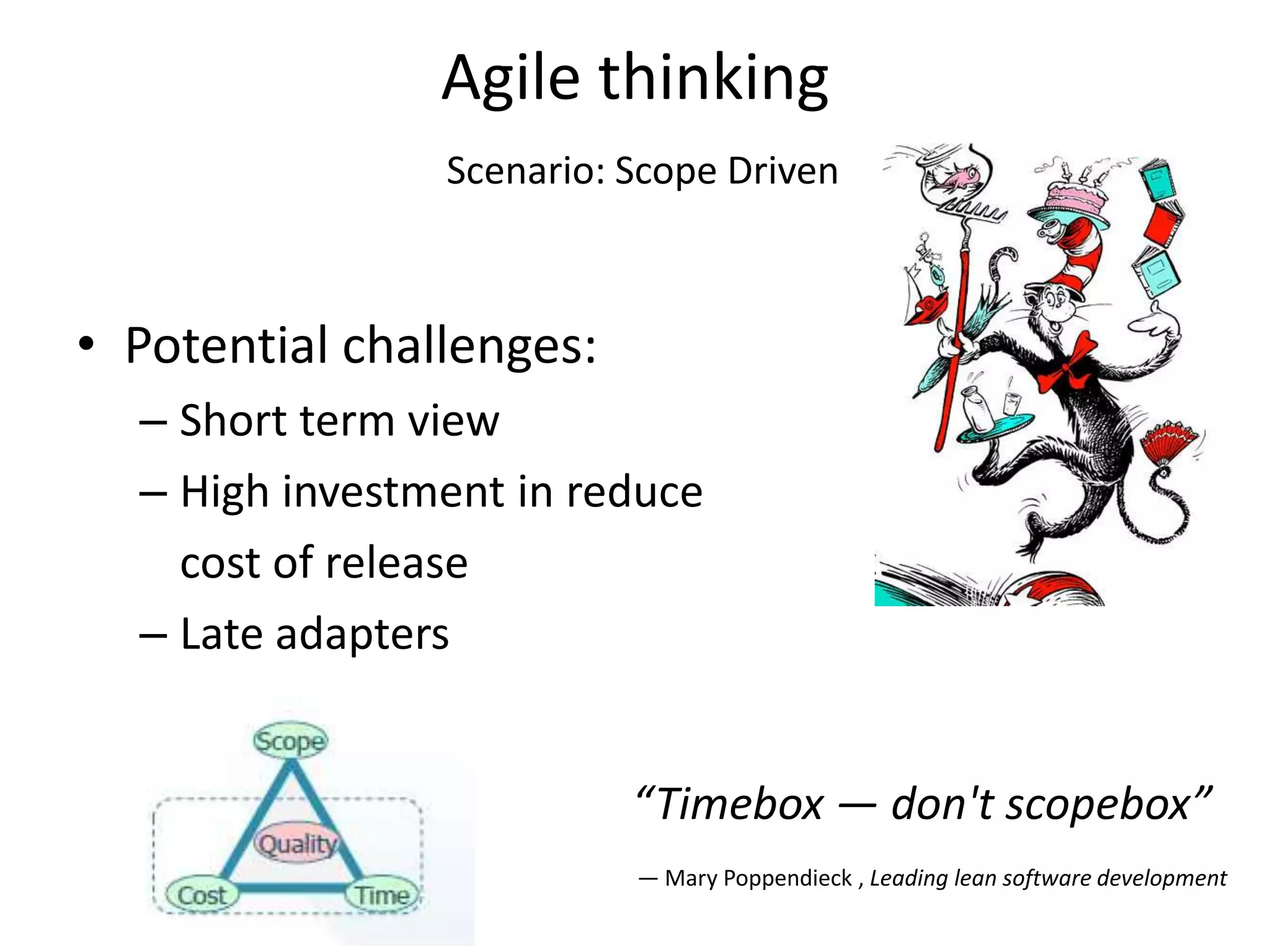
Agile thinking
                Scenario: Scope Driven


• Potential challenges:
  – Short term view
  – High investment in reduce
    cost of release
  – Late adapters


                          “Timebox — don't scopebox”
                          — Mary Poppendieck , Leading lean software development
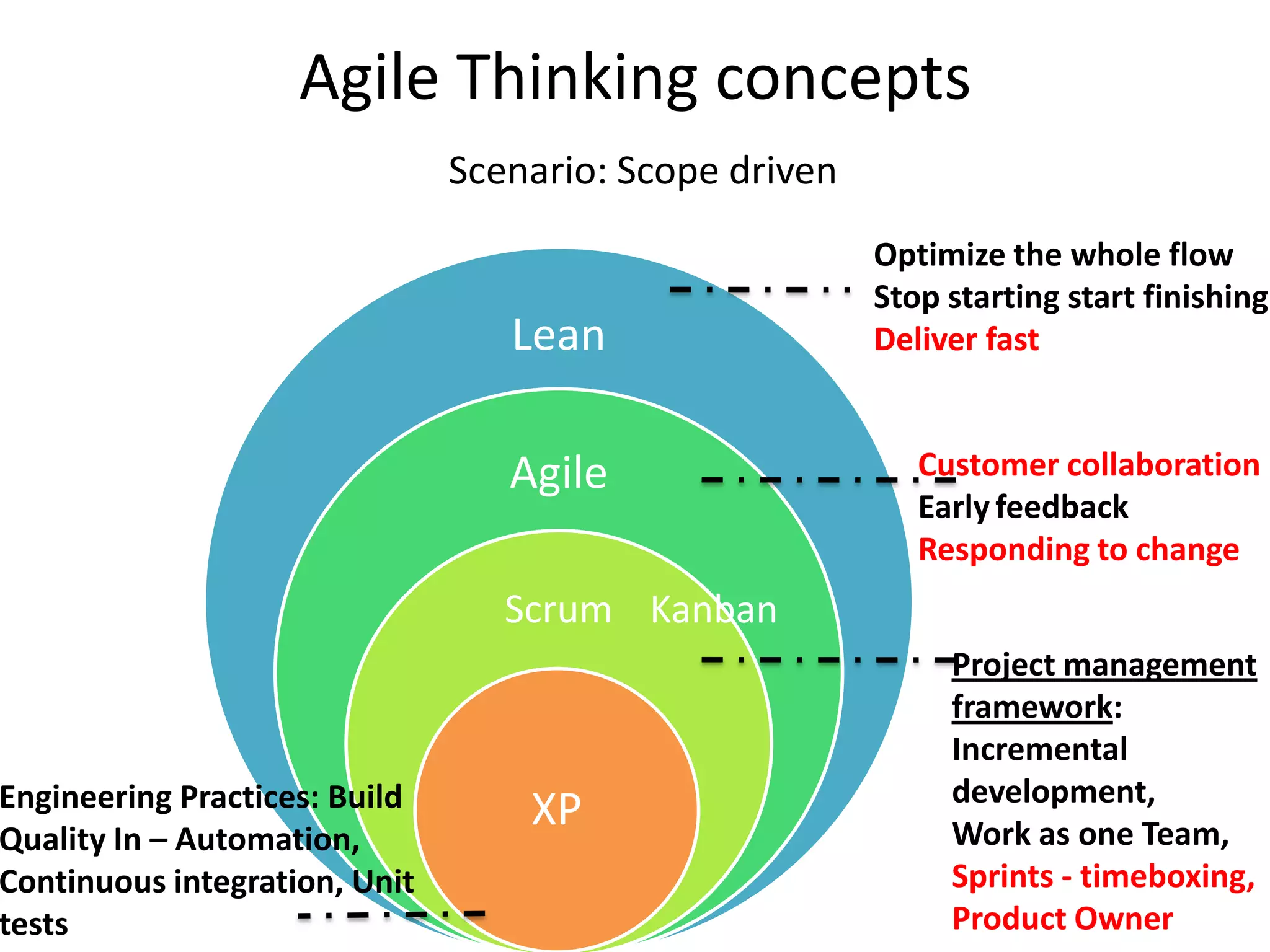
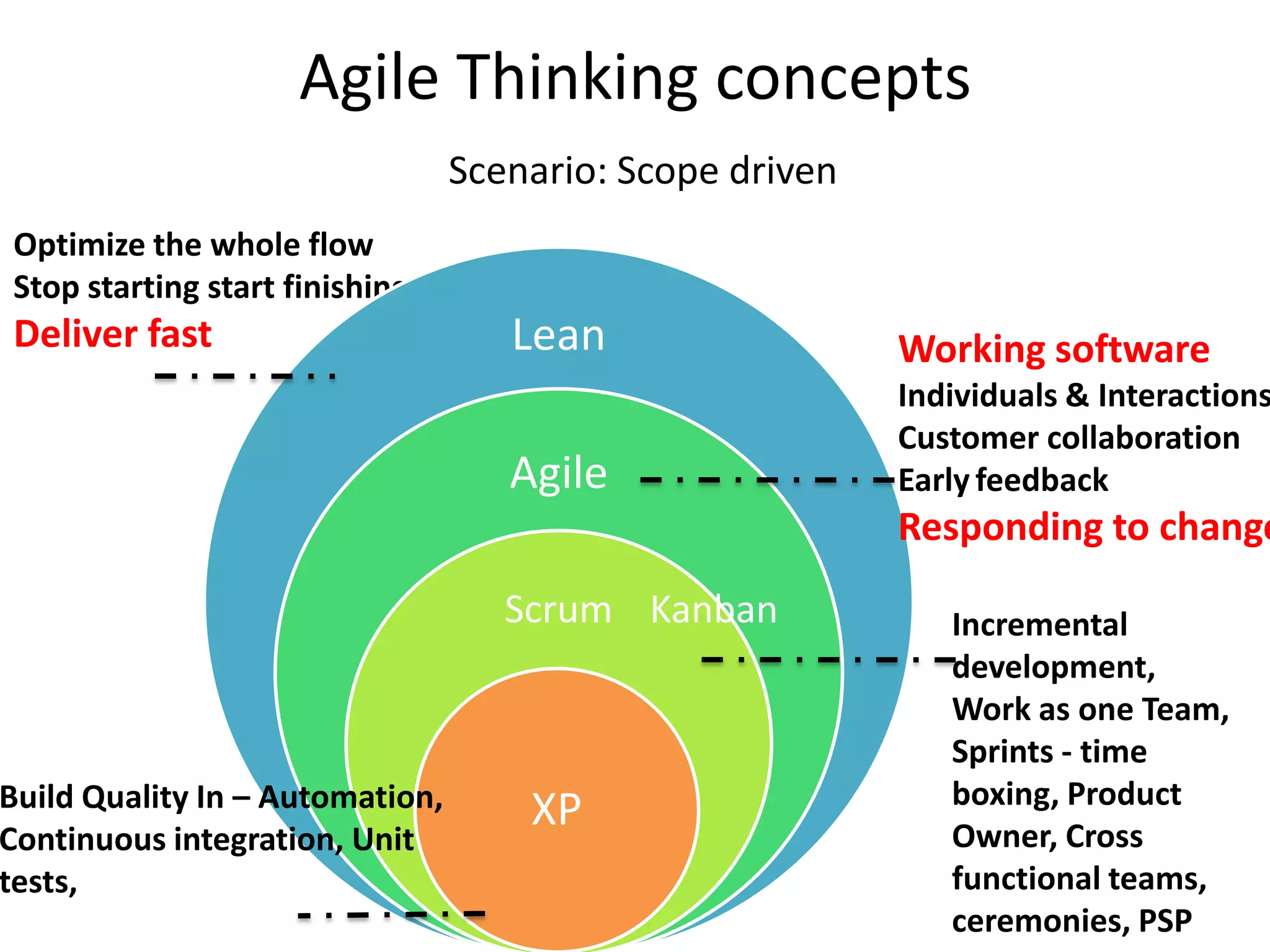
Agile Thinking concepts
                               Scenario: Scope driven
                                                        Optimize the whole flow
                                                        Stop starting start finishing
                                  Lean                  Deliver fast


                                  Agile                    Customer collaboration
                                                           Early feedback
                                                           Responding to change
                                  Scrum Kanban
                                                             Project management
                                                             framework:
                                                             Incremental
Engineering Practices: Build                                 development,
                                   XP                        Work as one Team,
Quality In – Automation,
Continuous integration, Unit                                 Sprints - timeboxing,
tests                                                        Product Owner
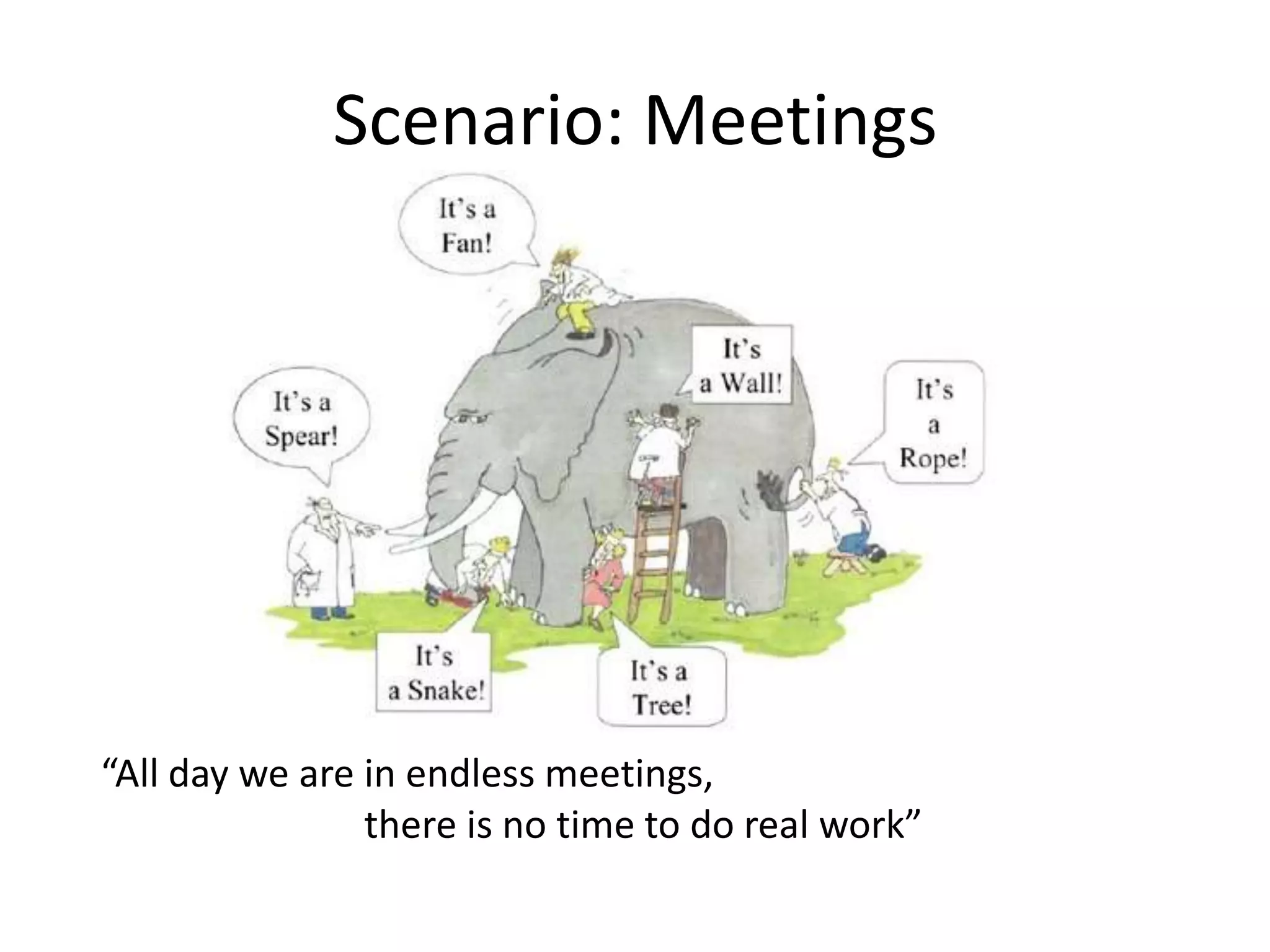
Scenario: Meetings


“All day we are in endless meetings,
                there is no time to do real work”
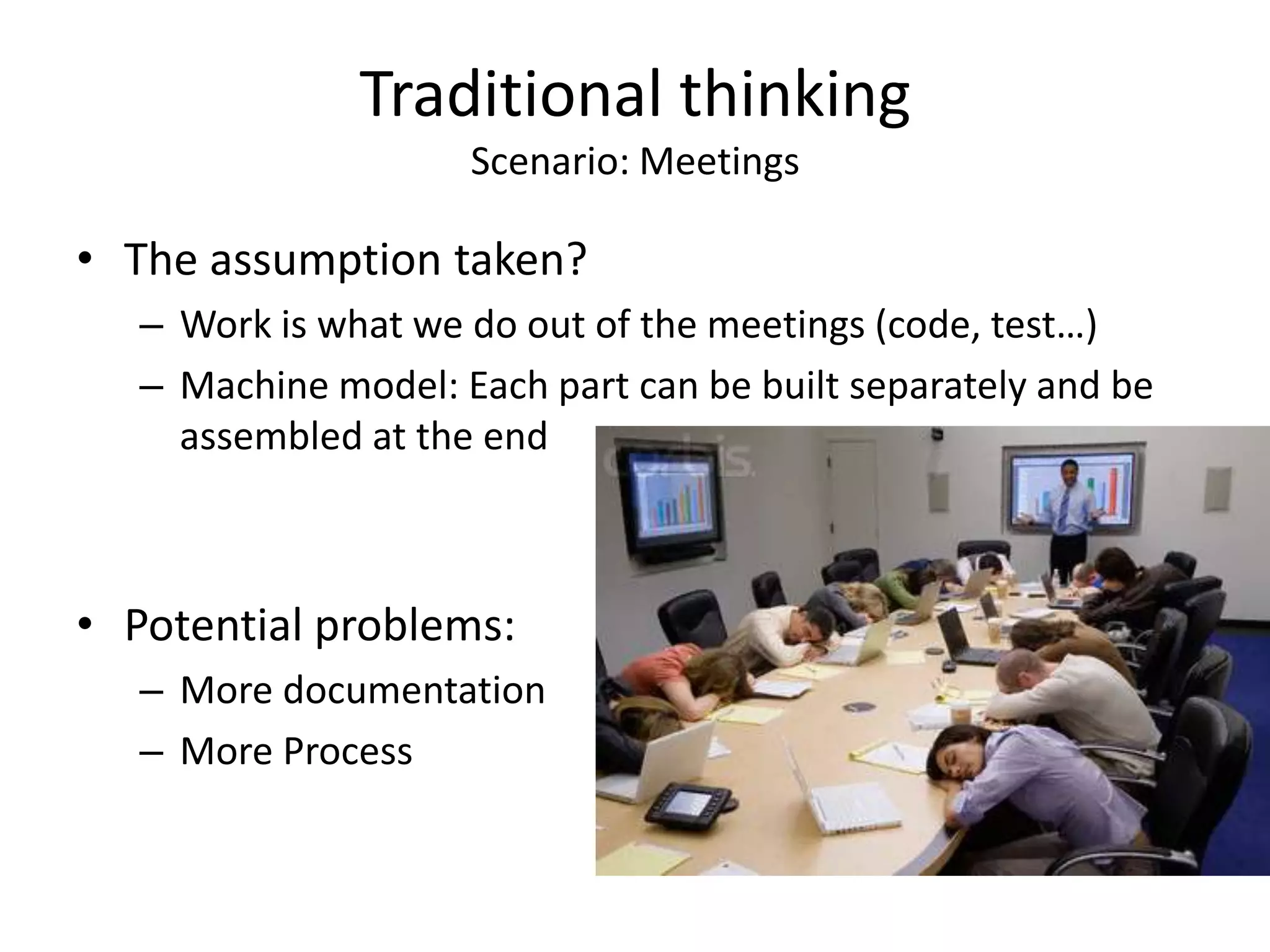
Traditional thinking
                     Scenario: Meetings

• The assumption taken?
   – Work is what we do out of the meetings (code, test…)
   – Machine model: Each part can be built separately and be
     assembled at the end


• Potential problems:
   – More documentation
   – More Process
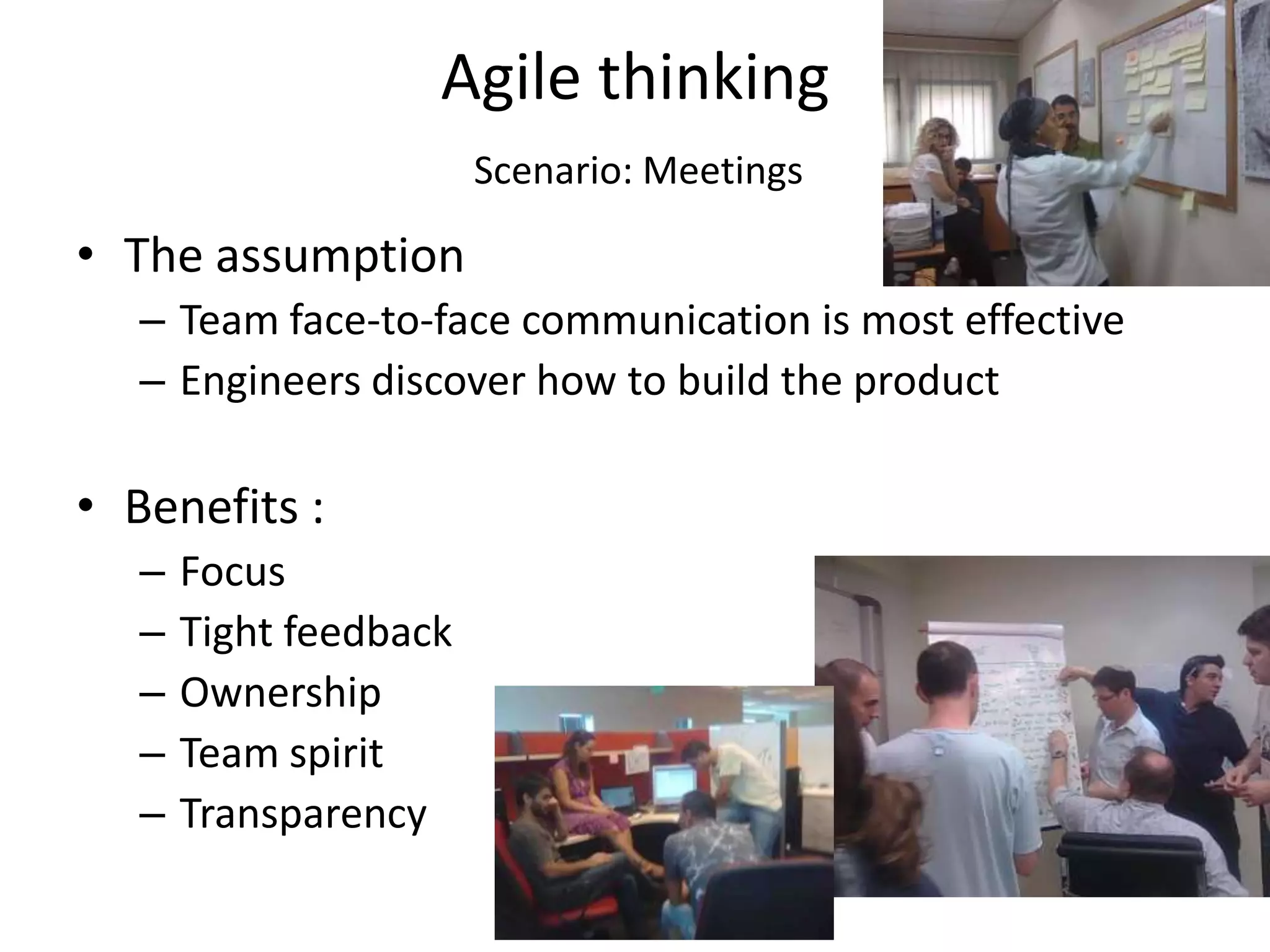
Agile thinking
                        Scenario: Meetings

• The assumption
   – Team face-to-face communication is most effective
   – Engineers discover how to build the product

• Benefits :
   –   Focus
   –   Tight feedback
   –   Ownership
   –   Team spirit
   –   Transparency
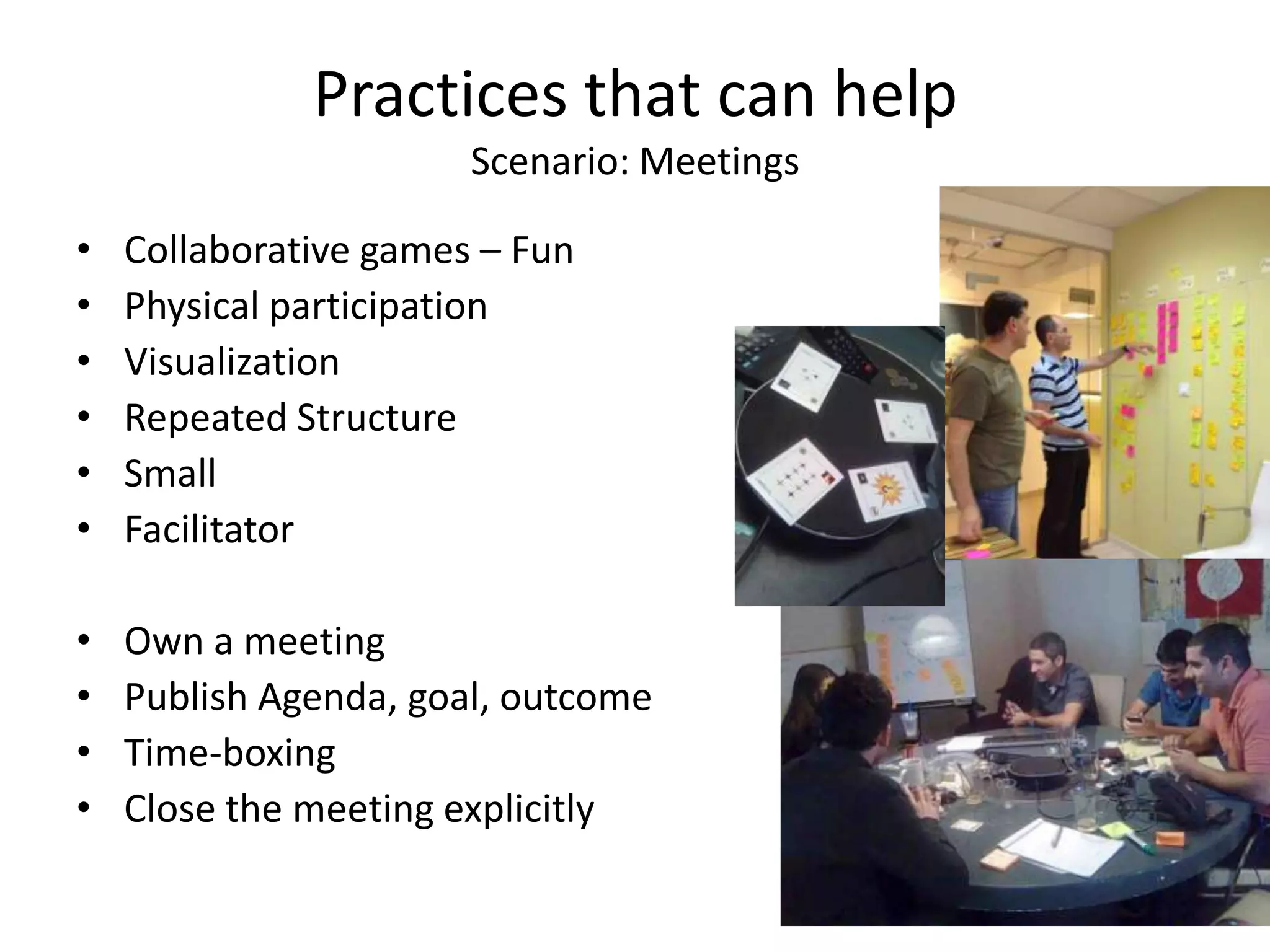
Practices that can help
                       Scenario: Meetings

•   Collaborative games – Fun
•   Physical participation
•   Visualization
•   Repeated Structure
•   Small
•   Facilitator

•   Own a meeting
•   Publish Agenda, goal, outcome
•   Time-boxing
•   Close the meeting explicitly
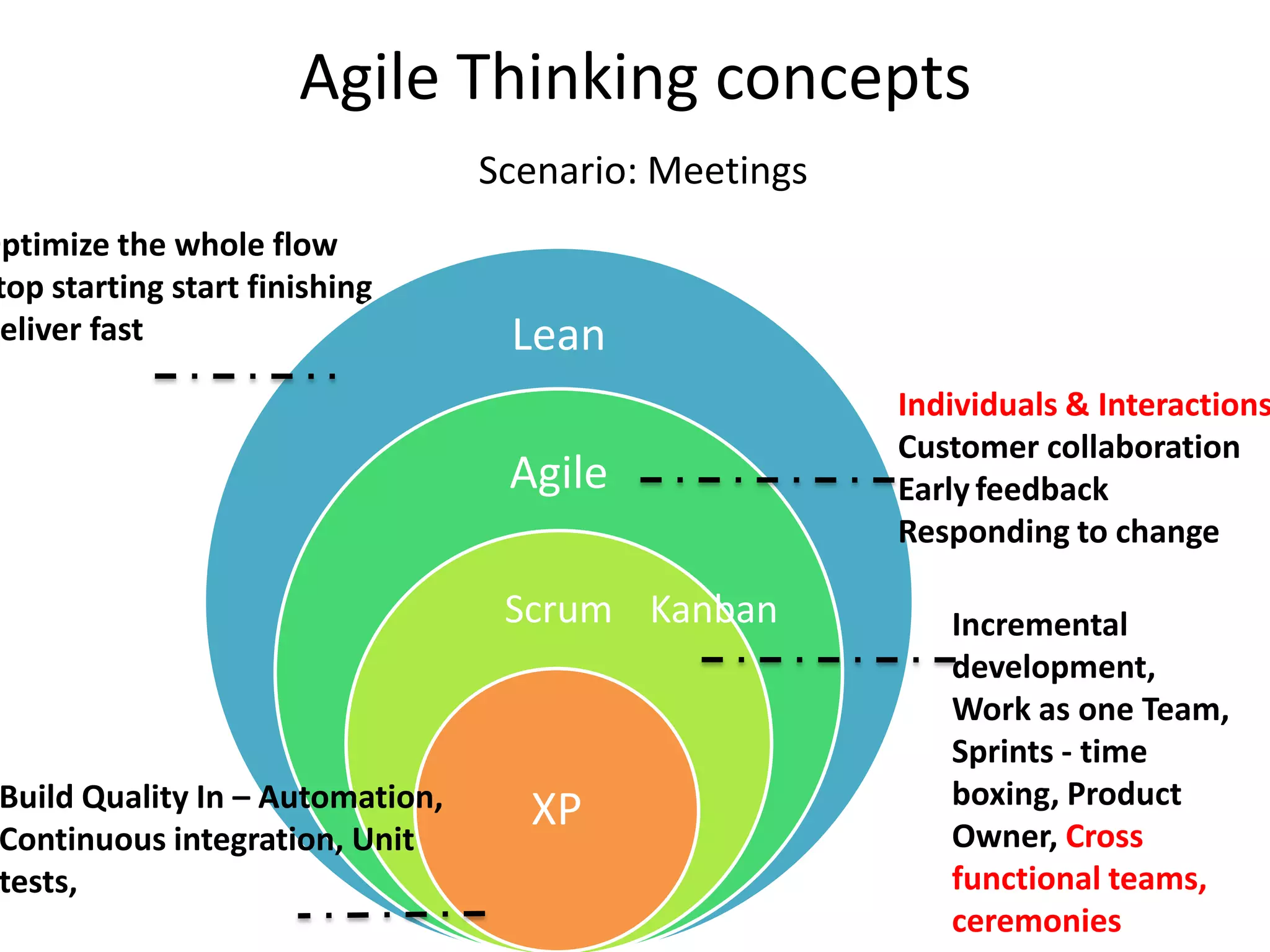
Agile Thinking concepts
                                  Scenario: Meetings
Optimize the whole flow
 top starting start finishing
 eliver fast                       Lean
                                                       Individuals & Interactions
                                                       Customer collaboration
                                   Agile               Early feedback
                                                       Responding to change

                                   Scrum Kanban           Incremental
                                                          development,
                                                          Work as one Team,
                                                          Sprints - time
 Build Quality In – Automation,                           boxing, Product
                                    XP                    Owner, Cross
 Continuous integration, Unit
 tests,                                                   functional teams,
                                                          ceremonies
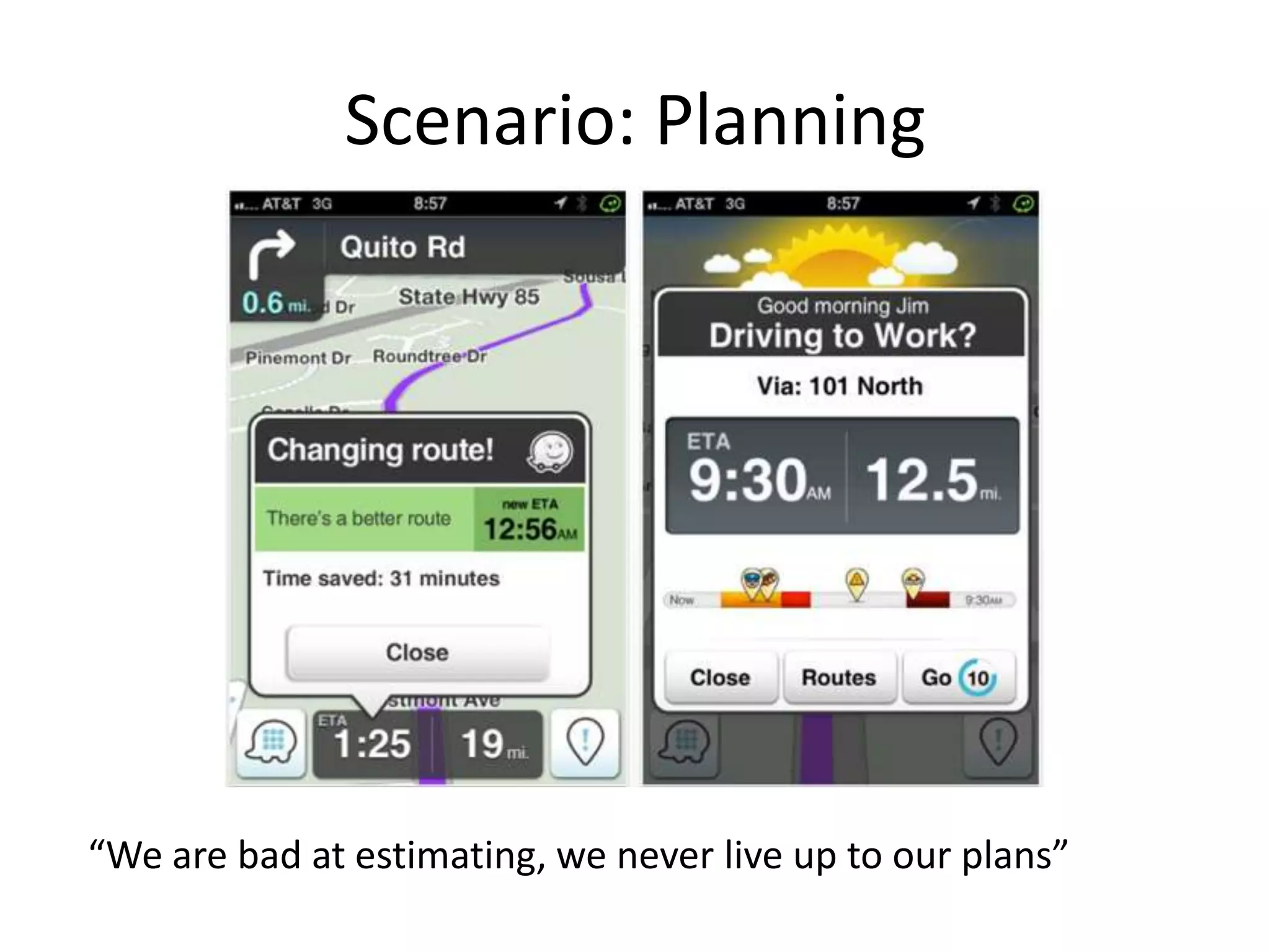
Scenario: Planning


“We are bad at estimating, we never live up to our plans”
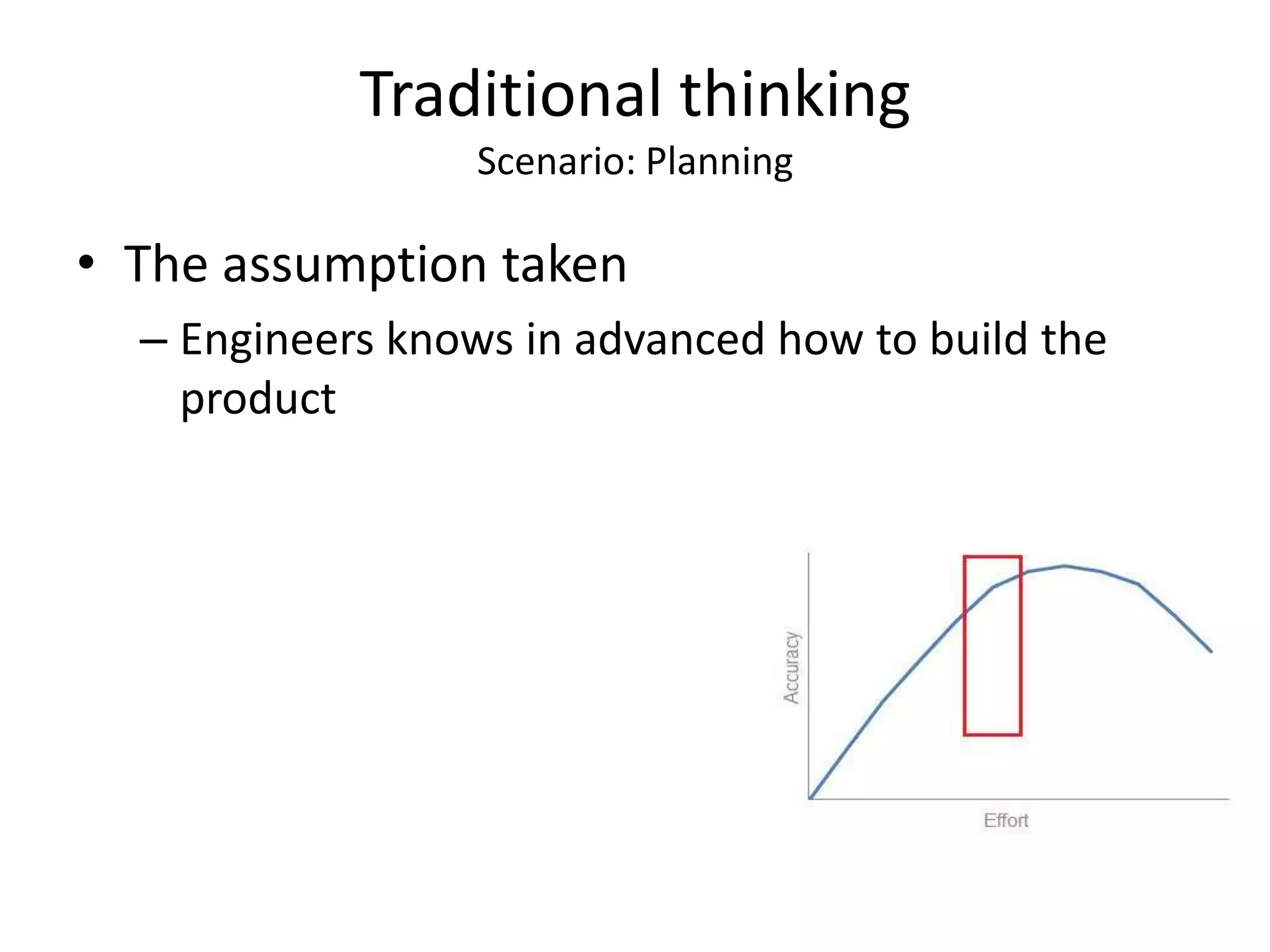
Traditional thinking
                  Scenario: Planning

• The assumption taken
  – Engineers knows in advanced how to build the
    product
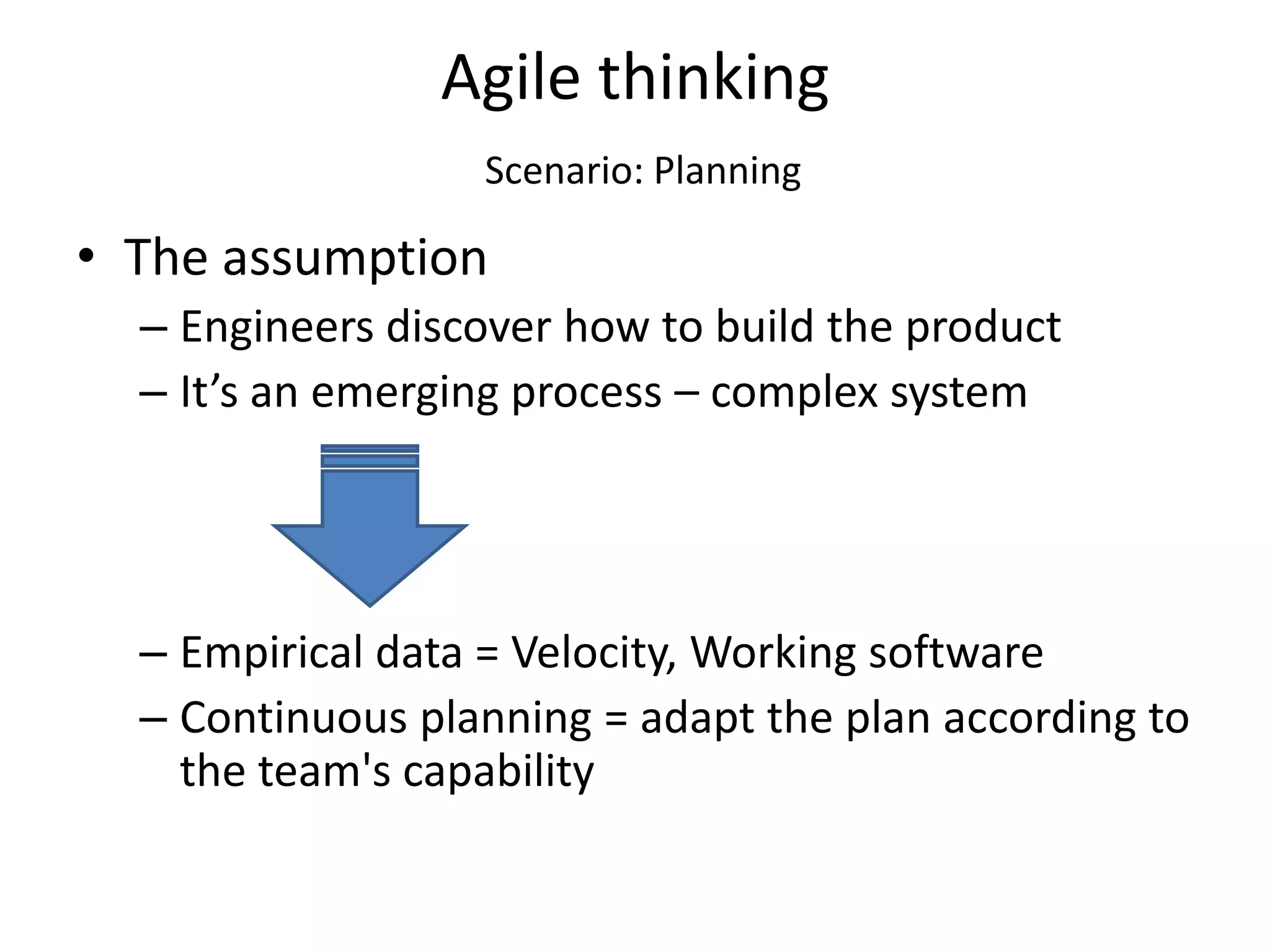
Agile thinking
                  Scenario: Planning

• The assumption
  – Engineers discover how to build the product
  – It’s an emerging process – complex system


  – Empirical data = Velocity, Working software
  – Continuous planning = adapt the plan according to
    the team's capability
Agile Thinking concepts
                                 Scenario: Scope driven
Optimize the whole flow
Stop starting start finishing
Deliver fast                        Lean                  Working software
                                                          Individuals & Interactions
                                                          Customer collaboration
                                    Agile                 Early feedback
                                                          Responding to change
                                    Scrum Kanban             Incremental
                                                             development,
                                                             Work as one Team,
                                                             Sprints - time
Build Quality In – Automation,                               boxing, Product
                                     XP                      Owner, Cross
Continuous integration, Unit
tests,                                                       functional teams,
                                                             ceremonies, PSP
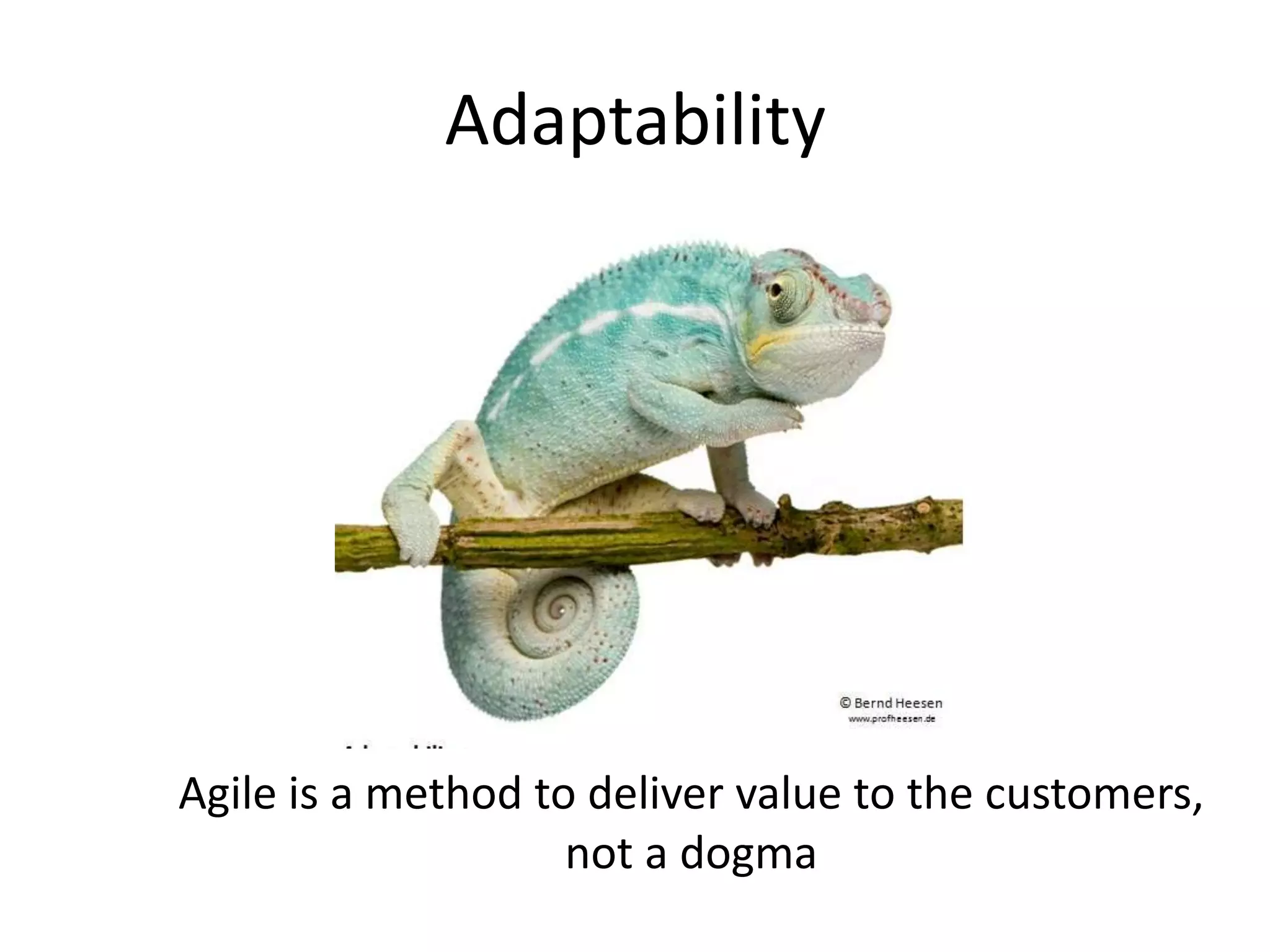
Adaptability


Agile is a method to deliver value to the customers,
                    not a dogma

Becoming Agile - Challenge the Traditional Thinking

  • 1.
    Challenging the traditional thinking AgilIL2012
  • 2.
    Yael Rabinovich Software industrysince 1998 Agile coach @ AgileSparks since 2009 Agile coach, AgileSparks Mail: Yael@Agilesparks.com
  • 3.
    Challenging the traditional thinking AgilIL2012
  • 4.
    Scenario: Retesting "Well, there'sno point in testing now, If the code changes, I'll just need to re-test all this stuff anyway. Call me when things stop changing."
  • 5.
    Traditional thinking Scenario: Retesting • What's the assumption taken? – Things will stop changing – Testing time = tests execution time – Testing role certifying the product is ready for delivery • The benefits – Test execution time potentially will be reduced – People motivation – Test coverage is easier to track
  • 6.
    Agile thinking Scenario: Retesting • The assumption – Things will keep changing – The role of the tester is Improving the quality of the product before it's complete • Benefits – Total delivery time potentially reduced – Fixes are simpler (risktime) – Tester role is more relied on and critical – leading role – Progress is more reliable – Increase in quality
  • 7.
    Agile thinking Scenario: Retesting • Potential challenges: – More testing time – Doing the same again and again – low motivation – Effort on automation
  • 8.
    Agile Thinking concepts Scenario: Retesting Optimize the whole flow Stop starting start finishing Lean Agile Early feedback Scrum Kanban Incremental development, Work as one Team, Build Quality In – Automation, Continuous XP integration, Unit tests
  • 9.
    Scenario: Utilization “Should Istart something new that is waiting for me ?”
  • 10.
    Traditional thinking Scenario: Utilization • The assumption taken – I’m measured as efficient by the pace I produce • The benefits: – People’s skills are highly utilized
  • 11.
    Agile thinking Scenario: Utilization • The assumption – Effectiveness is measured by the time it takes us to get things done – from concept to consumption – Optimize the whole vs. Local optimization – Work as one team Can I help directly? Do something in my domain that doesn’t create work down stream ?Or assist in making downstream faster ? Innovation ? Improvement backlog?
  • 12.
    Scenario: Scope Driven "Wemust include this new capability in this release, it’s strategic. It will result with postponing in 2 -3 months the release date"
  • 13.
    Traditional thinking Scenario: Scope Driven • What's the assumption taken? – Customer knows what they want • Potential problems: – You may loose the window of opportunity – Time expands - Student syndrome, Parkinson’s law – Your team will run out of energy – You end up with “scope creep”
  • 14.
    Agile thinking Scenario: Scope Driven • The assumption – Early feedback – Continuous short delivery cycles – Customers discover what they want • Benefits : – Incremental value & ROI – build customer trust – Easy to plan – Creates sense of urgency – 80/20 rule (less is more)
  • 15.
    Agile thinking Scenario: Scope Driven • Potential challenges: – Short term view – High investment in reduce cost of release – Late adapters “Timebox — don't scopebox” — Mary Poppendieck , Leading lean software development
  • 16.
    Agile Thinking concepts Scenario: Scope driven Optimize the whole flow Stop starting start finishing Lean Deliver fast Agile Customer collaboration Early feedback Responding to change Scrum Kanban Project management framework: Incremental Engineering Practices: Build development, XP Work as one Team, Quality In – Automation, Continuous integration, Unit Sprints - timeboxing, tests Product Owner
  • 17.
    Scenario: Meetings “All daywe are in endless meetings, there is no time to do real work”
  • 18.
    Traditional thinking Scenario: Meetings • The assumption taken? – Work is what we do out of the meetings (code, test…) – Machine model: Each part can be built separately and be assembled at the end • Potential problems: – More documentation – More Process
  • 19.
    Agile thinking Scenario: Meetings • The assumption – Team face-to-face communication is most effective – Engineers discover how to build the product • Benefits : – Focus – Tight feedback – Ownership – Team spirit – Transparency
  • 20.
    Practices that canhelp Scenario: Meetings • Collaborative games – Fun • Physical participation • Visualization • Repeated Structure • Small • Facilitator • Own a meeting • Publish Agenda, goal, outcome • Time-boxing • Close the meeting explicitly
  • 21.
    Agile Thinking concepts Scenario: Meetings Optimize the whole flow top starting start finishing eliver fast Lean Individuals & Interactions Customer collaboration Agile Early feedback Responding to change Scrum Kanban Incremental development, Work as one Team, Sprints - time Build Quality In – Automation, boxing, Product XP Owner, Cross Continuous integration, Unit tests, functional teams, ceremonies
  • 22.
    Scenario: Planning “We arebad at estimating, we never live up to our plans”
  • 23.
    Traditional thinking Scenario: Planning • The assumption taken – Engineers knows in advanced how to build the product
  • 24.
    Agile thinking Scenario: Planning • The assumption – Engineers discover how to build the product – It’s an emerging process – complex system – Empirical data = Velocity, Working software – Continuous planning = adapt the plan according to the team's capability
  • 25.
    Agile Thinking concepts Scenario: Scope driven Optimize the whole flow Stop starting start finishing Deliver fast Lean Working software Individuals & Interactions Customer collaboration Agile Early feedback Responding to change Scrum Kanban Incremental development, Work as one Team, Sprints - time Build Quality In – Automation, boxing, Product XP Owner, Cross Continuous integration, Unit tests, functional teams, ceremonies, PSP
  • 26.
    Adaptability Agile is amethod to deliver value to the customers, not a dogma

Editor's Notes

  • #2 http://www.slideshare.net/nur2008/think-for-yourself-12648908http://www.slideshare.net/jchyip/think-like-an-agilistאספתי מיקרים, דילמות שמבטאות את השינוי המחשבתי שנדרש לעשות על מנת להיות אגיליםאבל מזה בכלל להיות אגילים – מתבטא בתוצאות העיסקיות שאנחנו מצפים, תרבות שאנחנו מאמצים – השאיפה להיות בעלי יכולת תגובה מהירה ושיפור האפקטיביות שלנוחלק מהמקרים שנעבור עליהם הם דילמות שנוצרו עקב אימוץ של חלק מהשיטות והכלים האגילים והדגש יהיה על אופן המחשבה השונה בנוסף לכליםאני מתייחסת לפרוייקטי תוכנה
  • #4 http://www.slideshare.net/nur2008/think-for-yourself-12648908http://www.slideshare.net/jchyip/think-like-an-agilistאספתי מיקרים, דילמות שמבטאות את השינוי המחשבתי שנדרש לעשות על מנת להיות אגיליםאבל מזה בכלל להיות אגילים – מתבטא בתוצאות העיסקיות שאנחנו מצפים, תרבות שאנחנו מאמצים – השאיפה להיות בעלי יכולת תגובה מהירה ושיפור האפקטיביות שלנוחלק מהמקרים שנעבור עליהם הם דילמות שנוצרו עקב אימוץ של חלק מהשיטות והכלים האגילים והדגש יהיה על אופן המחשבה השונה בנוסף לכליםאני מתייחסת לפרוייקטי תוכנה
  • #5 image source: 6inchmove.comAnother option:
  • #6 Picture:car: http://www.alfaholics.com/our-cars/completed-builds/sprint-gt-shell-conversion-to-aluminium/ready-to-ship-home/
  • #11 http://blog.jentekk.com/2008/03/21/scope_creep_website_development_issues/
  • #12 Practice 80/20 rule. 80/20 rule refers to the phenomenon where 20% of causes lead to 80% of the results. Quit trying to be a perfectionist and focus on the 20% of the things that matter. Read my 3-part series on 80/20 Principlefor more on 80/20 rule and how to implement it in your life.Time box. Set aside a fixed time slot to work on your tasks. You must work on that task and only that task during that time slot, no more, no less. (Hence the term, time ‘box’, since the task is boxed within the time). Most people set aside a time to work on a task and continue working on it till they are done, even if it means exceeding the time. Because of that, they develop the mentality that it’s okay not to finish a task within the allotted time slot since there’s time later to do it. This decreases their productivity. With time boxing, the non-negotiable cut-off timing makes you more productive.Picture:http://personalexcellence.co/blog/boost-your-productivity-in-50-ways/
  • #14 http://blog.jentekk.com/2008/03/21/scope_creep_website_development_issues/תמונה:http://read-and-written.blogspot.co.il/2011/12/time-expands.html
  • #15 Practice 80/20 rule. 80/20 rule refers to the phenomenon where 20% of causes lead to 80% of the results. Quit trying to be a perfectionist and focus on the 20% of the things that matter. Read my 3-part series on 80/20 Principlefor more on 80/20 rule and how to implement it in your life.Time box. Set aside a fixed time slot to work on your tasks. You must work on that task and only that task during that time slot, no more, no less. (Hence the term, time ‘box’, since the task is boxed within the time). Most people set aside a time to work on a task and continue working on it till they are done, even if it means exceeding the time. Because of that, they develop the mentality that it’s okay not to finish a task within the allotted time slot since there’s time later to do it. This decreases their productivity. With time boxing, the non-negotiable cut-off timing makes you more productive.Picture:http://personalexcellence.co/blog/boost-your-productivity-in-50-ways/דוגמאות:טועמים גלידה לפני שקונים
  • #16 Practice 80/20 rule. 80/20 rule refers to the phenomenon where 20% of causes lead to 80% of the results. Quit trying to be a perfectionist and focus on the 20% of the things that matter. Read my 3-part series on 80/20 Principlefor more on 80/20 rule and how to implement it in your life.Time box. Set aside a fixed time slot to work on your tasks. You must work on that task and only that task during that time slot, no more, no less. (Hence the term, time ‘box’, since the task is boxed within the time). Most people set aside a time to work on a task and continue working on it till they are done, even if it means exceeding the time. Because of that, they develop the mentality that it’s okay not to finish a task within the allotted time slot since there’s time later to do it. This decreases their productivity. With time boxing, the non-negotiable cut-off timing makes you more productive.Picture:http://personalexcellence.co/blog/boost-your-productivity-in-50-ways/
  • #19 http://blog.jentekk.com/2008/03/21/scope_creep_website_development_issues/
  • #20 Practice 80/20 rule. 80/20 rule refers to the phenomenon where 20% of causes lead to 80% of the results. Quit trying to be a perfectionist and focus on the 20% of the things that matter. Read my 3-part series on 80/20 Principlefor more on 80/20 rule and how to implement it in your life.Time box. Set aside a fixed time slot to work on your tasks. You must work on that task and only that task during that time slot, no more, no less. (Hence the term, time ‘box’, since the task is boxed within the time). Most people set aside a time to work on a task and continue working on it till they are done, even if it means exceeding the time. Because of that, they develop the mentality that it’s okay not to finish a task within the allotted time slot since there’s time later to do it. This decreases their productivity. With time boxing, the non-negotiable cut-off timing makes you more productive.Picture:http://personalexcellence.co/blog/boost-your-productivity-in-50-ways/
  • #24 http://blog.jentekk.com/2008/03/21/scope_creep_website_development_issues/
  • #27 http://notbuyinganything.blogspot.co.il/2011/02/human-species-is-wonderfully-adaptable.html תמונה