Spanish Colonization in the
Philippines
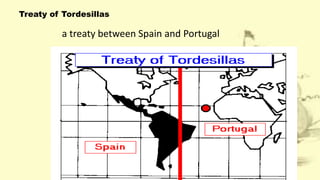
Treaty of Tordesillas
a treaty between Spain and Portugal
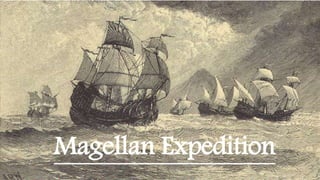
Magellan Expedition
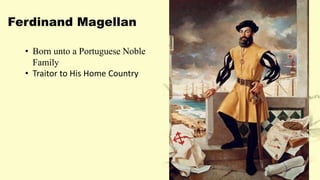
Ferdinand Magellan
• Born unto a Portuguese Noble
Family
• Traitor to His Home Country
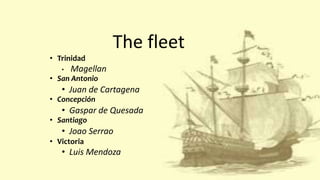
The fleet
• Trinidad
• Magellan
• San Antonio
• Juan de Cartagena
• Concepción
• Gaspar de Quesada
• Santiago
• Joao Serrao
• Victoria
• Luis Mendoza
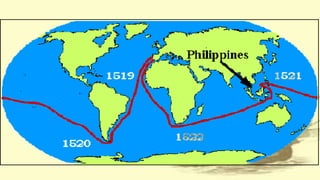
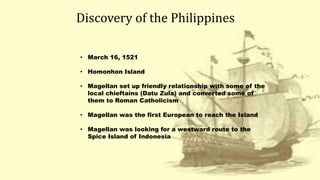
Discovery of the Philippines
• March 16, 1521
• Homonhon Island
• Magellan set up friendly relationship with some of the
local chieftains (Datu Zula) and converted some of
them to Roman Catholicism
• Magellan was the first European to reach the Island
• Magellan was looking for a westward route to the
Spice Island of Indonesia
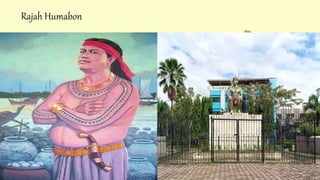
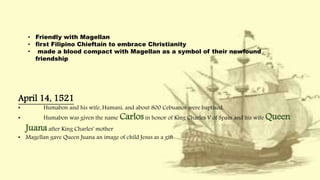
Rajah Humabon
• Friendly with Magellan
• first Filipino Chieftain to embrace Christianity
• made a blood compact with Magellan as a symbol of their newfound
friendship
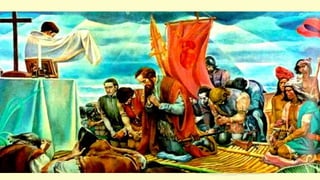
April 14, 1521
• Humabon and his wife, Humani, and about 800 Cebuanos were baptized.
• Humabon was given the name Carlosin honor of King Charles V of Spain and his wife Queen
Juanaafter King Charles' mother
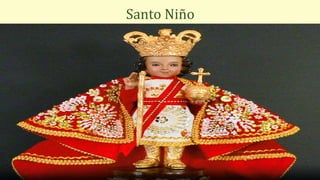
• Magellan gave Queen Juana an image of child Jesus as a gift
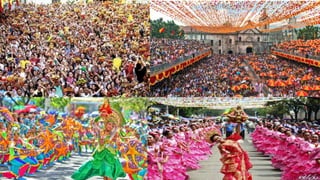
Santo Niño
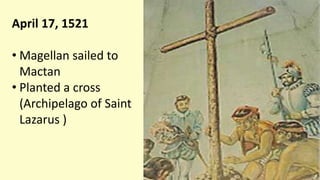
April 17, 1521
• Magellan sailed to
Mactan
• Planted a cross
(Archipelago of Saint
Lazarus )
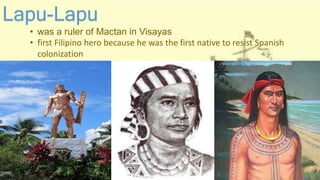
Lapu-Lapu
• was a ruler of Mactan in Visayas
• first Filipino hero because he was the first native to resist Spanish
colonization
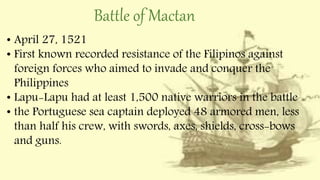
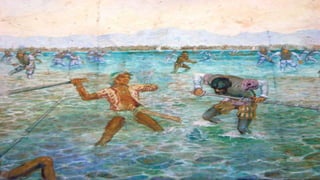
Battle of Mactan
• April 27, 1521
• First known recorded resistance of the Filipinos against
foreign forces who aimed to invade and conquer the
Philippines
• Lapu-Lapu had at least 1,500 native warriors in the battle
• the Portuguese sea captain deployed 48 armored men, less
than half his crew, with swords, axes, shields, cross-bows
and guns.
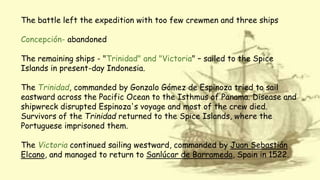
The battle left the expedition with too few crewmen and three ships
Concepción- abandoned
The remaining ships - "Trinidad" and "Victoria" – sailed to the Spice
Islands in present-day Indonesia.
The Trinidad, commanded by Gonzalo Gómez de Espinoza tried to sail
eastward across the Pacific Ocean to the Isthmus of Panama. Disease and
shipwreck disrupted Espinoza's voyage and most of the crew died.
Survivors of the Trinidad returned to the Spice Islands, where the
Portuguese imprisoned them.
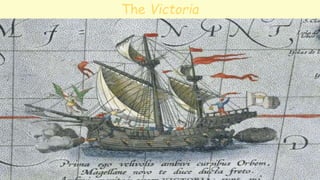
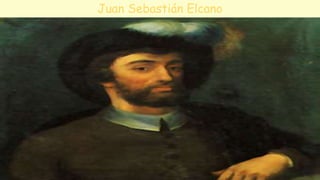
The Victoria continued sailing westward, commanded by Juan Sebastián
Elcano, and managed to return to Sanlúcar de Barrameda, Spain in 1522.
The Victoria
Juan Sebastián Elcano
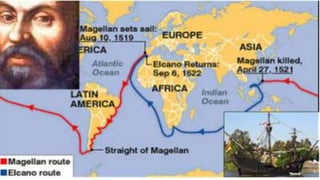
Magellan expedition was considered historic
because it marked the first circumnavigation of
the globe and proved that the world was round .
Other expeditions
Garcia Jofre Loaisa (1525)
Sebastian Cabot (1526)
Alvaro de Saavedra (1527)
Ruy Lopez de Villalobos (1524)
Miguel Lopez de Legazpi (1564)
Villalobos Expedition
Ruy Lopez de Villalobos
• November 1, 1542, followed the route of Magellan
• Mindanao, February 1543
• He established a colony in Saranggani
• Bernardo de la Torre, was sent to get some food
• Villalobos in his happiness, named the Samar and Leyte Felipinas
(King Philip II)
• Villalobos sailed for Moluccas but was captured by the Portuguese
Legazpi Expedition
Miguel Lopez de Legazpi
• accompanied by Andres de Urdaneta
• Sailed from Mexican port of Navidad on November 21,
1564, 4 ships and about 380 men
• Reached Cebu on February 1565, after short struggle with
the natives he proceed to Leyte and then Bohol
April 27, 1565
• Returned to Cebu and invited the natives to come down from the
mountain
• Si Makyo and Si Katapan
Agreement
1. The Filipinos promised to be loyal to the King of Spain and to the Spaniards
2. The Filipinos promised to help the Spaniards in any battle against the enemy; in
return, the Spaniards promised to protect the Filipinos from all enemies
3. A Filipino who had committed a crime against a Spaniard shall be turned over to
the Spanish authorities, while a Spaniards who had committed a crime against
Filipino shall be turned over to the Filipino chieftains
4. Goods to be sold to either the Spaniards or the Filipinos shall be priced
moderately
5. An Armed Filipino shall not allowed to enter the Spanish settlement
The Settlement in Panay
• Some of his own men refused to work
• Others also robbed the graves of the Filipinos
• There was also a conspiracy among the Spanish soldiers to
seize the ship of San Pablo
• Legazpi also faced with the hostility of Portuguese, Gonzalo
de Pereira
Panay
• 1569
• Second Spanish settlement
• Legazpi won over the people of Panay by telling them of his peaceful
intentions
• The Spanish missionaries, the Augustinian friars, converted some natives to
Christianity.
The First Spanish Voyage to Manila
• Legazpi decided to Spread Spanish rule to other islands of Archipelago
• Small expeditions were sent
• Masbate, Burias and Ticao were claimed in the name of the King of
Spain
• Captain Enriquez de Guzman, Albay
• Juan de Salcedo, few Spanish soldiers and 500 Bisayans
Ilim Island
Lubang Island
He returned to Panay after reaching the outer rim of Manila
Bay, reported that Manila was a prosperous Muslim Kingdom
May 8,1570
• Martin de Goiti
• Manila was ruled by Raja Sulayman
Legazpi was happy to hear from Goiti news about the Manila.
Legazpi became the first Governor-General
Father Diego de Herrera, an Augustinian friar, suggested that they settle in Manila
June 24, 1571- Legazpi made the Manila the capital of the Philippines.
Legazpi appointed two alcaldes, an alguacil mayor, twelve regidores, and one
escibano.
With the foundation of Manila as the capital of the Philippines, the foundation of
the Spanish colonial empire in the Orient was said to have been laid.
Founding of Manila
Expeditions to other Parts of Luzon
 Goiti – central Luzon as far as Pangasinan
 Juan de Salcedo – south of Manila
 Conquered Taytay, Cainta and other towns of what is now Rizal Province
 1572, he went to northern Luzon and defeated the Filipinos in Zambales, Pangasinan, and
the Ilocos region.
 In what is now Vigan, he founded the town of Villa Fernandina in honor of Prince Fernando,
the first born son of King Philip II
 From the Ilocos, he proceeded to the north-eastern coast of Luzon, marched along the Pacific
coast of what is now Quezon province, sailed to Polillo Island, back to the shore of Luzon,
and from here returned to Manila over trails, hills and mountains.
 Tragedy greeted him in Manila because he was informed that Legazpi died on August 20,
1572.
Foundations of Spanish Rule
National Government
 Headed by Governor-General
 Head of the Supreme court
 He possessed vast executive, legislative and judicial
 Commander-in-chief of the army and navy
 Economic planner of the country
 Member of audiencia
The Audiencia
Established on 1584 in order to give justice to the
aggrieved people in the colony
Governor Santiago de Vera
Highest court insofar as civil and criminal cases were
concerned
Also audited the finances of the government
Local Government
 Provinces which were already peaceful and recognizing the authority of
Spain were governed by civil provincial governors
 Those not yet fully pacified and conquered were ruled by military officers
Alcalde Mayor
• His salary was small but he could collect a part of the tributes to increase his
income
• Indulto di commercio
• Abolished on 1844
Municipal Government
o Headed by Gobernadorcillo or capitan municipal or simply capitan
o 13 electors who were prominent in the town
o 6 of these electors were former cabezas de barangay
o 6 were actual cabeza de barangays
o 13th elector was the outgoing capitan
Cabeza
o Each barrio or barangay of the town was headed by a cabeza who did not
receive any salary
o Given a part of the taxes collected in his barrio
o Considered member of the principalia or the aristocracy
The Residencia and Visita
To stop the abuses of high Spanish officials in the
colonies
Residencia
* public investigation
* trial of outgoing colonial officials in order to ascertain whether they had
committed abuses in the performance of their duties
* the procedure was for the incoming governor-general to conduct the
investigation and trial of his predecessor and other officials of the government
* result of the investigation and trial was sent to Spain for final decision
Vista
Secret investigation of an official’s acts as a public servant whose
purpose was to make him work honestly and efficiently as he was
expected to do
Forced Labor
The Spanish officials in the Philippines compelled the Filipinos to
work in the construction of churches, roads, bridges, ships and in
the hauling and timber-cutting industries.
Polo y Sevicio
1. That Filipinos to be drafted for work must be paid for their work
2. That Filipino labourers should not be made to work in distant places where
they could not return to their families
3. That the drafting of labourers should not coincide with the planting and
harvest seasons
4. That physically incapable men should not be overworked
5. That forced labor should be resorted to only in a clear case of absolute
necessity
6. That the number of laborers drafted should be diminished as soon as laborers
from other countries (probably referring to Chinese) had volunteered to
work
The Encomienda
• Distribution of lands to loyal Spanish subjects
• These men had helped conquer the Philippines
• The encomienda was actually not a land, but a favour from the King under which
the Spaniard receiving the favour was given the right to collect tributes or taxes
from the inhabitants of an area assigned to him
• The man who received this favour is called encomiendero
Three kinds of Encomiendas
1.Royal Encomienda
2.Ecclesiastical Encomienda
3.Private Encomienda
The encomienderos were required by law to perform the following duties:
1. to give protection to the natives
2. to help the missionaries convert the natives to Christianity
3. to promote education
Abuses:
1.Brutal treatment of the Filipinos
2.Collecting more tribute than that authorized by law
3.Forcing the people to work for them
4.Seizure of the people’s animals and crops without just
compensation
The Tribute
• Filipinos were compelled to pay tribute to the Spanish colonial government
• It is a form of recognition of the Filipino’s loyalty to the King of Spain
• It was introduced on 1570, the tribute was small
• Above sixteen years and below sixty
• In 1589, the tribute increased which a small part of it went to the Church,
sanctorum
• The tribute was abolished on 1884 and the cedula persona was introduced.
Taxes
• Diezmos prediales-consisted of one-tenth of the produce of the land
• Donativo de Zamboanga- introduced in 1635, tax specifically used for
the conquest of Jolo.
• Vinta- tax paid by the people of some provinces along the coast of
western Luzon for the defense of the coasts from Muslim
The Galleon Trade
• The Manila-Acapulco Trade
• Main source of income for the colony during the early years
• The Galleon trade brought silver from New Spain, which was used to purchase Asian goods such
as silk from China, spices from the Moluccas, lacquerware from Japan and Philippine cotton
textiles
• Government monopoly
• Only two Galleons were used:
• One sailed from Acapulco to Manila with some 500,000 pesos worth of goods, spending 120
days at sea
• the other sailed from Manila to Acapulco with some 250,000 pesos worth of goods spending
90 days at sea
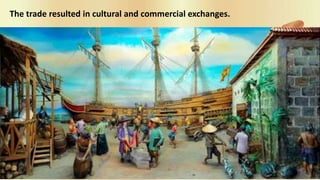
The trade resulted in cultural and commercial exchanges.
Carlos Maria de la Torre
• Sent to Philippines on 1869
• Most liberal and most loved governor-general of the Philippines
• Encouraged freedom of speech and abolished censorship of the press
• Abolished flogging and substituted imprisonment as punishment for desertion
among native soldiers and proved his benevolence by subduing an agrarian
uprising and pardoning the rebels
• Regime was short-lived
Rafael de Izquierdo
• 1871 to 1873
• “with a crucifix in one hand, and a sword on the other”
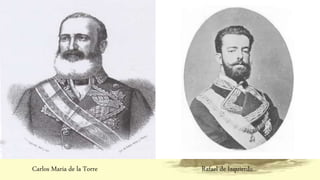
Carlos Maria de la Torre Rafael de Izquierdo
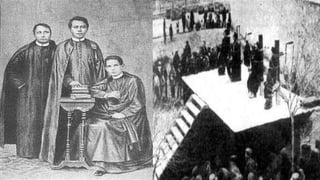
• January 20, 1872, a group of native artillery men,
marines, soldiers and workers in the arsenal of
Cavite, led by Sergeant La Madrid, seized the
nearby fort of San Felipe.
• The leaders were shot and the rest were taken
prisoners
• January 21
• Jose Burgos
• Mariano Gomez
Resistance Against Spanish Rule
Cavite Mutiny
The Campaign for Reforms
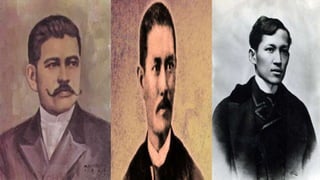
The Great Triumvirate
Graciano Lopez Jaena
Jose Rizal
Marcelo H del Pilar
Graciano Lopez Jaena
founded La Solidaridad
first editor
Jose Rizal
Noli Me Tangere (Touch me not)
exposed the defects of the Spanish administration of the Philippines, the greed and the
immortality of the friars, and the superstitions of the Filipinos
El Filibusterismo (The Rebel)
expressed the political ideas and in the story form, predicted the coming
of the revolution
Marcelo H Del Pilar
Diariong Tagalog
published suggestions on how to improve the administration of the
country
Katipunan Revolution
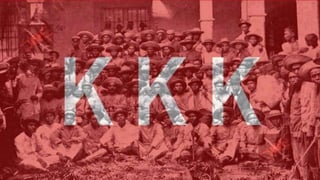
Andres Bonifacio
July 7, 1892
Kataas-taasang, Kagalang-galangang Katipunan
ng mga Anak ang Bayan
Organization fighting for independence from Spain
Thank You! 
Aesha Farhani U. Aguam

Spanish colonization

  • 1.
    Spanish Colonization inthe Philippines
  • 2.
    Treaty of Tordesillas atreaty between Spain and Portugal
  • 3.
  • 4.
    Ferdinand Magellan • Bornunto a Portuguese Noble Family • Traitor to His Home Country
  • 6.
    The fleet • Trinidad •Magellan • San Antonio • Juan de Cartagena • Concepción • Gaspar de Quesada • Santiago • Joao Serrao • Victoria • Luis Mendoza
  • 7.
    Discovery of thePhilippines • March 16, 1521 • Homonhon Island • Magellan set up friendly relationship with some of the local chieftains (Datu Zula) and converted some of them to Roman Catholicism • Magellan was the first European to reach the Island • Magellan was looking for a westward route to the Spice Island of Indonesia
  • 8.
  • 9.
    • Friendly withMagellan • first Filipino Chieftain to embrace Christianity • made a blood compact with Magellan as a symbol of their newfound friendship April 14, 1521 • Humabon and his wife, Humani, and about 800 Cebuanos were baptized. • Humabon was given the name Carlosin honor of King Charles V of Spain and his wife Queen Juanaafter King Charles' mother • Magellan gave Queen Juana an image of child Jesus as a gift
  • 11.
  • 13.
    April 17, 1521 •Magellan sailed to Mactan • Planted a cross (Archipelago of Saint Lazarus )
  • 14.
    Lapu-Lapu • was aruler of Mactan in Visayas • first Filipino hero because he was the first native to resist Spanish colonization
  • 15.
    Battle of Mactan •April 27, 1521 • First known recorded resistance of the Filipinos against foreign forces who aimed to invade and conquer the Philippines • Lapu-Lapu had at least 1,500 native warriors in the battle • the Portuguese sea captain deployed 48 armored men, less than half his crew, with swords, axes, shields, cross-bows and guns.
  • 17.
    The battle leftthe expedition with too few crewmen and three ships Concepción- abandoned The remaining ships - "Trinidad" and "Victoria" – sailed to the Spice Islands in present-day Indonesia. The Trinidad, commanded by Gonzalo Gómez de Espinoza tried to sail eastward across the Pacific Ocean to the Isthmus of Panama. Disease and shipwreck disrupted Espinoza's voyage and most of the crew died. Survivors of the Trinidad returned to the Spice Islands, where the Portuguese imprisoned them. The Victoria continued sailing westward, commanded by Juan Sebastián Elcano, and managed to return to Sanlúcar de Barrameda, Spain in 1522.
  • 18.
  • 19.
  • 21.
    Magellan expedition wasconsidered historic because it marked the first circumnavigation of the globe and proved that the world was round .
  • 22.
    Other expeditions Garcia JofreLoaisa (1525) Sebastian Cabot (1526) Alvaro de Saavedra (1527) Ruy Lopez de Villalobos (1524) Miguel Lopez de Legazpi (1564)
  • 23.
    Villalobos Expedition Ruy Lopezde Villalobos • November 1, 1542, followed the route of Magellan • Mindanao, February 1543 • He established a colony in Saranggani • Bernardo de la Torre, was sent to get some food • Villalobos in his happiness, named the Samar and Leyte Felipinas (King Philip II) • Villalobos sailed for Moluccas but was captured by the Portuguese
  • 24.
    Legazpi Expedition Miguel Lopezde Legazpi • accompanied by Andres de Urdaneta • Sailed from Mexican port of Navidad on November 21, 1564, 4 ships and about 380 men • Reached Cebu on February 1565, after short struggle with the natives he proceed to Leyte and then Bohol
  • 25.
    April 27, 1565 •Returned to Cebu and invited the natives to come down from the mountain • Si Makyo and Si Katapan Agreement 1. The Filipinos promised to be loyal to the King of Spain and to the Spaniards 2. The Filipinos promised to help the Spaniards in any battle against the enemy; in return, the Spaniards promised to protect the Filipinos from all enemies 3. A Filipino who had committed a crime against a Spaniard shall be turned over to the Spanish authorities, while a Spaniards who had committed a crime against Filipino shall be turned over to the Filipino chieftains 4. Goods to be sold to either the Spaniards or the Filipinos shall be priced moderately 5. An Armed Filipino shall not allowed to enter the Spanish settlement
  • 26.
    The Settlement inPanay • Some of his own men refused to work • Others also robbed the graves of the Filipinos • There was also a conspiracy among the Spanish soldiers to seize the ship of San Pablo • Legazpi also faced with the hostility of Portuguese, Gonzalo de Pereira Panay • 1569 • Second Spanish settlement • Legazpi won over the people of Panay by telling them of his peaceful intentions • The Spanish missionaries, the Augustinian friars, converted some natives to Christianity.
  • 27.
    The First SpanishVoyage to Manila • Legazpi decided to Spread Spanish rule to other islands of Archipelago • Small expeditions were sent • Masbate, Burias and Ticao were claimed in the name of the King of Spain • Captain Enriquez de Guzman, Albay • Juan de Salcedo, few Spanish soldiers and 500 Bisayans Ilim Island Lubang Island He returned to Panay after reaching the outer rim of Manila Bay, reported that Manila was a prosperous Muslim Kingdom
  • 28.
    May 8,1570 • Martinde Goiti • Manila was ruled by Raja Sulayman Legazpi was happy to hear from Goiti news about the Manila. Legazpi became the first Governor-General Father Diego de Herrera, an Augustinian friar, suggested that they settle in Manila June 24, 1571- Legazpi made the Manila the capital of the Philippines. Legazpi appointed two alcaldes, an alguacil mayor, twelve regidores, and one escibano. With the foundation of Manila as the capital of the Philippines, the foundation of the Spanish colonial empire in the Orient was said to have been laid. Founding of Manila
  • 29.
    Expeditions to otherParts of Luzon  Goiti – central Luzon as far as Pangasinan  Juan de Salcedo – south of Manila  Conquered Taytay, Cainta and other towns of what is now Rizal Province  1572, he went to northern Luzon and defeated the Filipinos in Zambales, Pangasinan, and the Ilocos region.  In what is now Vigan, he founded the town of Villa Fernandina in honor of Prince Fernando, the first born son of King Philip II  From the Ilocos, he proceeded to the north-eastern coast of Luzon, marched along the Pacific coast of what is now Quezon province, sailed to Polillo Island, back to the shore of Luzon, and from here returned to Manila over trails, hills and mountains.  Tragedy greeted him in Manila because he was informed that Legazpi died on August 20, 1572.
  • 30.
    Foundations of SpanishRule National Government  Headed by Governor-General  Head of the Supreme court  He possessed vast executive, legislative and judicial  Commander-in-chief of the army and navy  Economic planner of the country  Member of audiencia
  • 31.
    The Audiencia Established on1584 in order to give justice to the aggrieved people in the colony Governor Santiago de Vera Highest court insofar as civil and criminal cases were concerned Also audited the finances of the government
  • 32.
    Local Government  Provinceswhich were already peaceful and recognizing the authority of Spain were governed by civil provincial governors  Those not yet fully pacified and conquered were ruled by military officers Alcalde Mayor • His salary was small but he could collect a part of the tributes to increase his income • Indulto di commercio • Abolished on 1844
  • 33.
    Municipal Government o Headedby Gobernadorcillo or capitan municipal or simply capitan o 13 electors who were prominent in the town o 6 of these electors were former cabezas de barangay o 6 were actual cabeza de barangays o 13th elector was the outgoing capitan Cabeza o Each barrio or barangay of the town was headed by a cabeza who did not receive any salary o Given a part of the taxes collected in his barrio o Considered member of the principalia or the aristocracy
  • 34.
    The Residencia andVisita To stop the abuses of high Spanish officials in the colonies Residencia * public investigation * trial of outgoing colonial officials in order to ascertain whether they had committed abuses in the performance of their duties * the procedure was for the incoming governor-general to conduct the investigation and trial of his predecessor and other officials of the government * result of the investigation and trial was sent to Spain for final decision
  • 35.
    Vista Secret investigation ofan official’s acts as a public servant whose purpose was to make him work honestly and efficiently as he was expected to do Forced Labor The Spanish officials in the Philippines compelled the Filipinos to work in the construction of churches, roads, bridges, ships and in the hauling and timber-cutting industries.
  • 36.
    Polo y Sevicio 1.That Filipinos to be drafted for work must be paid for their work 2. That Filipino labourers should not be made to work in distant places where they could not return to their families 3. That the drafting of labourers should not coincide with the planting and harvest seasons 4. That physically incapable men should not be overworked 5. That forced labor should be resorted to only in a clear case of absolute necessity 6. That the number of laborers drafted should be diminished as soon as laborers from other countries (probably referring to Chinese) had volunteered to work
  • 37.
    The Encomienda • Distributionof lands to loyal Spanish subjects • These men had helped conquer the Philippines • The encomienda was actually not a land, but a favour from the King under which the Spaniard receiving the favour was given the right to collect tributes or taxes from the inhabitants of an area assigned to him • The man who received this favour is called encomiendero Three kinds of Encomiendas 1.Royal Encomienda 2.Ecclesiastical Encomienda 3.Private Encomienda
  • 38.
    The encomienderos wererequired by law to perform the following duties: 1. to give protection to the natives 2. to help the missionaries convert the natives to Christianity 3. to promote education Abuses: 1.Brutal treatment of the Filipinos 2.Collecting more tribute than that authorized by law 3.Forcing the people to work for them 4.Seizure of the people’s animals and crops without just compensation
  • 39.
    The Tribute • Filipinoswere compelled to pay tribute to the Spanish colonial government • It is a form of recognition of the Filipino’s loyalty to the King of Spain • It was introduced on 1570, the tribute was small • Above sixteen years and below sixty • In 1589, the tribute increased which a small part of it went to the Church, sanctorum • The tribute was abolished on 1884 and the cedula persona was introduced. Taxes • Diezmos prediales-consisted of one-tenth of the produce of the land • Donativo de Zamboanga- introduced in 1635, tax specifically used for the conquest of Jolo. • Vinta- tax paid by the people of some provinces along the coast of western Luzon for the defense of the coasts from Muslim
  • 40.
    The Galleon Trade •The Manila-Acapulco Trade • Main source of income for the colony during the early years • The Galleon trade brought silver from New Spain, which was used to purchase Asian goods such as silk from China, spices from the Moluccas, lacquerware from Japan and Philippine cotton textiles • Government monopoly • Only two Galleons were used: • One sailed from Acapulco to Manila with some 500,000 pesos worth of goods, spending 120 days at sea • the other sailed from Manila to Acapulco with some 250,000 pesos worth of goods spending 90 days at sea
  • 41.
    The trade resultedin cultural and commercial exchanges.
  • 42.
    Carlos Maria dela Torre • Sent to Philippines on 1869 • Most liberal and most loved governor-general of the Philippines • Encouraged freedom of speech and abolished censorship of the press • Abolished flogging and substituted imprisonment as punishment for desertion among native soldiers and proved his benevolence by subduing an agrarian uprising and pardoning the rebels • Regime was short-lived Rafael de Izquierdo • 1871 to 1873 • “with a crucifix in one hand, and a sword on the other”
  • 43.
    Carlos Maria dela Torre Rafael de Izquierdo
  • 44.
    • January 20,1872, a group of native artillery men, marines, soldiers and workers in the arsenal of Cavite, led by Sergeant La Madrid, seized the nearby fort of San Felipe. • The leaders were shot and the rest were taken prisoners • January 21 • Jose Burgos • Mariano Gomez Resistance Against Spanish Rule Cavite Mutiny
  • 47.
    The Campaign forReforms The Great Triumvirate Graciano Lopez Jaena Jose Rizal Marcelo H del Pilar
  • 49.
    Graciano Lopez Jaena foundedLa Solidaridad first editor Jose Rizal Noli Me Tangere (Touch me not) exposed the defects of the Spanish administration of the Philippines, the greed and the immortality of the friars, and the superstitions of the Filipinos El Filibusterismo (The Rebel) expressed the political ideas and in the story form, predicted the coming of the revolution Marcelo H Del Pilar Diariong Tagalog published suggestions on how to improve the administration of the country
  • 50.
    Katipunan Revolution Andres Bonifacio July7, 1892 Kataas-taasang, Kagalang-galangang Katipunan ng mga Anak ang Bayan Organization fighting for independence from Spain
  • 52.
    Thank You!  AeshaFarhani U. Aguam