FUNCTIONS
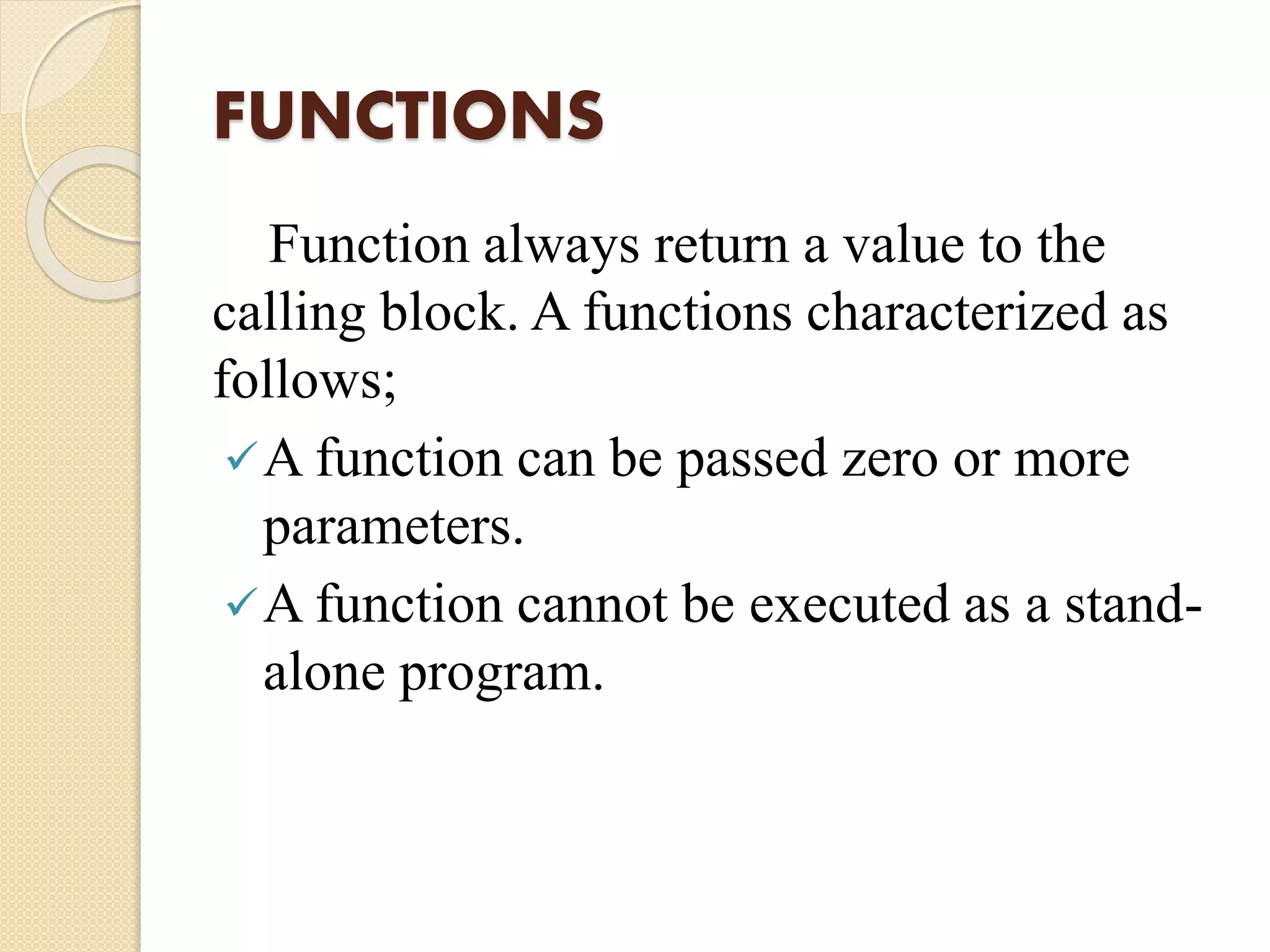
Function always return a value to the
calling block. A functions characterized as
follows;
A function can be passed zero or more
parameters.
A function cannot be executed as a stand-
alone program.
SYNTAX:
CREATE [OR REPLACE] FUNCTION functionname
[(parameter1,[parameter2…..]) ]
RETURN Datatype
IS
[constant | variable declarations]
BEGIN
executable statements
RETURN returnvalue
[EXCEPTION
expection-handling statements
RETURN returnvalue]
END [functionname];
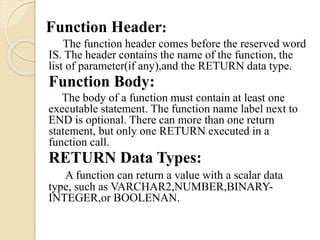
Function Header:
The function header comes before the reserved word
IS. The header contains the name of the function, the
list of parameter(if any),and the RETURN data type.
Function Body:
The body of a function must contain at least one
executable statement. The function name label next to
END is optional. There can more than one return
statement, but only one RETURN executed in a
function call.
RETURN Data Types:
A function can return a value with a scalar data
type, such as VARCHAR2,NUMBER,BINARY-
INTEGER,or BOOLENAN.
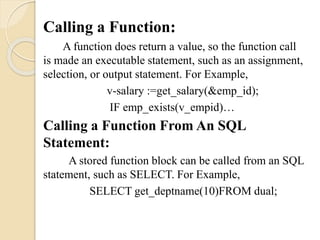
Calling a Function:
A function does return a value, so the function call
is made an executable statement, such as an assignment,
selection, or output statement. For Example,
v-salary :=get_salary(&emp_id);
IF emp_exists(v_empid)…
Calling a Function From An SQL
Statement:
A stored function block can be called from an SQL
statement, such as SELECT. For Example,
SELECT get_deptname(10)FROM dual;
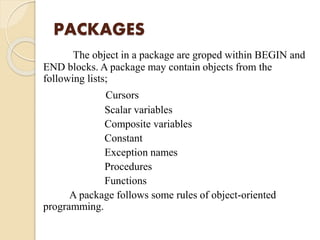
PACKAGES
The object in a package are groped within BEGIN and
END blocks. A package may contain objects from the
following lists;
Cursors
Scalar variables
Composite variables
Constant
Exception names
Procedures
Functions
A package follows some rules of object-oriented
programming.
Structure Of A Package:
A package provides an extra layer to a module. A
module has a specification and a body. A module’s
header specifies the name and the parameters.
Package Specification:
It contains definitions of function and procedures,
declaration of global or public variables. A packages
specification does not contain any code, but it does
contain information about the elements of the package.
SYNTAX:
CREATE [OR REPLACE] PACKAGE
packagename
IS
[constant, variable and type declarations]
[exception declaration]
[cursor specifications]
[function specifications]
[procedure specifications]
END [packagename];
PACKAGE BODY:
A package body contains actual programming code for
the modules described in the specification section. The
module code in the body without a description in the
specification is called a private module, or a hidden
module, and it is not visible outside the body of the package.
SYNTAX:
PACKAGE BODY packagename
IS
[variable and declaration]
[cursor specification and SELECT queries]
[header and body functions]
[header and body procedures]
[BEGIN
executable statement]
[EXCEPTION
exception handlers]
END[packagename];
TRIGGERS
It is stored in the database and is called automatically
when a triggering occurs. A user cannot call a trigger
explicitly. A trigger can be created to fire before or after the
triggering event. It is also known as firing the trigger.
A trigger is very useful in generating values for derived
columns, keeping track of tables access, preventing invalid
entries, performing validity checks, or maintaining security.
BEFORE Triggers:
The BEFORE trigger is useful when you want to plug
into some values in a new rows, insert a calculated column
into a new row, or validate a value in the INSERT query with
a lookup in another table.
AFTER Triggers:
It utilizes the built-in BOOLEAN functions
INSERTING, UPDATING, and DELECTING. If the
triggering event in one of the three DML statement, the
function related to the DML statement returns TRUE and the
other two return FALSE.
INSTEAD OF Trigger:
The INSTEAD OF trigger is a roe trigger. If a view is
based on a SELECT query that obtains set operator, group
function, GROUP BY, and HAVING clauses, DISTRICT
function, join, and a ROWNUM pesudocolumn, data
manipulation is not possible through it. An INSTEAD OF
trigger is used to modify a table that cannot be modified
through a view.

Orcal FUNCTIONS

  • 1.
    FUNCTIONS Function always returna value to the calling block. A functions characterized as follows; A function can be passed zero or more parameters. A function cannot be executed as a stand- alone program.
  • 2.
    SYNTAX: CREATE [OR REPLACE]FUNCTION functionname [(parameter1,[parameter2…..]) ] RETURN Datatype IS [constant | variable declarations] BEGIN executable statements RETURN returnvalue [EXCEPTION expection-handling statements RETURN returnvalue] END [functionname];
  • 3.
    Function Header: The functionheader comes before the reserved word IS. The header contains the name of the function, the list of parameter(if any),and the RETURN data type. Function Body: The body of a function must contain at least one executable statement. The function name label next to END is optional. There can more than one return statement, but only one RETURN executed in a function call. RETURN Data Types: A function can return a value with a scalar data type, such as VARCHAR2,NUMBER,BINARY- INTEGER,or BOOLENAN.
  • 4.
    Calling a Function: Afunction does return a value, so the function call is made an executable statement, such as an assignment, selection, or output statement. For Example, v-salary :=get_salary(&emp_id); IF emp_exists(v_empid)… Calling a Function From An SQL Statement: A stored function block can be called from an SQL statement, such as SELECT. For Example, SELECT get_deptname(10)FROM dual;
  • 5.
    PACKAGES The object ina package are groped within BEGIN and END blocks. A package may contain objects from the following lists; Cursors Scalar variables Composite variables Constant Exception names Procedures Functions A package follows some rules of object-oriented programming.
  • 6.
    Structure Of APackage: A package provides an extra layer to a module. A module has a specification and a body. A module’s header specifies the name and the parameters. Package Specification: It contains definitions of function and procedures, declaration of global or public variables. A packages specification does not contain any code, but it does contain information about the elements of the package.
  • 7.
    SYNTAX: CREATE [OR REPLACE]PACKAGE packagename IS [constant, variable and type declarations] [exception declaration] [cursor specifications] [function specifications] [procedure specifications] END [packagename];
  • 8.
    PACKAGE BODY: A packagebody contains actual programming code for the modules described in the specification section. The module code in the body without a description in the specification is called a private module, or a hidden module, and it is not visible outside the body of the package. SYNTAX: PACKAGE BODY packagename IS [variable and declaration] [cursor specification and SELECT queries] [header and body functions] [header and body procedures] [BEGIN executable statement] [EXCEPTION exception handlers] END[packagename];
  • 9.
    TRIGGERS It is storedin the database and is called automatically when a triggering occurs. A user cannot call a trigger explicitly. A trigger can be created to fire before or after the triggering event. It is also known as firing the trigger. A trigger is very useful in generating values for derived columns, keeping track of tables access, preventing invalid entries, performing validity checks, or maintaining security. BEFORE Triggers: The BEFORE trigger is useful when you want to plug into some values in a new rows, insert a calculated column into a new row, or validate a value in the INSERT query with a lookup in another table.
  • 10.
    AFTER Triggers: It utilizesthe built-in BOOLEAN functions INSERTING, UPDATING, and DELECTING. If the triggering event in one of the three DML statement, the function related to the DML statement returns TRUE and the other two return FALSE. INSTEAD OF Trigger: The INSTEAD OF trigger is a roe trigger. If a view is based on a SELECT query that obtains set operator, group function, GROUP BY, and HAVING clauses, DISTRICT function, join, and a ROWNUM pesudocolumn, data manipulation is not possible through it. An INSTEAD OF trigger is used to modify a table that cannot be modified through a view.