INTRODUCTION
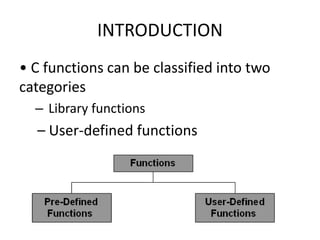
• C functions can be classified into two
categories
– Library functions
– User-defined functions
LIBRARY FUNCTIONS
– Library functions are not required to be
written by
– printf and scanf belong to the category of
library function
– sqrt, cos, strcat, etc are some of library
functions
USER-DEFINED FUNCTIONS
– User-defined functions has to be developed by
the user at the time of writing a program
– A user-defined functions can later become a
part of the C program library
– main is an example of user-defined functions
ELEMENTS OF USER-DEFINED
FUNCTIONS
There are three elements related to functions
– Function definition
– Function call
– Function declaration
• The function definition is an independent program module that is specially
written to implement the requirements of the function.
• To use this function we need to invoke it at a required place in the program.
This is known as the function call.
• The program that calls the function is referred to as the calling program or
calling function.
• The calling program should declare any function that is to be used later in
the program. This is known as the function declaration or function prototype.
FUNCTION DECLARATION
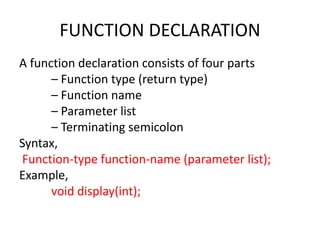
A function declaration consists of four parts
– Function type (return type)
– Function name
– Parameter list
– Terminating semicolon
Syntax,
Function-type function-name (parameter list);
Example,
void display(int);
FUNCTION DEFINITION
A function definition, also known as function
implementation shall include the following
elements;
– Function name;
– Function type;
– List of parameters;
– Local variable declaration;
– Function statements; and
– A return statement.
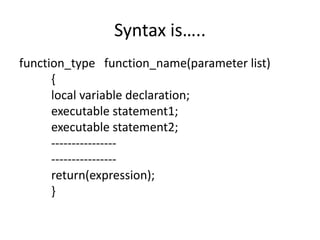
Syntax is…..
function_type function_name(parameter list)
{
local variable declaration;
executable statement1;
executable statement2;
----------------
----------------
return(expression);
}
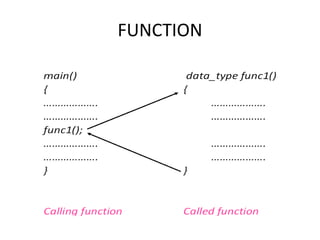
FUNCTION
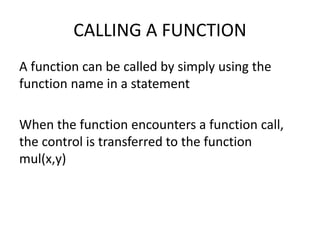
CALLING A FUNCTION
A function can be called by simply using the
function name in a statement
When the function encounters a function call,
the control is transferred to the function
mul(x,y)
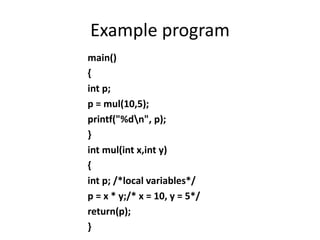
Example program
main()
{
int p;
p = mul(10,5);
printf("%dn", p);
}
int mul(int x,int y)
{
int p; /*local variables*/
p = x * y;/* x = 10, y = 5*/
return(p);
}
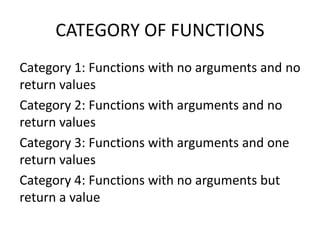
CATEGORY OF FUNCTIONS
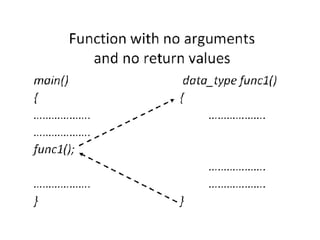
Category 1: Functions with no arguments and no
return values
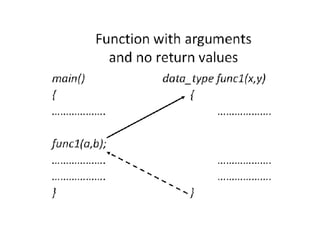
Category 2: Functions with arguments and no
return values
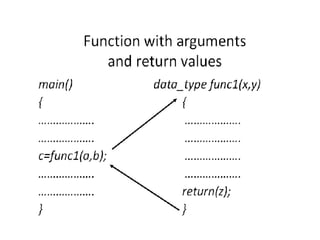
Category 3: Functions with arguments and one
return values
Category 4: Functions with no arguments but
return a value
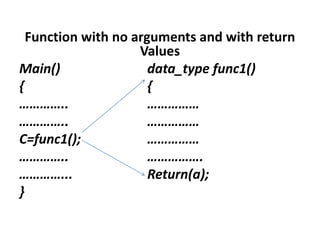
Function with no arguments and with return
Values
Main() data_type func1()
{ {
………….. ……………
………….. ……………
C=func1(); ……………
………….. …………….
…………... Return(a);
}
RETURNING A VALUE
• C function returns a value of the type int as a
default case when no other type is specified
explicitly.
return(value);
Return the integer value of sum
User defined function in c

User defined function in c

  • 2.
    INTRODUCTION • C functionscan be classified into two categories – Library functions – User-defined functions
  • 3.
    LIBRARY FUNCTIONS – Libraryfunctions are not required to be written by – printf and scanf belong to the category of library function – sqrt, cos, strcat, etc are some of library functions
  • 4.
    USER-DEFINED FUNCTIONS – User-definedfunctions has to be developed by the user at the time of writing a program – A user-defined functions can later become a part of the C program library – main is an example of user-defined functions
  • 5.
    ELEMENTS OF USER-DEFINED FUNCTIONS Thereare three elements related to functions – Function definition – Function call – Function declaration • The function definition is an independent program module that is specially written to implement the requirements of the function. • To use this function we need to invoke it at a required place in the program. This is known as the function call. • The program that calls the function is referred to as the calling program or calling function. • The calling program should declare any function that is to be used later in the program. This is known as the function declaration or function prototype.
  • 6.
    FUNCTION DECLARATION A functiondeclaration consists of four parts – Function type (return type) – Function name – Parameter list – Terminating semicolon Syntax, Function-type function-name (parameter list); Example, void display(int);
  • 7.
    FUNCTION DEFINITION A functiondefinition, also known as function implementation shall include the following elements; – Function name; – Function type; – List of parameters; – Local variable declaration; – Function statements; and – A return statement.
  • 8.
    Syntax is….. function_type function_name(parameterlist) { local variable declaration; executable statement1; executable statement2; ---------------- ---------------- return(expression); }
  • 9.
  • 10.
    CALLING A FUNCTION Afunction can be called by simply using the function name in a statement When the function encounters a function call, the control is transferred to the function mul(x,y)
  • 11.
    Example program main() { int p; p= mul(10,5); printf("%dn", p); } int mul(int x,int y) { int p; /*local variables*/ p = x * y;/* x = 10, y = 5*/ return(p); }
  • 12.
    CATEGORY OF FUNCTIONS Category1: Functions with no arguments and no return values Category 2: Functions with arguments and no return values Category 3: Functions with arguments and one return values Category 4: Functions with no arguments but return a value
  • 16.
    Function with noarguments and with return Values Main() data_type func1() { { ………….. …………… ………….. …………… C=func1(); …………… ………….. ……………. …………... Return(a); }
  • 17.
    RETURNING A VALUE •C function returns a value of the type int as a default case when no other type is specified explicitly. return(value); Return the integer value of sum