Applying for tenure: Five things I wish I had known . . .

Ajay K. Kohli
Gary T. and Elizabeth R. Jones Chair
Georgia Institute of Technology

DOCSIG, AMA Winter Educators’ Conference
February 20, 2014
Agenda
•  Getting external letters
•  Demonstrating intellectual independence
•  Research contribution assessments
•  Putting together the dossier
•  Evaluator information processing

2
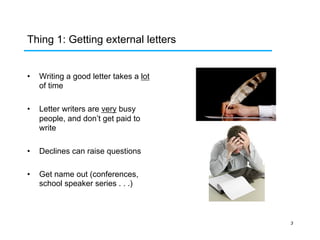
Thing 1: Getting external letters
• 

Writing a good letter takes a lot
of time

• 

Letter writers are very busy
people, and don’t get paid to
write

• 

Declines can raise questions

• 

Get name out (conferences,
school speaker series . . .)

3
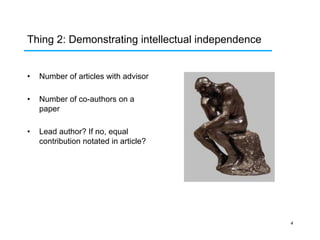
Thing 2: Demonstrating intellectual independence
• 

Number of articles with advisor

• 

Number of co-authors on a
paper

• 

Lead author? If no, equal
contribution notated in article?

4
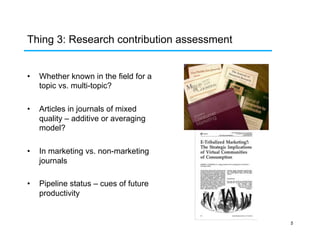
Thing 3: Research contribution assessment
• 

Whether known in the field for a
topic vs. multi-topic?

• 

Articles in journals of mixed
quality – additive or averaging
model?

• 

In marketing vs. non-marketing
journals

• 

Pipeline status – cues of future
productivity

5
Thing 4: Putting together the dossier
• 

Your “Statement of
Accomplishment” is the
“CliffsNotes” for letter writers

• 

CV and Statement of
Accomplishments needs to be
easy to process
–  Use bullets
–  Use bolds, italics, underlines
–  But don’t emphasize everything!

6
Thing 4: Putting together the dossier . . . (cont’d)
• 

Limit the “supplemental
materials”
–  If something is really important,
incorporate it in the CV or Statement
itself

• 

Cover all “line items” if possible
–  “Talking points”

• 

Don’t “play games” with information

7
Thing 5: Evaluator information processing
• 

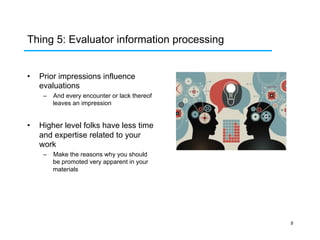
Prior impressions influence
evaluations
–  And every encounter or lack thereof
leaves an impression

• 

Higher level folks have less time
and expertise related to your
work
–  Make the reasons why you should
be promoted very apparent in your
materials

8
After this . . .

9
Thank you!

10

Ajay Kohli- Tenure

  • 1.
    Applying for tenure:Five things I wish I had known . . . Ajay K. Kohli Gary T. and Elizabeth R. Jones Chair Georgia Institute of Technology DOCSIG, AMA Winter Educators’ Conference February 20, 2014
  • 2.
    Agenda •  Getting externalletters •  Demonstrating intellectual independence •  Research contribution assessments •  Putting together the dossier •  Evaluator information processing 2
  • 3.
    Thing 1: Gettingexternal letters •  Writing a good letter takes a lot of time •  Letter writers are very busy people, and don’t get paid to write •  Declines can raise questions •  Get name out (conferences, school speaker series . . .) 3
  • 4.
    Thing 2: Demonstratingintellectual independence •  Number of articles with advisor •  Number of co-authors on a paper •  Lead author? If no, equal contribution notated in article? 4
  • 5.
    Thing 3: Researchcontribution assessment •  Whether known in the field for a topic vs. multi-topic? •  Articles in journals of mixed quality – additive or averaging model? •  In marketing vs. non-marketing journals •  Pipeline status – cues of future productivity 5
  • 6.
    Thing 4: Puttingtogether the dossier •  Your “Statement of Accomplishment” is the “CliffsNotes” for letter writers •  CV and Statement of Accomplishments needs to be easy to process –  Use bullets –  Use bolds, italics, underlines –  But don’t emphasize everything! 6
  • 7.
    Thing 4: Puttingtogether the dossier . . . (cont’d) •  Limit the “supplemental materials” –  If something is really important, incorporate it in the CV or Statement itself •  Cover all “line items” if possible –  “Talking points” •  Don’t “play games” with information 7
  • 8.
    Thing 5: Evaluatorinformation processing •  Prior impressions influence evaluations –  And every encounter or lack thereof leaves an impression •  Higher level folks have less time and expertise related to your work –  Make the reasons why you should be promoted very apparent in your materials 8
  • 9.
  • 10.