RADICAL TRANSPARENCY
IN MEASURING MARKETING PERFORMANCE
19% 54.2%
OF TOTAL U.S. AD SPENDDIGITAL AD SPEND
2019FORECAST
“Attribution is something everyone knows they need
to have, but they don’t understand it…”
—Jeff Greenfield, C3 Metrics
WHY DO MARKETERS STRUGGLE TO
ADVANCE OUR ATTRIBUTION EFFORTS?
Lack of understanding
Lack of companywide buy-in
Difficulties in accessing the right data
Problems with technology integration
Transparency and accuracy of reporting
ONE SIZE DOES NOT FIT ALL
WHAT TYPE OF ATTRIBUTION MODELING IS
BEST FOR MY COMPANY?
Digital Attribution
• Last-click
• First-click
• View-through
Digital Attribution
• Last-click
• First-click
• View-through
Multitouch Attribution
• Linear
• Position-based
• Time decay
• Algorithmic
• Holistic
ONE SIZE DOES NOT FIT ALL
TEST
MEASURE
ADJUST
-$5 -$5 +$100
WHAT’S OUR RETURN ON AD SPEND?
-$5
+$100 +$100
-$5 -$5
+$100
-$5
$100/$5 = $20 ROAS $100/$5 = $20 ROAS
$100/$10 = $10 ROAS
WHICH OF THESE ADS GETS
THE CREDIT?
LAST-CLICK
FIRST-CLICK
ARTSCIENCETRACKING PLAN
Channel CampaignPlatform
www.nba.com/jazz/tickets/single-game?cid=jazz_social_twitter_natural_tixpush20190122
As a marketing
department, we
began including URL
parameters on all
digital ads.
We do that so when a customer clicks
and lands on our site,
we’d know exactly how
they got there.
Select a channel from
the drop-down menu.
Enter the name
of the campaign.
Enter the webpage
where customers
should land
The tool spits out a link
with all the needed
parameters
Using various
platforms, we
capture large
amounts of website
data, including
these URL
parameters
These platforms
combine data across
both Jazz and
Ticketmaster websites,
allowing us to track
visitors from when they
first click an ad, to when
they make a purchase
We put this website
data into our data
warehouse, where
we link it together
with marketing
spend and sales data
We then attribute spend,
traffic, orders and
revenue to the
appropriate marketing
channels and campaigns
Channel
Rev
TY
Rev
LY
Rev
YoY
Spend
TY
Spend
LY
Spend
YoY
Rev/Spend
TY
Rev/Spend
LY
Rev/Spend
YoY
Orders
TY
Direct/Other Site $2,491,576 $2,018,071 23% 14,834
Search-Nat $1,660,727 $494,673 236% 9,631
Email $553,285 $158,568 249% 2,773
Search-Paid $128,495 $88,312 46% $20,450 $55,575 -56% $6.28 $1.59 295% 701
Social-Nat $124,183 $18,777 561% 671
Social-Paid $11,835 $6,689 77% $62,115 $33,970 130% $0.19 $0.20 -3% 147
App Push $9,843 $965 920% 68
Display $7,259 $10,610 -32% $3,524 $80,063 -95% $2.06 $0.13 1,455% 34
Grand Total $4,987,203 $2,796,663 78% $86,088 $169,608 -49% $57.93 $16.49 251%
MARKETING SCORECARD
Campaign
Rev
TY
Orders
TY
Orders
LY
AOS
TY
Tix
TY
Tix
LY
Custs
TY
jazz_email_market_2019.01.07_lakerspack_offer $24,428 70 0 $349 416 0 70
jazz_email_market_2018.11.28_holidaypacks_offer $24,189 99 0 $244 299 0 87
jazz_email_market_2018.11.15_tripledouble_offer $20,326 75 0 $271 533 0 67
jazz_email_market_2018.10.03_gssubscriber_offer $20,206 71 0 $285 244 0 70
jazz_email_market_2018.12.17_picktwo_offer $20,188 85 0 $238 264 0 76
jazz_email_market_2018.09.07_offer $16,710 96 0 $174 303 0 79
jazz_email_market_2018.11.26_cybermonday_offer $13,843 59 0 $235 212 0 55
jazz_email_market_2018.10.22_mem_offer $13,149 78 0 $169 320 0 76
jazz_email_market_2018.12.11_twopack_offer $12,992 51 0 $255 212 0 50
jazz_email_market_2018.10.12_bobblehead_offer $10,813 49 0 $221 223 0 41
jazz_email_market_2018.08.21_MiniPlans_offer $10,614 16 0 $663 210 0 17
jazz_email_market_2018.11.23_blackfriday_offer $10,405 48 0 $217 174 0 45
jazz_email_market_2018.10.15_gsw_offer $10,094 47 0 $215 130 0 47
jazz_email_market_2019.01.04_starwars_offer $9,329 76 0 $123 202 0 72
jazz_email_market_2018.11.05_games_offer $7,672 19 0 $404 70 0 20
jazz_email_market_2018.07.26_PreSeasonOnSale_offer $6,199 27 0 $230 113 0 20
jazz_email_market_2018.12.03_korverbeehive_offer $5,986 67 0 $89 198 0 67
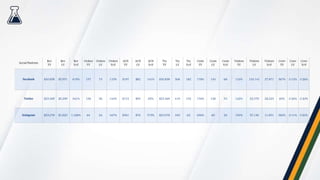
Social Platform
Rev
TY
Rev
LY
Rev
YoY
Orders
TY
Orders
LY
Orders
YoY
AOS
TY
AOS
LY
AOS
YoY
Tix
TY
Tix
LY
Tix
YoY
Custs
TY
Custs
LY
Custs
YoY
Visitors
TY
Visitors
LY
Visitors
YoY
Conv
TY
Conv
LY
Conv
YoY
Facebook $30,858 $5,951 419% 157 73 115% $197 $82 141% $30,858 506 182 178% 143 68 110% 130,141 27,871 367% 0.12% 0.26%
Twitter $23,369 $5,299 341% 136 56 143% $172 $95 82% $23,369 419 152 176% 128 53 142% 52,379 28,323 85% 0.26% 0.20%
Instagram $23,078 $1,820 1,168% 64 24 167% $361 $76 375% $23,078 345 62 456% 60 24 150% 57,136 11,851 382% 0.11% 0.20%
Channel
Orders
TY
Orders
LY
Orders
YoY
AOS
TY
AOS
LY
AOS
YoY
Tix
TY
Tix
LY
Tix
YoY
Visitors
TY
Visitors
LY
Visitors
YoY
Direct/Other Site 14,834 16,009 -7% $168 $126 33% 39,480 37,329 6% 868,171 813,010 7%
Search-Nat 9,631 3,501 175% $172 $141 22% 24,602 8,981 174% 552,034 300,281 84%
Email 2,773 1,111 150% $200 $143 40% 8,891 2,960 200% 120,460 37,129 224%
Search-Paid 701 789 -11% $183 $112 64% 1,994 1,856 7% 4,980 16,161 -69%
Social-Nat 671 273 146% $185 $69 169% 2,095 582 260% 236,727 67,329 252%
Social-Paid 147 79 85% $81 $84 -4% 343 189 81% 16,422 6,406 156%
App Push 68 7 861% $146 $137 6% 203 13 1,460% 11,597 522 2,122%
Display 34 93 -64% $215 $114 89% 94 211 -55% 2,357 6,514 -64%
MARKETING SCORECARD
$4.71
$4.71
$7.45
$1.24
$0.17
$3.77
$2.88
$3.75
$0
$2
$4
$6
$8
CLICK/VIEW-THRU ROAS
Display
IP Targeting
KSL.com
Social
Digital Video
Paid Search
SLTrib.com
Grand Total
31.5%
26.3%
18.8%
15.8%
6.5%
0.6% 0.5%
IMPRESSIONS
Determine the overall impact of each channel relative to others
Measure and test the performance of individual campaigns
Intelligently shift advertising spend across channels
Allocate internal resources appropriately to areas of highest impact
DOES IT HELP?
Online revenue
is up 78%YOY
Digital ad-spend
is down 49%YOY
Online revenue
is up 78%YOY
Digital ad-spend
is down 49%YOY
Return on ad-spend
is up 251%YOY
WHAT ARE THE KEY TAKEAWAYS?
Re-evaluate your current attribution methodology
Determine what you want it to do in the future
Identify what data and technology is needed
Identify who needs to be on-board to make it happen
BE THE
RADICALLY TRANSPARENT
CHAMPION!!!
QUESTIONS?

Radical Transparency

Editor's Notes

  • #3 This has nothing to do with my topic, but…
  • #4 Forecasters expect 2019 to mark a major milestone in advertising Total digital ad spend will grow 19% to $129.34 billion Will equate to 54.2% of estimated total US ad spending This is great news but also presents some challenges: Challenging in that the landscape becomes more competitive, potentially driving cost up… But the great news is this corporate buy-in to digital advertising makes our jobs easier to measure and track ROAS
  • #5 Building an attribution model for your organization can be a complicated matter
  • #8 But let me remind you…
  • #9 But at the end of the day, we all still have our CFO in our ear, asking us over and over, what our ROAS is.
  • #11 There are many types of attribution modeling. How do we know which direction to go?
  • #12 There are many types of attribution modeling. How do we know which direction to go?
  • #13 Let me remind you…
  • #14 We’re all probably doing something to measure our marketing efforts. Attribution modeling is an evolution Some may be looking solely at your audience reach, Some are diving deeper into specific campaign and looking at native analytics to measure success. Others developing multichannel attribution models that look across all channels, assign credit for conversions and impact and are very fluid in their ability to optimize marketing spend. Others are taking it to a whole new level. Multichannel and Holistic attribution models provide a much more transparent view of how our marketing dollars are really working for us. We’re not going to talk about Holistic today. We’re going to focus on multichannel attribution today and I’m going to walk you through our 2-year journey to get here.
  • #15 For us, this process started 2 years ago, when I moved into my current role. At the time, we didn’t have any type of attribution model and nobody could really tell me what was working well for us. As someone who has believed in digital advertising for quite some time, I knew we needed to make some fundamental changes. Traditional and digital switch This would allow us to more accurately track success, and at the same time, be more nimble with our messaging (marketing for sports requires you to be agile in your messaging) These changes required me to get the organizational buy-in necessary to do A LOT of testing
  • #16 So, we decided to experiment with nearly every digital advertising platform we could think of.
  • #17 We needed to test, measure and adjust. Easier said than done. There are problems out there that we will encounter.
  • #18 Let’s say a customer… Clicks a Google display ad, then… Clicks a Facebook ad, then… Buys tickets to a game for $100
  • #20 Facebook tells me one thing, Google tells me another. Facebook doesn’t capture Google spend, and vice-versa, so both platforms independently report $100 revenue on $5 spend But in reality, we made $100 on $10 spend I could follow this model and tell my bosses that my ROAS on FB and Google are through the roof! But is that really accurate?
  • #21 What it’s really like…. At the beginning of the season, we have local Lakers fan that wants to get tickets to a game, so he does a Google search and clicks on a pay-per-click ad. That takes him to utahjazz.com to look for tickets and he decides not to purchase right now. But, look at his desktop image, he’s a die-hard Laker fan and even though I wish he was a Jazz fan, we’ll still take money from Lakers fans.
  • #22 We know that he looked at Lakers tickets so we remarket to him and get him to click on an ad while he’s on ESPN.com. That takes him back to the site but he still doesn’t convert. By the looks of his desktop image, maybe he’s sensing the disarray going on with the team and doesn’t want to spend the dough??? I don’t know.
  • #23 So now we know that he’s looked at Lakers tickets twice and hasn’t converted so this triggers an email from the Jazz for a ticket package that includes the Lakers game. Again, he doesn’t convert. What’s happening with this Laker fan? I mean, I guess it DOES take an average of 6.9 touchpoints per conversion?
  • #24 Finally, we serve him a Facebook ad for this same Lakers game, he gets redirected back to the site, searches for tickets, and ends up buying $700 tickets…to the Golden State Warriors game. But apparently he’s been a fan of theirs since day 1?!
  • #25 With an average of 6.9 touchpoints per conversion, who gets the credit, but more importantly, what is REALLY working?
  • #26 If you looked solely at Last-Click, you would say “FB gets all the credit” If you looked at First-click only, you would say “Paid search is performing really well for us” If you looked at each of the individual platform metrics, they would all take credit for the sale. This is a problem and we needed to fix this. Since each of these ads had some level of impact on the buyer’s conversion and the individual platforms don’t consider all channels under the digital marketing umbrella, we needed to build something that would. We needed to build something that would provide transparency in determining what is really working for our organization So, where do we start?
  • #27 First, we needed to set our target for ROAS…Right? But this is where most folks make their biggest mistakes. They try to determine an industry average Or Finance gives them a target number And they set the number and then work towards it Let me share my philosophy…The ROAS number means NOTHING. Build a radically transparent attribution model, determine your baseline numbers, and then measure yourself off the trajectory and growth of those numbers. Your trend line will determine your success. Start with the concept of radical transparency. Get your data RIGHT.
  • #28 In order to get your data right, try these three steps: You’ll need a well-thought out tracking management plan Then, mix in A LOT of science, And add a smattering of art
  • #29 Let’s start with a tracking plan…
  • #30 Now, if you’re built anything like us, you have several different folks that need to be able to add tracking…and you need consistency. So we built a shared tool that allowed our marketing staff to easily generate these parameters in a consistent format. Regardless of whether it is on paid channels or free channels, it gets tagged properly. This ensures that our analytics team can correctly identify the channel, platform, and campaign of every ad.
  • #31 So, let’s get a little more technical for a minute With this set-up, we are prepared to track everything.
  • #32 For us, Science happens at the conversion level. We want to know what channels are our best channels for converting costumers.
  • #33 So, as part of our Marketing Scorecard, and because it makes sense for our business objectives, we look closely at last-click attribution. I can look closely at this portion of the Scorecard and get the facts. I can view: YOY Sales #’s Traffic ROAS And a variety of other things. I know how well each of my channels are performing at the conversion level.
  • #34 I can even drill down into individual EMAIL campaigns if I want to dive deeper, or…
  • #35 I can look at a specific social media channel, like Facebook or Instagram, and see how it is performing.
  • #36 But the path to conversion is rarely a straight line. I still need to place value on higher-funnel ad channels. If I don’t, if I just cut those off because they are not converting well, my pool of customers may dry out. (losing the assist to conversion) So, this is where we add some art to model. Some folks may find it more valuable to build out complex algorithms or build time-decay models that allocate impact points. That may be best for company. It is not currently necessary for our organization.
  • #37 This is where we begin to measure a channel’s performance based on the amount of traffic it drives to our site. Looking at the total number of orders per channel, will sometimes tell me something different than the revenue numbers on their own. We may look at the average order size by channel and determine that a specific channel is perfect for upper bowl ticket messaging.
  • #38 We even include in our Scorecard a conversion ROAS based on a de-duped view-through and click-through model, To determine what upper funnel channels are LEADING to conversion We want to measure our reach in the market, so might look at digital impressions combined with traditional media impressions
  • #39 As we blend the art and science of multichannel attribution we are able to make data-driven decisions. We can:
  • #41 Through the first half of the season…
  • #42 And for a moment…the Utah Jazz marketing department gets to feel as cool as Donovan Mitchell
  • #43 But let me remind you…
  • #45 But let me remind you…