PRESENTATION – 2
JAY SHARMA
SOFTWARE DEVELOPMENT
LIFE CYCLE
The development models are the various
process or methodologies that are being selected for
the development of the project depending on the
project’s aim and goals. There are many development
life cycle models that have been developed in order
to achieve different required objectives. The models
specify the various stages of the process and the order
in which they are carried out.
JAY SHARMA
There are various Software development
models or methodologies.
They are as follows:
1) Waterfall model
2)V model
3)Incremental model
4)RAD model
5)Agile model
6)Iterative model
7)Spiral model
JAY SHARMA
RAD
RAD model is Rapid Application Development
model. It is a type of incremental model. In RAD
model the components or functions are developed in
parallel as if they were mini projects. The
developments are time boxed, delivered and then
assembled into a working prototype. This can
quickly give the customer something to see and use
and to provide feedback regarding the delivery and
their requirements
JAY SHARMA
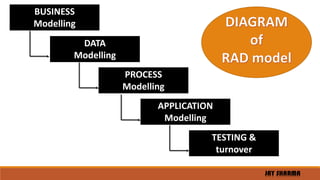
BUSINESS
Modelling
DATA
Modelling
PROCESS
Modelling
APPLICATION
Modelling
TESTING &
turnover
JAY SHARMA
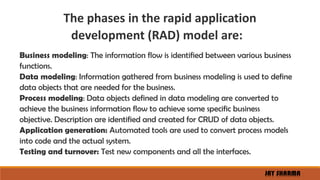
The phases in the rapid application
development (RAD) model are:
Business modeling: The information flow is identified between various business
functions.
Data modeling: Information gathered from business modeling is used to define
data objects that are needed for the business.
Process modeling: Data objects defined in data modeling are converted to
achieve the business information flow to achieve some specific business
objective. Description are identified and created for CRUD of data objects.
Application generation: Automated tools are used to convert process models
into code and the actual system.
Testing and turnover: Test new components and all the interfaces.
JAY SHARMA
Advantages of the RAD model:
 Reduced development time.
 Increases reusability of components
 Quick initial reviews occur
 Encourages customer feedback
 Integration from very beginning solves a lot of
integration issue.
JAY SHARMA
Disadvantages of RAD model:
 Depends on strong team and individual
performances for identifying business requirements.
 Only system that can be modularized can be built
using RAD
 Requires highly skilled developers/designers.
 High dependency on modeling skills
 Inapplicable to cheaper projects as cost of modeling
and automated code generation is very high.
JAY SHARMA
When to use RAD model:
 RAD should be used when there is a need to create a system
that can be modularized in 2-3 months of time.
 It should be used if there’s high availability of designers for
modeling and the budget is high enough to afford their cost
along with the cost of automated code generating tools.
 RAD SDLC model should be chosen only if resources with high
business knowledge are available and there is a need to
produce the system in a short span of time (2-3 months).
JAY SHARMA
THANK YOU
JAY SHARMA

SDLC RAD model

  • 1.
  • 2.
    SOFTWARE DEVELOPMENT LIFE CYCLE Thedevelopment models are the various process or methodologies that are being selected for the development of the project depending on the project’s aim and goals. There are many development life cycle models that have been developed in order to achieve different required objectives. The models specify the various stages of the process and the order in which they are carried out. JAY SHARMA
  • 3.
    There are variousSoftware development models or methodologies. They are as follows: 1) Waterfall model 2)V model 3)Incremental model 4)RAD model 5)Agile model 6)Iterative model 7)Spiral model JAY SHARMA
  • 4.
    RAD RAD model isRapid Application Development model. It is a type of incremental model. In RAD model the components or functions are developed in parallel as if they were mini projects. The developments are time boxed, delivered and then assembled into a working prototype. This can quickly give the customer something to see and use and to provide feedback regarding the delivery and their requirements JAY SHARMA
  • 5.
  • 6.
    The phases inthe rapid application development (RAD) model are: Business modeling: The information flow is identified between various business functions. Data modeling: Information gathered from business modeling is used to define data objects that are needed for the business. Process modeling: Data objects defined in data modeling are converted to achieve the business information flow to achieve some specific business objective. Description are identified and created for CRUD of data objects. Application generation: Automated tools are used to convert process models into code and the actual system. Testing and turnover: Test new components and all the interfaces. JAY SHARMA
  • 7.
    Advantages of theRAD model:  Reduced development time.  Increases reusability of components  Quick initial reviews occur  Encourages customer feedback  Integration from very beginning solves a lot of integration issue. JAY SHARMA
  • 8.
    Disadvantages of RADmodel:  Depends on strong team and individual performances for identifying business requirements.  Only system that can be modularized can be built using RAD  Requires highly skilled developers/designers.  High dependency on modeling skills  Inapplicable to cheaper projects as cost of modeling and automated code generation is very high. JAY SHARMA
  • 9.
    When to useRAD model:  RAD should be used when there is a need to create a system that can be modularized in 2-3 months of time.  It should be used if there’s high availability of designers for modeling and the budget is high enough to afford their cost along with the cost of automated code generating tools.  RAD SDLC model should be chosen only if resources with high business knowledge are available and there is a need to produce the system in a short span of time (2-3 months). JAY SHARMA
  • 10.