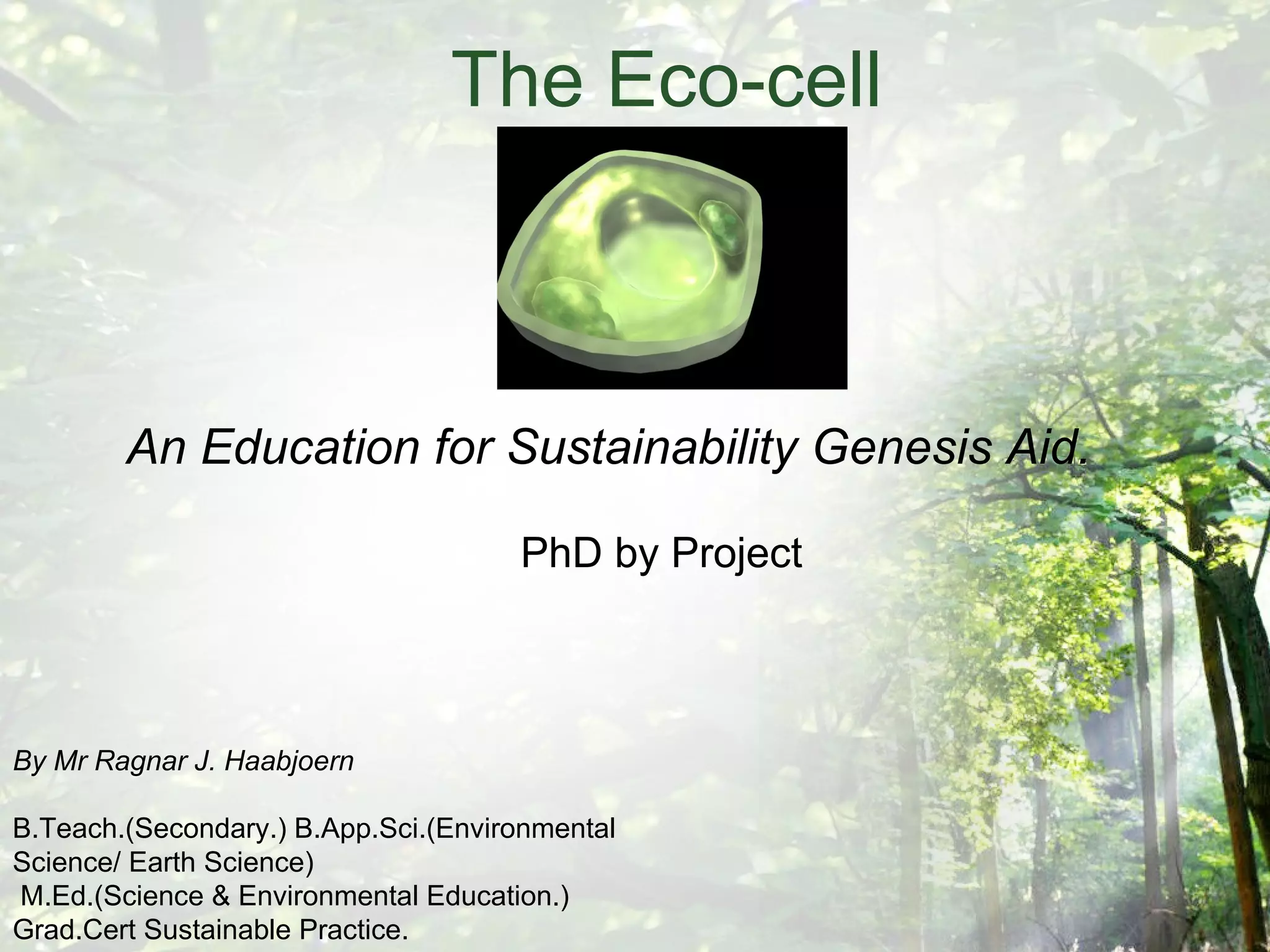

The Eco-cell An Education for Sustainability Genesis Aid. PhD by Project By Mr Ragnar J. Haabjoern B.Teach.(Secondary.) B.App.Sci.(Environmental Science/ Earth Science) M.Ed.(Science & Environmental Education.)  Grad.Cert Sustainable Practice.
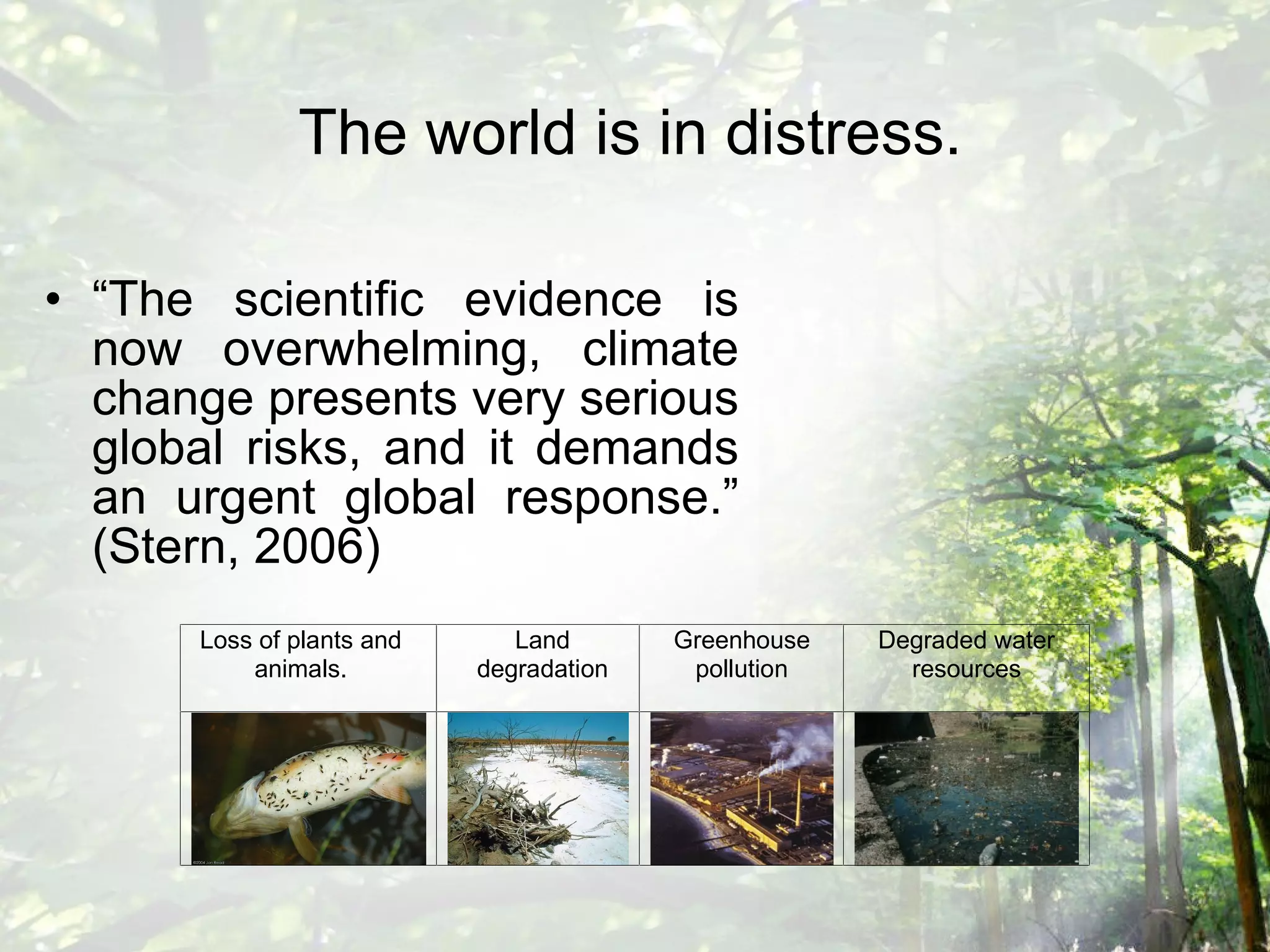
The world is in distress.   “ The scientific evidence is now overwhelming, climate change presents very serious global risks, and it demands an urgent global response.” (Stern, 2006)
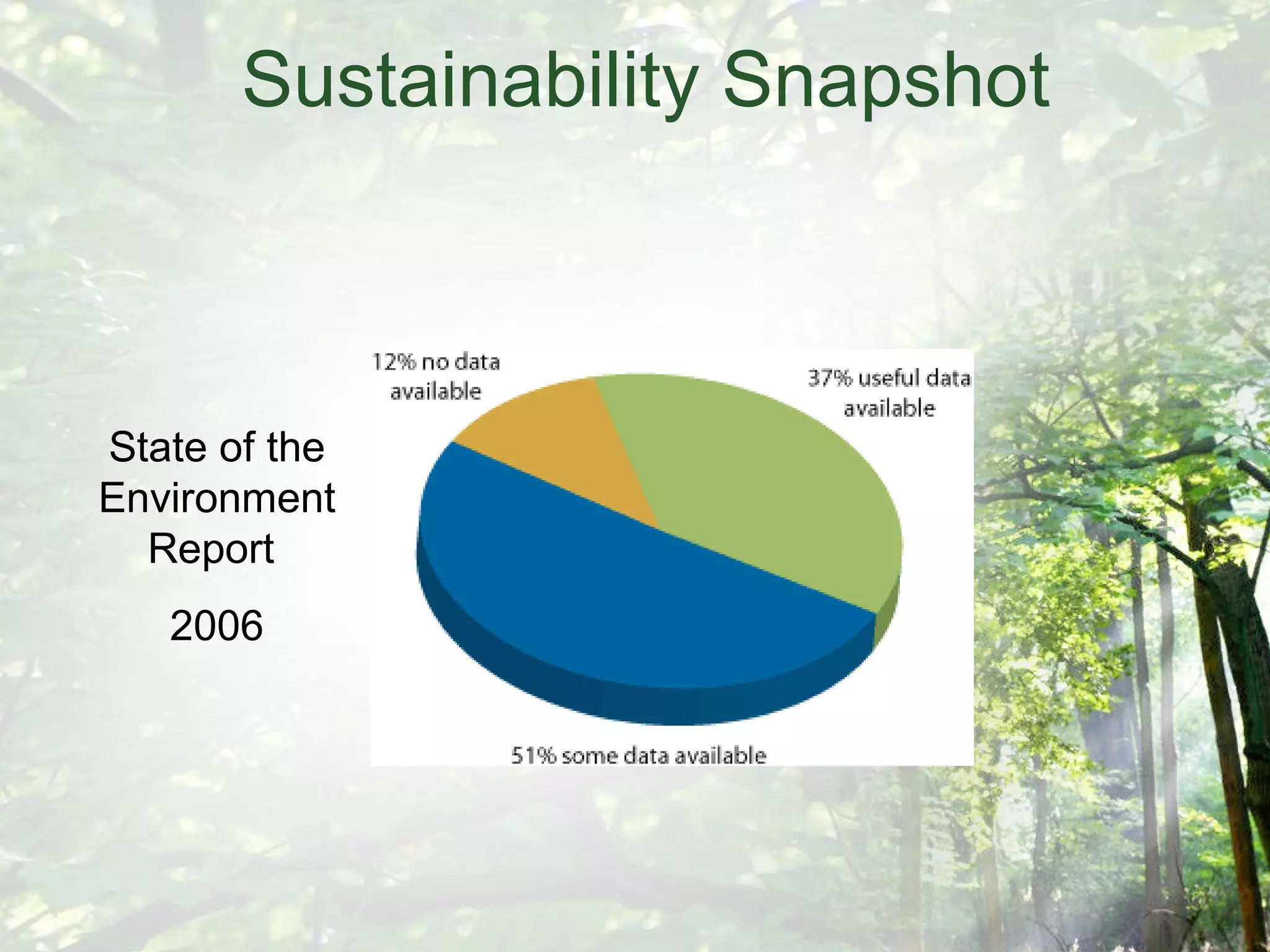
Sustainability Snapshot State of the Environment Report  2006
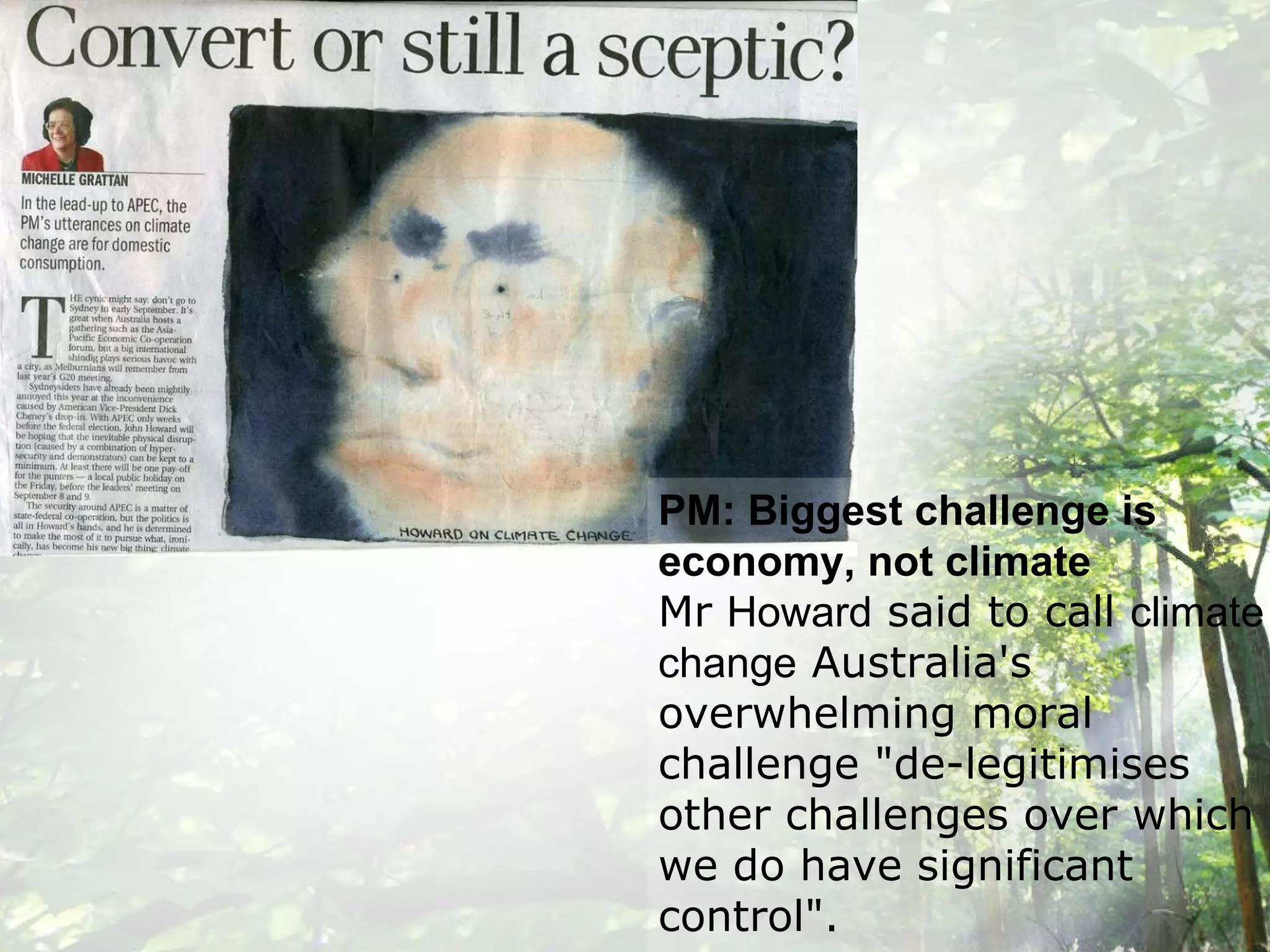
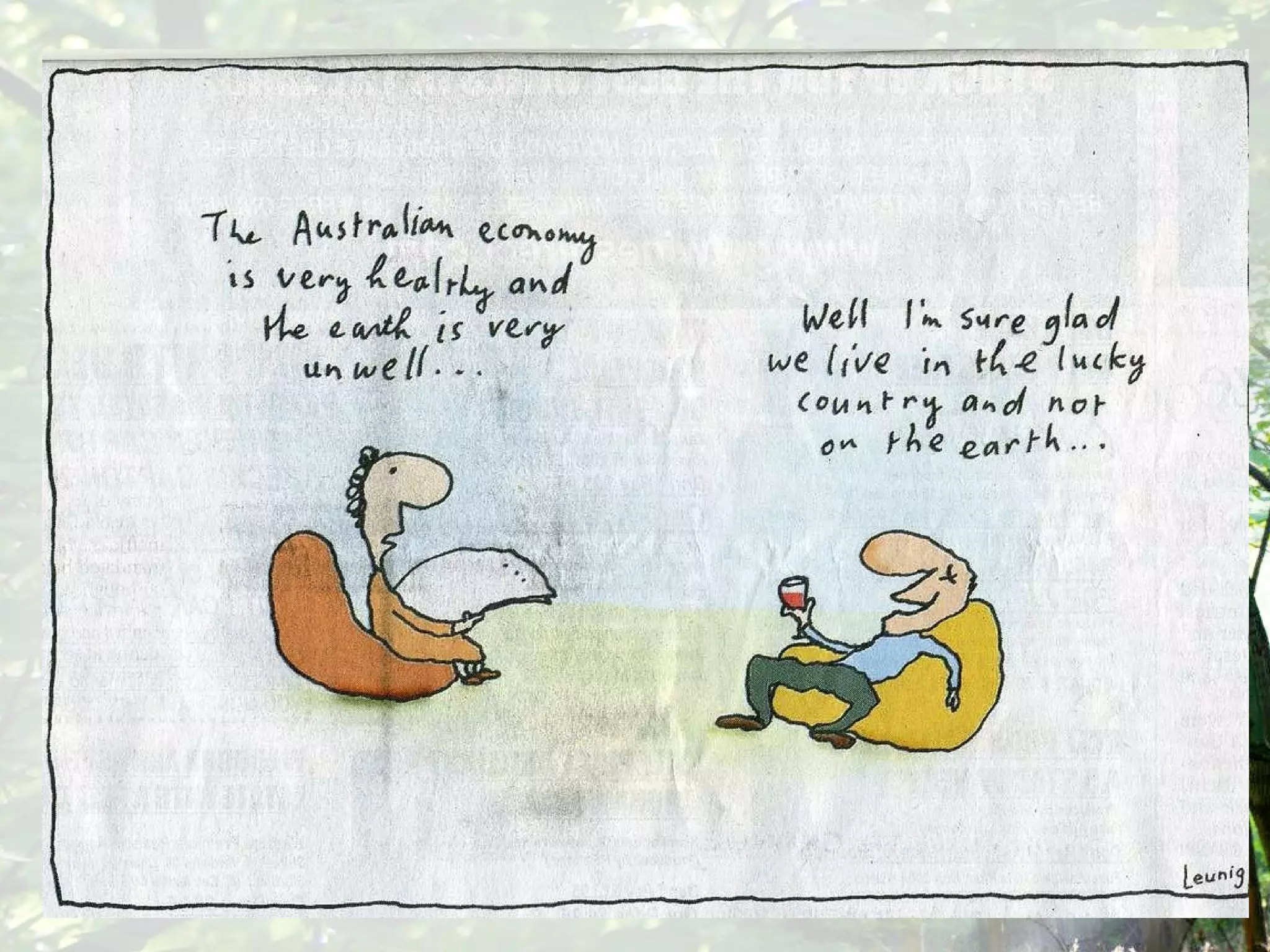
PM: Biggest challenge is economy, not climate Mr  Howard  said to call  climate   change  Australia's overwhelming moral challenge "de-legitimises other challenges over which we do have significant control".
 
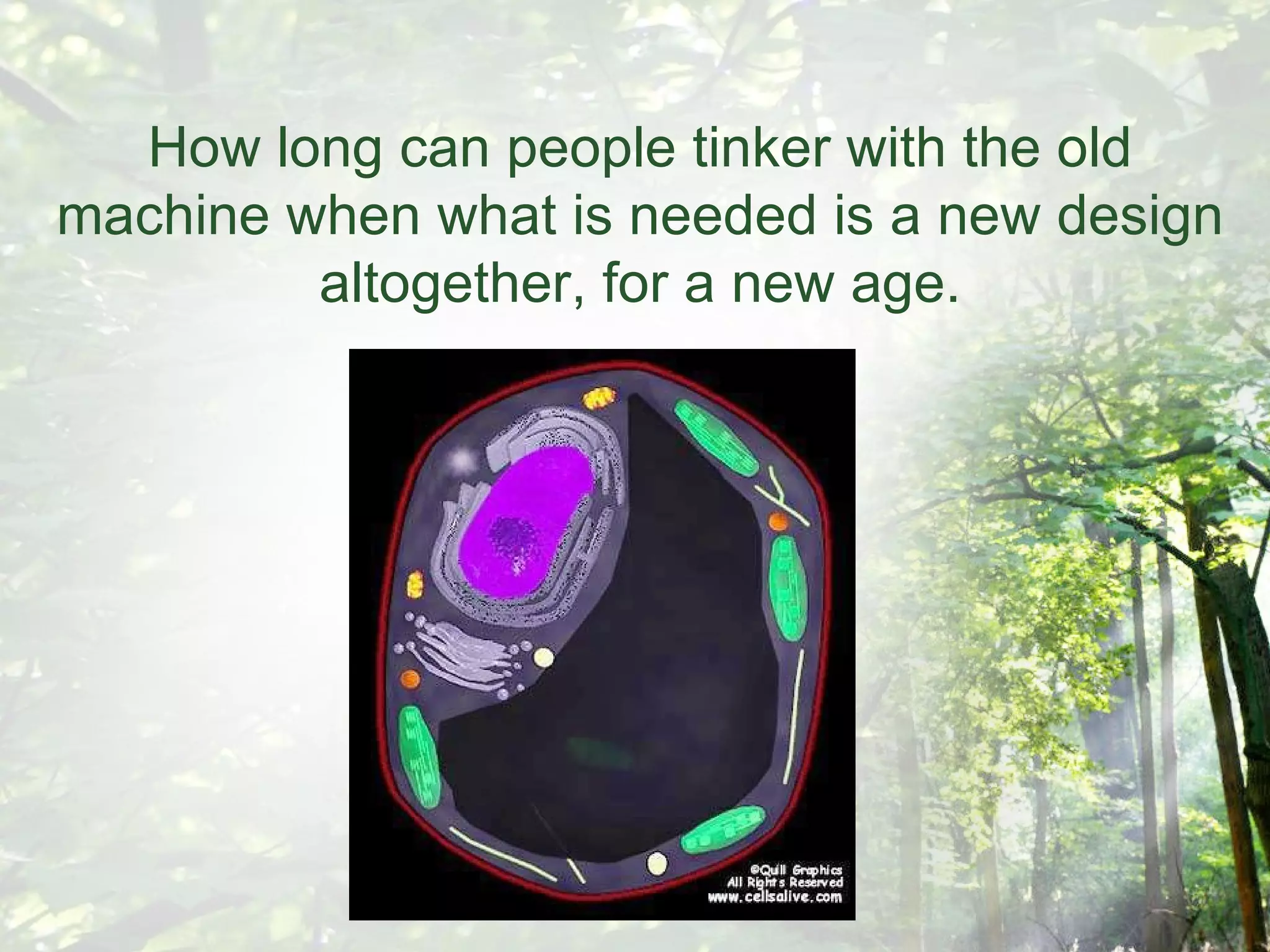
How long can people tinker with the old machine when what is needed is a new design altogether, for a new age.
Design for the Eco-cell will be developed from four research questions. (i) How can  Deep Ecology  be used to assist education practioners in teaching for sustainability? (ii) What role can  Buddhist philosophy  play in assisting teaching ecological values and ethics? (iii) How can  systems theory  understandings assist with the evolution of beyond compliance education for sustainability strategies? (iv) How can  Biomimicry  assist with the design of an education for sustainability framework?
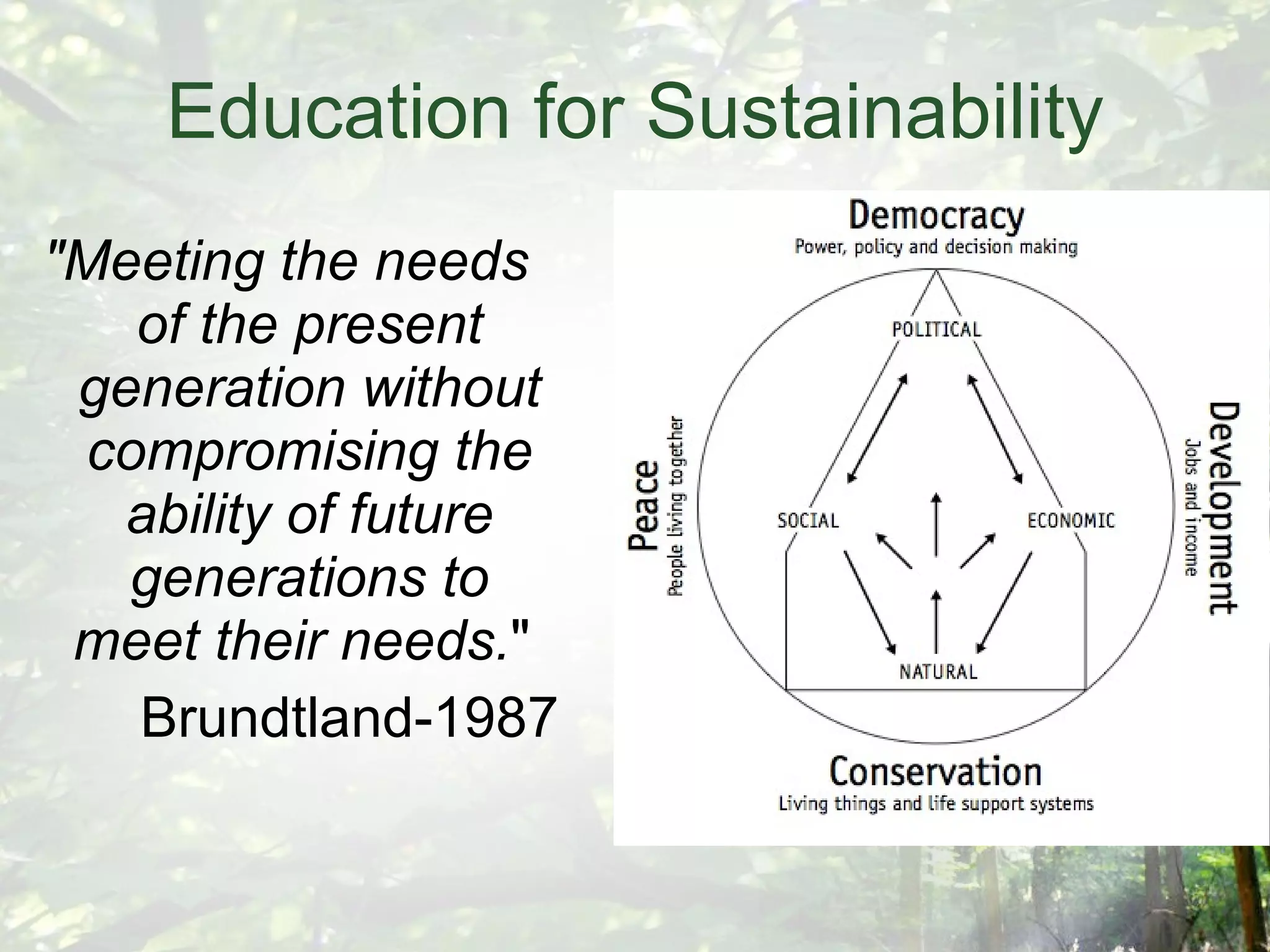
Education for Sustainability "Meeting the needs of the present generation without compromising the ability of future generations to meet their needs. "  Brundtland-1987
Critical Sustainability Themes Scale Human Connections to the physical and Natural World Ethics and Values How Natural Systems Function Technological and Economic Relationships to Sustainability Motivating Environmentally Sustainable Behaviour Pedagogical Strategies for Integrating Sustainability Education for Sustainability
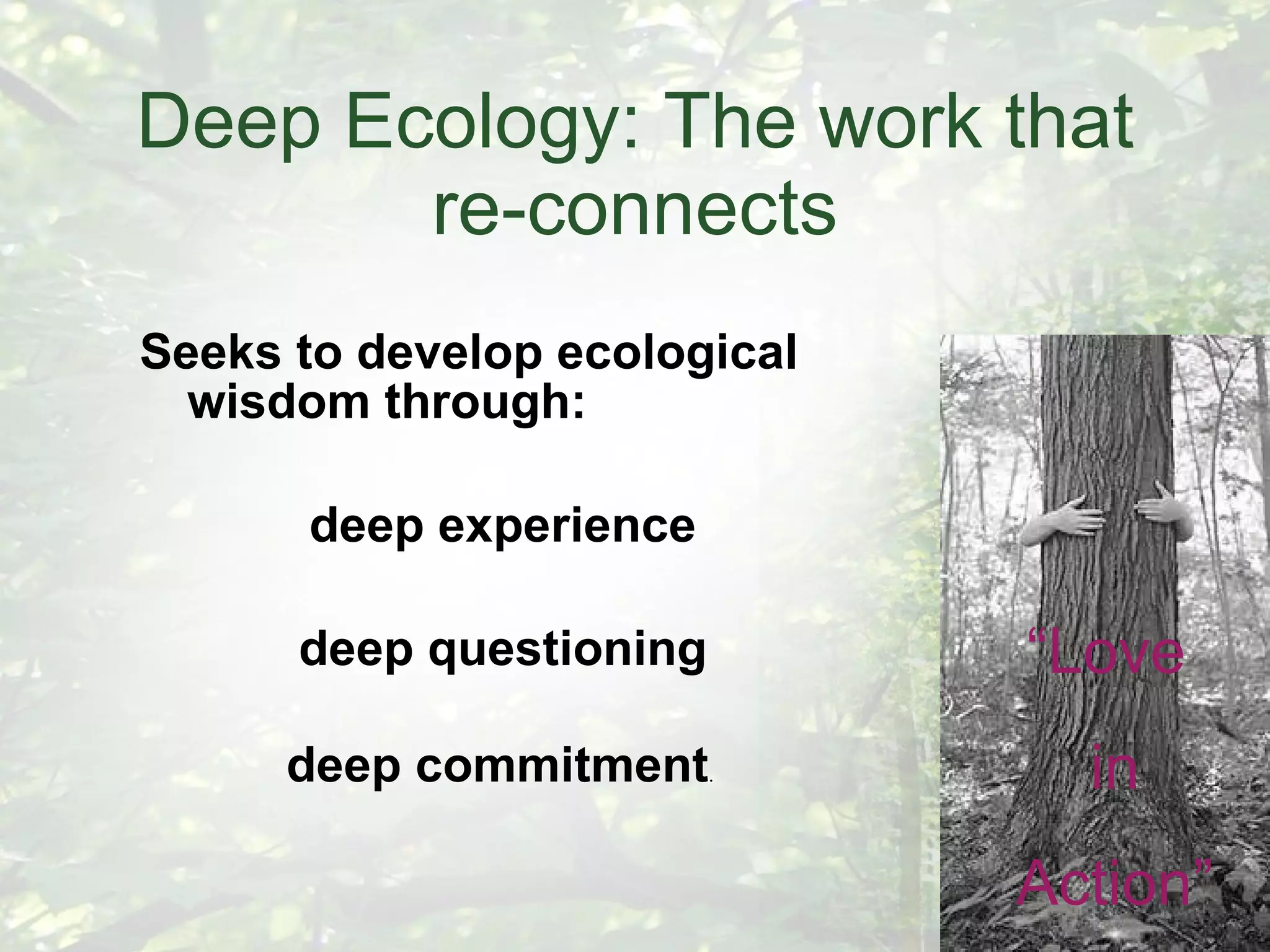
Deep Ecology: The work that re-connects Seeks to develop ecological wisdom through: deep experience deep questioning  deep commitment .  “ Love in Action”
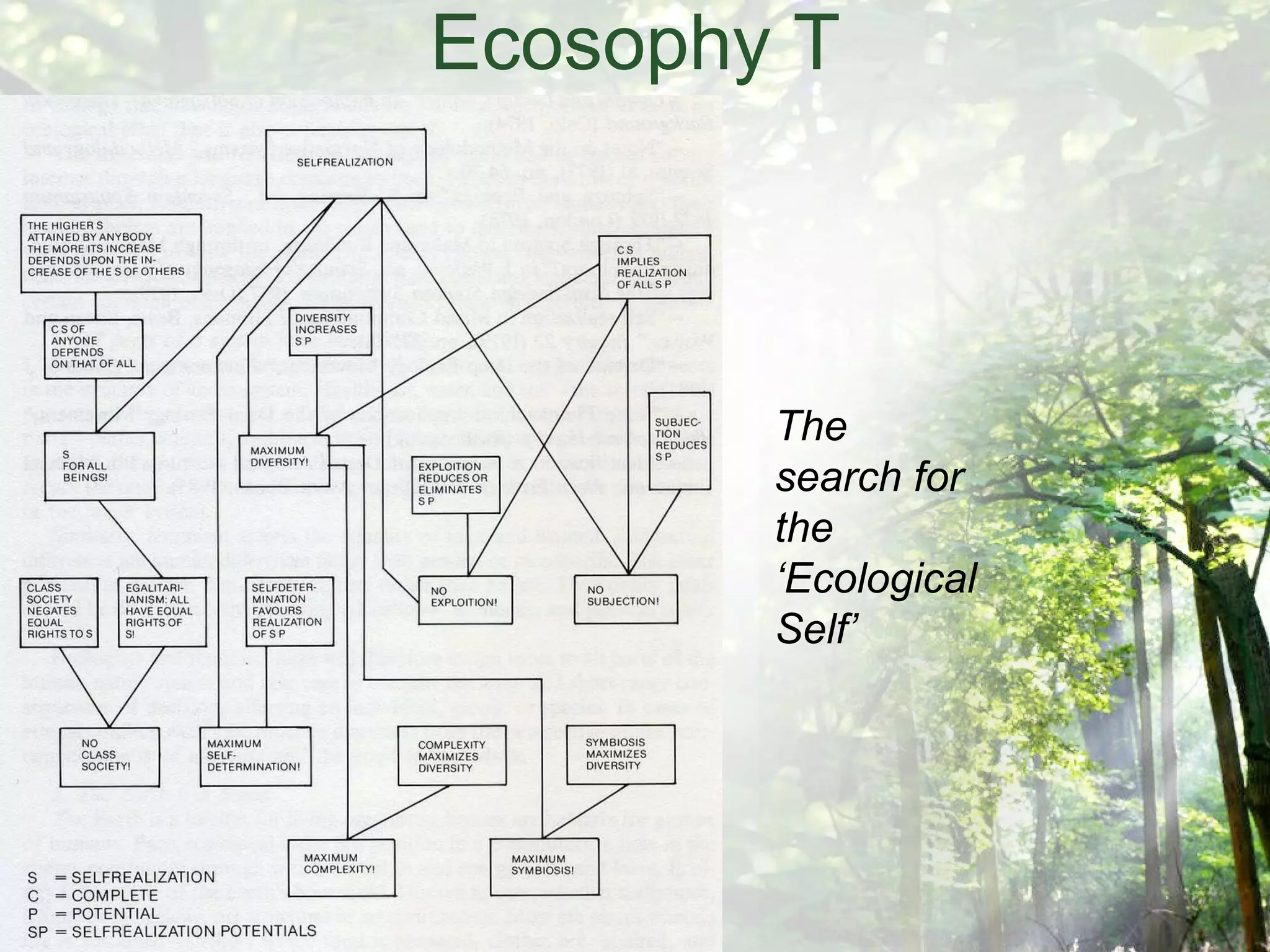
Ecosophy T The search for the ‘Ecological Self’
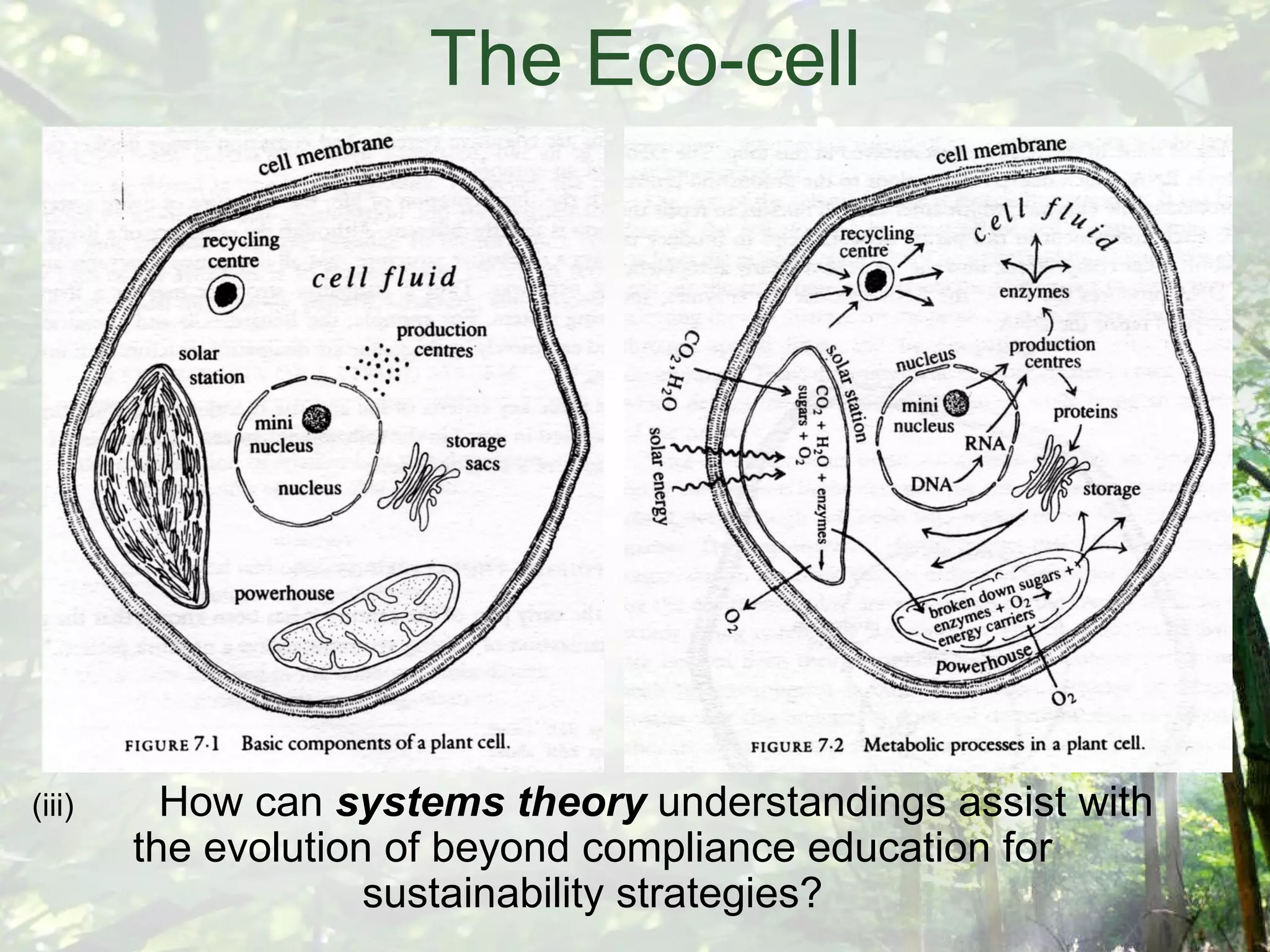
The Eco-cell  (iii) How can  systems theory  understandings assist with the evolution of beyond compliance education for sustainability strategies?
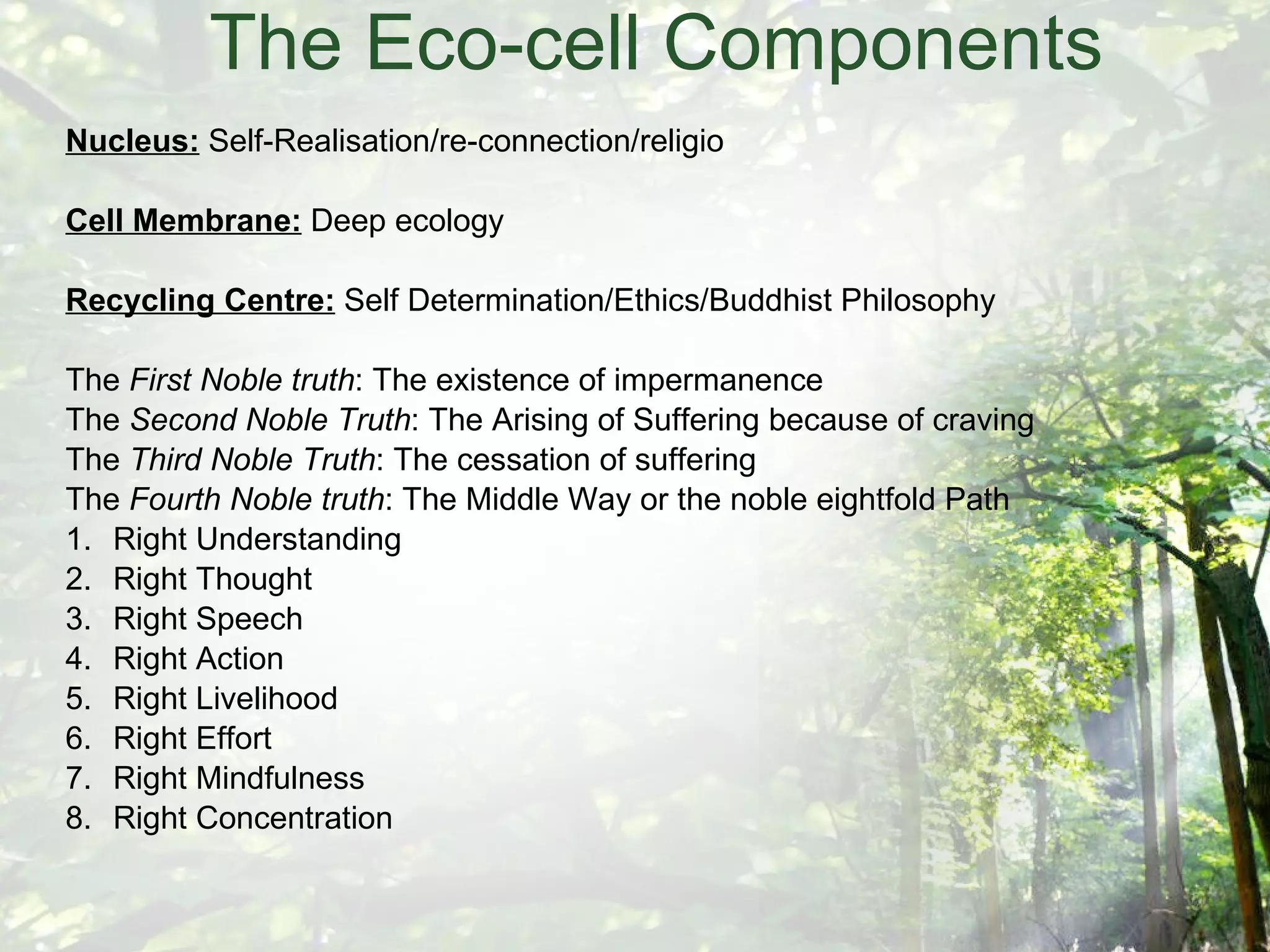
The Eco-cell Components Nucleus:  Self-Realisation/re-connection/religio Cell Membrane:  Deep ecology Recycling Centre:  Self Determination/Ethics/Buddhist Philosophy The  First Noble truth : The existence of impermanence The  Second Noble Truth : The Arising of Suffering because of craving The  Third Noble Truth : The cessation of suffering The  Fourth Noble truth : The Middle Way or the noble eightfold Path 1. Right Understanding 2. Right Thought 3. Right Speech 4. Right Action 5. Right Livelihood 6. Right Effort 7. Right Mindfulness 8. Right Concentration
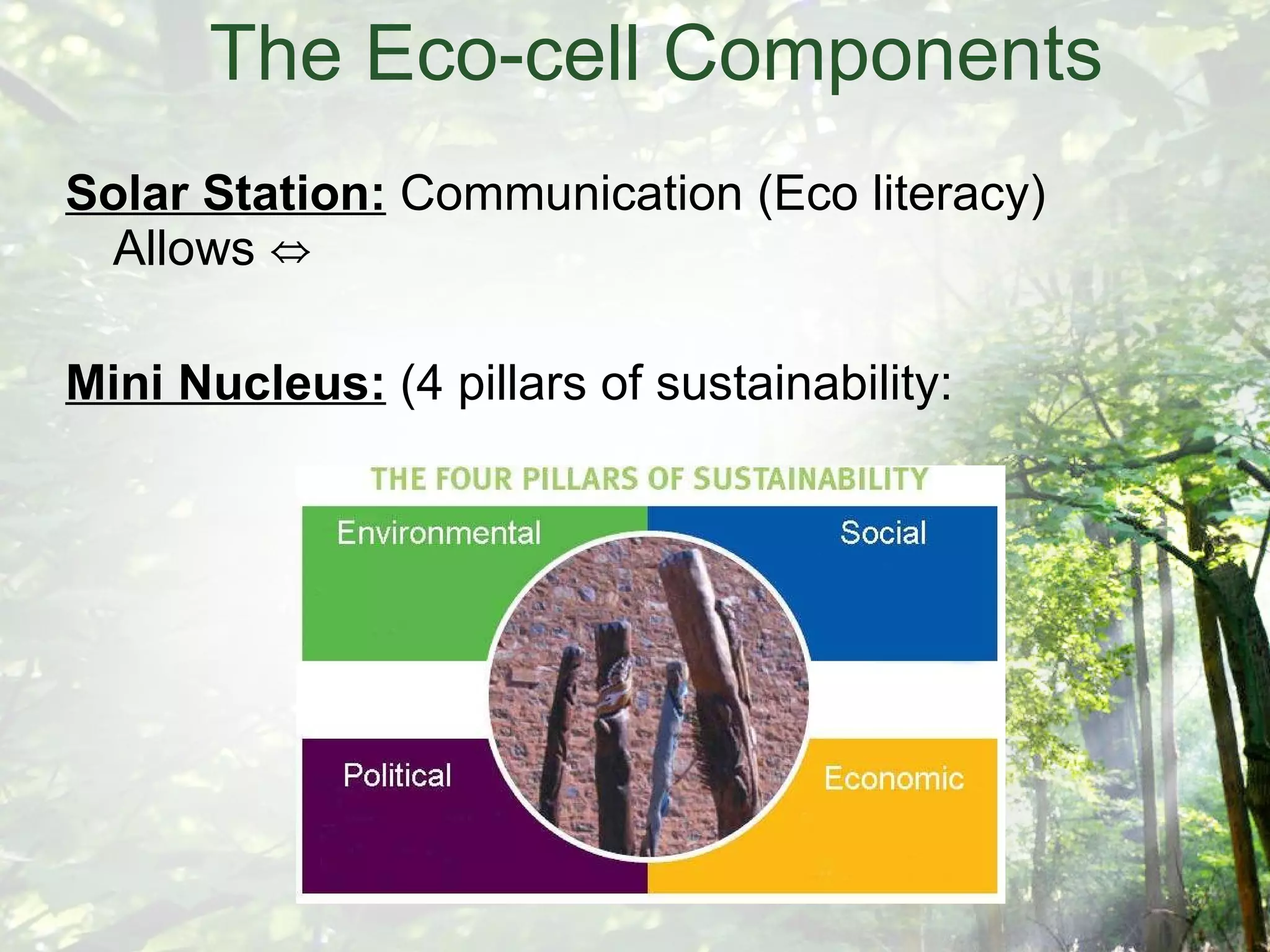
The Eco-cell Components Solar Station:  Communication (Eco literacy) Allows ⇔ Mini Nucleus:  (4 pillars of sustainability:
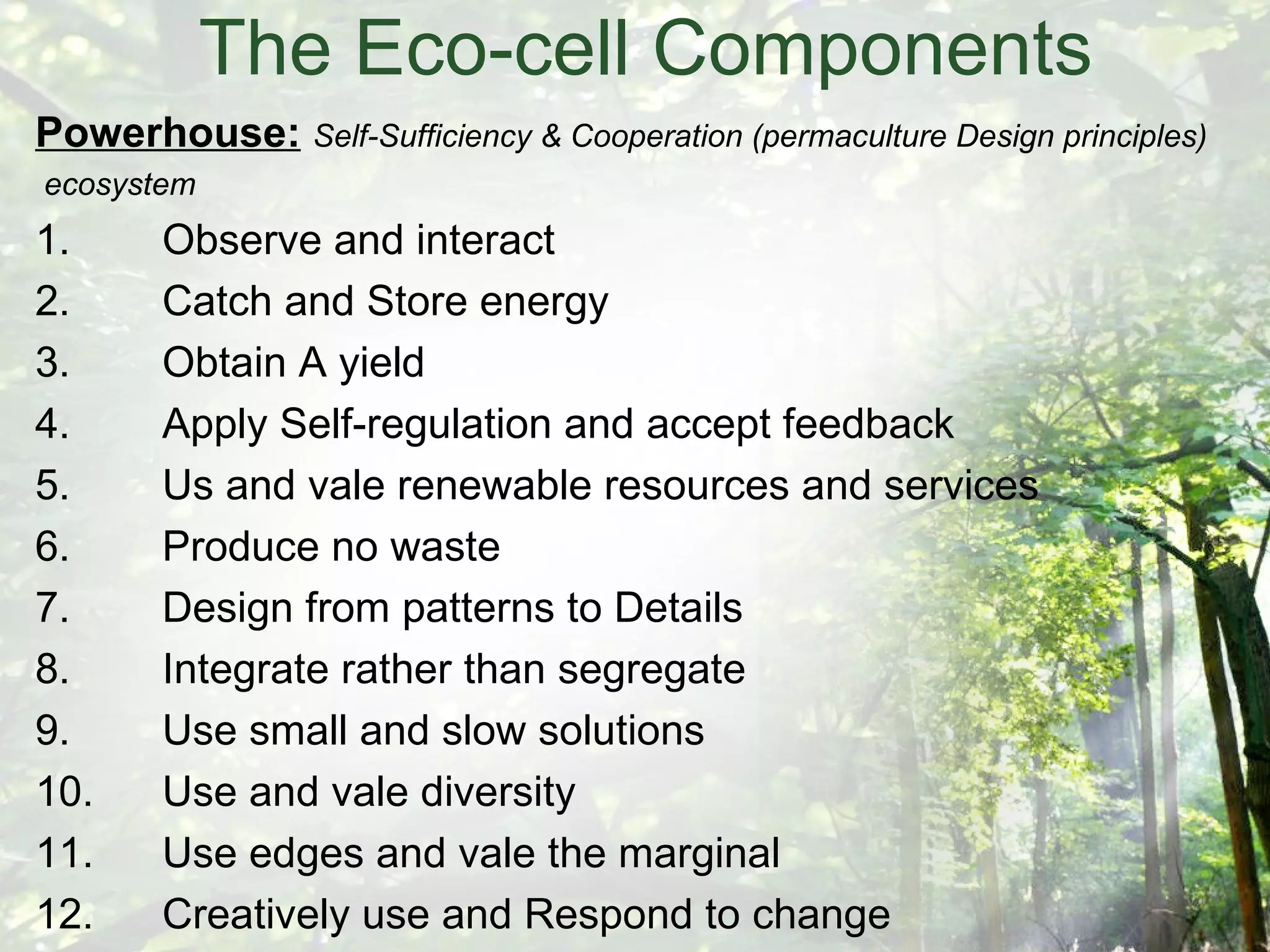
The Eco-cell Components Powerhouse:   Self-Sufficiency & Cooperation (permaculture Design principles) ecosystem 1. Observe and interact 2. Catch and Store energy 3. Obtain A yield 4. Apply Self-regulation and accept feedback 5. Us and vale renewable resources and services 6. Produce no waste 7. Design from patterns to Details 8. Integrate rather than segregate 9. Use small and slow solutions 10. Use and vale diversity 11. Use edges and vale the marginal 12. Creatively use and Respond to change
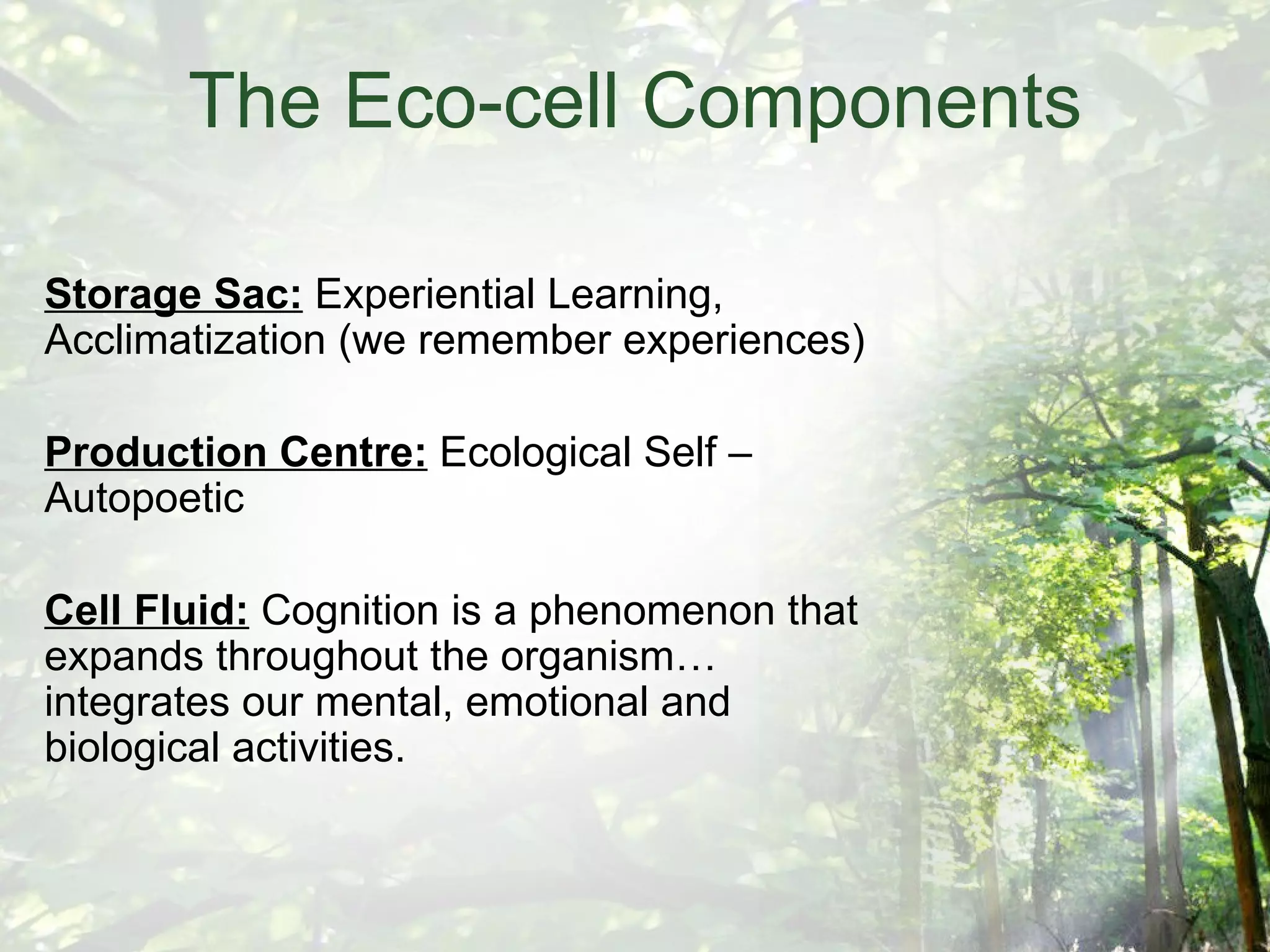
The Eco-cell Components Storage Sac:  Experiential Learning, Acclimatization (we remember experiences) Production Centre:  Ecological Self –Autopoetic Cell Fluid:  Cognition is a phenomenon that expands throughout the organism…integrates our mental, emotional and biological activities.
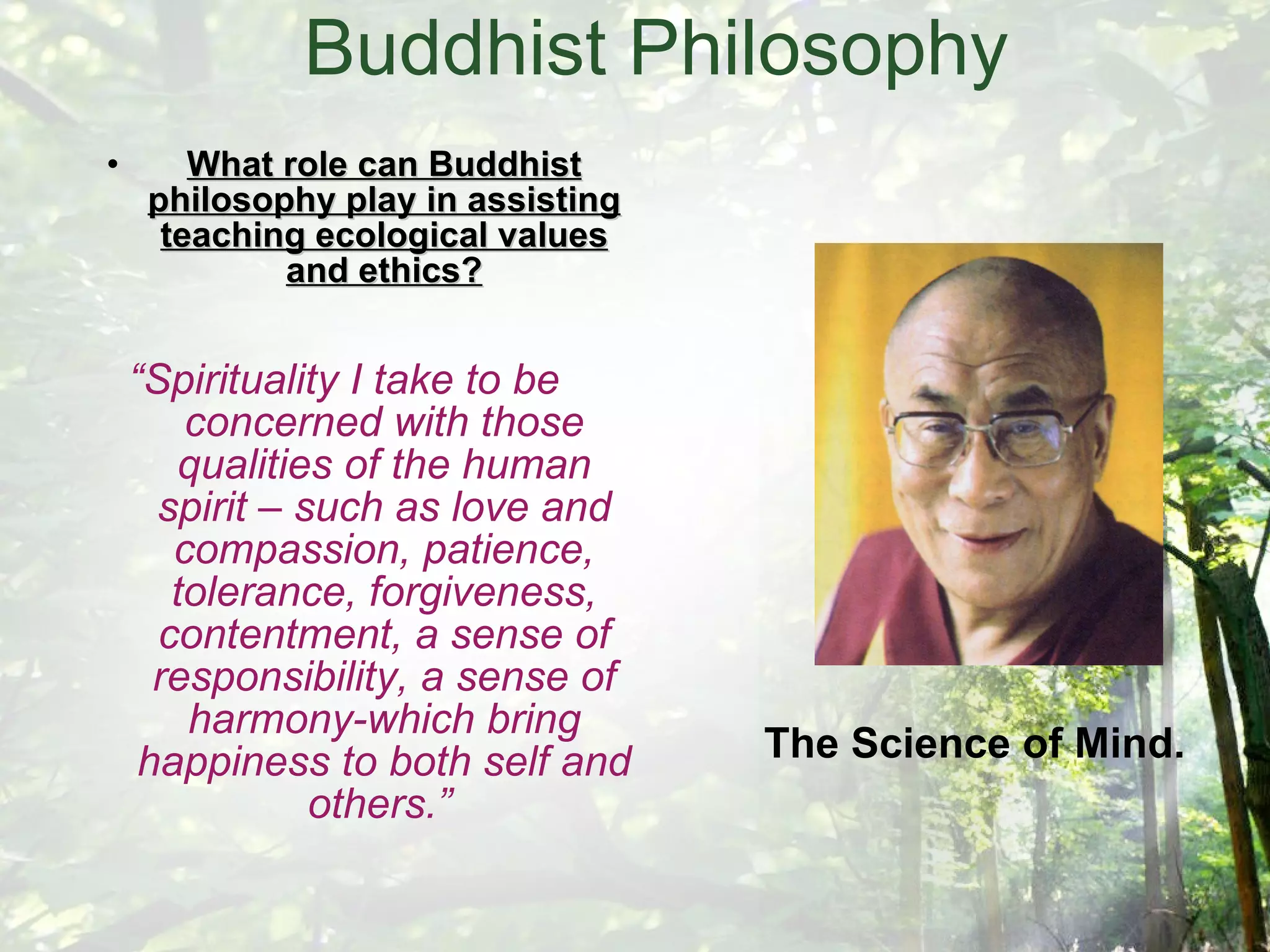
Buddhist Philosophy What role can Buddhist philosophy play in assisting teaching ecological values and ethics? “ Spirituality I take to be concerned with those qualities of the human spirit – such as love and compassion, patience, tolerance, forgiveness, contentment, a sense of responsibility, a sense of harmony-which bring happiness to both self and others.”   The Science of Mind.
General environmental ethics/values that are commonly associated with Buddhism: Buddhist Philosophy Compassion Loving kindness Effort/responsibility Equanimity Charity Humility Gratitude/thankfulness Non-self Mindfulness Interrelatedness/interbeing
Biomimicry How can Biomimicry assist with the design of an education for sustainability framework? Nature runs on sunlight. Nature uses only the energy it needs. Nature fits form to function. Nature recycles everything. Nature rewards cooperation. Nature banks on diversity. Nature demands local expertise. Nature curbs excesses from within. Nature taps the power of limits.
Methods The research Paradigm Qualitative A case Study Intrinsic Case Study Analysis Case Description- (Terrestrial Plant Ecology) Emergent Design Flexibility Green is dynamic
The way is the goal! The goal is the way! Gandhi
Green Emergent Design Holistic Perspective  (Gestalt) A systems Perspective and Systems Theory  (organic) Chaos and Complexity Theory: Nonlinear dynamics  (Metaphors for thinking about what we observe, how observe, and what we know as a result of our observations
Methods (Continued) Educational Research Design “a series of approaches,  with the intent of producing  new theories ,  artifacts ,  and  practices  that account for potentially impact learning and teaching in naturalistic settings.”
Educational Research Design Interventionist:  The research aims at designing an intervention in the real world. Iterative:  The research incorporates a cyclic approach of design, evaluation and revision Process Orientated:  a black box model of input-output measurement is avoided; focus is on understanding and improving interventions. Utility- orientated:  the merit of a design is measured, in part, by its practicality for users in real contexts. Theory-orientated: the design is based upon theoretical propositions.
Guidelines for good design Studies Riskier designs Design research discovers ways to build systems based on theories and to determine the effectiveness of these systems in practice “… therefore needs to balance boldness and caution in a different way .”
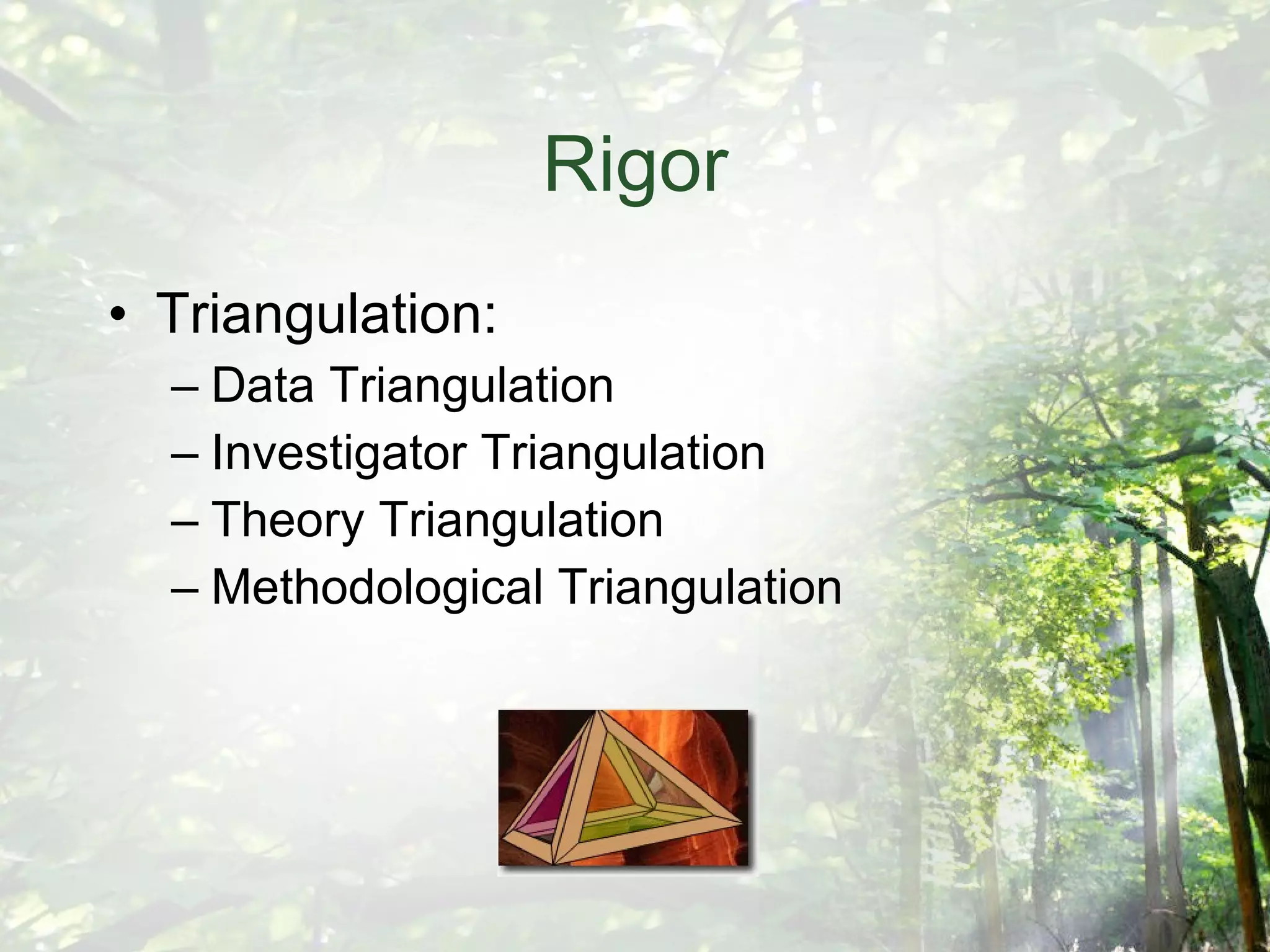
Rigor Triangulation: Data Triangulation Investigator Triangulation Theory Triangulation Methodological Triangulation
Literature review Ecology Community and lifestyle Arne Naess Web Of Life: Fritjof Capra Hidden Connections: Fritjof Capra Eco Literacy: Fritjof Capra Thinking Like a Mountain: John Seed Is it painful to think: David Rothenburg Deep Ecology: George Sessions Wisdom in the open Air: Peter Reed Deep Ecology and Buddhism: David Henning Green Buddha: C Titmus Dharma Rain Ethics: Spinoza Mutual causality J Macy Looking for Spinoza: Antonio Dimasio Biomimicry Janine Banyshus Permaculture: David Holmgren Universe in a single Atom: Dalai Lama Ethics for a new millennium: Dalai Lama Gaia: James Lovelock Wisdom of the elders: David Suzuki The sacred Balance: David Suzuki Tela paper No 8: John Fien Evaluation: Victorian Sustainable Schools pilot Project: (Laaraine Larri) Qualitative research Methods, Patton, Burns Art of Case study: Stake Dharma Gaia:
Interviewees, Consultants Sue and Col Lennox founder of Ozgreen Dr Jeff Su: Business development Manager Gould Group Jason Alexander: Director of Earth Institute John Seed: Director of Rainforest information centre Dr Kathleen Sullivan UN Nuclear disarmament educator
“ There is no scientific  method as such, but the vital feature of a scientist’s procedure has been merely to do his utmost with his mind,  no holds barred ” Nobel prize winning physicist Percy Bridgman
Thank You.

The Eco-cell project proposal

  • 1.
    The Eco-cell AnEducation for Sustainability Genesis Aid. PhD by Project By Mr Ragnar J. Haabjoern B.Teach.(Secondary.) B.App.Sci.(Environmental Science/ Earth Science) M.Ed.(Science & Environmental Education.) Grad.Cert Sustainable Practice.
  • 2.
    The world isin distress. “ The scientific evidence is now overwhelming, climate change presents very serious global risks, and it demands an urgent global response.” (Stern, 2006)
  • 3.
    Sustainability Snapshot Stateof the Environment Report 2006
  • 4.
    PM: Biggest challengeis economy, not climate Mr Howard said to call climate change Australia's overwhelming moral challenge "de-legitimises other challenges over which we do have significant control".
  • 5.
  • 6.
    How long canpeople tinker with the old machine when what is needed is a new design altogether, for a new age.
  • 7.
    Design for theEco-cell will be developed from four research questions. (i) How can Deep Ecology be used to assist education practioners in teaching for sustainability? (ii) What role can Buddhist philosophy play in assisting teaching ecological values and ethics? (iii) How can systems theory understandings assist with the evolution of beyond compliance education for sustainability strategies? (iv) How can Biomimicry assist with the design of an education for sustainability framework?
  • 8.
    Education for Sustainability"Meeting the needs of the present generation without compromising the ability of future generations to meet their needs. " Brundtland-1987
  • 9.
    Critical Sustainability ThemesScale Human Connections to the physical and Natural World Ethics and Values How Natural Systems Function Technological and Economic Relationships to Sustainability Motivating Environmentally Sustainable Behaviour Pedagogical Strategies for Integrating Sustainability Education for Sustainability
  • 10.
    Deep Ecology: Thework that re-connects Seeks to develop ecological wisdom through: deep experience deep questioning deep commitment . “ Love in Action”
  • 11.
    Ecosophy T Thesearch for the ‘Ecological Self’
  • 12.
    The Eco-cell (iii) How can systems theory understandings assist with the evolution of beyond compliance education for sustainability strategies?
  • 13.
    The Eco-cell ComponentsNucleus: Self-Realisation/re-connection/religio Cell Membrane: Deep ecology Recycling Centre: Self Determination/Ethics/Buddhist Philosophy The First Noble truth : The existence of impermanence The Second Noble Truth : The Arising of Suffering because of craving The Third Noble Truth : The cessation of suffering The Fourth Noble truth : The Middle Way or the noble eightfold Path 1. Right Understanding 2. Right Thought 3. Right Speech 4. Right Action 5. Right Livelihood 6. Right Effort 7. Right Mindfulness 8. Right Concentration
  • 14.
    The Eco-cell ComponentsSolar Station: Communication (Eco literacy) Allows ⇔ Mini Nucleus: (4 pillars of sustainability:
  • 15.
    The Eco-cell ComponentsPowerhouse: Self-Sufficiency & Cooperation (permaculture Design principles) ecosystem 1. Observe and interact 2. Catch and Store energy 3. Obtain A yield 4. Apply Self-regulation and accept feedback 5. Us and vale renewable resources and services 6. Produce no waste 7. Design from patterns to Details 8. Integrate rather than segregate 9. Use small and slow solutions 10. Use and vale diversity 11. Use edges and vale the marginal 12. Creatively use and Respond to change
  • 16.
    The Eco-cell ComponentsStorage Sac: Experiential Learning, Acclimatization (we remember experiences) Production Centre: Ecological Self –Autopoetic Cell Fluid: Cognition is a phenomenon that expands throughout the organism…integrates our mental, emotional and biological activities.
  • 17.
    Buddhist Philosophy Whatrole can Buddhist philosophy play in assisting teaching ecological values and ethics? “ Spirituality I take to be concerned with those qualities of the human spirit – such as love and compassion, patience, tolerance, forgiveness, contentment, a sense of responsibility, a sense of harmony-which bring happiness to both self and others.” The Science of Mind.
  • 18.
    General environmental ethics/valuesthat are commonly associated with Buddhism: Buddhist Philosophy Compassion Loving kindness Effort/responsibility Equanimity Charity Humility Gratitude/thankfulness Non-self Mindfulness Interrelatedness/interbeing
  • 19.
    Biomimicry How canBiomimicry assist with the design of an education for sustainability framework? Nature runs on sunlight. Nature uses only the energy it needs. Nature fits form to function. Nature recycles everything. Nature rewards cooperation. Nature banks on diversity. Nature demands local expertise. Nature curbs excesses from within. Nature taps the power of limits.
  • 20.
    Methods The researchParadigm Qualitative A case Study Intrinsic Case Study Analysis Case Description- (Terrestrial Plant Ecology) Emergent Design Flexibility Green is dynamic
  • 21.
    The way isthe goal! The goal is the way! Gandhi
  • 22.
    Green Emergent DesignHolistic Perspective (Gestalt) A systems Perspective and Systems Theory (organic) Chaos and Complexity Theory: Nonlinear dynamics (Metaphors for thinking about what we observe, how observe, and what we know as a result of our observations
  • 23.
    Methods (Continued) EducationalResearch Design “a series of approaches, with the intent of producing new theories , artifacts , and practices that account for potentially impact learning and teaching in naturalistic settings.”
  • 24.
    Educational Research DesignInterventionist: The research aims at designing an intervention in the real world. Iterative: The research incorporates a cyclic approach of design, evaluation and revision Process Orientated: a black box model of input-output measurement is avoided; focus is on understanding and improving interventions. Utility- orientated: the merit of a design is measured, in part, by its practicality for users in real contexts. Theory-orientated: the design is based upon theoretical propositions.
  • 25.
    Guidelines for gooddesign Studies Riskier designs Design research discovers ways to build systems based on theories and to determine the effectiveness of these systems in practice “… therefore needs to balance boldness and caution in a different way .”
  • 26.
    Rigor Triangulation: DataTriangulation Investigator Triangulation Theory Triangulation Methodological Triangulation
  • 27.
    Literature review EcologyCommunity and lifestyle Arne Naess Web Of Life: Fritjof Capra Hidden Connections: Fritjof Capra Eco Literacy: Fritjof Capra Thinking Like a Mountain: John Seed Is it painful to think: David Rothenburg Deep Ecology: George Sessions Wisdom in the open Air: Peter Reed Deep Ecology and Buddhism: David Henning Green Buddha: C Titmus Dharma Rain Ethics: Spinoza Mutual causality J Macy Looking for Spinoza: Antonio Dimasio Biomimicry Janine Banyshus Permaculture: David Holmgren Universe in a single Atom: Dalai Lama Ethics for a new millennium: Dalai Lama Gaia: James Lovelock Wisdom of the elders: David Suzuki The sacred Balance: David Suzuki Tela paper No 8: John Fien Evaluation: Victorian Sustainable Schools pilot Project: (Laaraine Larri) Qualitative research Methods, Patton, Burns Art of Case study: Stake Dharma Gaia:
  • 28.
    Interviewees, Consultants Sueand Col Lennox founder of Ozgreen Dr Jeff Su: Business development Manager Gould Group Jason Alexander: Director of Earth Institute John Seed: Director of Rainforest information centre Dr Kathleen Sullivan UN Nuclear disarmament educator
  • 29.
    “ There isno scientific method as such, but the vital feature of a scientist’s procedure has been merely to do his utmost with his mind, no holds barred ” Nobel prize winning physicist Percy Bridgman
  • 30.

Editor's Notes

  • #4 Does the Government really care?? Is neoliberalism the dominant paradigm.
  • #5 Climate change there was no proof: great global warming swindle 10% still think it is not human
  • #6 Through my investigation of the real source of our civilizations plight Values pops up So what do intend to do---- The Eco cell.
  • #7 Lets go back to the garden. Newtonian Newtonian physics, clock work, gestalt parts and whole A cell can grow, evolve, adapt evolve, it is an organism a living organisation.
  • #13 Theory of living things - understanding of pattern Structure involves quantities, pattern involves qualities(configuration of relationships. Systems theory interdependence - ecosystem similarities
  • #16 Zero waste , Nature wastes nothing, uses the ultimate power source, Solar energy, harmony balance photosynthesis
  • #17 Make sure you connect to literature
  • #18 deep ecology and deep spirituality as philosophic sisters. Quality of life. Goes against GDP Depression pill Altruism towards others and the environment Happier person and planet
  • #22 Naess inspiration Non-violence artifact creation and project planning framework methodology
  • #24 Aristotle identified two types of wisdom - the esoteric/metaphysical and practical wisdom Practical wisdom , or phronesis, is also aimed at truth, but truth in the service of action.