It’s now or
   never!!
        Created by:
   -Prarthana Kharod
     -Meghana Kharod
       -Stuti Mankad
What is the presentation all about?

•   Diwali is originally religious festival
•   Presently, main attraction –”FIREWORKS”
•   We are trying to create an awareness about
    the harmful effects of fireworks, by this
    presentation…
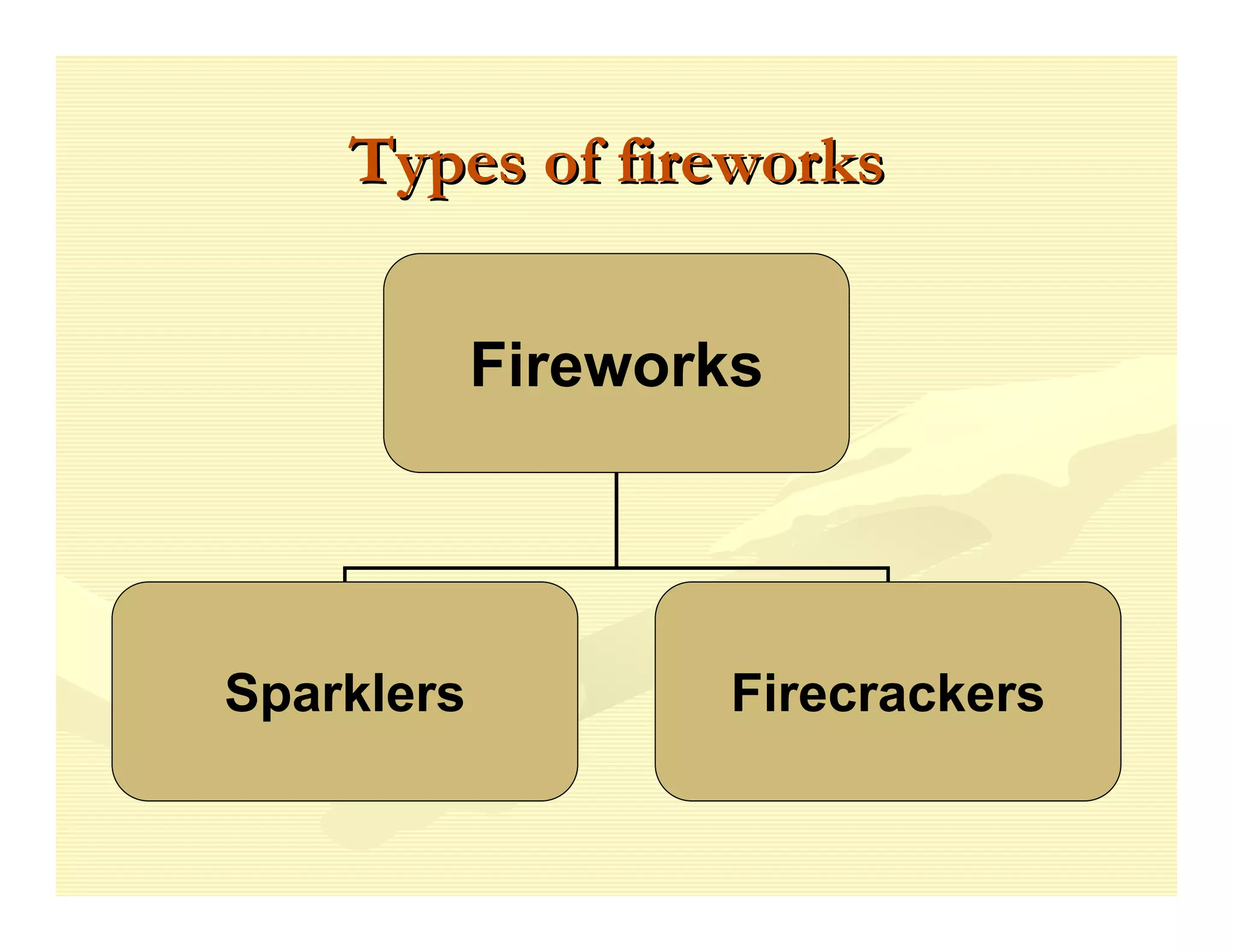
Types of fireworks

            Fireworks


Sparklers          Firecrackers
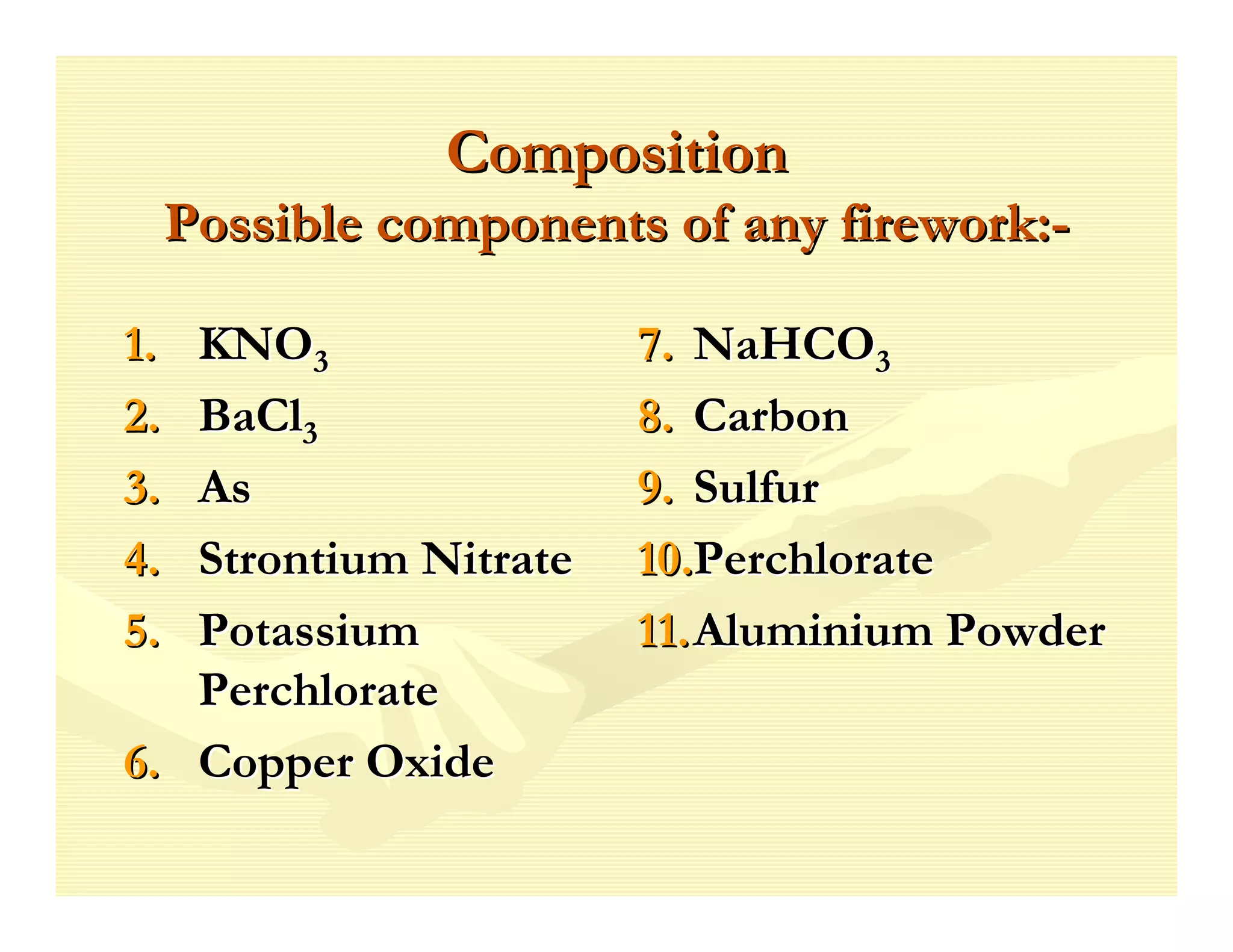
Composition
     Possible components of any firework:-

1. KNO3                 7. NaHCO3
2. BaCl3                8. Carbon
3. As                   9. Sulfur
4. Strontium Nitrate    10.Perchlorate
5. Potassium            11. Aluminium Powder
   Perchlorate
6. Copper Oxide
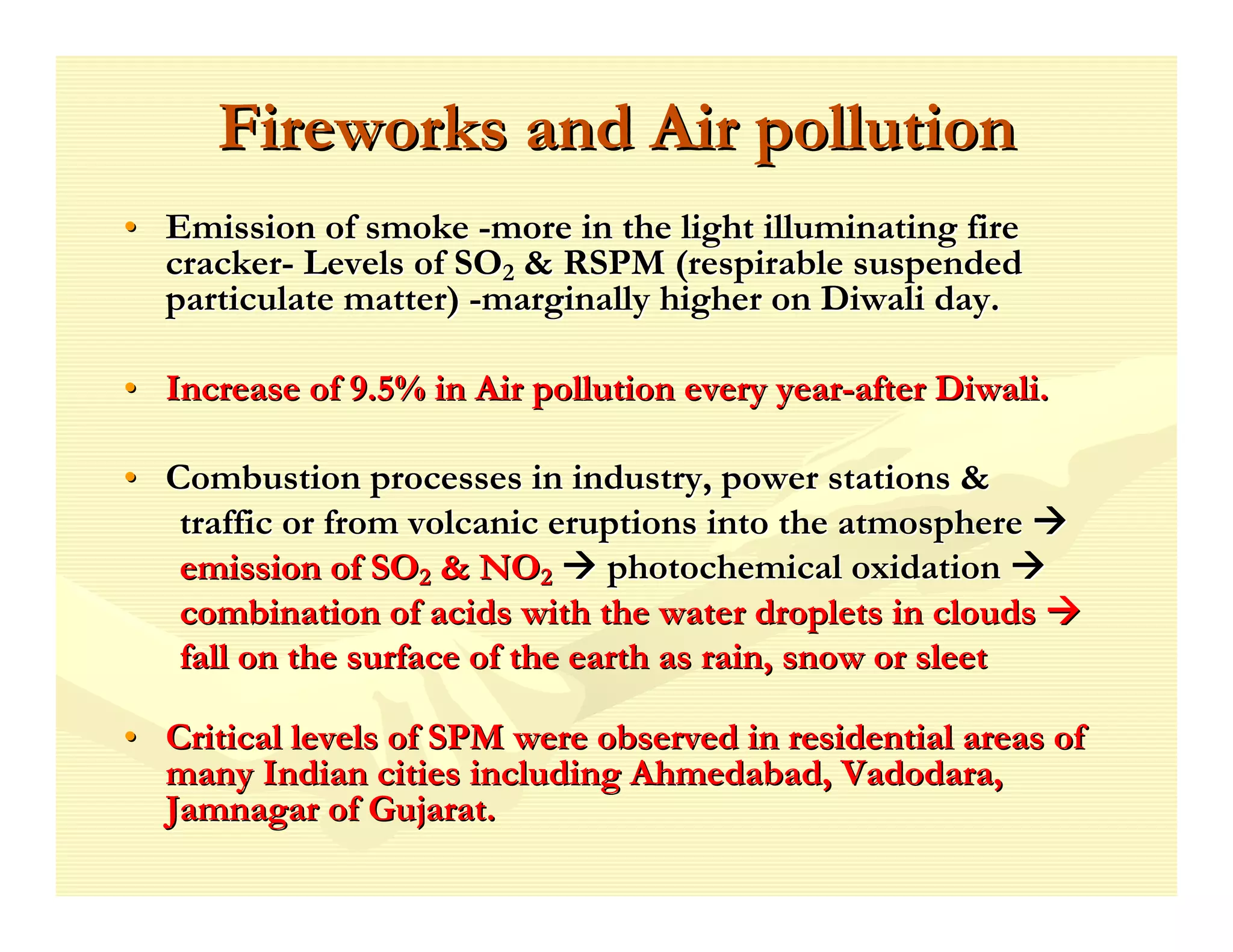
Fireworks and Air pollution
• Emission of smoke -more in the light illuminating fire
  cracker- Levels of SO2 & RSPM (respirable suspended
  particulate matter) -marginally higher on Diwali day.

• Increase of 9.5% in Air pollution every year-after Diwali.

• Combustion processes in industry, power stations &
   traffic or from volcanic eruptions into the atmosphere 
   emission of SO2 & NO2  photochemical oxidation 
   combination of acids with the water droplets in clouds 
   fall on the surface of the earth as rain, snow or sleet

• Critical levels of SPM were observed in residential areas of
  many Indian cities including Ahmedabad, Vadodara,
  Jamnagar of Gujarat.
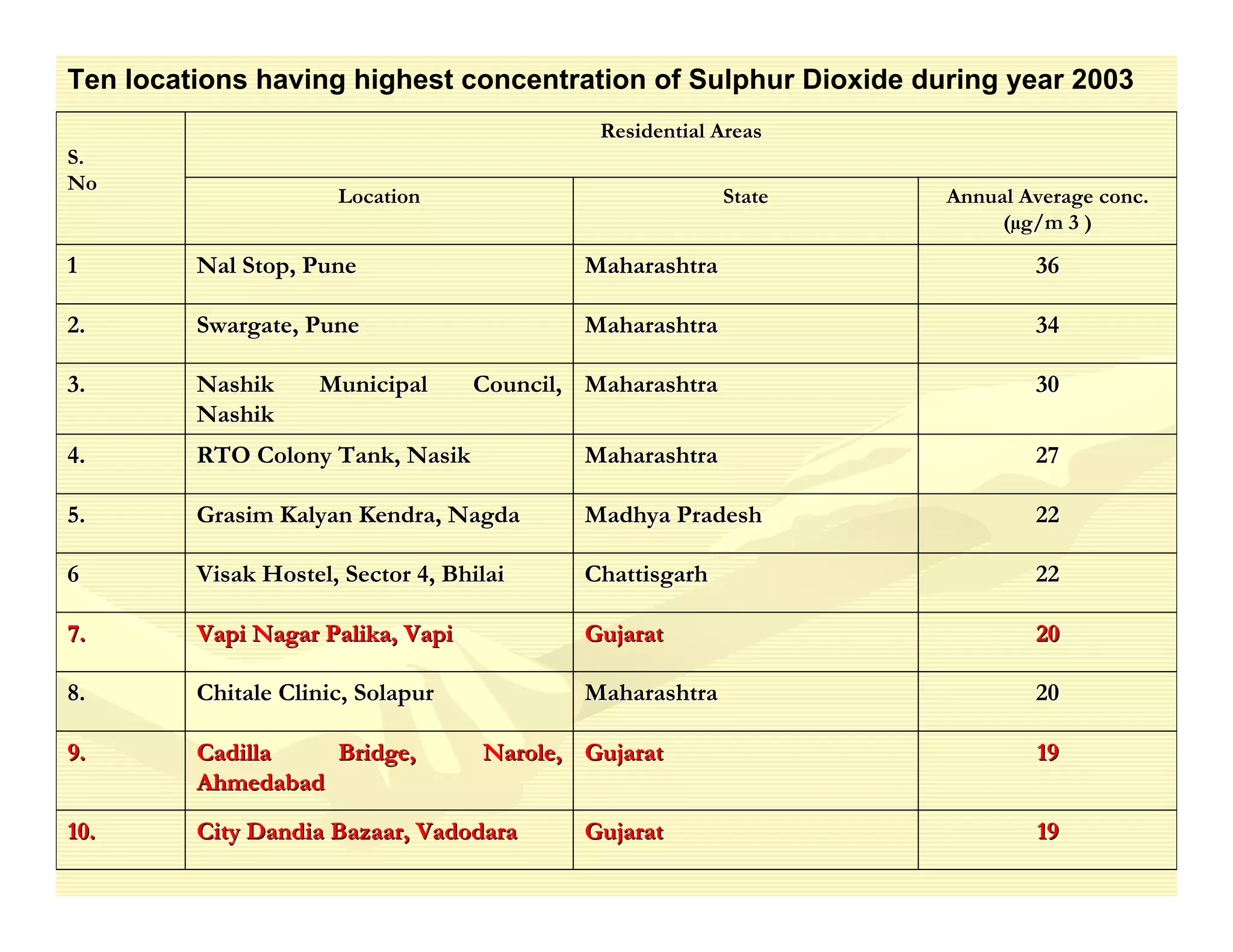
Ten locations having highest concentration of Sulphur Dioxide during year 2003
                                             Residential Areas
S.
No
                      Location                            State   Annual Average conc.
                                                                       (µg/m 3 )

1        Nal Stop, Pune                     Maharashtra                   36

2.       Swargate, Pune                     Maharashtra                   34

3.       Nashik     Municipal      Council, Maharashtra                   30
         Nashik
4.       RTO Colony Tank, Nasik             Maharashtra                   27

5.       Grasim Kalyan Kendra, Nagda        Madhya Pradesh                22

6        Visak Hostel, Sector 4, Bhilai     Chattisgarh                   22

7.       Vapi Nagar Palika, Vapi            Gujarat                       20

8.       Chitale Clinic, Solapur            Maharashtra                   20

9.       Cadilla   Bridge,          Narole, Gujarat                       19
         Ahmedabad
10.      City Dandia Bazaar, Vadodara       Gujarat                       19
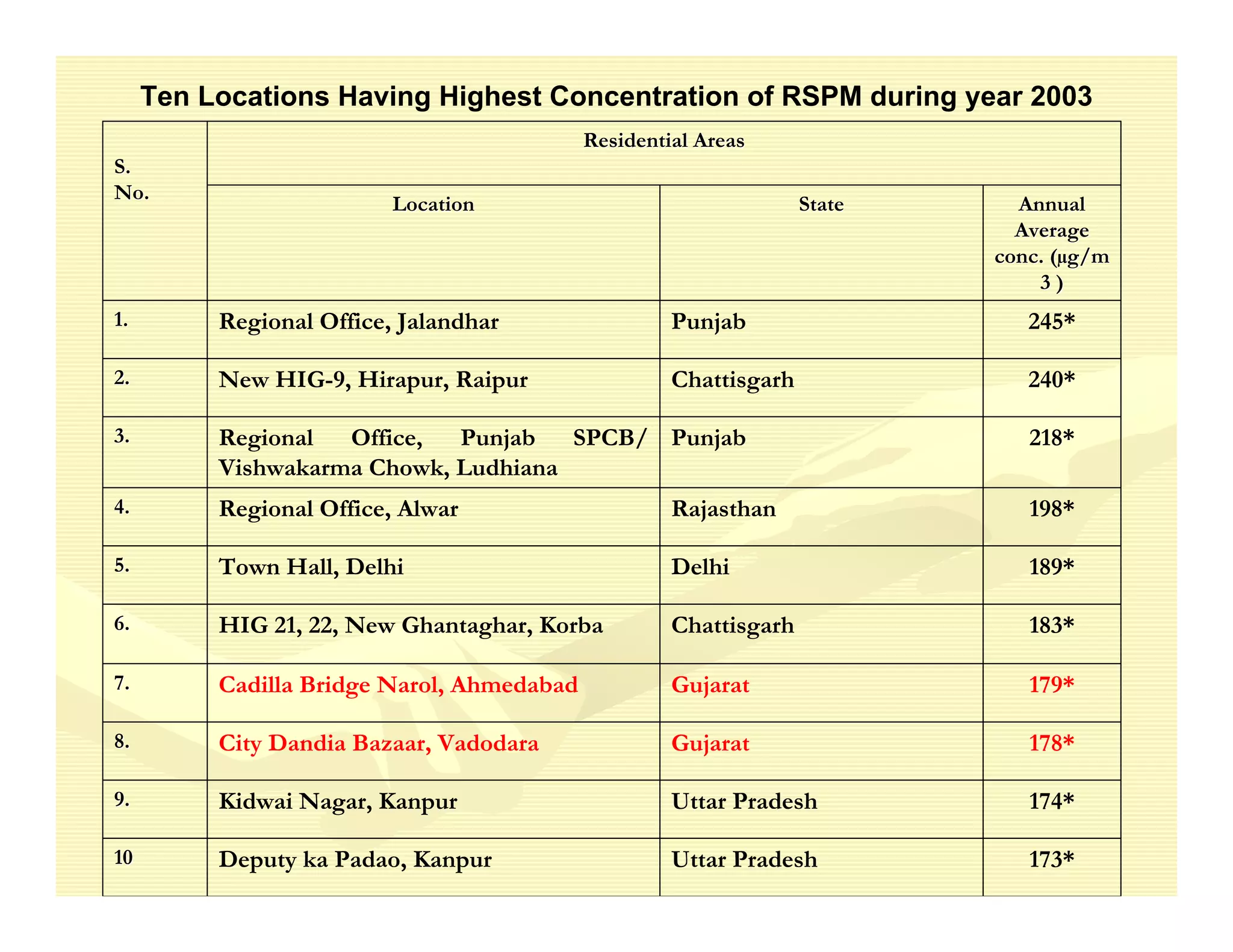
Ten Locations Having Highest Concentration of RSPM during year 2003
                                            Residential Areas
S.
No.
                          Location                                 State     Annual
                                                                             Average
                                                                           conc. (µg/m
                                                                               3)
1.        Regional Office, Jalandhar                 Punjab                   245*

2.        New HIG-9, Hirapur, Raipur                 Chattisgarh              240*

3.        Regional  Office,  Punjab   SPCB/ Punjab                            218*
          Vishwakarma Chowk, Ludhiana
4.        Regional Office, Alwar                     Rajasthan                198*

5.        Town Hall, Delhi                           Delhi                    189*

6.        HIG 21, 22, New Ghantaghar, Korba          Chattisgarh              183*

7.        Cadilla Bridge Narol, Ahmedabad            Gujarat                  179*

8.        City Dandia Bazaar, Vadodara               Gujarat                  178*

9.        Kidwai Nagar, Kanpur                       Uttar Pradesh            174*

10        Deputy ka Padao, Kanpur                    Uttar Pradesh            173*
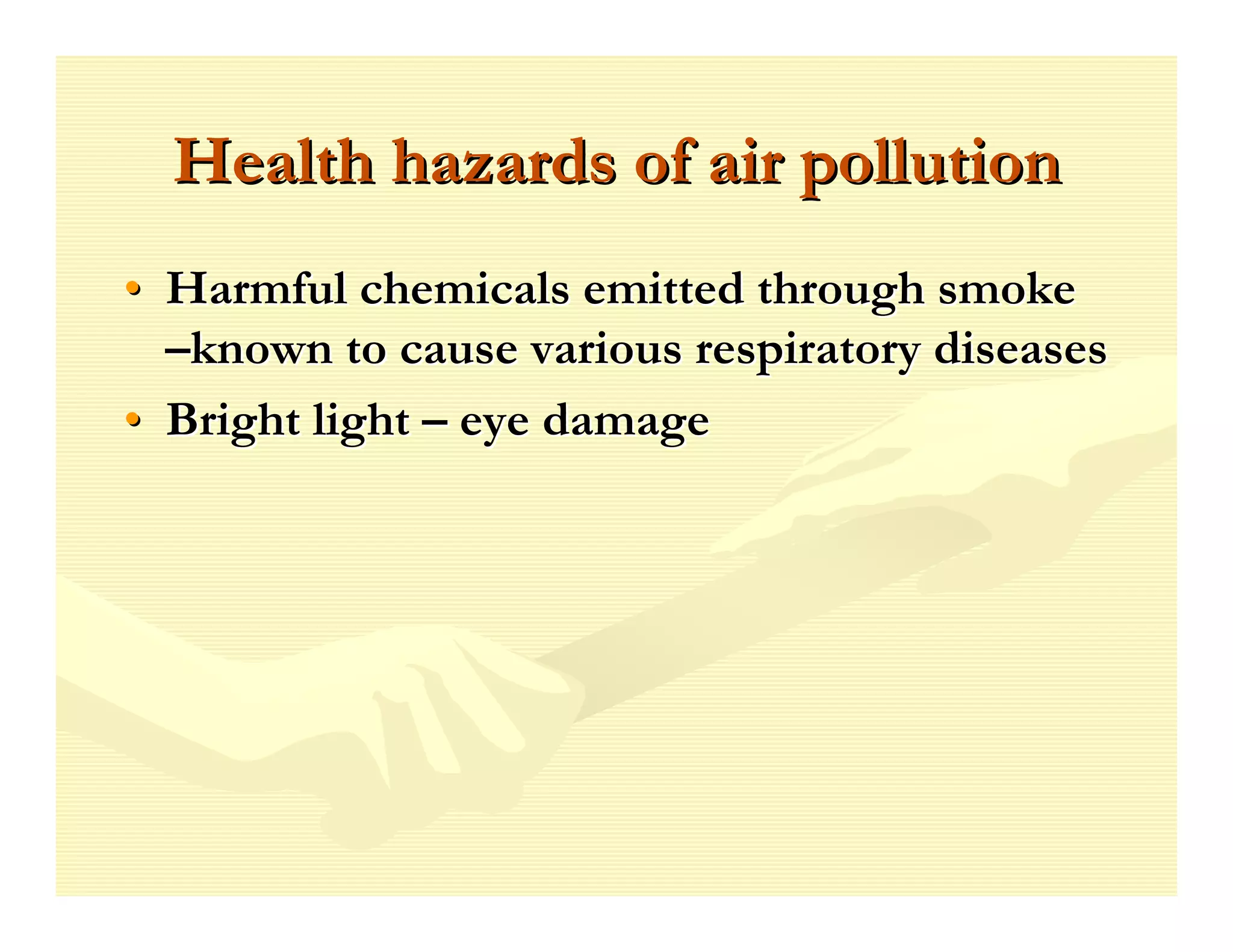
Health hazards of air pollution
• Harmful chemicals emitted through smoke
  –known to cause various respiratory diseases
• Bright light – eye damage
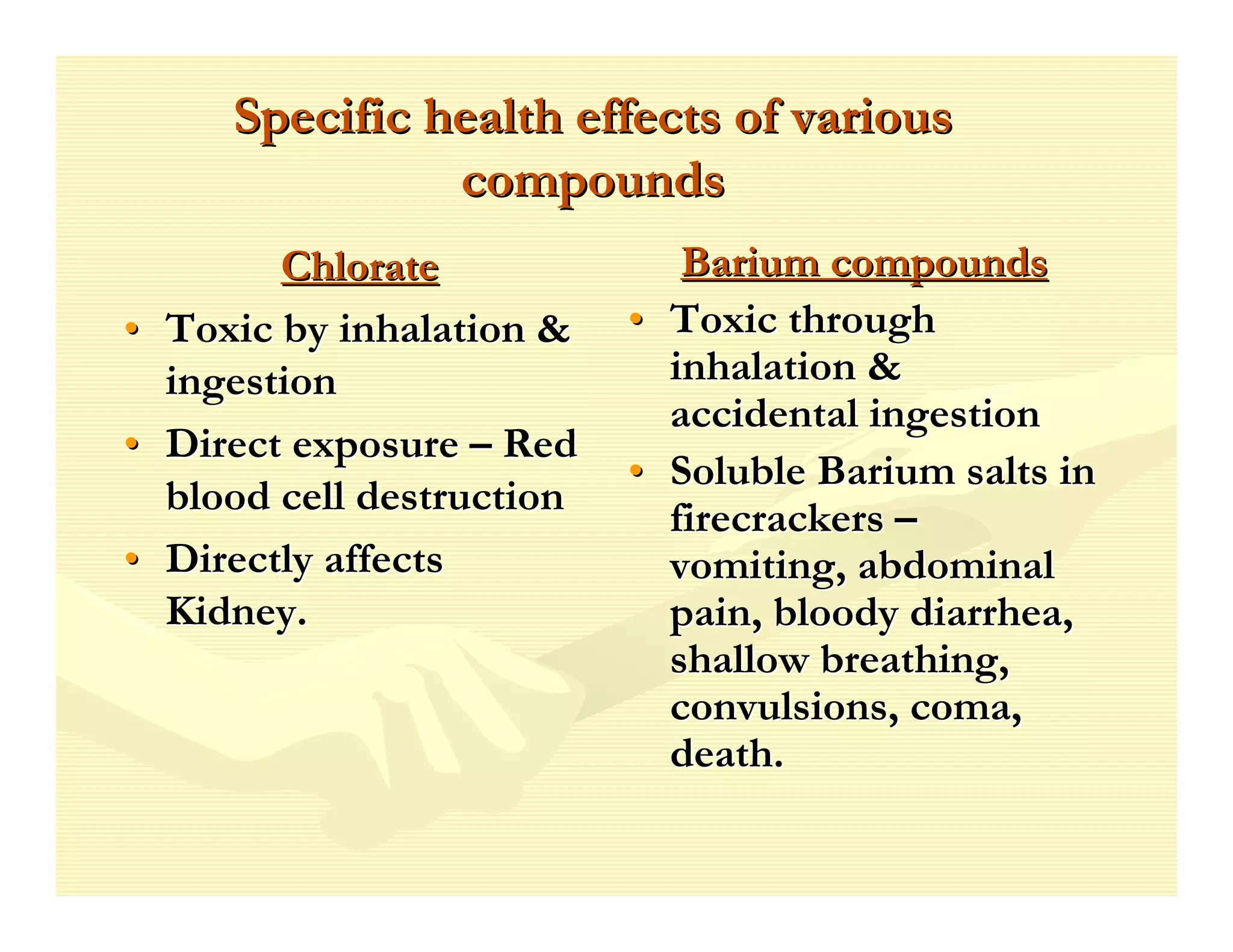
Specific health effects of various
                 compounds
          Chlorate              Barium compounds
•   Toxic by inhalation &    • Toxic through
    ingestion                  inhalation &
                               accidental ingestion
•   Direct exposure – Red
                             • Soluble Barium salts in
    blood cell destruction
                               firecrackers –
•   Directly affects           vomiting, abdominal
    Kidney.                    pain, bloody diarrhea,
                               shallow breathing,
                               convulsions, coma,
                               death.
Nitrate compounds           Sulfur compounds
• Toxic through            • Acute inhalation of
  inhalation & skin          Sulfur powder/dust –
  contact                    shortness of breath,
• Inhalation – acute         cough, tightness &
  pulmonary edema or         feeling of burning in
  COPD                       the chest
• Skin contact –           • Poisoning – irritation
  significant absorption     of eyes, skin, lungs &
  from burnt areas –         GIT
  causes corrosion of
  skin & other tissues
• Copper – irritation of respiratory tract
• Cadmium – Anemia and kidney damage
• Lead – Nervous system affection
• Magnesium – Dust & fume cause metal fume
                fever
• Sodium – Reacts violently with moisture & can
           attack skin
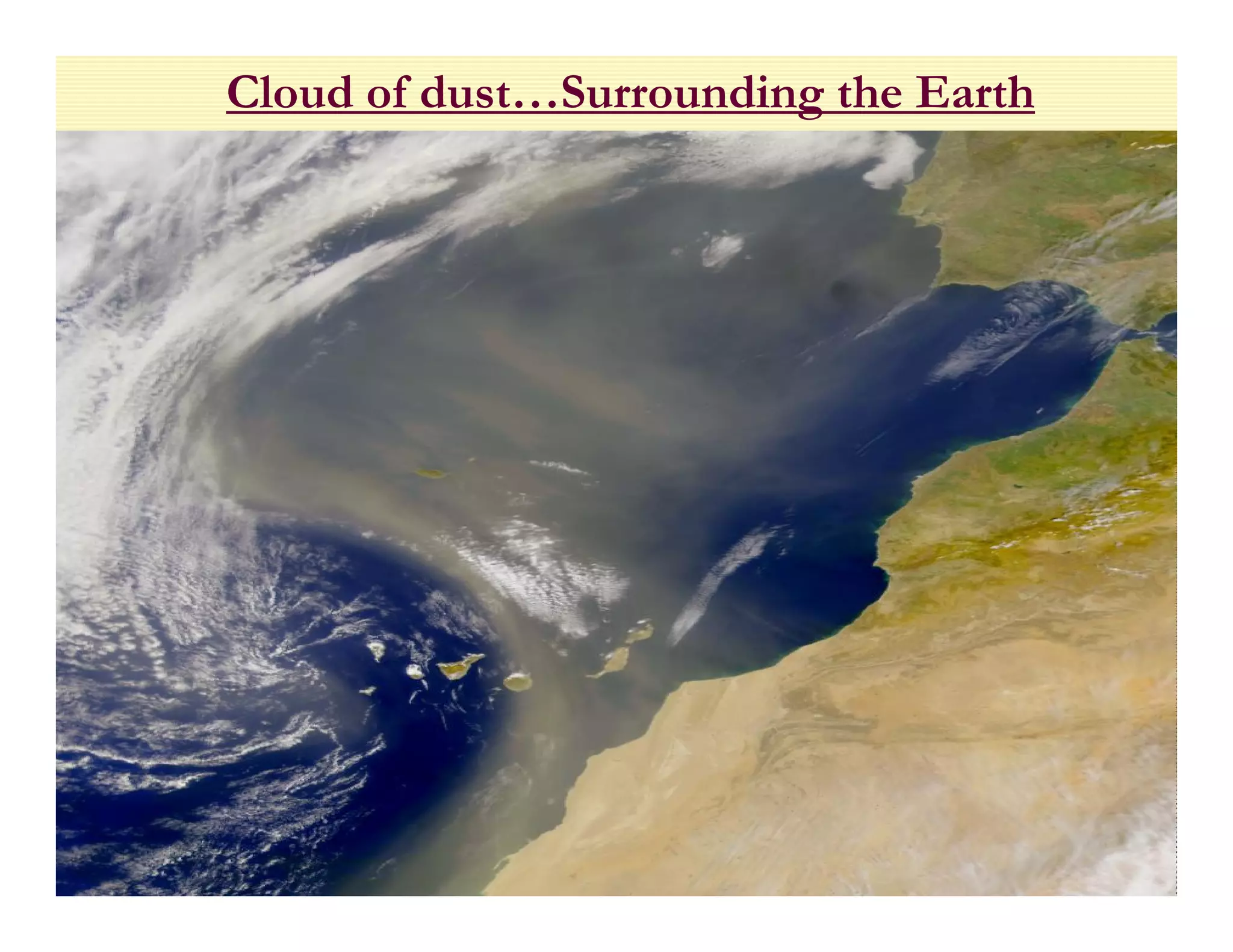
Cloud of dust…Surrounding the Earth
Fireworks and Noise pollution
• Noise- Wrong sound, at wrong time, at
  wrong place
• <80 db- No hearing loss
• 80-130 db- Temporary hearing loss
• >=150 db- physical rupture of human ear
            drum
• Crackers that make a noise of more than 125
  db at 4 meter distance from the point of
  bursting- banned by the law.
Remember- Noise made by
most of the crackers, harm
            us.
Health hazards of Noise pollution
1. Auditory
• Physical damage to ear
• Inability to detect weak sounds
2. Non Auditory
• High Blood Pressure
• Emotional and psychological effects
• Irritability, anxiety, stress
• Mental fatigue
• Poor performance of school children
• Affects particularly children
• May lead to accidents like fire, blasts etc.
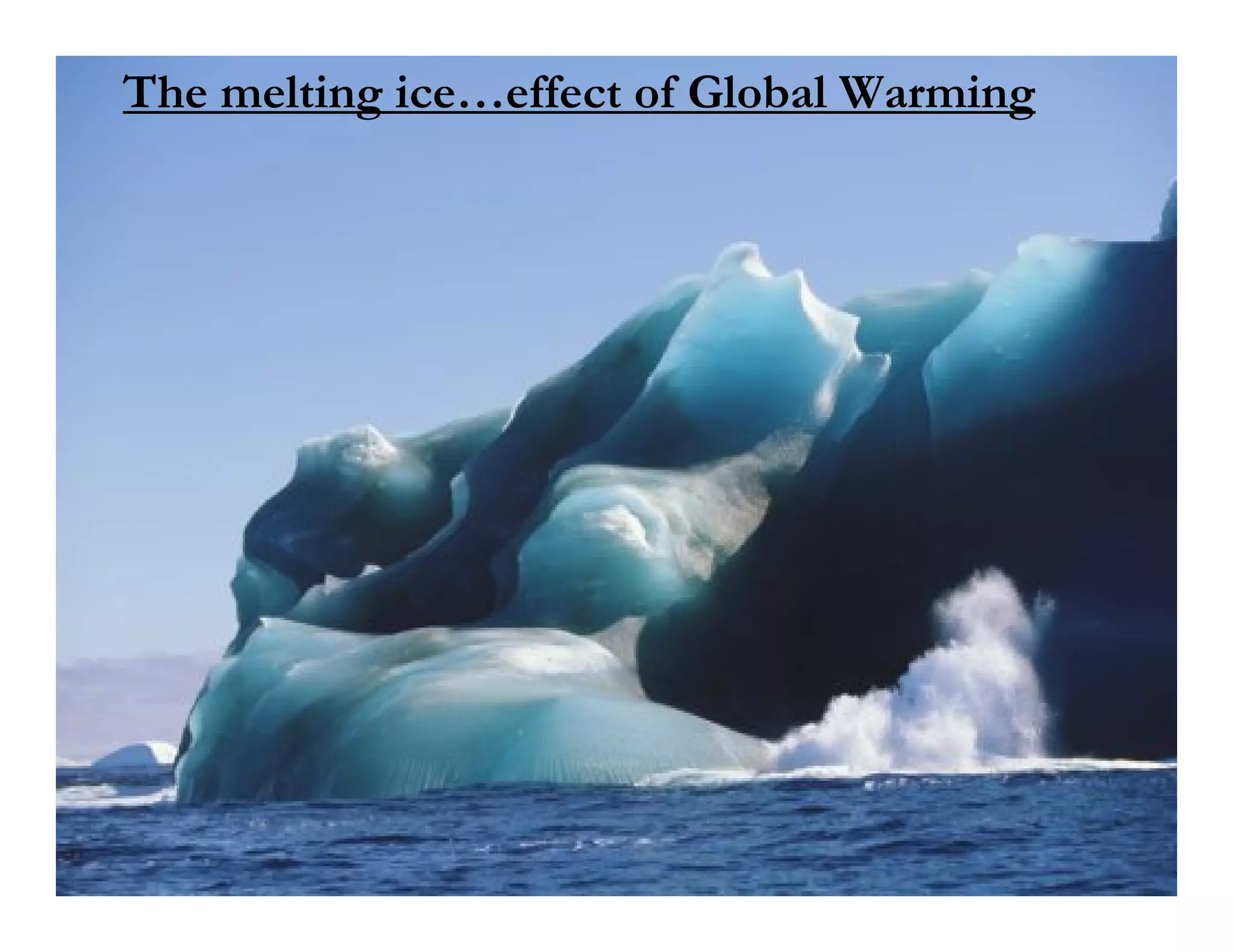
Global warming & climate change

• Burning issue
• Global warming has changed the climate,
  significantly
The melting ice…effect of Global Warming
Where should I go now???
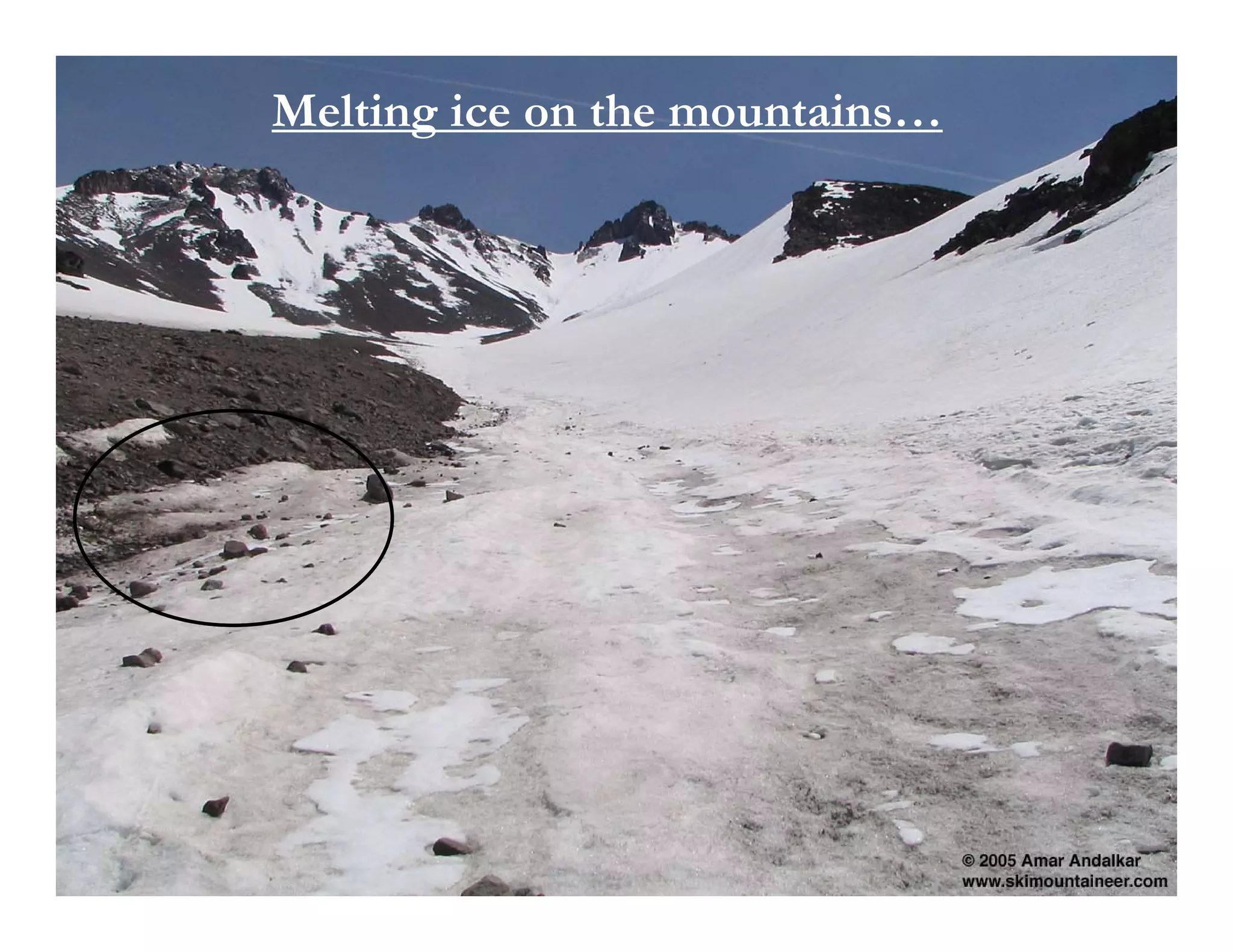
Melting ice on the mountains…
Effects of Climate Change
• The joint warmest years globally since world records began
  in 1856 were 1998 and 2005, followed by 2001/2/3/4/6!
• In last 50 years, The Arctic ice sheet has lost almost half its
  thickness-contracting at approx 8% per decade.
• Water shortages occurred.
• According to the insurance industry, three times as many
  severe natural disasters during the 1990s as during the
  1960s.
• Lengthening of growing seasons in the most northern and
  southern countries, animal and plant species moving to
  higher ground, decline of some animal and plant
  populations, earlier tree flowering, insect emergence and
  egg-laying in birds.
Continue…

            Effects of Climate Change
   • Additional deaths due to the migration of disease
     caused by warming could already be 5 million,
     according to the World Health Organization.
   • Desertification of Northern China ,During 2005,
     desert has increased by an area larger than Britain.
   • During 2003, high temperature caused over 20,000
     deaths in Europe. In India- 1400 people died due
     to the exceptional temperature up to 49°C.
Fireworks & Child Labor
• India has the largest number of child
  workers in the world.
• Most of the fireworks-manufactured by child
  labourers.
• Gov. of India banned child labour.
• The children are doing their work at home
  to fetch money, particularly in Sivakashi,
  Tamilnadu.
Child labour

• Children, spread over Nungi and
  Champahati in South 24 Parganas or
  Bagnan in Howrah, West Bengal, are
  making fire crackers.
• According to the 2001 census, India has 12.6
  million child workers. Activists estimate the
  figure is more than 60 million.
Advantages & disadvantages of
             fireworks
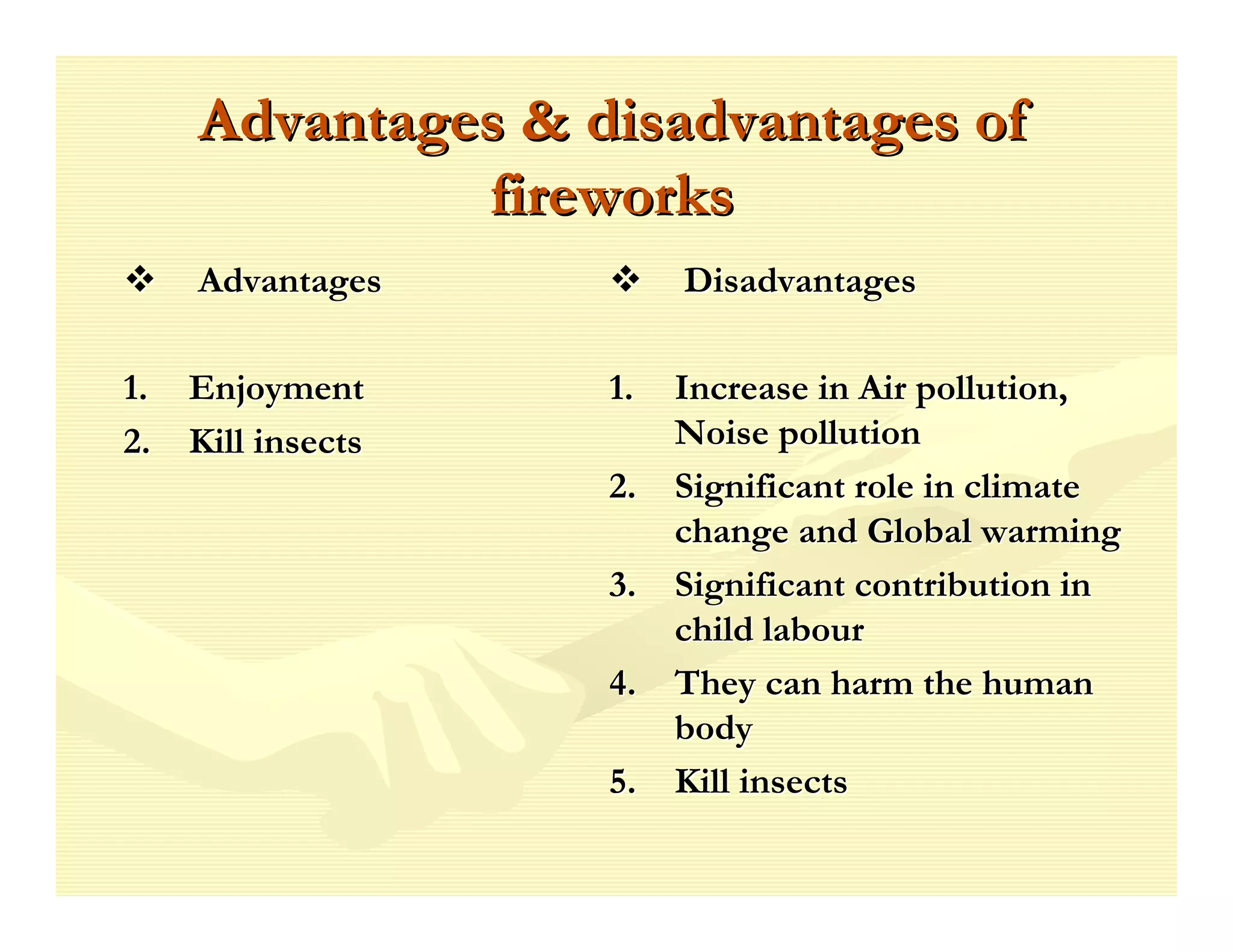
   Advantages        Disadvantages

1. Enjoyment      1.   Increase in Air pollution,
2. Kill insects        Noise pollution
                  2.   Significant role in climate
                       change and Global warming
                  3.   Significant contribution in
                       child labour
                  4.   They can harm the human
                       body
                  5.   Kill insects
New and safer ways to celebrate
                Diwali
•   Decorate your house
•   Shop for you and your family.
•   Prepare sweets and enjoy them
•   Spend your saved money on an outing. Have a nice
    trip with your family members.
•   Use that money for some good cause.
•   Watch movies and stage programmes
•   Invest your precious money and secure your future
If no action is taken…
• Already, Global warming and greenhouse
  effect have started changing the basic
  formation of air.
• If we don’t take any action, end of the Earth
  is not so far.
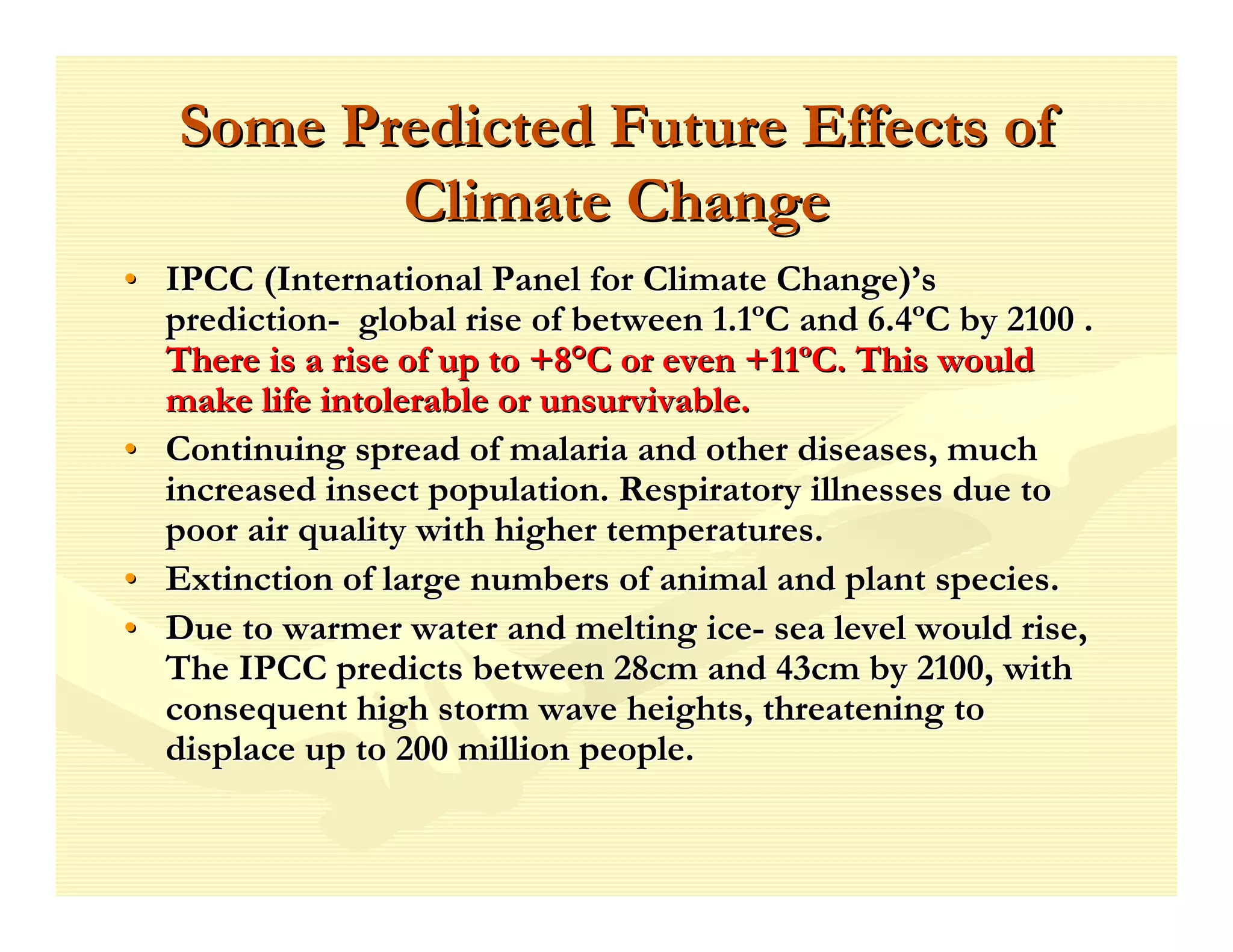
Some Predicted Future Effects of
          Climate Change
• IPCC (International Panel for Climate Change)’s
  prediction- global rise of between 1.1ºC and 6.4ºC by 2100 .
  There is a rise of up to +8°C or even +11ºC. This would
  make life intolerable or unsurvivable.
• Continuing spread of malaria and other diseases, much
  increased insect population. Respiratory illnesses due to
  poor air quality with higher temperatures.
• Extinction of large numbers of animal and plant species.
• Due to warmer water and melting ice- sea level would rise,
  The IPCC predicts between 28cm and 43cm by 2100, with
  consequent high storm wave heights, threatening to
  displace up to 200 million people.
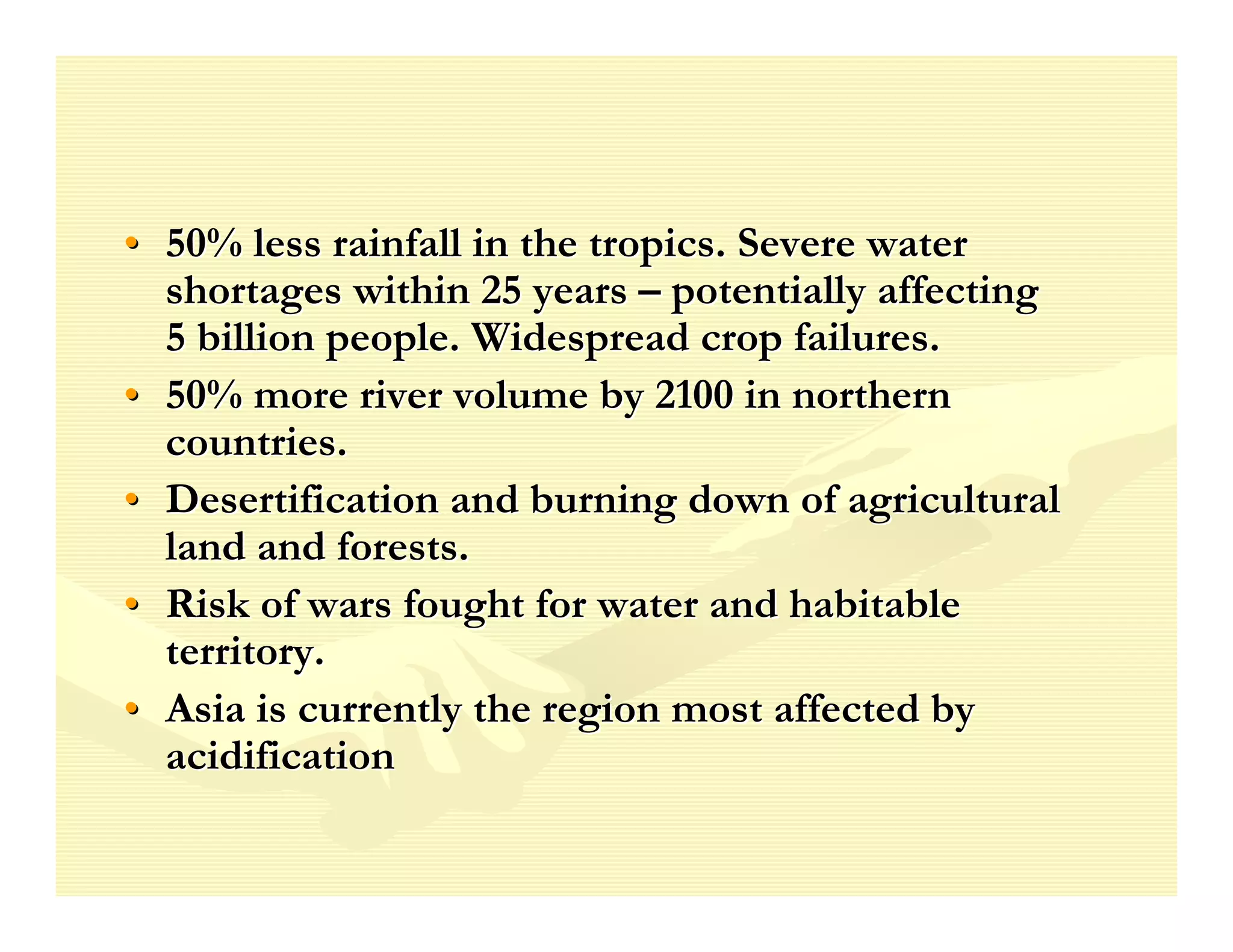
• 50% less rainfall in the tropics. Severe water
  shortages within 25 years – potentially affecting
  5 billion people. Widespread crop failures.
• 50% more river volume by 2100 in northern
  countries.
• Desertification and burning down of agricultural
  land and forests.
• Risk of wars fought for water and habitable
  territory.
• Asia is currently the region most affected by
  acidification
• Remember, we have only 95 years to recover
  the damage, according to the scientists.
• It is a very short period to survive.
• Now we have to decide, what we want.
  Enjoyment and luxury or life?
• It is the time to act…


           Do or die!!!
Acknowledgement
      I sincerely thank the following sources….

•   Greenfacts.com
•   The Earth institute at Columbia University
•   indianchild.com
•   transport2000.org
•   cca.org
•   cpcb.nic.in
•   diwalifestival.org
•   Exploringourenvironment (Maharashtra government site)
LET’S CELEBRATE
 ECO-DIWALI…
HAPPY ECO-DIWALI

   THANK YOU…

Lets make a change, this Diwali

  • 1.
    It’s now or never!! Created by: -Prarthana Kharod -Meghana Kharod -Stuti Mankad
  • 2.
    What is thepresentation all about? • Diwali is originally religious festival • Presently, main attraction –”FIREWORKS” • We are trying to create an awareness about the harmful effects of fireworks, by this presentation…
  • 3.
    Types of fireworks Fireworks Sparklers Firecrackers
  • 4.
    Composition Possible components of any firework:- 1. KNO3 7. NaHCO3 2. BaCl3 8. Carbon 3. As 9. Sulfur 4. Strontium Nitrate 10.Perchlorate 5. Potassium 11. Aluminium Powder Perchlorate 6. Copper Oxide
  • 5.
    Fireworks and Airpollution • Emission of smoke -more in the light illuminating fire cracker- Levels of SO2 & RSPM (respirable suspended particulate matter) -marginally higher on Diwali day. • Increase of 9.5% in Air pollution every year-after Diwali. • Combustion processes in industry, power stations & traffic or from volcanic eruptions into the atmosphere  emission of SO2 & NO2  photochemical oxidation  combination of acids with the water droplets in clouds  fall on the surface of the earth as rain, snow or sleet • Critical levels of SPM were observed in residential areas of many Indian cities including Ahmedabad, Vadodara, Jamnagar of Gujarat.
  • 6.
    Ten locations havinghighest concentration of Sulphur Dioxide during year 2003 Residential Areas S. No Location State Annual Average conc. (µg/m 3 ) 1 Nal Stop, Pune Maharashtra 36 2. Swargate, Pune Maharashtra 34 3. Nashik Municipal Council, Maharashtra 30 Nashik 4. RTO Colony Tank, Nasik Maharashtra 27 5. Grasim Kalyan Kendra, Nagda Madhya Pradesh 22 6 Visak Hostel, Sector 4, Bhilai Chattisgarh 22 7. Vapi Nagar Palika, Vapi Gujarat 20 8. Chitale Clinic, Solapur Maharashtra 20 9. Cadilla Bridge, Narole, Gujarat 19 Ahmedabad 10. City Dandia Bazaar, Vadodara Gujarat 19
  • 7.
    Ten Locations HavingHighest Concentration of RSPM during year 2003 Residential Areas S. No. Location State Annual Average conc. (µg/m 3) 1. Regional Office, Jalandhar Punjab 245* 2. New HIG-9, Hirapur, Raipur Chattisgarh 240* 3. Regional Office, Punjab SPCB/ Punjab 218* Vishwakarma Chowk, Ludhiana 4. Regional Office, Alwar Rajasthan 198* 5. Town Hall, Delhi Delhi 189* 6. HIG 21, 22, New Ghantaghar, Korba Chattisgarh 183* 7. Cadilla Bridge Narol, Ahmedabad Gujarat 179* 8. City Dandia Bazaar, Vadodara Gujarat 178* 9. Kidwai Nagar, Kanpur Uttar Pradesh 174* 10 Deputy ka Padao, Kanpur Uttar Pradesh 173*
  • 8.
    Health hazards ofair pollution • Harmful chemicals emitted through smoke –known to cause various respiratory diseases • Bright light – eye damage
  • 9.
    Specific health effectsof various compounds Chlorate Barium compounds • Toxic by inhalation & • Toxic through ingestion inhalation & accidental ingestion • Direct exposure – Red • Soluble Barium salts in blood cell destruction firecrackers – • Directly affects vomiting, abdominal Kidney. pain, bloody diarrhea, shallow breathing, convulsions, coma, death.
  • 10.
    Nitrate compounds Sulfur compounds • Toxic through • Acute inhalation of inhalation & skin Sulfur powder/dust – contact shortness of breath, • Inhalation – acute cough, tightness & pulmonary edema or feeling of burning in COPD the chest • Skin contact – • Poisoning – irritation significant absorption of eyes, skin, lungs & from burnt areas – GIT causes corrosion of skin & other tissues
  • 11.
    • Copper –irritation of respiratory tract • Cadmium – Anemia and kidney damage • Lead – Nervous system affection • Magnesium – Dust & fume cause metal fume fever • Sodium – Reacts violently with moisture & can attack skin
  • 12.
  • 13.
    Fireworks and Noisepollution • Noise- Wrong sound, at wrong time, at wrong place • <80 db- No hearing loss • 80-130 db- Temporary hearing loss • >=150 db- physical rupture of human ear drum • Crackers that make a noise of more than 125 db at 4 meter distance from the point of bursting- banned by the law.
  • 14.
    Remember- Noise madeby most of the crackers, harm us.
  • 15.
    Health hazards ofNoise pollution 1. Auditory • Physical damage to ear • Inability to detect weak sounds
  • 16.
    2. Non Auditory •High Blood Pressure • Emotional and psychological effects • Irritability, anxiety, stress • Mental fatigue • Poor performance of school children • Affects particularly children • May lead to accidents like fire, blasts etc.
  • 17.
    Global warming &climate change • Burning issue • Global warming has changed the climate, significantly
  • 18.
    The melting ice…effectof Global Warming
  • 19.
    Where should Igo now???
  • 20.
    Melting ice onthe mountains…
  • 21.
    Effects of ClimateChange • The joint warmest years globally since world records began in 1856 were 1998 and 2005, followed by 2001/2/3/4/6! • In last 50 years, The Arctic ice sheet has lost almost half its thickness-contracting at approx 8% per decade. • Water shortages occurred. • According to the insurance industry, three times as many severe natural disasters during the 1990s as during the 1960s. • Lengthening of growing seasons in the most northern and southern countries, animal and plant species moving to higher ground, decline of some animal and plant populations, earlier tree flowering, insect emergence and egg-laying in birds.
  • 22.
    Continue… Effects of Climate Change • Additional deaths due to the migration of disease caused by warming could already be 5 million, according to the World Health Organization. • Desertification of Northern China ,During 2005, desert has increased by an area larger than Britain. • During 2003, high temperature caused over 20,000 deaths in Europe. In India- 1400 people died due to the exceptional temperature up to 49°C.
  • 23.
    Fireworks & ChildLabor • India has the largest number of child workers in the world. • Most of the fireworks-manufactured by child labourers. • Gov. of India banned child labour. • The children are doing their work at home to fetch money, particularly in Sivakashi, Tamilnadu.
  • 24.
    Child labour • Children,spread over Nungi and Champahati in South 24 Parganas or Bagnan in Howrah, West Bengal, are making fire crackers. • According to the 2001 census, India has 12.6 million child workers. Activists estimate the figure is more than 60 million.
  • 25.
    Advantages & disadvantagesof fireworks  Advantages  Disadvantages 1. Enjoyment 1. Increase in Air pollution, 2. Kill insects Noise pollution 2. Significant role in climate change and Global warming 3. Significant contribution in child labour 4. They can harm the human body 5. Kill insects
  • 26.
    New and saferways to celebrate Diwali • Decorate your house • Shop for you and your family. • Prepare sweets and enjoy them • Spend your saved money on an outing. Have a nice trip with your family members. • Use that money for some good cause. • Watch movies and stage programmes • Invest your precious money and secure your future
  • 27.
    If no actionis taken… • Already, Global warming and greenhouse effect have started changing the basic formation of air. • If we don’t take any action, end of the Earth is not so far.
  • 28.
    Some Predicted FutureEffects of Climate Change • IPCC (International Panel for Climate Change)’s prediction- global rise of between 1.1ºC and 6.4ºC by 2100 . There is a rise of up to +8°C or even +11ºC. This would make life intolerable or unsurvivable. • Continuing spread of malaria and other diseases, much increased insect population. Respiratory illnesses due to poor air quality with higher temperatures. • Extinction of large numbers of animal and plant species. • Due to warmer water and melting ice- sea level would rise, The IPCC predicts between 28cm and 43cm by 2100, with consequent high storm wave heights, threatening to displace up to 200 million people.
  • 29.
    • 50% lessrainfall in the tropics. Severe water shortages within 25 years – potentially affecting 5 billion people. Widespread crop failures. • 50% more river volume by 2100 in northern countries. • Desertification and burning down of agricultural land and forests. • Risk of wars fought for water and habitable territory. • Asia is currently the region most affected by acidification
  • 30.
    • Remember, wehave only 95 years to recover the damage, according to the scientists. • It is a very short period to survive. • Now we have to decide, what we want. Enjoyment and luxury or life? • It is the time to act… Do or die!!!
  • 31.
    Acknowledgement I sincerely thank the following sources…. • Greenfacts.com • The Earth institute at Columbia University • indianchild.com • transport2000.org • cca.org • cpcb.nic.in • diwalifestival.org • Exploringourenvironment (Maharashtra government site)
  • 32.
  • 33.
    HAPPY ECO-DIWALI THANK YOU…