



AS Macro Revision
Economic Growth
Spring 2014
We add new resources / links / articles every day
to our Economics blogs
Follow this link for the AS Macro Blog on Tutor2u
www.tutor2u.net/blog/index.php/economics/categories/C59
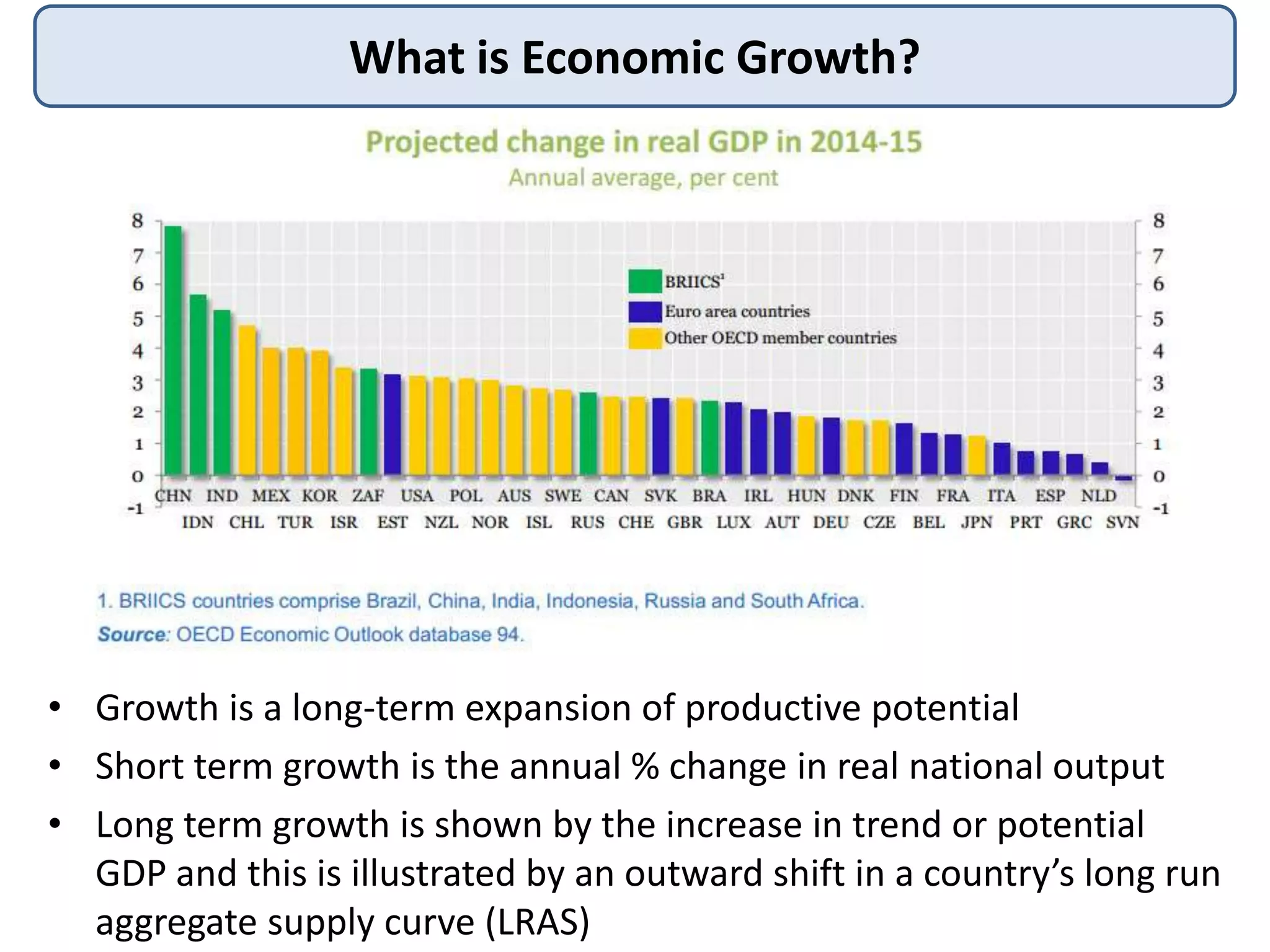
What is Economic Growth?

• Growth is a long-term expansion of productive potential
• Short term growth is the annual % change in real national output
• Long term growth is shown by the increase in trend or potential
GDP and this is illustrated by an outward shift in a country’s long run
aggregate supply curve (LRAS)
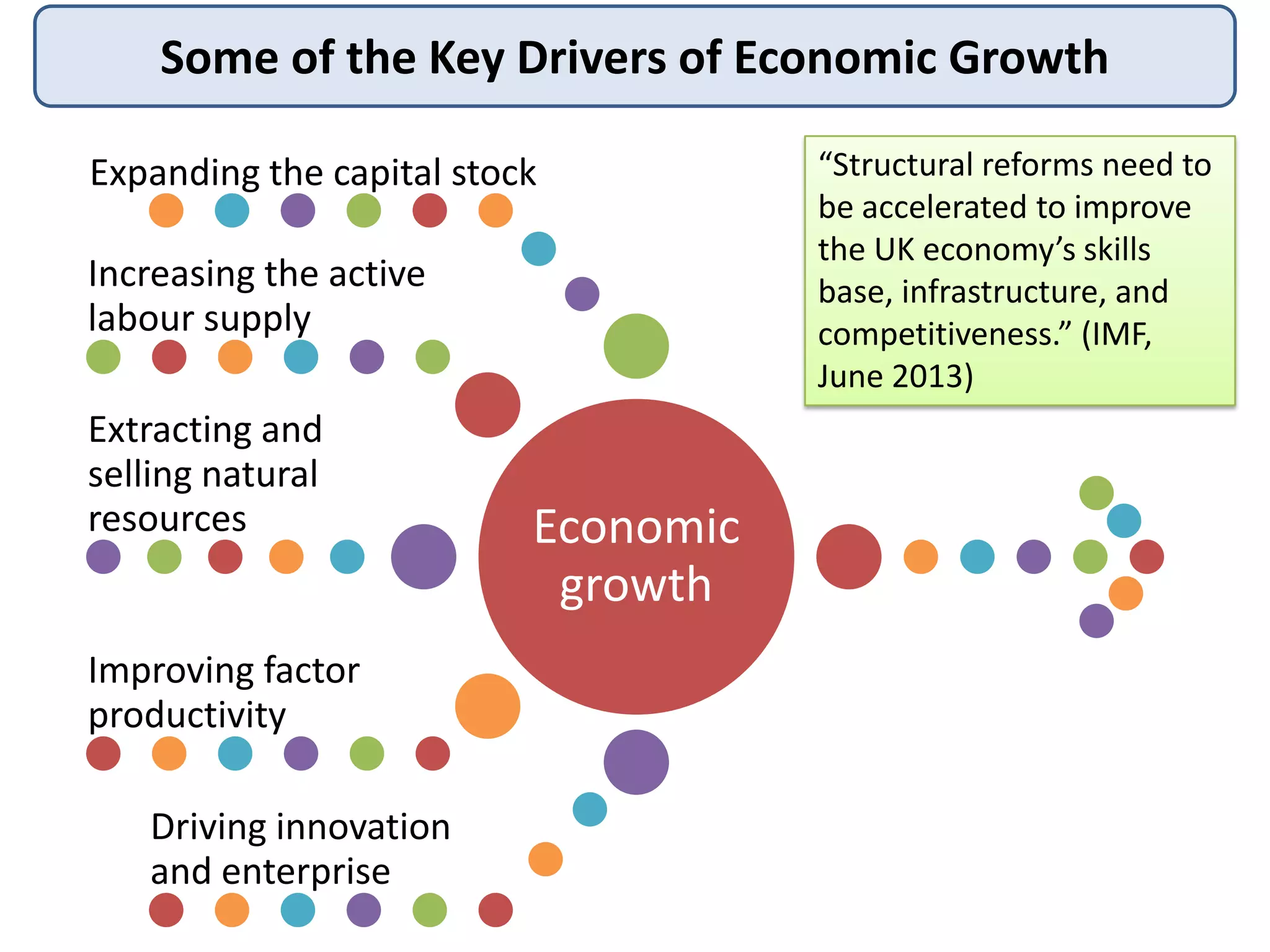
Some of the Key Drivers of Economic Growth
Expanding the capital stock
Increasing the active
labour supply
Extracting and
selling natural
resources

Improving factor
productivity
Driving innovation
and enterprise

Economic
growth

“Structural reforms need to
be accelerated to improve
the UK economy’s skills
base, infrastructure, and
competitiveness.” (IMF,
June 2013)
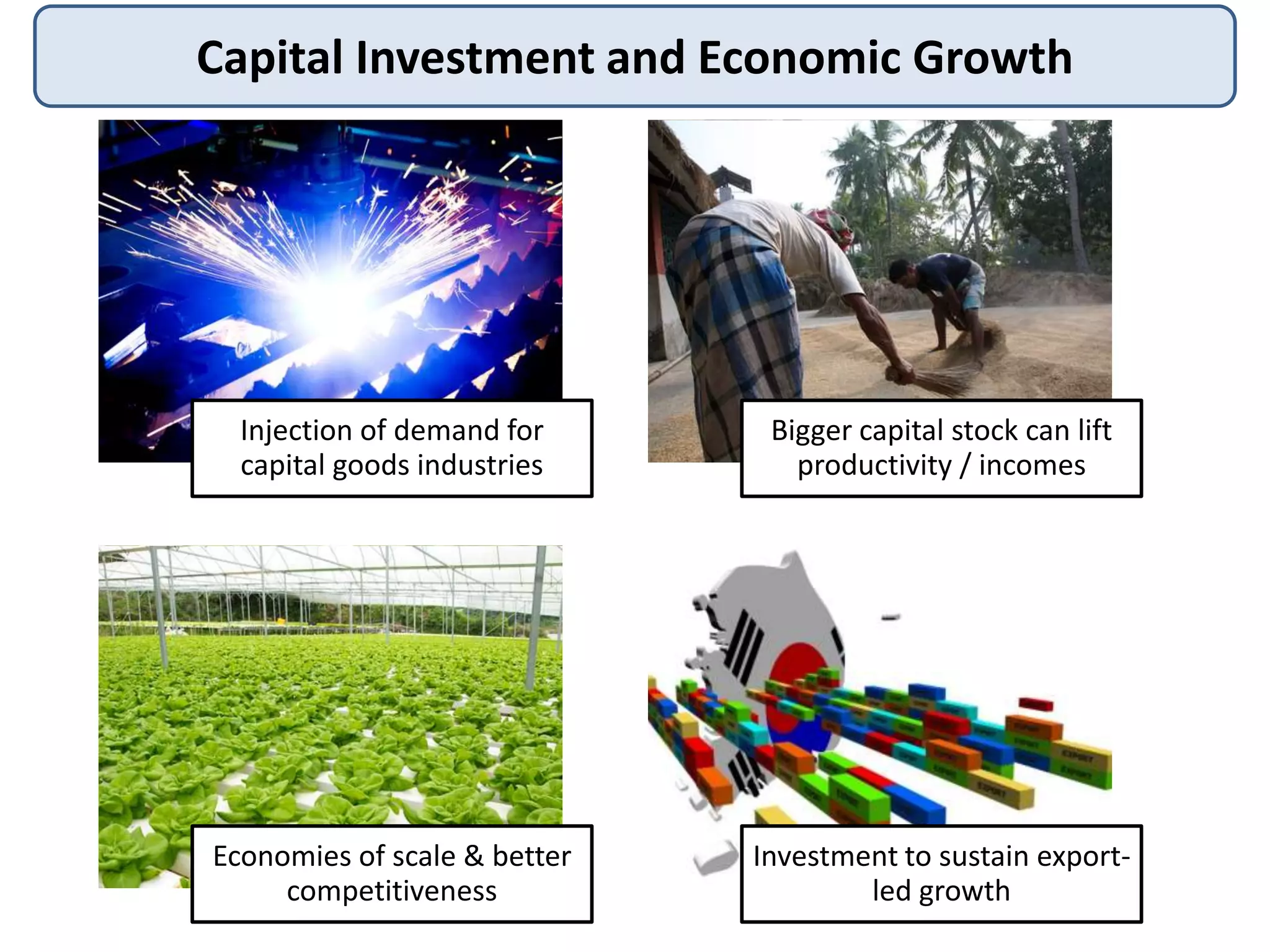
Capital Investment and Economic Growth

Injection of demand for
capital goods industries

Bigger capital stock can lift
productivity / incomes

Economies of scale & better
competitiveness

Investment to sustain exportled growth
Get help on the AS
macroeconomics course
using twitter

#econ2

@tutor2u_econ
www.tutor2u.net
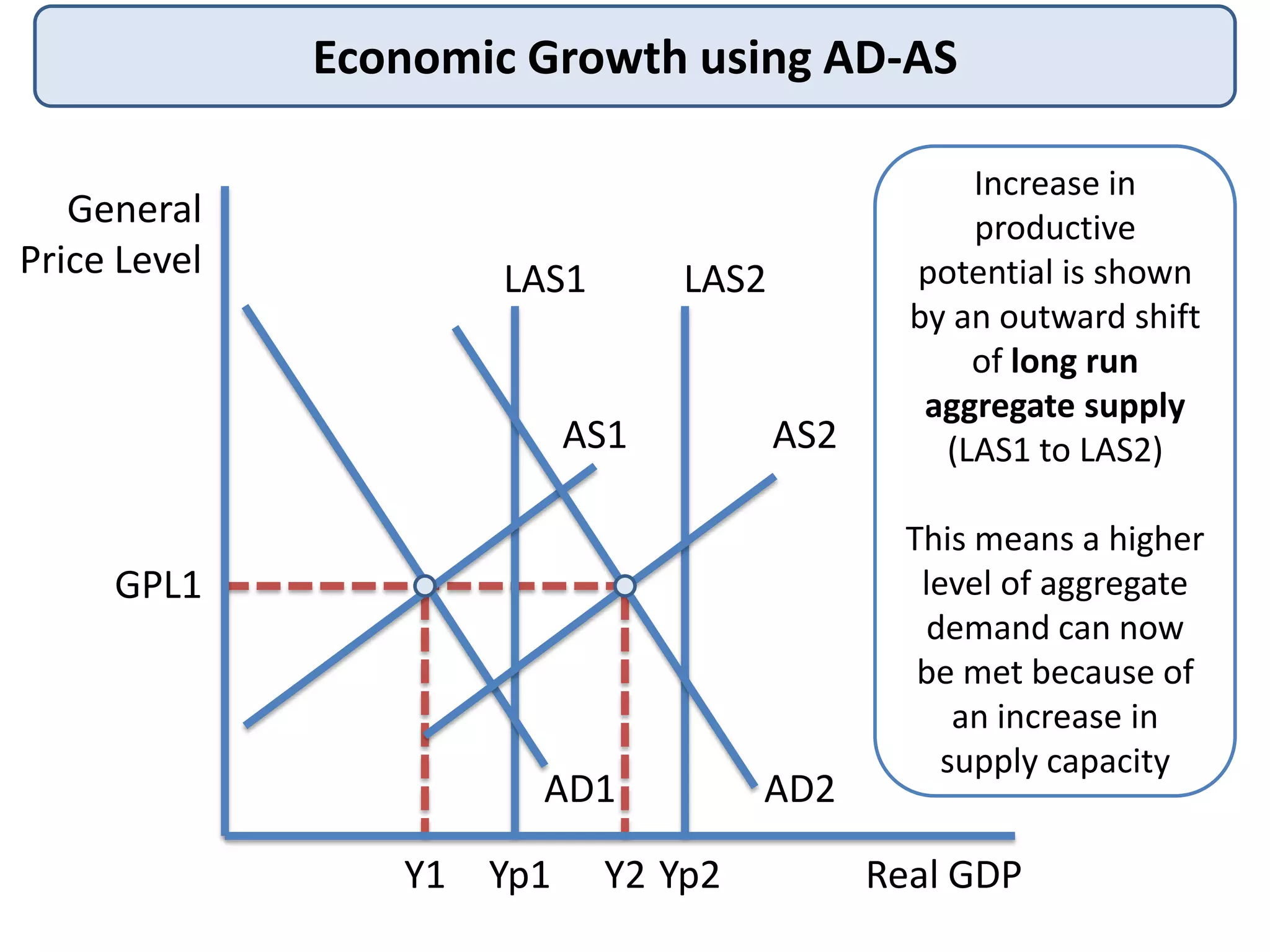
Economic Growth using AD-AS
General
Price Level

LAS1

LAS2

AS1

AS2

GPL1

AD1
Y1

Yp1

Y2 Yp2

AD2

Increase in
productive
potential is shown
by an outward shift
of long run
aggregate supply
(LAS1 to LAS2)
This means a higher
level of aggregate
demand can now
be met because of
an increase in
supply capacity

Real GDP
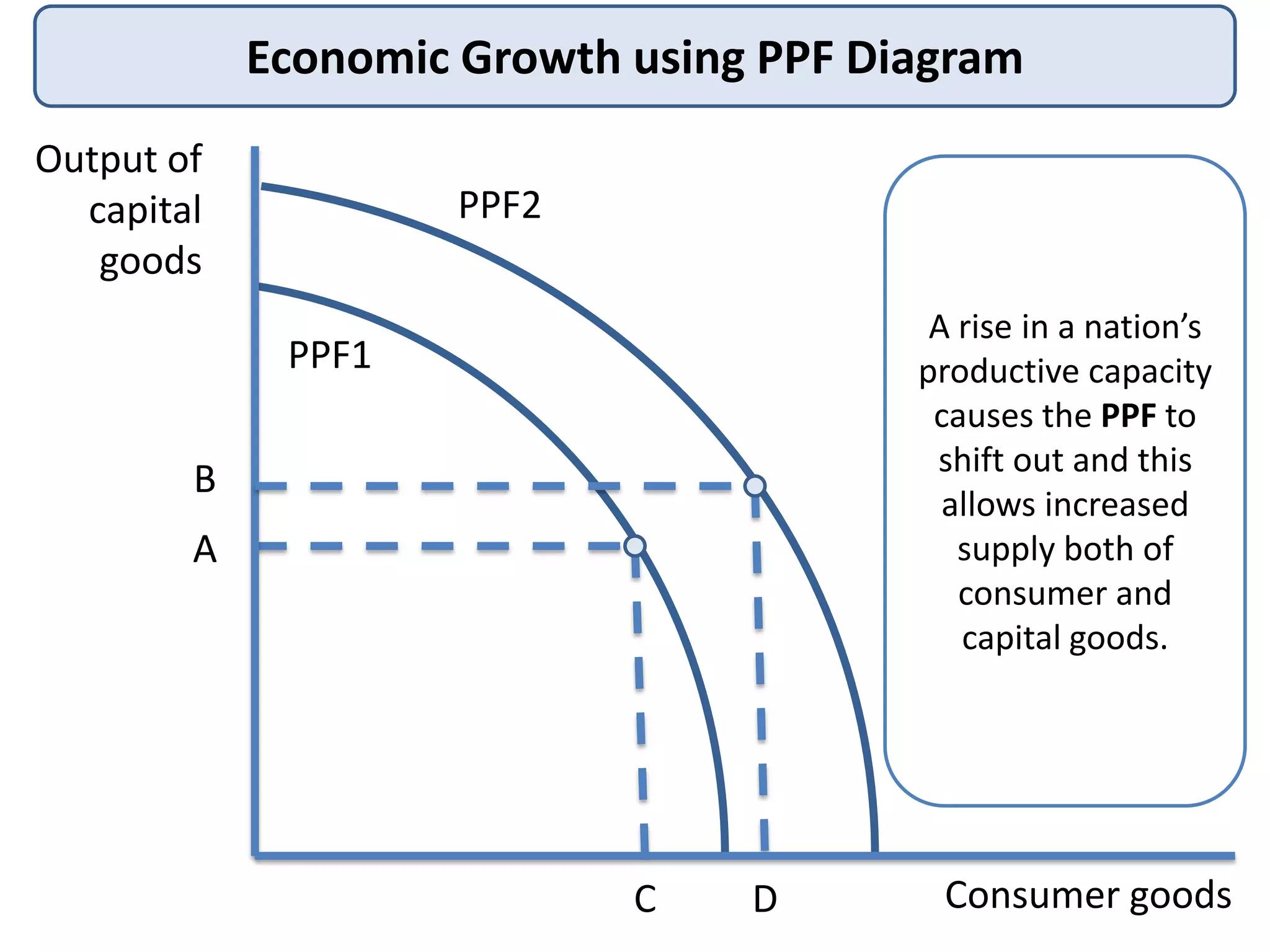
Economic Growth using PPF Diagram
Output of
capital
goods

PPF2
A rise in a nation’s
productive capacity
causes the PPF to
shift out and this
allows increased
supply both of
consumer and
capital goods.

PPF1

B
A

C

D

Consumer goods
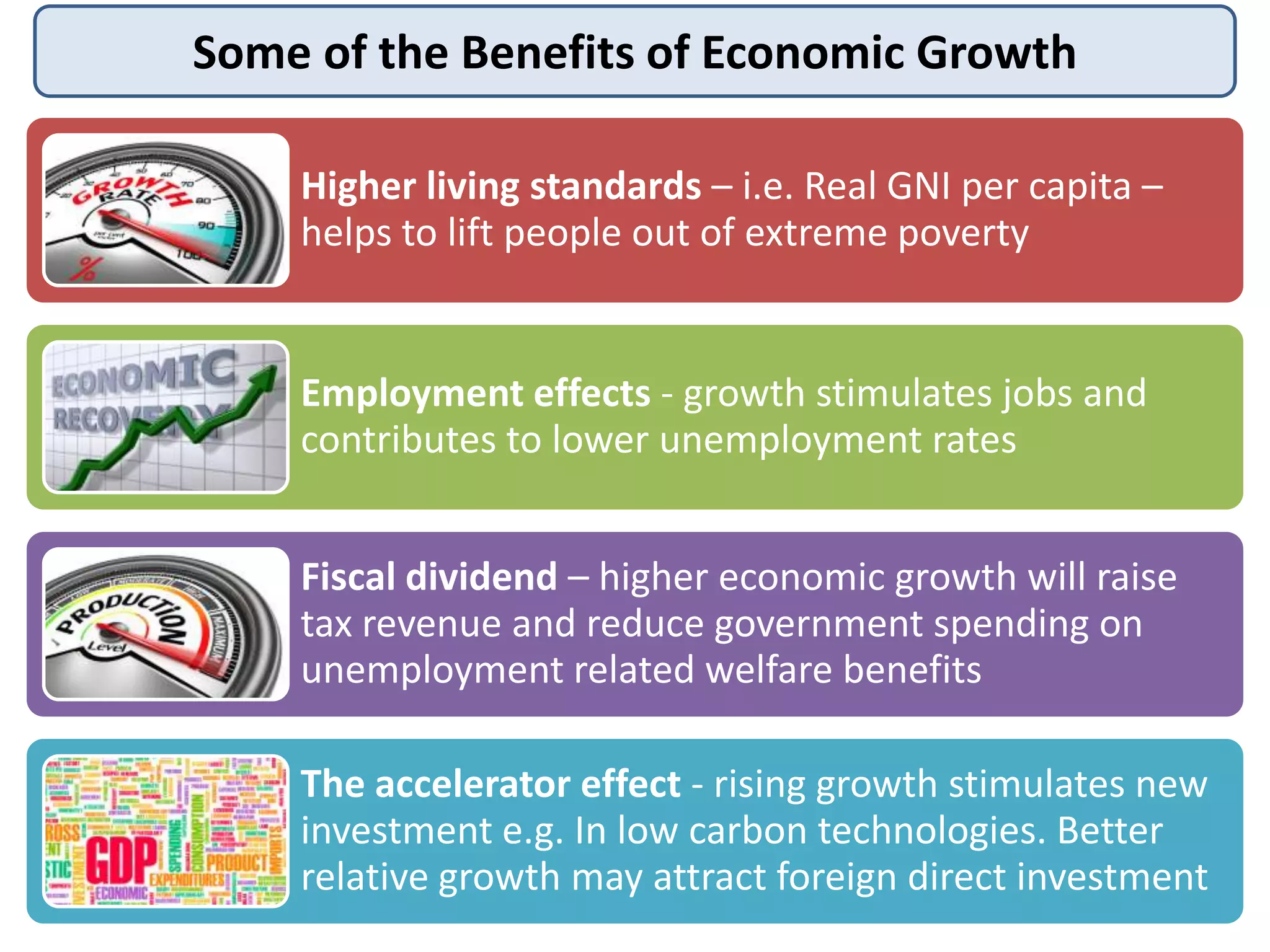
Some of the Benefits of Economic Growth
Higher living standards – i.e. Real GNI per capita –
helps to lift people out of extreme poverty

Employment effects - growth stimulates jobs and
contributes to lower unemployment rates

Fiscal dividend – higher economic growth will raise
tax revenue and reduce government spending on
unemployment related welfare benefits
The accelerator effect - rising growth stimulates new
investment e.g. In low carbon technologies. Better
relative growth may attract foreign direct investment
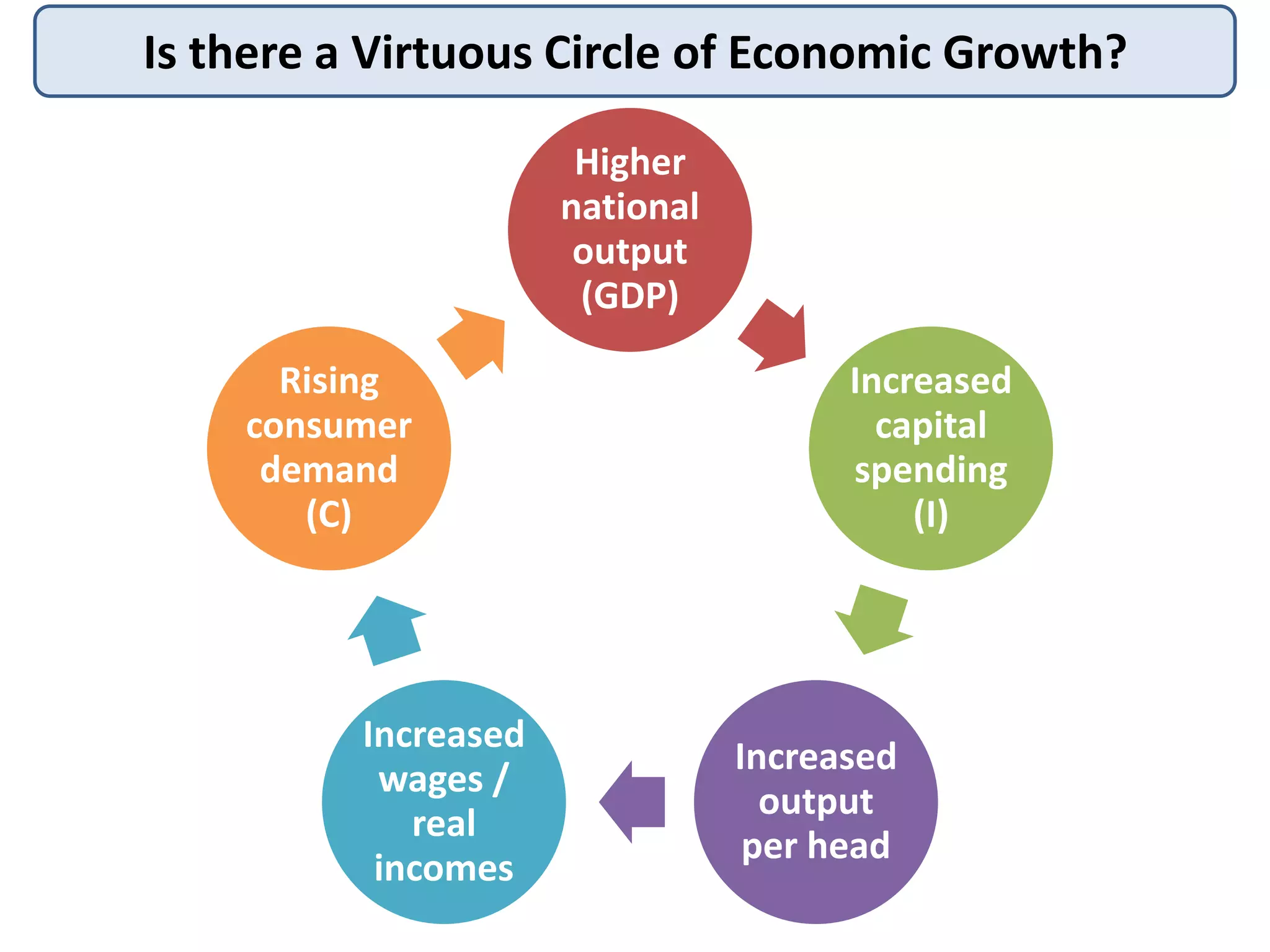
Is there a Virtuous Circle of Economic Growth?
Higher
national
output
(GDP)
Rising
consumer
demand
(C)

Increased
wages /
real
incomes

Increased
capital
spending
(I)

Increased
output
per head
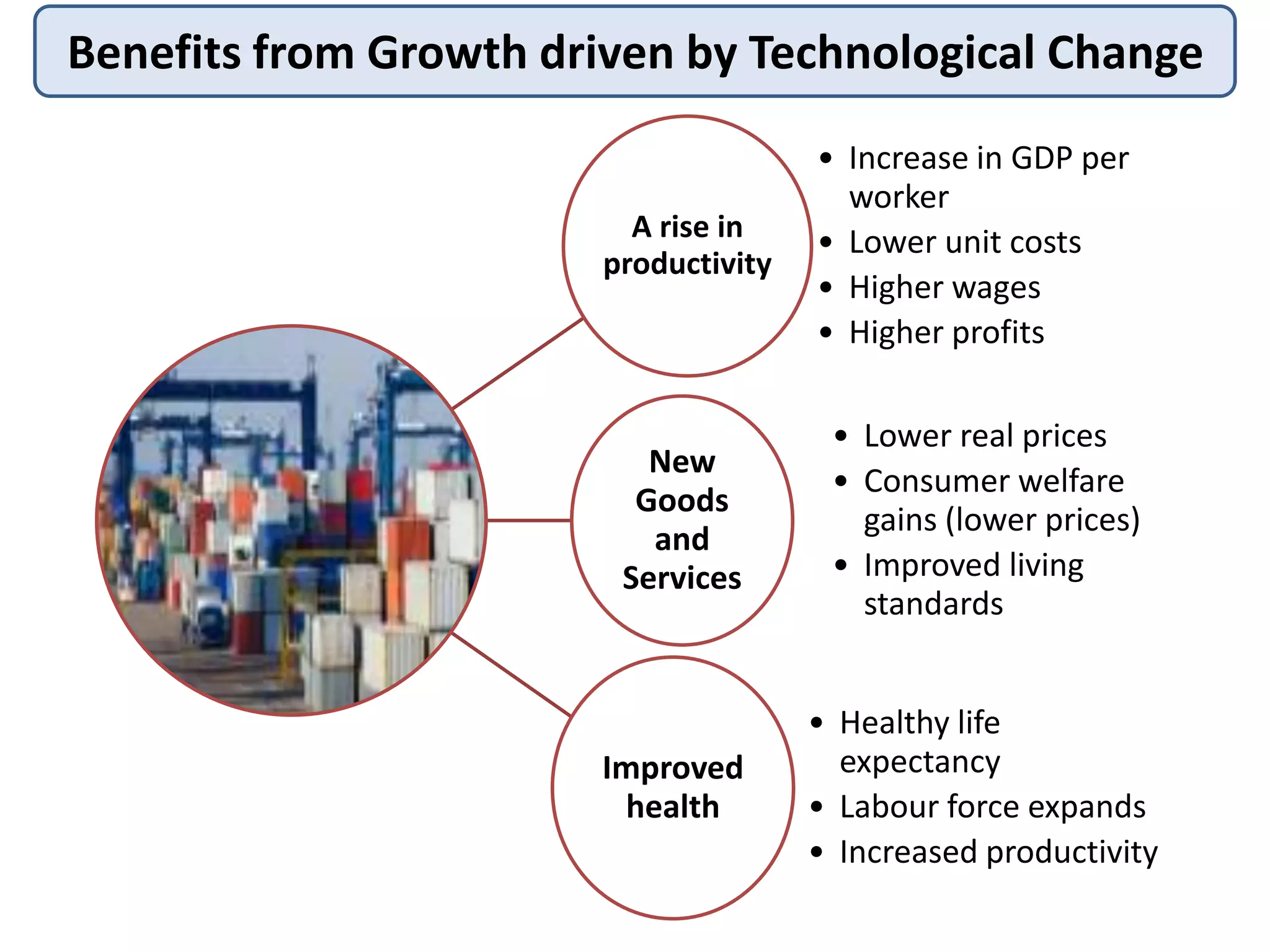
Benefits from Growth driven by Technological Change

A rise in
productivity

• Increase in GDP per
worker
• Lower unit costs
• Higher wages
• Higher profits

New
Goods
and
Services

• Lower real prices
• Consumer welfare
gains (lower prices)
• Improved living
standards

Improved
health

• Healthy life
expectancy
• Labour force expands
• Increased productivity
We add new resources / links / articles every day
to our Economics blogs
Follow this link for the AS Macro Blog on Tutor2u
www.tutor2u.net/blog/index.php/economics/categories/C59
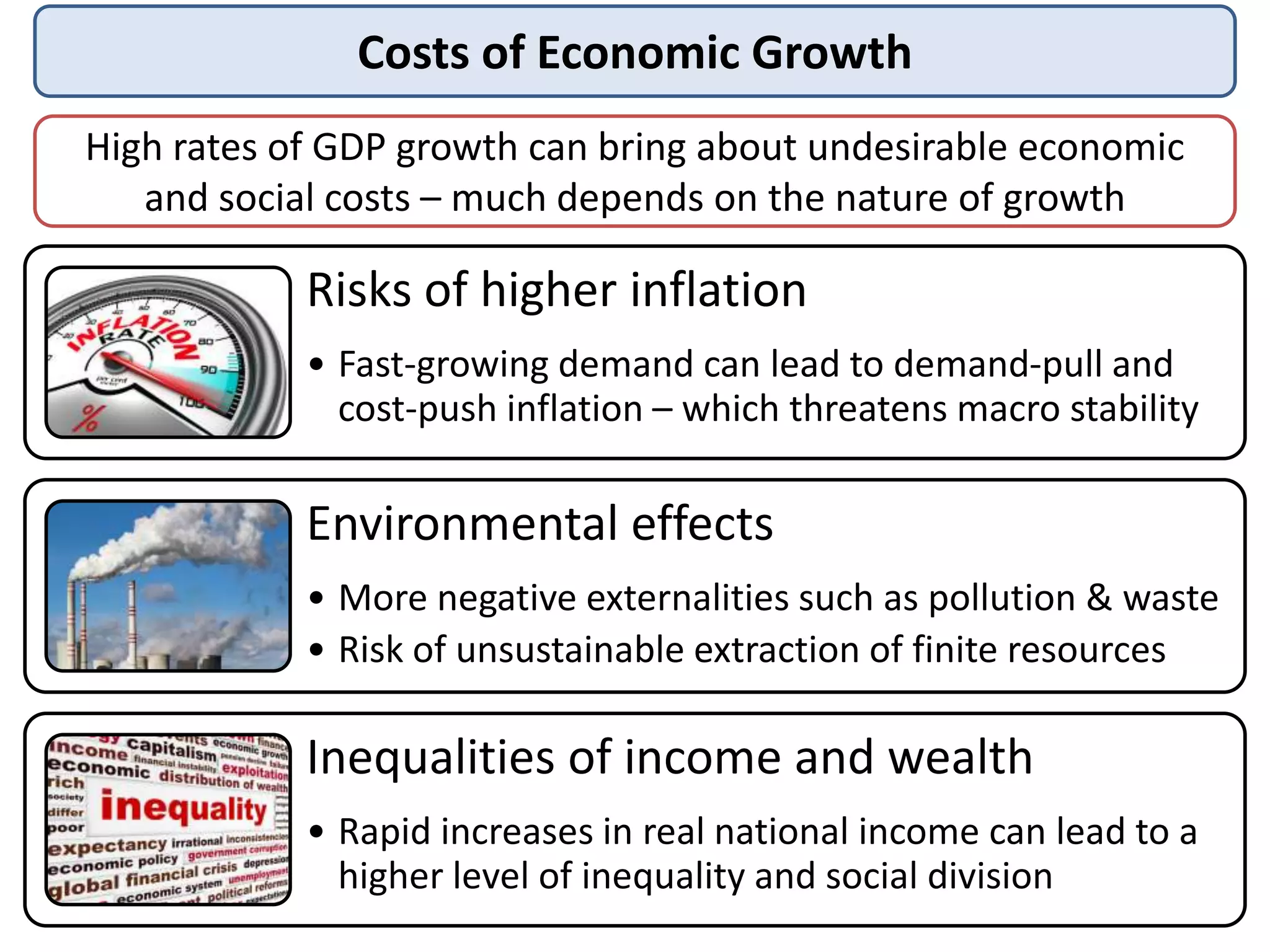
Costs of Economic Growth
High rates of GDP growth can bring about undesirable economic
and social costs – much depends on the nature of growth

Risks of higher inflation
• Fast-growing demand can lead to demand-pull and
cost-push inflation – which threatens macro stability

Environmental effects
• More negative externalities such as pollution & waste
• Risk of unsustainable extraction of finite resources

Inequalities of income and wealth
• Rapid increases in real national income can lead to a
higher level of inequality and social division
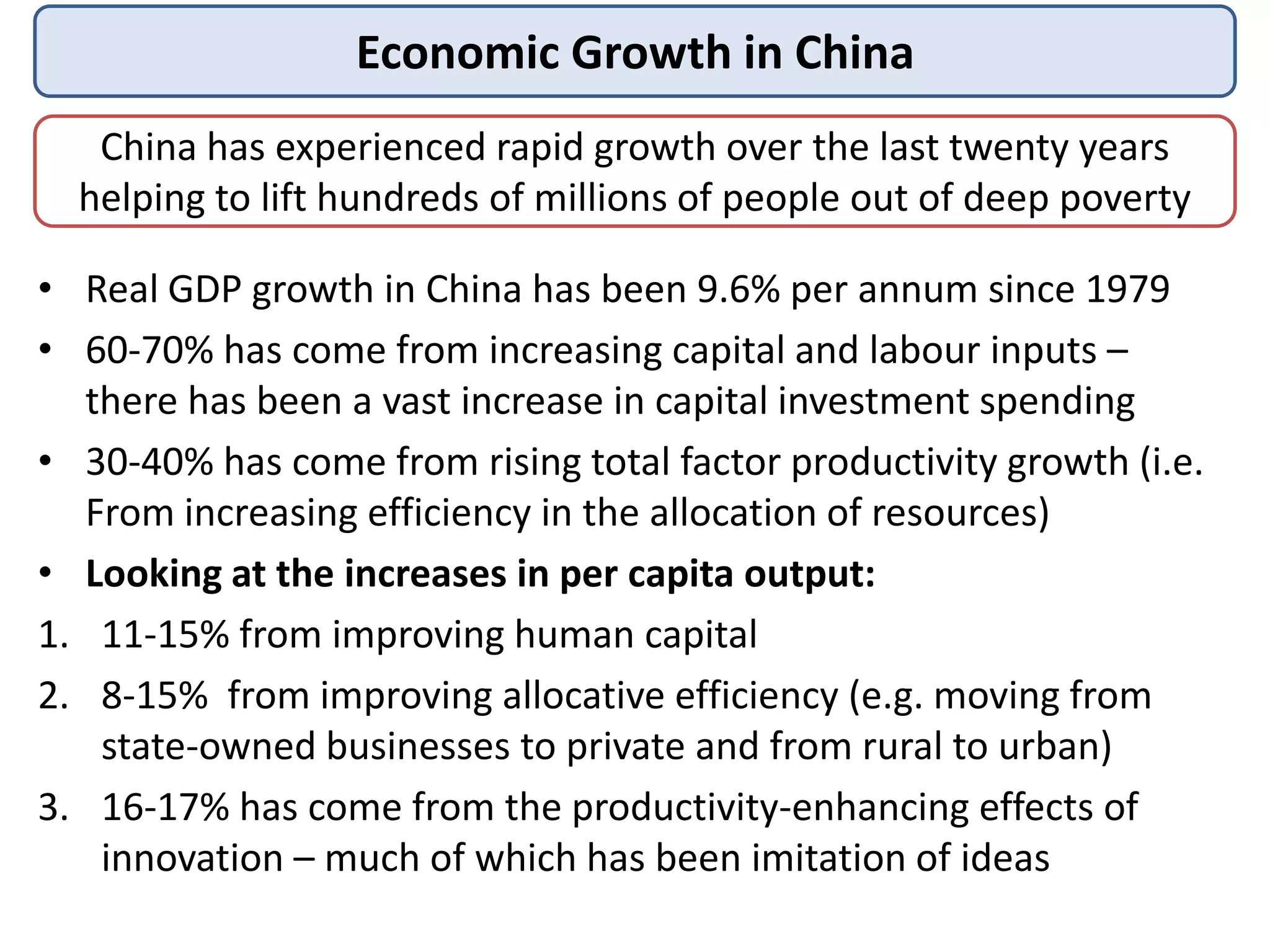
Economic Growth in China
China has experienced rapid growth over the last twenty years
helping to lift hundreds of millions of people out of deep poverty
• Real GDP growth in China has been 9.6% per annum since 1979
• 60-70% has come from increasing capital and labour inputs –
there has been a vast increase in capital investment spending
• 30-40% has come from rising total factor productivity growth (i.e.
From increasing efficiency in the allocation of resources)
• Looking at the increases in per capita output:
1. 11-15% from improving human capital
2. 8-15% from improving allocative efficiency (e.g. moving from
state-owned businesses to private and from rural to urban)
3. 16-17% has come from the productivity-enhancing effects of
innovation – much of which has been imitation of ideas
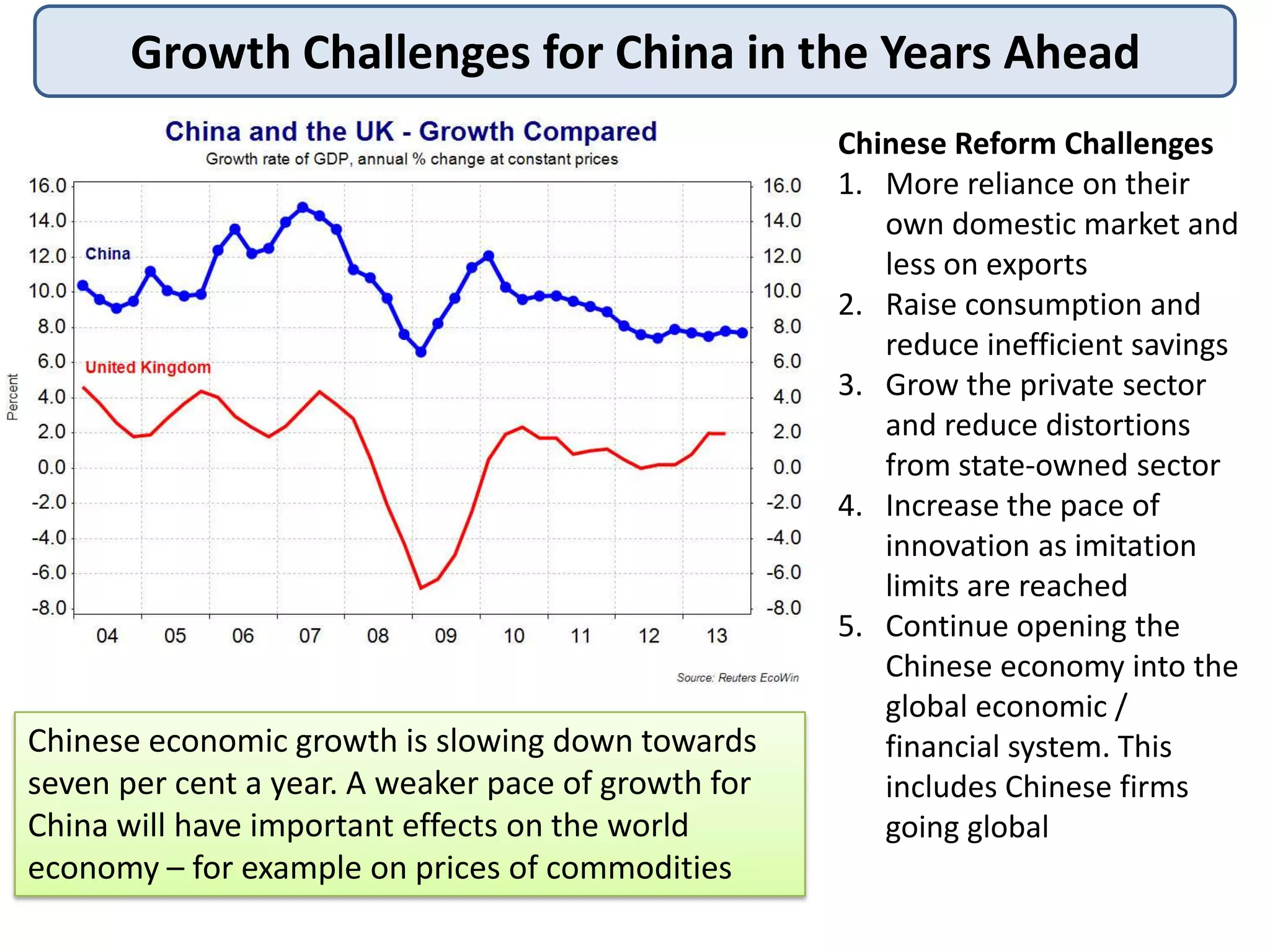
Growth Challenges for China in the Years Ahead

Chinese economic growth is slowing down towards
seven per cent a year. A weaker pace of growth for
China will have important effects on the world
economy – for example on prices of commodities

Chinese Reform Challenges
1. More reliance on their
own domestic market and
less on exports
2. Raise consumption and
reduce inefficient savings
3. Grow the private sector
and reduce distortions
from state-owned sector
4. Increase the pace of
innovation as imitation
limits are reached
5. Continue opening the
Chinese economy into the
global economic /
financial system. This
includes Chinese firms
going global
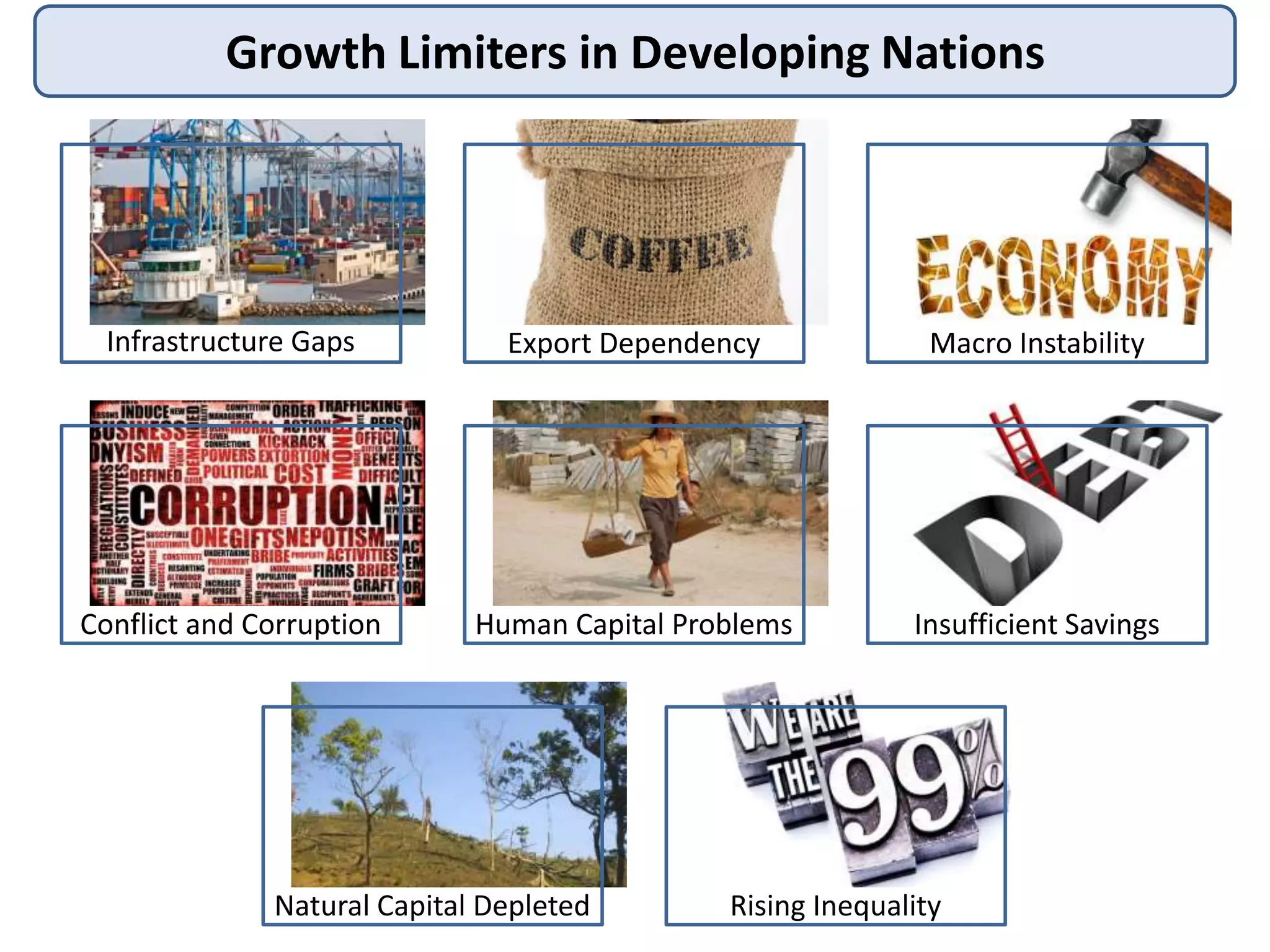
Growth Limiters in Developing Nations

Infrastructure Gaps

Export Dependency

Macro Instability

Conflict and Corruption

Human Capital Problems

Insufficient Savings

Natural Capital Depleted

Rising Inequality
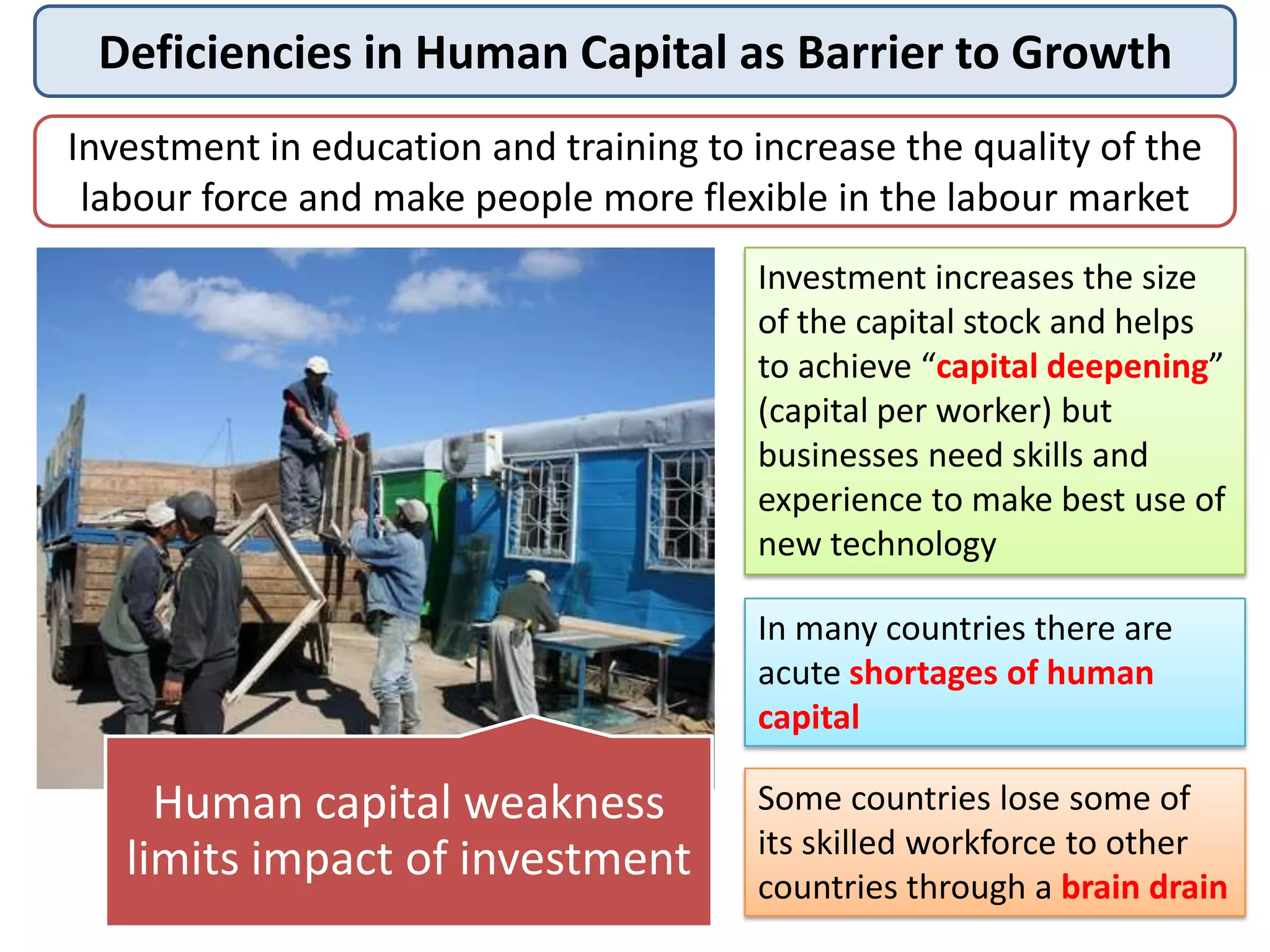
Deficiencies in Human Capital as Barrier to Growth
Investment in education and training to increase the quality of the
labour force and make people more flexible in the labour market
Investment increases the size
of the capital stock and helps
to achieve “capital deepening”
(capital per worker) but
businesses need skills and
experience to make best use of
new technology
In many countries there are
acute shortages of human
capital

Human capital weakness
limits impact of investment

Some countries lose some of
its skilled workforce to other
countries through a brain drain
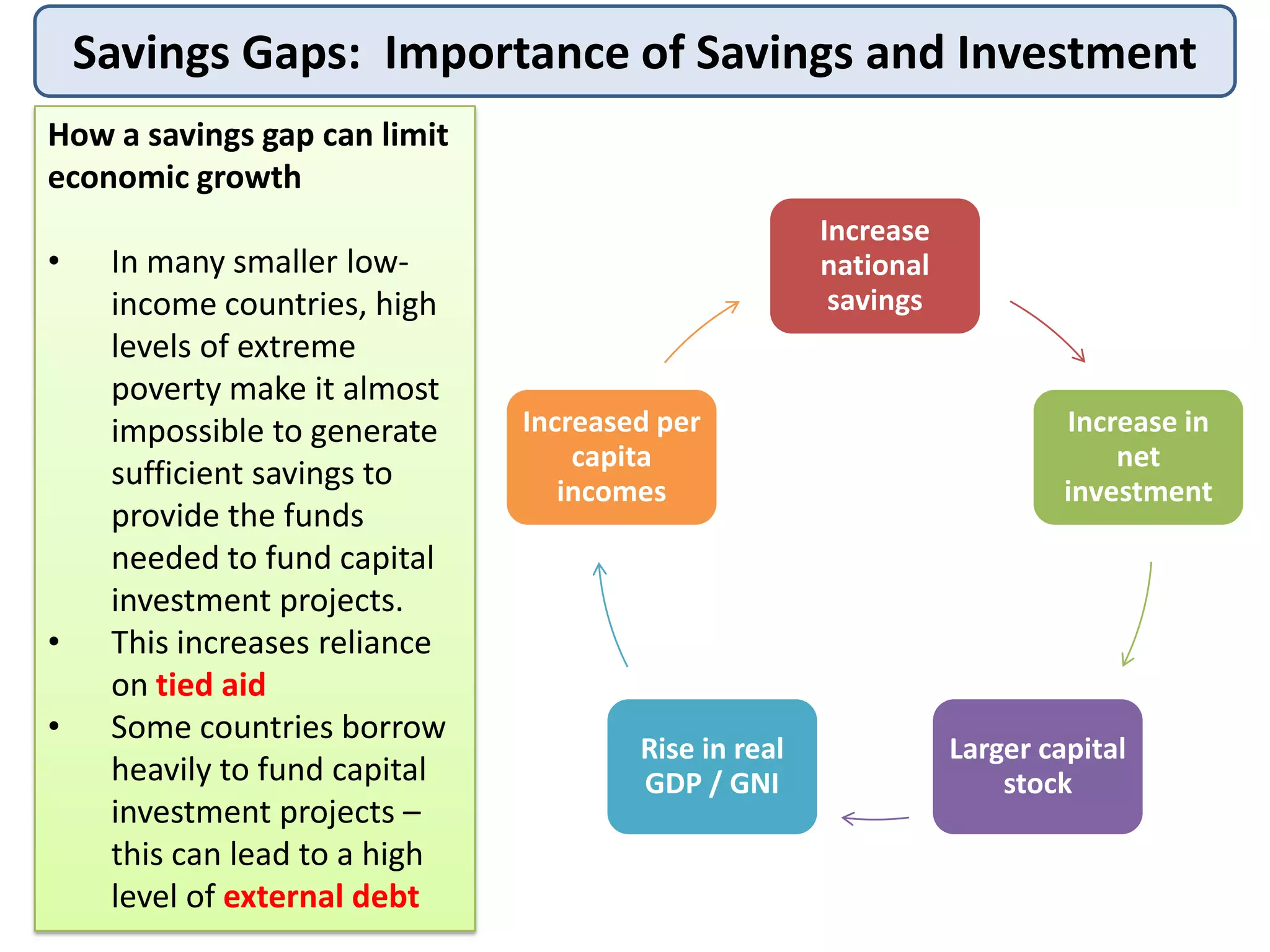
Savings Gaps: Importance of Savings and Investment
How a savings gap can limit
economic growth
•

•
•

In many smaller lowincome countries, high
levels of extreme
poverty make it almost
impossible to generate
sufficient savings to
provide the funds
needed to fund capital
investment projects.
This increases reliance
on tied aid
Some countries borrow
heavily to fund capital
investment projects –
this can lead to a high
level of external debt

Increase
national
savings

Increased per
capita
incomes

Rise in real
GDP / GNI

Increase in
net
investment

Larger capital
stock
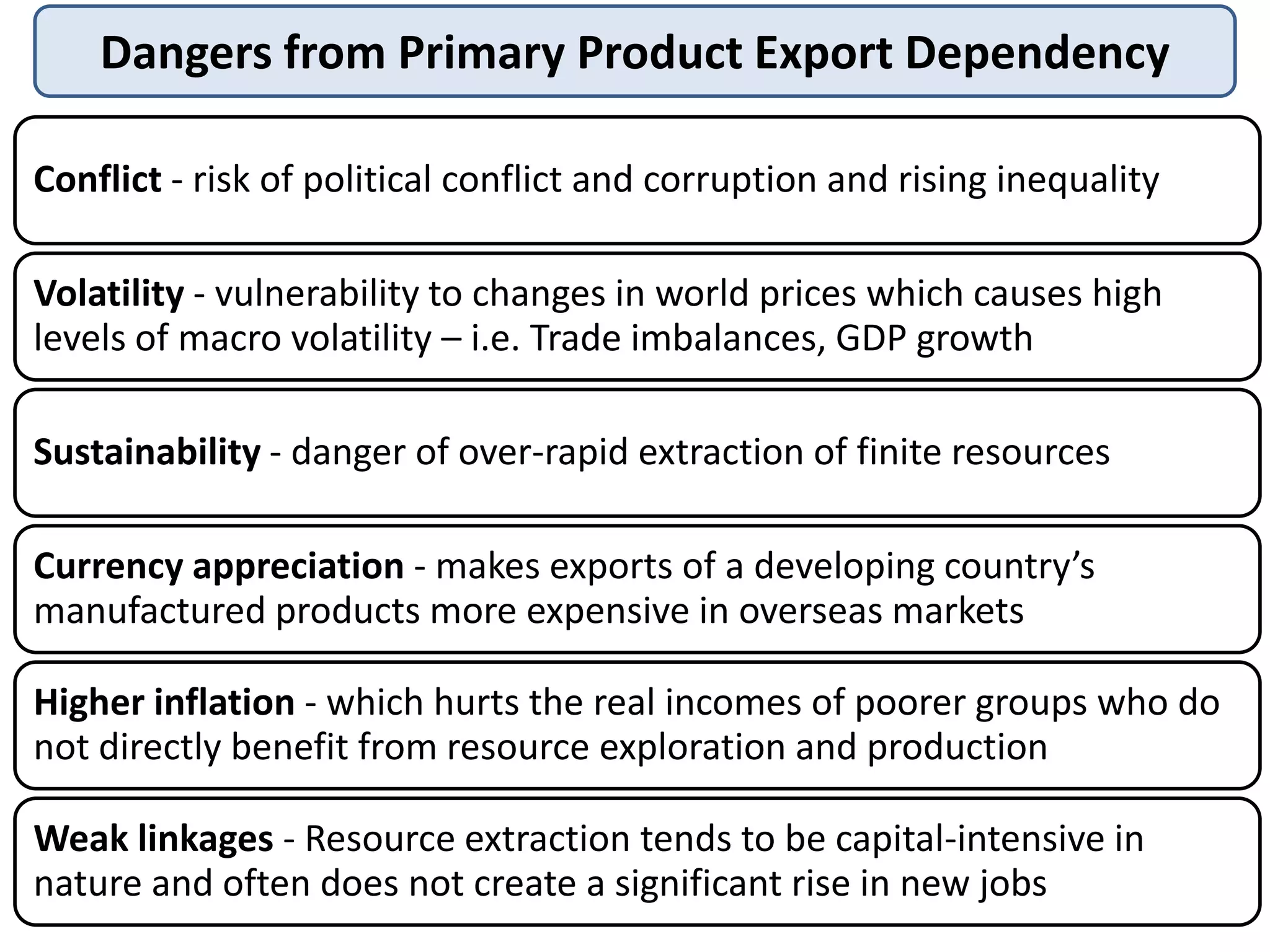
Dangers from Primary Product Export Dependency
Conflict - risk of political conflict and corruption and rising inequality
Volatility - vulnerability to changes in world prices which causes high
levels of macro volatility – i.e. Trade imbalances, GDP growth
Sustainability - danger of over-rapid extraction of finite resources
Currency appreciation - makes exports of a developing country’s
manufactured products more expensive in overseas markets
Higher inflation - which hurts the real incomes of poorer groups who do
not directly benefit from resource exploration and production
Weak linkages - Resource extraction tends to be capital-intensive in
nature and often does not create a significant rise in new jobs
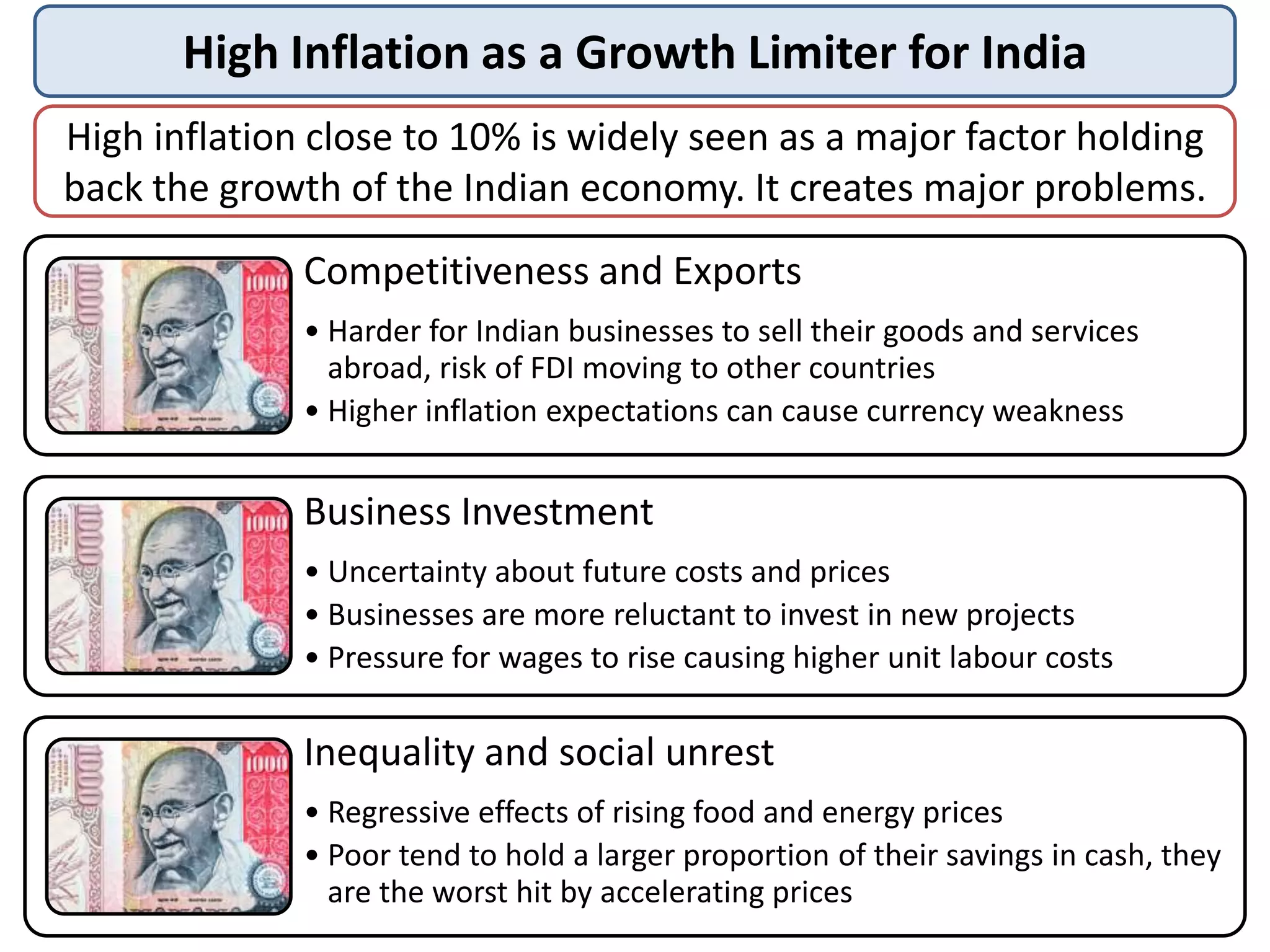
High Inflation as a Growth Limiter for India
High inflation close to 10% is widely seen as a major factor holding
back the growth of the Indian economy. It creates major problems.
Competitiveness and Exports
• Harder for Indian businesses to sell their goods and services
abroad, risk of FDI moving to other countries
• Higher inflation expectations can cause currency weakness

Business Investment
• Uncertainty about future costs and prices
• Businesses are more reluctant to invest in new projects
• Pressure for wages to rise causing higher unit labour costs

Inequality and social unrest
• Regressive effects of rising food and energy prices
• Poor tend to hold a larger proportion of their savings in cash, they
are the worst hit by accelerating prices
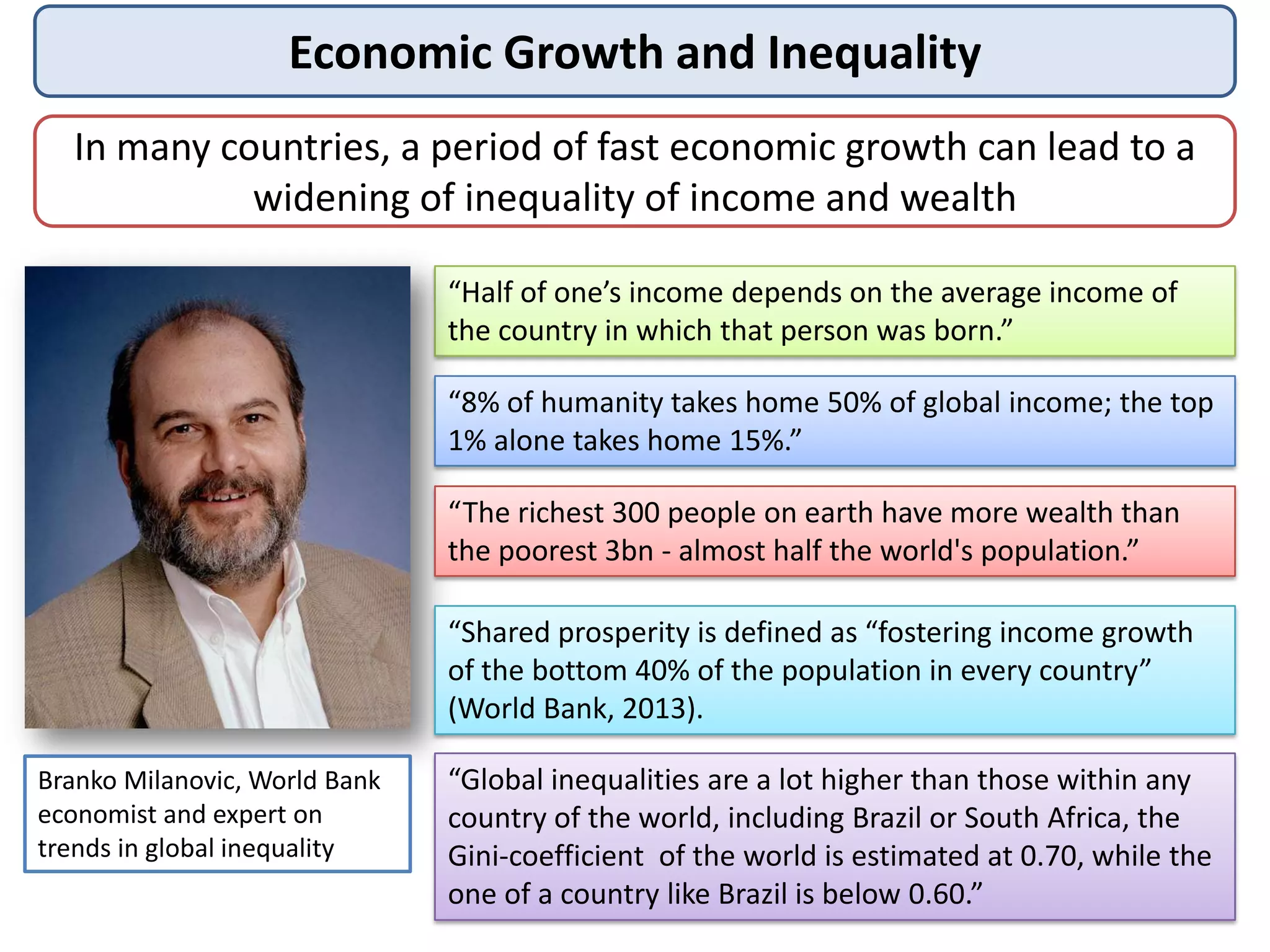
Economic Growth and Inequality
In many countries, a period of fast economic growth can lead to a
widening of inequality of income and wealth
“Half of one’s income depends on the average income of
the country in which that person was born.”
“8% of humanity takes home 50% of global income; the top
1% alone takes home 15%.”
“The richest 300 people on earth have more wealth than
the poorest 3bn - almost half the world's population.”
“Shared prosperity is defined as “fostering income growth
of the bottom 40% of the population in every country”
(World Bank, 2013).
Branko Milanovic, World Bank
economist and expert on
trends in global inequality

“Global inequalities are a lot higher than those within any
country of the world, including Brazil or South Africa, the
Gini-coefficient of the world is estimated at 0.70, while the
one of a country like Brazil is below 0.60.”
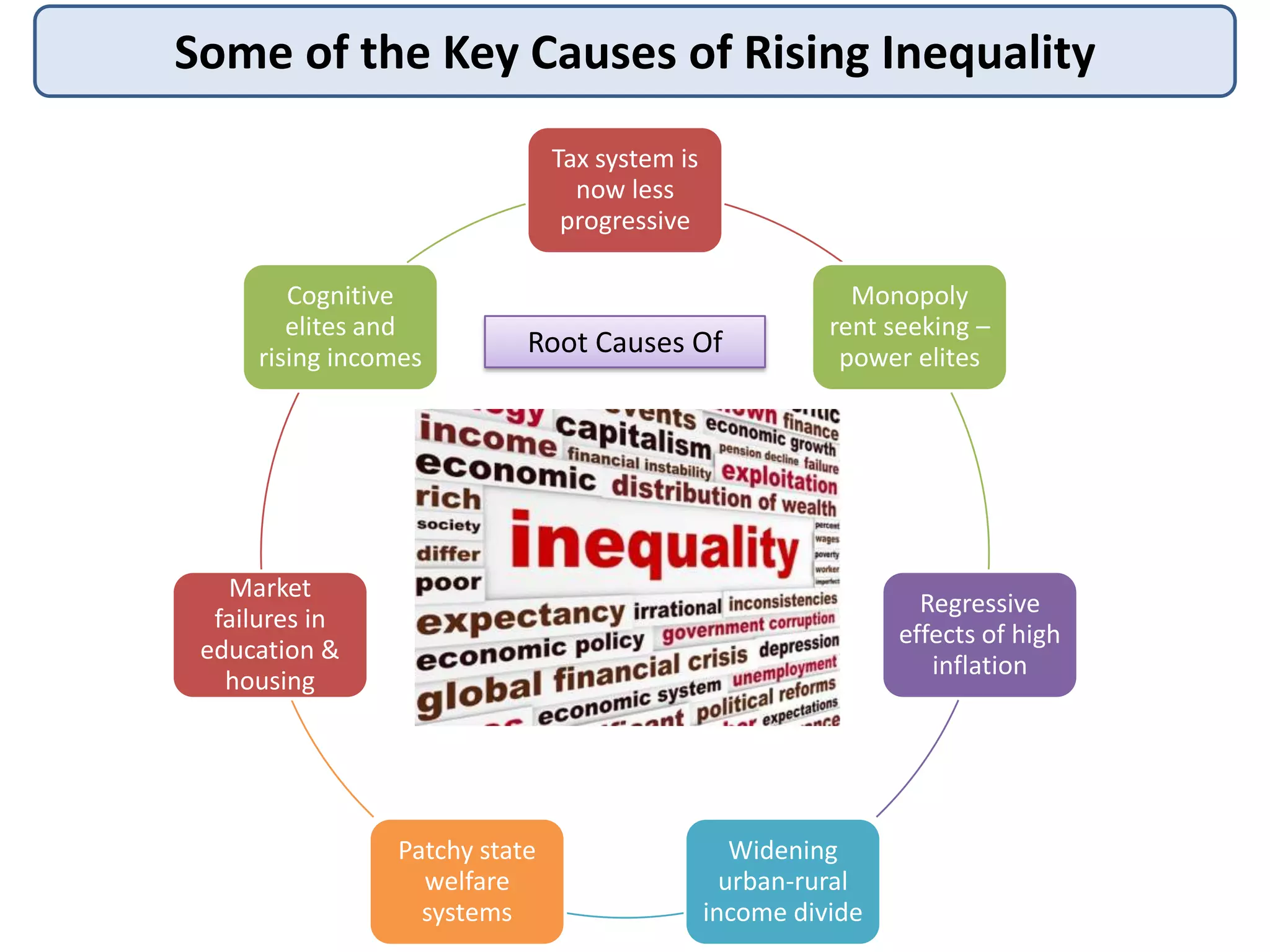
Some of the Key Causes of Rising Inequality
Tax system is
now less
progressive
Cognitive
elites and
rising incomes

Root Causes Of

Monopoly
rent seeking –
power elites

Market
failures in
education &
housing

Regressive
effects of high
inflation

Patchy state
welfare
systems

Widening
urban-rural
income divide
Get help on the AS
macroeconomics course
using twitter

#econ2

@tutor2u_econ
www.tutor2u.net

AS Macro Revision: Economic Growth

  • 1.
    AS Macro Revision EconomicGrowth Spring 2014
  • 2.
    We add newresources / links / articles every day to our Economics blogs Follow this link for the AS Macro Blog on Tutor2u www.tutor2u.net/blog/index.php/economics/categories/C59
  • 3.
    What is EconomicGrowth? • Growth is a long-term expansion of productive potential • Short term growth is the annual % change in real national output • Long term growth is shown by the increase in trend or potential GDP and this is illustrated by an outward shift in a country’s long run aggregate supply curve (LRAS)
  • 4.
    Some of theKey Drivers of Economic Growth Expanding the capital stock Increasing the active labour supply Extracting and selling natural resources Improving factor productivity Driving innovation and enterprise Economic growth “Structural reforms need to be accelerated to improve the UK economy’s skills base, infrastructure, and competitiveness.” (IMF, June 2013)
  • 5.
    Capital Investment andEconomic Growth Injection of demand for capital goods industries Bigger capital stock can lift productivity / incomes Economies of scale & better competitiveness Investment to sustain exportled growth
  • 6.
    Get help onthe AS macroeconomics course using twitter #econ2 @tutor2u_econ www.tutor2u.net
  • 7.
    Economic Growth usingAD-AS General Price Level LAS1 LAS2 AS1 AS2 GPL1 AD1 Y1 Yp1 Y2 Yp2 AD2 Increase in productive potential is shown by an outward shift of long run aggregate supply (LAS1 to LAS2) This means a higher level of aggregate demand can now be met because of an increase in supply capacity Real GDP
  • 8.
    Economic Growth usingPPF Diagram Output of capital goods PPF2 A rise in a nation’s productive capacity causes the PPF to shift out and this allows increased supply both of consumer and capital goods. PPF1 B A C D Consumer goods
  • 9.
    Some of theBenefits of Economic Growth Higher living standards – i.e. Real GNI per capita – helps to lift people out of extreme poverty Employment effects - growth stimulates jobs and contributes to lower unemployment rates Fiscal dividend – higher economic growth will raise tax revenue and reduce government spending on unemployment related welfare benefits The accelerator effect - rising growth stimulates new investment e.g. In low carbon technologies. Better relative growth may attract foreign direct investment
  • 10.
    Is there aVirtuous Circle of Economic Growth? Higher national output (GDP) Rising consumer demand (C) Increased wages / real incomes Increased capital spending (I) Increased output per head
  • 11.
    Benefits from Growthdriven by Technological Change A rise in productivity • Increase in GDP per worker • Lower unit costs • Higher wages • Higher profits New Goods and Services • Lower real prices • Consumer welfare gains (lower prices) • Improved living standards Improved health • Healthy life expectancy • Labour force expands • Increased productivity
  • 12.
    We add newresources / links / articles every day to our Economics blogs Follow this link for the AS Macro Blog on Tutor2u www.tutor2u.net/blog/index.php/economics/categories/C59
  • 13.
    Costs of EconomicGrowth High rates of GDP growth can bring about undesirable economic and social costs – much depends on the nature of growth Risks of higher inflation • Fast-growing demand can lead to demand-pull and cost-push inflation – which threatens macro stability Environmental effects • More negative externalities such as pollution & waste • Risk of unsustainable extraction of finite resources Inequalities of income and wealth • Rapid increases in real national income can lead to a higher level of inequality and social division
  • 14.
    Economic Growth inChina China has experienced rapid growth over the last twenty years helping to lift hundreds of millions of people out of deep poverty • Real GDP growth in China has been 9.6% per annum since 1979 • 60-70% has come from increasing capital and labour inputs – there has been a vast increase in capital investment spending • 30-40% has come from rising total factor productivity growth (i.e. From increasing efficiency in the allocation of resources) • Looking at the increases in per capita output: 1. 11-15% from improving human capital 2. 8-15% from improving allocative efficiency (e.g. moving from state-owned businesses to private and from rural to urban) 3. 16-17% has come from the productivity-enhancing effects of innovation – much of which has been imitation of ideas
  • 15.
    Growth Challenges forChina in the Years Ahead Chinese economic growth is slowing down towards seven per cent a year. A weaker pace of growth for China will have important effects on the world economy – for example on prices of commodities Chinese Reform Challenges 1. More reliance on their own domestic market and less on exports 2. Raise consumption and reduce inefficient savings 3. Grow the private sector and reduce distortions from state-owned sector 4. Increase the pace of innovation as imitation limits are reached 5. Continue opening the Chinese economy into the global economic / financial system. This includes Chinese firms going global
  • 16.
    Growth Limiters inDeveloping Nations Infrastructure Gaps Export Dependency Macro Instability Conflict and Corruption Human Capital Problems Insufficient Savings Natural Capital Depleted Rising Inequality
  • 17.
    Deficiencies in HumanCapital as Barrier to Growth Investment in education and training to increase the quality of the labour force and make people more flexible in the labour market Investment increases the size of the capital stock and helps to achieve “capital deepening” (capital per worker) but businesses need skills and experience to make best use of new technology In many countries there are acute shortages of human capital Human capital weakness limits impact of investment Some countries lose some of its skilled workforce to other countries through a brain drain
  • 18.
    Savings Gaps: Importanceof Savings and Investment How a savings gap can limit economic growth • • • In many smaller lowincome countries, high levels of extreme poverty make it almost impossible to generate sufficient savings to provide the funds needed to fund capital investment projects. This increases reliance on tied aid Some countries borrow heavily to fund capital investment projects – this can lead to a high level of external debt Increase national savings Increased per capita incomes Rise in real GDP / GNI Increase in net investment Larger capital stock
  • 19.
    Dangers from PrimaryProduct Export Dependency Conflict - risk of political conflict and corruption and rising inequality Volatility - vulnerability to changes in world prices which causes high levels of macro volatility – i.e. Trade imbalances, GDP growth Sustainability - danger of over-rapid extraction of finite resources Currency appreciation - makes exports of a developing country’s manufactured products more expensive in overseas markets Higher inflation - which hurts the real incomes of poorer groups who do not directly benefit from resource exploration and production Weak linkages - Resource extraction tends to be capital-intensive in nature and often does not create a significant rise in new jobs
  • 20.
    High Inflation asa Growth Limiter for India High inflation close to 10% is widely seen as a major factor holding back the growth of the Indian economy. It creates major problems. Competitiveness and Exports • Harder for Indian businesses to sell their goods and services abroad, risk of FDI moving to other countries • Higher inflation expectations can cause currency weakness Business Investment • Uncertainty about future costs and prices • Businesses are more reluctant to invest in new projects • Pressure for wages to rise causing higher unit labour costs Inequality and social unrest • Regressive effects of rising food and energy prices • Poor tend to hold a larger proportion of their savings in cash, they are the worst hit by accelerating prices
  • 21.
    Economic Growth andInequality In many countries, a period of fast economic growth can lead to a widening of inequality of income and wealth “Half of one’s income depends on the average income of the country in which that person was born.” “8% of humanity takes home 50% of global income; the top 1% alone takes home 15%.” “The richest 300 people on earth have more wealth than the poorest 3bn - almost half the world's population.” “Shared prosperity is defined as “fostering income growth of the bottom 40% of the population in every country” (World Bank, 2013). Branko Milanovic, World Bank economist and expert on trends in global inequality “Global inequalities are a lot higher than those within any country of the world, including Brazil or South Africa, the Gini-coefficient of the world is estimated at 0.70, while the one of a country like Brazil is below 0.60.”
  • 22.
    Some of theKey Causes of Rising Inequality Tax system is now less progressive Cognitive elites and rising incomes Root Causes Of Monopoly rent seeking – power elites Market failures in education & housing Regressive effects of high inflation Patchy state welfare systems Widening urban-rural income divide
  • 23.
    Get help onthe AS macroeconomics course using twitter #econ2 @tutor2u_econ www.tutor2u.net